The role of agricultural r&d in
the agricultural innovation
system framework
Ponniah Anandajayasekeram
Outline
1.   Introduction
2.   Evolution of AIS Framework
3.   Agricultural Innovation Systems Perspective
        Innovation
        Innovation Systems
        Innovation Systems Perspective
4.   Concepts of Open Innovation, Innovation Intermediaries, Innovation
     Platforms
5.   Role of ‘R’ in the Innovation Process
6.   Value Chain Analysis and IS Framework
7.   Current Status
8.   Implications and Challenges
9.   Conclusions
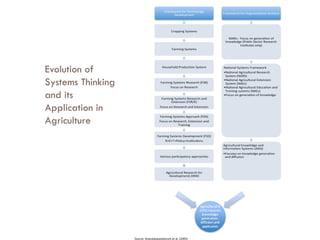
Evolution of
Systems Thinking
and its
Application in
Agriculture
What is Innovation?
   Anything new introduced into an economic or social
    process
   Invention is a solution to a problem
   Innovation deals with commercialization and actual use
    of invention
   Innovations can be technological, managerial,
    organizational, institutional and service delivery

    Research converts money in to knowledge and innovation
                 converts knowledge in to money
What is an Innovation System (IS)?
   IS can have four elements:
    1.   Actors – organizations and individuals
    2.   Actions and interactions
    3.   Interactive learning
    4.   Institutions

   IS can be defined at the national, sectoral,
    commodity, and proposed intervention level
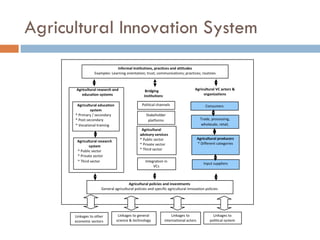
Agricultural Innovation System
Innovation Systems Perspective
   Using innovation lens in the design, implementation
    and evaluation
   The ultimate goal of the actors is innovation
   Important to distinguish between organizations and
    institutions
   Partnerships and networks are central
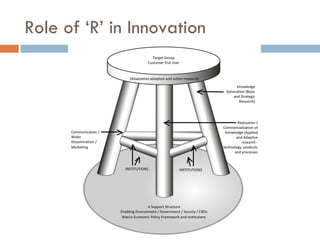
Role of ‘R’ in Innovation
Role of ‘R’ in the Innovation Process
   For innovation to occur research/knowledge is fundamental
   All functions need to be performed, but who performs them and how is not
    pre-determined
   Adequate investments should be made to support all actors and activities
   Innovation takes place through combination of different types of
    information and not exclusively by formal R
   To contribute to development R should be embedded in the
    entrepreneurial, political and policy processes – embedded in the
    development context
   ‘Knowledge frontier R’ remains important
   All types of ‘R’ are still relevant but development oriented ‘R’ is well
    placed to contribute to innovation and socioeconomic impact

     Important: Understanding of the users’ needs and the translation of that
                 knowledge in to action across all functional areas
Where are we?
IS Framework and Ag R&D in SSA
   Organizational landscape is complex, dynamic and rich
       Range of actors – predominant role by public ‘R’ organizations (81% of
        the R capacity, 60% of investment)
       Ministry of Agriculture is primarily responsible for R
       In 28 out of 31 countries, crop and livestock R under one Ministry
       University staff spend considerable amount of time in R , under different
        Ministry
       SROs and continental bodies are contributing to R&D in many ways;
        including priority setting and influencing national policies
       Private sector involvement very limited but on the increase; policy
        environment is week or non-existent
       Extension systems are undergoing serious transformation and
        restructuring-Pluralistic extension system
       8 out of the 31 countries met the target investment and average
        research intensity is 0.61%
       Role of FOs,NGOs,CBOs are increasing
Where are we?
   Research approach, process and linkages
       Prescriptive top down Participatory approaches
       Currently influenced by VCA, IAR4D, ISP
       Appropriate recommendations but not innovation
       Current status of linkages and collaboration far from ideal
   Activities related to AIS in the region
       Major studies concluded that technological development should
        be embedded in broader development and IS concept
       SROs have embraced ISP and integrated into projects
       IARCs and influential donors are supporting projects
       In many countries ISP is identified as one of the organizing
        principles of R
Lessons from Past Experience
   Institutionalization is an evolutionary process. There is no single model.
   A number of pre-conditions need to be met
   Process involves two phases – preparatory and institutionalization
   Process was weak in providing policy feedback
   Resource imbalance R, E, Education affected effectiveness and linkages
   Possible to integrate the concepts and principles with educational and
    learning institutes-Capacity to build capacity.
   Commodity-oriented ‘R’ programs are conducive for systems-oriented ‘R’
   Key factor for success: collaboration and long term commitment by NARIs,
    IARCs and donors; Comprehensive CS
   Key obstacle: not penalized for producing technology that are not
    adopted, or rewarded for ‘R’ with higher adoption rate
Lessons from Past Experience
   Preconditions for successful institutionalization:
     Clear   demonstration of utility of the process;
     Policy and leadership commitment;
     Broader participation and effective linkages;
     Experienced, trained, motivated and committed staff;
     A clear organizational strategy (internally driven) for
      institutionalization; and
     A national capacity to offer continuous training on the
      concept, principles and procedures, i.e. integration into
      the learning curricula.
Lessons from past experience
   Top 10 Killers of Innovation (Wycoff, 2004):
       Not creating a culture that supports innovation
       Not getting buy-in and ownership from unit managers
       Not having widely understood, system-wide process
       Not allocating resources to the process
       Not tying projects to organizational strategy
       Not spending enough time and energy on the fuzzy front-end
       Not building sufficient diversity into the process
       Not developing criteria and metrics in advance
       Not training and coaching innovation teams
       Not having an idea management system
Challenges
   Changing the organizational culture – innovation as a core value
    and to institutionalize the emerging paradigms
   Creating the necessary capacity for innovation
   How to scale up innovations and the capacity to innovate
   Creating the necessary environment and reward system; investment
    needed to foster partnership
   Limited empirical evidence of the application of AIS its utility and
    value addition
   How to ensure attention is given to socioeconomic equity and
    environmental sustainability; addressing poverty and pro-poor
    innovations
   How to develop a coherent set of policies that foster innovation
Conclusion
   Innovation an essential ingredient for successful R&D
    AR4D; VCA; ISP – complementary possible to integrate into R&D processes
   No uniquely best system for all situations; goal is to find the most appropriate
    system (best – fit)
   Does not undermine the value of research; good communication or effective
    extension – different functions are critical
   Investment is needed to support all components
   Role of “institutions” is vital, partnerships and network are the cornerstones
   Building necessary capacity; nurturing and managing a productive and sustainable
    mechanism and modalities of operation is an evolutionary process, and requires
    long term commitment and investment by all actors.
   Need to have a very pragmatic approach
   Thank You

The role of agricultural r&d in the agricultural innovation system framework

  • 1.
    The role ofagricultural r&d in the agricultural innovation system framework Ponniah Anandajayasekeram
  • 2.
    Outline 1. Introduction 2. Evolution of AIS Framework 3. Agricultural Innovation Systems Perspective  Innovation  Innovation Systems  Innovation Systems Perspective 4. Concepts of Open Innovation, Innovation Intermediaries, Innovation Platforms 5. Role of ‘R’ in the Innovation Process 6. Value Chain Analysis and IS Framework 7. Current Status 8. Implications and Challenges 9. Conclusions
  • 3.
    Evolution of Systems Thinking andits Application in Agriculture
  • 4.
    What is Innovation?  Anything new introduced into an economic or social process  Invention is a solution to a problem  Innovation deals with commercialization and actual use of invention  Innovations can be technological, managerial, organizational, institutional and service delivery Research converts money in to knowledge and innovation converts knowledge in to money
  • 5.
    What is anInnovation System (IS)?  IS can have four elements: 1. Actors – organizations and individuals 2. Actions and interactions 3. Interactive learning 4. Institutions  IS can be defined at the national, sectoral, commodity, and proposed intervention level
  • 6.
  • 7.
    Innovation Systems Perspective  Using innovation lens in the design, implementation and evaluation  The ultimate goal of the actors is innovation  Important to distinguish between organizations and institutions  Partnerships and networks are central
  • 8.
    Role of ‘R’in Innovation
  • 9.
    Role of ‘R’in the Innovation Process  For innovation to occur research/knowledge is fundamental  All functions need to be performed, but who performs them and how is not pre-determined  Adequate investments should be made to support all actors and activities  Innovation takes place through combination of different types of information and not exclusively by formal R  To contribute to development R should be embedded in the entrepreneurial, political and policy processes – embedded in the development context  ‘Knowledge frontier R’ remains important  All types of ‘R’ are still relevant but development oriented ‘R’ is well placed to contribute to innovation and socioeconomic impact Important: Understanding of the users’ needs and the translation of that knowledge in to action across all functional areas
  • 10.
    Where are we? ISFramework and Ag R&D in SSA  Organizational landscape is complex, dynamic and rich  Range of actors – predominant role by public ‘R’ organizations (81% of the R capacity, 60% of investment)  Ministry of Agriculture is primarily responsible for R  In 28 out of 31 countries, crop and livestock R under one Ministry  University staff spend considerable amount of time in R , under different Ministry  SROs and continental bodies are contributing to R&D in many ways; including priority setting and influencing national policies  Private sector involvement very limited but on the increase; policy environment is week or non-existent  Extension systems are undergoing serious transformation and restructuring-Pluralistic extension system  8 out of the 31 countries met the target investment and average research intensity is 0.61%  Role of FOs,NGOs,CBOs are increasing
  • 11.
    Where are we?  Research approach, process and linkages  Prescriptive top down Participatory approaches  Currently influenced by VCA, IAR4D, ISP  Appropriate recommendations but not innovation  Current status of linkages and collaboration far from ideal  Activities related to AIS in the region  Major studies concluded that technological development should be embedded in broader development and IS concept  SROs have embraced ISP and integrated into projects  IARCs and influential donors are supporting projects  In many countries ISP is identified as one of the organizing principles of R
  • 12.
    Lessons from PastExperience  Institutionalization is an evolutionary process. There is no single model.  A number of pre-conditions need to be met  Process involves two phases – preparatory and institutionalization  Process was weak in providing policy feedback  Resource imbalance R, E, Education affected effectiveness and linkages  Possible to integrate the concepts and principles with educational and learning institutes-Capacity to build capacity.  Commodity-oriented ‘R’ programs are conducive for systems-oriented ‘R’  Key factor for success: collaboration and long term commitment by NARIs, IARCs and donors; Comprehensive CS  Key obstacle: not penalized for producing technology that are not adopted, or rewarded for ‘R’ with higher adoption rate
  • 13.
    Lessons from PastExperience  Preconditions for successful institutionalization:  Clear demonstration of utility of the process;  Policy and leadership commitment;  Broader participation and effective linkages;  Experienced, trained, motivated and committed staff;  A clear organizational strategy (internally driven) for institutionalization; and  A national capacity to offer continuous training on the concept, principles and procedures, i.e. integration into the learning curricula.
  • 14.
    Lessons from pastexperience  Top 10 Killers of Innovation (Wycoff, 2004):  Not creating a culture that supports innovation  Not getting buy-in and ownership from unit managers  Not having widely understood, system-wide process  Not allocating resources to the process  Not tying projects to organizational strategy  Not spending enough time and energy on the fuzzy front-end  Not building sufficient diversity into the process  Not developing criteria and metrics in advance  Not training and coaching innovation teams  Not having an idea management system
  • 15.
    Challenges  Changing the organizational culture – innovation as a core value and to institutionalize the emerging paradigms  Creating the necessary capacity for innovation  How to scale up innovations and the capacity to innovate  Creating the necessary environment and reward system; investment needed to foster partnership  Limited empirical evidence of the application of AIS its utility and value addition  How to ensure attention is given to socioeconomic equity and environmental sustainability; addressing poverty and pro-poor innovations  How to develop a coherent set of policies that foster innovation
  • 16.
    Conclusion  Innovation an essential ingredient for successful R&D  AR4D; VCA; ISP – complementary possible to integrate into R&D processes  No uniquely best system for all situations; goal is to find the most appropriate system (best – fit)  Does not undermine the value of research; good communication or effective extension – different functions are critical  Investment is needed to support all components  Role of “institutions” is vital, partnerships and network are the cornerstones  Building necessary capacity; nurturing and managing a productive and sustainable mechanism and modalities of operation is an evolutionary process, and requires long term commitment and investment by all actors.  Need to have a very pragmatic approach
  • 17.
    Thank You

Editor's Notes

  • #5 Attributes Something new to the user Better than what currently exists Economically viable and socially desirable Widespread appeal
  • #6 IS can have four elements: Organizations and individuals involved in generating, diffusing, adapting and using ‘new’ knowledge Their actions and interactions The interactive learning that occurs when organizations and individuals engage in these processes The institutions (rules of engagements, norms, conventions – both formal and informal) that govern how these interactions and processes take place
  • #8 Suggest the analysis of three elements The components of the system (actors) The relationships and interactions between these components The competencies, functions, processes and results that such components generate