Framework for exploring different
models of innovation and partnership.
Andy Hall
AGRICULTURE & FOOD
Agriculture and Global Change research program.
APAARI Conference November 2016
This presentation draws from …
Andy Hall, Jeroen Dijkman, Bruce Taylor, Liana Williams and Jennifer
Kelly (2016) Towards a framework for unlocking transformative
agricultural innovation.
CSIRO/ CGIAR ISPC working draft
Presentation title | Presenter name2 |
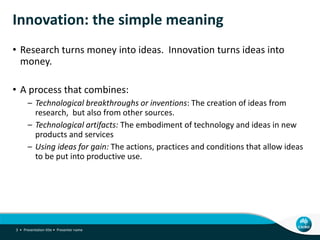
Innovation: the simple meaning
• Research turns money into ideas. Innovation turns ideas into
money.
• A process that combines:
– Technological breakthroughs or inventions: The creation of ideas from
research, but also from other sources.
– Technological artifacts: The embodiment of technology and ideas in new
products and services
– Using ideas for gain: The actions, practices and conditions that allow ideas
to be put into productive use.
Presentation title • Presenter name3 •
Innovation: more meanings
• The process of creating and putting into use combinations of knowledge
from many different sources
• This knowledge may be brand-new, but usually it is new combinations of
existing knowledge
• Not research or technology, but might involve both.
• To be termed innovation, the use of this knowledge has to be novel to
the farmer or the firm, neighbours and competitors, but not necessarily
new globally
• Invention, on the other hand, is the creation of new knowledge new to
the world, usually by research organisations, but also by artisans and
others
4 |
Different ways of organising agriculture innovation• Dr Andy Hall
Presentation title | Presenter name5 |
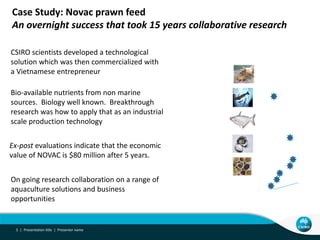
CSIRO scientists developed a technological
solution which was then commercialized with
a Vietnamese entrepreneur
Ex-post evaluations indicate that the economic
value of NOVAC is $80 million after 5 years.
Bio-available nutrients from non marine
sources. Biology well known. Breakthrough
research was how to apply that as an industrial
scale production technology
On going research collaboration on a range of
aquaculture solutions and business
opportunities
Case Study: Novac prawn feed
An overnight success that took 15 years collaborative research
Presentation title | Presenter name
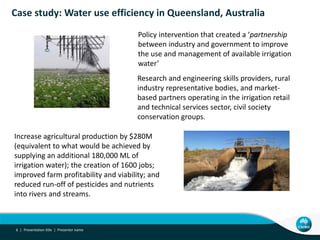
Case study: Water use efficiency in Queensland, Australia
6 |
Policy intervention that created a ‘partnership
between industry and government to improve
the use and management of available irrigation
water’
Increase agricultural production by $280M
(equivalent to what would be achieved by
supplying an additional 180,000 ML of
irrigation water); the creation of 1600 jobs;
improved farm profitability and viability; and
reduced run-off of pesticides and nutrients
into rivers and streams.
Research and engineering skills providers, rural
industry representative bodies, and market-
based partners operating in the irrigation retail
and technical services sector, civil society
conservation groups.
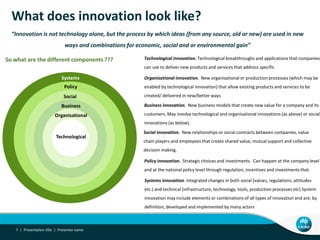
What does innovation look like?
Presentation title | Presenter name7 |
Systems
Policy
Social
Business
Organisational
Technological
Technological innovation. Technological breakthroughs and applications that companies
can use to deliver new products and services that address specific
Organisational innovation. New organisational or production processes (which may be
enabled by technological innovation) that allow existing products and services to be
created/ delivered in new/better ways
Policy innovation. Strategic choices and investments. Can happen at the company level
and at the national policy level through regulation, incentives and investments that.
Business innovation. New business models that create new value for a company and its
customers. May involve technological and organisational innovations (as above) or social
innovations (as below).
Social innovation. New relationships or social contracts between companies, value
chain players and employees that create shared value, mutual support and collective
decision making.
Systems innovation. Integrated changes in both social (values, regulations, attitudes
etc.) and technical (infrastructure, technology, tools, production processes etc) System
innovation may include elements or combinations of all types of innovation and are, by
definition, developed and implemented by many actors
“Innovation is not technology alone, but the process by which ideas (from any source, old or new) are used in new
ways and combinations for economic, social and or environmental gain”
So what are the different components ???
How does innovation happen?
There are broadly 2 views.
• A technology transfer pipeline view
• A “systems” views that suggests different types
of innovation need to be coupled together.
• Neither can be universally correct.
8 |
Different ways of organising agriculture innovation• Dr Andy Hall
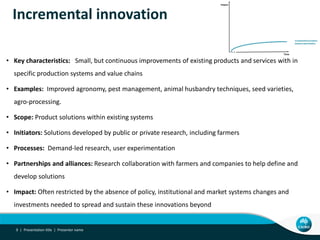
Incremental innovation
• Key characteristics: Small, but continuous improvements of existing products and services with in
specific production systems and value chains
• Examples: Improved agronomy, pest management, animal husbandry techniques, seed varieties,
agro-processing.
• Scope: Product solutions within existing systems
• Initiators: Solutions developed by public or private research, including farmers
• Processes: Demand-led research, user experimentation
• Partnerships and alliances: Research collaboration with farmers and companies to help define and
develop solutions
• Impact: Often restricted by the absence of policy, institutional and market systems changes and
investments needed to spread and sustain these innovations beyond
Presentation title | Presenter name9 |
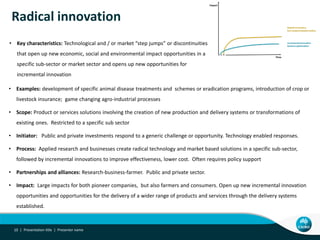
Radical innovation
• Key characteristics: Technological and / or market “step jumps” or discontinuities
that open up new economic, social and environmental impact opportunities in a
specific sub-sector or market sector and opens up new opportunities for
incremental innovation
Presentation title | Presenter name10 |
• Examples: development of specific animal disease treatments and schemes or eradication programs, introduction of crop or
livestock insurance; game changing agro-industrial processes
• Scope: Product or services solutions involving the creation of new production and delivery systems or transformations of
existing ones. Restricted to a specific sub sector
• Initiator: Public and private investments respond to a generic challenge or opportunity. Technology enabled responses.
• Process: Applied research and businesses create radical technology and market based solutions in a specific sub-sector,
followed by incremental innovations to improve effectiveness, lower cost. Often requires policy support
• Partnerships and alliances: Research-business-farmer. Public and private sector.
• Impact: Large impacts for both pioneer companies, but also farmers and consumers. Open up new incremental innovation
opportunities and opportunities for the delivery of a wider range of products and services through the delivery systems
established.
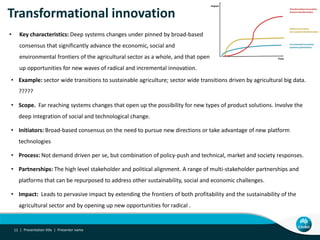
Transformational innovation
• Example: sector wide transitions to sustainable agriculture; sector wide transitions driven by agricultural big data.
?????
• Scope. Far reaching systems changes that open up the possibility for new types of product solutions. Involve the
deep integration of social and technological change.
• Initiators: Broad-based consensus on the need to pursue new directions or take advantage of new platform
technologies
• Process: Not demand driven per se, but combination of policy-push and technical, market and society responses.
• Partnerships: The high level stakeholder and political alignment. A range of multi-stakeholder partnerships and
platforms that can be repurposed to address other sustainability, social and economic challenges.
• Impact: Leads to pervasive impact by extending the frontiers of both profitability and the sustainability of the
agricultural sector and by opening up new opportunities for radical .
Presentation title | Presenter name11 |
• Key characteristics: Deep systems changes under pinned by broad-based
consensus that significantly advance the economic, social and
environmental frontiers of the agricultural sector as a whole, and that open
up opportunities for new waves of radical and incremental innovation.
12 •
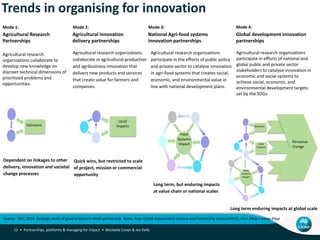
Agricultural Research
Partnerships
Agricultural innovation
delivery partnerships
National Agri-food systems
innovation partnerships
Global development innovation
partnerships
Agricultural research
organizations collaborate to
develop new knowledge on
discreet technical dimensions of
prioritized problems and
opportunities.
Agricultural research organizations
collaborate in agricultural production
and agribusiness innovation that
delivers new products and services
that create value for farmers and
companies.
Agricultural research organizations
participate in the efforts of public policy
and private sector to catalyse innovation
in agri-food systems that creates social,
economic, and environmental value in
line with national development plans.
Agricultural research organizations
participate in efforts of national and
global public and private sector
stakeholders to catalyse innovation in
economic and social systems to
achieve social, economic, and
environmental development targets
set by the SDGs.
Mode 1: Mode 3:Mode 2: Mode 4:
Solutions
Local
Impacts
Food
Systems
Impact
Pervasive
change
Solutions
Local
Impacts
Food
Systems
Impact
Long term enduring impacts at global scale
Long term, but enduring impacts
at value chain or national scales
Quick wins, but restricted to scale
of project, mission or commercial
opportunity
Dependent on linkages to other
delivery, innovation and societal
change processes
Partnerships, platforms & managing for impact • Michaela Cosijn & Jen Kelly
Source: ISPC, 2016. Strategic study of good practice in AR4D partnership. Rome, Italy. CGIAR Independent Science and Partnership Council (ISPC), viii + 39pp + annex 49pp
Trends in organising for innovation
Why is it important to recognize these different
modes of innovation and partnership?
• The “grand challenges” of agriculture are going to need transformational
innovation. Incremental change is valuable, but not enough.
• Global food security. Coping with climate change. Equitable, sustainable and healthy
food systems. A growth sector to employ our grandchildren.
• A portfolio lens to explore partnerships, strategies, policies and ways of
working that lock too much of our efforts in incremental innovation.
• A roadmap for rethinking partnerships, for rethinking the role and practice of
research in the innovation processes we aspire to, and for revisiting the roles
and investments of the public and the private sectors in change processes going
forward.
Presentation title | Presenter name13 |
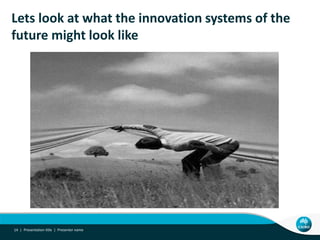
Lets look at what the innovation systems of the
future might look like
Presentation title | Presenter name14 |

Andy hall framework partnership and innovation@apaari

  • 1.
    Framework for exploringdifferent models of innovation and partnership. Andy Hall AGRICULTURE & FOOD Agriculture and Global Change research program. APAARI Conference November 2016
  • 2.
    This presentation drawsfrom … Andy Hall, Jeroen Dijkman, Bruce Taylor, Liana Williams and Jennifer Kelly (2016) Towards a framework for unlocking transformative agricultural innovation. CSIRO/ CGIAR ISPC working draft Presentation title | Presenter name2 |
  • 3.
    Innovation: the simplemeaning • Research turns money into ideas. Innovation turns ideas into money. • A process that combines: – Technological breakthroughs or inventions: The creation of ideas from research, but also from other sources. – Technological artifacts: The embodiment of technology and ideas in new products and services – Using ideas for gain: The actions, practices and conditions that allow ideas to be put into productive use. Presentation title • Presenter name3 •
  • 4.
    Innovation: more meanings •The process of creating and putting into use combinations of knowledge from many different sources • This knowledge may be brand-new, but usually it is new combinations of existing knowledge • Not research or technology, but might involve both. • To be termed innovation, the use of this knowledge has to be novel to the farmer or the firm, neighbours and competitors, but not necessarily new globally • Invention, on the other hand, is the creation of new knowledge new to the world, usually by research organisations, but also by artisans and others 4 | Different ways of organising agriculture innovation• Dr Andy Hall
  • 5.
    Presentation title |Presenter name5 | CSIRO scientists developed a technological solution which was then commercialized with a Vietnamese entrepreneur Ex-post evaluations indicate that the economic value of NOVAC is $80 million after 5 years. Bio-available nutrients from non marine sources. Biology well known. Breakthrough research was how to apply that as an industrial scale production technology On going research collaboration on a range of aquaculture solutions and business opportunities Case Study: Novac prawn feed An overnight success that took 15 years collaborative research
  • 6.
    Presentation title |Presenter name Case study: Water use efficiency in Queensland, Australia 6 | Policy intervention that created a ‘partnership between industry and government to improve the use and management of available irrigation water’ Increase agricultural production by $280M (equivalent to what would be achieved by supplying an additional 180,000 ML of irrigation water); the creation of 1600 jobs; improved farm profitability and viability; and reduced run-off of pesticides and nutrients into rivers and streams. Research and engineering skills providers, rural industry representative bodies, and market- based partners operating in the irrigation retail and technical services sector, civil society conservation groups.
  • 7.
    What does innovationlook like? Presentation title | Presenter name7 | Systems Policy Social Business Organisational Technological Technological innovation. Technological breakthroughs and applications that companies can use to deliver new products and services that address specific Organisational innovation. New organisational or production processes (which may be enabled by technological innovation) that allow existing products and services to be created/ delivered in new/better ways Policy innovation. Strategic choices and investments. Can happen at the company level and at the national policy level through regulation, incentives and investments that. Business innovation. New business models that create new value for a company and its customers. May involve technological and organisational innovations (as above) or social innovations (as below). Social innovation. New relationships or social contracts between companies, value chain players and employees that create shared value, mutual support and collective decision making. Systems innovation. Integrated changes in both social (values, regulations, attitudes etc.) and technical (infrastructure, technology, tools, production processes etc) System innovation may include elements or combinations of all types of innovation and are, by definition, developed and implemented by many actors “Innovation is not technology alone, but the process by which ideas (from any source, old or new) are used in new ways and combinations for economic, social and or environmental gain” So what are the different components ???
  • 8.
    How does innovationhappen? There are broadly 2 views. • A technology transfer pipeline view • A “systems” views that suggests different types of innovation need to be coupled together. • Neither can be universally correct. 8 | Different ways of organising agriculture innovation• Dr Andy Hall
  • 9.
    Incremental innovation • Keycharacteristics: Small, but continuous improvements of existing products and services with in specific production systems and value chains • Examples: Improved agronomy, pest management, animal husbandry techniques, seed varieties, agro-processing. • Scope: Product solutions within existing systems • Initiators: Solutions developed by public or private research, including farmers • Processes: Demand-led research, user experimentation • Partnerships and alliances: Research collaboration with farmers and companies to help define and develop solutions • Impact: Often restricted by the absence of policy, institutional and market systems changes and investments needed to spread and sustain these innovations beyond Presentation title | Presenter name9 |
  • 10.
    Radical innovation • Keycharacteristics: Technological and / or market “step jumps” or discontinuities that open up new economic, social and environmental impact opportunities in a specific sub-sector or market sector and opens up new opportunities for incremental innovation Presentation title | Presenter name10 | • Examples: development of specific animal disease treatments and schemes or eradication programs, introduction of crop or livestock insurance; game changing agro-industrial processes • Scope: Product or services solutions involving the creation of new production and delivery systems or transformations of existing ones. Restricted to a specific sub sector • Initiator: Public and private investments respond to a generic challenge or opportunity. Technology enabled responses. • Process: Applied research and businesses create radical technology and market based solutions in a specific sub-sector, followed by incremental innovations to improve effectiveness, lower cost. Often requires policy support • Partnerships and alliances: Research-business-farmer. Public and private sector. • Impact: Large impacts for both pioneer companies, but also farmers and consumers. Open up new incremental innovation opportunities and opportunities for the delivery of a wider range of products and services through the delivery systems established.
  • 11.
    Transformational innovation • Example:sector wide transitions to sustainable agriculture; sector wide transitions driven by agricultural big data. ????? • Scope. Far reaching systems changes that open up the possibility for new types of product solutions. Involve the deep integration of social and technological change. • Initiators: Broad-based consensus on the need to pursue new directions or take advantage of new platform technologies • Process: Not demand driven per se, but combination of policy-push and technical, market and society responses. • Partnerships: The high level stakeholder and political alignment. A range of multi-stakeholder partnerships and platforms that can be repurposed to address other sustainability, social and economic challenges. • Impact: Leads to pervasive impact by extending the frontiers of both profitability and the sustainability of the agricultural sector and by opening up new opportunities for radical . Presentation title | Presenter name11 | • Key characteristics: Deep systems changes under pinned by broad-based consensus that significantly advance the economic, social and environmental frontiers of the agricultural sector as a whole, and that open up opportunities for new waves of radical and incremental innovation.
  • 12.
    12 • Agricultural Research Partnerships Agriculturalinnovation delivery partnerships National Agri-food systems innovation partnerships Global development innovation partnerships Agricultural research organizations collaborate to develop new knowledge on discreet technical dimensions of prioritized problems and opportunities. Agricultural research organizations collaborate in agricultural production and agribusiness innovation that delivers new products and services that create value for farmers and companies. Agricultural research organizations participate in the efforts of public policy and private sector to catalyse innovation in agri-food systems that creates social, economic, and environmental value in line with national development plans. Agricultural research organizations participate in efforts of national and global public and private sector stakeholders to catalyse innovation in economic and social systems to achieve social, economic, and environmental development targets set by the SDGs. Mode 1: Mode 3:Mode 2: Mode 4: Solutions Local Impacts Food Systems Impact Pervasive change Solutions Local Impacts Food Systems Impact Long term enduring impacts at global scale Long term, but enduring impacts at value chain or national scales Quick wins, but restricted to scale of project, mission or commercial opportunity Dependent on linkages to other delivery, innovation and societal change processes Partnerships, platforms & managing for impact • Michaela Cosijn & Jen Kelly Source: ISPC, 2016. Strategic study of good practice in AR4D partnership. Rome, Italy. CGIAR Independent Science and Partnership Council (ISPC), viii + 39pp + annex 49pp Trends in organising for innovation
  • 13.
    Why is itimportant to recognize these different modes of innovation and partnership? • The “grand challenges” of agriculture are going to need transformational innovation. Incremental change is valuable, but not enough. • Global food security. Coping with climate change. Equitable, sustainable and healthy food systems. A growth sector to employ our grandchildren. • A portfolio lens to explore partnerships, strategies, policies and ways of working that lock too much of our efforts in incremental innovation. • A roadmap for rethinking partnerships, for rethinking the role and practice of research in the innovation processes we aspire to, and for revisiting the roles and investments of the public and the private sectors in change processes going forward. Presentation title | Presenter name13 |
  • 14.
    Lets look atwhat the innovation systems of the future might look like Presentation title | Presenter name14 |