Global HSPA Update
                                                                     June 30, 2010

                                                                     www.gsacom.com


                                                                                                   GSA LinkedIN Group

www.facebook.com/pages/Global-mobile-Suppliers-Association-GSA/123462771012551                www.linkedin.com/groups?gid=2313721


                   www.gsacom.com/rss/gsanews.php4


                                                                          www.twitter.com/gsacom
                   info@gsacom.com
                   www.gsacom.com                                                                   Global mobile Suppliers Association © 2010

  Global HSPA Update June 30, 2010                                                                                    Slide no. 1/15
High Speed Packet Access (HSPA)
First evolution of WCDMA evolution


     The path to mobile broadband began with WCDMA and its first evolution - High
    Speed Packet Access (HSPA), a 3GPP global standard, boosting capacity, system
                           performance and user data speeds

              HSPA is the leading mobile broadband technology globally
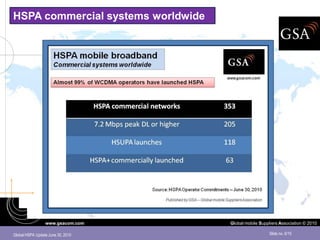
                       98.8% of commercial WCDMA operators have launched HSPA


                        401 HSPA Operator Commitments in 154 countries/territories

                                   353 commercial operators launched in 147 countries

                                        Including 63 commercial HSPA+ networks
                 www.gsacom.com                                               Global mobile Suppliers Association © 2010

Global HSPA Update June 30, 2010                                                                Slide no. 2/15
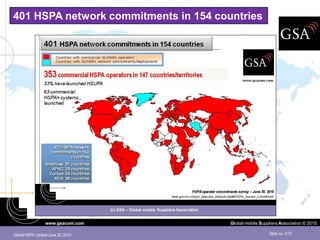
401 HSPA network commitments in 154 countries


                 www.gsacom.com        Global mobile Suppliers Association © 2010

Global HSPA Update June 30, 2010                         Slide no. 3/15
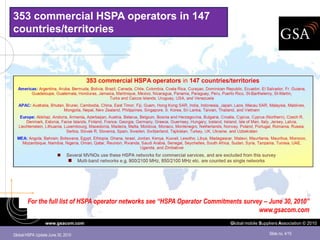
353 commercial HSPA operators in 147
countries/territories


       For the full list of HSPA operator networks see “HSPA Operator Commitments survey – June 30, 2010”
                                                                                       www.gsacom.com
                 www.gsacom.com                                              Global mobile Suppliers Association © 2010

Global HSPA Update June 30, 2010                                                               Slide no. 4/15
High Speed Packet Access


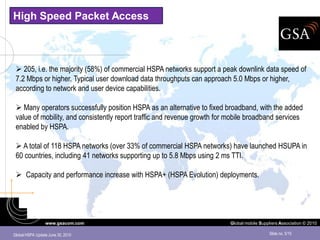
  205, i.e. the majority (58%) of commercial HSPA networks support a peak downlink data speed of
 7.2 Mbps or higher. Typical user download data throughputs can approach 5.0 Mbps or higher,
 according to network and user device capabilities.

  Many operators successfully position HSPA as an alternative to fixed broadband, with the added
 value of mobility, and consistently report traffic and revenue growth for mobile broadband services
 enabled by HSPA.

  A total of 118 HSPA networks (over 33% of commercial HSPA networks) have launched HSUPA in
 60 countries, including 41 networks supporting up to 5.8 Mbps using 2 ms TTI.

  Capacity and performance increase with HSPA+ (HSPA Evolution) deployments.


                 www.gsacom.com                                            Global mobile Suppliers Association © 2010

Global HSPA Update June 30, 2010                                                             Slide no. 5/15
HSPA commercial systems worldwide


                 www.gsacom.com     Global mobile Suppliers Association © 2010

Global HSPA Update June 30, 2010                      Slide no. 6/15
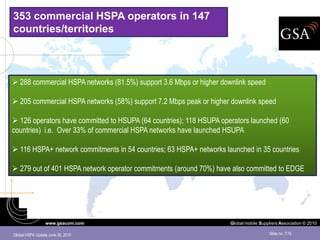
353 commercial HSPA operators in 147
countries/territories


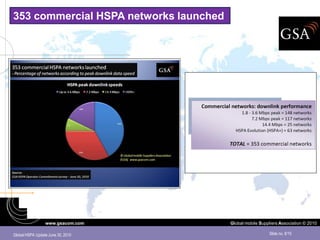
 288 commercial HSPA networks (81.5%) support 3.6 Mbps or higher downlink speed

 205 commercial HSPA networks (58%) support 7.2 Mbps peak or higher downlink speed

 126 operators have committed to HSUPA (64 countries); 118 HSUPA operators launched (60
countries) i.e. Over 33% of commercial HSPA networks have launched HSUPA

 116 HSPA+ network commitments in 54 countries; 63 HSPA+ networks launched in 35 countries

 279 out of 401 HSPA network operator commitments (around 70%) have also committed to EDGE


                 www.gsacom.com                                      Global mobile Suppliers Association © 2010

Global HSPA Update June 30, 2010                                                       Slide no. 7/15
353 commercial HSPA networks launched


                 www.gsacom.com         Global mobile Suppliers Association © 2010

Global HSPA Update June 30, 2010                          Slide no. 8/15
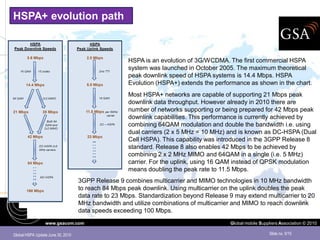
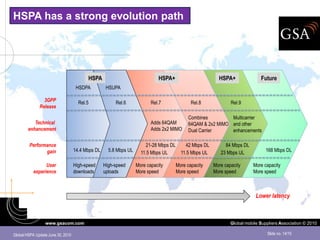
HSPA+ evolution path


                                                    HSPA is an evolution of 3G/WCDMA. The first commercial HSPA
                                                    system was launched in October 2005. The maximum theoretical
                                                    peak downlink speed of HSPA systems is 14.4 Mbps. HSPA
                                                    Evolution (HSPA+) extends the performance as shown in the chart.
                                                    Most HSPA+ networks are capable of supporting 21 Mbps peak
                                                    downlink data throughput. However already in 2010 there are
                                                    number of networks supporting or being prepared for 42 Mbps peak
                                                    downlink capabilities. This performance is currently achieved by
                                                    combining 64QAM modulation and double the bandwidth i.e. using
                                                    dual carriers (2 x 5 MHz = 10 MHz) and is known as DC-HSPA (Dual
                                                    Cell HSPA). This capability was introduced in the 3GPP Release 8
                                                    standard. Release 8 also enables 42 Mbps to be achieved by
                                                    combining 2 x 2 MHz MIMO and 64QAM in a single (i.e. 5 MHz)
                                                    carrier. For the uplink, using 16 QAM instead of QPSK modulation
                                                    means doubling the peak rate to 11.5 Mbps.
                                   3GPP Release 9 combines multicarrier and MIMO technologies in 10 MHz bandwidth
                                   to reach 84 Mbps peak downlink. Using multicarrier on the uplink doubles the peak
                                   data rate to 23 Mbps. Standardization beyond Release 9 may extend multicarrier to 20
                                   MHz bandwidth and utilize combinations of multicarrier and MIMO to reach downlink
                                   data speeds exceeding 100 Mbps.
                 www.gsacom.com                                                          Global mobile Suppliers Association © 2010

Global HSPA Update June 30, 2010                                                                           Slide no. 9/15
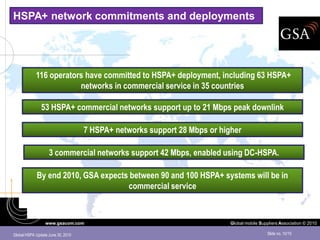
HSPA+ network commitments and deployments


            116 operators have committed to HSPA+ deployment, including 63 HSPA+
                        networks in commercial service in 35 countries

               53 HSPA+ commercial networks support up to 21 Mbps peak downlink

                                   7 HSPA+ networks support 28 Mbps or higher

                   3 commercial networks support 42 Mbps, enabled using DC-HSPA.

            By end 2010, GSA expects between 90 and 100 HSPA+ systems will be in
                                    commercial service


                 www.gsacom.com                                           Global mobile Suppliers Association © 2010

Global HSPA Update June 30, 2010                                                           Slide no. 10/15
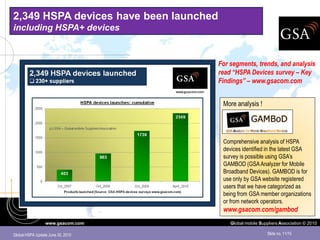
2,349 HSPA devices have been launched
including HSPA+ devices


                                        For segments, trends, and analysis
                                        read “HSPA Devices survey – Key
                                        Findings” – www.gsacom.com


                                         More analysis !


                                         Comprehensive analysis of HSPA
                                         devices identified in the latest GSA
                                         survey is possible using GSA’s
                                         GAMBOD (GSA Analyzer for Mobile
                                         Broadband Devices). GAMBOD is for
                                         use only by GSA website registered
                                         users that we have categorized as
                                         being from GSA member organizations
                                         or from network operators.
                                         www.gsacom.com/gambod
                 www.gsacom.com             Global mobile Suppliers Association © 2010

Global HSPA Update June 30, 2010                             Slide no. 11/15
HSPA in lower frequency bands: 900, 850 MHz


While the majority of today’s 3G/HSPA networks operate in the 2100 MHz band, the use of lower frequencies, such
as 900 MHz, provides a much larger geographical coverage area compared to what is possible when deploying at
2100 MHz. HSPA deployments in the 900 MHz band significantly reduce the number of cell sites needed to cover
rural and suburban areas, securing major CAPEX and OPEX savings for 3G deployments. These cost and
coverage benefits similarly also apply to HSPA deployments at 850 MHz.


GSA has published a UMTS900 operator case study on Optus in Australia, which shows significant cost and
coverage benefits of deploying 3G mobile broadband services with UMTS900. The case study examines the
business drivers and practical experiences of Optus, who launched UMTS900 in May 2008. It confirms the findings
from GSA’s earlier UMTS900 case study on Elisa Corporation in Finland, and provides additional insights.


                 www.gsacom.com                                                  Global mobile Suppliers Association © 2010

Global HSPA Update June 30, 2010                                                                  Slide no. 12/15
HSPA in lower frequency bands: 900, 850 MHz


     The Optus network is the largest UMTS900 network in the world. In addition to cost savings, the ability to
     use existing infrastructure dramatically reduced the time needed for deployment. Optus saw the rollout of
     UMTS900 in suburban and rural areas as a natural extension of its initial 3G deployment in the more
     heavily populated areas where 2100 MHz is used. UMTS900 has brought 3G and mobile broadband
     services more cost-effectively to outside the cities. More than just the need for fewer installations,
     UMTS900 facilitates the addition of a much larger data market because it provides better indoor coverage
     than 2100 MHz.


     More information:
      Optus Australia UMTS900 Operator Case Study
      Elisa Finland UMTS900 Operator Case Study
      GSA UMTS900 Global Status Information Paper

                       All are available at www.gsacom.com


                 www.gsacom.com                                                       Global mobile Suppliers Association © 2010

Global HSPA Update June 30, 2010                                                                       Slide no. 13/15
HSPA has a strong evolution path


                                         HSPA                               HSPA+                     HSPA+               Future
                                    HSDPA          HSUPA

                3GPP                 Rel.5             Rel.6             Rel.7             Rel.8            Rel.9
              Release

                                                                                         Combines         Multicarrier
           Technical                                                     Adds 64QAM      64QAM & 2x2 MIMO and other
        enhancement                                                      Adds 2x2 MIMO   Dual Carrier     enhancements

        Performance                                                   21-28 Mbps DL   42 Mbps DL         84 Mbps DL
               gain                14.4 Mbps DL     5.8 Mbps UL     11.5 Mbps UL    11.5 Mbps UL       23 Mbps UL            168 Mbps DL

                 User              High-speed     High-speed      More capacity     More capacity   More capacity      More capacity
           experience              downloads      uploads         More speed        More speed      More speed         More speed


                                                                                                                        Lower latency


                 www.gsacom.com                                                                             Global mobile Suppliers Association © 2010

Global HSPA Update June 30, 2010                                                                                             Slide no. 14/15
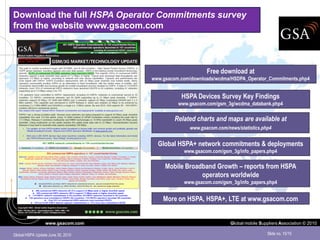
Download the full HSPA Operator Commitments survey
from the website www.gsacom.com


                                                         Free download at
                                   www.gsacom.com/downloads/wcdma/HSDPA_Operator_Commitments.php4


                                              HSPA Devices Survey Key Findings
                                             www.gsacom.com/gsm_3g/wcdma_databank.php4

                                            Related charts and maps are available at
                                                  www.gsacom.com/news/statistics.php4


                                     Global HSPA+ network commitments & deployments
                                               www.gsacom.com/gsm_3g/info_papers.php4

                                        Mobile Broadband Growth – reports from HSPA
                                                    operators worldwide
                                               www.gsacom.com/gsm_3g/info_papers.php4


                                       More on HSPA, HSPA+, LTE at www.gsacom.com


                 www.gsacom.com                                    Global mobile Suppliers Association © 2010

Global HSPA Update June 30, 2010                                                    Slide no. 15/15

GSA HSPA Slide Deck June 2010

  • 1.
    Global HSPA Update June 30, 2010 www.gsacom.com GSA LinkedIN Group www.facebook.com/pages/Global-mobile-Suppliers-Association-GSA/123462771012551 www.linkedin.com/groups?gid=2313721 www.gsacom.com/rss/gsanews.php4 www.twitter.com/gsacom info@gsacom.com www.gsacom.com Global mobile Suppliers Association © 2010 Global HSPA Update June 30, 2010 Slide no. 1/15
  • 2.
    High Speed PacketAccess (HSPA) First evolution of WCDMA evolution The path to mobile broadband began with WCDMA and its first evolution - High Speed Packet Access (HSPA), a 3GPP global standard, boosting capacity, system performance and user data speeds HSPA is the leading mobile broadband technology globally 98.8% of commercial WCDMA operators have launched HSPA 401 HSPA Operator Commitments in 154 countries/territories 353 commercial operators launched in 147 countries Including 63 commercial HSPA+ networks www.gsacom.com Global mobile Suppliers Association © 2010 Global HSPA Update June 30, 2010 Slide no. 2/15
  • 3.
    401 HSPA networkcommitments in 154 countries www.gsacom.com Global mobile Suppliers Association © 2010 Global HSPA Update June 30, 2010 Slide no. 3/15
  • 4.
    353 commercial HSPAoperators in 147 countries/territories For the full list of HSPA operator networks see “HSPA Operator Commitments survey – June 30, 2010” www.gsacom.com www.gsacom.com Global mobile Suppliers Association © 2010 Global HSPA Update June 30, 2010 Slide no. 4/15
  • 5.
    High Speed PacketAccess  205, i.e. the majority (58%) of commercial HSPA networks support a peak downlink data speed of 7.2 Mbps or higher. Typical user download data throughputs can approach 5.0 Mbps or higher, according to network and user device capabilities.  Many operators successfully position HSPA as an alternative to fixed broadband, with the added value of mobility, and consistently report traffic and revenue growth for mobile broadband services enabled by HSPA.  A total of 118 HSPA networks (over 33% of commercial HSPA networks) have launched HSUPA in 60 countries, including 41 networks supporting up to 5.8 Mbps using 2 ms TTI.  Capacity and performance increase with HSPA+ (HSPA Evolution) deployments. www.gsacom.com Global mobile Suppliers Association © 2010 Global HSPA Update June 30, 2010 Slide no. 5/15
  • 6.
    HSPA commercial systemsworldwide www.gsacom.com Global mobile Suppliers Association © 2010 Global HSPA Update June 30, 2010 Slide no. 6/15
  • 7.
    353 commercial HSPAoperators in 147 countries/territories  288 commercial HSPA networks (81.5%) support 3.6 Mbps or higher downlink speed  205 commercial HSPA networks (58%) support 7.2 Mbps peak or higher downlink speed  126 operators have committed to HSUPA (64 countries); 118 HSUPA operators launched (60 countries) i.e. Over 33% of commercial HSPA networks have launched HSUPA  116 HSPA+ network commitments in 54 countries; 63 HSPA+ networks launched in 35 countries  279 out of 401 HSPA network operator commitments (around 70%) have also committed to EDGE www.gsacom.com Global mobile Suppliers Association © 2010 Global HSPA Update June 30, 2010 Slide no. 7/15
  • 8.
    353 commercial HSPAnetworks launched www.gsacom.com Global mobile Suppliers Association © 2010 Global HSPA Update June 30, 2010 Slide no. 8/15
  • 9.
    HSPA+ evolution path HSPA is an evolution of 3G/WCDMA. The first commercial HSPA system was launched in October 2005. The maximum theoretical peak downlink speed of HSPA systems is 14.4 Mbps. HSPA Evolution (HSPA+) extends the performance as shown in the chart. Most HSPA+ networks are capable of supporting 21 Mbps peak downlink data throughput. However already in 2010 there are number of networks supporting or being prepared for 42 Mbps peak downlink capabilities. This performance is currently achieved by combining 64QAM modulation and double the bandwidth i.e. using dual carriers (2 x 5 MHz = 10 MHz) and is known as DC-HSPA (Dual Cell HSPA). This capability was introduced in the 3GPP Release 8 standard. Release 8 also enables 42 Mbps to be achieved by combining 2 x 2 MHz MIMO and 64QAM in a single (i.e. 5 MHz) carrier. For the uplink, using 16 QAM instead of QPSK modulation means doubling the peak rate to 11.5 Mbps. 3GPP Release 9 combines multicarrier and MIMO technologies in 10 MHz bandwidth to reach 84 Mbps peak downlink. Using multicarrier on the uplink doubles the peak data rate to 23 Mbps. Standardization beyond Release 9 may extend multicarrier to 20 MHz bandwidth and utilize combinations of multicarrier and MIMO to reach downlink data speeds exceeding 100 Mbps. www.gsacom.com Global mobile Suppliers Association © 2010 Global HSPA Update June 30, 2010 Slide no. 9/15
  • 10.
    HSPA+ network commitmentsand deployments 116 operators have committed to HSPA+ deployment, including 63 HSPA+ networks in commercial service in 35 countries 53 HSPA+ commercial networks support up to 21 Mbps peak downlink 7 HSPA+ networks support 28 Mbps or higher 3 commercial networks support 42 Mbps, enabled using DC-HSPA. By end 2010, GSA expects between 90 and 100 HSPA+ systems will be in commercial service www.gsacom.com Global mobile Suppliers Association © 2010 Global HSPA Update June 30, 2010 Slide no. 10/15
  • 11.
    2,349 HSPA deviceshave been launched including HSPA+ devices For segments, trends, and analysis read “HSPA Devices survey – Key Findings” – www.gsacom.com More analysis ! Comprehensive analysis of HSPA devices identified in the latest GSA survey is possible using GSA’s GAMBOD (GSA Analyzer for Mobile Broadband Devices). GAMBOD is for use only by GSA website registered users that we have categorized as being from GSA member organizations or from network operators. www.gsacom.com/gambod www.gsacom.com Global mobile Suppliers Association © 2010 Global HSPA Update June 30, 2010 Slide no. 11/15
  • 12.
    HSPA in lowerfrequency bands: 900, 850 MHz While the majority of today’s 3G/HSPA networks operate in the 2100 MHz band, the use of lower frequencies, such as 900 MHz, provides a much larger geographical coverage area compared to what is possible when deploying at 2100 MHz. HSPA deployments in the 900 MHz band significantly reduce the number of cell sites needed to cover rural and suburban areas, securing major CAPEX and OPEX savings for 3G deployments. These cost and coverage benefits similarly also apply to HSPA deployments at 850 MHz. GSA has published a UMTS900 operator case study on Optus in Australia, which shows significant cost and coverage benefits of deploying 3G mobile broadband services with UMTS900. The case study examines the business drivers and practical experiences of Optus, who launched UMTS900 in May 2008. It confirms the findings from GSA’s earlier UMTS900 case study on Elisa Corporation in Finland, and provides additional insights. www.gsacom.com Global mobile Suppliers Association © 2010 Global HSPA Update June 30, 2010 Slide no. 12/15
  • 13.
    HSPA in lowerfrequency bands: 900, 850 MHz The Optus network is the largest UMTS900 network in the world. In addition to cost savings, the ability to use existing infrastructure dramatically reduced the time needed for deployment. Optus saw the rollout of UMTS900 in suburban and rural areas as a natural extension of its initial 3G deployment in the more heavily populated areas where 2100 MHz is used. UMTS900 has brought 3G and mobile broadband services more cost-effectively to outside the cities. More than just the need for fewer installations, UMTS900 facilitates the addition of a much larger data market because it provides better indoor coverage than 2100 MHz. More information:  Optus Australia UMTS900 Operator Case Study  Elisa Finland UMTS900 Operator Case Study  GSA UMTS900 Global Status Information Paper All are available at www.gsacom.com www.gsacom.com Global mobile Suppliers Association © 2010 Global HSPA Update June 30, 2010 Slide no. 13/15
  • 14.
    HSPA has astrong evolution path HSPA HSPA+ HSPA+ Future HSDPA HSUPA 3GPP Rel.5 Rel.6 Rel.7 Rel.8 Rel.9 Release Combines Multicarrier Technical Adds 64QAM 64QAM & 2x2 MIMO and other enhancement Adds 2x2 MIMO Dual Carrier enhancements Performance 21-28 Mbps DL 42 Mbps DL 84 Mbps DL gain 14.4 Mbps DL 5.8 Mbps UL 11.5 Mbps UL 11.5 Mbps UL 23 Mbps UL 168 Mbps DL User High-speed High-speed More capacity More capacity More capacity More capacity experience downloads uploads More speed More speed More speed More speed Lower latency www.gsacom.com Global mobile Suppliers Association © 2010 Global HSPA Update June 30, 2010 Slide no. 14/15
  • 15.
    Download the fullHSPA Operator Commitments survey from the website www.gsacom.com Free download at www.gsacom.com/downloads/wcdma/HSDPA_Operator_Commitments.php4 HSPA Devices Survey Key Findings www.gsacom.com/gsm_3g/wcdma_databank.php4 Related charts and maps are available at www.gsacom.com/news/statistics.php4 Global HSPA+ network commitments & deployments www.gsacom.com/gsm_3g/info_papers.php4 Mobile Broadband Growth – reports from HSPA operators worldwide www.gsacom.com/gsm_3g/info_papers.php4 More on HSPA, HSPA+, LTE at www.gsacom.com www.gsacom.com Global mobile Suppliers Association © 2010 Global HSPA Update June 30, 2010 Slide no. 15/15