1
HSPA+ Advanced
HSPA+ enhancements in 3GPP R11 and
beyond May 2013
2
2013 2014 2015 2016+2013 2014 2015 2016+
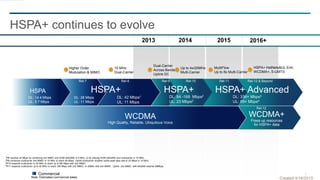
HSPA+ continues to evolve
Note: Estimated commercial dates.
Rel-11Rel-10Rel-9Rel-8Rel-7
DL: 84 -168 Mbps2
UL: 23 Mbps2
DL: 28 Mbps
UL: 11 Mbps
DL: 42 Mbps1
UL: 11 Mbps
DL: 14.4 Mbps
UL: 5.7 Mbps
DL: 336+ Mbps4
UL: 69+ Mbps4
1R8 reaches 42 Mbps by combining 2x2 MIMO and HOM (64QAM) in 5 MHz, or by utilizing HOM (64QAM) and multicarrier in 10 MHz.
2R9 combines multicarrier and MIMO in 10 MHz to reach 84 Mbps. Uplink multicarrier doubles uplink peak data rate to 23 Mbps in 10 MHz.
3R10 expands multicarrier to 20 MHz to reach up to168 Mbps with 2x2 MIMO.
4R11 expands multicarrier up to 40 MHz to reach 336 Mbps with 2x2 MIMO, or 20Mhz with 4x4 MIMO. Uplink 2x2 MIMO with 64QAM reaches 69Mbps.
Rel-12 & Beyond
Rel-12
Created 4/16/2013
10 MHz
Dual-Carrier
Up to 4x/20MHz
Multi-Carrier
Dual-Carrier
Across Bands
Uplink DC
MultiFlow
Up to 8x Multi-Carrier
Higher Order
Modulation & MIMO
HSPA+ HetNets&UL Enh.
WCDMA+, S-UMTS
HSPA+ AdvancedHSPA+HSPA
WCDMA
High Quality, Reliable, Ubiquitous Voice
HSPA+
WCDMA+
Frees up resources
for HSPA+ data
Commercial
3
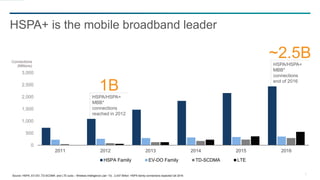
HSPA+ is the mobile broadband leader
0
500
1,000
1,500
2,000
2,500
3,000
2011 2012 2013 2014 2015 2016
HSPA Family EV-DO Family TD-SCDMA LTE
Source: HSPA, EV-DO ,TD-SCDMA and LTE subs – Wireless Intelligence (Jan ‘13) . 2,437 Billion HSPA family connections expected Q4 2016
Connections
(Millions)
1BHSPA/HSPA+
MBB*
connections
reached in 2012
~2.5BHSPA/HSPA+
MBB*
connections
end of 2016
4
Dual-Carrier HSPA+ is the new baseline
5
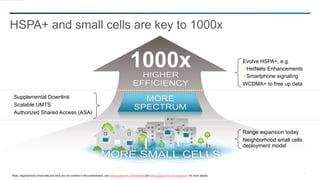
HSPA+ and small cells are key to 1000x
1000x
Note: neighborhood small cells and ASA are not covered in this presentation, see www.qualcomm.com/hetNets and www.qual;comm.com/spectrum for more details.
Range expansion today
Neighborhood small cells
deployment model
Evolve HSPA+, e.g.
HetNets Enhancements
Smartphone signaling
WCDMA+ to free up data
Supplemental Downlink
Scalable UMTS
Authorized Shared Access (ASA)
6
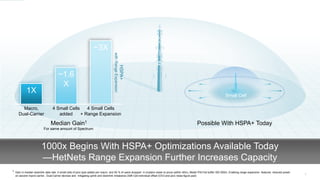
HSPA+
withRangeExpansion
Small Cell
Possible With HSPA+ Today
~3X
4 Small Cells
+ Range Expansion
~1.6
X
4 Small Cells
added
1X
Macro,
Dual-Carrier
Median Gain1
For same amount of Spectrum
1 Gain in median downlink data rate, 4 small cells of pico type added per macro and 50 % of users dropped in clusters closer to picos (within 40m), Model PA3 full buffer ISD 500m. Enabling range expansion features: reduced power
on second macro carrier , Dual-Carrier devices and mitigating uplink and downlink imbalance (3dB Cell-individual offset (CIO) and pico noise-figure pad)
1000x Begins With HSPA+ Optimizations Available Today
—HetNets Range Expansion Further Increases Capacity
7
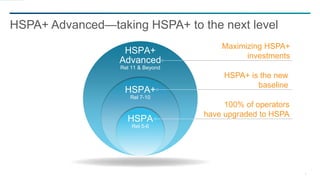
HSPA+ Advanced—taking HSPA+ to the next level
HSPA+
Rel 7-10
HSPA+
Advanced
Rel 11 & Beyond
HSPA
Rel 5-6
Maximizing HSPA+
investments
HSPA+ is the new
baseline
100% of operators
have upgraded to HSPA
8
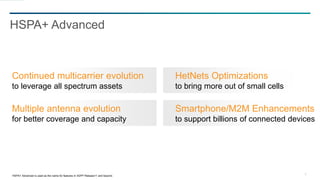
Continued multicarrier evolution
to leverage all spectrum assets
HetNets Optimizations
to bring more out of small cells
Multiple antenna evolution
for better coverage and capacity
Smartphone/M2M Enhancements
to support billions of connected devices
HSPA+ Advanced is used as the name for features in 3GPP Release11 and beyond.
HSPA+ Advanced
9
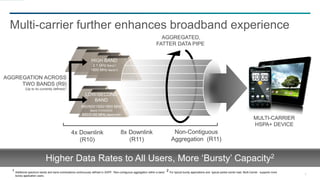
AGGREGATION ACROSS
TWO BANDS (R9)
(Up to 4x currently defined)1
LOW/SECOND
BAND
850/900/1500/1800 MHz
Band V/VIII/XI/III
850/2100 MHz Band V/IV
HIGH BAND
2.1 GHz Band I
1900 MHz Band II
Multi-carrier further enhances broadband experience
1 Additional spectrum bands and band combinations continuously defined in 3GPP. 2Non-contiguous aggregation within a band.
2 For typical bursty applications and typical partial carrier load, Multi-Carrier supports more
bursty application users.
AGGREGATED,
FATTER DATA PIPE
8x Downlink
(R11)
Non-Contiguous
Aggregation (R11)
4x Downlink
(R10)
MULTI-CARRIER
HSPA+ DEVICE
Higher Data Rates to All Users, More ‘Bursty’ Capacity2
10
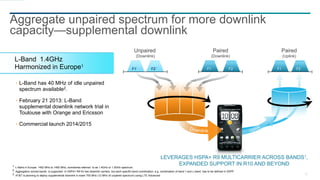
Aggregate unpaired spectrum for more downlink
capacity—supplemental downlink
LEVERAGES HSPA+ R9 MULTICARRIER ACROSS BANDS1,
EXPANDED SUPPORT IN R10 AND BEYOND
F2’ F1 F1F1’ F2 F2
Paired
(Downlink)
Paired
(Uplink)
Unpaired
(Downlink)
L-Band 1.4GHz
Harmonized in Europe1
L-Band has 40 MHz of idle unpaired
spectrum available2.
February 21 2013: L-Band
supplemental downlink network trial in
Toulouse with Orange and Ericsson
Commercial launch 2014/2015
1 L-Band in Europe: 1452 MHz to 1492 MHz, sometimes referred to as 1.4GHz or 1.5GHz spectrum.
2 Aggregation across bands is supported in HSPA+ R9 for two downlink carriers, but each specific band combination, e.g. combination of band 1 and L-band, has to be defined in 3GPP.
3 AT&T is planning to deploy supplemental downlink in lower 700 MHz (12 MHz of unpaired spectrum) using LTE Advanced.
11
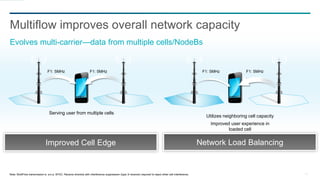
Improved Cell Edge Network Load Balancing
F1: 5MHz F1: 5MHz F1: 5MHz F1: 5MHz
Serving user from multiple cells
Utilizes neighboring cell capacity
Improved user experience in
loaded cell
Multiflow improves overall network capacity
Evolves multi-carrier—data from multiple cells/NodeBs
Note: MultiFlow transmission is a.k.a. SFDC. Receive diversity with interference suppression (type 3i receiver) required to reject other-cell interference.
12
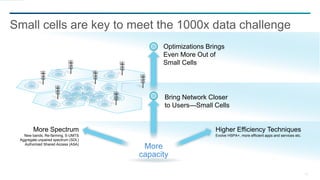
Small cells are key to meet the 1000x data challenge
More
capacity
Bring Network Closer
to Users—Small Cells
Optimizations Brings
Even More Out of
Small Cells
Higher Efficiency Techniques
Evolve HSPA+, more efficient apps and services etc.
More Spectrum
New bands, Re-farming, S-UMTS
Aggregate unpaired spectrum (SDL)
Authorized Shared Access (ASA)
13
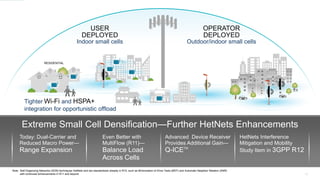
Extreme Small Cell Densification—Further HetNets Enhancements
OPERATOR
DEPLOYED
Outdoor/indoor small cells
USER
DEPLOYED
Indoor small cells
RESIDENTIAL
ENTERPRISE
Tighter Wi-Fi and HSPA+
integration for opportunistic offload
Today: Dual-Carrier and
Reduced Macro Power—
Range Expansion
Advanced Device Receiver
Provides Additional Gain—
Q-ICETM
Even Better with
MultiFlow (R11)—
Balance Load
Across Cells
HetNets Interference
Mitigation and Mobility
Study Item in 3GPP R12
Note: Self-Organizing Networks (SON) techniques HetNets and are standardized already in R10, such as Minimization of Drive Tests (MDT) and Automatic Neighbor Relation (ANR)
with continued enhancements in R11 and beyond
14
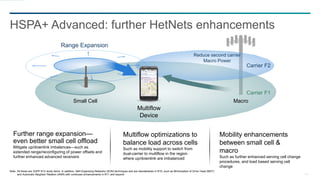
HSPA+ Advanced: further HetNets enhancements
Multiflow optimizations to
balance load across cells
Such as mobility support to switch from
dual-carrier to multiflow in the region
where up/downlink are imbalanced
Further range expansion—
even better small cell offload
Mitigate up/downlink imbalances—such as
extended range/reconfiguring of power offsets and
further enhanced advanced receivers
Mobility enhancements
between small cell &
macro
Such as further enhanced serving cell change
procedures, and load based serving cell
change
MacroSmall Cell
Multiflow
Device
Range Expansion
Reduce second carrier
Macro Power
Carrier F2
Carrier F1
Note: All these are 3GPP R12 study items. In addition, Self-Organizing Networks (SON) techniques and are standardized in R10, such as Minimization of Drive Tests (MDT)
and Automatic Neighbor Relation (ANR) with continued enhancements in R11 and beyond
15
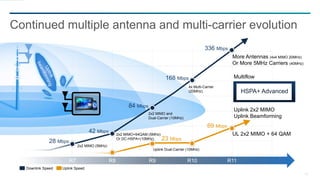
Continued multiple antenna and multi-carrier evolution
28 Mbps
42 Mbps
84 Mbps
2x2 MIMO+64QAM (5MHz)
Or DC-HSPA+(10MHz)
2x2 MIMO (5MHz)
4x Multi-Carrier
(20MHz)
2x2 MIMO and
Dual-Carrier (10MHz)
Uplink 2x2 MIMO
Uplink Beamforming
336 Mbps
HSPA+ Advanced
69 Mbps
UL 2x2 MIMO + 64 QAM
Uplink Dual-Carrier (10MHz)
23 Mbps
168 Mbps
Downlink Speed Uplink Speed
Multiflow
R7 R8 R9 R10 R11
More Antennas (4x4 MIMO 20MHz)
Or More 5MHz Carriers (40MHz)
16
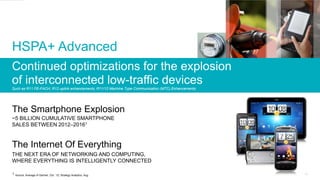
Continued optimizations for the explosion
of interconnected low-traffic devices
Such as R11 FE-FACH, R12 uplink enhancements, R11/12 Machine Type Communication (MTC) Enhancements
The Internet Of Everything
THE NEXT ERA OF NETWORKING AND COMPUTING,
WHERE EVERYTHING IS INTELLIGENTLY CONNECTED
The Smartphone Explosion
~5 BILLION CUMULATIVE SMARTPHONE
SALES BETWEEN 2012–20161
1 Source: Average of Gartner, Oct. ’12; Strategy Analytics, Aug.
HSPA+ Advanced
17
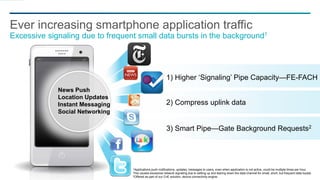
Ever increasing smartphone application traffic
Excessive signaling due to frequent small data bursts in the background1
1Applications push notifications, updates, messages to users, even when application is not active, could be multiple times per hour.
This causes excessive network signaling due to setting up and tearing down the data channel for small, short, but frequent data bursts.
2Offered as part of our CnE solution, device connectivity engine.
1) Higher ‘Signaling’ Pipe Capacity—FE-FACH
2) Compress uplink data
3) Smart Pipe—Gate Background Requests2
Instant Messaging
Location Updates
Social Networking
News Push
18
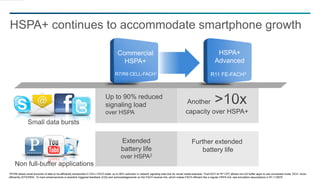
HSPA+ continues to accommodate smartphone growth
1R7/R8 allows small amounts of data to be efficiently transported in CELL-FACH state: up to 90% reduction in network signaling load due for social media example. 2Cell-DCH w/ R7 CPC allows non full buffer apps to use connected mode, DCH, more
efficiently (DTX/DRX). 3A main enhancements is downlink triggered feedback (CQI) and acknowledgements on the FACH reverse link, which makes FACH efficient like a regular HSPA link, see simulation assumptions in R1-112679
HSPA+
Advanced
Commercial
HSPA+
R7/R8 CELL-FACH1
R11 FE-FACH3
Small data bursts
Non full-buffer applications
Up to 90% reduced
signaling load
over HSPA
Another
capacity over HSPA+
Extended
battery life
over HSPA2
Further extended
battery life
19
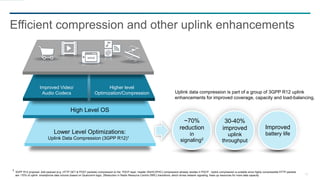
Efficient compression and other uplink enhancements
1 3GPP R12 proposal: Add payload (e.g. HTTP GET & POST packets) compression to the PDCP layer, header (RoHC/IPHC) compression already resides in PDCP. Uplink compression is suitable since highly compressible HTTP packets
are ~70% of uplink smartphone data volume (based on Qualcomm logs). 2Reduction in Radio Resource Control (RRC) transitions, which drives network signaling, frees up resources for more data capacity
Improved
battery lifeLower Level Optimizations:
Uplink Data Compression (3GPP R12)1
High Level OS
30-40%
improved
uplink
throughput
~70%
reduction
in
signaling2
Improved Video/
Audio Codecs
Higher level
Optimization/Compression Uplink data compression is part of a group of 3GPP R12 uplink
enhancements for improved coverage, capacity and load-balancing.
20
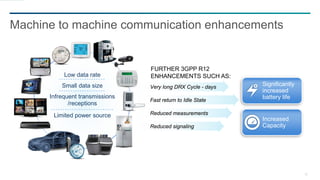
Low data rate
Small data size
Infrequent transmissions
/receptions
Limited power source
Machine to machine communication enhancements
FURTHER 3GPP R12
ENHANCEMENTS SUCH AS:
Very long DRX Cycle - days
Fast return to Idle State
Reduced measurements
Reduced signaling
Increased
Capacity
Significantly
increased
battery life
21
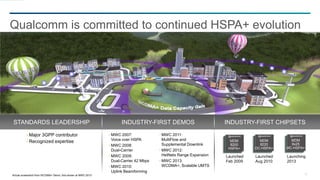
Qualcomm is committed to continued HSPA+ evolution
INDUSTRY-FIRST CHIPSETS
Major 3GPP contributor
Recognized expertise
MWC 2007:
Voice over HSPA
MWC 2008:
Dual-Carrier
MWC 2009:
Dual-Carrier 42 Mbps
MWC 2010:
Uplink Beamforming
INDUSTRY-FIRST DEMOSSTANDARDS LEADERSHIP
MDM
8220
DC-HSPA+
MDM
8200
HSPA+
Launched
Feb 2009
Launched
Aug 2010
MDM
9x25
MC-HSPA+
Launching
2013
Actual screenshot from WCDMA+ Demo, first shown at MWC 2013
MWC 2011:
MultiFlow and
Supplemental Downlink
MWC 2012:
HetNets Range Expansion
MWC 2013:
WCDMA+, Scalable UMTS
22
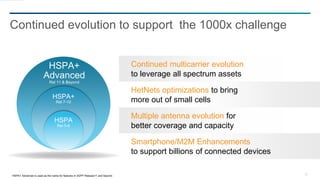
Continued evolution to support the 1000x challenge
HSPA+ Advanced is used as the name for features in 3GPP Release11 and beyond.
HSPA+
Rel 7-10
HSPA+
Advanced
Rel 11 & Beyond
HSPA
Rel 5-6
Continued multicarrier evolution
to leverage all spectrum assets
HetNets optimizations to bring
more out of small cells
Multiple antenna evolution for
better coverage and capacity
Smartphone/M2M Enhancements
to support billions of connected devices
23
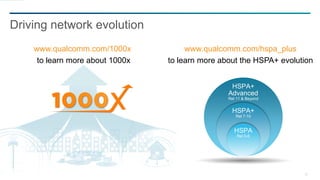
Driving network evolution
www.qualcomm.com/1000x
to learn more about 1000x
www.qualcomm.com/hspa_plus
to learn more about the HSPA+ evolution
HSPA+
Rel 7-10
HSPA+
Advanced
Rel 11 & Beyond
HSPA
Rel 5-6
24
@Qualcomm_tech
http://www.qualcomm.com/blog/contributors/prakash-sangam
http://www.slideshare.net/qualcommwirelessevolution
http://storify.com/qualcomm_tech
http://www.youtube.com/playlist?list=PL8AD95E4F585237C1&feature=plcp
www.qualcomm.com/technology
Questions? - Connect with Us
BLOG
25
For more information on Qualcomm, visit us at:
www.qualcomm.com & www.qualcomm.com/blog
Qualcomm is a trademark of Qualcomm Incorporated, registered in the United States and other
countries.
Other products and brand names may be trademarks or registered trademarks of their respective
owners
Thank you
Follow us on:

Hspa advanced-taking-hspa-to-the-next-level

  • 1.
    1 HSPA+ Advanced HSPA+ enhancementsin 3GPP R11 and beyond May 2013
  • 2.
    2 2013 2014 20152016+2013 2014 2015 2016+ HSPA+ continues to evolve Note: Estimated commercial dates. Rel-11Rel-10Rel-9Rel-8Rel-7 DL: 84 -168 Mbps2 UL: 23 Mbps2 DL: 28 Mbps UL: 11 Mbps DL: 42 Mbps1 UL: 11 Mbps DL: 14.4 Mbps UL: 5.7 Mbps DL: 336+ Mbps4 UL: 69+ Mbps4 1R8 reaches 42 Mbps by combining 2x2 MIMO and HOM (64QAM) in 5 MHz, or by utilizing HOM (64QAM) and multicarrier in 10 MHz. 2R9 combines multicarrier and MIMO in 10 MHz to reach 84 Mbps. Uplink multicarrier doubles uplink peak data rate to 23 Mbps in 10 MHz. 3R10 expands multicarrier to 20 MHz to reach up to168 Mbps with 2x2 MIMO. 4R11 expands multicarrier up to 40 MHz to reach 336 Mbps with 2x2 MIMO, or 20Mhz with 4x4 MIMO. Uplink 2x2 MIMO with 64QAM reaches 69Mbps. Rel-12 & Beyond Rel-12 Created 4/16/2013 10 MHz Dual-Carrier Up to 4x/20MHz Multi-Carrier Dual-Carrier Across Bands Uplink DC MultiFlow Up to 8x Multi-Carrier Higher Order Modulation & MIMO HSPA+ HetNets&UL Enh. WCDMA+, S-UMTS HSPA+ AdvancedHSPA+HSPA WCDMA High Quality, Reliable, Ubiquitous Voice HSPA+ WCDMA+ Frees up resources for HSPA+ data Commercial
  • 3.
    3 HSPA+ is themobile broadband leader 0 500 1,000 1,500 2,000 2,500 3,000 2011 2012 2013 2014 2015 2016 HSPA Family EV-DO Family TD-SCDMA LTE Source: HSPA, EV-DO ,TD-SCDMA and LTE subs – Wireless Intelligence (Jan ‘13) . 2,437 Billion HSPA family connections expected Q4 2016 Connections (Millions) 1BHSPA/HSPA+ MBB* connections reached in 2012 ~2.5BHSPA/HSPA+ MBB* connections end of 2016
  • 4.
    4 Dual-Carrier HSPA+ isthe new baseline
  • 5.
    5 HSPA+ and smallcells are key to 1000x 1000x Note: neighborhood small cells and ASA are not covered in this presentation, see www.qualcomm.com/hetNets and www.qual;comm.com/spectrum for more details. Range expansion today Neighborhood small cells deployment model Evolve HSPA+, e.g. HetNets Enhancements Smartphone signaling WCDMA+ to free up data Supplemental Downlink Scalable UMTS Authorized Shared Access (ASA)
  • 6.
    6 HSPA+ withRangeExpansion Small Cell Possible WithHSPA+ Today ~3X 4 Small Cells + Range Expansion ~1.6 X 4 Small Cells added 1X Macro, Dual-Carrier Median Gain1 For same amount of Spectrum 1 Gain in median downlink data rate, 4 small cells of pico type added per macro and 50 % of users dropped in clusters closer to picos (within 40m), Model PA3 full buffer ISD 500m. Enabling range expansion features: reduced power on second macro carrier , Dual-Carrier devices and mitigating uplink and downlink imbalance (3dB Cell-individual offset (CIO) and pico noise-figure pad) 1000x Begins With HSPA+ Optimizations Available Today —HetNets Range Expansion Further Increases Capacity
  • 7.
    7 HSPA+ Advanced—taking HSPA+to the next level HSPA+ Rel 7-10 HSPA+ Advanced Rel 11 & Beyond HSPA Rel 5-6 Maximizing HSPA+ investments HSPA+ is the new baseline 100% of operators have upgraded to HSPA
  • 8.
    8 Continued multicarrier evolution toleverage all spectrum assets HetNets Optimizations to bring more out of small cells Multiple antenna evolution for better coverage and capacity Smartphone/M2M Enhancements to support billions of connected devices HSPA+ Advanced is used as the name for features in 3GPP Release11 and beyond. HSPA+ Advanced
  • 9.
    9 AGGREGATION ACROSS TWO BANDS(R9) (Up to 4x currently defined)1 LOW/SECOND BAND 850/900/1500/1800 MHz Band V/VIII/XI/III 850/2100 MHz Band V/IV HIGH BAND 2.1 GHz Band I 1900 MHz Band II Multi-carrier further enhances broadband experience 1 Additional spectrum bands and band combinations continuously defined in 3GPP. 2Non-contiguous aggregation within a band. 2 For typical bursty applications and typical partial carrier load, Multi-Carrier supports more bursty application users. AGGREGATED, FATTER DATA PIPE 8x Downlink (R11) Non-Contiguous Aggregation (R11) 4x Downlink (R10) MULTI-CARRIER HSPA+ DEVICE Higher Data Rates to All Users, More ‘Bursty’ Capacity2
  • 10.
    10 Aggregate unpaired spectrumfor more downlink capacity—supplemental downlink LEVERAGES HSPA+ R9 MULTICARRIER ACROSS BANDS1, EXPANDED SUPPORT IN R10 AND BEYOND F2’ F1 F1F1’ F2 F2 Paired (Downlink) Paired (Uplink) Unpaired (Downlink) L-Band 1.4GHz Harmonized in Europe1 L-Band has 40 MHz of idle unpaired spectrum available2. February 21 2013: L-Band supplemental downlink network trial in Toulouse with Orange and Ericsson Commercial launch 2014/2015 1 L-Band in Europe: 1452 MHz to 1492 MHz, sometimes referred to as 1.4GHz or 1.5GHz spectrum. 2 Aggregation across bands is supported in HSPA+ R9 for two downlink carriers, but each specific band combination, e.g. combination of band 1 and L-band, has to be defined in 3GPP. 3 AT&T is planning to deploy supplemental downlink in lower 700 MHz (12 MHz of unpaired spectrum) using LTE Advanced.
  • 11.
    11 Improved Cell EdgeNetwork Load Balancing F1: 5MHz F1: 5MHz F1: 5MHz F1: 5MHz Serving user from multiple cells Utilizes neighboring cell capacity Improved user experience in loaded cell Multiflow improves overall network capacity Evolves multi-carrier—data from multiple cells/NodeBs Note: MultiFlow transmission is a.k.a. SFDC. Receive diversity with interference suppression (type 3i receiver) required to reject other-cell interference.
  • 12.
    12 Small cells arekey to meet the 1000x data challenge More capacity Bring Network Closer to Users—Small Cells Optimizations Brings Even More Out of Small Cells Higher Efficiency Techniques Evolve HSPA+, more efficient apps and services etc. More Spectrum New bands, Re-farming, S-UMTS Aggregate unpaired spectrum (SDL) Authorized Shared Access (ASA)
  • 13.
    13 Extreme Small CellDensification—Further HetNets Enhancements OPERATOR DEPLOYED Outdoor/indoor small cells USER DEPLOYED Indoor small cells RESIDENTIAL ENTERPRISE Tighter Wi-Fi and HSPA+ integration for opportunistic offload Today: Dual-Carrier and Reduced Macro Power— Range Expansion Advanced Device Receiver Provides Additional Gain— Q-ICETM Even Better with MultiFlow (R11)— Balance Load Across Cells HetNets Interference Mitigation and Mobility Study Item in 3GPP R12 Note: Self-Organizing Networks (SON) techniques HetNets and are standardized already in R10, such as Minimization of Drive Tests (MDT) and Automatic Neighbor Relation (ANR) with continued enhancements in R11 and beyond
  • 14.
    14 HSPA+ Advanced: furtherHetNets enhancements Multiflow optimizations to balance load across cells Such as mobility support to switch from dual-carrier to multiflow in the region where up/downlink are imbalanced Further range expansion— even better small cell offload Mitigate up/downlink imbalances—such as extended range/reconfiguring of power offsets and further enhanced advanced receivers Mobility enhancements between small cell & macro Such as further enhanced serving cell change procedures, and load based serving cell change MacroSmall Cell Multiflow Device Range Expansion Reduce second carrier Macro Power Carrier F2 Carrier F1 Note: All these are 3GPP R12 study items. In addition, Self-Organizing Networks (SON) techniques and are standardized in R10, such as Minimization of Drive Tests (MDT) and Automatic Neighbor Relation (ANR) with continued enhancements in R11 and beyond
  • 15.
    15 Continued multiple antennaand multi-carrier evolution 28 Mbps 42 Mbps 84 Mbps 2x2 MIMO+64QAM (5MHz) Or DC-HSPA+(10MHz) 2x2 MIMO (5MHz) 4x Multi-Carrier (20MHz) 2x2 MIMO and Dual-Carrier (10MHz) Uplink 2x2 MIMO Uplink Beamforming 336 Mbps HSPA+ Advanced 69 Mbps UL 2x2 MIMO + 64 QAM Uplink Dual-Carrier (10MHz) 23 Mbps 168 Mbps Downlink Speed Uplink Speed Multiflow R7 R8 R9 R10 R11 More Antennas (4x4 MIMO 20MHz) Or More 5MHz Carriers (40MHz)
  • 16.
    16 Continued optimizations forthe explosion of interconnected low-traffic devices Such as R11 FE-FACH, R12 uplink enhancements, R11/12 Machine Type Communication (MTC) Enhancements The Internet Of Everything THE NEXT ERA OF NETWORKING AND COMPUTING, WHERE EVERYTHING IS INTELLIGENTLY CONNECTED The Smartphone Explosion ~5 BILLION CUMULATIVE SMARTPHONE SALES BETWEEN 2012–20161 1 Source: Average of Gartner, Oct. ’12; Strategy Analytics, Aug. HSPA+ Advanced
  • 17.
    17 Ever increasing smartphoneapplication traffic Excessive signaling due to frequent small data bursts in the background1 1Applications push notifications, updates, messages to users, even when application is not active, could be multiple times per hour. This causes excessive network signaling due to setting up and tearing down the data channel for small, short, but frequent data bursts. 2Offered as part of our CnE solution, device connectivity engine. 1) Higher ‘Signaling’ Pipe Capacity—FE-FACH 2) Compress uplink data 3) Smart Pipe—Gate Background Requests2 Instant Messaging Location Updates Social Networking News Push
  • 18.
    18 HSPA+ continues toaccommodate smartphone growth 1R7/R8 allows small amounts of data to be efficiently transported in CELL-FACH state: up to 90% reduction in network signaling load due for social media example. 2Cell-DCH w/ R7 CPC allows non full buffer apps to use connected mode, DCH, more efficiently (DTX/DRX). 3A main enhancements is downlink triggered feedback (CQI) and acknowledgements on the FACH reverse link, which makes FACH efficient like a regular HSPA link, see simulation assumptions in R1-112679 HSPA+ Advanced Commercial HSPA+ R7/R8 CELL-FACH1 R11 FE-FACH3 Small data bursts Non full-buffer applications Up to 90% reduced signaling load over HSPA Another capacity over HSPA+ Extended battery life over HSPA2 Further extended battery life
  • 19.
    19 Efficient compression andother uplink enhancements 1 3GPP R12 proposal: Add payload (e.g. HTTP GET & POST packets) compression to the PDCP layer, header (RoHC/IPHC) compression already resides in PDCP. Uplink compression is suitable since highly compressible HTTP packets are ~70% of uplink smartphone data volume (based on Qualcomm logs). 2Reduction in Radio Resource Control (RRC) transitions, which drives network signaling, frees up resources for more data capacity Improved battery lifeLower Level Optimizations: Uplink Data Compression (3GPP R12)1 High Level OS 30-40% improved uplink throughput ~70% reduction in signaling2 Improved Video/ Audio Codecs Higher level Optimization/Compression Uplink data compression is part of a group of 3GPP R12 uplink enhancements for improved coverage, capacity and load-balancing.
  • 20.
    20 Low data rate Smalldata size Infrequent transmissions /receptions Limited power source Machine to machine communication enhancements FURTHER 3GPP R12 ENHANCEMENTS SUCH AS: Very long DRX Cycle - days Fast return to Idle State Reduced measurements Reduced signaling Increased Capacity Significantly increased battery life
  • 21.
    21 Qualcomm is committedto continued HSPA+ evolution INDUSTRY-FIRST CHIPSETS Major 3GPP contributor Recognized expertise MWC 2007: Voice over HSPA MWC 2008: Dual-Carrier MWC 2009: Dual-Carrier 42 Mbps MWC 2010: Uplink Beamforming INDUSTRY-FIRST DEMOSSTANDARDS LEADERSHIP MDM 8220 DC-HSPA+ MDM 8200 HSPA+ Launched Feb 2009 Launched Aug 2010 MDM 9x25 MC-HSPA+ Launching 2013 Actual screenshot from WCDMA+ Demo, first shown at MWC 2013 MWC 2011: MultiFlow and Supplemental Downlink MWC 2012: HetNets Range Expansion MWC 2013: WCDMA+, Scalable UMTS
  • 22.
    22 Continued evolution tosupport the 1000x challenge HSPA+ Advanced is used as the name for features in 3GPP Release11 and beyond. HSPA+ Rel 7-10 HSPA+ Advanced Rel 11 & Beyond HSPA Rel 5-6 Continued multicarrier evolution to leverage all spectrum assets HetNets optimizations to bring more out of small cells Multiple antenna evolution for better coverage and capacity Smartphone/M2M Enhancements to support billions of connected devices
  • 23.
    23 Driving network evolution www.qualcomm.com/1000x tolearn more about 1000x www.qualcomm.com/hspa_plus to learn more about the HSPA+ evolution HSPA+ Rel 7-10 HSPA+ Advanced Rel 11 & Beyond HSPA Rel 5-6
  • 24.
  • 25.
    25 For more informationon Qualcomm, visit us at: www.qualcomm.com & www.qualcomm.com/blog Qualcomm is a trademark of Qualcomm Incorporated, registered in the United States and other countries. Other products and brand names may be trademarks or registered trademarks of their respective owners Thank you Follow us on: