SAFETY IN TEXTILE
SECTOR
SAFETY IN TEXTILE
SECTOR
Presented By:
Institute Of Quality &
Technology Management
Punjab University
Institution / University
CONTENTS:
 Introduction
 Textile Manufacturing Process-
Overview
 Work Environment in Textile
Industry & Associated Hazards
 Hazards associated with Key
Textile processes
 Textile Hazards , Consequences
& Control Measures
 Conclusion
Presented By: Contents:
1.Sabeena Irfan-
364
INTRODUCTION:
o Textile is a term that comes from “texere” which is a Latin word, that
means “to weave". A cloth, especially one manufactured by weaving or

knitting; a fabric.
o Texitile industry is the mechanical facility that converts filament,
fibre or yarn that can be made into fablic or cloth and the resulting
material.
 Approximately 60 million workers are employed in the textile industry
globally and the figure for Pakistan is 15 million
 The number of industries working in this sector is estimated to
be around 670. Out of 670 units, about 400 are member of
the all Pakistan Textile Mills Association (APTMA)
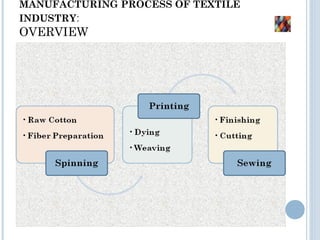
MANUFACTURING PROCESS OF TEXTILE
INDUSTRY:
OVERVIEW
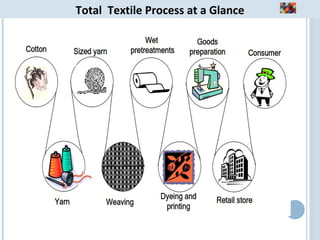
Total Textile Process at a Glance
MANUFACTURING PROCESS OF TEXTILE
INDUSTRY:
Spinning:
Process by which fibers are
converted into yarn.
Weaving:
The process of interlacing at least
two yarns at right angles to form
a fabric. Cloth Is Usually Woven
On a Loom,
Dying:
Process for imparting & applying
color to cotton
Printing:
Production of design or motif on a
substrate
Finishing:
A process physical/chemical
applied to a substrate to produce
a desired effect.
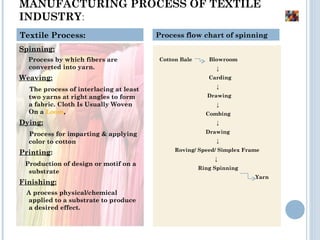
Cotton Bale Blowroom
↓
Carding
↓
Drawing
↓
Combing
↓
Drawing
↓
Roving/ Speed/ Simplex Frame
↓
Ring Spinning
Yarn
Textile Process: Process flow chart of spinning
THE WORK ENVIRONMENT IN TEXTILE INDUSTRY
& ASSOCIATED HAZARDS:
 The work environment in the textile mills is hamful due to
noise, dust, and exposure to chemicals. Chemicals generate
liquid waste containing substantial pollutants in the form of
organic and suspended matter, such as fibres and grease
(UNEP, 1991).
 Field works have shown that, in most countries in
production stage, noise levels are beyond the legal limit of
85dB.
 Workers in the textile industry are exposed to airborne dust
containing infectious, allergic and toxic substances.
Presented By: Contents:
2.Hafsa Mateen-
3100
HAZARDS ASSOCIATED WITH TEXITILE
INDUSTRY.
 Hazard is any substance or agent that can cause
potential health effect.
 During textile processing the workers are exposed to
various hazards and risks
 Textile Hazards are classified into:
1. Chemical 3.Ergonomic
2. Physical 4. Biological
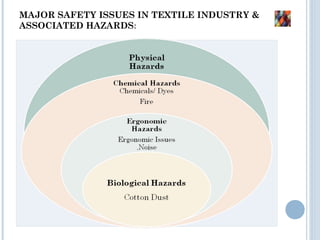
MAJOR SAFETY ISSUES IN TEXTILE INDUSTRY &
ASSOCIATED HAZARDS:
KEY TEXTILE PROCESSES AND
HAZARDS INVOLVED
  HAZARDS P R O C E S S
Preparation
of yarn
Spinning Knitting Finishing Packaging.
Chemical N N Y Y Y
Physical Y Y Y Y Y
Ergonomics Y Y Y Y Y
Psychosocial Y Y Y Y Y
Biological Y Y Y Y Y
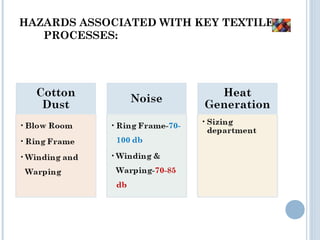
HAZARDS ASSOCIATED WITH KEY TEXTILE
PROCESSES:
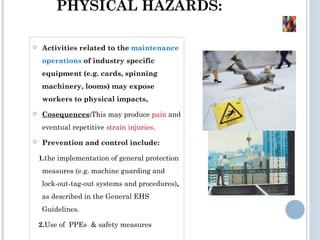
PHYSICAL HAZARDS:
 Activities related to the maintenance
operations of industry specific
equipment (e.g. cards, spinning
machinery, looms) may expose
workers to physical impacts,
 Cosequences:This may produce pain and
eventual repetitive strain injuries.
 Prevention and control include:
1.the implementation of general protection
measures (e.g. machine guarding and
lock-out-tag-out systems and procedures),
as described in the General EHS
Guidelines.
2.Use of PPEs & safety measures
Presented By: Contents:
3.Shakeela Mushtaq-
324
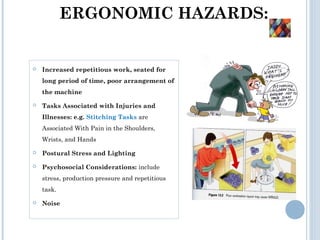
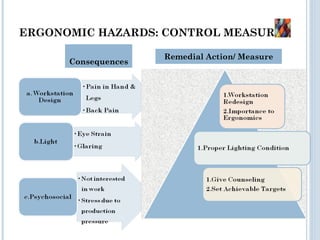
ERGONOMIC HAZARDS:
 Increased repetitious work, seated for
long period of time, poor arrangement of
the machine
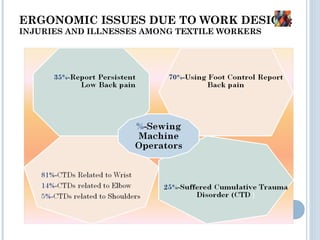
 Tasks Associated with Injuries and
Illnesses: e.g. Stitching Tasks are
Associated With Pain in the Shoulders,
Wrists, and Hands
 Postural Stress and Lighting
 Psychosocial Considerations: include
stress, production pressure and repetitious
task.
 Noise
ERGONOMIC ISSUES DUE TO WORK DESIGN:
INJURIES AND ILLNESSES AMONG TEXTILE WORKERS
ERGONOMIC HAZARDS: CONTROL MEASURES
Consequences
Remedial Action/ Measure
Presented By: Contents:
4.Hafsa Mateen-
3100
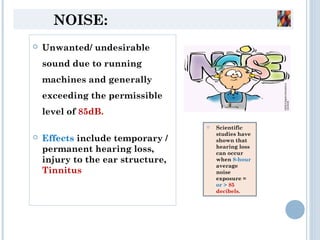
NOISE:
 Unwanted/ undesirable
sound due to running
machines and generally
exceeding the permissible
level of 85dB.
 Effects include temporary /
permanent hearing loss,
injury to the ear structure,
Tinnitus
 Scientific
studies have
shown that
hearing loss
can occur
when 8-hour
average
noise
exposure =
or > 85
decibels.
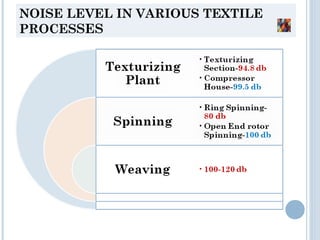
NOISE LEVEL IN VARIOUS TEXTILE
PROCESSES
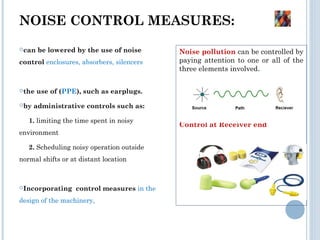
NOISE CONTROL MEASURES:
can be lowered by the use of noise
control enclosures, absorbers, silencers
the use of (PPE), such as earplugs.
by administrative controls such as:
1. limiting the time spent in noisy
environment
2. Scheduling noisy operation outside
normal shifts or at distant location
Incorporating control measures in the
design of the machinery,
Noise pollution can be controlled by
paying attention to one or all of the
three elements involved.
Control at Receiver end
Presented By: Contents:
5.Sadia Butt-355
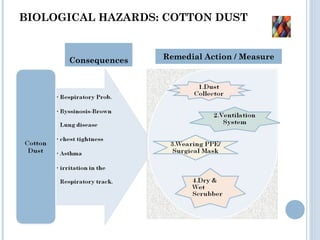
BIOLOGICAL HAZARDS: COTTON DUST
 Biohazard means those
infective agents presenting a
risk of death, injury or illness
to workers
 Byssinosis, commonly known
as Brown Lung, is caused
among textile workers due to
excessive exposure to cotton
dust.
 The symptoms include
tightening of the chest,
coughing, asthma,
respiratory problems.
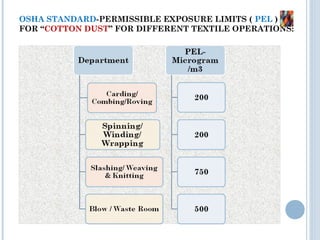
 For an 8-hour day work,
OSHA Standard has specified
PEL for “Cotton Dust”
OSHA STANDARD-PERMISSIBLE EXPOSURE LIMITS ( PEL )
FOR “COTTON DUST” FOR DIFFERENT TEXTILE OPERATIONS:
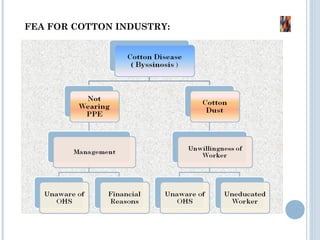
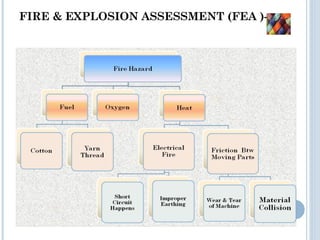
FEA FOR COTTON INDUSTRY:
BIOLOGICAL HAZARDS: COTTON DUST
Consequences Remedial Action / Measure
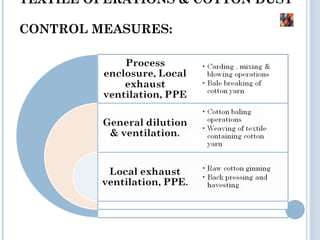
TEXTILE OPERATIONS & COTTON DUST
CONTROL MEASURES:
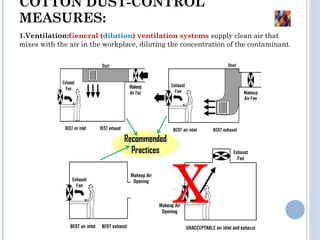
COTTON DUST-CONTROL
MEASURES:
1.Ventilation:General (dilution) ventilation systems supply clean air that
mixes with the air in the workplace, diluting the concentration of the contaminant.
COTTON DUST-CONTROL MEASURES:
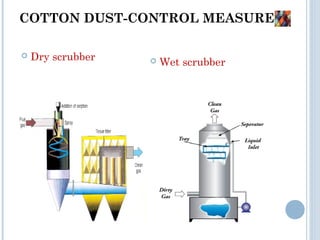
2.Using Scrubbers:
The Scrubber is one of the most common pollution
control device used by industries.
There are two types of Scrubbers: Wet
Scrubbers & Dry Scrubbers.
The only difference is in case of Dry Scrubbers
‘End Product’ is in solid form while in case of Wet
Scrubbers it is found in liquid form.
COTTON DUST-CONTROL MEASURES:
 Dry scrubber  Wet scrubber
Presented By: Contents:
6.Amina Khan-376
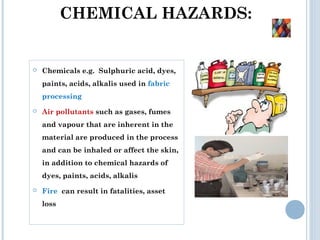
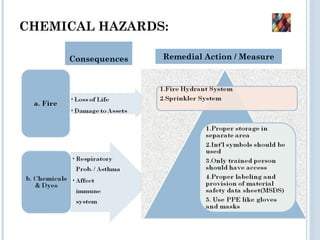
CHEMICAL HAZARDS:
 Chemicals e.g. Sulphuric acid, dyes,
paints, acids, alkalis used in fabric
processing
 Air pollutants such as gases, fumes
and vapour that are inherent in the
material are produced in the process
and can be inhaled or affect the skin,
in addition to chemical hazards of
dyes, paints, acids, alkalis
 Fire can result in fatalities, asset
loss
FIRE & EXPLOSION ASSESSMENT (FEA )-
CHEMICAL HAZARDS:
Consequences Remedial Action / Measure
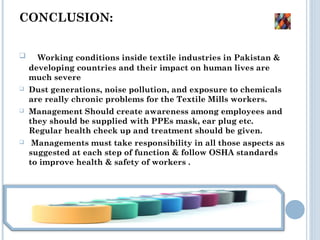
CONCLUSION: 
 Working conditions inside textile industries in Pakistan &
developing countries and their impact on human lives are
much severe
 Dust generations, noise pollution, and exposure to chemicals
are really chronic problems for the Textile Mills workers.
 Management Should create awareness among employees and
they should be supplied with PPEs mask, ear plug etc.
Regular health check up and treatment should be given.
 Managements must take responsibility in all those aspects as
suggested at each step of function & follow OSHA standards
to improve health & safety of workers .
Health and Safety Issues in textile sector

Health and Safety Issues in textile sector

  • 2.
  • 3.
    Presented By: Institute OfQuality & Technology Management Punjab University Institution / University
  • 4.
    CONTENTS:  Introduction  TextileManufacturing Process- Overview  Work Environment in Textile Industry & Associated Hazards  Hazards associated with Key Textile processes  Textile Hazards , Consequences & Control Measures  Conclusion
  • 5.
  • 6.
    INTRODUCTION: o Textile isa term that comes from “texere” which is a Latin word, that means “to weave". A cloth, especially one manufactured by weaving or knitting; a fabric. o Texitile industry is the mechanical facility that converts filament, fibre or yarn that can be made into fablic or cloth and the resulting material.  Approximately 60 million workers are employed in the textile industry globally and the figure for Pakistan is 15 million  The number of industries working in this sector is estimated to be around 670. Out of 670 units, about 400 are member of the all Pakistan Textile Mills Association (APTMA)
  • 7.
    MANUFACTURING PROCESS OFTEXTILE INDUSTRY: OVERVIEW
  • 8.
  • 9.
    MANUFACTURING PROCESS OFTEXTILE INDUSTRY: Spinning: Process by which fibers are converted into yarn. Weaving: The process of interlacing at least two yarns at right angles to form a fabric. Cloth Is Usually Woven On a Loom, Dying: Process for imparting & applying color to cotton Printing: Production of design or motif on a substrate Finishing: A process physical/chemical applied to a substrate to produce a desired effect. Cotton Bale Blowroom ↓ Carding ↓ Drawing ↓ Combing ↓ Drawing ↓ Roving/ Speed/ Simplex Frame ↓ Ring Spinning Yarn Textile Process: Process flow chart of spinning
  • 10.
    THE WORK ENVIRONMENTIN TEXTILE INDUSTRY & ASSOCIATED HAZARDS:  The work environment in the textile mills is hamful due to noise, dust, and exposure to chemicals. Chemicals generate liquid waste containing substantial pollutants in the form of organic and suspended matter, such as fibres and grease (UNEP, 1991).  Field works have shown that, in most countries in production stage, noise levels are beyond the legal limit of 85dB.  Workers in the textile industry are exposed to airborne dust containing infectious, allergic and toxic substances.
  • 11.
  • 12.
    HAZARDS ASSOCIATED WITHTEXITILE INDUSTRY.  Hazard is any substance or agent that can cause potential health effect.  During textile processing the workers are exposed to various hazards and risks  Textile Hazards are classified into: 1. Chemical 3.Ergonomic 2. Physical 4. Biological
  • 13.
    MAJOR SAFETY ISSUESIN TEXTILE INDUSTRY & ASSOCIATED HAZARDS:
  • 14.
    KEY TEXTILE PROCESSESAND HAZARDS INVOLVED   HAZARDS P R O C E S S Preparation of yarn Spinning Knitting Finishing Packaging. Chemical N N Y Y Y Physical Y Y Y Y Y Ergonomics Y Y Y Y Y Psychosocial Y Y Y Y Y Biological Y Y Y Y Y
  • 15.
    HAZARDS ASSOCIATED WITHKEY TEXTILE PROCESSES:
  • 16.
    PHYSICAL HAZARDS:  Activitiesrelated to the maintenance operations of industry specific equipment (e.g. cards, spinning machinery, looms) may expose workers to physical impacts,  Cosequences:This may produce pain and eventual repetitive strain injuries.  Prevention and control include: 1.the implementation of general protection measures (e.g. machine guarding and lock-out-tag-out systems and procedures), as described in the General EHS Guidelines. 2.Use of PPEs & safety measures
  • 17.
  • 18.
    ERGONOMIC HAZARDS:  Increasedrepetitious work, seated for long period of time, poor arrangement of the machine  Tasks Associated with Injuries and Illnesses: e.g. Stitching Tasks are Associated With Pain in the Shoulders, Wrists, and Hands  Postural Stress and Lighting  Psychosocial Considerations: include stress, production pressure and repetitious task.  Noise
  • 19.
    ERGONOMIC ISSUES DUETO WORK DESIGN: INJURIES AND ILLNESSES AMONG TEXTILE WORKERS
  • 20.
    ERGONOMIC HAZARDS: CONTROLMEASURES Consequences Remedial Action/ Measure
  • 21.
  • 22.
    NOISE:  Unwanted/ undesirable sounddue to running machines and generally exceeding the permissible level of 85dB.  Effects include temporary / permanent hearing loss, injury to the ear structure, Tinnitus  Scientific studies have shown that hearing loss can occur when 8-hour average noise exposure = or > 85 decibels.
  • 23.
    NOISE LEVEL INVARIOUS TEXTILE PROCESSES
  • 24.
    NOISE CONTROL MEASURES: canbe lowered by the use of noise control enclosures, absorbers, silencers the use of (PPE), such as earplugs. by administrative controls such as: 1. limiting the time spent in noisy environment 2. Scheduling noisy operation outside normal shifts or at distant location Incorporating control measures in the design of the machinery, Noise pollution can be controlled by paying attention to one or all of the three elements involved. Control at Receiver end
  • 25.
  • 26.
    BIOLOGICAL HAZARDS: COTTONDUST  Biohazard means those infective agents presenting a risk of death, injury or illness to workers  Byssinosis, commonly known as Brown Lung, is caused among textile workers due to excessive exposure to cotton dust.  The symptoms include tightening of the chest, coughing, asthma, respiratory problems.  For an 8-hour day work, OSHA Standard has specified PEL for “Cotton Dust”
  • 27.
    OSHA STANDARD-PERMISSIBLE EXPOSURELIMITS ( PEL ) FOR “COTTON DUST” FOR DIFFERENT TEXTILE OPERATIONS:
  • 28.
    FEA FOR COTTONINDUSTRY:
  • 29.
    BIOLOGICAL HAZARDS: COTTONDUST Consequences Remedial Action / Measure
  • 30.
    TEXTILE OPERATIONS &COTTON DUST CONTROL MEASURES:
  • 31.
    COTTON DUST-CONTROL MEASURES: 1.Ventilation:General (dilution)ventilation systems supply clean air that mixes with the air in the workplace, diluting the concentration of the contaminant.
  • 32.
    COTTON DUST-CONTROL MEASURES: 2.UsingScrubbers: The Scrubber is one of the most common pollution control device used by industries. There are two types of Scrubbers: Wet Scrubbers & Dry Scrubbers. The only difference is in case of Dry Scrubbers ‘End Product’ is in solid form while in case of Wet Scrubbers it is found in liquid form.
  • 33.
    COTTON DUST-CONTROL MEASURES: Dry scrubber  Wet scrubber
  • 34.
  • 35.
    CHEMICAL HAZARDS:  Chemicalse.g. Sulphuric acid, dyes, paints, acids, alkalis used in fabric processing  Air pollutants such as gases, fumes and vapour that are inherent in the material are produced in the process and can be inhaled or affect the skin, in addition to chemical hazards of dyes, paints, acids, alkalis  Fire can result in fatalities, asset loss
  • 36.
    FIRE & EXPLOSIONASSESSMENT (FEA )-
  • 37.
  • 38.
    CONCLUSION:   Working conditionsinside textile industries in Pakistan & developing countries and their impact on human lives are much severe  Dust generations, noise pollution, and exposure to chemicals are really chronic problems for the Textile Mills workers.  Management Should create awareness among employees and they should be supplied with PPEs mask, ear plug etc. Regular health check up and treatment should be given.  Managements must take responsibility in all those aspects as suggested at each step of function & follow OSHA standards to improve health & safety of workers .