1
SADIA WAZIR
ROLL # 25
BOILER
2
INTRODUCTION
Boiler is a closed vessel in which the heat produced by
the combustion of fuel is transferred to water for its
conversion into steam at the desired temperature and
pressure.
3
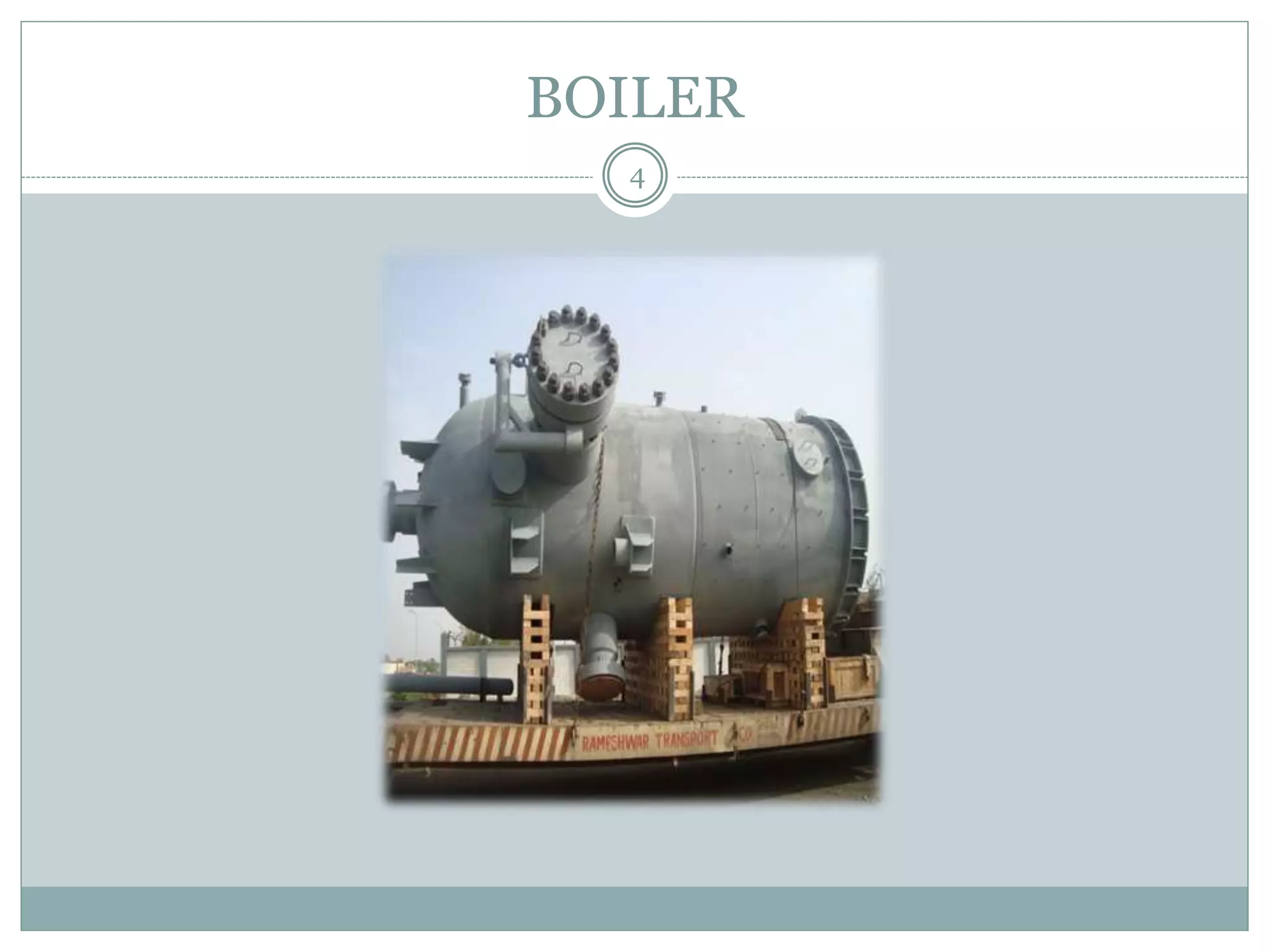
BOILER
4
Why we use boiler ?
5
 A boiler is a device used for generating:
a) Steam for power generation
b) Hot water for heating purpose
PRIMARY REQUIREMENT OF BOILER
 The primary requirements of steam generators or
boilers are:
a) The water must be contained safely
b) The steam must be delivered safely in desired
conditions as regards its pressure, temperature, quality
and required rate
6
FACTORS AFFECTING THE CHOICE OF
BOILER
The selection of type and size of a steam boiler depends upon
the following factors:
 The power required and the working pressure
 Geographical position of the plant
 Availability of fuel
 Supply and quality of feed water
 The probable load factor
 Space available
 Labor available
 Steam pressure and superheat desired
7
CLASSIFICATION
The Boilers may be classified as under:
 Horizontal boiler, vertical or inclined boilers
 Fire tube and water tube boilers
 Externally fired and internally fired boilers
 Forced circulation and natural circulation boilers
 High, medium and low pressure boilers
 Stationary boiler and portable boiler
 Single tube boilers and multi tube boilers
8
BOILER ACCESSORIES
Feed pump
Injector
Economizer
Air pre-heater
Superheated
Steam separator
9
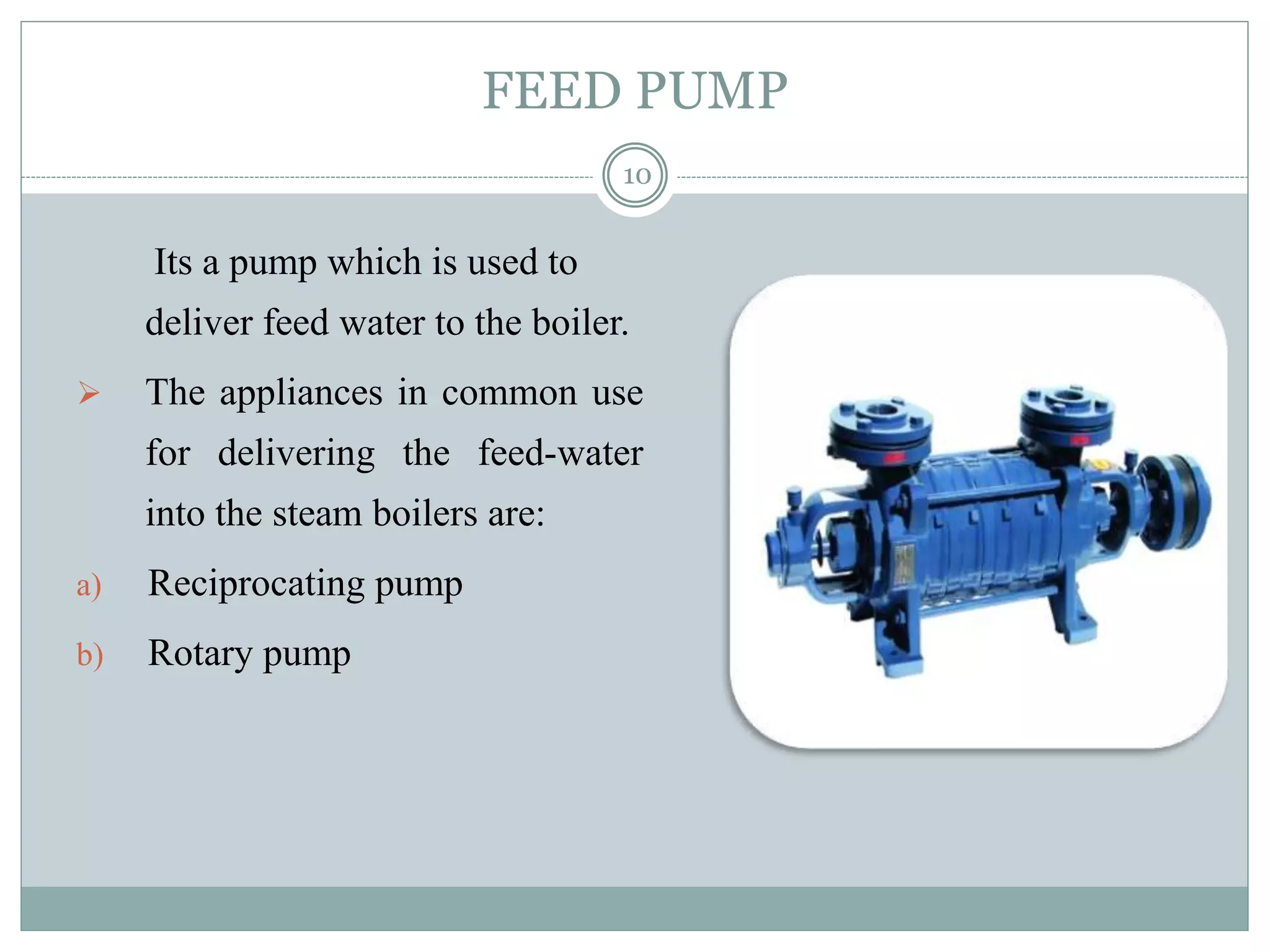
FEED PUMP
Its a pump which is used to
deliver feed water to the boiler.
 The appliances in common use
for delivering the feed-water
into the steam boilers are:
a) Reciprocating pump
b) Rotary pump
10
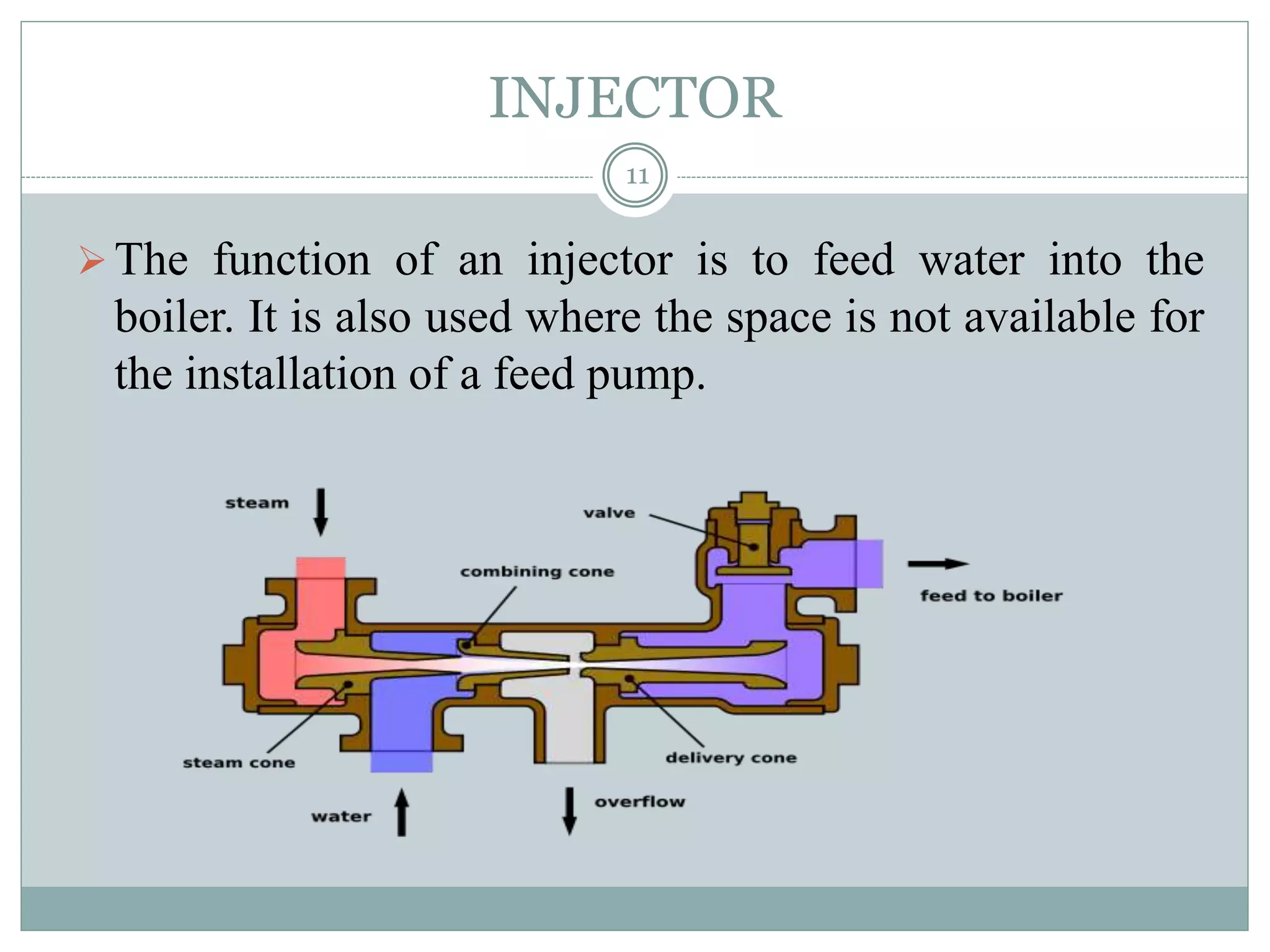
INJECTOR
The function of an injector is to feed water into the
boiler. It is also used where the space is not available for
the installation of a feed pump.
11
ECONOMISER
 An economizer is a device in which the waste heat of the
flue gases is utilized for heating the feed water.
 Economizer are of two types :
 Independent type, and
 Integral type
12
AIR PREHEATER
The function of the air pre-heater is to increase the
temperature of air before it enters the furnace.
It is generally placed after the economizer.
13
CLASSIFICATION
14
HORIZONTAL, VERTICAL OR INCLINED BOILER
 If the axis of the boiler is horizontal, the boiler is called
horizontal if the axis is vertical, it is called vertical boiler
and if the axis is inclined it is called as inclined boiler.
 The parts of horizontal boiler is can be inspected and
repaired easily but it occupies more space. The vertical
boiler occupies less floor area.
15
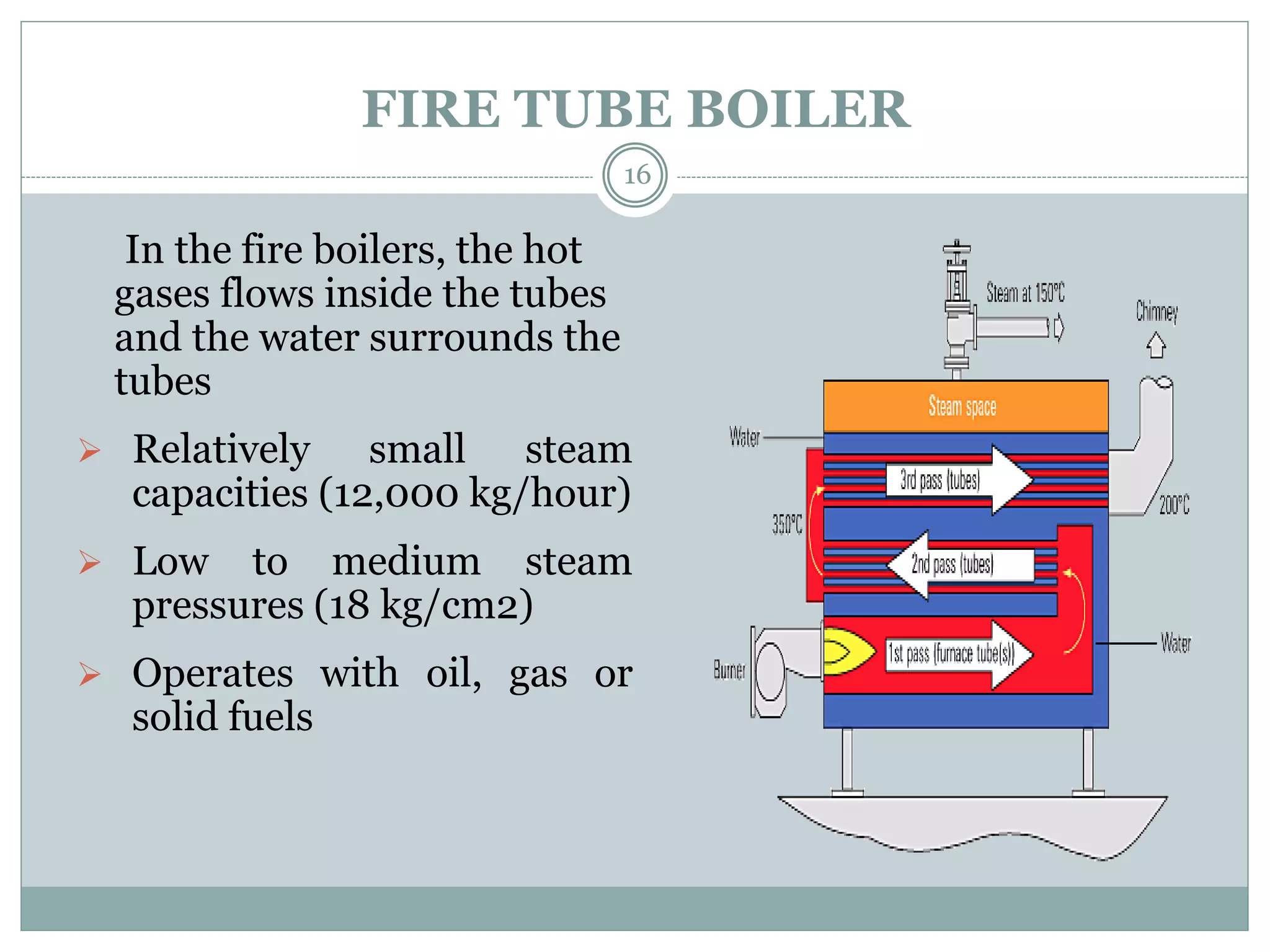
FIRE TUBE BOILER
In the fire boilers, the hot
gases flows inside the tubes
and the water surrounds the
tubes
 Relatively small steam
capacities (12,000 kg/hour)
 Low to medium steam
pressures (18 kg/cm2)
 Operates with oil, gas or
solid fuels
16
ADVANTAGES
17
 Fire tube boiler is so easy to use, operate, clean and
maintain
Fire tube boiler can be used in small scale industries.
Fire tube boiler is relatively cheaper than water tube
boiler.
A fire tube boiler costs 25 to 40 percent less than a
comparatively sized water tube boiler.
DIS ADVANTAGES
18
The fire tube boiler can not produce steam at a
pressure higher than 250 pounds per square inch.
Capacity of generated steam is limited. Fire tube
boilers are limited to approximately 2,500 HP, or
about 86,000 lb/hr.
Steam quality less as compared to WTB
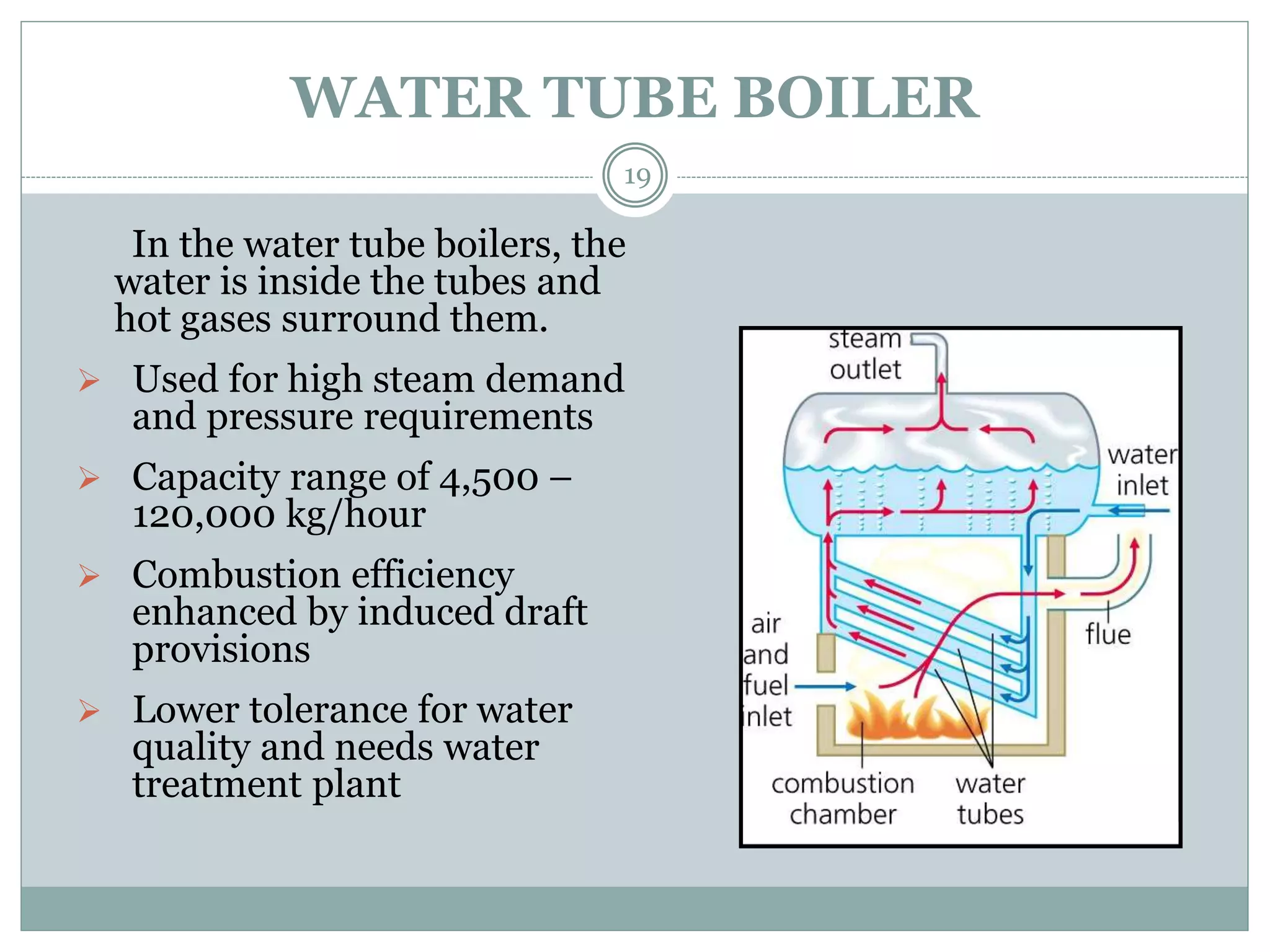
WATER TUBE BOILER
In the water tube boilers, the
water is inside the tubes and
hot gases surround them.
 Used for high steam demand
and pressure requirements
 Capacity range of 4,500 –
120,000 kg/hour
 Combustion efficiency
enhanced by induced draft
provisions
 Lower tolerance for water
quality and needs water
treatment plant
19
ADVANTAGES
20
 To operate boiler at a high capacity, the water tube
packaged boiler is best.
 Water tube boiler packages are designed to handle larger
capacities, up to approximately 650,000 lb/hr, which is
equivalent to about 19,000 HP.
 A water tube boiler also is superior for high temperature
and steam pressure.
 It can operate at pressures up to 1,500 psi.
 For large-capacity loads, large design pressure
requirements, tracking rapid load swings or extreme
horsepower needs, the water tube boiler essentially is the
only choice.
EXTERNALLY FIRED AND INTERNALLY FIRED
 The boiler is known as externally fired if the fire
is outside the shell.
 In case of internally fired boilers, the furnace is
located inside the shell.
22
FORCED CIRCULATION AND NATURAL CIRCULATION
In forced circulation type of boilers, the circulation
of water is done by forced pump.
In natural circulation type of boilers, circulation of
water in the boiler takes place due to natural
convention currents produced by the application of
heat.
23
HIGHER PRESSURE AND LOW PRESSURE
BOILERS
 The boiler which produce steam at pressures of 80
bar and above are called high pressure boilers.
 The boilers which produce steam at pressure below
80 bar are called low pressure boilers.
24
STATIONARY AND PORTABLE
Primarily, the boilers are classified as either
stationary or mobile.
Stationary boilers are used for power plant steam,
for central station utility power plants, for plant
process steam etc.
Mobile boilers or portable boilers include
locomotive type, and other small units for
temporary use at sites.
25
SINGLE TUBE AND MULTI TUBE BOILER
THE fire tube boilers are classified as single tube and
multi-tube boilers, depending upon whether the fire
tube is one or more than one.
26
27
MIANTENANCE
1. Boiler Performance
2. Boiler blow down
3. Boiler feed water treatment
ASSESSMENT OF BOILER
28
BOILER PERFORMANCE
• Causes Of Poor Boiler Performance
- Poor combustion
- Heat transfer surface fouling
- Poor operation and maintenance
- Deteriorating fuel and water quality
• Heat Balance : Identify heat losses
• Boiler Efficiency: Determine deviation from best
efficiency
29
BOILER BLOW DOWN
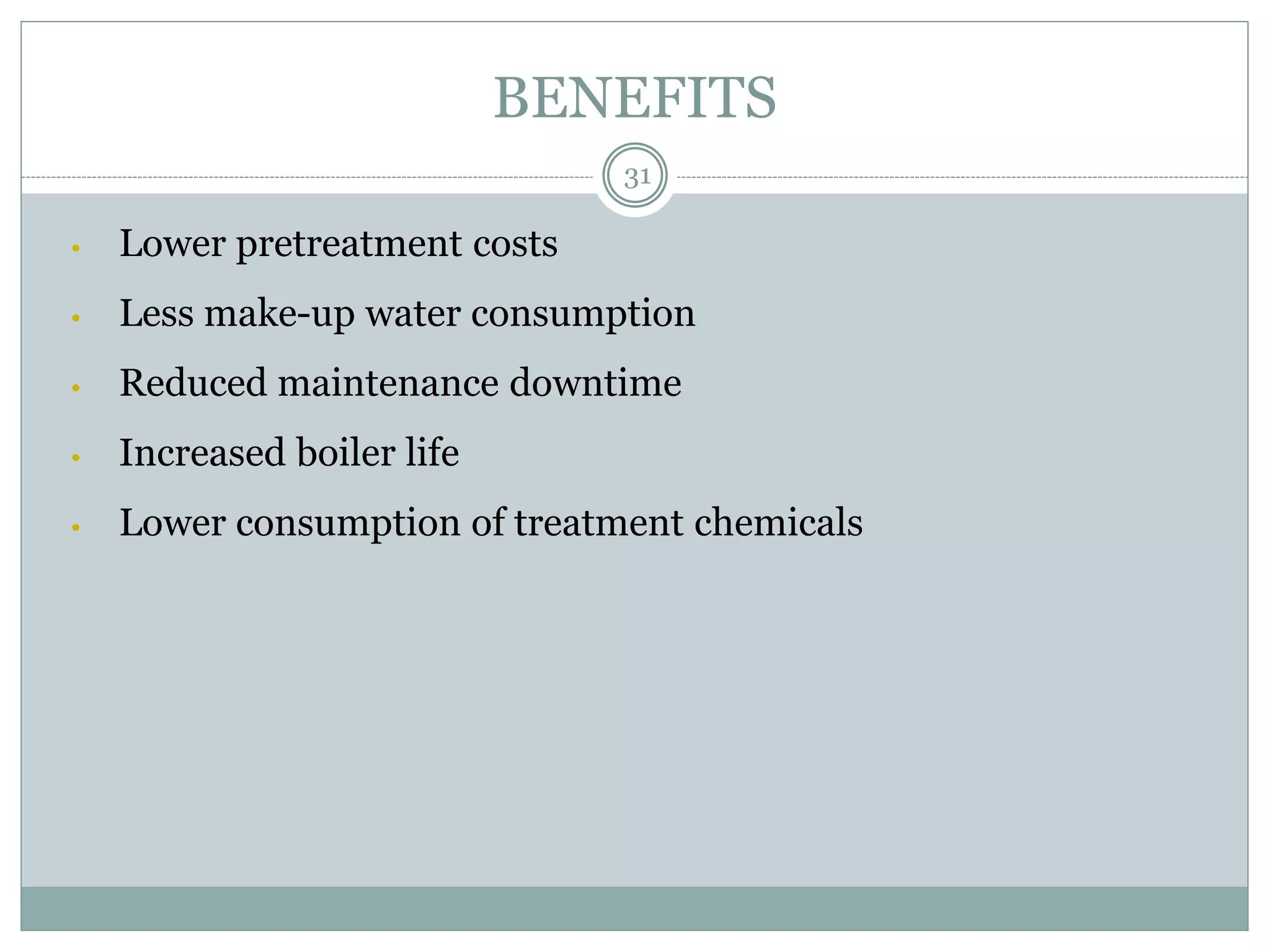
• Controls ‘total dissolved solids’ (TDS) in the water
that is boiled
• Blows off water and replaces it with feed water
• Conductivity measured as indication of TDS levels
• Calculation of quantity blow down required:
Feed water TDS x % Make up water
Maximum Permissible TDS in Boiler water
30
BENEFITS
• Lower pretreatment costs
• Less make-up water consumption
• Reduced maintenance downtime
• Increased boiler life
• Lower consumption of treatment chemicals
31
Boiler Feed Water Treatment
 Quality of steam depend on water treatment to
control
 Steam purity
 Deposits
 Corrosion
 Efficient heat transfer only if boiler water is free
from deposit-forming solids
32
33

Boiler, utility

  • 1.
  • 2.
    SADIA WAZIR ROLL #25 BOILER 2
  • 3.
    INTRODUCTION Boiler is aclosed vessel in which the heat produced by the combustion of fuel is transferred to water for its conversion into steam at the desired temperature and pressure. 3
  • 4.
  • 5.
    Why we useboiler ? 5  A boiler is a device used for generating: a) Steam for power generation b) Hot water for heating purpose
  • 6.
    PRIMARY REQUIREMENT OFBOILER  The primary requirements of steam generators or boilers are: a) The water must be contained safely b) The steam must be delivered safely in desired conditions as regards its pressure, temperature, quality and required rate 6
  • 7.
    FACTORS AFFECTING THECHOICE OF BOILER The selection of type and size of a steam boiler depends upon the following factors:  The power required and the working pressure  Geographical position of the plant  Availability of fuel  Supply and quality of feed water  The probable load factor  Space available  Labor available  Steam pressure and superheat desired 7
  • 8.
    CLASSIFICATION The Boilers maybe classified as under:  Horizontal boiler, vertical or inclined boilers  Fire tube and water tube boilers  Externally fired and internally fired boilers  Forced circulation and natural circulation boilers  High, medium and low pressure boilers  Stationary boiler and portable boiler  Single tube boilers and multi tube boilers 8
  • 9.
    BOILER ACCESSORIES Feed pump Injector Economizer Airpre-heater Superheated Steam separator 9
  • 10.
    FEED PUMP Its apump which is used to deliver feed water to the boiler.  The appliances in common use for delivering the feed-water into the steam boilers are: a) Reciprocating pump b) Rotary pump 10
  • 11.
    INJECTOR The function ofan injector is to feed water into the boiler. It is also used where the space is not available for the installation of a feed pump. 11
  • 12.
    ECONOMISER  An economizeris a device in which the waste heat of the flue gases is utilized for heating the feed water.  Economizer are of two types :  Independent type, and  Integral type 12
  • 13.
    AIR PREHEATER The functionof the air pre-heater is to increase the temperature of air before it enters the furnace. It is generally placed after the economizer. 13
  • 14.
  • 15.
    HORIZONTAL, VERTICAL ORINCLINED BOILER  If the axis of the boiler is horizontal, the boiler is called horizontal if the axis is vertical, it is called vertical boiler and if the axis is inclined it is called as inclined boiler.  The parts of horizontal boiler is can be inspected and repaired easily but it occupies more space. The vertical boiler occupies less floor area. 15
  • 16.
    FIRE TUBE BOILER Inthe fire boilers, the hot gases flows inside the tubes and the water surrounds the tubes  Relatively small steam capacities (12,000 kg/hour)  Low to medium steam pressures (18 kg/cm2)  Operates with oil, gas or solid fuels 16
  • 17.
    ADVANTAGES 17  Fire tubeboiler is so easy to use, operate, clean and maintain Fire tube boiler can be used in small scale industries. Fire tube boiler is relatively cheaper than water tube boiler. A fire tube boiler costs 25 to 40 percent less than a comparatively sized water tube boiler.
  • 18.
    DIS ADVANTAGES 18 The firetube boiler can not produce steam at a pressure higher than 250 pounds per square inch. Capacity of generated steam is limited. Fire tube boilers are limited to approximately 2,500 HP, or about 86,000 lb/hr. Steam quality less as compared to WTB
  • 19.
    WATER TUBE BOILER Inthe water tube boilers, the water is inside the tubes and hot gases surround them.  Used for high steam demand and pressure requirements  Capacity range of 4,500 – 120,000 kg/hour  Combustion efficiency enhanced by induced draft provisions  Lower tolerance for water quality and needs water treatment plant 19
  • 20.
    ADVANTAGES 20  To operateboiler at a high capacity, the water tube packaged boiler is best.  Water tube boiler packages are designed to handle larger capacities, up to approximately 650,000 lb/hr, which is equivalent to about 19,000 HP.  A water tube boiler also is superior for high temperature and steam pressure.  It can operate at pressures up to 1,500 psi.  For large-capacity loads, large design pressure requirements, tracking rapid load swings or extreme horsepower needs, the water tube boiler essentially is the only choice.
  • 21.
    EXTERNALLY FIRED ANDINTERNALLY FIRED  The boiler is known as externally fired if the fire is outside the shell.  In case of internally fired boilers, the furnace is located inside the shell. 22
  • 22.
    FORCED CIRCULATION ANDNATURAL CIRCULATION In forced circulation type of boilers, the circulation of water is done by forced pump. In natural circulation type of boilers, circulation of water in the boiler takes place due to natural convention currents produced by the application of heat. 23
  • 23.
    HIGHER PRESSURE ANDLOW PRESSURE BOILERS  The boiler which produce steam at pressures of 80 bar and above are called high pressure boilers.  The boilers which produce steam at pressure below 80 bar are called low pressure boilers. 24
  • 24.
    STATIONARY AND PORTABLE Primarily,the boilers are classified as either stationary or mobile. Stationary boilers are used for power plant steam, for central station utility power plants, for plant process steam etc. Mobile boilers or portable boilers include locomotive type, and other small units for temporary use at sites. 25
  • 25.
    SINGLE TUBE ANDMULTI TUBE BOILER THE fire tube boilers are classified as single tube and multi-tube boilers, depending upon whether the fire tube is one or more than one. 26
  • 26.
  • 27.
    1. Boiler Performance 2.Boiler blow down 3. Boiler feed water treatment ASSESSMENT OF BOILER 28
  • 28.
    BOILER PERFORMANCE • CausesOf Poor Boiler Performance - Poor combustion - Heat transfer surface fouling - Poor operation and maintenance - Deteriorating fuel and water quality • Heat Balance : Identify heat losses • Boiler Efficiency: Determine deviation from best efficiency 29
  • 29.
    BOILER BLOW DOWN •Controls ‘total dissolved solids’ (TDS) in the water that is boiled • Blows off water and replaces it with feed water • Conductivity measured as indication of TDS levels • Calculation of quantity blow down required: Feed water TDS x % Make up water Maximum Permissible TDS in Boiler water 30
  • 30.
    BENEFITS • Lower pretreatmentcosts • Less make-up water consumption • Reduced maintenance downtime • Increased boiler life • Lower consumption of treatment chemicals 31
  • 31.
    Boiler Feed WaterTreatment  Quality of steam depend on water treatment to control  Steam purity  Deposits  Corrosion  Efficient heat transfer only if boiler water is free from deposit-forming solids 32
  • 32.