MOTIVATION CSH Pharma Group
Motivation The act or process of stimulating to action, providing an incentive or motive, especially for an act.
What Motivates you?
What Motivates Employees to Stay Career growth, learning,  development Exciting work – challenge Meaningful work Great people Part of a team Good boss Recognition Fun Autonomy
Flexibility Fair pay & benefits Inspiring leadership Pride organization/mission/product  quality Work environment Location Job security Family-friendly employer Cutting edge technology
Theories of motivation
Theories of motivation fall into three  categories: Classical theory & scientific  management Behavior theory Contemporary motivation theories
Classical Theory of Motivation Oldest theory of motivation (early 20th  century)  –  asserts that workers are motivated only by money   •  suggested that employees would work harder if they  were paid more they were paid more –  and firms that found the most efficient methods of and  firms that found the most efficient methods of production would do better than others  –  this became known as scientific management –  led to a multitude of “time and motion ” studies to discover the optimal way to perform a task
Behaviour Theory •  says that ANY attention paid to  employees increases productivity   –  productivity goes up if employees think  management is paying attention!  •  experimental studies found that:  –  increasing/decreasing lighting had same effect  –  changing pay did not improve productivity
Contemporary Motivation Theories •  contemporary essentially means “modern” •  these theories focus on importance of  good human relations in motivating  employees  •  several modern theories have  arisen  HR model: Theory X and Theory Y  Maslow’s Hierarchy of Needs  two-factor theory  expectancy theory  equity theory  goal setting theory
Human Resources Model  McGregor studied managers’  attitudes   toward human resources   –  discovered two broad types of attitudes  Summarized them as  –  Theory X :  people do not want to work and need  incentives to do so  •  implies employees are basically lazy  –  Theory Y  :  hypothesizes that people are self-motivated  and want to succeed  •  says people do not need to be forced to excel
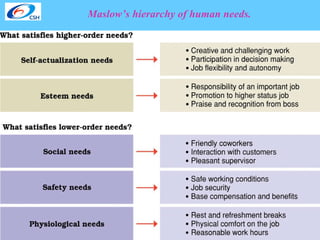
Maslow’s Hierarchy of Needs Model •  says people have several levels of needs   –  physiological –  security  –  social  –  esteem  –  self-actualization •  Maslow  said workers are motivated by their lowest level of  unattained needs  –  e.g. once someone’s physiological needs are satisfied, they are motivated  by their security needs
Maslow’s hierarchy of human needs.
•  suggests that job satisfaction depends  on two factors •  hygiene factors hygiene relate to working  conditions  –  good working conditions ensure that no  dissatisfaction exists  •  motivating factors motivating relate to  recognition, achievement, and responsibility   –  motivating factors enhance employee  satisfaction  Two-Factor Theory
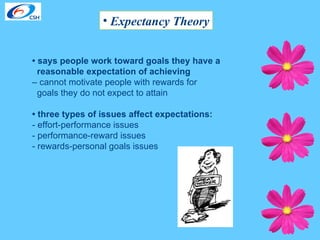
Expectancy Theory •  says people work toward goals they have a  reasonable expectation of achieving –  cannot motivate people with rewards for  goals they do not expect to attain  •  three types of issues affect expectations:  - effort-performance issues - performance-reward issues - rewards-personal goals issues
Equity Theory •  focuses on the concept of “ fairness” •  employees look at how they are treated  on two fronts: –  inputs vs. outputs: am I getting as much out of  this job as I put into it?  –  am I getting as much out of my job as those who perform similar tasks for this firm?  •  employees who see themselves as being treated unfairly often act to “tip the scales”
Goal Setting Theory •  strives to discover the types of goals  that best motivate employees  •  two characteristics of effective goals:   –  they are difficult but attainable  –  they are specific: a quantifiable target is  set  •  e.g. “increase output by 10% ” rather than rather than “do  your best” •  goals are most effective if employees have  a hand in defining them
Enhancing Job Satisfaction & Morale •  have to have to use knowledge about motivation –  what can agribusinesses do to keep morale high &  keep employees satisfied?  •  6 types of programs are commonly used: –  reinforcement/ behaviour modification –  management by objectives  –  participative management  –  team management  –  job enrichment & job redesign  –  modified work schedules
•  involves a system of rewards and  punishments to elicit desired behaviour •  reinforcement is associating specific  outcomes with specific outcomes with specific  behaviours  –  can be can be “positive positive” or “negative  negative” •  firms can also punish employees for improper or  undesirable behaviour Modification Theory Reinforcement/Behaviour
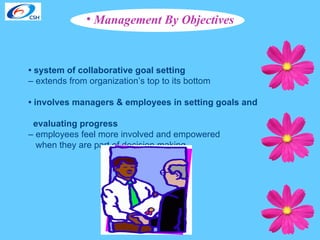
•  system of collaborative goal setting –  extends from organization’s top to its bottom •  involves managers & employees in setting goals and  evaluating progress  –  employees feel more involved and empowered  when they are part of decision making Management By Objectives
Participative Management •  management philosophy whereby workers  have a voice in management of the firm –  help define their own jobs  –  participate in traditional management  decisions  •  this can be a key method for empowering  workers   –  helps them feel more important to the firm
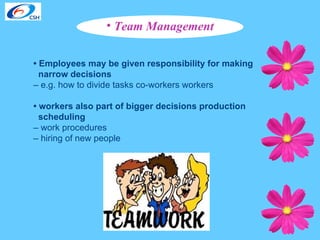
Team Management •  Employees may be given responsibility for making  narrow decisions   –  e.g. how to divide tasks co-workers workers •  workers also part of bigger decisions production  scheduling   –  work procedures  –  hiring of new people
Job Enrichment & Job Redesign  •  job enrichment adds motivating factors to existing job activities   –  e.g. provide more responsibility or decision  making authority  •  job redesign allows employees to reshape some  of their duties to provide a better   “ fit” –  three common ways to do this:   •  combining tasks  •  forming natural workgroups  •  establishing client relationships
Modified Work Schedules •  many firms allow flexible work schedules to  accommodate a changing workforce 4 main types of modified work schedules: –  flextime  –  compressed workweek  –  telecommuting  –  work share  programs  •  modified work schedules help employees  balance their personal & professional lives
Great Motivators •  Full appreciation for job well done •  Be part of decisions •  Open communications •  Interesting & meaningful work •  Good relationships at work
Appreciate the Employee •  Stress the positives •  Say “Thank You!” •  Praise workers for going the extra mile •  Reward Employees – “You get what you reward”  •  Train-Train-Train
Include In Decisions •  Ask how you can use more of their talents •  Ask what they would change •  Ask for their ideas and how you can put the ideas into action
Communicate! •  Tell them exactly what you want – Then let them do it! •  How can I help you succeed? •  Discuss organization and individual goals – Ask about their goals •  Share information – Let them know what is happening •  Refuse to gossip
Meaningful Work  •  75% of employees think they have a direct impact on organization’s success •  Tell them how their job is important •  Cross-train
Good Relationships At Work •  Get to know your employees •  Be sure everyone shares information •  Apply the same standards to everyone •  Continually stress equal, fair treatment for all •  Celebrate! – Have fun!
Guidelines
Emphasize successes – not failure Deliver recognition/reward openly and publicize it Tailor recognition to needs of individual Immediate recognition Be honest and personal when you recognize  performance Ensure direct connection between reward and effort Recognize those who recognize others
Rewards •  Monetary – raise/bonus (merit/one time merit) •  Administrative time off •  Office party/brunch/luncheon •  Certificates/mementos •  Training opportunities
AND . . . Don’t Forget •  Mentor employees •  Coach employees •  Discuss performance throughout the year
 

Motivation

  • 1.
  • 2.
    Motivation The actor process of stimulating to action, providing an incentive or motive, especially for an act.
  • 3.
  • 4.
    What Motivates Employeesto Stay Career growth, learning, development Exciting work – challenge Meaningful work Great people Part of a team Good boss Recognition Fun Autonomy
  • 5.
    Flexibility Fair pay& benefits Inspiring leadership Pride organization/mission/product quality Work environment Location Job security Family-friendly employer Cutting edge technology
  • 6.
  • 7.
    Theories of motivationfall into three categories: Classical theory & scientific management Behavior theory Contemporary motivation theories
  • 8.
    Classical Theory ofMotivation Oldest theory of motivation (early 20th century) – asserts that workers are motivated only by money • suggested that employees would work harder if they were paid more they were paid more – and firms that found the most efficient methods of and firms that found the most efficient methods of production would do better than others – this became known as scientific management – led to a multitude of “time and motion ” studies to discover the optimal way to perform a task
  • 9.
    Behaviour Theory • says that ANY attention paid to employees increases productivity – productivity goes up if employees think management is paying attention! • experimental studies found that: – increasing/decreasing lighting had same effect – changing pay did not improve productivity
  • 10.
    Contemporary Motivation Theories• contemporary essentially means “modern” • these theories focus on importance of good human relations in motivating employees • several modern theories have arisen HR model: Theory X and Theory Y Maslow’s Hierarchy of Needs two-factor theory expectancy theory equity theory goal setting theory
  • 11.
    Human Resources Model McGregor studied managers’ attitudes toward human resources – discovered two broad types of attitudes Summarized them as – Theory X : people do not want to work and need incentives to do so • implies employees are basically lazy – Theory Y : hypothesizes that people are self-motivated and want to succeed • says people do not need to be forced to excel
  • 12.
    Maslow’s Hierarchy ofNeeds Model • says people have several levels of needs – physiological – security – social – esteem – self-actualization • Maslow said workers are motivated by their lowest level of unattained needs – e.g. once someone’s physiological needs are satisfied, they are motivated by their security needs
  • 13.
  • 14.
    • suggeststhat job satisfaction depends on two factors • hygiene factors hygiene relate to working conditions – good working conditions ensure that no dissatisfaction exists • motivating factors motivating relate to recognition, achievement, and responsibility – motivating factors enhance employee satisfaction Two-Factor Theory
  • 15.
    Expectancy Theory • says people work toward goals they have a reasonable expectation of achieving – cannot motivate people with rewards for goals they do not expect to attain • three types of issues affect expectations: - effort-performance issues - performance-reward issues - rewards-personal goals issues
  • 16.
    Equity Theory • focuses on the concept of “ fairness” • employees look at how they are treated on two fronts: – inputs vs. outputs: am I getting as much out of this job as I put into it? – am I getting as much out of my job as those who perform similar tasks for this firm? • employees who see themselves as being treated unfairly often act to “tip the scales”
  • 17.
    Goal Setting Theory• strives to discover the types of goals that best motivate employees • two characteristics of effective goals: – they are difficult but attainable – they are specific: a quantifiable target is set • e.g. “increase output by 10% ” rather than rather than “do your best” • goals are most effective if employees have a hand in defining them
  • 18.
    Enhancing Job Satisfaction& Morale • have to have to use knowledge about motivation – what can agribusinesses do to keep morale high & keep employees satisfied? • 6 types of programs are commonly used: – reinforcement/ behaviour modification – management by objectives – participative management – team management – job enrichment & job redesign – modified work schedules
  • 19.
    • involvesa system of rewards and punishments to elicit desired behaviour • reinforcement is associating specific outcomes with specific outcomes with specific behaviours – can be can be “positive positive” or “negative negative” • firms can also punish employees for improper or undesirable behaviour Modification Theory Reinforcement/Behaviour
  • 20.
    • systemof collaborative goal setting – extends from organization’s top to its bottom • involves managers & employees in setting goals and evaluating progress – employees feel more involved and empowered when they are part of decision making Management By Objectives
  • 21.
    Participative Management • management philosophy whereby workers have a voice in management of the firm – help define their own jobs – participate in traditional management decisions • this can be a key method for empowering workers – helps them feel more important to the firm
  • 22.
    Team Management • Employees may be given responsibility for making narrow decisions – e.g. how to divide tasks co-workers workers • workers also part of bigger decisions production scheduling – work procedures – hiring of new people
  • 23.
    Job Enrichment &Job Redesign • job enrichment adds motivating factors to existing job activities – e.g. provide more responsibility or decision making authority • job redesign allows employees to reshape some of their duties to provide a better “ fit” – three common ways to do this: • combining tasks • forming natural workgroups • establishing client relationships
  • 24.
    Modified Work Schedules• many firms allow flexible work schedules to accommodate a changing workforce 4 main types of modified work schedules: – flextime – compressed workweek – telecommuting – work share programs • modified work schedules help employees balance their personal & professional lives
  • 25.
    Great Motivators • Full appreciation for job well done • Be part of decisions • Open communications • Interesting & meaningful work • Good relationships at work
  • 26.
    Appreciate the Employee• Stress the positives • Say “Thank You!” • Praise workers for going the extra mile • Reward Employees – “You get what you reward” • Train-Train-Train
  • 27.
    Include In Decisions• Ask how you can use more of their talents • Ask what they would change • Ask for their ideas and how you can put the ideas into action
  • 28.
    Communicate! • Tell them exactly what you want – Then let them do it! • How can I help you succeed? • Discuss organization and individual goals – Ask about their goals • Share information – Let them know what is happening • Refuse to gossip
  • 29.
    Meaningful Work • 75% of employees think they have a direct impact on organization’s success • Tell them how their job is important • Cross-train
  • 30.
    Good Relationships AtWork • Get to know your employees • Be sure everyone shares information • Apply the same standards to everyone • Continually stress equal, fair treatment for all • Celebrate! – Have fun!
  • 31.
  • 32.
    Emphasize successes –not failure Deliver recognition/reward openly and publicize it Tailor recognition to needs of individual Immediate recognition Be honest and personal when you recognize performance Ensure direct connection between reward and effort Recognize those who recognize others
  • 33.
    Rewards • Monetary – raise/bonus (merit/one time merit) • Administrative time off • Office party/brunch/luncheon • Certificates/mementos • Training opportunities
  • 34.
    AND . .. Don’t Forget • Mentor employees • Coach employees • Discuss performance throughout the year
  • 35.