Ready to be a Successful Agile Product Manager?
Anupam Kundu
www.Agiledossier.com / Twitter: mydibba
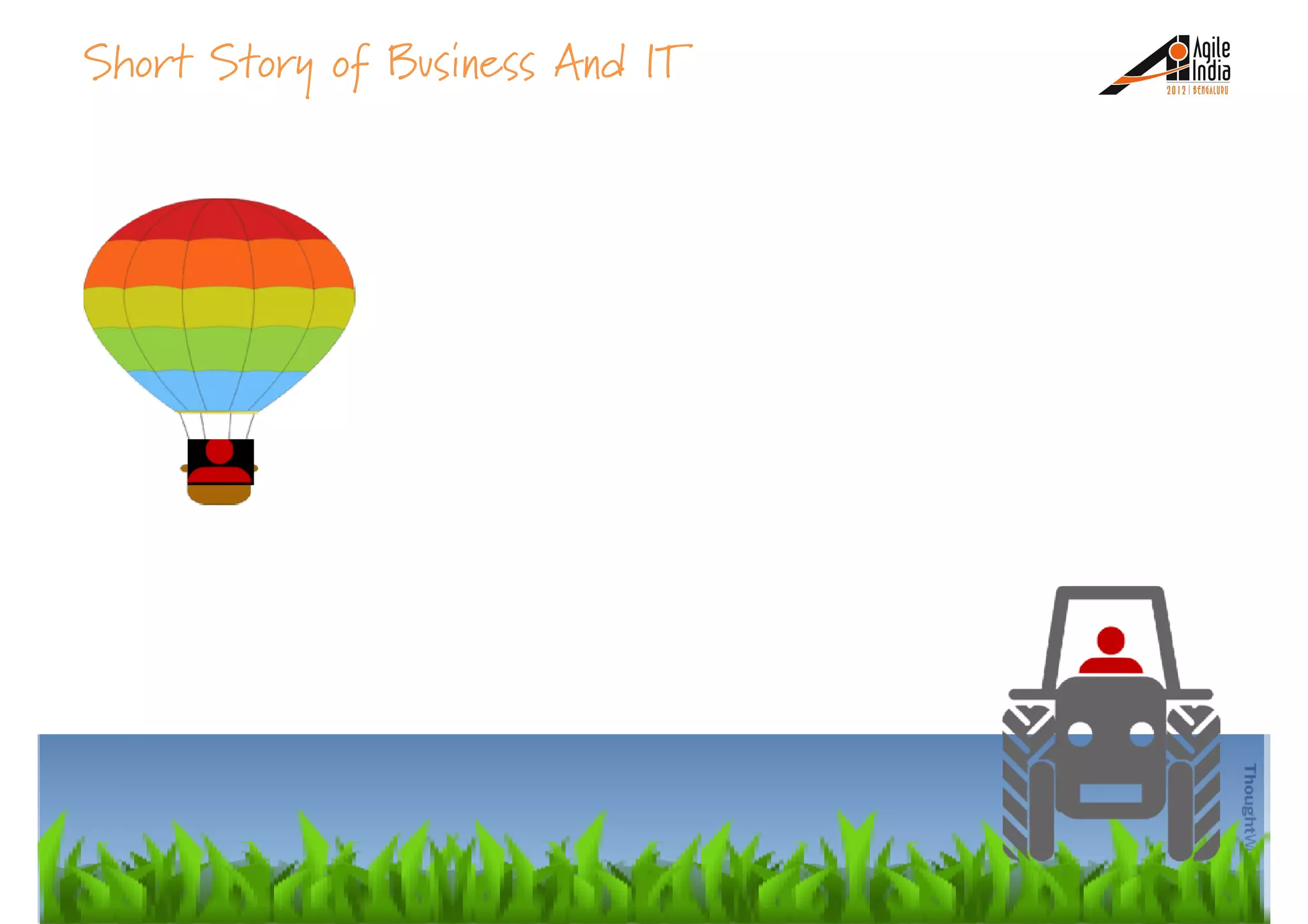
Short Story of Business And IT
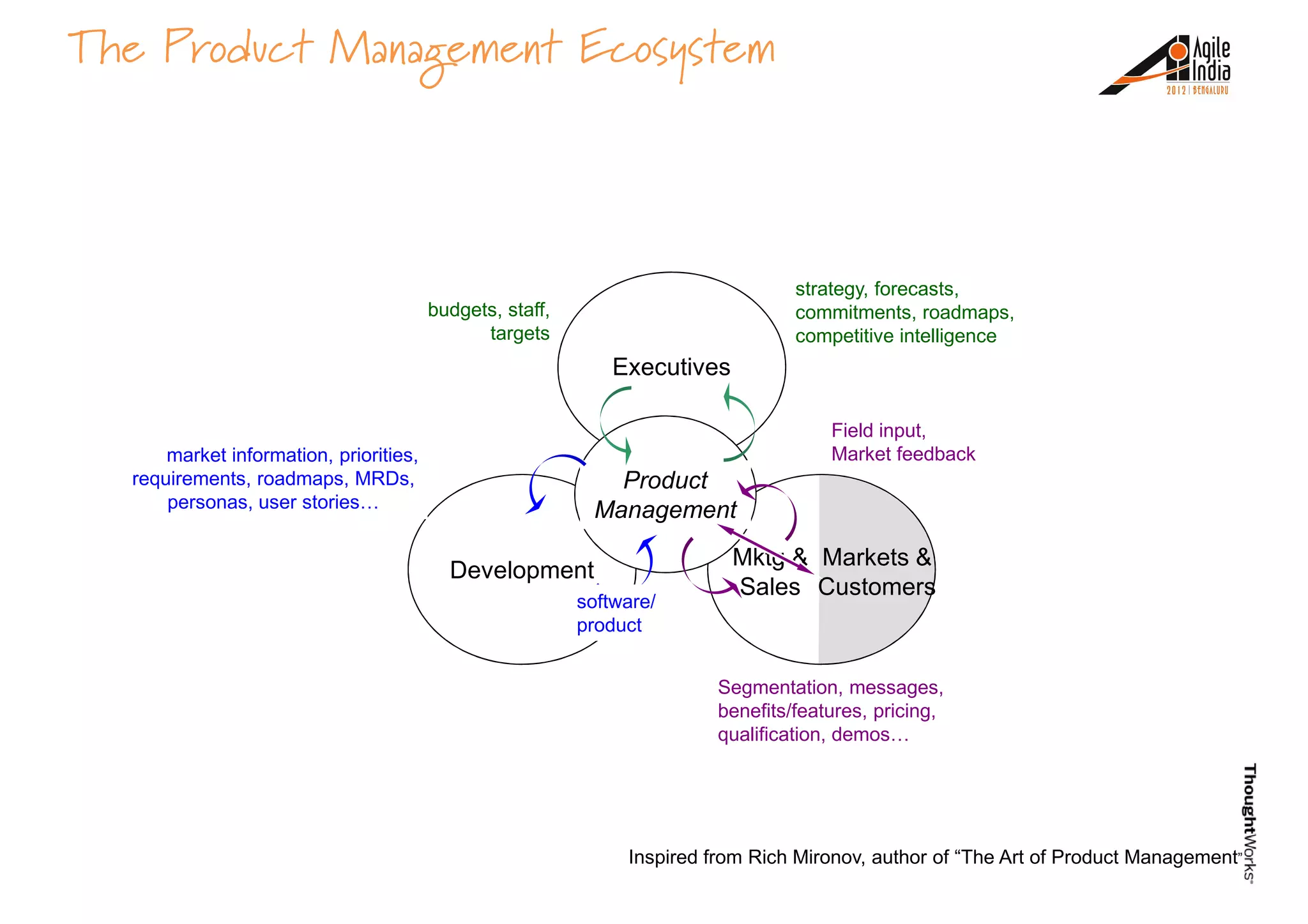
The Product Management Ecosystem
strategy, forecasts,
commitments, roadmaps,budgets, staff,
Development
Mktg &
Sales
Executives
Product
Management
market information, priorities,
requirements, roadmaps, MRDs,
personas, user stories…
software/
product
commitments, roadmaps,
competitive intelligence
budgets, staff,
targets
Field input,
Market feedback
Markets &
Customers
product
Segmentation, messages,
benefits/features, pricing,
qualification, demos…
Inspired from Rich Mironov, author of “The Art of Product Management”
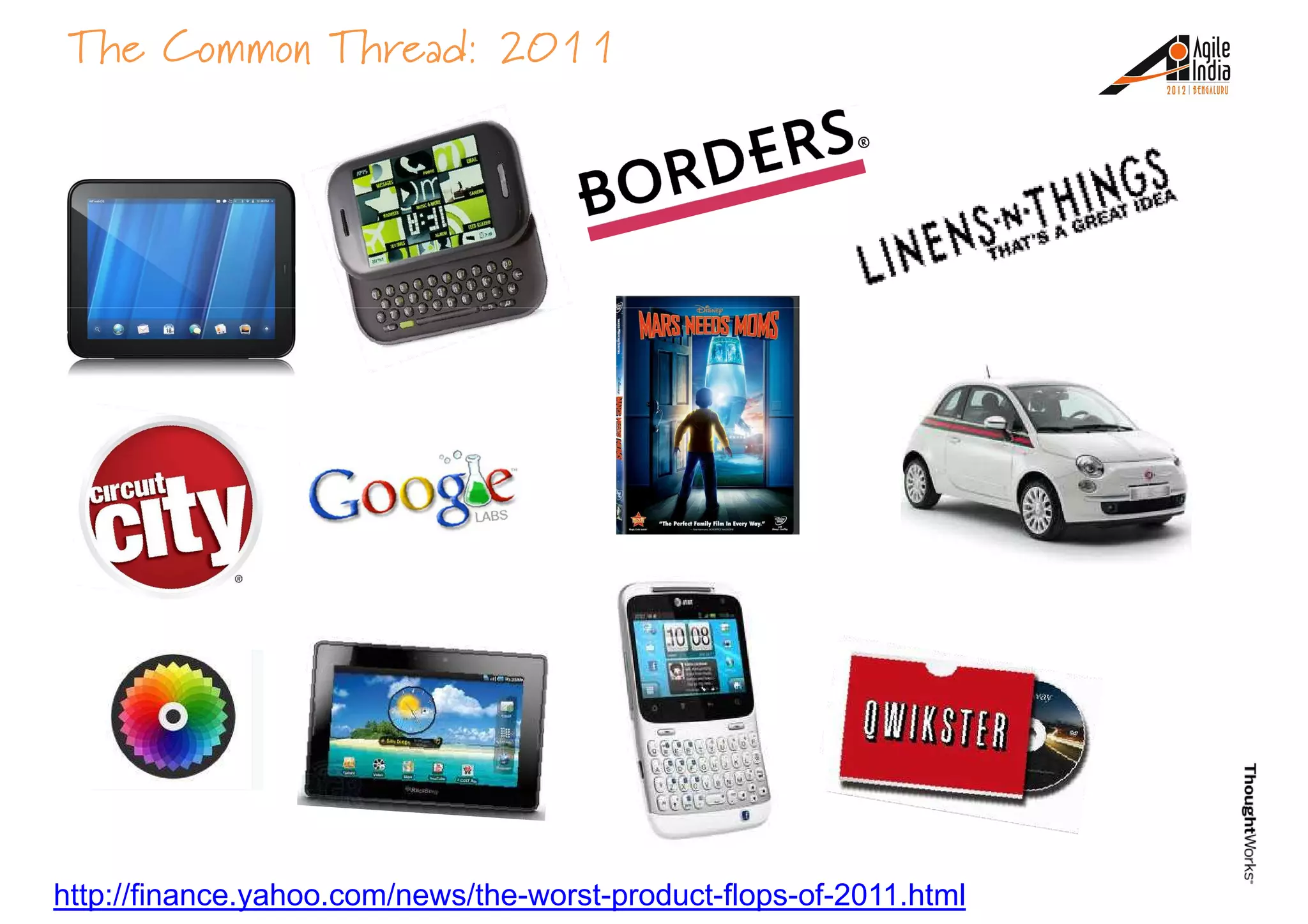
The Common Thread: 2011
http://finance.yahoo.com/news/the-worst-product-flops-of-2011.html
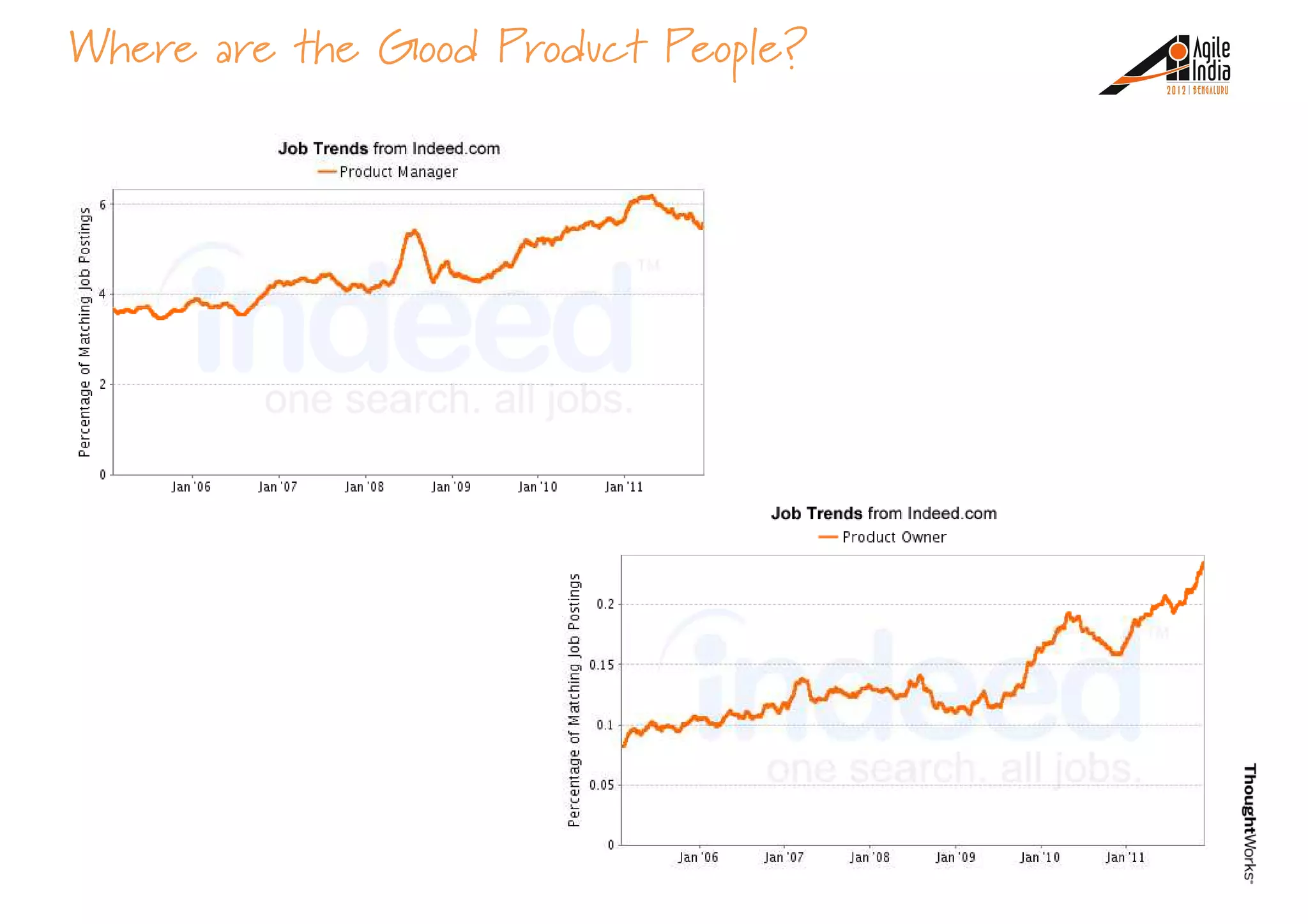
Where are the Good Product People?
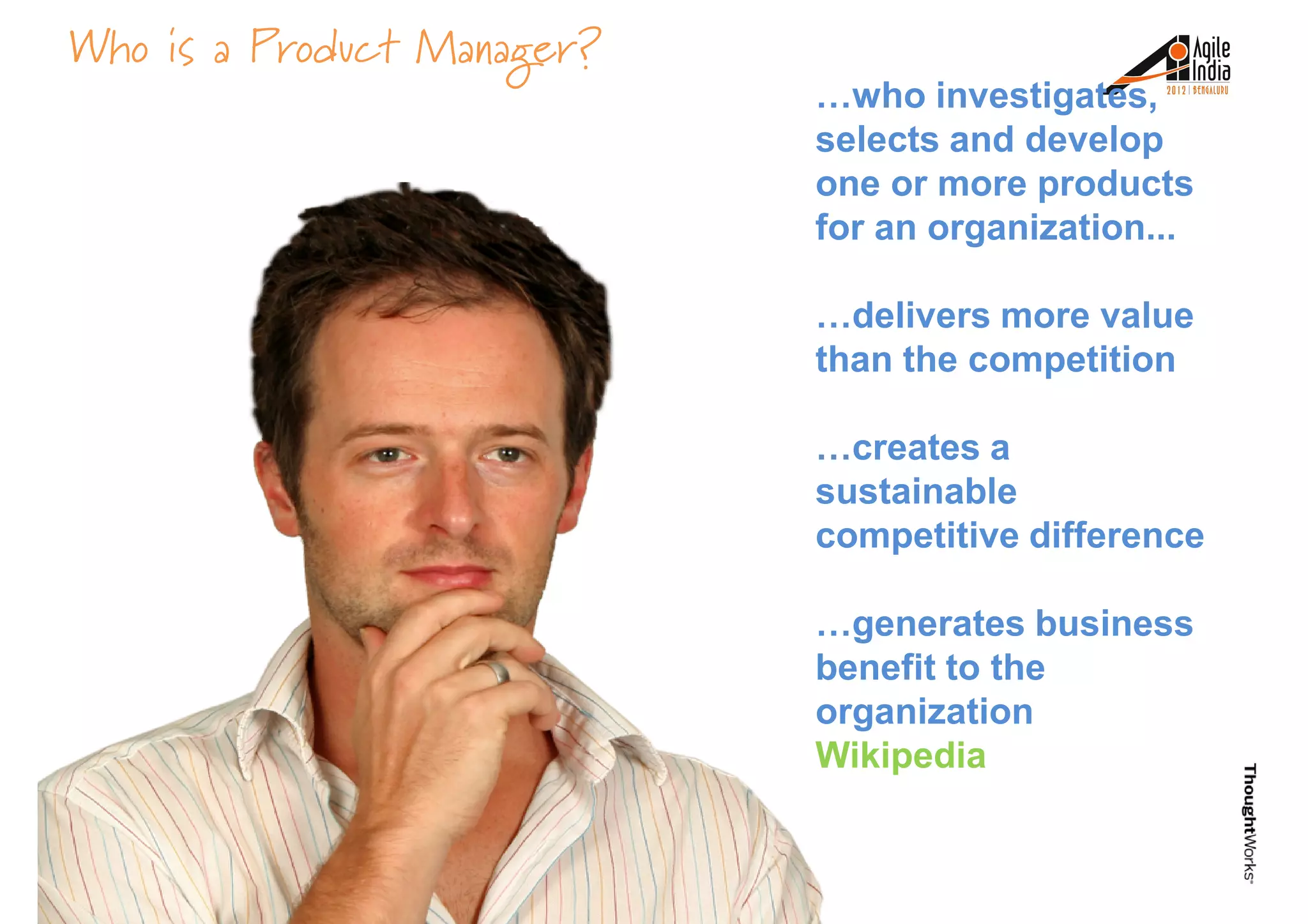
Who is a Product Manager?
…who investigates,
selects and develop
one or more products
for an organization...
…delivers more value…delivers more value
than the competition
…creates a
sustainable
competitive difference
…generates business…generates business
benefit to the
organization
Wikipedia
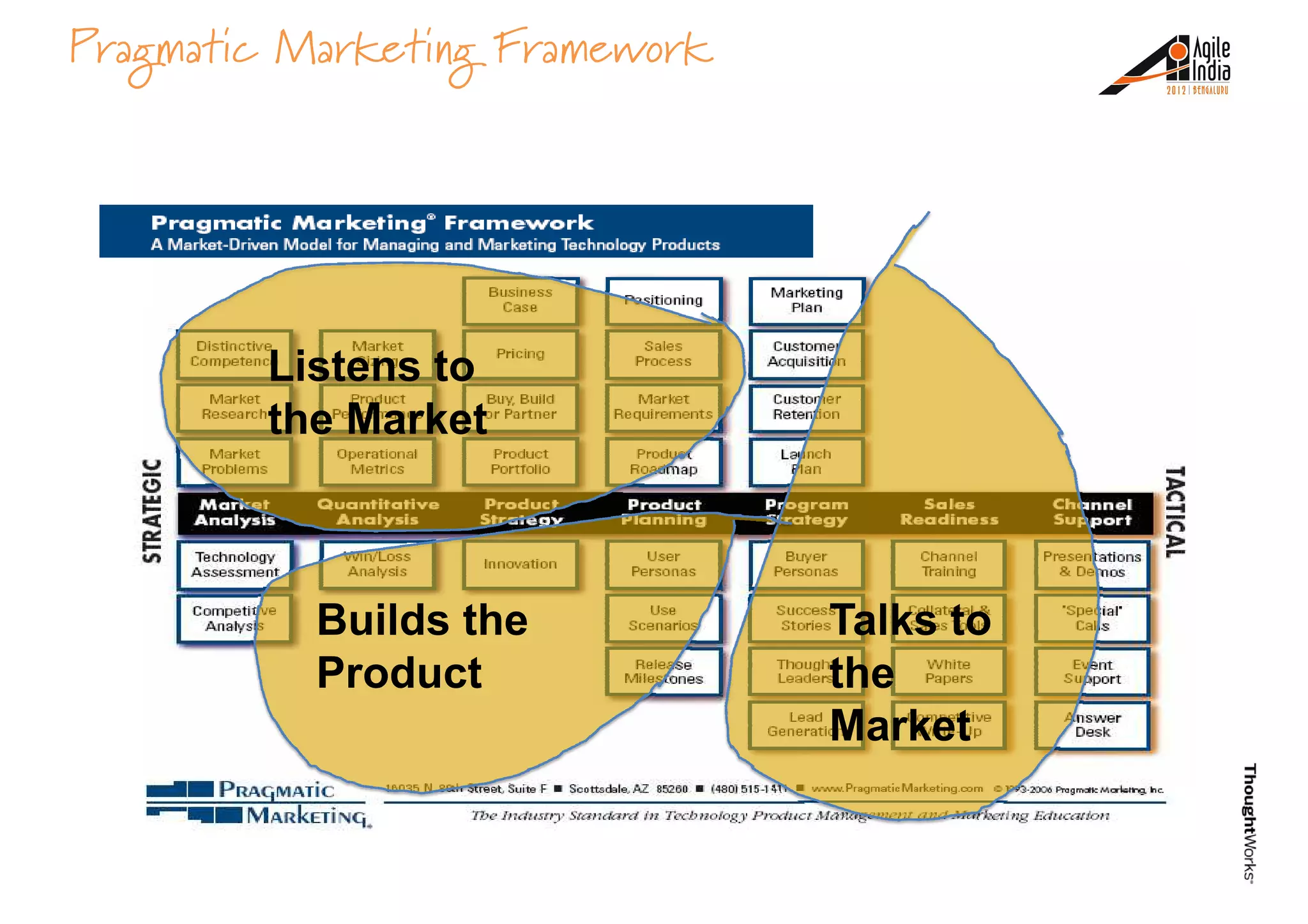
Pragmatic Marketing Framework
Talks toBuilds the
Listens to
the Market
Talks to
the
Market
Builds the
Product
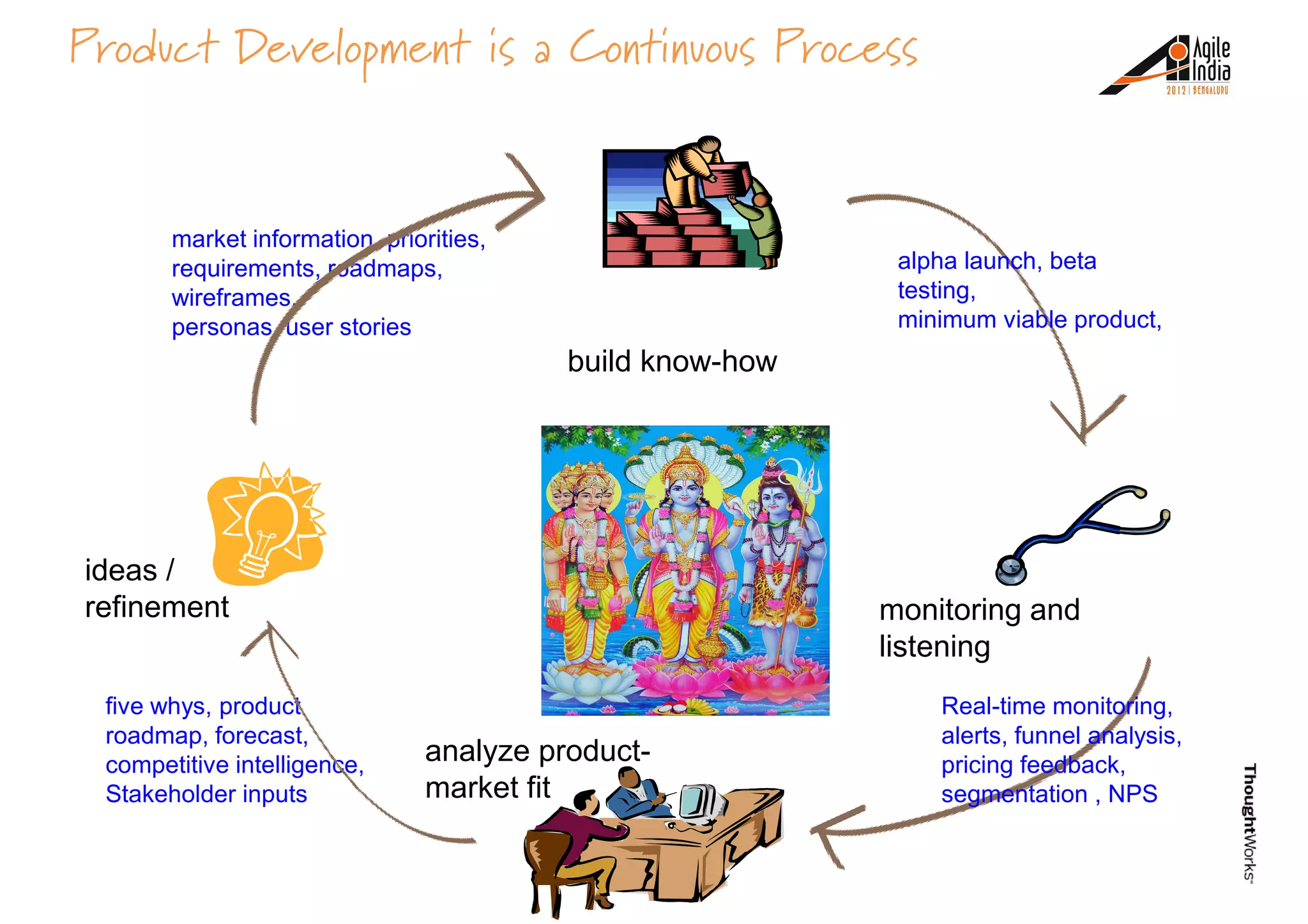
market information, priorities,
requirements, roadmaps,
wireframes,
alpha launch, beta
testing,
minimum viable product,
Product Development is a Continuous Process
wireframes,
personas, user stories minimum viable product,
build know-how
monitoring and
ideas /
refinement
five whys, product
roadmap, forecast,
competitive intelligence,
Stakeholder inputs
Real-time monitoring,
alerts, funnel analysis,
pricing feedback,
segmentation , NPS
monitoring and
listening
analyze product-
market fit
refinement
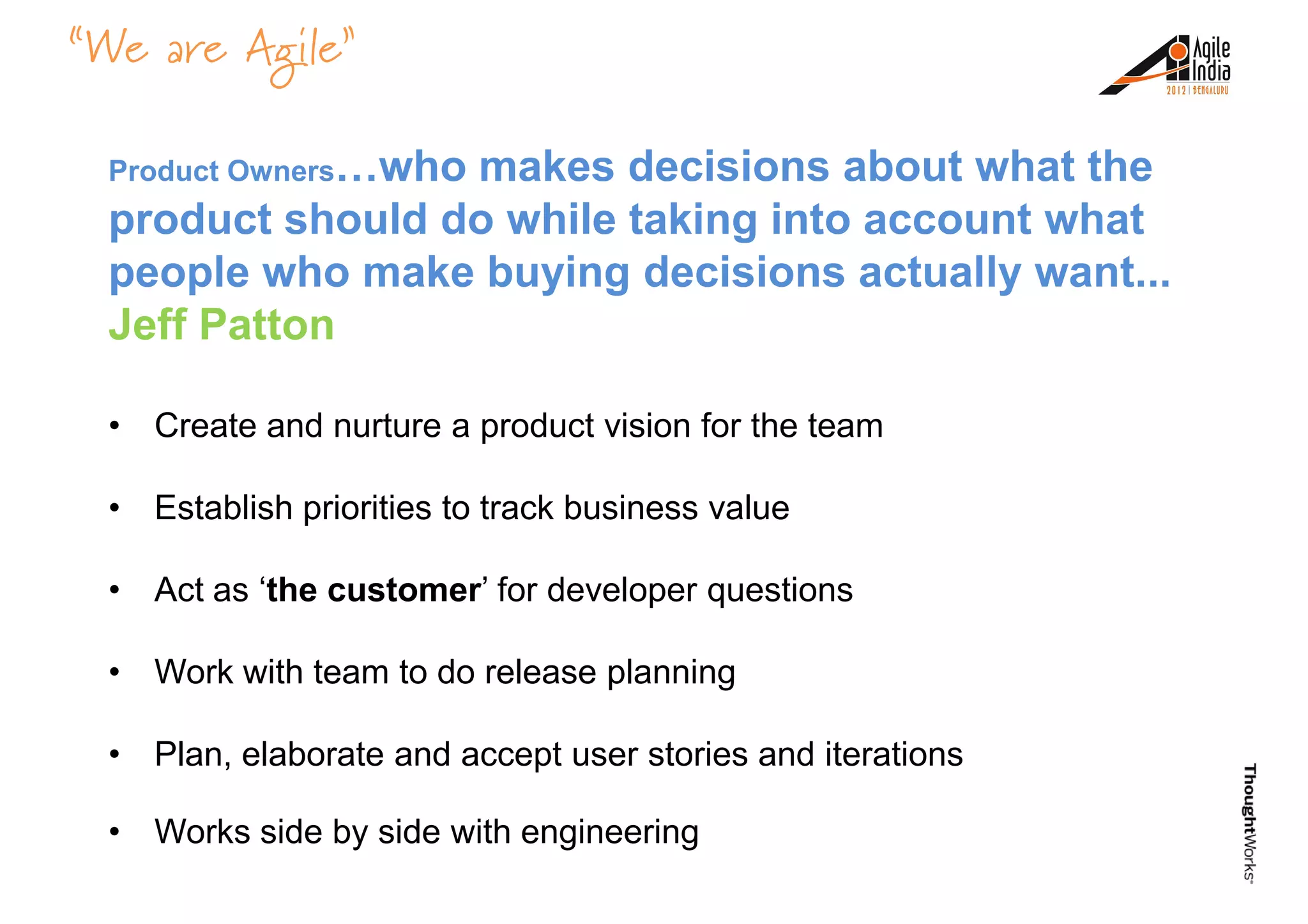
“We are Agile”
Product Owners…who makes decisions about what the
product should do while taking into account what
people who make buying decisions actually want...
Jeff PattonJeff Patton
• Create and nurture a product vision for the team
• Establish priorities to track business value
• Act as ‘the customer’ for developer questions
• Work with team to do release planning
• Plan, elaborate and accept user stories and iterations
• Works side by side with engineering
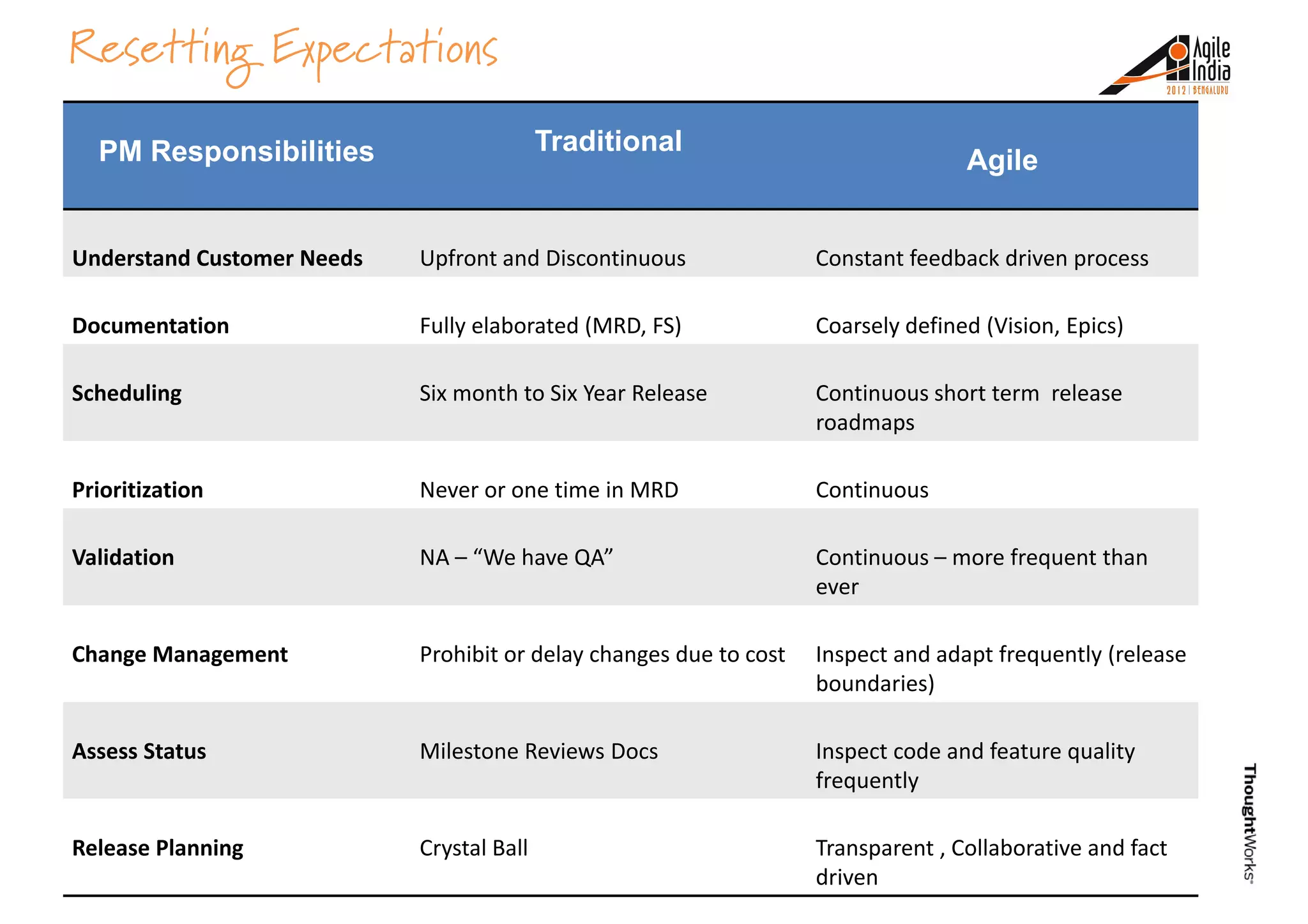
Resetting Expectations
PM Responsibilities Traditional
Agile
Understand Customer Needs Upfront and Discontinuous Constant feedback driven process
Documentation Fully elaborated (MRD, FS) Coarsely defined (Vision, Epics)
Scheduling Six month to Six Year Release Continuous short term release
roadmaps
Prioritization Never or one time in MRD Continuous
Validation NA – “We have QA” Continuous – more frequent than
ever
Change Management Prohibit or delay changes due to cost Inspect and adapt frequently (release
boundaries)
Assess Status Milestone Reviews Docs Inspect code and feature quality
frequently
Release Planning Crystal Ball Transparent , Collaborative and fact
driven
....pause....
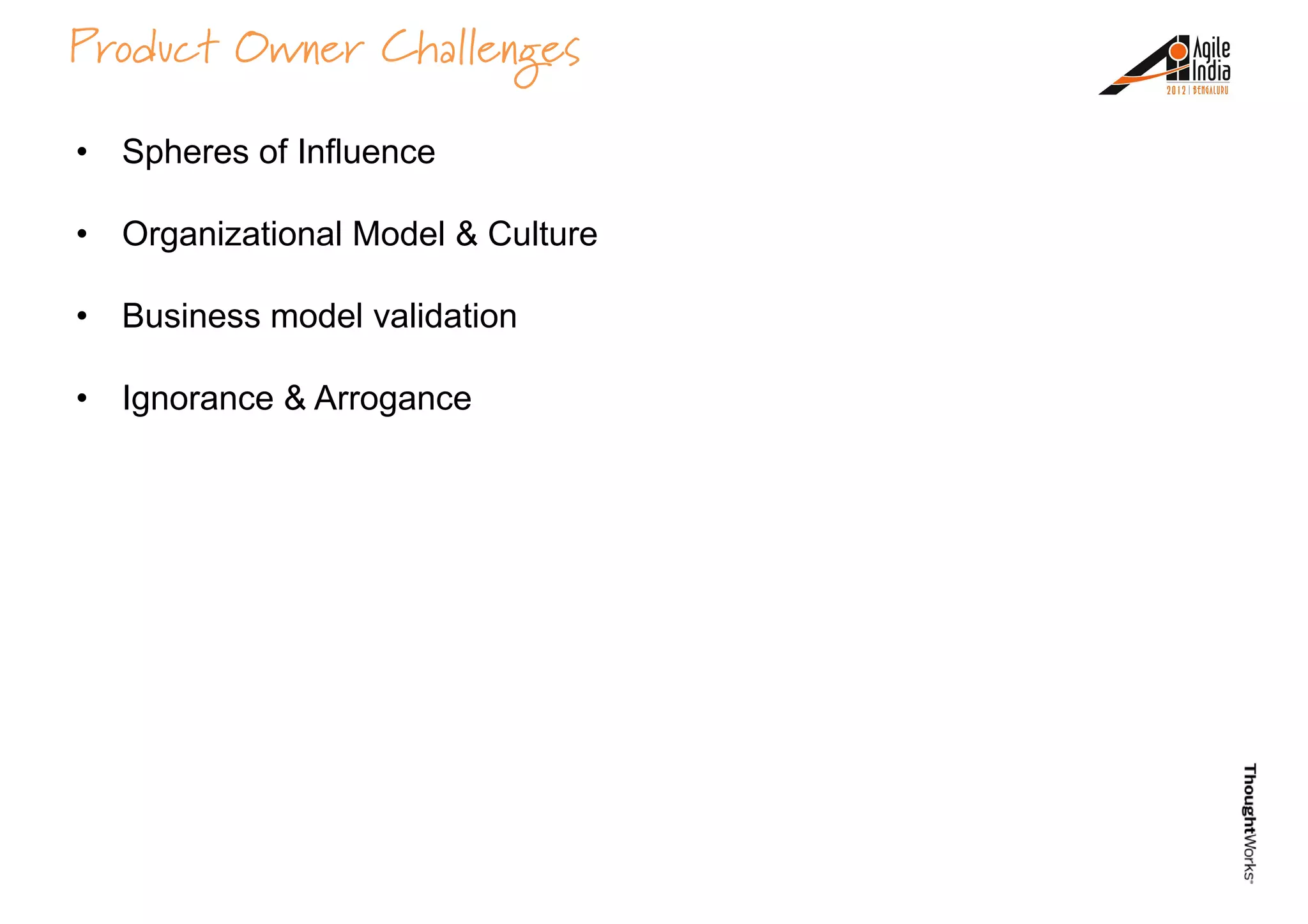
Product Owner Challenges
• Spheres of Influence
• Organizational Model & Culture
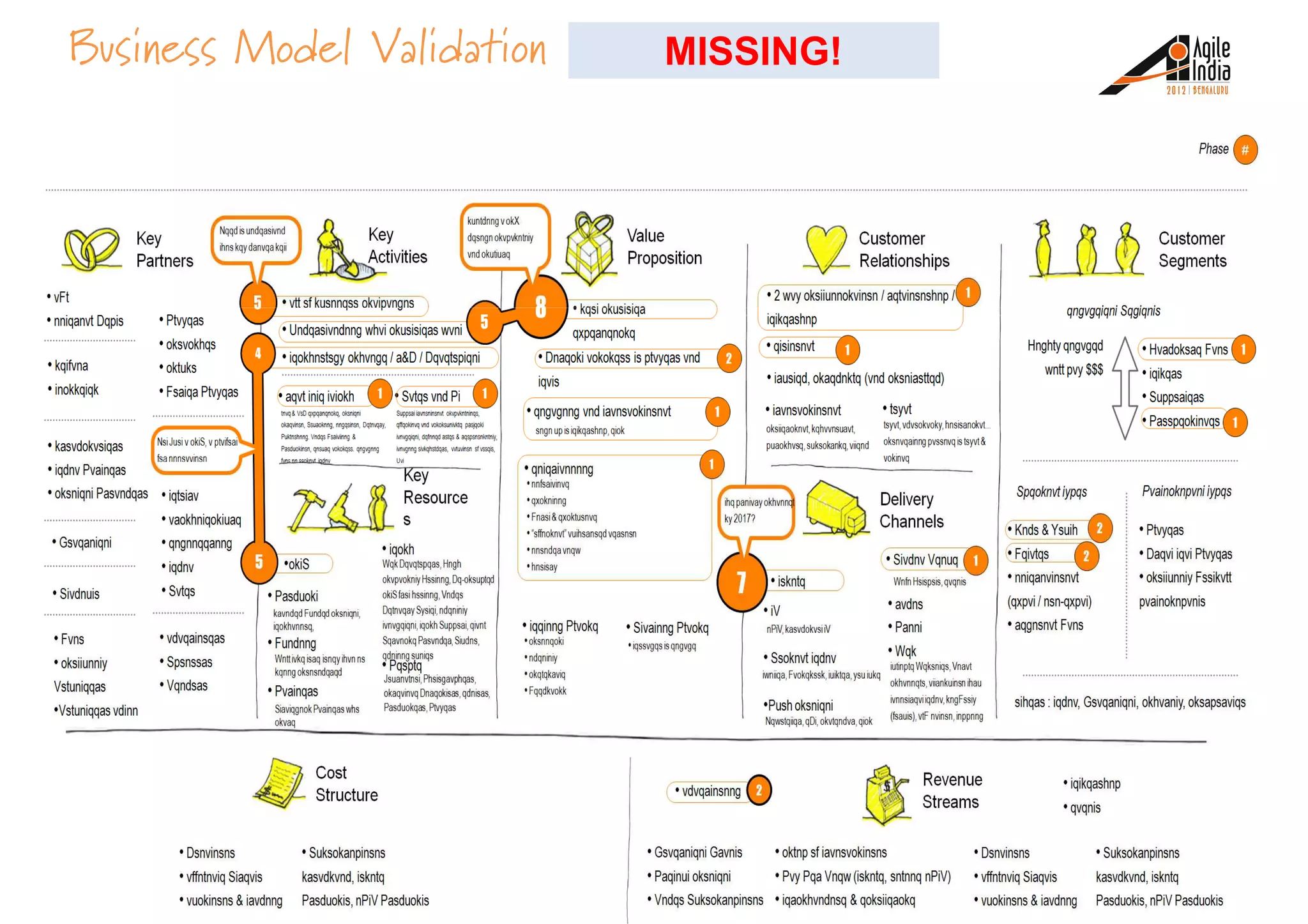
• Business model validation• Business model validation
• Ignorance & Arrogance
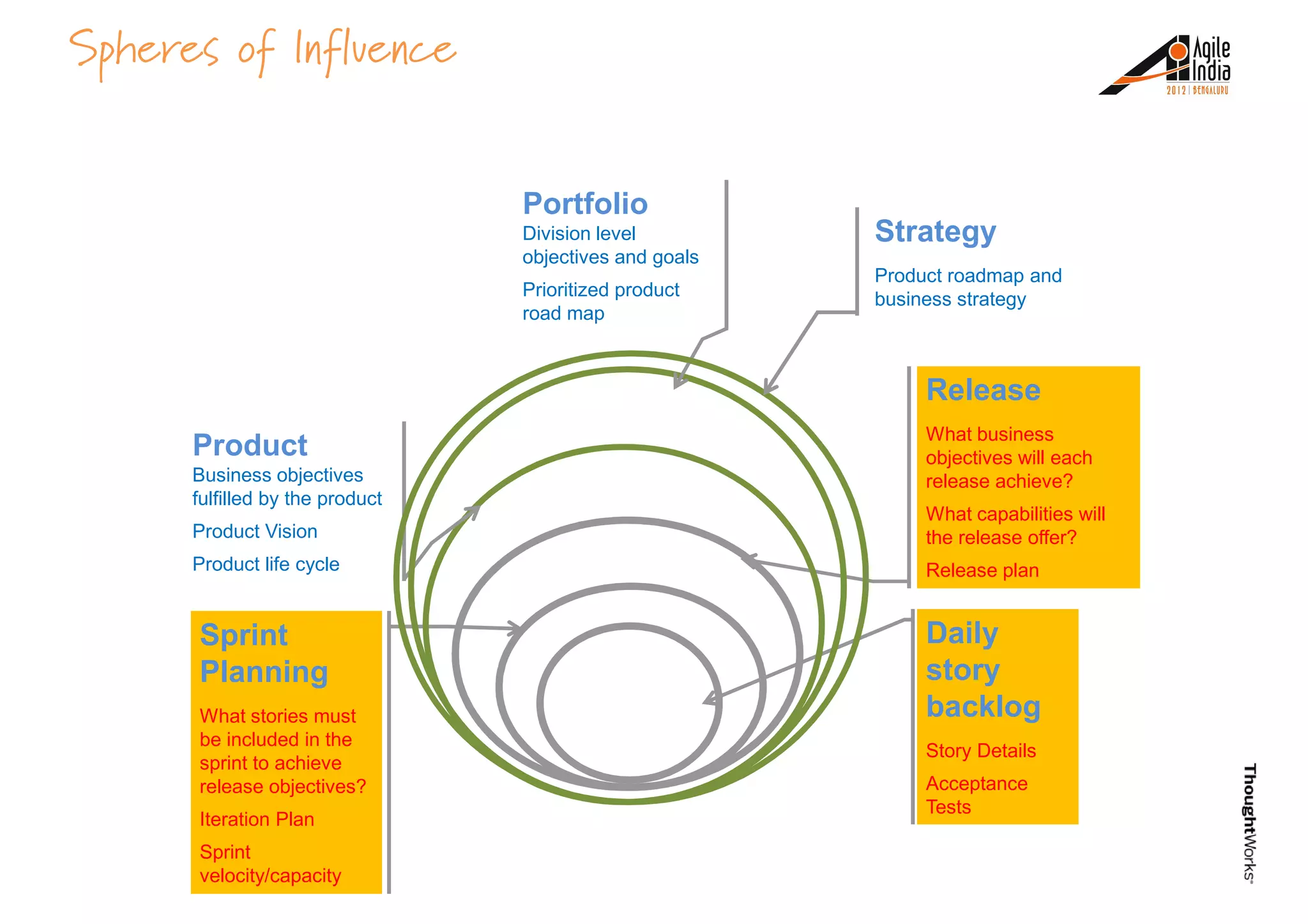
Spheres of Influence
Portfolio
Division level
objectives and goals
Prioritized product
road map
Strategy
Product roadmap and
business strategy
Daily
Release
What business
objectives will each
release achieve?
What capabilities will
the release offer?
Release plan
Product
Business objectives
fulfilled by the product
Product Vision
Product life cycle
road map
business strategy
Daily
story
backlog
Story Details
Acceptance
Tests
Sprint
Planning
What stories must
be included in the
sprint to achieve
release objectives?
Iteration Plan
Sprint
velocity/capacity
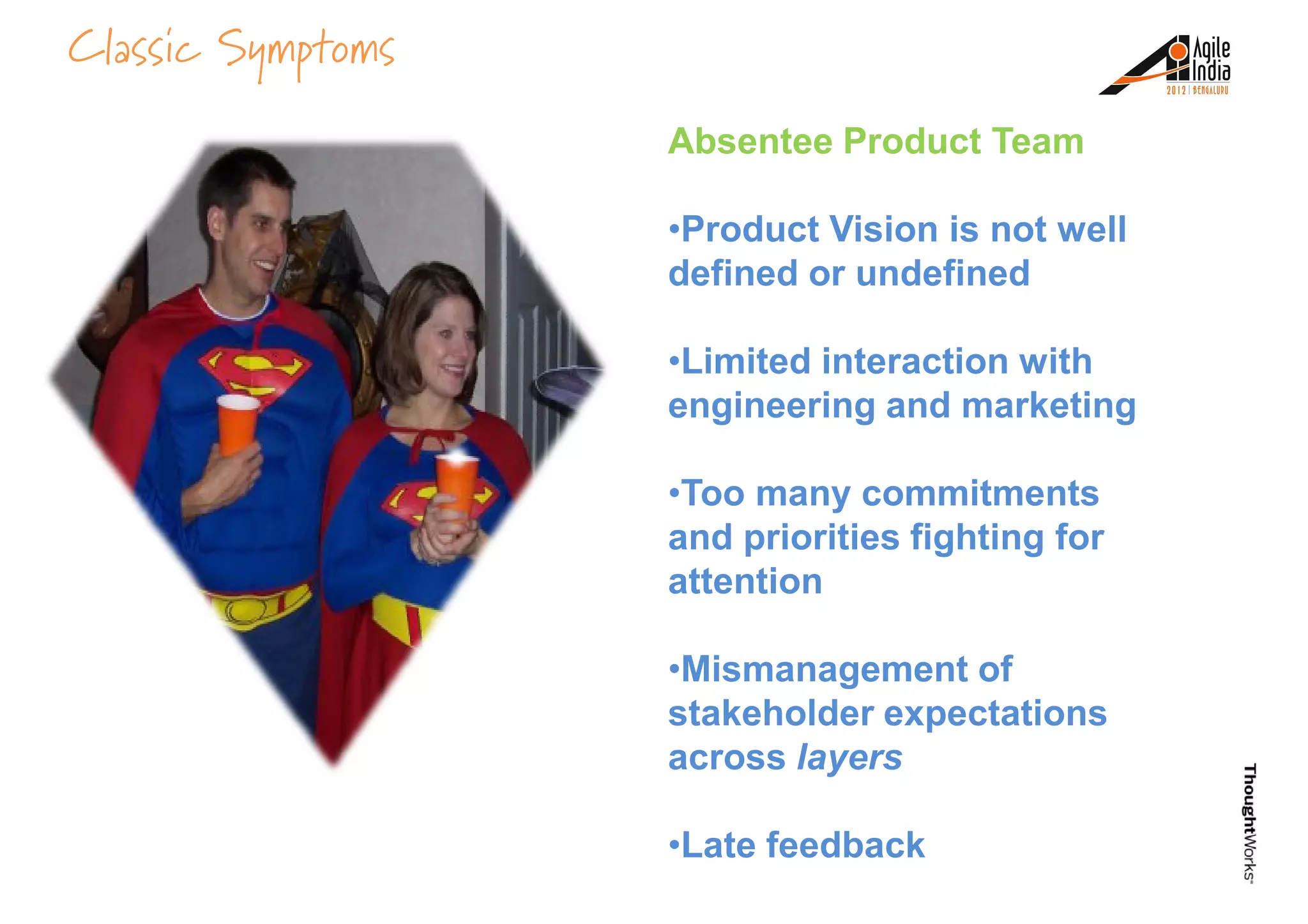
Classic Symptoms
Absentee Product Team
•Product Vision is not well
defined or undefined
•Limited interaction with
engineering and marketing
•Too many commitments
and priorities fighting for
attention
•Mismanagement of
stakeholder expectations
across layers
•Late feedback
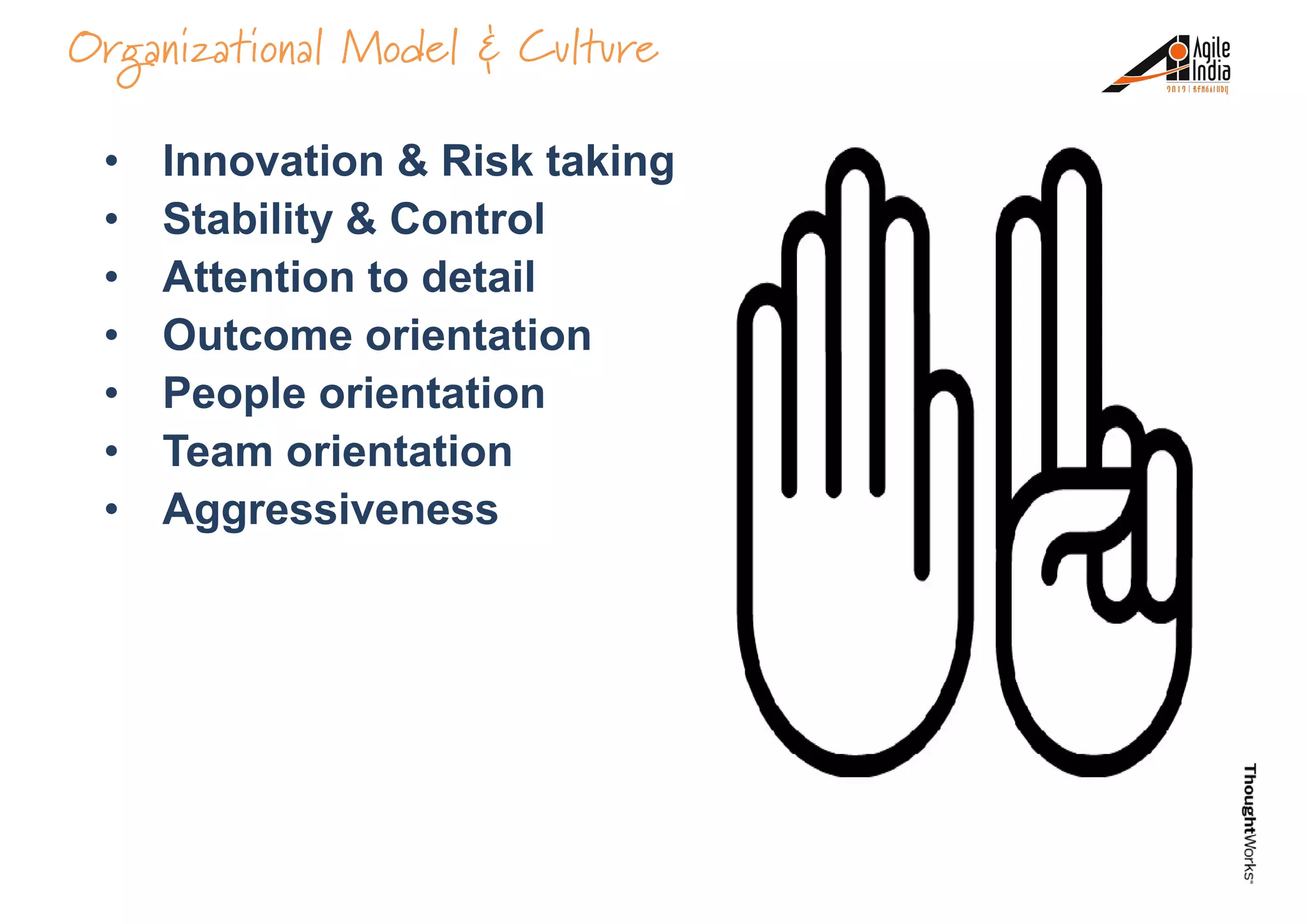
Organizational Model & Culture
• Innovation & Risk taking
• Stability & Control
• Attention to detail
• Outcome orientation
• People orientation
• Team orientation
• Aggressiveness
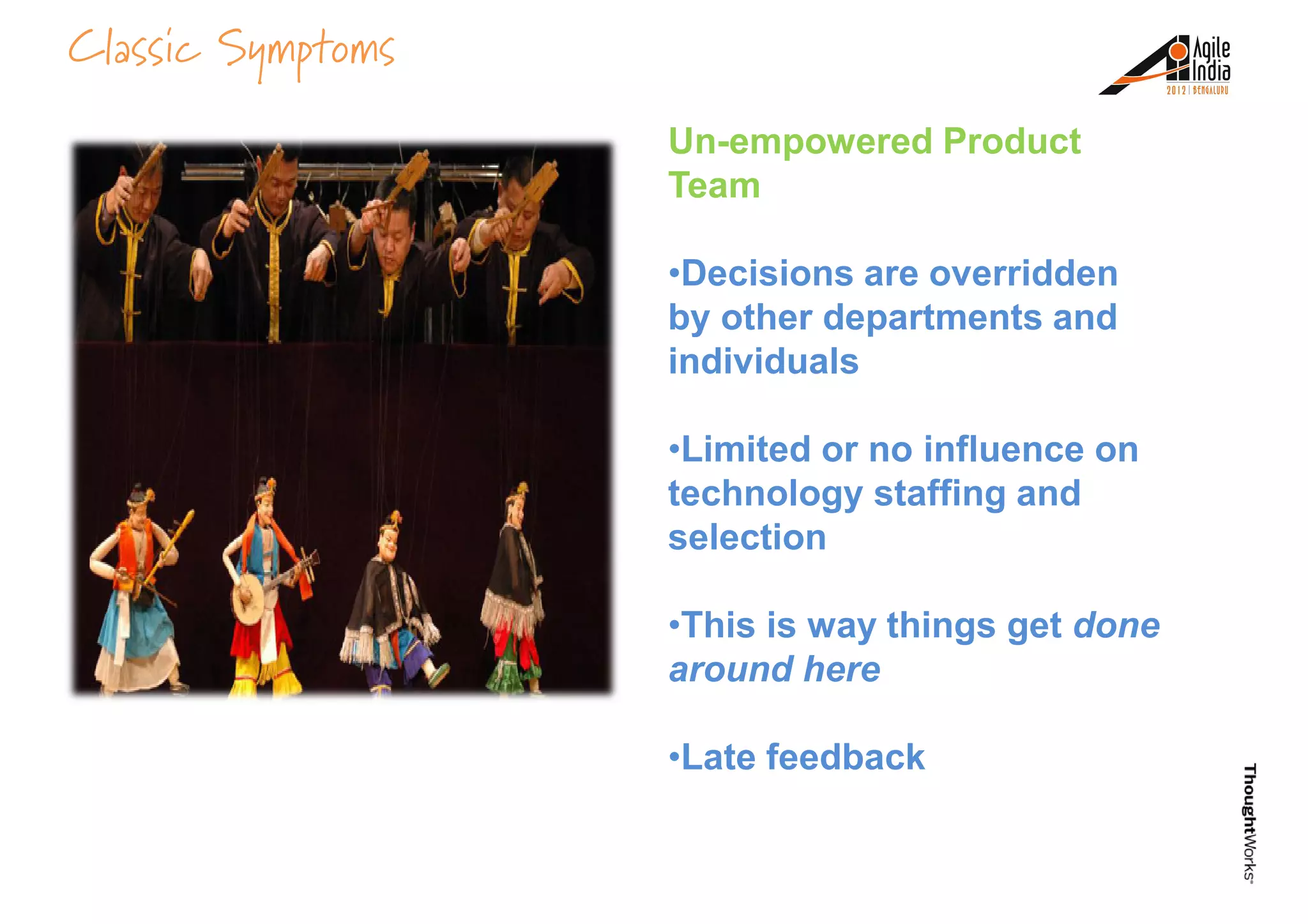
Classic Symptoms
Un-empowered Product
Team
•Decisions are overridden
by other departments andby other departments and
individuals
•Limited or no influence on
technology staffing and
selection
•This is way things get done•This is way things get done
around here
•Late feedback
Business Model Validation MISSING!
Classic Symptoms
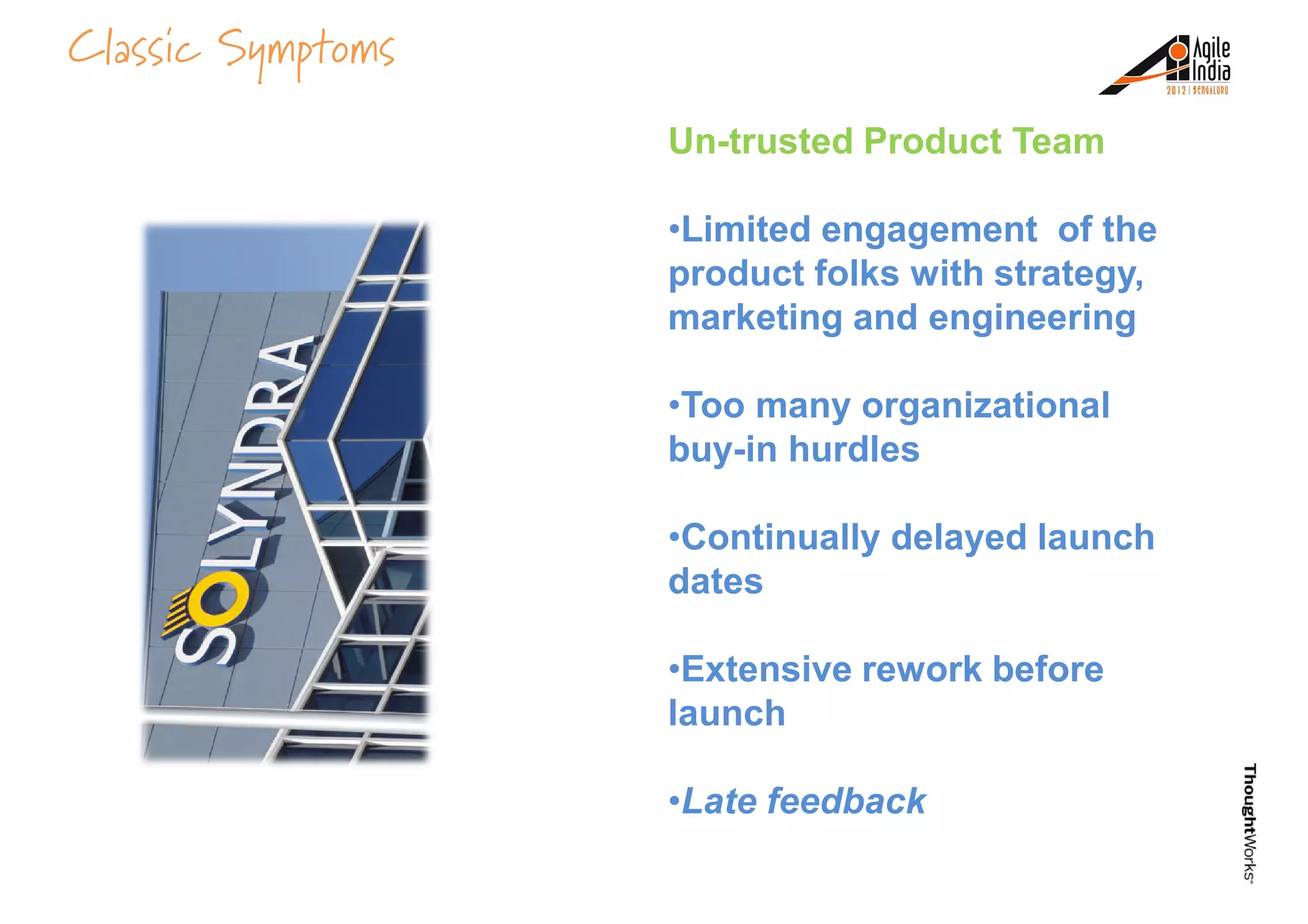
Un-trusted Product Team
•Limited engagement of the
product folks with strategy,
marketing and engineeringmarketing and engineering
•Too many organizational
buy-in hurdles
•Continually delayed launch
dates
•Extensive rework before
launch
•Late feedback
Arrogant PO / Product Team
Classic Symptoms
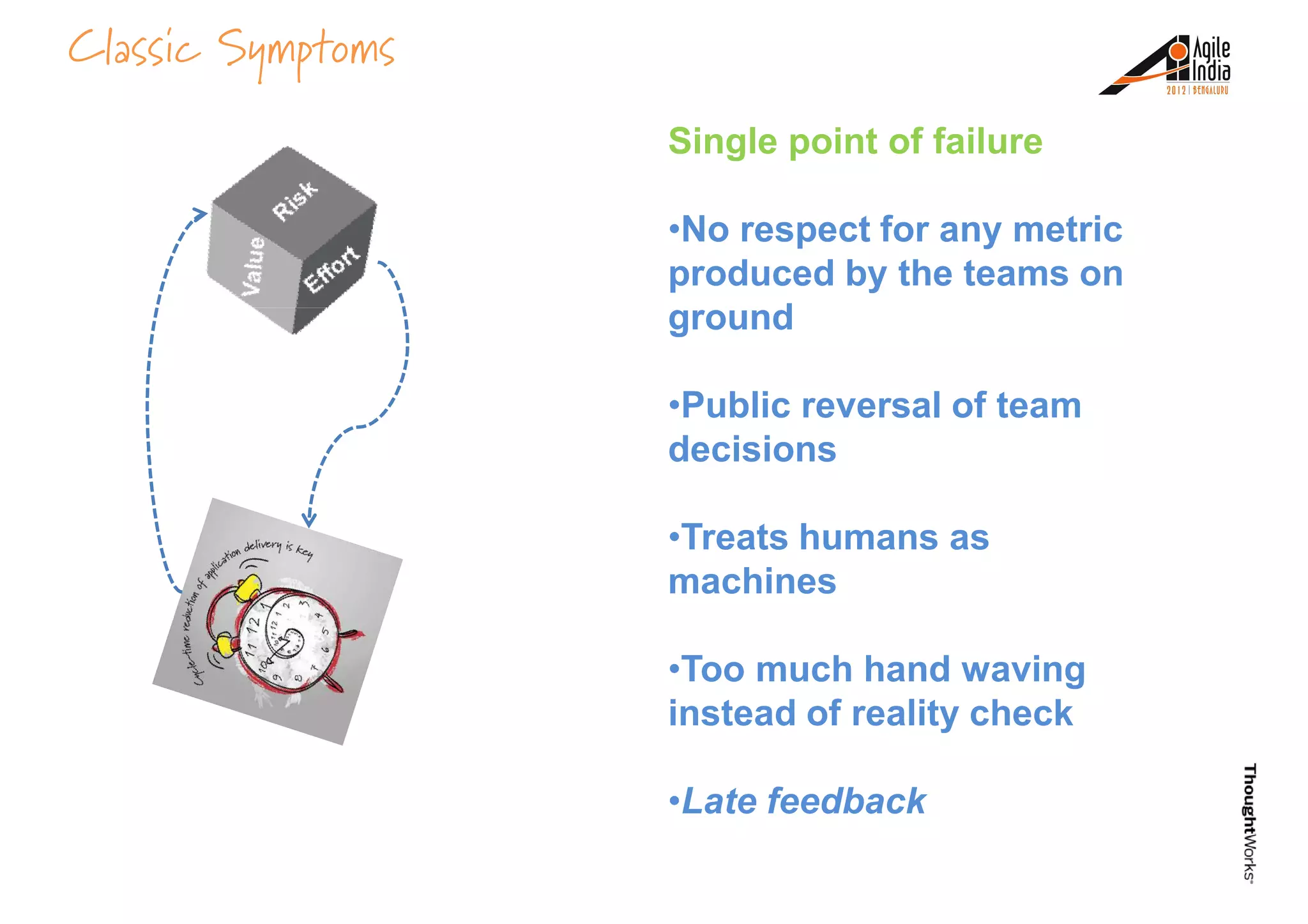
Single point of failure
•No respect for any metric
produced by the teams on
groundground
•Public reversal of team
decisions
•Treats humans as
machines
•Too much hand waving
instead of reality check
•Late feedback
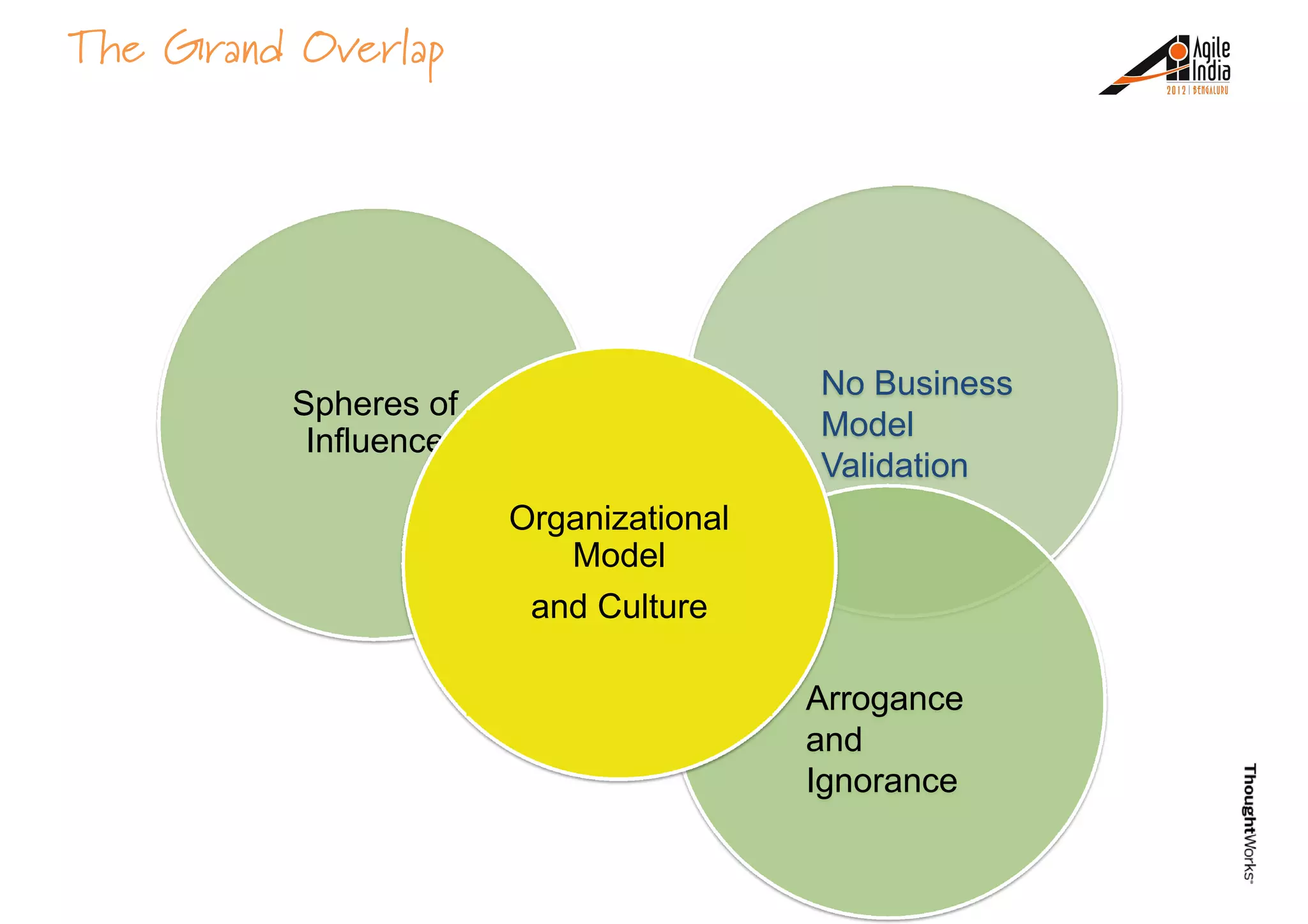
The Grand Overlap
Spheres of
Influence
No Business
Model
Validation
Organizational
Model
and Culture
Arrogance
and
Ignorance
and Culture
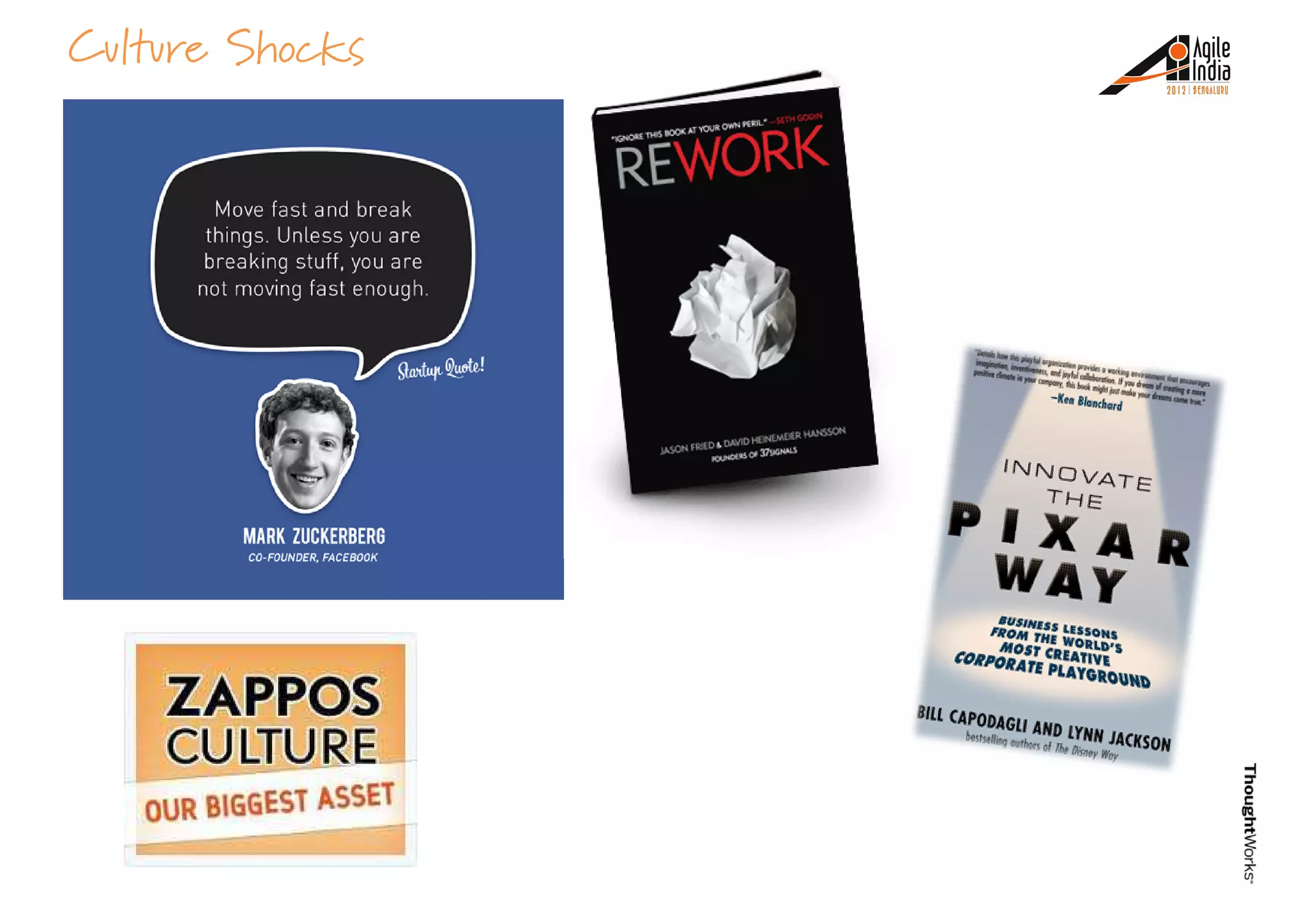
Culture Shocks
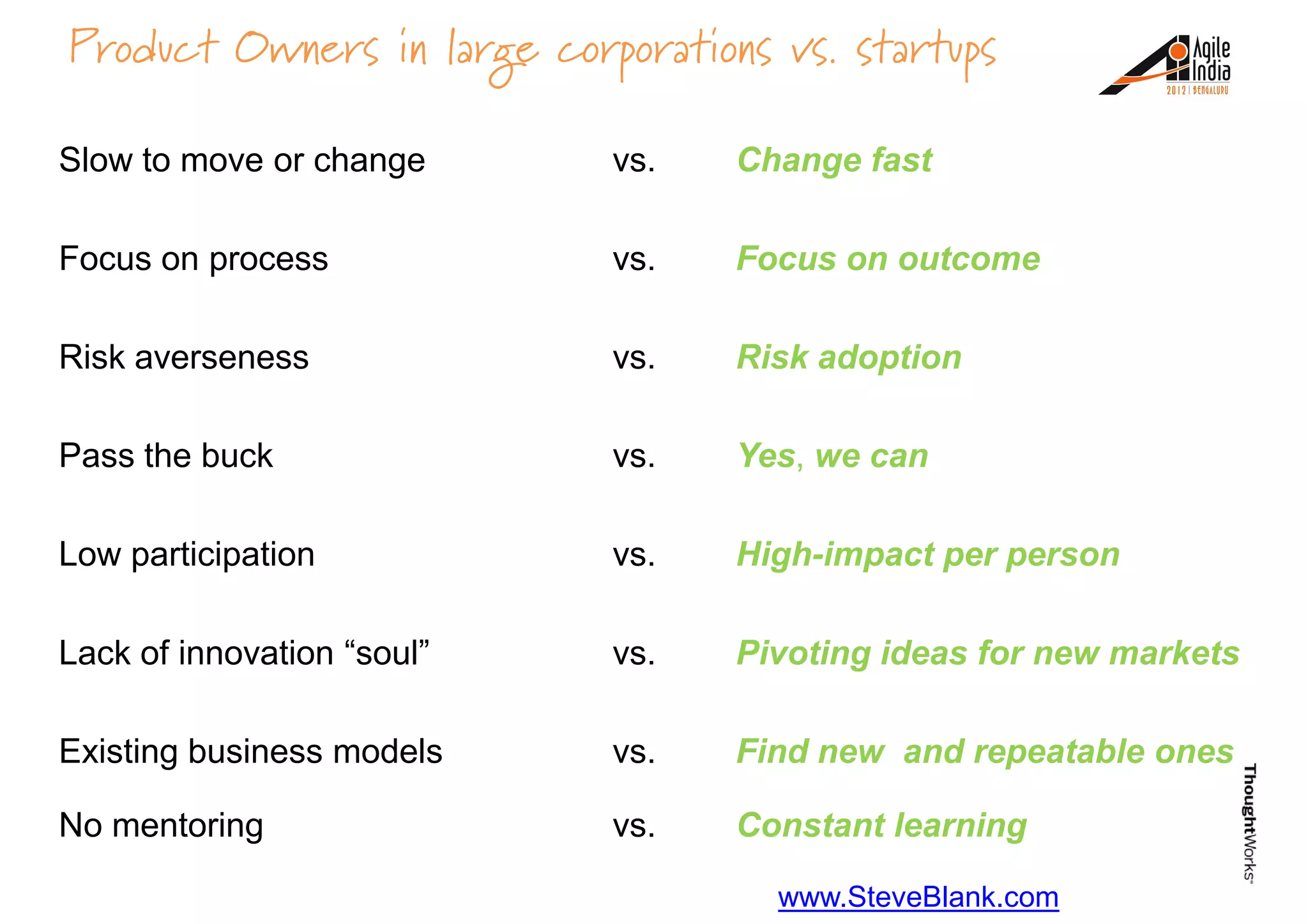
Slow to move or change vs. Change fast
Focus on process vs. Focus on outcome
Product Owners in large corporations vs. startups
Risk averseness vs. Risk adoption
Pass the buck vs. Yes, we can
Low participation vs. High-impact per person
Lack of innovation “soul” vs. Pivoting ideas for new markets
Existing business models vs. Find new and repeatable ones
No mentoring vs. Constant learning
www.SteveBlank.com
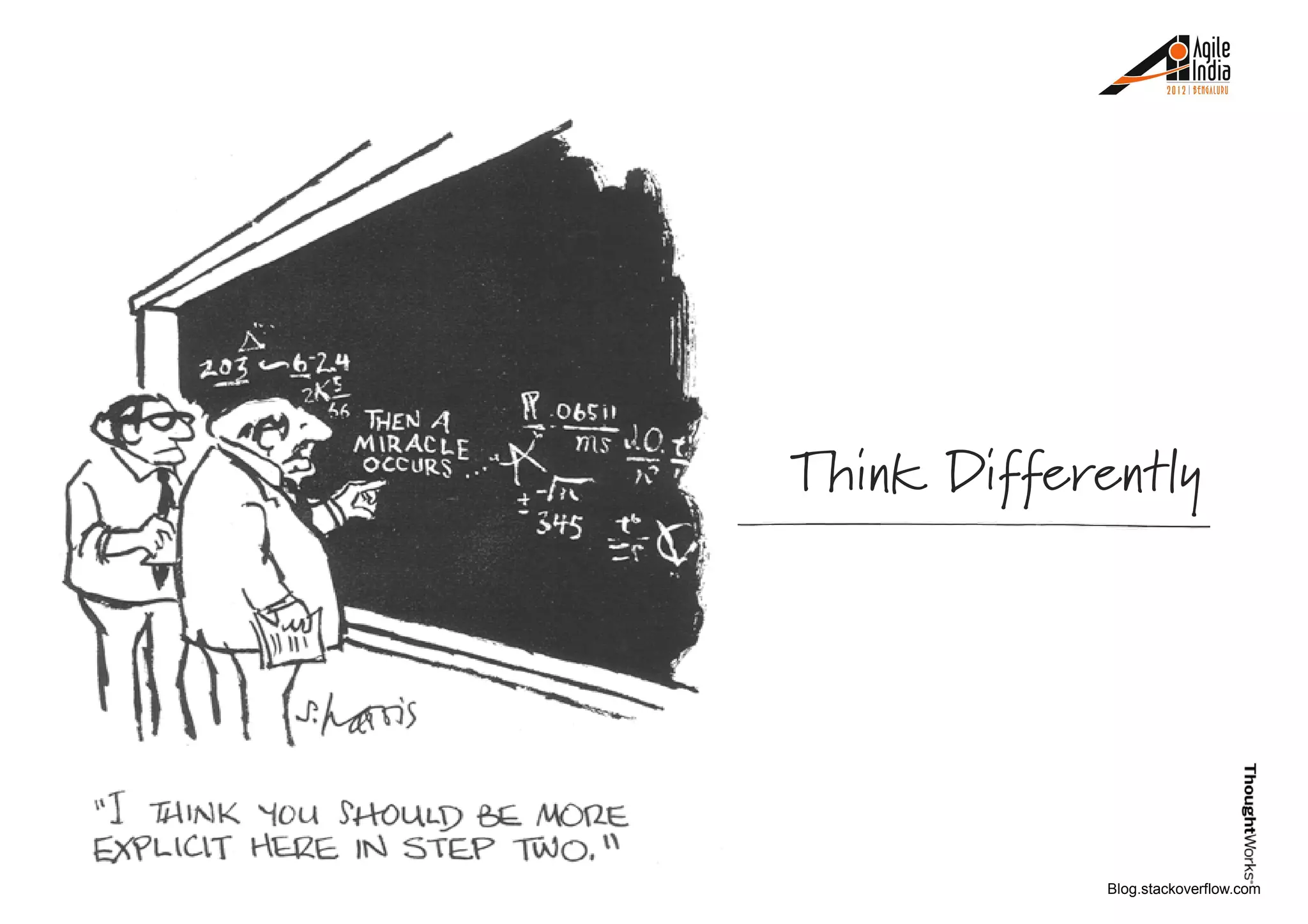
Think Differently
Blog.stackoverflow.com
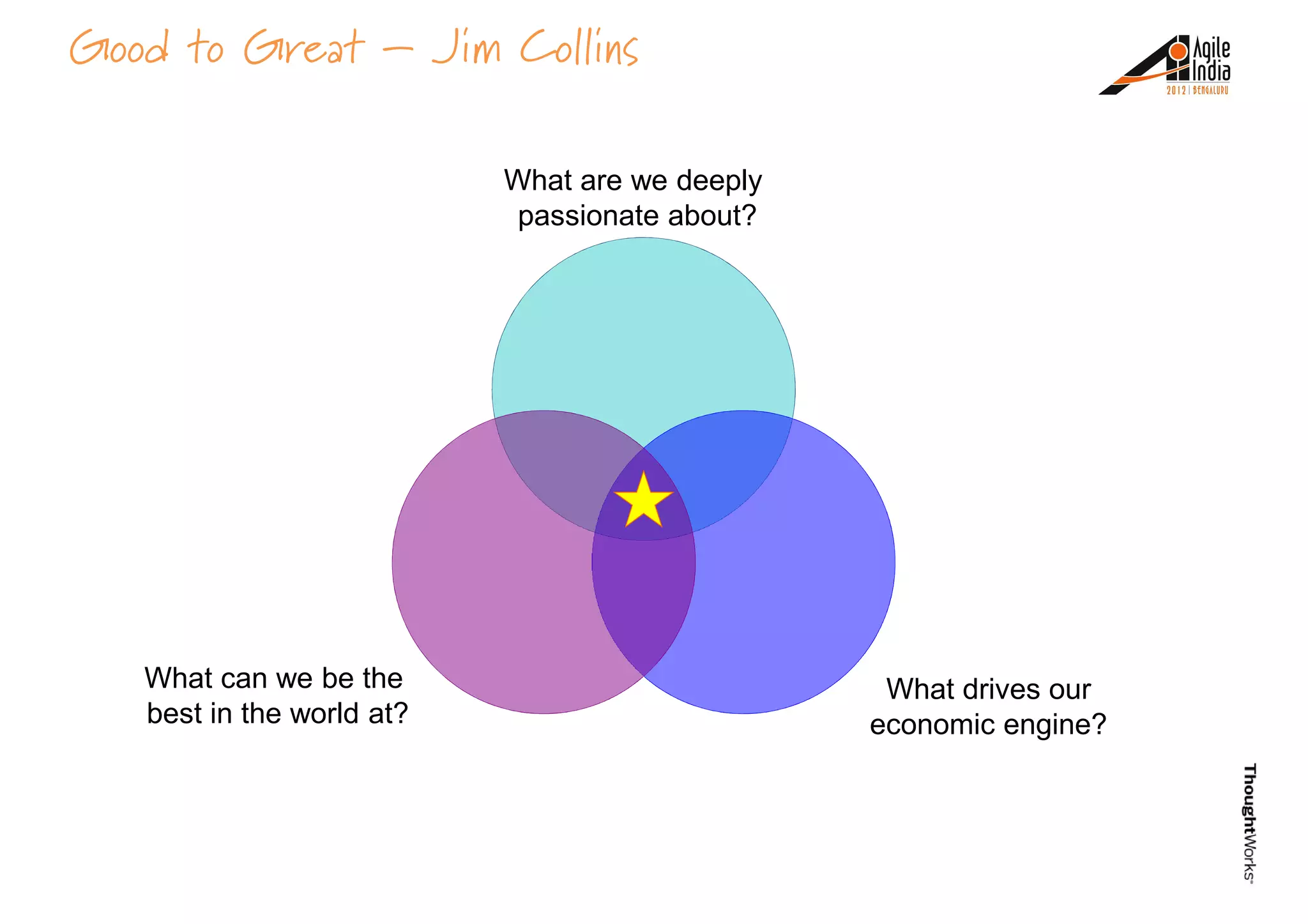
Good to Great – Jim Collins
What are we deeply
passionate about?
What drives our
economic engine?
What can we be the
best in the world at?
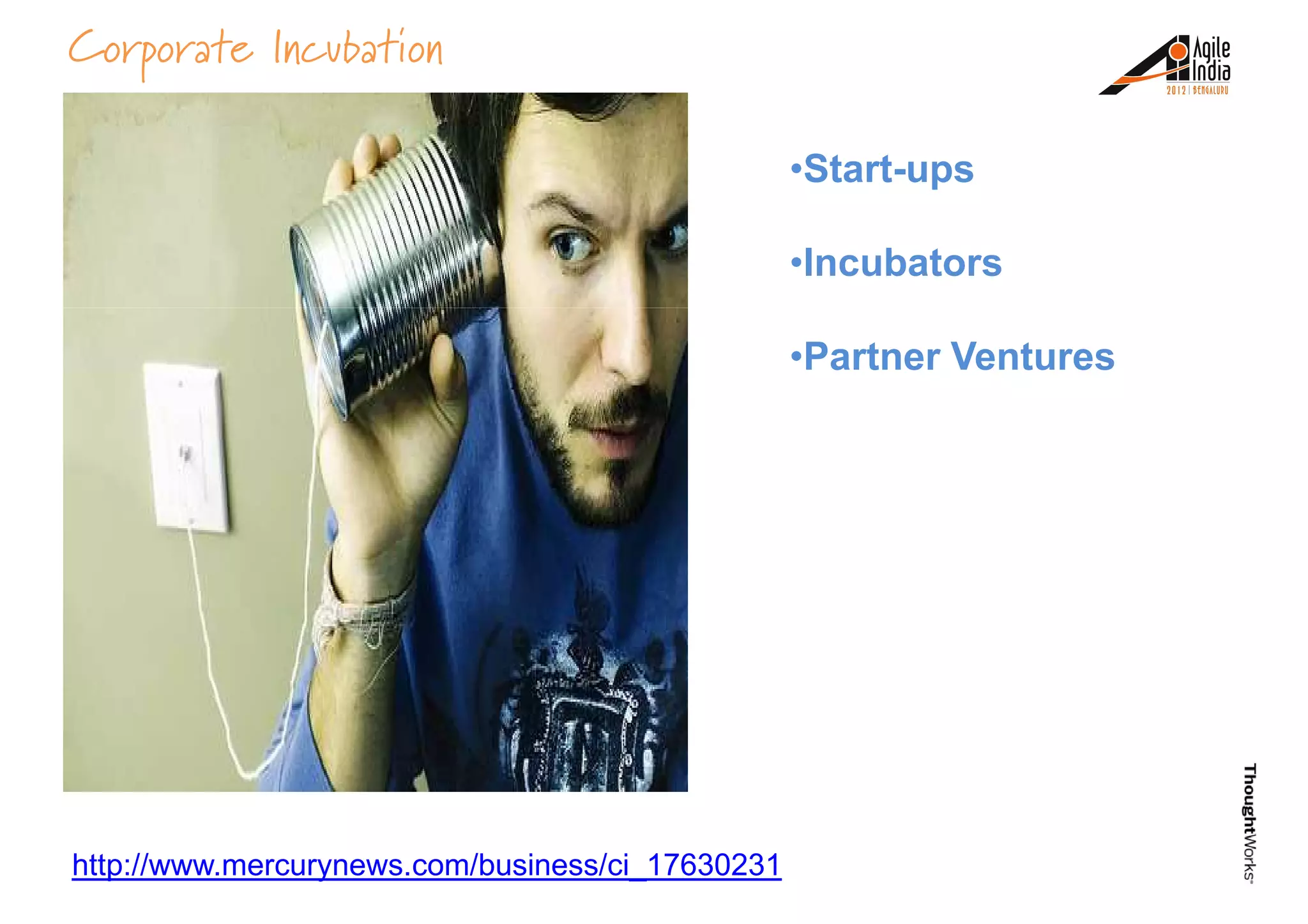
•Start-ups
•Incubators
Corporate Incubation
•Partner Ventures
http://www.mercurynews.com/business/ci_17630231
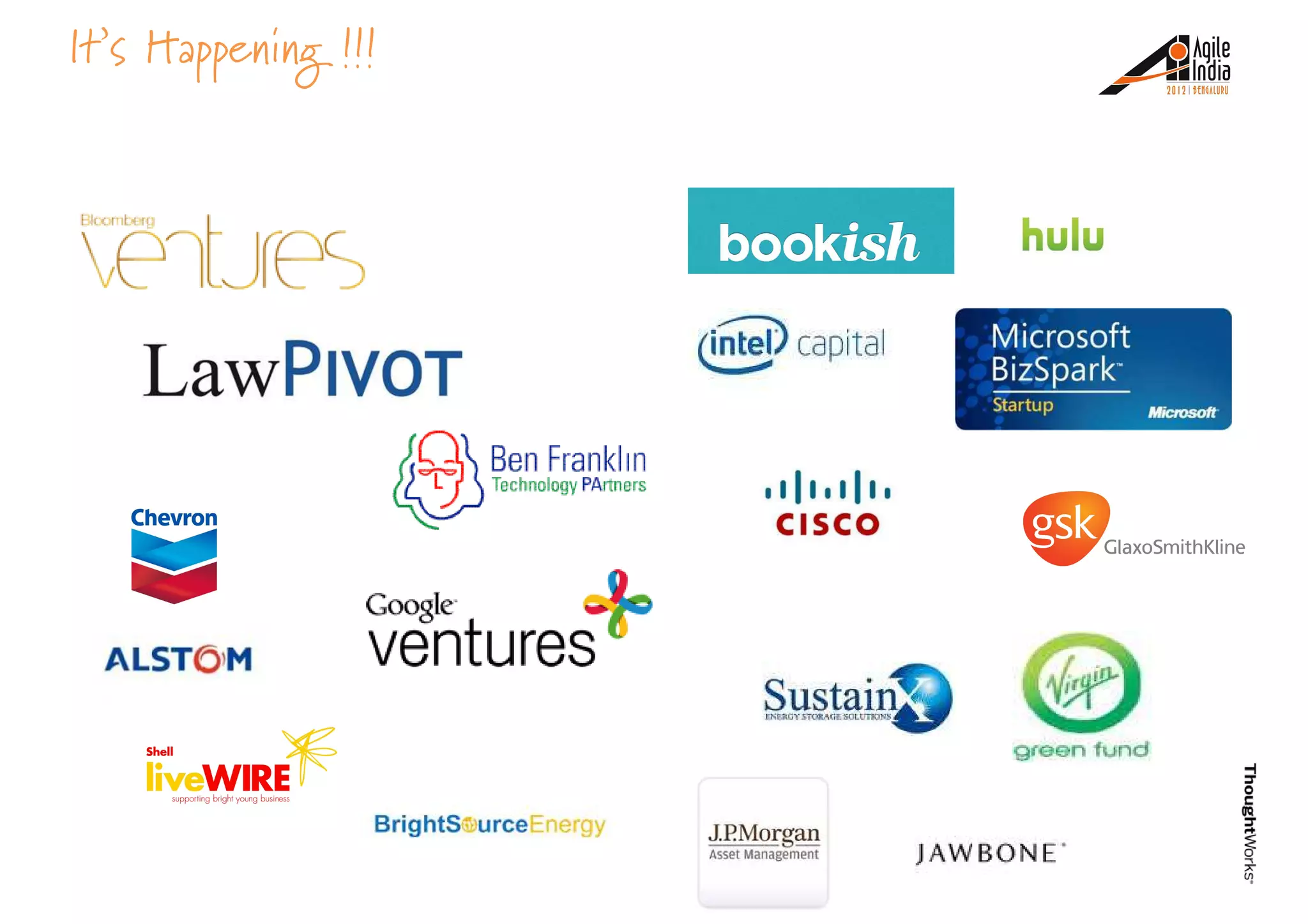
It’s Happening !!!
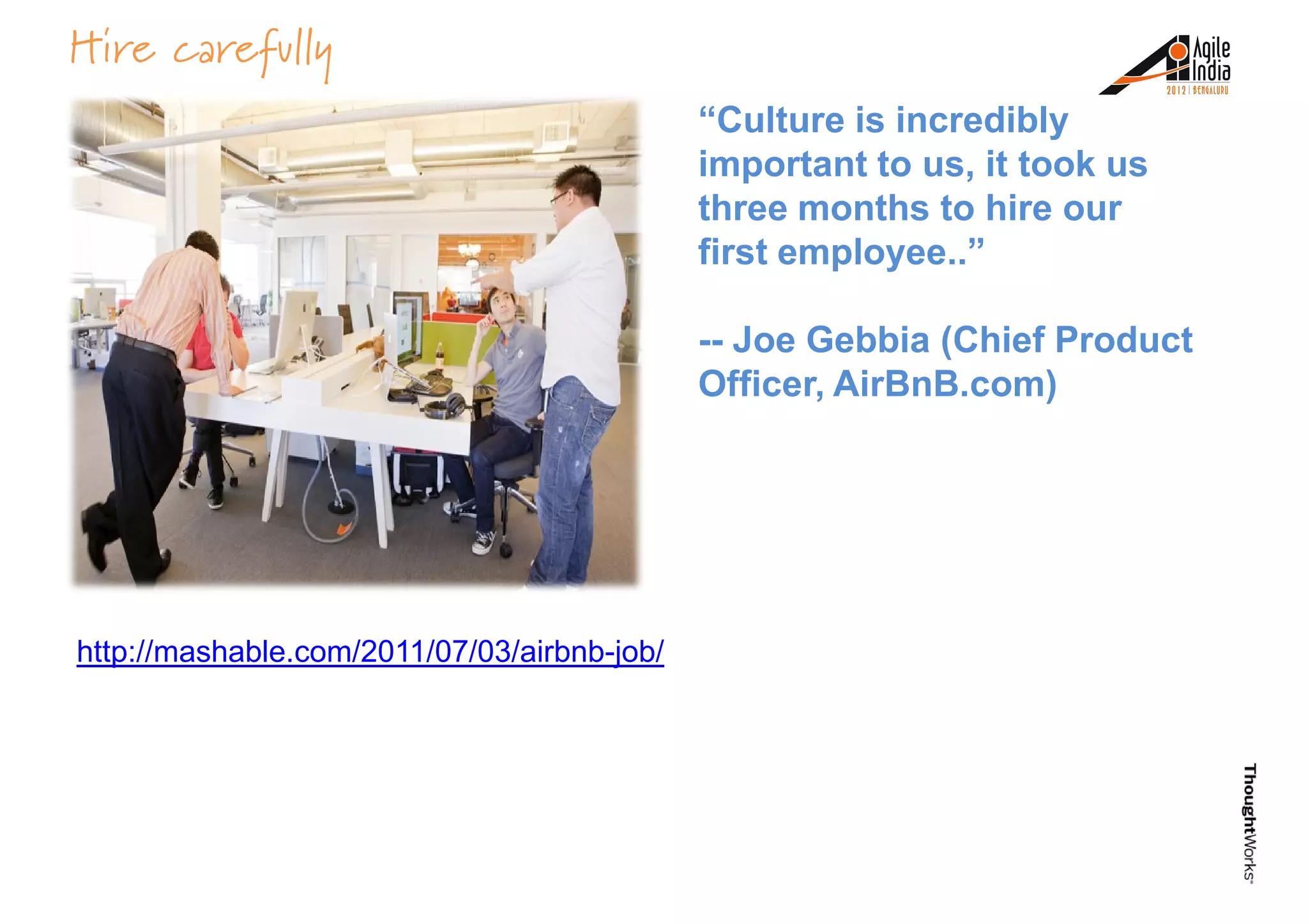
Hire carefully
“Culture is incredibly
important to us, it took us
three months to hire our
first employee..”
-- Joe Gebbia (Chief Product
Officer, AirBnB.com)
http://mashable.com/2011/07/03/airbnb-job/
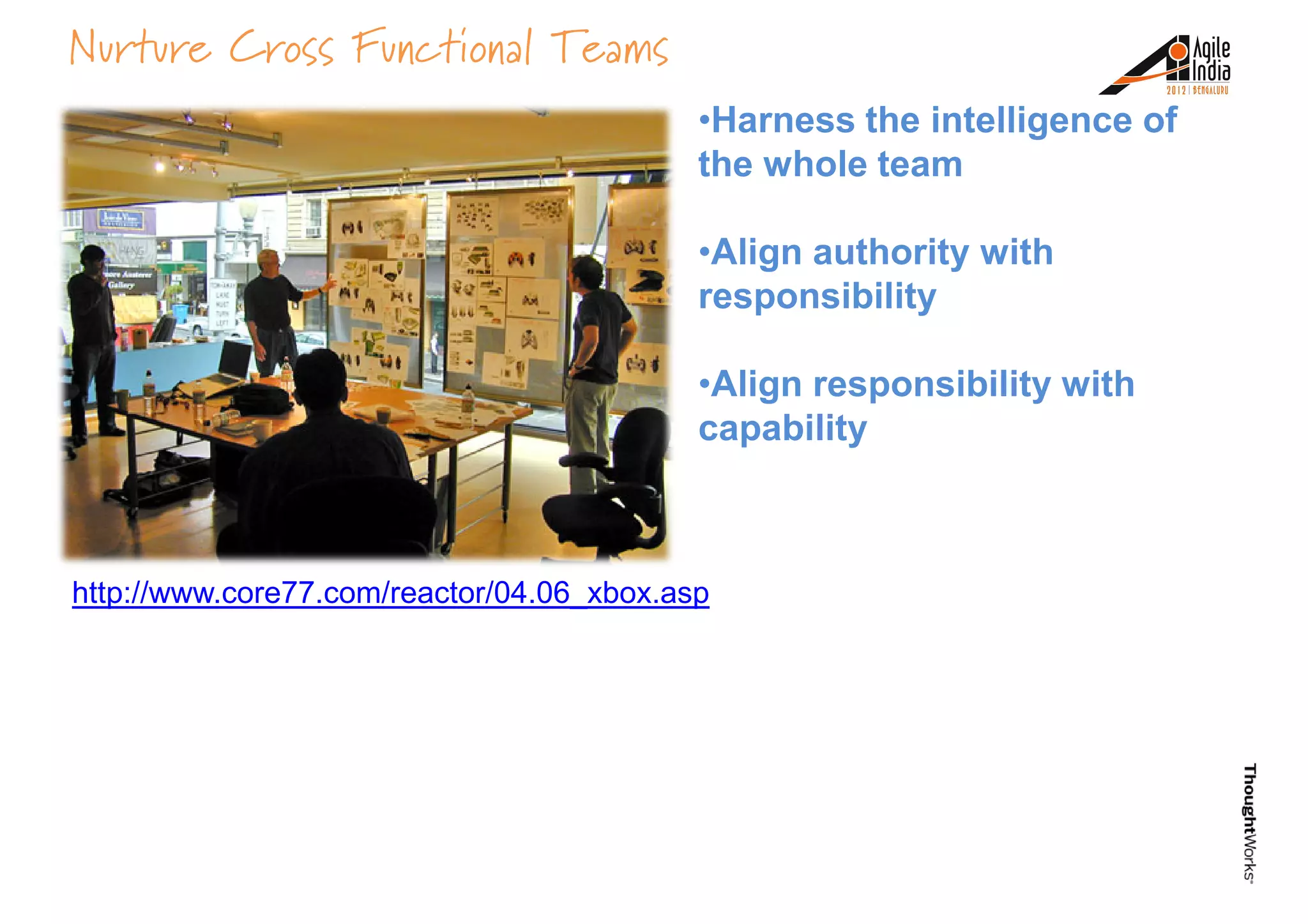
Nurture Cross Functional Teams
•Harness the intelligence of
the whole team
•Align authority with
responsibility
http://www.core77.com/reactor/04.06_xbox.asp
responsibility
•Align responsibility with
capability
Spawn Entrepreneurial Culture
“Revenue is >$700 million in 2010,
no one has a boss, employees
negotiate responsibilities with
their peers, everyone can spend
the company’s money, and eachthe company’s money, and each
individual is responsible for
procuring the tools needed to do
his or her work…”
First, Let’s Fire All The Managers –
Gary Hamel in HBR
http://hbr.org/2011/12/first-lets-fire-all-the-managers/ar/1
•Continually balance all
stakeholder risks against
business
value
Focus on Business Value
•Execute iteratively and
incrementally
http://www.fastcompany.com/most-innovative-companies/2012/legalzoom
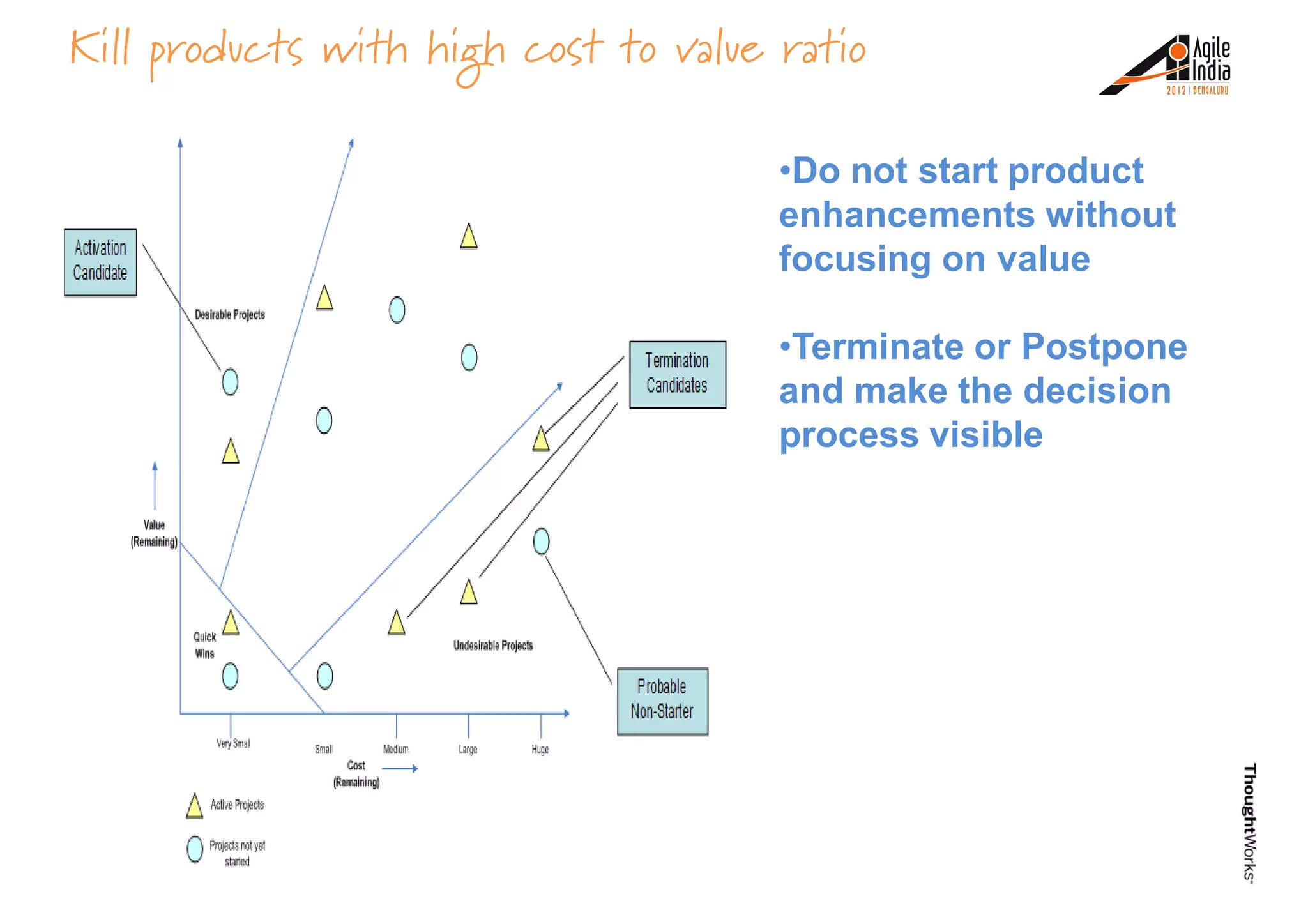
•Do not start product
enhancements without
focusing on value
Kill products with high cost to value ratio
•Terminate or Postpone
and make the decision
process visible
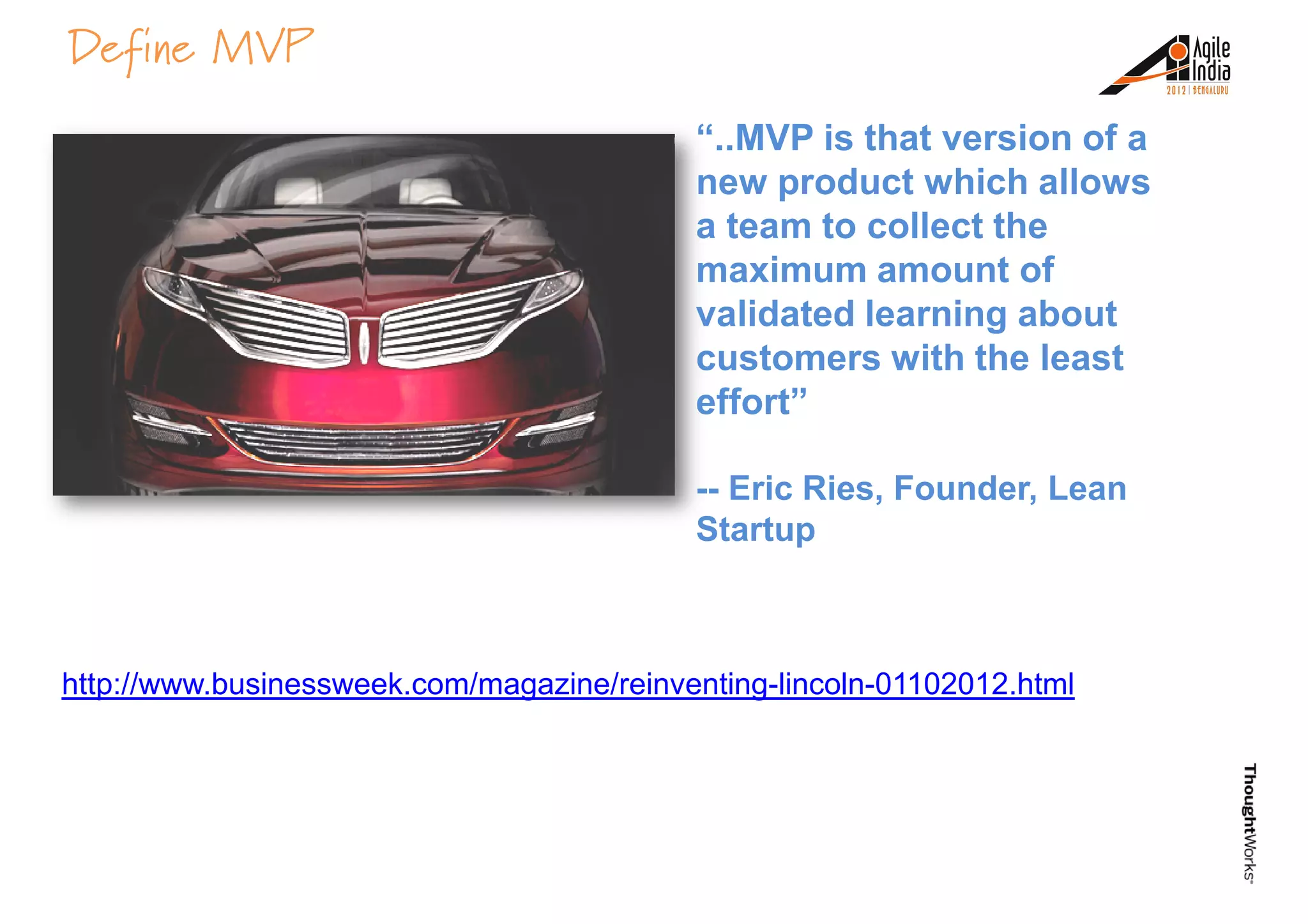
Define MVP
“..MVP is that version of a
new product which allows
a team to collect the
maximum amount of
validated learning aboutvalidated learning about
customers with the least
effort”
-- Eric Ries, Founder, Lean
Startup
http://www.businessweek.com/magazine/reinventing-lincoln-01102012.html
Monitor & Listen (& Change)
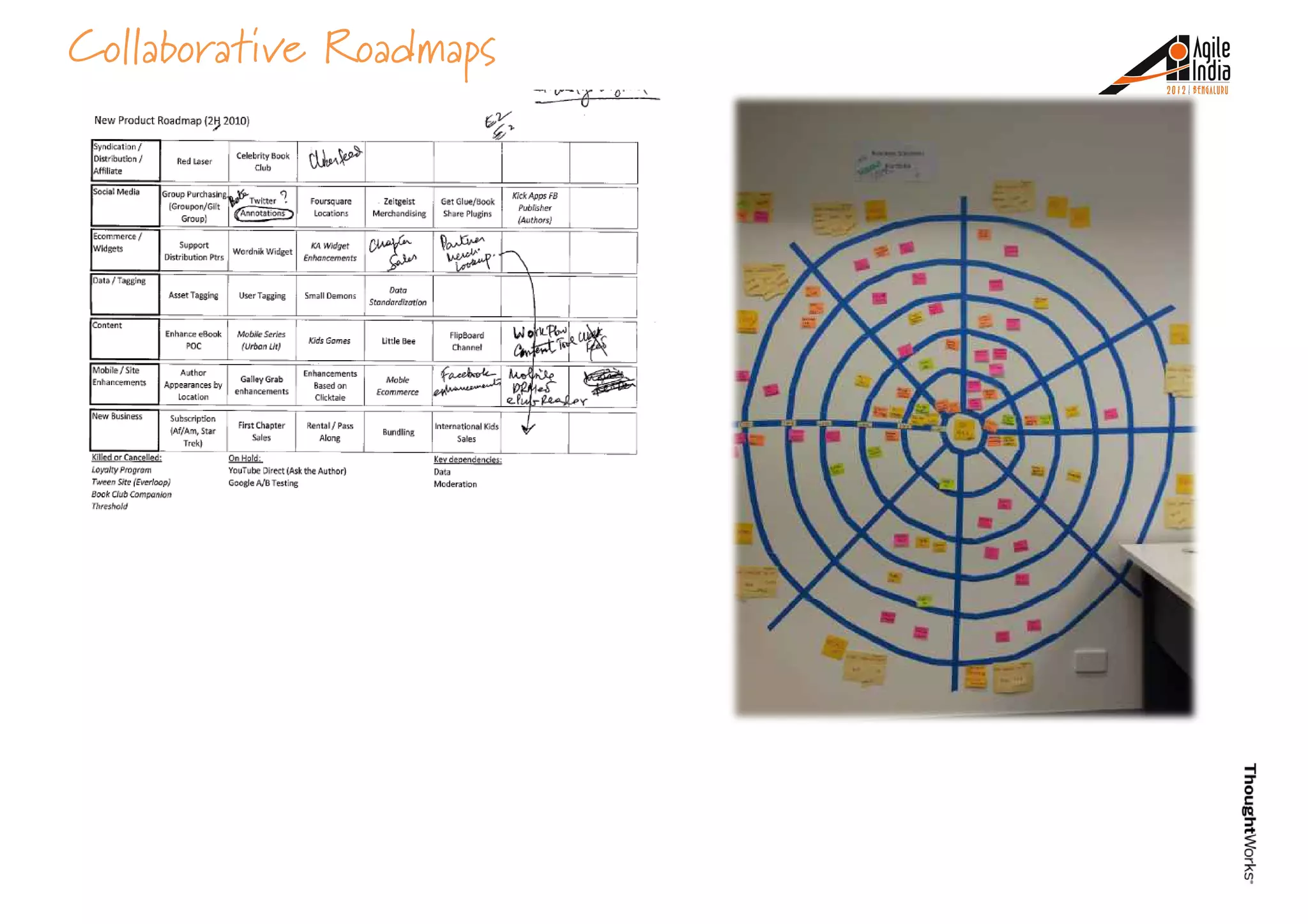
Collaborative Roadmaps
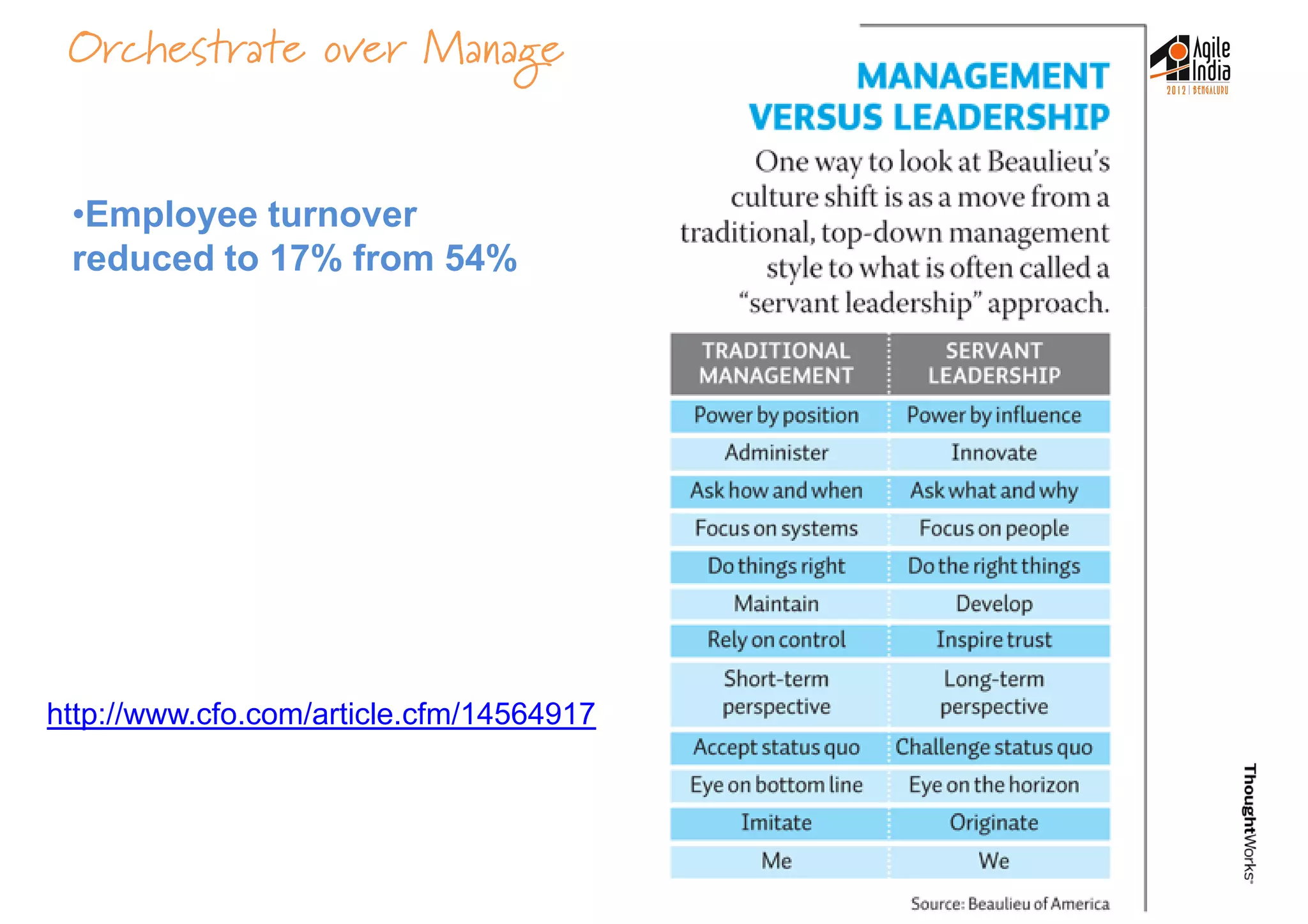
Orchestrate over Manage
•Employee turnover
reduced to 17% from 54%
http://www.cfo.com/article.cfm/14564917
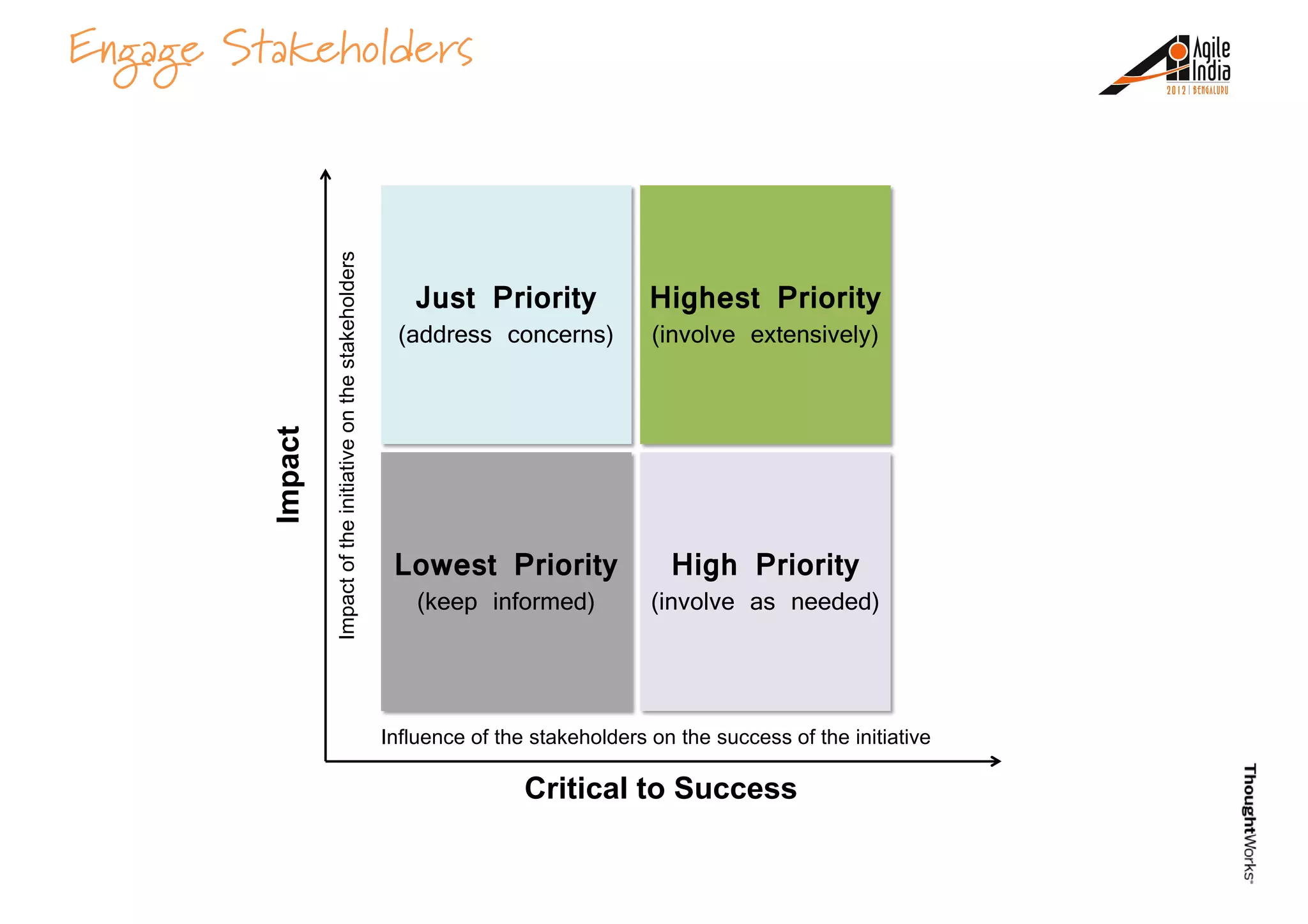
Engage Stakeholders
Highest PriorityJust Priority
Impactoftheinitiativeonthestakeholders
Highest Priority
(involve extensively)
High Priority
(involve as needed)
Just Priority
(address concerns)
Lowest Priority
(keep informed)
Impact
Impactoftheinitiativeonthestakeholders
(involve as needed)(keep informed)
Impactoftheinitiativeonthestakeholders
Critical to Success
Influence of the stakeholders on the success of the initiative
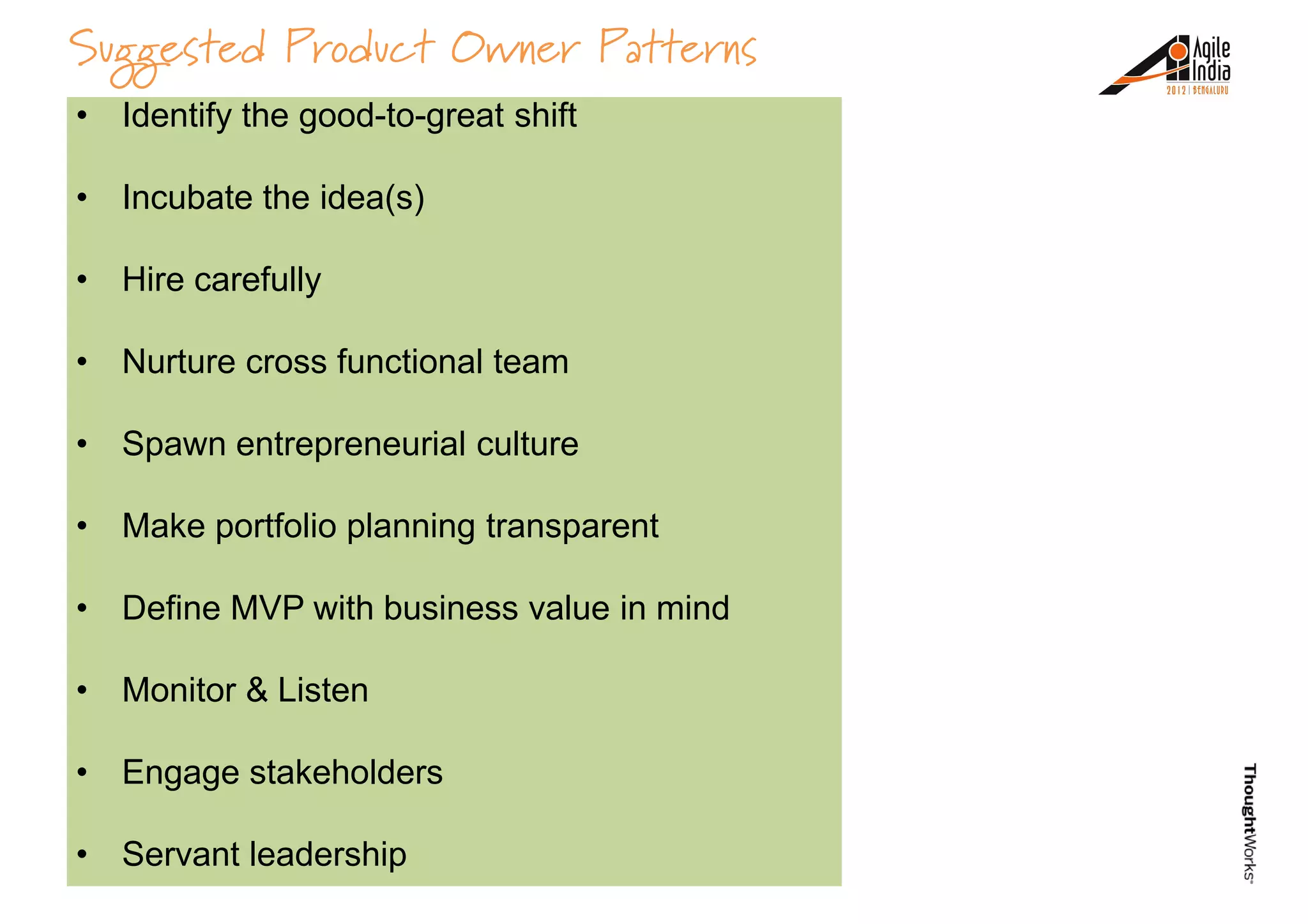
Suggested Product Owner Patterns
• Spheres of influence
• Organizational Model &
Culture
• Identify the good-to-great shift
• Incubate the idea(s)
• Hire carefully
• Business model validation
• Ignorance & Arrogance
• Nurture cross functional team
• Spawn entrepreneurial culture
• Make portfolio planning transparent
• Define MVP with business value in mind• Define MVP with business value in mind
• Monitor & Listen
• Engage stakeholders
• Servant leadership
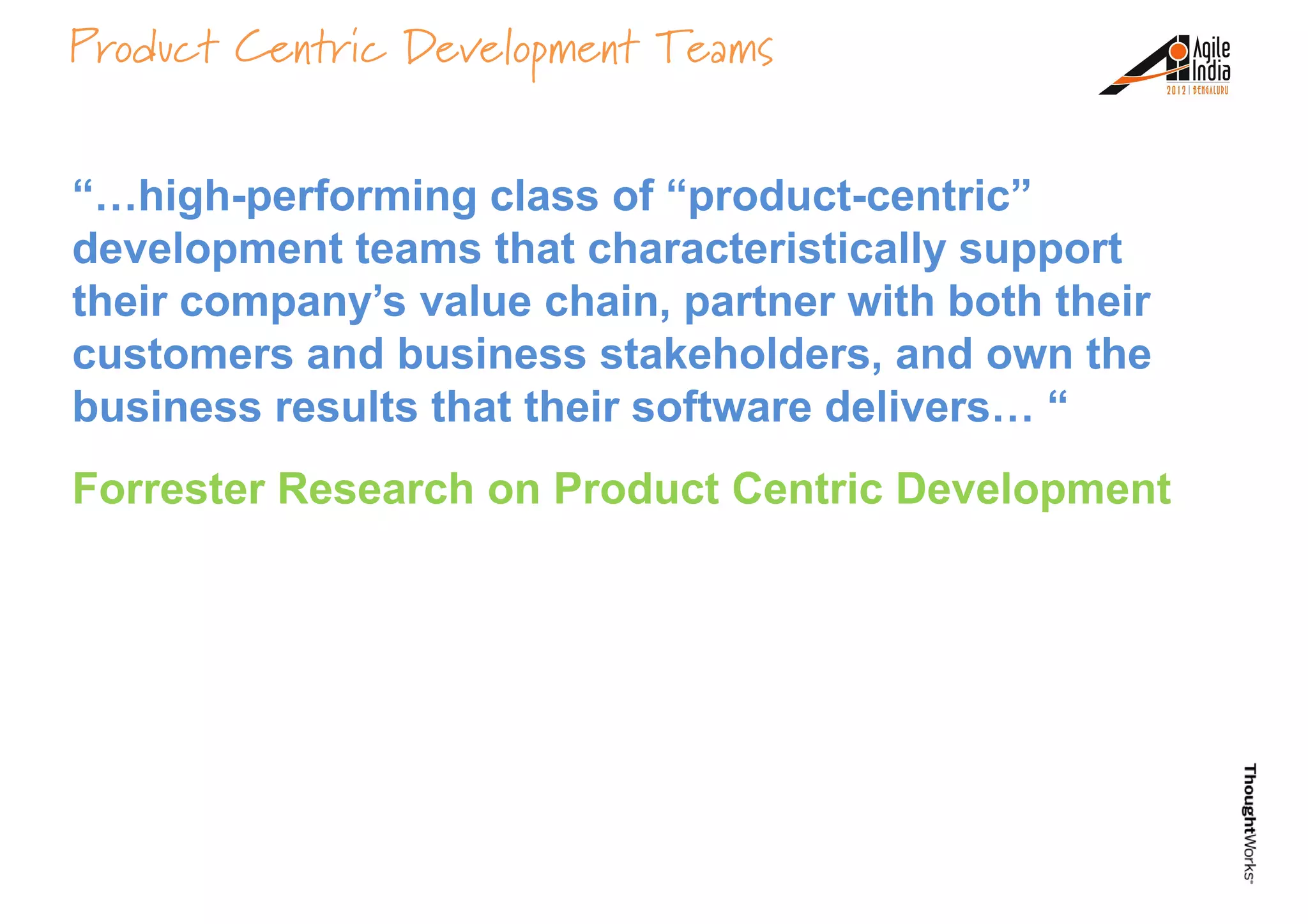
Product Centric Development Teams
“…high-performing class of “product-centric”
development teams that characteristically support
their company’s value chain, partner with both theirtheir company’s value chain, partner with both their
customers and business stakeholders, and own the
business results that their software delivers… “
Forrester Research on Product Centric Development
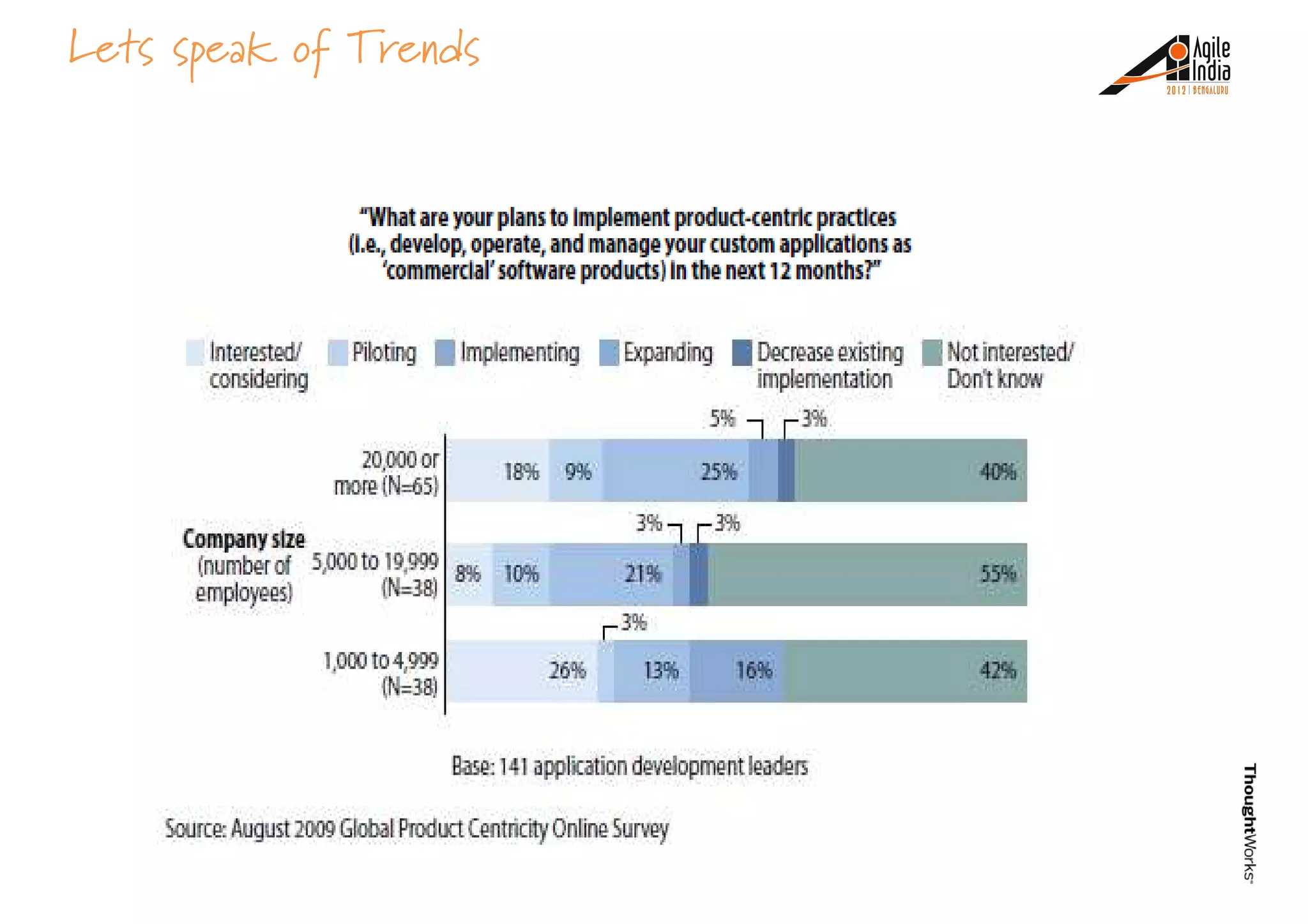
Lets speak of Trends
People-centred than process
centred
Customer focused
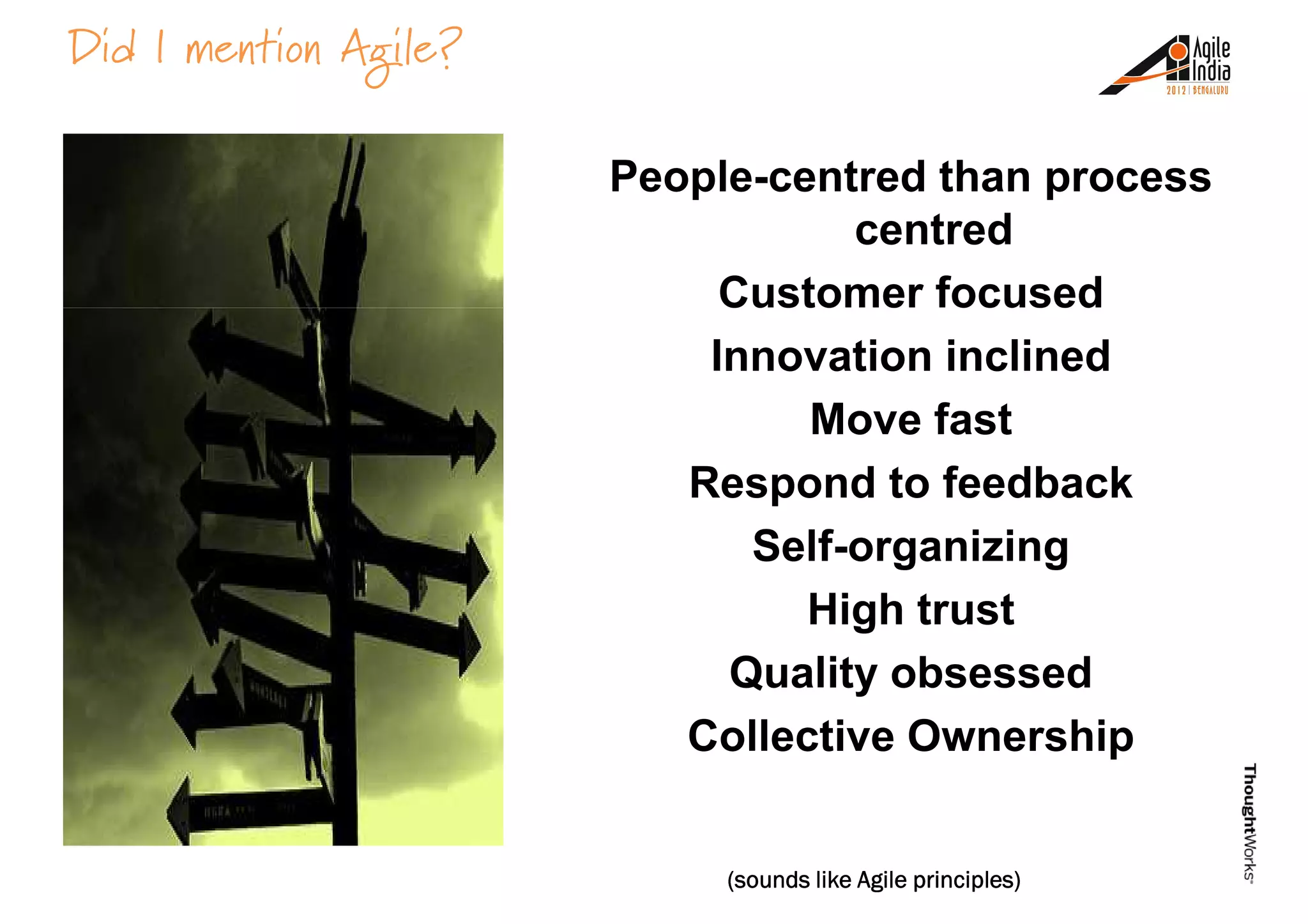
Did I mention Agile?
Customer focused
Innovation inclined
Move fast
Respond to feedback
Self-organizing
High trustHigh trust
Quality obsessed
Collective Ownership
(sounds like(sounds like(sounds like(sounds like Agile principles)Agile principles)Agile principles)Agile principles)
Questions??
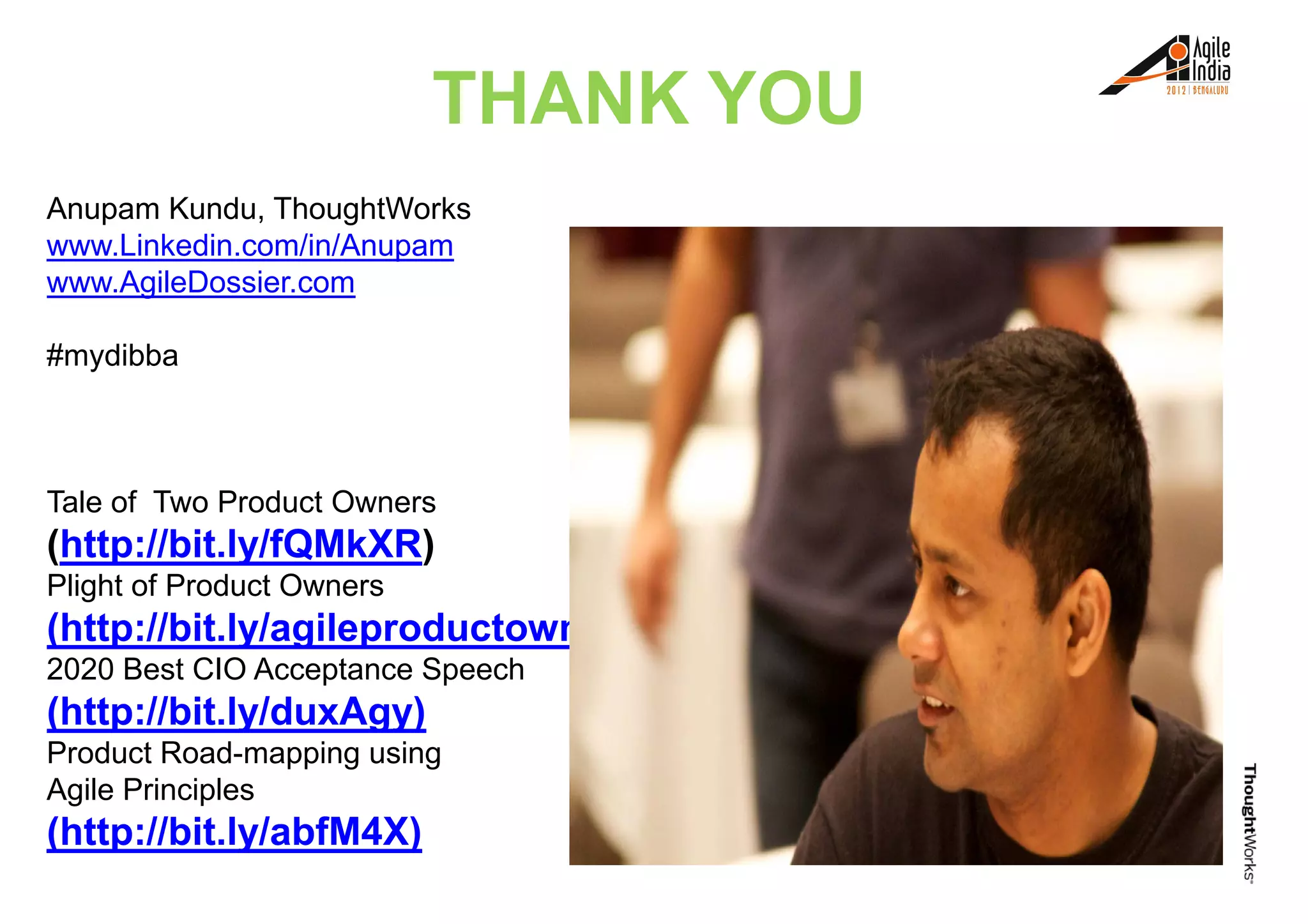
Anupam Kundu, ThoughtWorks
www.Linkedin.com/in/Anupam
www.AgileDossier.com
THANK YOU
#mydibba
Tale of Two Product Owners
(http://bit.ly/fQMkXR)
Plight of Product Owners
(http://bit.ly/agileproductowners)(http://bit.ly/agileproductowners)
2020 Best CIO Acceptance Speech
(http://bit.ly/duxAgy)
Product Road-mapping using
Agile Principles
(http://bit.ly/abfM4X)
•Build Cross-functional Teams (http://www.flickr.com/photos/activefree/137467210/)
•Spawn Entrepreneurial Culture (http://www.geoffsnyder.com/the-entrepreneurial-rift)
•Business Model Image (Jason Furnell, ThoughtWorks) / Alexander Osterwalder:
•http://www.forbes.com/sites/timworstall/2011/09/17/solyndra-yes-it-was-possible-to-see-this-failure-coming/
•http://en.wikipedia.org/wiki/Business_Model_Canvas
Image Courtesy
•http://en.wikipedia.org/wiki/Business_Model_Canvas
•Organizational Culture Symptoms (http://www.blacktomato.co.uk/44035/taiwan-art/)
•Focus on Business Value (Life Magazine Photography)
•Big Corporations Funding Start-ups (http://www.flickr.com/photos/nichollsphotos/2906834393/)
•Arrogant Bastard Ale (http://sandiegopho.com/menus/beers.html)
•Organization Culture (http://www.designofsignage.com/application/symbol/hands/largesymbols/number-seven-
7.html)
•Changing Perspectives (http://www.productmarketing.com/productmarketing/magazine/1/2/07sj.asp)
• Think Differently (http://blog.stackoverflow.com/2008/07/stack-overflow-private-beta-begins/)
• Lincoln MKZ spy shot (http://blog.davis-moore.com/2011/09/lincoln-mkz-under-cover/)
• Some imagery and clip-arts borrowed from ThoughtWorks• Some imagery and clip-arts borrowed from ThoughtWorks

How to Be A Successful Agile Product Manager

  • 1.
    Ready to bea Successful Agile Product Manager? Anupam Kundu www.Agiledossier.com / Twitter: mydibba
  • 2.
    Short Story ofBusiness And IT
  • 3.
    The Product ManagementEcosystem strategy, forecasts, commitments, roadmaps,budgets, staff, Development Mktg & Sales Executives Product Management market information, priorities, requirements, roadmaps, MRDs, personas, user stories… software/ product commitments, roadmaps, competitive intelligence budgets, staff, targets Field input, Market feedback Markets & Customers product Segmentation, messages, benefits/features, pricing, qualification, demos… Inspired from Rich Mironov, author of “The Art of Product Management”
  • 4.
    The Common Thread:2011 http://finance.yahoo.com/news/the-worst-product-flops-of-2011.html
  • 5.
    Where are theGood Product People?
  • 6.
    Who is aProduct Manager? …who investigates, selects and develop one or more products for an organization... …delivers more value…delivers more value than the competition …creates a sustainable competitive difference …generates business…generates business benefit to the organization Wikipedia
  • 7.
    Pragmatic Marketing Framework TalkstoBuilds the Listens to the Market Talks to the Market Builds the Product
  • 8.
    market information, priorities, requirements,roadmaps, wireframes, alpha launch, beta testing, minimum viable product, Product Development is a Continuous Process wireframes, personas, user stories minimum viable product, build know-how monitoring and ideas / refinement five whys, product roadmap, forecast, competitive intelligence, Stakeholder inputs Real-time monitoring, alerts, funnel analysis, pricing feedback, segmentation , NPS monitoring and listening analyze product- market fit refinement
  • 9.
    “We are Agile” ProductOwners…who makes decisions about what the product should do while taking into account what people who make buying decisions actually want... Jeff PattonJeff Patton • Create and nurture a product vision for the team • Establish priorities to track business value • Act as ‘the customer’ for developer questions • Work with team to do release planning • Plan, elaborate and accept user stories and iterations • Works side by side with engineering
  • 10.
    Resetting Expectations PM ResponsibilitiesTraditional Agile Understand Customer Needs Upfront and Discontinuous Constant feedback driven process Documentation Fully elaborated (MRD, FS) Coarsely defined (Vision, Epics) Scheduling Six month to Six Year Release Continuous short term release roadmaps Prioritization Never or one time in MRD Continuous Validation NA – “We have QA” Continuous – more frequent than ever Change Management Prohibit or delay changes due to cost Inspect and adapt frequently (release boundaries) Assess Status Milestone Reviews Docs Inspect code and feature quality frequently Release Planning Crystal Ball Transparent , Collaborative and fact driven
  • 11.
  • 12.
    Product Owner Challenges •Spheres of Influence • Organizational Model & Culture • Business model validation• Business model validation • Ignorance & Arrogance
  • 13.
    Spheres of Influence Portfolio Divisionlevel objectives and goals Prioritized product road map Strategy Product roadmap and business strategy Daily Release What business objectives will each release achieve? What capabilities will the release offer? Release plan Product Business objectives fulfilled by the product Product Vision Product life cycle road map business strategy Daily story backlog Story Details Acceptance Tests Sprint Planning What stories must be included in the sprint to achieve release objectives? Iteration Plan Sprint velocity/capacity
  • 14.
    Classic Symptoms Absentee ProductTeam •Product Vision is not well defined or undefined •Limited interaction with engineering and marketing •Too many commitments and priorities fighting for attention •Mismanagement of stakeholder expectations across layers •Late feedback
  • 15.
    Organizational Model &Culture • Innovation & Risk taking • Stability & Control • Attention to detail • Outcome orientation • People orientation • Team orientation • Aggressiveness
  • 16.
    Classic Symptoms Un-empowered Product Team •Decisionsare overridden by other departments andby other departments and individuals •Limited or no influence on technology staffing and selection •This is way things get done•This is way things get done around here •Late feedback
  • 17.
  • 18.
    Classic Symptoms Un-trusted ProductTeam •Limited engagement of the product folks with strategy, marketing and engineeringmarketing and engineering •Too many organizational buy-in hurdles •Continually delayed launch dates •Extensive rework before launch •Late feedback
  • 19.
    Arrogant PO /Product Team
  • 20.
    Classic Symptoms Single pointof failure •No respect for any metric produced by the teams on groundground •Public reversal of team decisions •Treats humans as machines •Too much hand waving instead of reality check •Late feedback
  • 21.
    The Grand Overlap Spheresof Influence No Business Model Validation Organizational Model and Culture Arrogance and Ignorance and Culture
  • 22.
  • 23.
    Slow to moveor change vs. Change fast Focus on process vs. Focus on outcome Product Owners in large corporations vs. startups Risk averseness vs. Risk adoption Pass the buck vs. Yes, we can Low participation vs. High-impact per person Lack of innovation “soul” vs. Pivoting ideas for new markets Existing business models vs. Find new and repeatable ones No mentoring vs. Constant learning www.SteveBlank.com
  • 24.
  • 25.
    Good to Great– Jim Collins What are we deeply passionate about? What drives our economic engine? What can we be the best in the world at?
  • 26.
  • 27.
  • 28.
    Hire carefully “Culture isincredibly important to us, it took us three months to hire our first employee..” -- Joe Gebbia (Chief Product Officer, AirBnB.com) http://mashable.com/2011/07/03/airbnb-job/
  • 29.
    Nurture Cross FunctionalTeams •Harness the intelligence of the whole team •Align authority with responsibility http://www.core77.com/reactor/04.06_xbox.asp responsibility •Align responsibility with capability
  • 30.
    Spawn Entrepreneurial Culture “Revenueis >$700 million in 2010, no one has a boss, employees negotiate responsibilities with their peers, everyone can spend the company’s money, and eachthe company’s money, and each individual is responsible for procuring the tools needed to do his or her work…” First, Let’s Fire All The Managers – Gary Hamel in HBR http://hbr.org/2011/12/first-lets-fire-all-the-managers/ar/1
  • 31.
    •Continually balance all stakeholderrisks against business value Focus on Business Value •Execute iteratively and incrementally http://www.fastcompany.com/most-innovative-companies/2012/legalzoom
  • 32.
    •Do not startproduct enhancements without focusing on value Kill products with high cost to value ratio •Terminate or Postpone and make the decision process visible
  • 33.
    Define MVP “..MVP isthat version of a new product which allows a team to collect the maximum amount of validated learning aboutvalidated learning about customers with the least effort” -- Eric Ries, Founder, Lean Startup http://www.businessweek.com/magazine/reinventing-lincoln-01102012.html
  • 34.
    Monitor & Listen(& Change)
  • 35.
  • 36.
    Orchestrate over Manage •Employeeturnover reduced to 17% from 54% http://www.cfo.com/article.cfm/14564917
  • 37.
    Engage Stakeholders Highest PriorityJustPriority Impactoftheinitiativeonthestakeholders Highest Priority (involve extensively) High Priority (involve as needed) Just Priority (address concerns) Lowest Priority (keep informed) Impact Impactoftheinitiativeonthestakeholders (involve as needed)(keep informed) Impactoftheinitiativeonthestakeholders Critical to Success Influence of the stakeholders on the success of the initiative
  • 38.
    Suggested Product OwnerPatterns • Spheres of influence • Organizational Model & Culture • Identify the good-to-great shift • Incubate the idea(s) • Hire carefully • Business model validation • Ignorance & Arrogance • Nurture cross functional team • Spawn entrepreneurial culture • Make portfolio planning transparent • Define MVP with business value in mind• Define MVP with business value in mind • Monitor & Listen • Engage stakeholders • Servant leadership
  • 39.
    Product Centric DevelopmentTeams “…high-performing class of “product-centric” development teams that characteristically support their company’s value chain, partner with both theirtheir company’s value chain, partner with both their customers and business stakeholders, and own the business results that their software delivers… “ Forrester Research on Product Centric Development
  • 40.
  • 41.
    People-centred than process centred Customerfocused Did I mention Agile? Customer focused Innovation inclined Move fast Respond to feedback Self-organizing High trustHigh trust Quality obsessed Collective Ownership (sounds like(sounds like(sounds like(sounds like Agile principles)Agile principles)Agile principles)Agile principles)
  • 42.
  • 43.
    Anupam Kundu, ThoughtWorks www.Linkedin.com/in/Anupam www.AgileDossier.com THANKYOU #mydibba Tale of Two Product Owners (http://bit.ly/fQMkXR) Plight of Product Owners (http://bit.ly/agileproductowners)(http://bit.ly/agileproductowners) 2020 Best CIO Acceptance Speech (http://bit.ly/duxAgy) Product Road-mapping using Agile Principles (http://bit.ly/abfM4X)
  • 44.
    •Build Cross-functional Teams(http://www.flickr.com/photos/activefree/137467210/) •Spawn Entrepreneurial Culture (http://www.geoffsnyder.com/the-entrepreneurial-rift) •Business Model Image (Jason Furnell, ThoughtWorks) / Alexander Osterwalder: •http://www.forbes.com/sites/timworstall/2011/09/17/solyndra-yes-it-was-possible-to-see-this-failure-coming/ •http://en.wikipedia.org/wiki/Business_Model_Canvas Image Courtesy •http://en.wikipedia.org/wiki/Business_Model_Canvas •Organizational Culture Symptoms (http://www.blacktomato.co.uk/44035/taiwan-art/) •Focus on Business Value (Life Magazine Photography) •Big Corporations Funding Start-ups (http://www.flickr.com/photos/nichollsphotos/2906834393/) •Arrogant Bastard Ale (http://sandiegopho.com/menus/beers.html) •Organization Culture (http://www.designofsignage.com/application/symbol/hands/largesymbols/number-seven- 7.html) •Changing Perspectives (http://www.productmarketing.com/productmarketing/magazine/1/2/07sj.asp) • Think Differently (http://blog.stackoverflow.com/2008/07/stack-overflow-private-beta-begins/) • Lincoln MKZ spy shot (http://blog.davis-moore.com/2011/09/lincoln-mkz-under-cover/) • Some imagery and clip-arts borrowed from ThoughtWorks• Some imagery and clip-arts borrowed from ThoughtWorks