
Gravity
Confessions of a serial intrapreneur
Harsh Jawharkar
Before we begin…
 The opinions expressed are solely my own based on
lessons learned over the last 14 years across multiple
industries and circumstances
 Practical lessons learned, no theory, no prescriptions
 Please share your own learnings and feedback –
hjawharkar@gmail.com
2
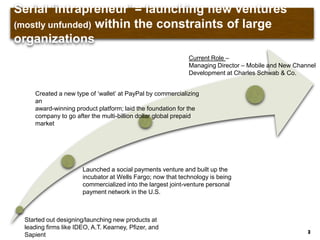
Serial „intrapreneur‟ = launching new ventures (mostly
unfunded) within the constraints of large organizations
3
Started out designing/launching new products at
leading firms like IDEO, A.T. Kearney, Pfizer, and
Sapient
Launched a social payments venture and built up the
incubator at Wells Fargo; now that technology is being
commercialized into the largest joint-venture personal
payment network in the U.S.
Created a new type of „wallet‟ at PayPal by commercializing
an
award-winning product platform; laid the foundation for the
company to go after the multi-billion dollar global prepaid
market
Current Role –
Managing Director – Mobile and New Channel
Development at Charles Schwab & Co.
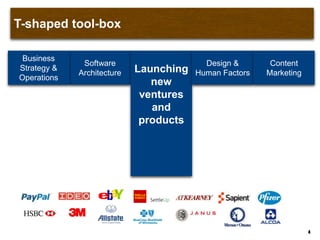
T-shaped tool-box
4
Channel
Marketing Launching
new
ventures
and
products
Design &
Human Factors
Digital
Advertising
Business
Strategy &
Operations
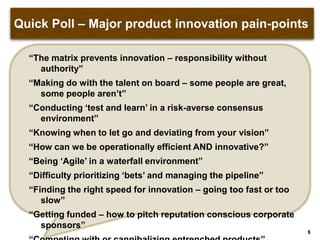
Quick Poll – Major product innovation pain-points
“The matrix prevents innovation – responsibility without authority”
“Making do with the talent on board – some people are great, some
people aren‟t”
“Conducting „test and learn‟ in a risk-averse consensus environment”
“Knowing when to let go and deviating from your vision”
“How can we be operationally efficient AND innovative?”
“Being „Agile‟ in a waterfall environment”
“Difficulty prioritizing „bets‟ and managing the pipeline”
“Finding the right speed for innovation – going too fast or too slow”
“Getting funded – how to pitch reputation conscious corporate
sponsors”
“Competing with or cannibalizing entrenched products”
5
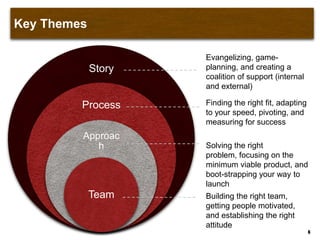
Key Themes
6
Story
Process
Approach
Team Building the right team,
getting people motivated,
and establishing the right
attitude
Solving the right problem,
focusing on the minimum
viable product, and boot-
strapping your way to launch
Finding the right fit, adapting
to your speed, pivoting, and
measuring for success
Evangelizing, game-
planning, and creating a
coalition of support (internal
and external)
Building the right team
7
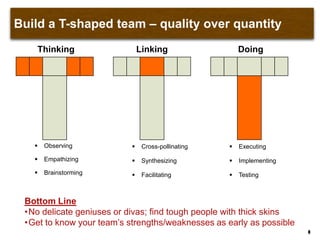
Build a T-shaped team – quality over quantity
Thinking Linking Doing
 Observing
 Empathizing
 Brainstorming
 Cross-pollinating
 Synthesizing
 Facilitating
 Executing
 Implementing
 Testing
8
Bottom Line
•No delicate geniuses or divas; find tough people with thick skins
•Get to know your team‟s strengths/weaknesses as early as possible
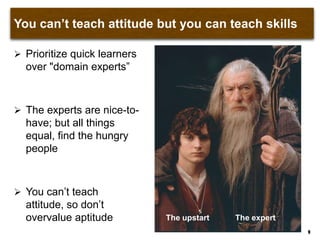
You can‟t teach attitude but you can teach skills
 Prioritize quick learners
over "domain experts”
 The experts are nice-to-
have; but all things
equal, find the hungry
people
 You can‟t teach attitude,
so don‟t overvalue
aptitude
9
The upstart The expert
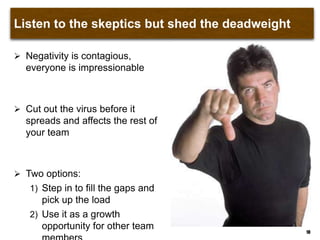
Listen to the skeptics but shed the deadweight
 Negativity is contagious,
everyone is impressionable
 Cut out the virus before it
spreads and affects the rest of
your team
 Two options:
1) Step in to fill the gaps and
pick up the load
2) Use it as a growth
opportunity for other team 10
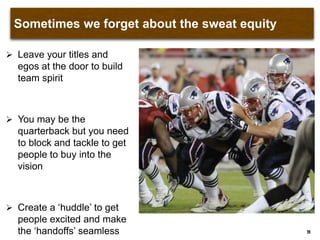
Sometimes we forget about the sweat equity
 Leave your titles and
egos at the door to build
team spirit
 You may be the
quarterback but you need
to block and tackle to get
people to buy into the
vision
 Create a „huddle‟ to get
people excited and make
the „handoffs‟ seamless 11
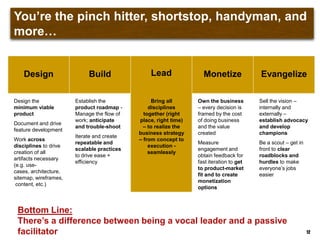
You‟re the pinch hitter, shortstop, handyman, and more…
Design Build Lead Monetize Evangelize
Design the
minimum viable
product
Document and drive
feature development
Work across
disciplines to drive
creation of all
artifacts necessary
(e.g. use-cases,
architecture,
sitemap, wireframes,
content, etc.)
Establish the
product roadmap -
Manage the flow of
work; anticipate
and trouble-shoot
Iterate and create
repeatable and
scalable practices
to drive ease +
efficiency
Own the business
– every decision is
framed by the cost
of doing business
and the value
created
Measure
engagement and
obtain feedback for
fast iteration to get
to product-market
fit and to create
monetization
options
Sell the vision –
internally and
externally –
establish advocacy
and develop
champions
Be a scout – get in
front to clear
roadblocks and
hurdles to make
everyone‟s jobs
easier
Bring all
disciplines
together (right
place, right time)
– to realize the
business strategy
– from concept to
execution -
seamlessly
12
Bottom Line:
There‟s a difference between being a decisive leader and a
passive „manager‟
Approaching the problem
13
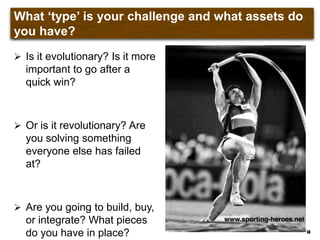
What „type‟ is your challenge and what assets do you
have?
 Is it evolutionary? Is it more
important to go after a
quick win?
 Or is it revolutionary? Are
you solving something
everyone else has failed
at?
 Are you going to build, buy,
or integrate? What pieces
do you have in place? 14
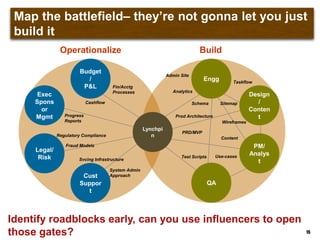
Map the battlefield– they‟re not gonna let you just build it
Operationalize Build
Lynchpi
n
Budget
/
P&L
Legal/
Risk
Exec
Spons
or
Mgmt
PRD/MVP
Wireframes
Taskflow
Sitemap
Use-casesTest Scripts
Content
Schema
Prod Architecture
Cashflow
Progress
Reports
Regulatory Compliance
Fraud Models
Cust
Suppor
t
Svcing Infrastructure
Admin Site
Fin/Acctg
Processes Analytics
System Admin
Approach
Engg
Design
/
Conten
t
PM/
Analys
t
QA
15
Identify roadblocks early, can you use influencers to open
those gates?
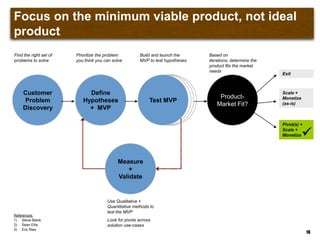
Focus on the minimum viable product, not ideal product
Customer
Problem
Discovery
Define
Hypotheses
+ MVP
Test MVP
Measure
+
Validate
Product-
Market Fit?
Exit
Scale +
Monetize
(as-is)
Pivot(s) +
Scale +
Monetize
References:
1) Steve Blank
2) Sean Ellis
3) Eric Ries

Use Qualitative +
Quantitative methods to
test the MVP
Look for pivots across
solution use-cases
Find the right set of
problems to solve
Prioritize the problem
you think you can solve
Build and launch the
MVP to test hypotheses
Based on iterations,
determine the product
fits the market needs
16
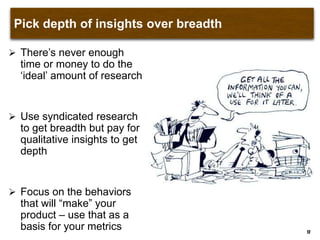
Pick depth of insights over breadth
 There‟s never enough
time or money to do the
„ideal‟ amount of research
 Use syndicated research
to get breadth but pay for
qualitative insights to get
depth
 Focus on the behaviors
that will “make” your
product – use that as a
basis for your metrics 17
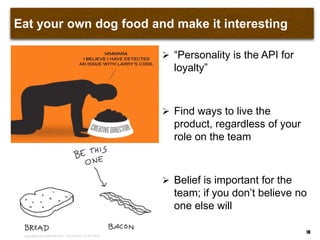
Eat your own dog food and make it interesting
18
 “Personality is the API for
loyalty”
 Find ways to live the
product, regardless of your
role on the team
 Belief is important for the
team; if you don‟t believe no
one else will
Sources:bigorangeslide.com, Fred Wilson‟s A VC Blog
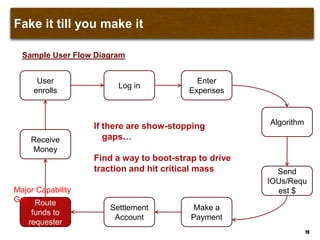
Fake it till you make it
19
User
enrolls
Log in
Enter
Expenses
Algorithm
Send
IOUs/Requ
est $
Make a
Payment
Settlement
Account
Route
funds to
requester
Receive
Money
Major Capability
Gap
If there are show-stopping
gaps…
Find a way to boot-strap to drive
traction and hit critical mass
Sample User Flow Diagram
Customizing the Process
20
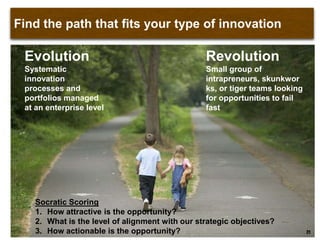
Find the path that fits your type of innovation
21
Evolution
Systematic
innovation
processes and
portfolios managed
at an enterprise level
Revolution
Small group of
intrapreneurs,
skunkworks, or tiger
teams looking for
opportunities to fail fast
Socratic Scoring
1. How attractive is the opportunity?
2. What is the level of alignment with our strategic objectives?
3. How actionable is the opportunity?
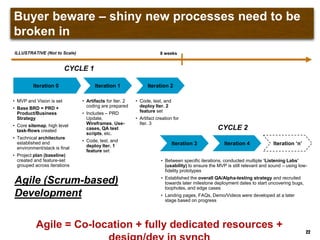
Buyer beware – shiny new processes need to be broken in
Iteration 0 Iteration 1 Iteration 2
8 weeksILLUSTRATIVE (Not to Scale)
CYCLE 1
CYCLE 2
• MVP and Vision is set
• Base BRD = PRD +
Product/Business
Strategy
• Core sitemap, high level
task-flows created
• Technical architecture
established and
environment/stack is final
• Project plan (baseline)
created and feature-set
grouped across iterations
• Artifacts for Iter. 2
coding are prepared
• Includes – PRD
Update,
Wireframes, Use-
cases, QA test
scripts, etc.
• Code, test, and
deploy Iter. 1
feature set
• Code, test, and
deploy Iter. 2
feature set
• Artifact creation for
Iter. 3
• Between specific iterations, conducted multiple „Listening Labs‟
(usability) to ensure the MVP is still relevant and sound – using low-
fidelity prototypes
• Established the overall QA/Alpha-testing strategy and recruited
towards later milestone deployment dates to start uncovering bugs,
loopholes, and edge cases
• Landing pages, FAQs, Demo/Videos were developed at a later
stage based on progress
Iteration 3 Iteration 4 Iteration „n‟
Agile (Scrum-based)
Development
22
Agile = Co-location + fully dedicated resources +
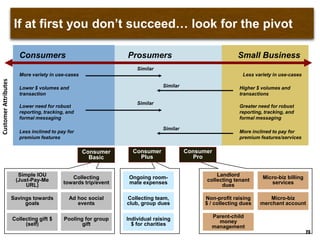
If at first you don‟t succeed… look for the pivot
Savings towards
goals
Small BusinessConsumers
CustomerAttributes
More variety in use-cases
Prosumers
Less variety in use-cases
Lower $ volumes and
transaction
Higher $ volumes and
transactions
Similar
Similar
Lower need for robust
reporting, tracking, and
formal messaging
Greater need for robust
reporting, tracking, and
formal messaging
Similar
Less inclined to pay for
premium features
More inclined to pay for
premium features/services
Similar
Collecting gift $
(self)
Collecting
towards trip/event
Ad hoc social
events
Pooling for group
gift
Ongoing room-
mate expenses
Collecting team,
club, group dues
Simple IOU
(Just-Pay-Me
URL)
Landlord
collecting tenant
dues
Non-profit raising
$ / collecting dues
Micro-biz billing
services
Micro-biz
merchant account
Parent-child
money
management
Individual raising
$ for charities
Consumer
Plus
Consumer
Pro
Consumer
Basic
23
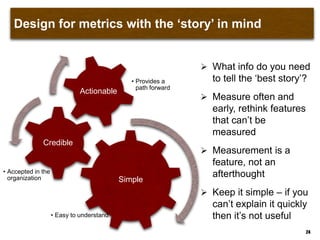
Design for metrics with the „story‟ in mind
 What info do you need
to tell the „best story‟?
 Measure often and
early, rethink features
that can‟t be
measured
 Measurement is a
feature, not an
afterthought
 Keep it simple – if you
can‟t explain it quickly
then it‟s not useful
24
Simple
• Easy to understand
Credible
• Accepted in the
organization
Actionable
• Provides a
path forward
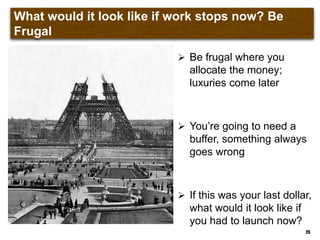
What would it look like if work stops now? Be Frugal
 Be frugal where you
allocate the money;
luxuries come later
 You‟re going to need a
buffer, something always
goes wrong
 If this was your last dollar,
what would it look like if
you had to launch now?
25
Telling the Story
26
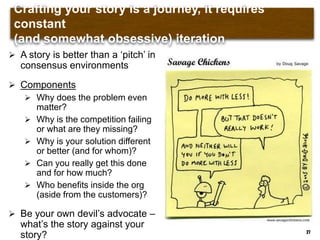
Crafting your story is a journey, it requires constant (and
somewhat obsessive) iteration
27
 A story is better than a „pitch‟ in
consensus environments
 Components
 Why does the problem even
matter?
 Why is the competition failing
or what are they missing?
 Why is your solution different
or better (and for whom)?
 Can you really get this done
and for how much?
 Who benefits inside the org
(aside from the customers)?
 Be your own devil‟s advocate –
what‟s the story against your
story?
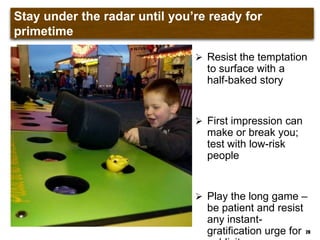
Stay under the radar until you‟re ready for primetime
 Resist the temptation
to surface with a
half-baked story
 First impression can
make or break you;
test with low-risk
people
 Play the long game –
be patient and resist
any instant-
gratification urge for 28
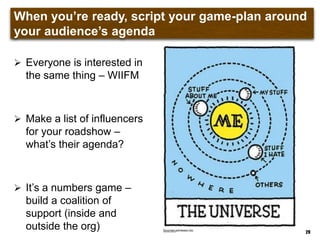
When you‟re ready, script your game-plan around your
audience‟s agenda
 Everyone is interested in
the same thing – WIIFM
 Make a list of influencers
for your roadshow –
what‟s their agenda?
 It‟s a numbers game –
build a coalition of
support (inside and
outside the org) 29
Sources:johnlesko.biz
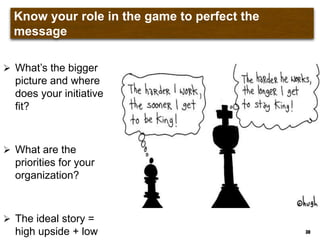
Know your role in the game in order to perfect the
message
 What‟s the bigger
picture and where
does your initiative
fit?
 What are the
priorities for your
organization?
 The ideal story =
high upside + low 30
Thank You!
 Harsh Jawharkar
 http://www.linkedin.com/in/harsh
 https://www.twitter.com/hjawharkar
31

Gravity v0.2

  • 1.
    Gravity Confessions of aserial intrapreneur Harsh Jawharkar
  • 2.
    Before we begin… The opinions expressed are solely my own based on lessons learned over the last 14 years across multiple industries and circumstances  Practical lessons learned, no theory, no prescriptions  Please share your own learnings and feedback – hjawharkar@gmail.com 2
  • 3.
    Serial „intrapreneur‟ =launching new ventures (mostly unfunded) within the constraints of large organizations 3 Started out designing/launching new products at leading firms like IDEO, A.T. Kearney, Pfizer, and Sapient Launched a social payments venture and built up the incubator at Wells Fargo; now that technology is being commercialized into the largest joint-venture personal payment network in the U.S. Created a new type of „wallet‟ at PayPal by commercializing an award-winning product platform; laid the foundation for the company to go after the multi-billion dollar global prepaid market Current Role – Managing Director – Mobile and New Channel Development at Charles Schwab & Co.
  • 4.
    T-shaped tool-box 4 Channel Marketing Launching new ventures and products Design& Human Factors Digital Advertising Business Strategy & Operations
  • 5.
    Quick Poll –Major product innovation pain-points “The matrix prevents innovation – responsibility without authority” “Making do with the talent on board – some people are great, some people aren‟t” “Conducting „test and learn‟ in a risk-averse consensus environment” “Knowing when to let go and deviating from your vision” “How can we be operationally efficient AND innovative?” “Being „Agile‟ in a waterfall environment” “Difficulty prioritizing „bets‟ and managing the pipeline” “Finding the right speed for innovation – going too fast or too slow” “Getting funded – how to pitch reputation conscious corporate sponsors” “Competing with or cannibalizing entrenched products” 5
  • 6.
    Key Themes 6 Story Process Approach Team Buildingthe right team, getting people motivated, and establishing the right attitude Solving the right problem, focusing on the minimum viable product, and boot- strapping your way to launch Finding the right fit, adapting to your speed, pivoting, and measuring for success Evangelizing, game- planning, and creating a coalition of support (internal and external)
  • 7.
  • 8.
    Build a T-shapedteam – quality over quantity Thinking Linking Doing  Observing  Empathizing  Brainstorming  Cross-pollinating  Synthesizing  Facilitating  Executing  Implementing  Testing 8 Bottom Line •No delicate geniuses or divas; find tough people with thick skins •Get to know your team‟s strengths/weaknesses as early as possible
  • 9.
    You can‟t teachattitude but you can teach skills  Prioritize quick learners over "domain experts”  The experts are nice-to- have; but all things equal, find the hungry people  You can‟t teach attitude, so don‟t overvalue aptitude 9 The upstart The expert
  • 10.
    Listen to theskeptics but shed the deadweight  Negativity is contagious, everyone is impressionable  Cut out the virus before it spreads and affects the rest of your team  Two options: 1) Step in to fill the gaps and pick up the load 2) Use it as a growth opportunity for other team 10
  • 11.
    Sometimes we forgetabout the sweat equity  Leave your titles and egos at the door to build team spirit  You may be the quarterback but you need to block and tackle to get people to buy into the vision  Create a „huddle‟ to get people excited and make the „handoffs‟ seamless 11
  • 12.
    You‟re the pinchhitter, shortstop, handyman, and more… Design Build Lead Monetize Evangelize Design the minimum viable product Document and drive feature development Work across disciplines to drive creation of all artifacts necessary (e.g. use-cases, architecture, sitemap, wireframes, content, etc.) Establish the product roadmap - Manage the flow of work; anticipate and trouble-shoot Iterate and create repeatable and scalable practices to drive ease + efficiency Own the business – every decision is framed by the cost of doing business and the value created Measure engagement and obtain feedback for fast iteration to get to product-market fit and to create monetization options Sell the vision – internally and externally – establish advocacy and develop champions Be a scout – get in front to clear roadblocks and hurdles to make everyone‟s jobs easier Bring all disciplines together (right place, right time) – to realize the business strategy – from concept to execution - seamlessly 12 Bottom Line: There‟s a difference between being a decisive leader and a passive „manager‟
  • 13.
  • 14.
    What „type‟ isyour challenge and what assets do you have?  Is it evolutionary? Is it more important to go after a quick win?  Or is it revolutionary? Are you solving something everyone else has failed at?  Are you going to build, buy, or integrate? What pieces do you have in place? 14
  • 15.
    Map the battlefield–they‟re not gonna let you just build it Operationalize Build Lynchpi n Budget / P&L Legal/ Risk Exec Spons or Mgmt PRD/MVP Wireframes Taskflow Sitemap Use-casesTest Scripts Content Schema Prod Architecture Cashflow Progress Reports Regulatory Compliance Fraud Models Cust Suppor t Svcing Infrastructure Admin Site Fin/Acctg Processes Analytics System Admin Approach Engg Design / Conten t PM/ Analys t QA 15 Identify roadblocks early, can you use influencers to open those gates?
  • 16.
    Focus on theminimum viable product, not ideal product Customer Problem Discovery Define Hypotheses + MVP Test MVP Measure + Validate Product- Market Fit? Exit Scale + Monetize (as-is) Pivot(s) + Scale + Monetize References: 1) Steve Blank 2) Sean Ellis 3) Eric Ries  Use Qualitative + Quantitative methods to test the MVP Look for pivots across solution use-cases Find the right set of problems to solve Prioritize the problem you think you can solve Build and launch the MVP to test hypotheses Based on iterations, determine the product fits the market needs 16
  • 17.
    Pick depth ofinsights over breadth  There‟s never enough time or money to do the „ideal‟ amount of research  Use syndicated research to get breadth but pay for qualitative insights to get depth  Focus on the behaviors that will “make” your product – use that as a basis for your metrics 17
  • 18.
    Eat your owndog food and make it interesting 18  “Personality is the API for loyalty”  Find ways to live the product, regardless of your role on the team  Belief is important for the team; if you don‟t believe no one else will Sources:bigorangeslide.com, Fred Wilson‟s A VC Blog
  • 19.
    Fake it tillyou make it 19 User enrolls Log in Enter Expenses Algorithm Send IOUs/Requ est $ Make a Payment Settlement Account Route funds to requester Receive Money Major Capability Gap If there are show-stopping gaps… Find a way to boot-strap to drive traction and hit critical mass Sample User Flow Diagram
  • 20.
  • 21.
    Find the paththat fits your type of innovation 21 Evolution Systematic innovation processes and portfolios managed at an enterprise level Revolution Small group of intrapreneurs, skunkworks, or tiger teams looking for opportunities to fail fast Socratic Scoring 1. How attractive is the opportunity? 2. What is the level of alignment with our strategic objectives? 3. How actionable is the opportunity?
  • 22.
    Buyer beware –shiny new processes need to be broken in Iteration 0 Iteration 1 Iteration 2 8 weeksILLUSTRATIVE (Not to Scale) CYCLE 1 CYCLE 2 • MVP and Vision is set • Base BRD = PRD + Product/Business Strategy • Core sitemap, high level task-flows created • Technical architecture established and environment/stack is final • Project plan (baseline) created and feature-set grouped across iterations • Artifacts for Iter. 2 coding are prepared • Includes – PRD Update, Wireframes, Use- cases, QA test scripts, etc. • Code, test, and deploy Iter. 1 feature set • Code, test, and deploy Iter. 2 feature set • Artifact creation for Iter. 3 • Between specific iterations, conducted multiple „Listening Labs‟ (usability) to ensure the MVP is still relevant and sound – using low- fidelity prototypes • Established the overall QA/Alpha-testing strategy and recruited towards later milestone deployment dates to start uncovering bugs, loopholes, and edge cases • Landing pages, FAQs, Demo/Videos were developed at a later stage based on progress Iteration 3 Iteration 4 Iteration „n‟ Agile (Scrum-based) Development 22 Agile = Co-location + fully dedicated resources +
  • 23.
    If at firstyou don‟t succeed… look for the pivot Savings towards goals Small BusinessConsumers CustomerAttributes More variety in use-cases Prosumers Less variety in use-cases Lower $ volumes and transaction Higher $ volumes and transactions Similar Similar Lower need for robust reporting, tracking, and formal messaging Greater need for robust reporting, tracking, and formal messaging Similar Less inclined to pay for premium features More inclined to pay for premium features/services Similar Collecting gift $ (self) Collecting towards trip/event Ad hoc social events Pooling for group gift Ongoing room- mate expenses Collecting team, club, group dues Simple IOU (Just-Pay-Me URL) Landlord collecting tenant dues Non-profit raising $ / collecting dues Micro-biz billing services Micro-biz merchant account Parent-child money management Individual raising $ for charities Consumer Plus Consumer Pro Consumer Basic 23
  • 24.
    Design for metricswith the „story‟ in mind  What info do you need to tell the „best story‟?  Measure often and early, rethink features that can‟t be measured  Measurement is a feature, not an afterthought  Keep it simple – if you can‟t explain it quickly then it‟s not useful 24 Simple • Easy to understand Credible • Accepted in the organization Actionable • Provides a path forward
  • 25.
    What would itlook like if work stops now? Be Frugal  Be frugal where you allocate the money; luxuries come later  You‟re going to need a buffer, something always goes wrong  If this was your last dollar, what would it look like if you had to launch now? 25
  • 26.
  • 27.
    Crafting your storyis a journey, it requires constant (and somewhat obsessive) iteration 27  A story is better than a „pitch‟ in consensus environments  Components  Why does the problem even matter?  Why is the competition failing or what are they missing?  Why is your solution different or better (and for whom)?  Can you really get this done and for how much?  Who benefits inside the org (aside from the customers)?  Be your own devil‟s advocate – what‟s the story against your story?
  • 28.
    Stay under theradar until you‟re ready for primetime  Resist the temptation to surface with a half-baked story  First impression can make or break you; test with low-risk people  Play the long game – be patient and resist any instant- gratification urge for 28
  • 29.
    When you‟re ready,script your game-plan around your audience‟s agenda  Everyone is interested in the same thing – WIIFM  Make a list of influencers for your roadshow – what‟s their agenda?  It‟s a numbers game – build a coalition of support (inside and outside the org) 29 Sources:johnlesko.biz
  • 30.
    Know your rolein the game in order to perfect the message  What‟s the bigger picture and where does your initiative fit?  What are the priorities for your organization?  The ideal story = high upside + low 30
  • 31.
    Thank You!  HarshJawharkar  http://www.linkedin.com/in/harsh  https://www.twitter.com/hjawharkar 31