six

free ideas to
improve
agile success

Pollyanna PIXTON
Co-Founder, Accelinnova
Evolutionary Systems
Director, Institute of Collaborative Leadership
President,

1
Agile Defined…

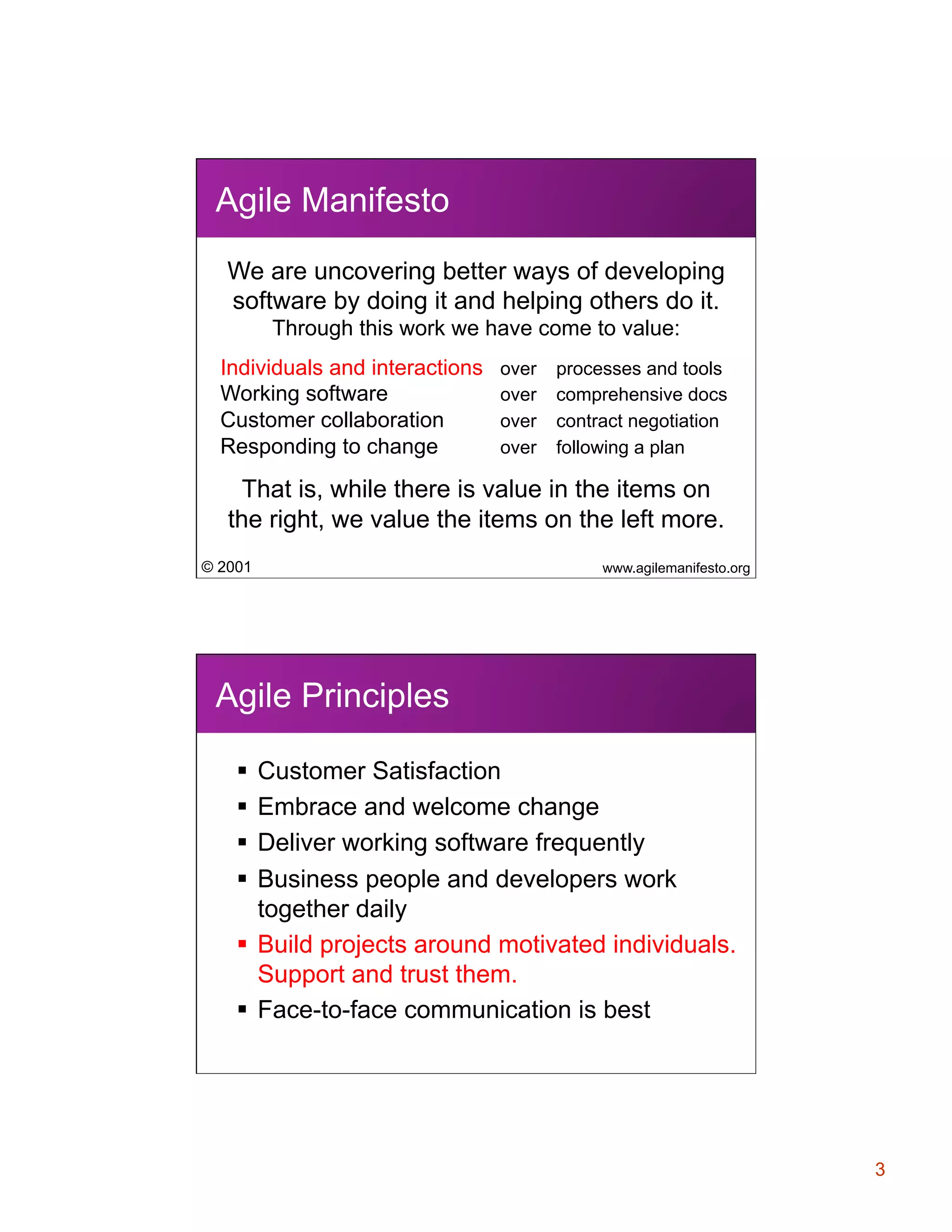
Agile Manifesto
We are uncovering better ways of developing
software by doing it and helping others do it.
Through this work we have come to value:
Individuals and interactions
Working software
Customer collaboration
Responding to change

over
over
over
over

processes and tools
comprehensive docs
contract negotiation
following a plan

That is, while there is value in the items on
the right, we value the items on the left more.
© 2001

www.agilemanifesto.org

2
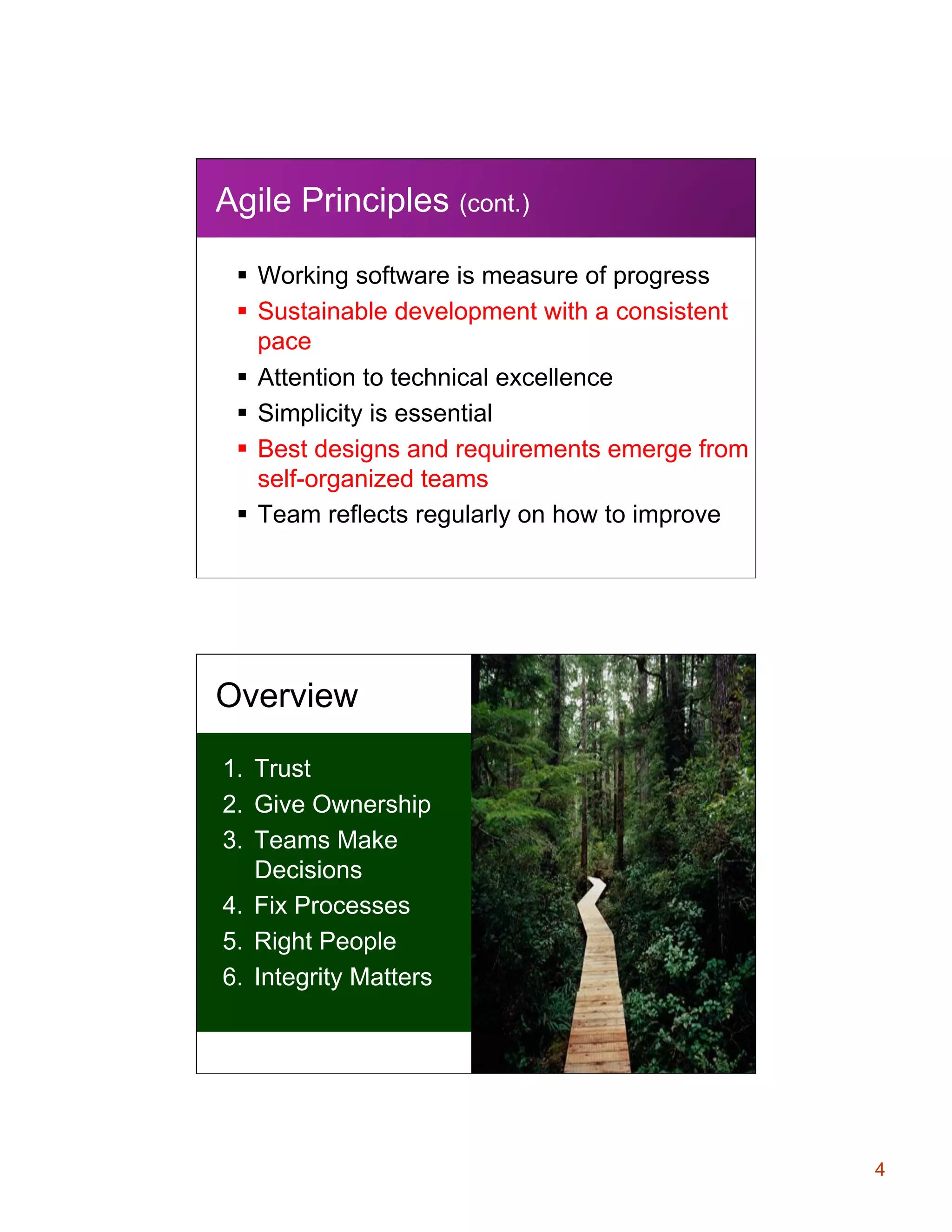
Agile Manifesto
We are uncovering better ways of developing
software by doing it and helping others do it.
Through this work we have come to value:
Individuals and interactions
Working software
Customer collaboration
Responding to change

over
over
over
over

processes and tools
comprehensive docs
contract negotiation
following a plan

That is, while there is value in the items on
the right, we value the items on the left more.
© 2001

www.agilemanifesto.org

Agile Principles
§  Customer Satisfaction
§  Embrace and welcome change
§  Deliver working software frequently
§  Business people and developers work
together daily
§  Build projects around motivated individuals.
Support and trust them.
§  Face-to-face communication is best

3
Agile Principles (cont.)
§  Working software is measure of progress
§  Sustainable development with a consistent
pace
§  Attention to technical excellence
§  Simplicity is essential
§  Best designs and requirements emerge from
self-organized teams
§  Team reflects regularly on how to improve

Overview
1.  Trust
2.  Give Ownership
3.  Teams Make
Decisions
4.  Fix Processes
5.  Right People
6.  Integrity Matters

4
Trust

trust

Trust
how do you
define trust?

5
Unleashing Innovation

why is
trust important?

Collaboration Process

the data …

6
2004-2008:
high trust companies
out perform low trust
companies by 43%
add 2009:
high trust companies
out perform low trust
companies by 126%
- Great Place to Work

trust companies
double performance
over S&P for 10 years
- Great Place to Work

high trust companies
out perform low trust
companies by 300%
- Watson Wyatt study

7
t
rus ?
T
of ags
ack ce T
L ri
P

transaction costs

Transaction
Costs

8
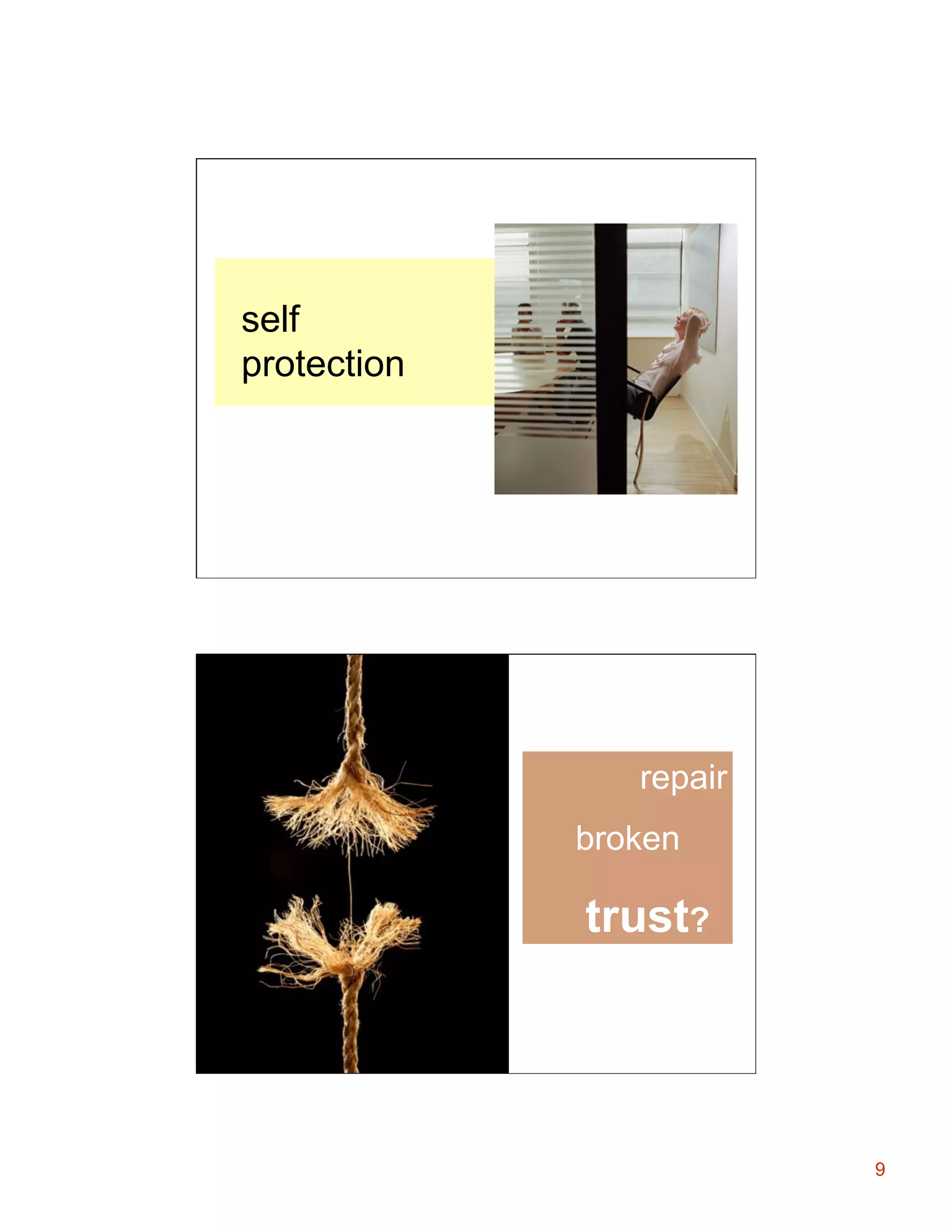
self
protection

repair
broken

trust?

9
other price tags?

Project Management

how can leaders
help teams build Trust?
§  Change Management

10
Project Management

remove

debilitating Fear

§  Dependency Management

in collaboration, people
fear …

- Warren Bennis
Beyond Bureaucracy

11
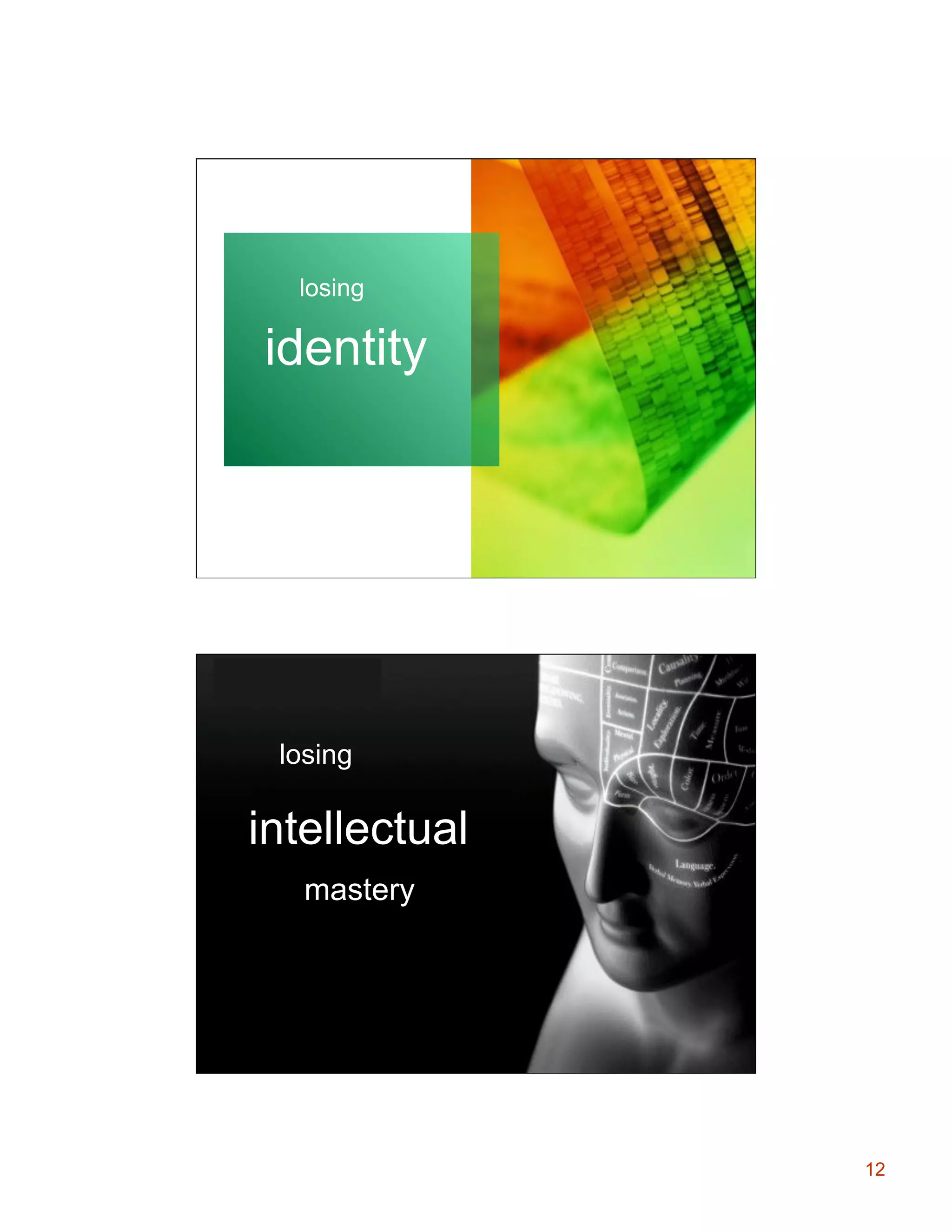
losing

identity

losing

intellectual
mastery

12
losing

individualism

Leadership Role
What can leaders do?

13
losing

identity

losing

intellectual
mastery

14
losing

individualism

what other fears do
people have?

15
Leadership Role
What can leaders do?

Unleashing Innovation

group and
prioritize
Collaboration Process

16
Exercise
§  What are the top fears in list?
§  Divide by 3 and round up
§  Everyone votes by raising hand
§  Work in groups on top three
§  Report out

fostering
trust

17
advance each other’s

intentions
and interests
don’t impede them

be proactive

in

moving work
forward

18
create

transparency

Project Management

honest and open

communication
§  Focus, Communication, and Expectation
Management

19
share
§  Build the right product

experiences

team

to

team trust…

20
“a

mega team”

validate others

21
accept risks collectively

leadership role ?

22
Leading
team based Agile
measurements
§  Collaboration Model
§  Collaboration Process

people do
what they are

measured
by
measure results

23
let

teams
evaluate

themselves

build

confidence

24
short iterations …
early wins

Collaboration Model

celebrate success !

25
Project Management

trust First !

§  Risk Management

Leadership Role

Suspicion is a permanent condition.
- Marcus Buckingham

26
Leadership Role

other leadership roles?

Trust

trust

summary

remove fear
validate others
accept risks together
team-based
measurements
§  authenticity
§ 
§ 
§ 
§ 

27
ownership

use

authentic motivation
- Alfie Kohn
Punished By Rewards

28
Unleashing Innovation
foster

collaboration
Collaboration Process

teams

collaborate
to

make their

decisions

29
let people

choose

let people

choose
how,

what,
and when

30
content

provide

meaningful
work

31
don’t take
back
their

ownership

don’t

give the

answers

32
or……
give them
the

solutions

ask

questions

33
questions
that

help teams

discover
solutions

howcan we avoid the temptation to rescue
How
our teams?
would
§  Ask Questions.like

you

§  What would you like me to do?
to
§  How would you like to solve that problem?
§  What would you like to do?

solve it?

34
what would

you

like me to do?

exercise: leader and worker conversation

35
Stay Positive

what questions worked?

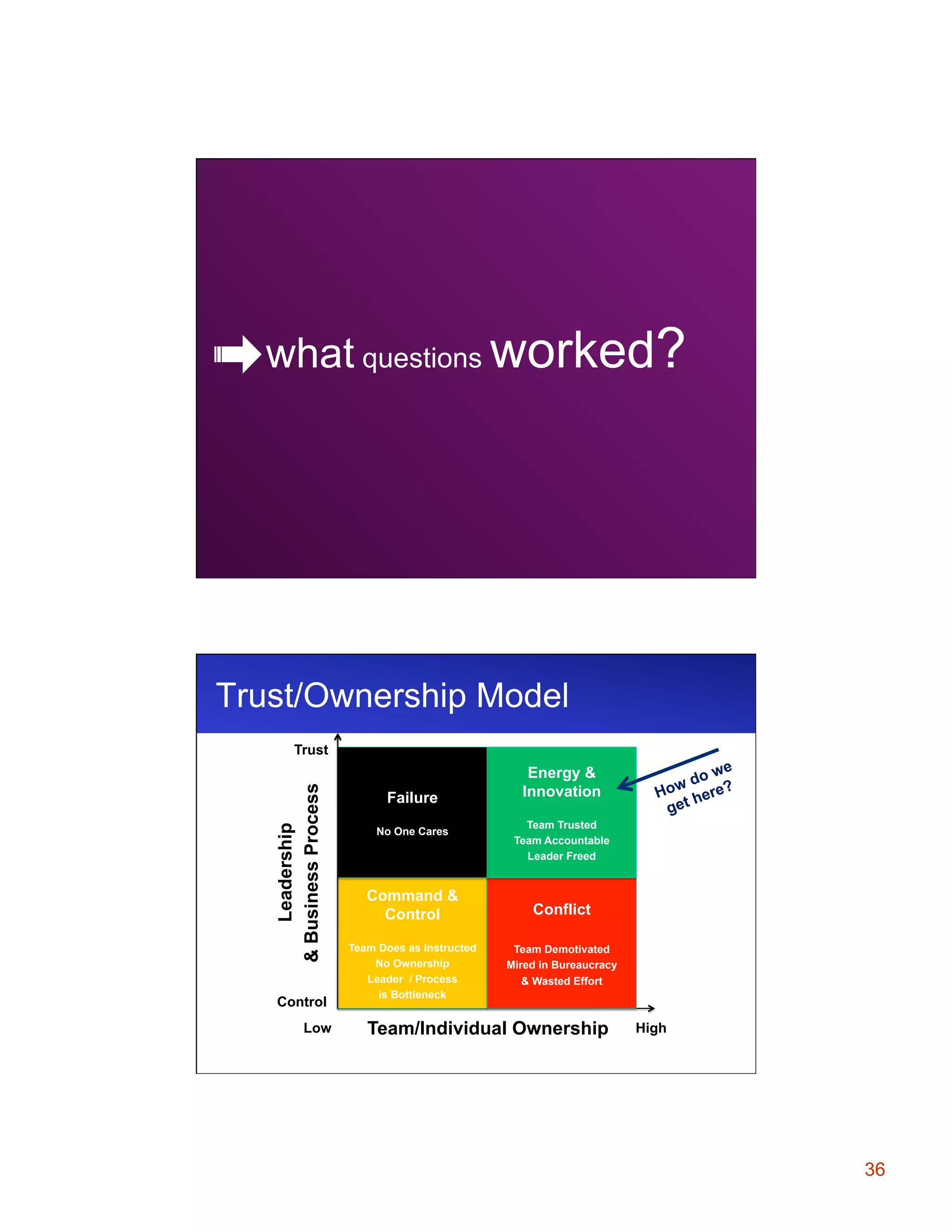
Trust/Ownership Model
Leadership
& Business Process

Trust

Control
Low

Failure
No One Cares

Command &
Control
Team Does as Instructed
No Ownership
Leader / Process
is Bottleneck

Energy &
Innovation

we
do
ow ere?
H
h
get

Team Trusted
Team Accountable
Leader Freed

Conflict
Team Demotivated
Mired in Bureaucracy
& Wasted Effort

Team/Individual Ownership

High

36
Stay Positive

How can you help teams/
people take ownership?

macro-

leadership
tool

37
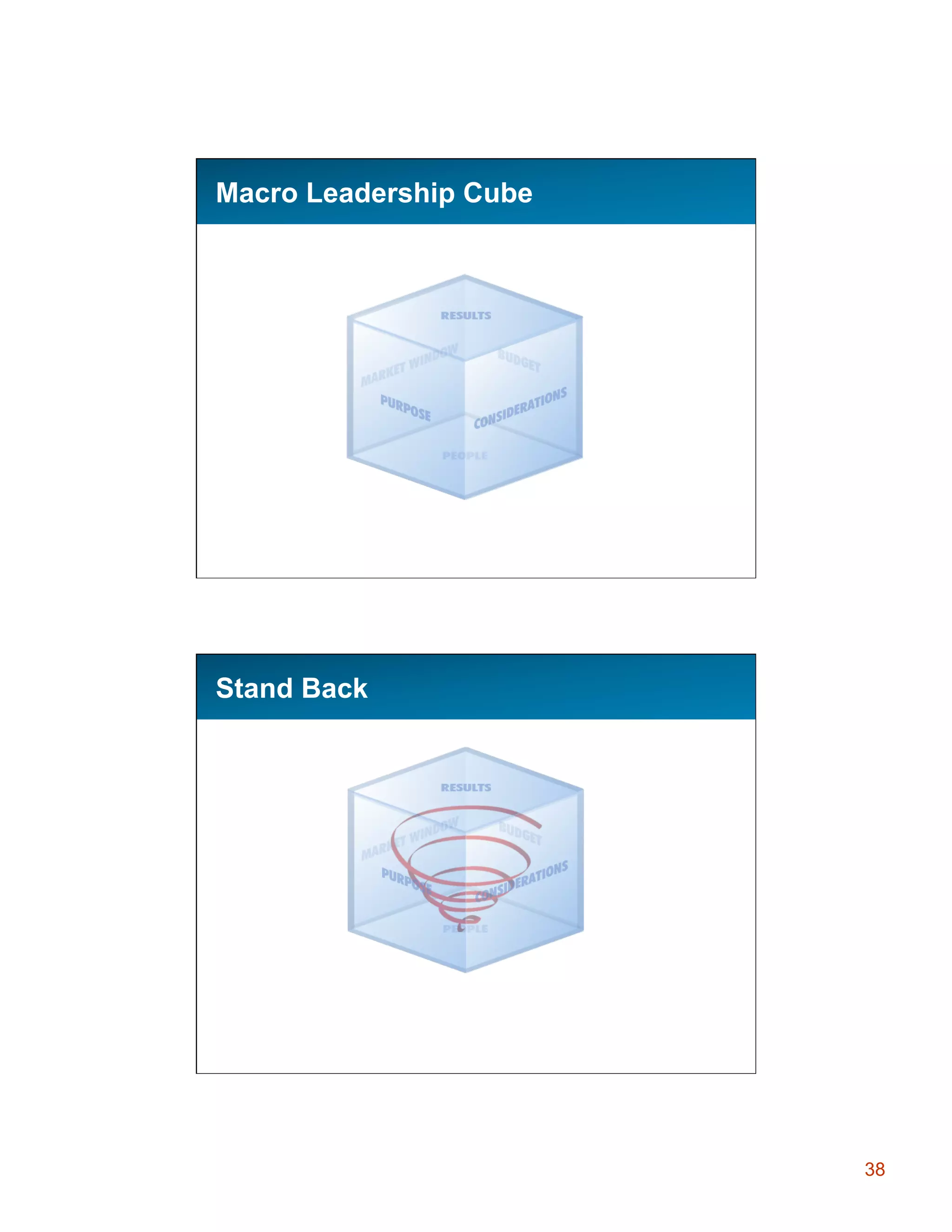
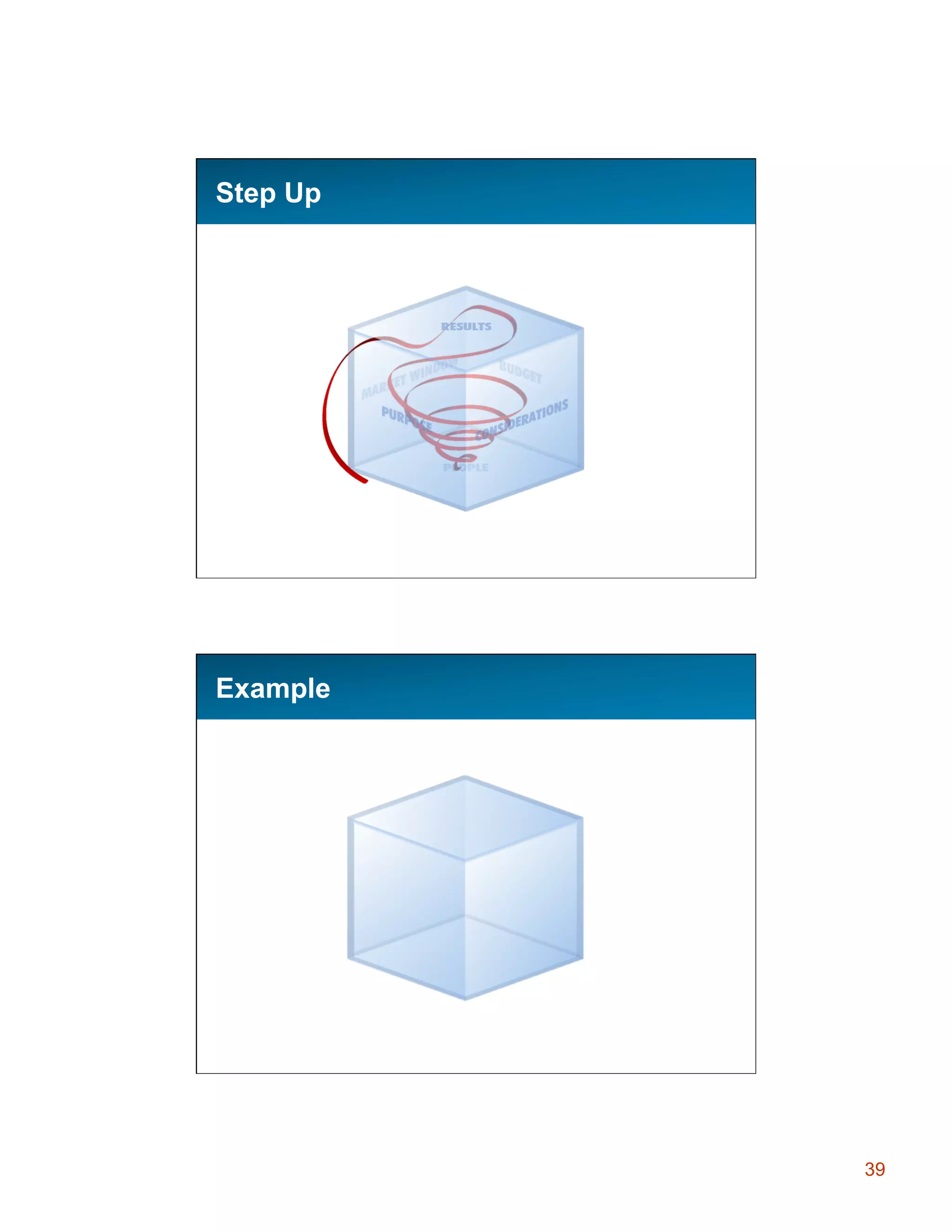
Macro Leadership Cube

Stand Back
Stand Back

38
Step Up
Step Up

Example
Example…

39
Your cube?
Your cube?

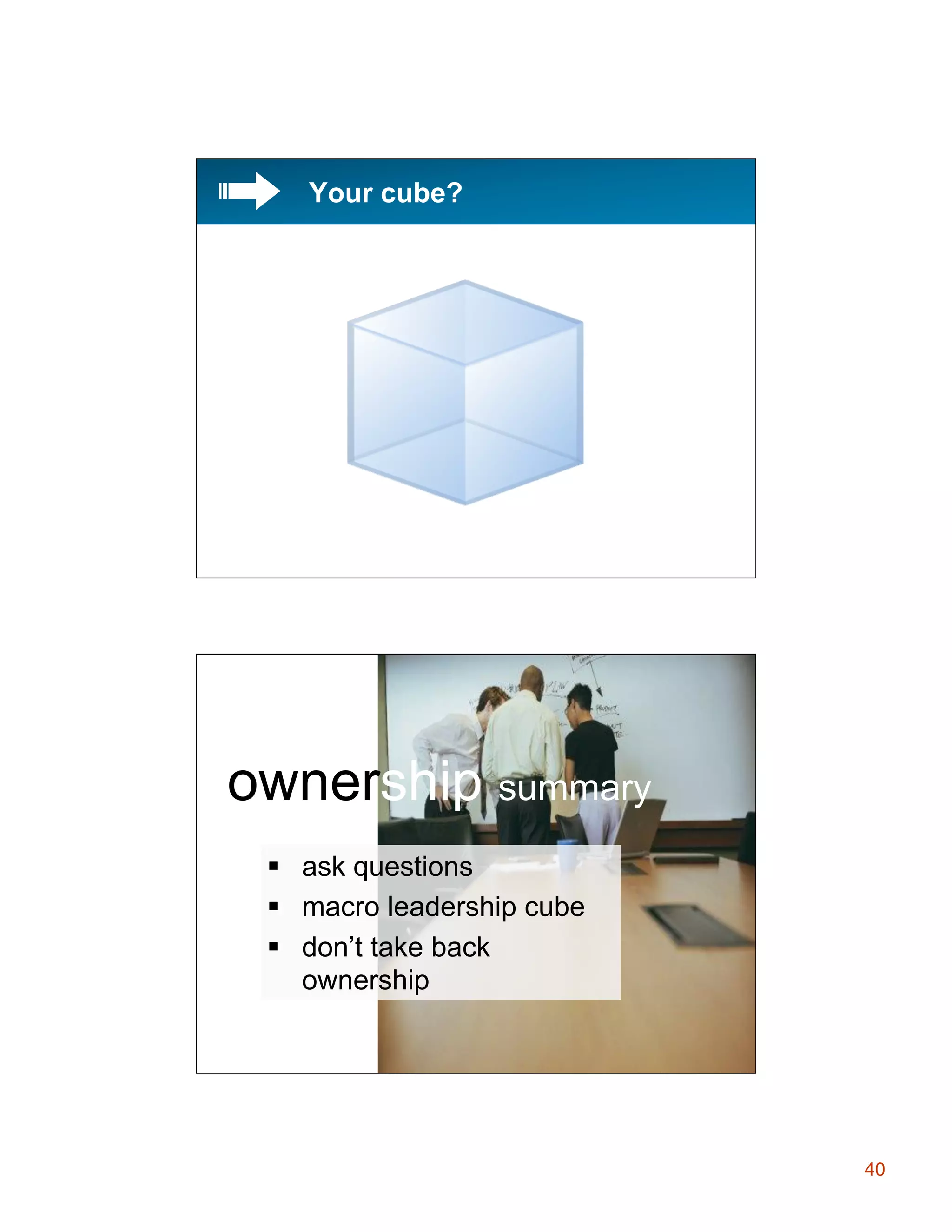
ownership summary
§  ask questions
§  macro leadership cube
§  don’t take back
ownership

40
team decides

why

decisions by teams?

41
Trustworthiness

positional
power =
decisions with

less information

How can we
make better decisions?

42
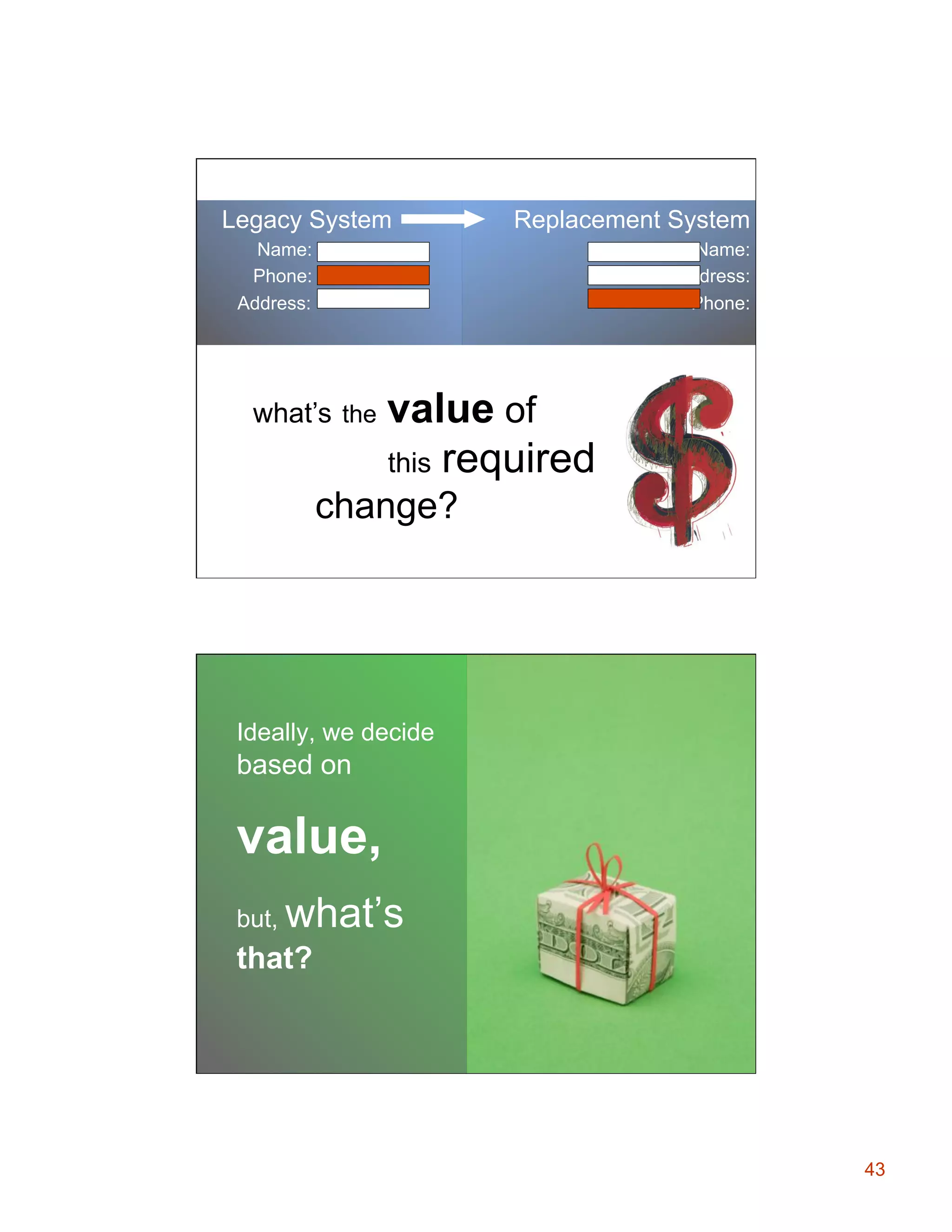
Legacy System

Replacement System

Name:
Phone:
Address:

Name:
Address:
Phone:

what’s the

value of
this required

change?

Ideally, we decide

based on

value,
but,

what’s

that?

43
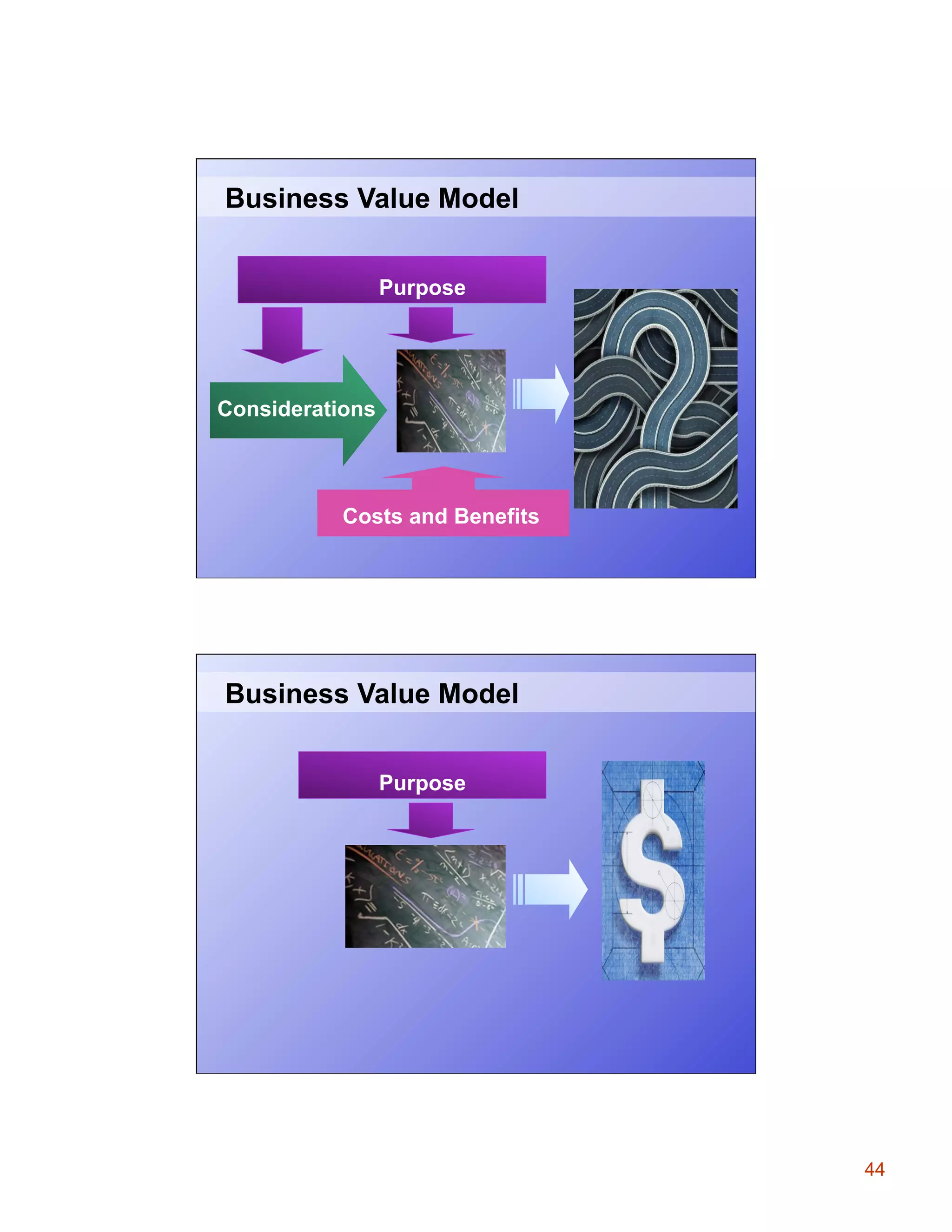
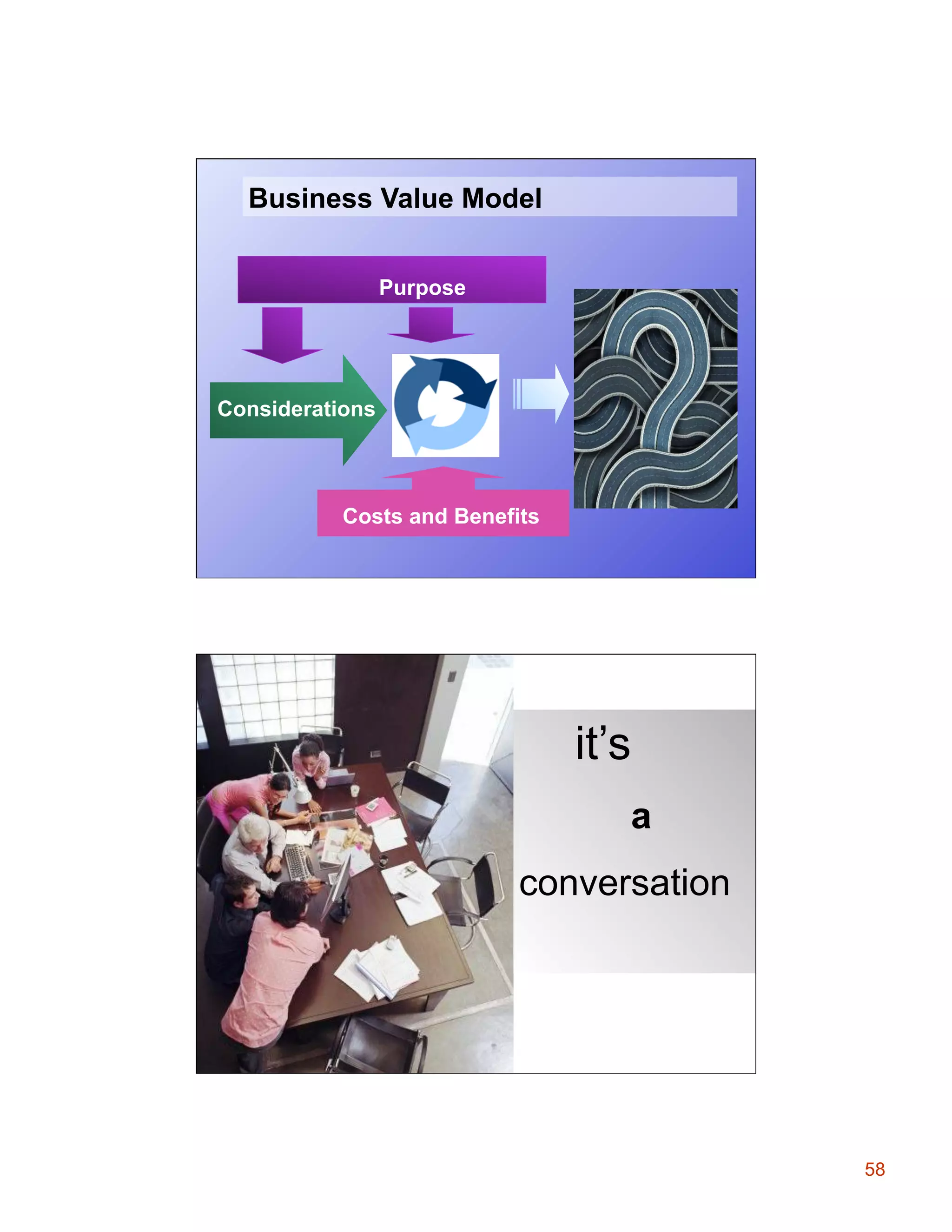
Business Value Model
Purpose

Considerations

Costs and Benefits

Business Value Model
Purpose

44
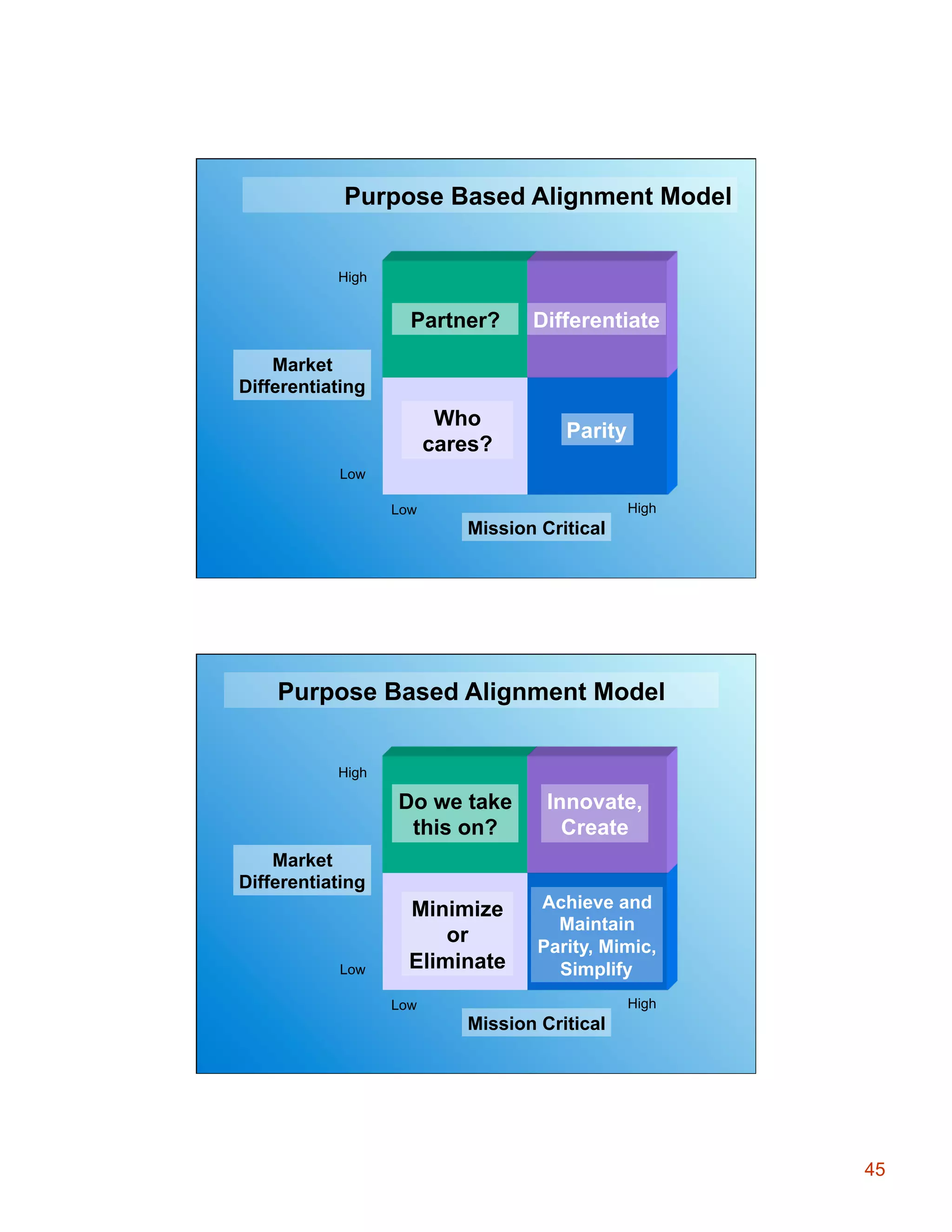
Purpose Based Alignment Model
High

Partner?

Differentiate

Who
cares?

Parity

Market
Differentiating

Low
High

Low

Mission Critical

Purpose Based Alignment Model
High

Do we take
this on?

Innovate,
Create

Minimize
or
Eliminate

Achieve and
Maintain
Parity, Mimic,
Simplify

Market
Differentiating

Low

High

Low

Mission Critical

45
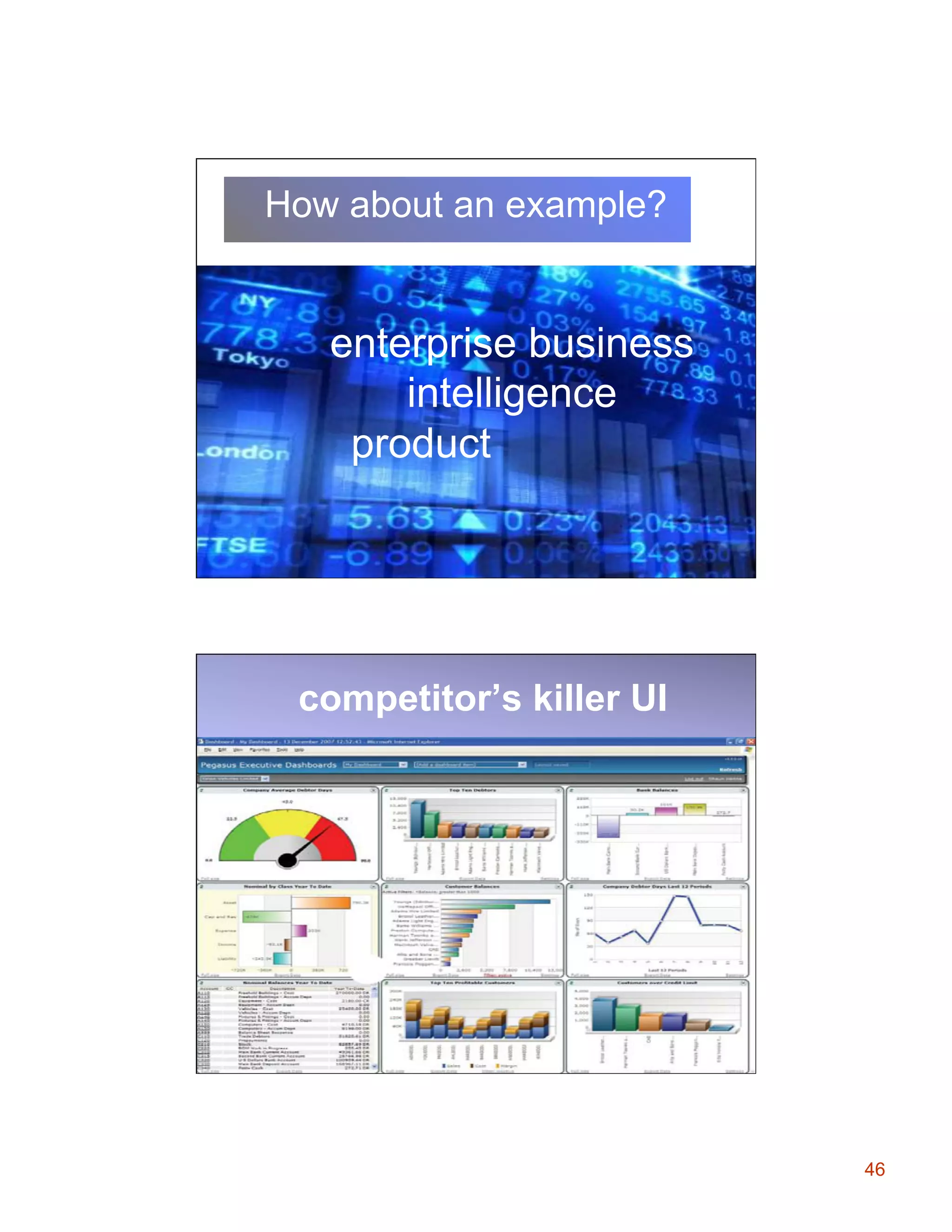
How about an example?

enterprise business
intelligence
product

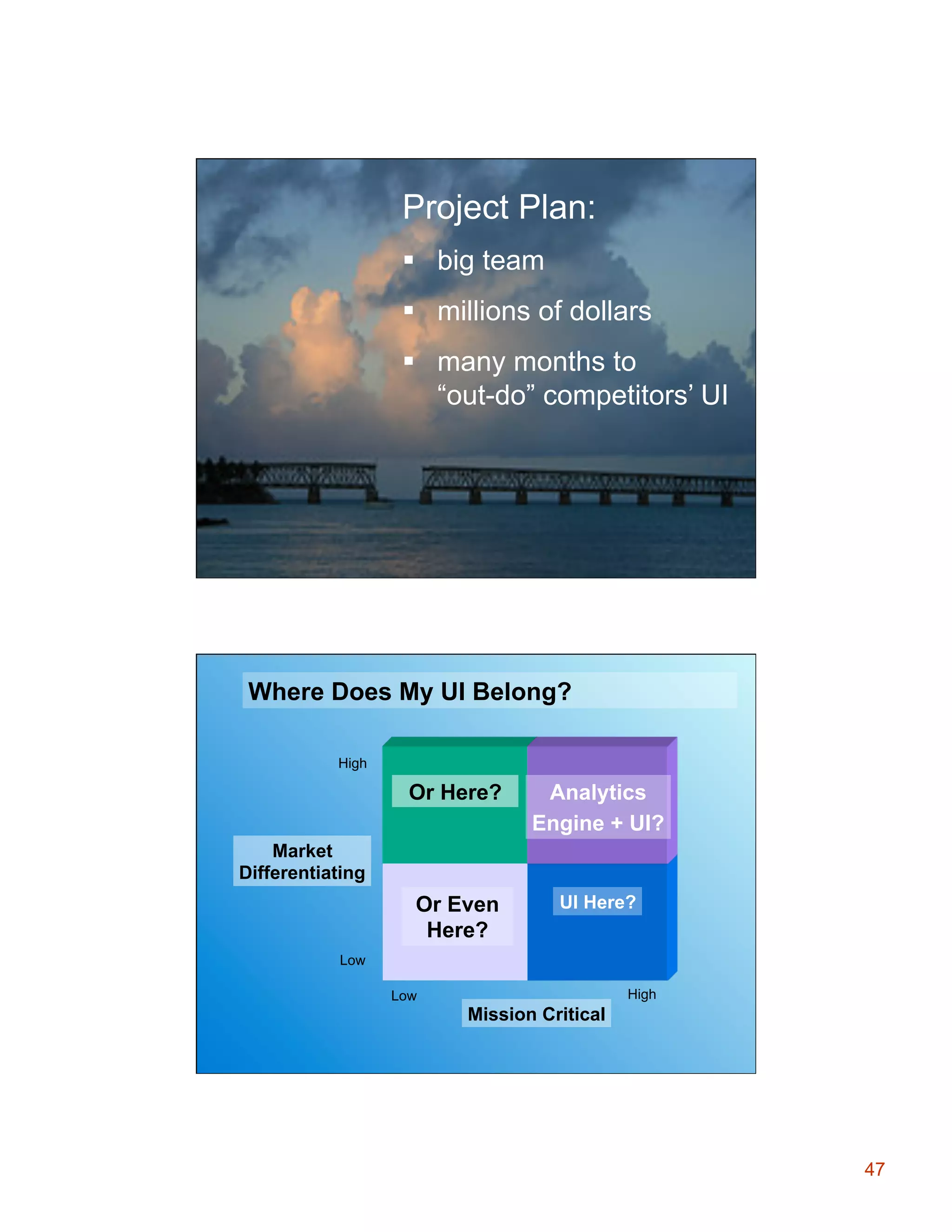
competitor’s killer UI

46
Project Plan:
§  big team
§  millions of dollars
§  many months to
“out-do” competitors’ UI

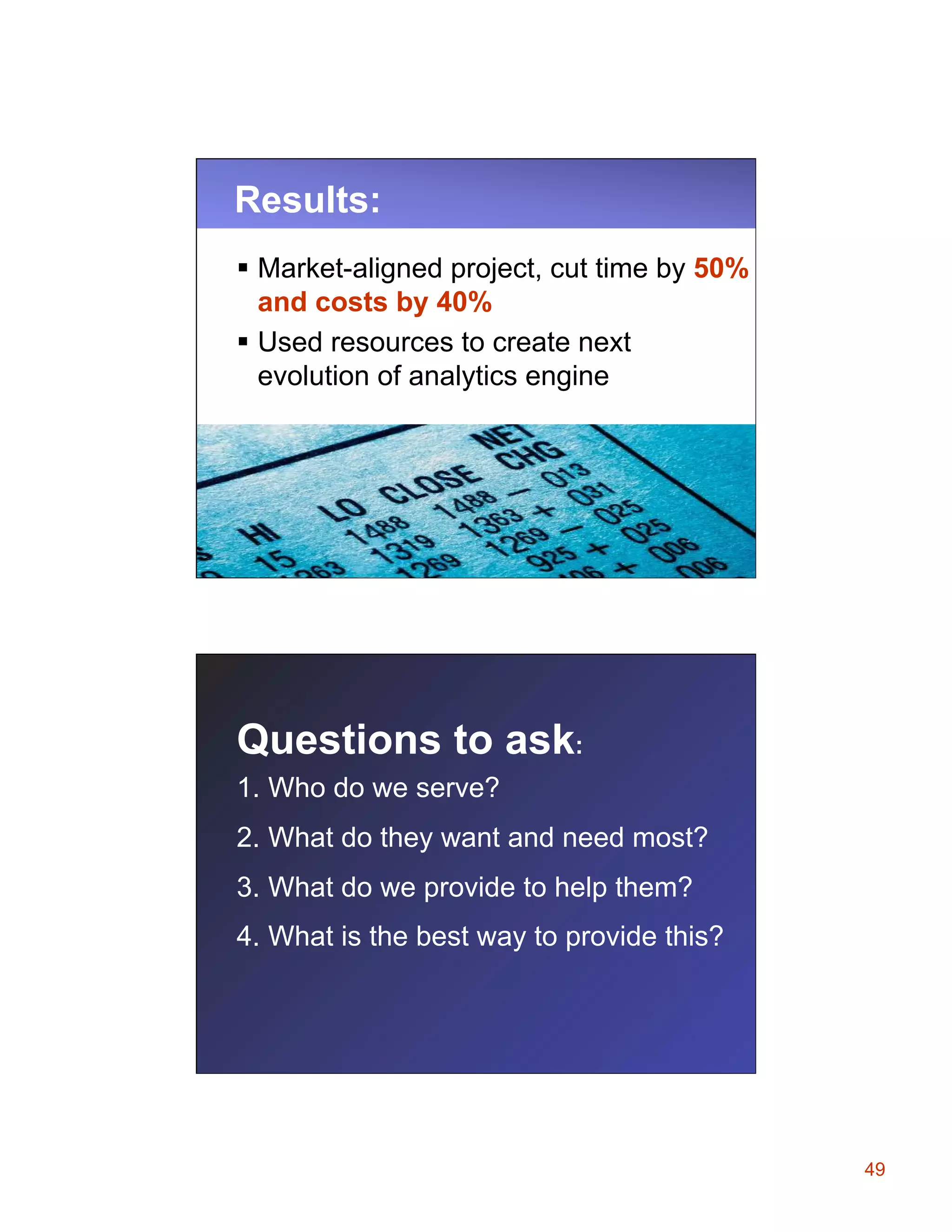
Where Does My UI Belong?
High

Or Here?

Analytics
Engine + UI?

Or Even
Here?

UI Here?

Market
Differentiating

Low
High

Low

Mission Critical

47
UI As Parity

new design
goals:
“go to school” on
competitor’s UI
don’t be so

bad

48
Results:
§  Market-aligned project, cut time by 50%
and costs by 40%
§  Used resources to create next
evolution of analytics engine

Questions to ask:
1.  Who do we serve?
2.  What do they want and need most?
3.  What do we provide to help them?
4.  What is the best way to provide this?

49
the

“billboard” test…

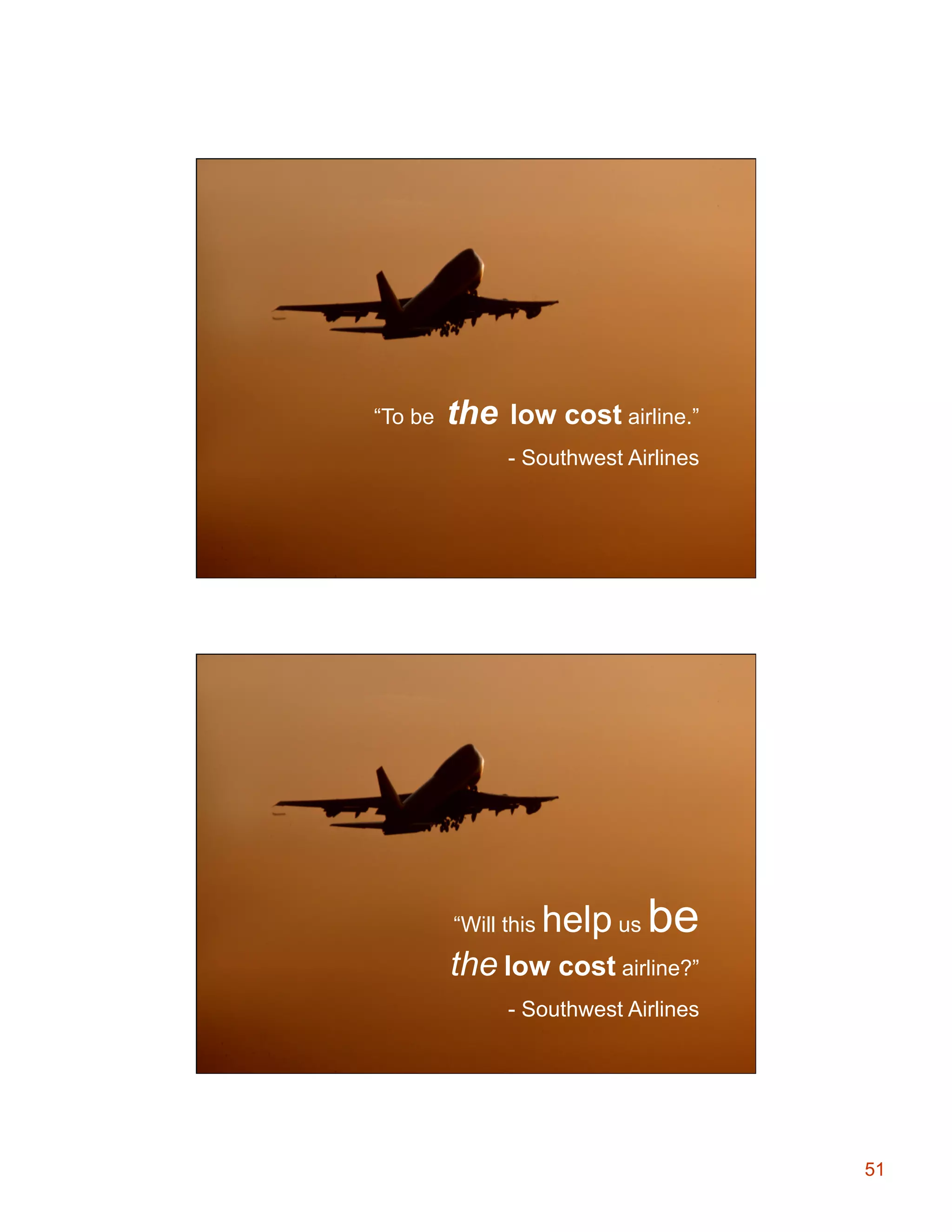
Order new
pages by
2pm and get
them tomorrow!

50
“To be

the low cost airline.”
- Southwest Airlines

“Will this

help us be

the low cost airline?”
- Southwest Airlines

51
decision filters:
make daily
decisions

schedule projects
what
to

develop

Start Up
Exercise: Pick a project.
Exercise

Pick
an objective,
a brand, or
a project.

52
What is the purpose?
High

Partner?

Differentiate

Who
cares?

Parity

Market
Differentiating

Low
High

Low

Mission Critical

What’s On Your Billboard?

53
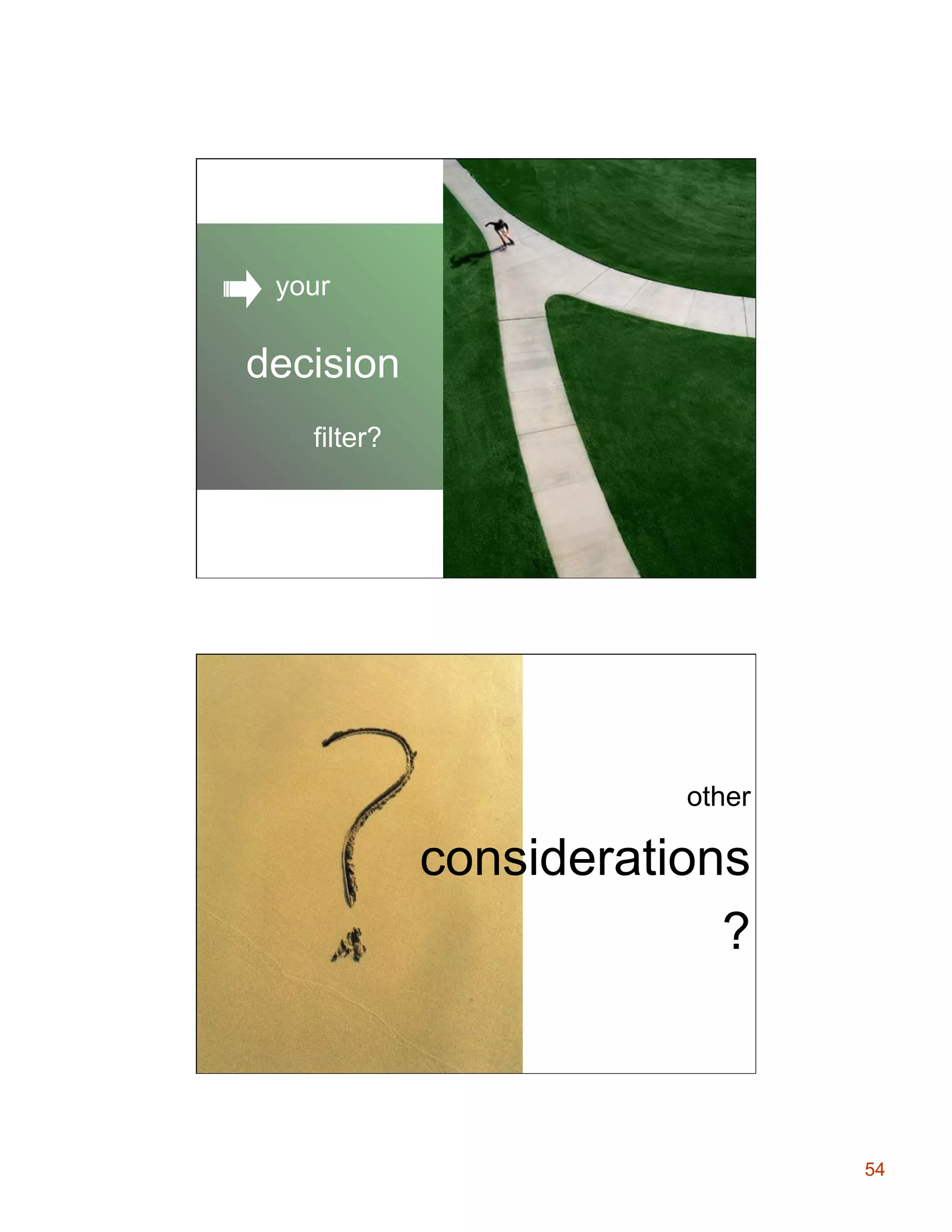
your

decision
filter?

other

considerations
?

54
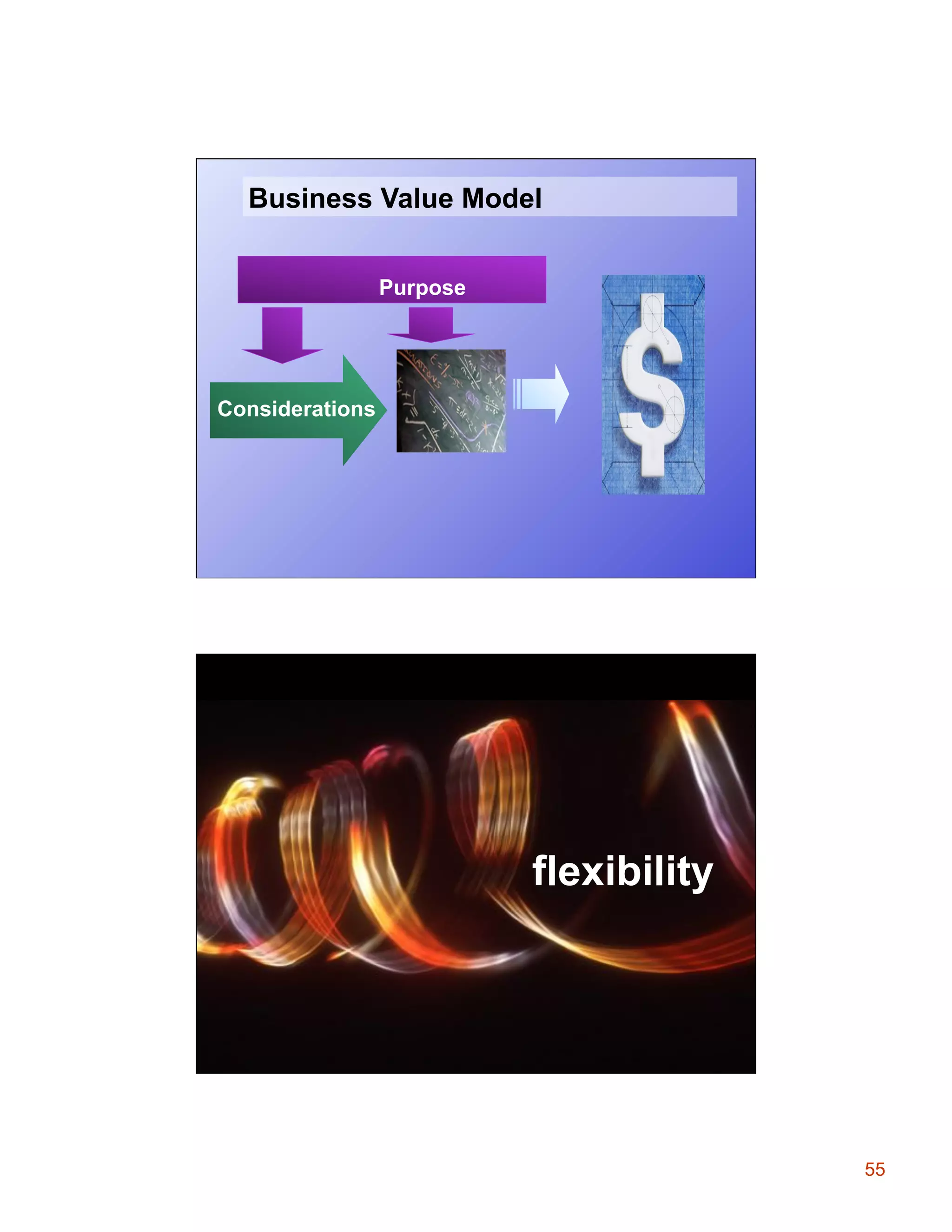
Business Value Model
Purpose

Considerations

Collaboration Model

flexibility

55
dependencies
Collaboration Model

time
to

market

56
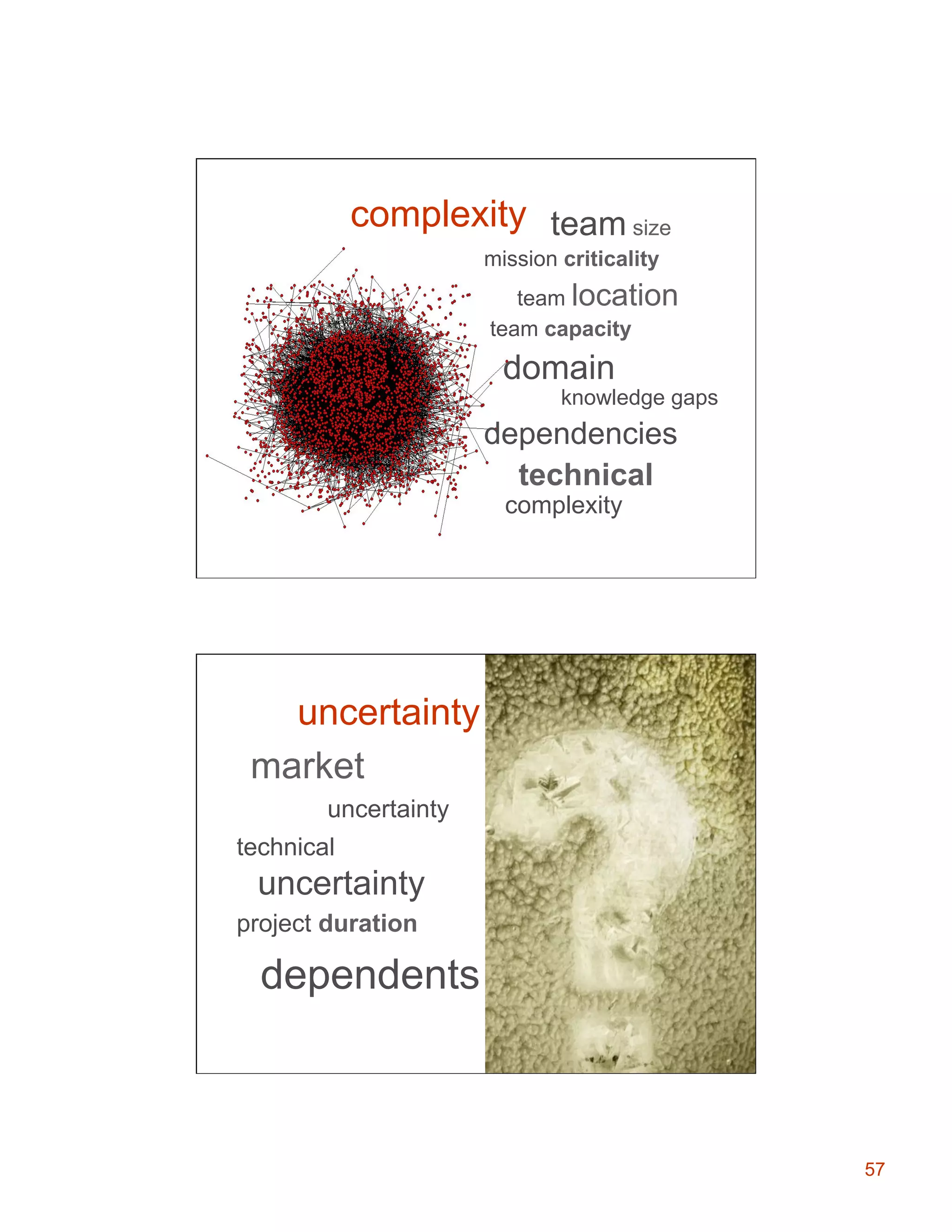
complexity team size
mission criticality
team location
team capacity

domain

knowledge gaps

dependencies
technical
complexity

uncertainty
market
uncertainty
technical

uncertainty
project duration

dependents

57
Business Value Model
Purpose

Considerations

Costs and Benefits

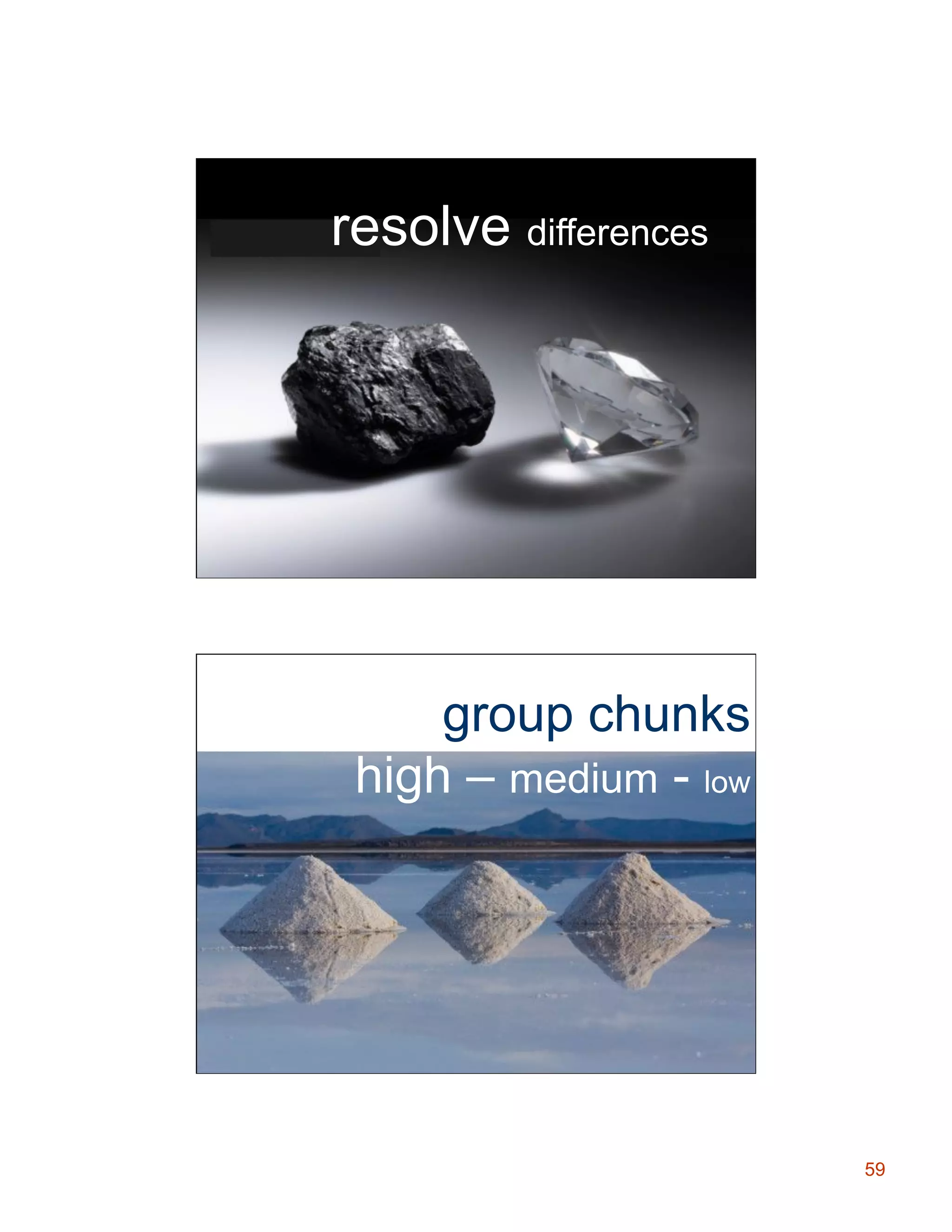
it’s
a
conversation

58
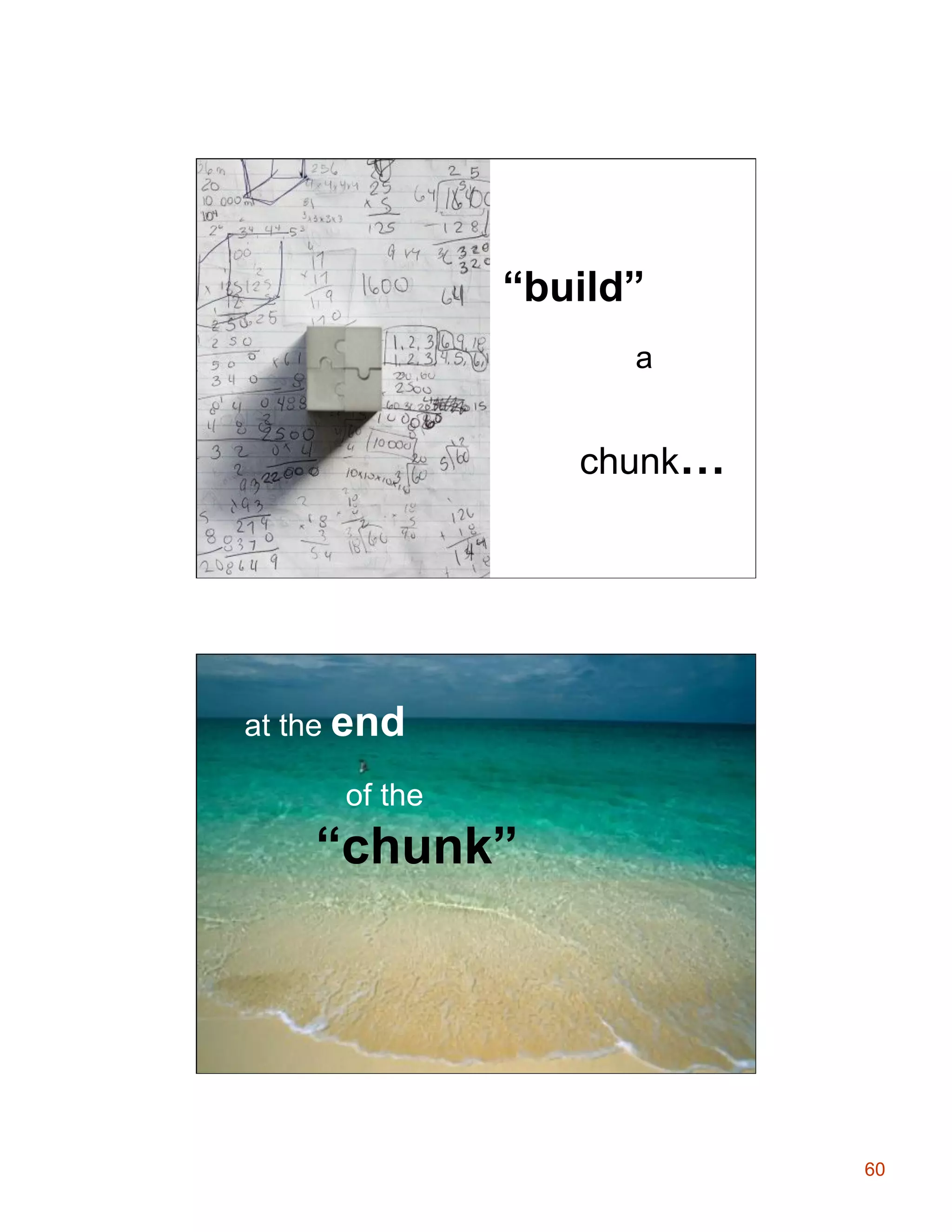
resolve differences

group chunks
high – medium - low

59
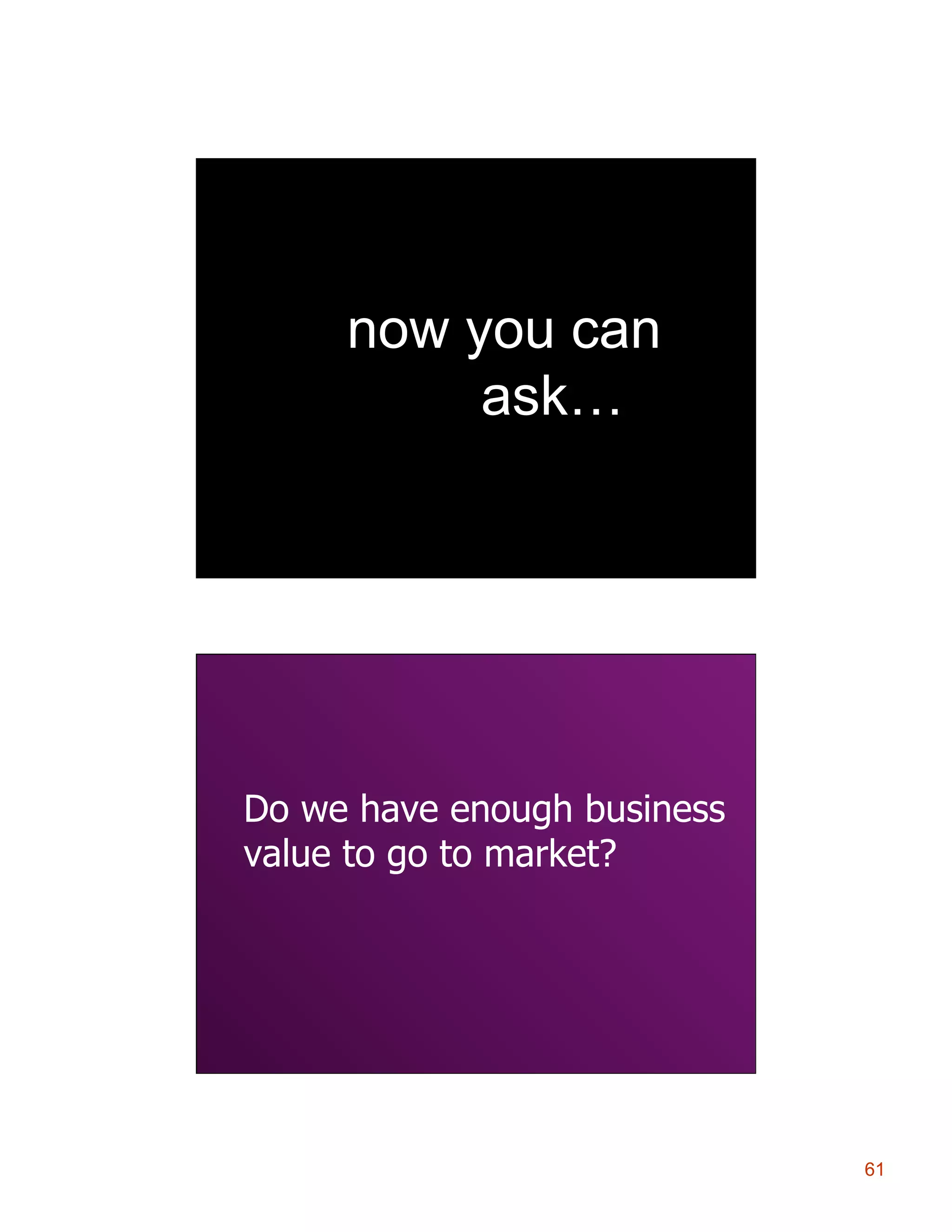
“build”
a

chunk…

at the end
of the

“chunk”

60
now you can
ask…

Do we have enough business
value to go to market?

61
Should we continue?

it’s
a
conversation

62
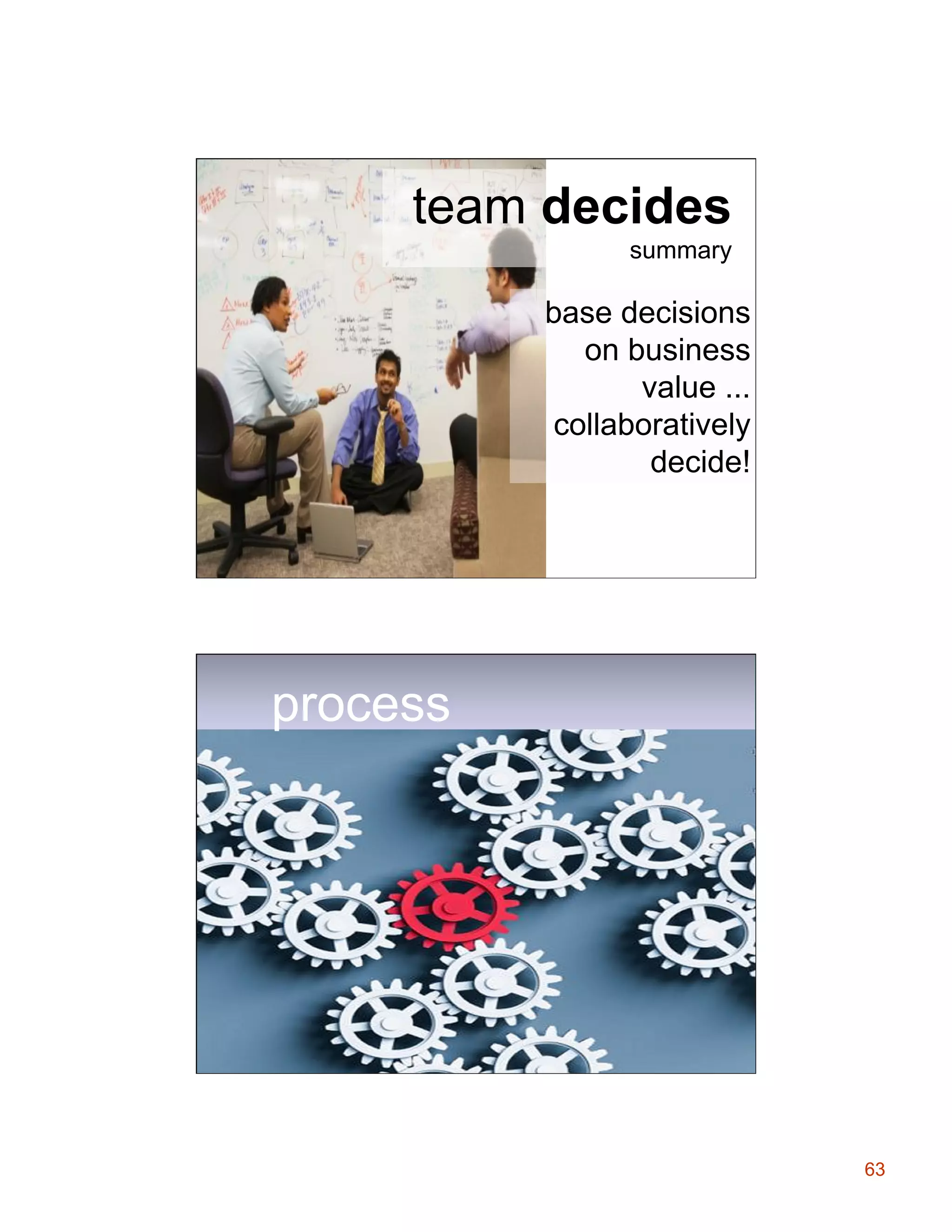
team decides
summary

base decisions
on business
value ...
collaboratively
decide!

process

63
fix

processes
not
people

What processes
aren’t working?

64
Leadership Role

How can we fix them?
Ask the team!

Project Management

collaboration

process

§  Dependency Management

65
what can we do
to fix the process?

brainstorm

66
group
in

silence

prioritize
based on
business

value

67
Business Value Model
Purpose

Considerations

Costs and Benefits

individuals

volunteer
for

and by

what

when

68
value stream mapping

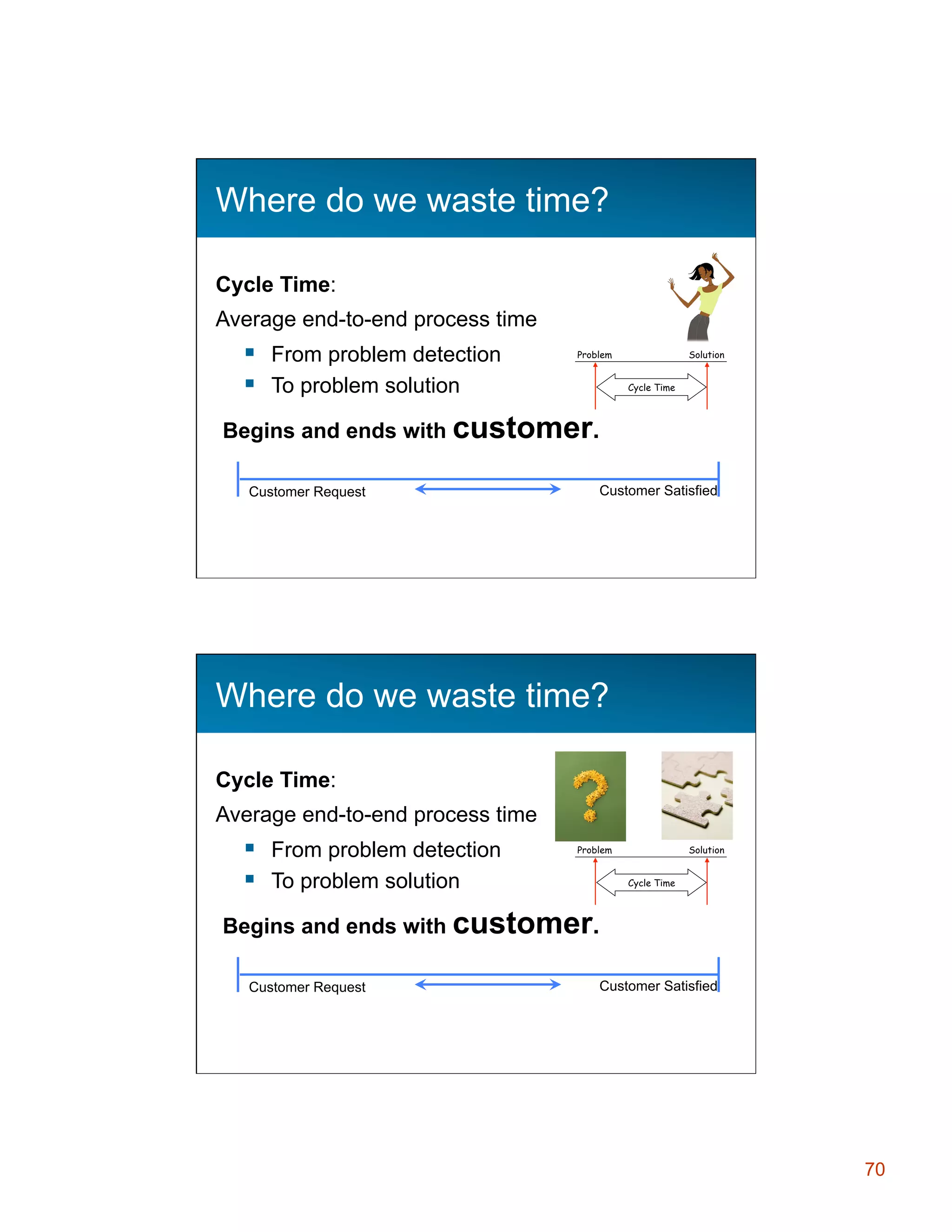
Where do we waste time?
Cycle Time:
Average end-to-end process time

§  From problem detection
§  To problem solution

Problem

Solution
Cycle Time

Begins and ends with customer.
Customer Request

Customer Satisfied

69
Where do we waste time?
Cycle Time:
Average end-to-end process time

§  From problem detection
§  To problem solution

Problem

Solution
Cycle Time

Begins and ends with customer.
Customer Request

Customer Satisfied

Where do we waste time?
Cycle Time:
Average end-to-end process time

§  From problem detection
§  To problem solution

Problem

Solution
Cycle Time

Begins and ends with customer.
Customer Request

Customer Satisfied

70
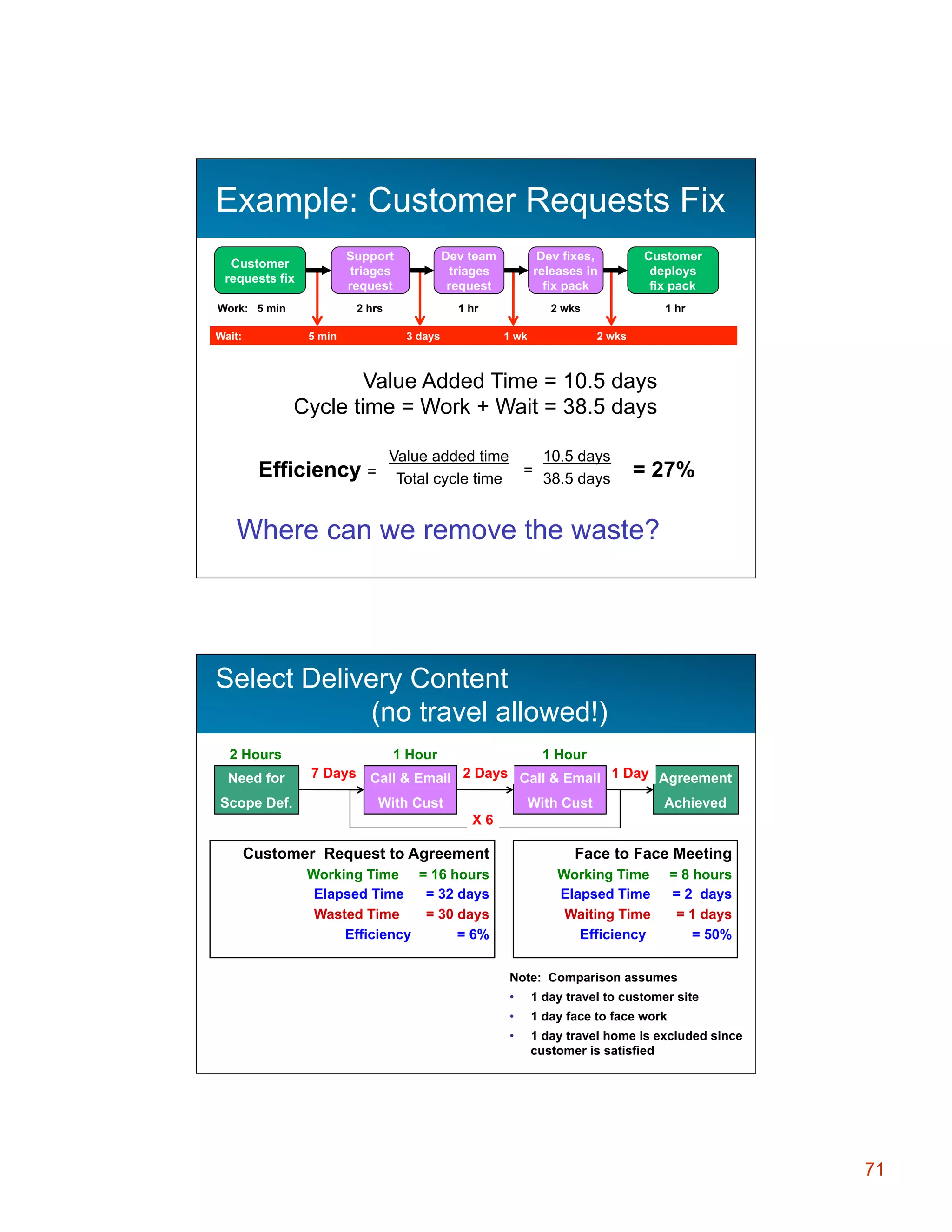
Example: Customer Requests Fix
Support
triages
request

Work: 5 min
Wait:

Dev team
triages
request

Dev fixes,
releases in
fix pack

Customer
deploys
fix pack

2 hrs

Customer
requests fix

1 hr

2 wks

1 hr

5 min

3 days

1 wk

2 wks

Value Added Time = 10.5 days
Cycle time = Work + Wait = 38.5 days
Efficiency =

Value added time
10.5 days
=
Total cycle time
38.5 days

= 27%

Where can we remove the waste?

Select Delivery Content
(no travel allowed!)
2 Hours
Need for
Scope Def.

1 Hour
1 Hour
7 Days Call & Email 2 Days Call & Email 1 Day Agreement
With Cust

With Cust

Achieved

X6

Customer Request to Agreement

Face to Face Meeting

Working Time = 16 hours
Elapsed Time
= 32 days
Wasted Time
= 30 days
Efficiency
= 6%

Working Time
Elapsed Time
Waiting Time
Efficiency

= 8 hours
= 2 days
= 1 days
= 50%

Note: Comparison assumes
• 

1 day travel to customer site

• 

1 day face to face work

• 

1 day travel home is excluded since
customer is satisfied

71
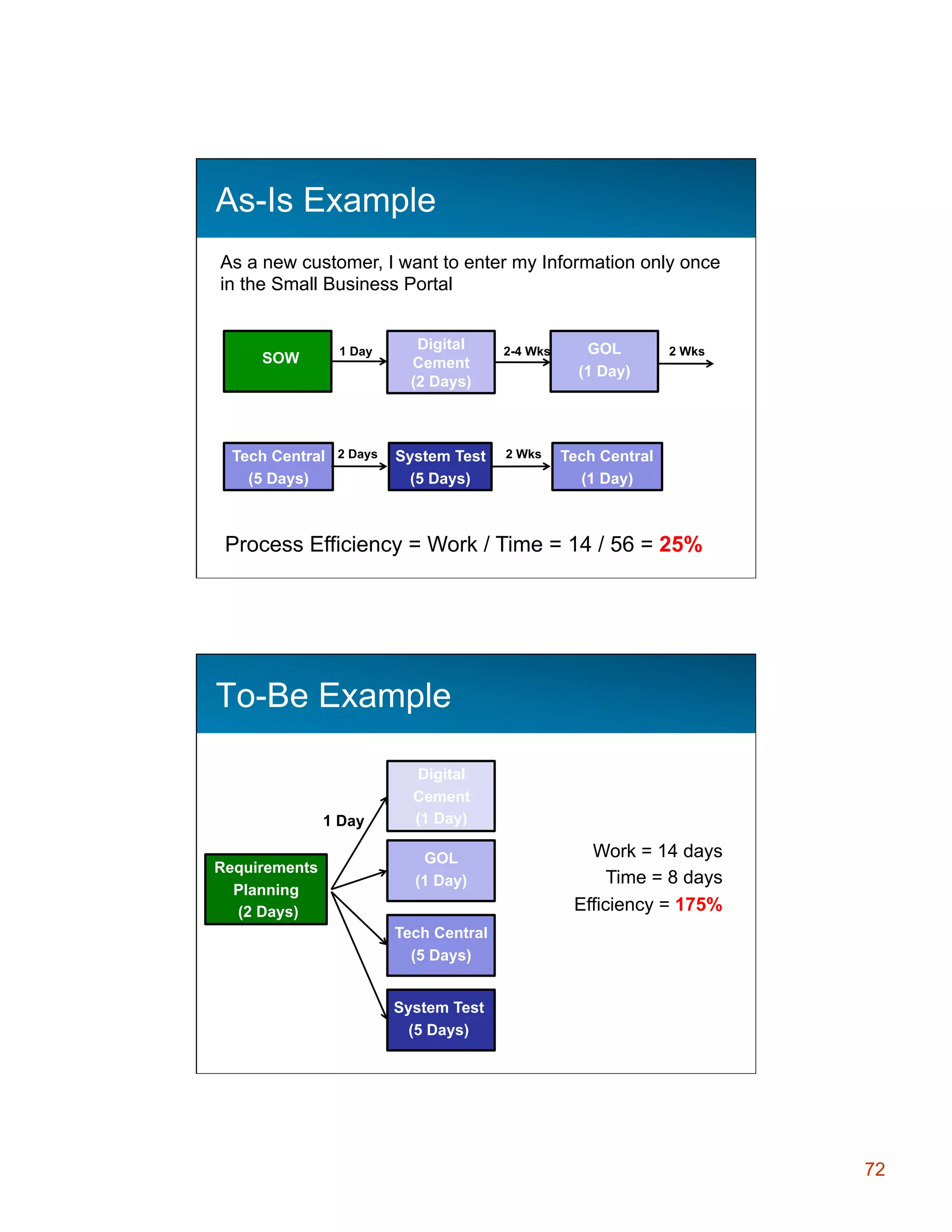
As-Is Example
As a new customer, I want to enter my Information only once
in the Small Business Portal

SOW

1 Day

Tech Central
(5 Days)

2 Days

Digital
Cement
(2 Days)

System Test
(5 Days)

2-4 Wks

GOL
(1 Day)

2 Wks

Tech Central
(1 Day)

2 Wks

Process Efficiency = Work / Time = 14 / 56 = 25%

To-Be Example

1 Day
Requirements
Planning
(2 Days)

Digital
Cement
(1 Day)
GOL
(1 Day)

Work = 14 days
Time = 8 days
Efficiency = 175%

Tech Central
(5 Days)
System Test
(5 Days)

72
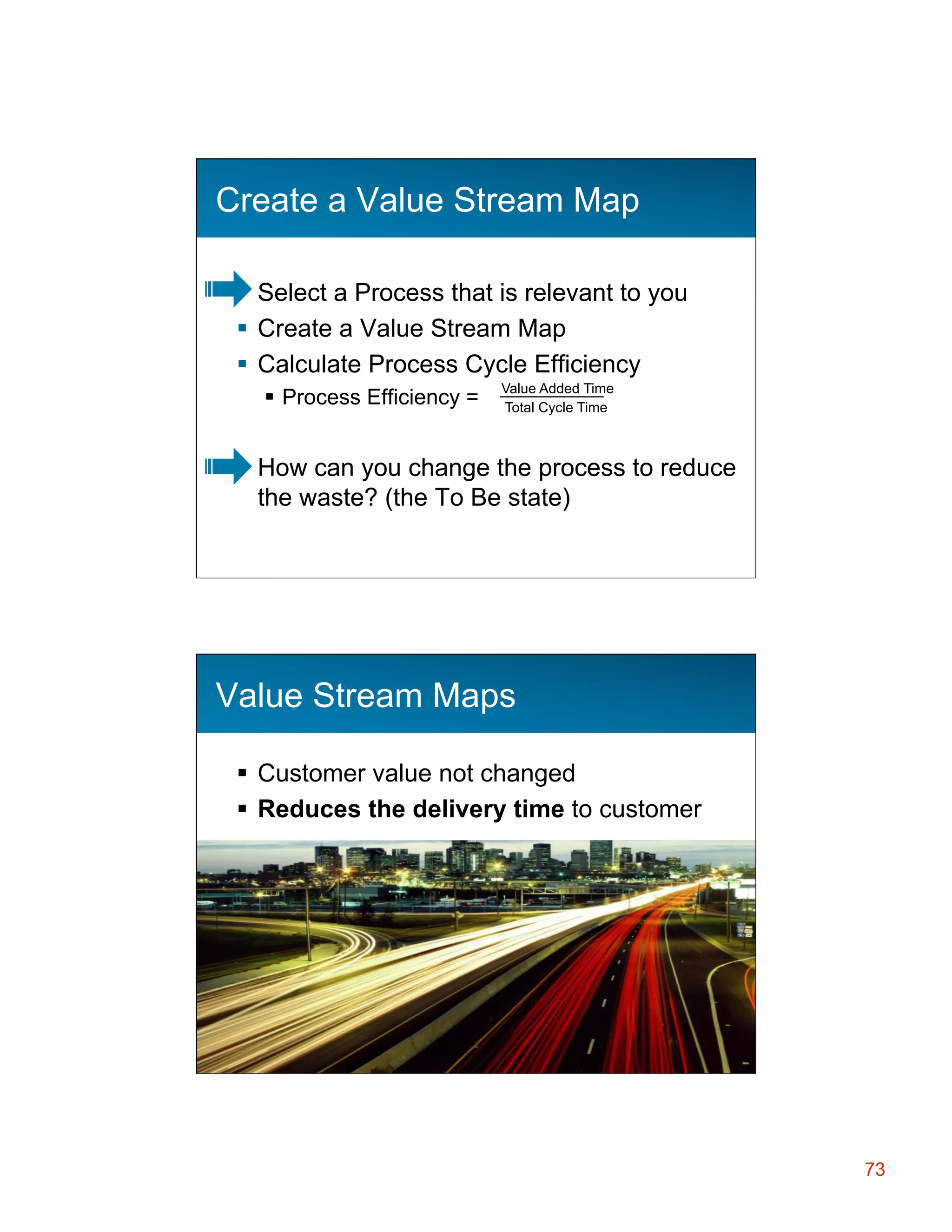
Create a Value Stream Map
§  Select a Process that is relevant to you
§  Create a Value Stream Map
§  Calculate Process Cycle Efficiency
§  Process Efficiency =

Value Added Time
Total Cycle Time

How can you change the process to reduce
the waste? (the To Be state)
145

Value Stream Maps
§  Customer value not changed
§  Reduces the delivery time to customer

73
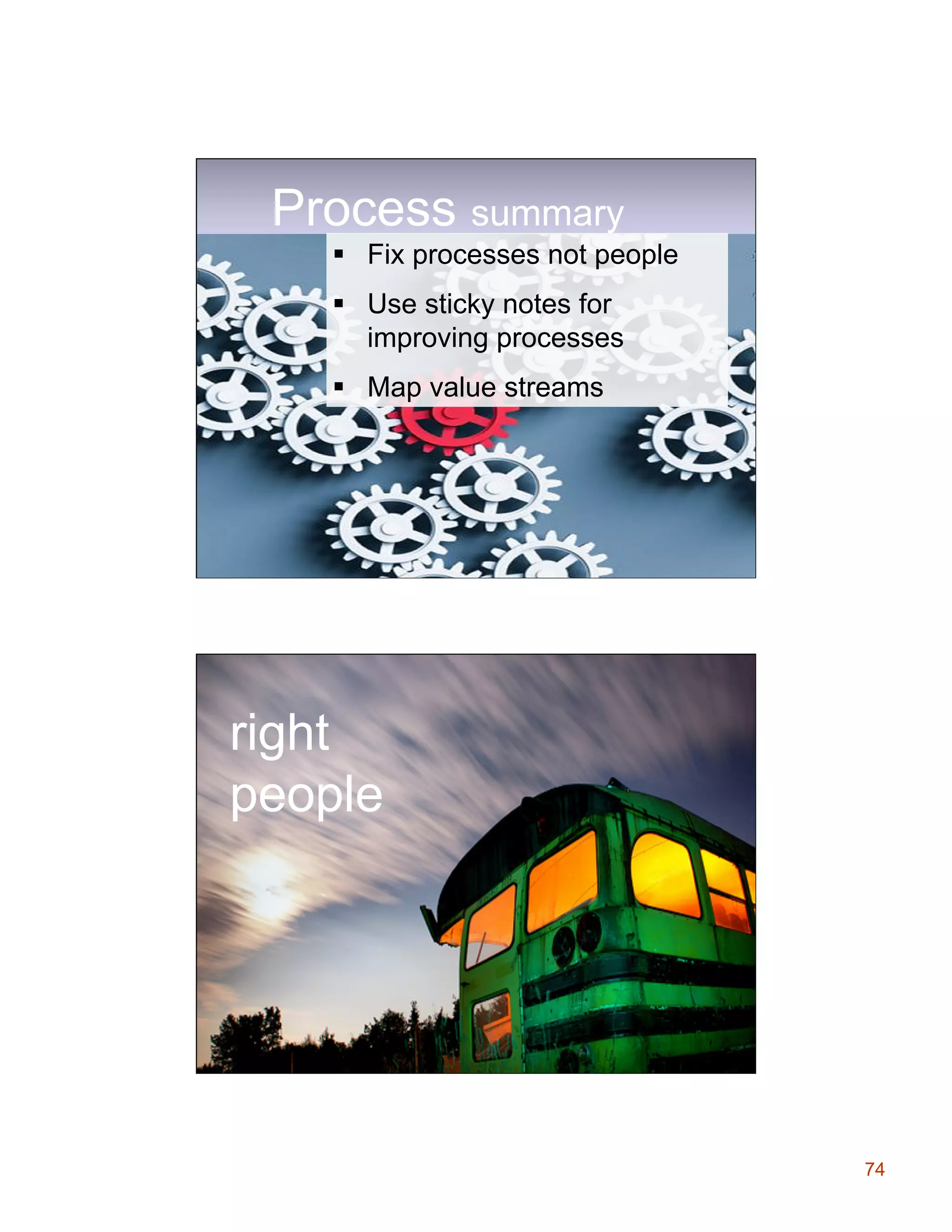
Process summary
§  Fix processes not people
§  Use sticky notes for
improving processes
§  Map value streams

right
people

74
get the right

people on the bus
in the right seats.
- Jim Collins

get the wrong people off the bus.

75
Passion
Best
Organizational

Fit

what

values

are you passionate about?

76
what do you do best ?

how do you define
success?

77
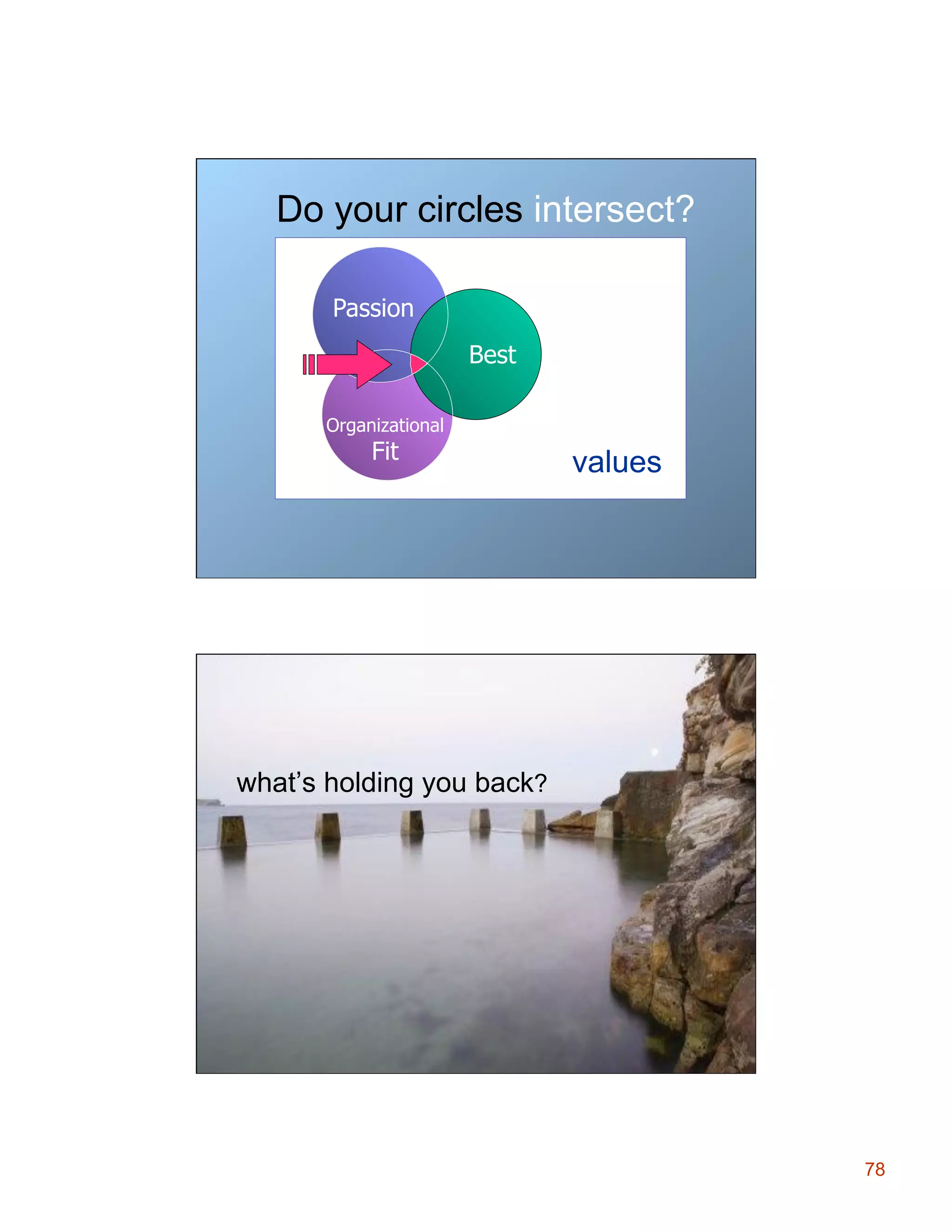
Do your circles intersect?
Passion
Best
Organizational

Fit

values

what’s holding you back?

78
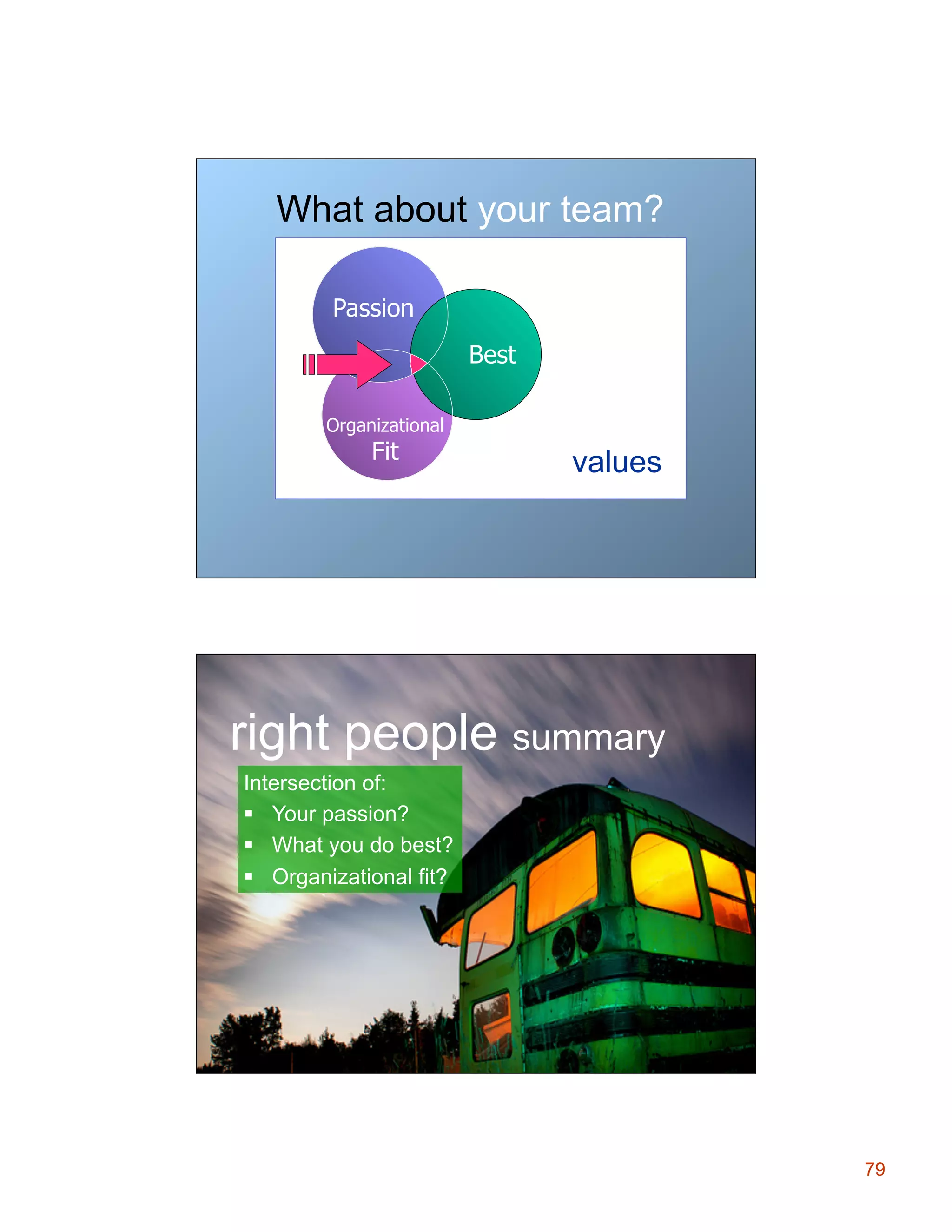
What about your team?
Passion
Best
Organizational

Fit

values

right people summary
Intersection of:
§  Your passion?
§  What you do best?
§  Organizational fit?

79
integrity matters

Trust
how do you
define

integrity?

80
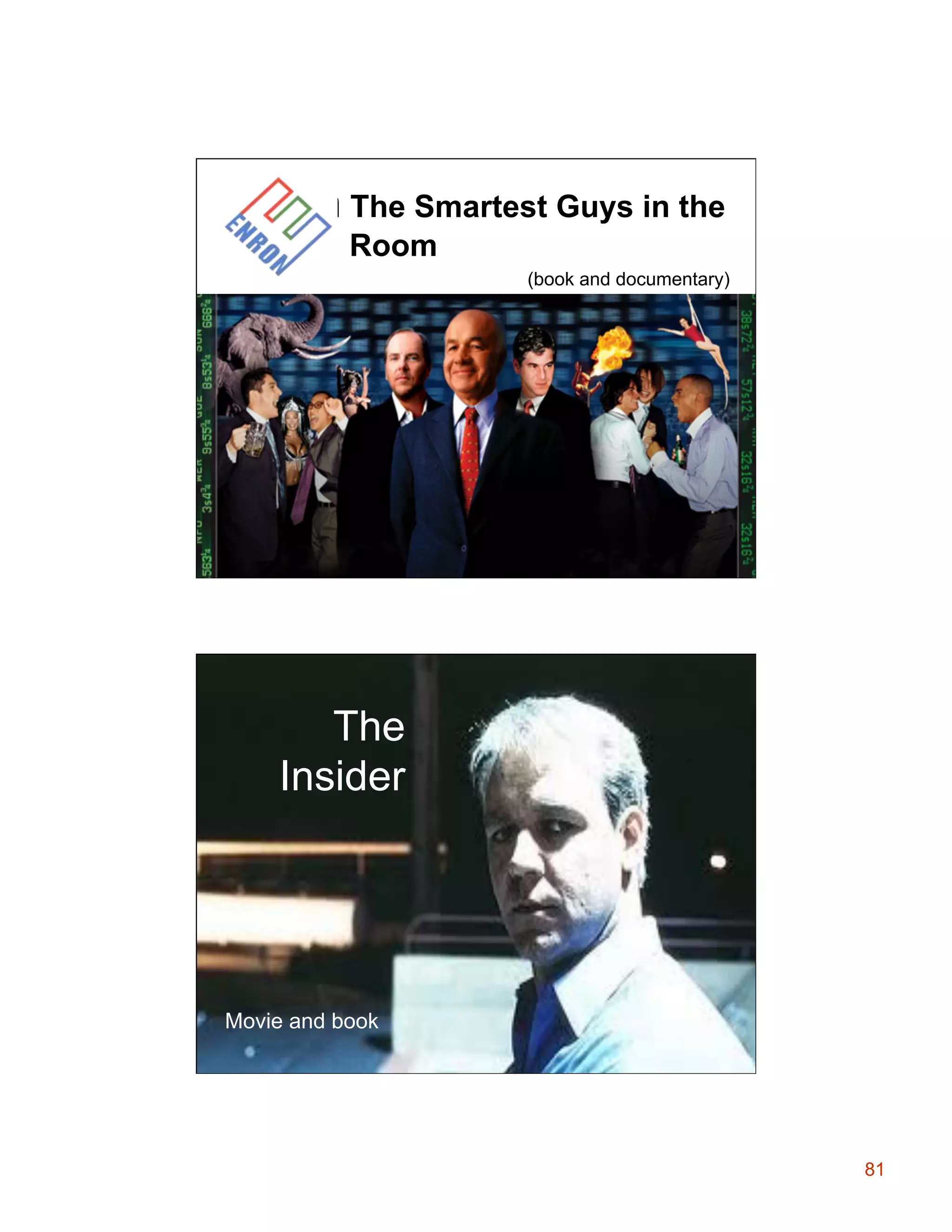
Enron The Smartest Guys in the
Room
(book and documentary)

The
Insider

Movie and book

81
other examples
of integrity?

Attract and retain:
first on the basis of integrity
second, motivation
third, capacity
fourth, understanding
fifth, knowledge

last and least, experience.
- Dee Hock, CEO Emeritus VISA International

82
…knowledge
without integrity
is dangerous
and dreadful.
- Samuel Johnson,
British author

how do you know if
someone has integrity?

83
Summary

summary

Trust

trust

summary

remove fear
validate others
accept risks together
team-based
measurements
§  authenticity
§ 
§ 
§ 
§ 

84
ownership summary
§  ask questions
§  macro leadership cube
§  don’t take back
ownership

team decides
summary

base decisions
on business value
collaboratively
decide!

85
process summary
§  Fix processes not people
§  Use sticky notes for
improving processes
§  Map value streams
right people summary
Intersection of:
§  Your passion?
§  What you do best?
§  Organizational fit?

86
integrity matters summary
hire and retain:

§ Integrity first
§ 
§ 
§ 
§ 
§ 

Motivation
Capacity
Understanding
Knowledge
Experience last

learn more…
Coming Soon!

Agile Culture Change
Our new book
due November 2013
ppixton@accelinnova.com
www.accelinnova.com
Text: 801.209.0195
Blog: pollyannapixton.com

87

Six Free Ideas to Improve Agile Success