
Hardware is hard(er)
Designing for distributed user experiences in IoT
Copyright Claire Rowland
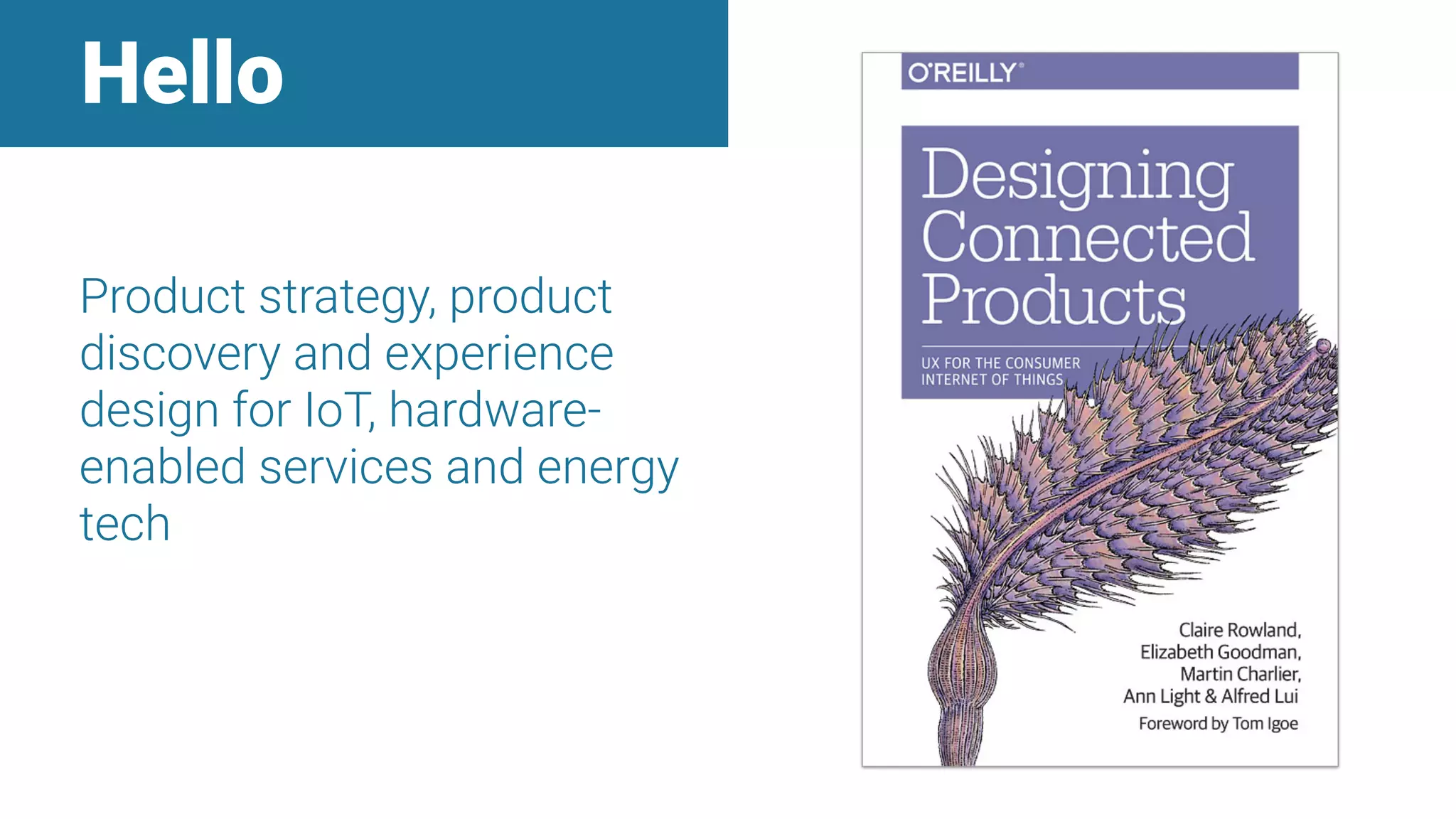
Hello
Product strategy, product
discovery and experience
design for IoT, hardware-
enabled services and energy
tech
What’s IoT, and why is it hard?
Connected products
Image: Philips
Hardware-enabled services
Image: EVEnergy
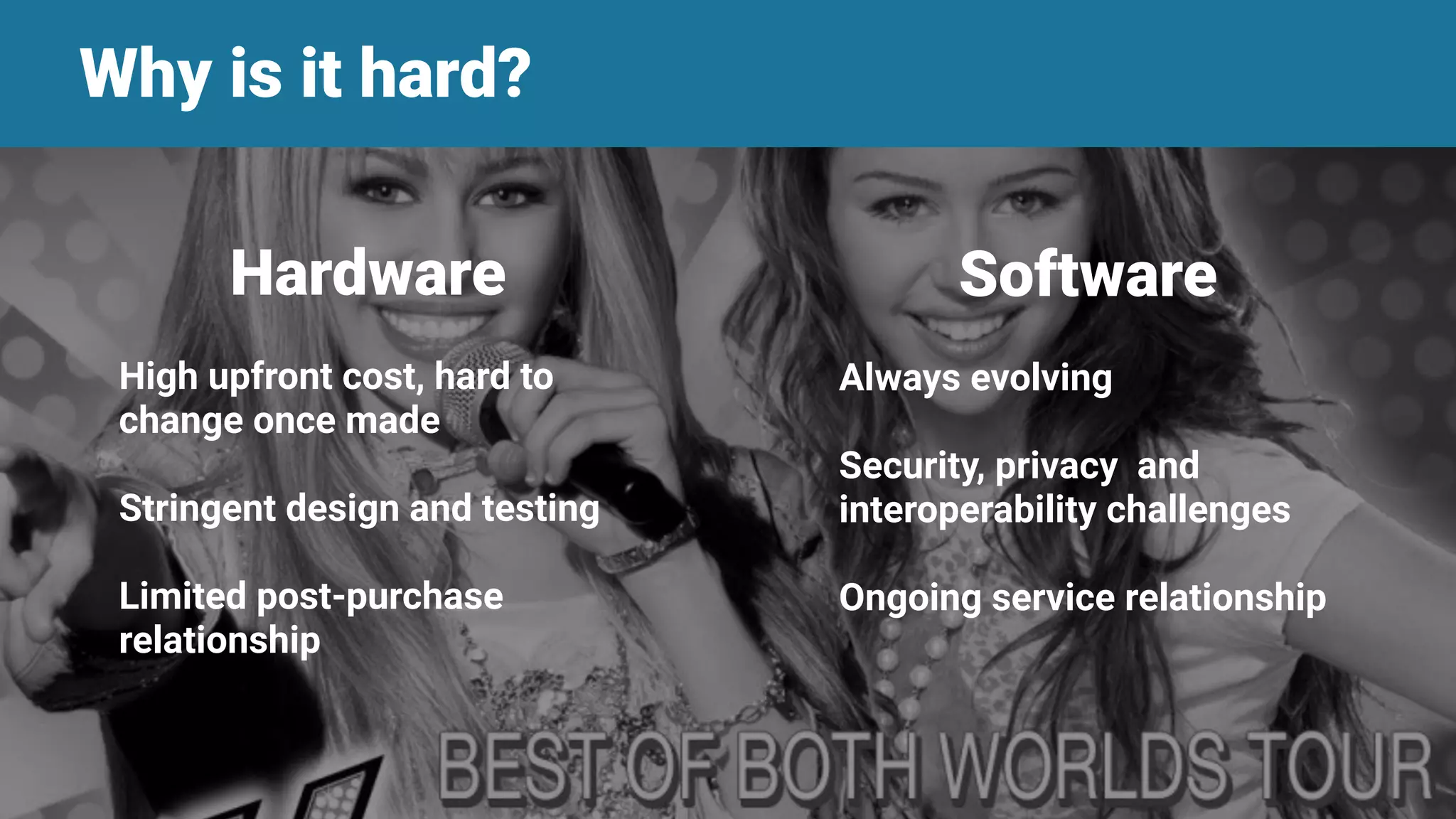
Why is it hard?
Software
Always evolving
Security, privacy and
interoperability challenges
Ongoing service relationship
Hardware
High upfront cost, hard to
change once made
Stringent design and testing
Limited post-purchase
relationship
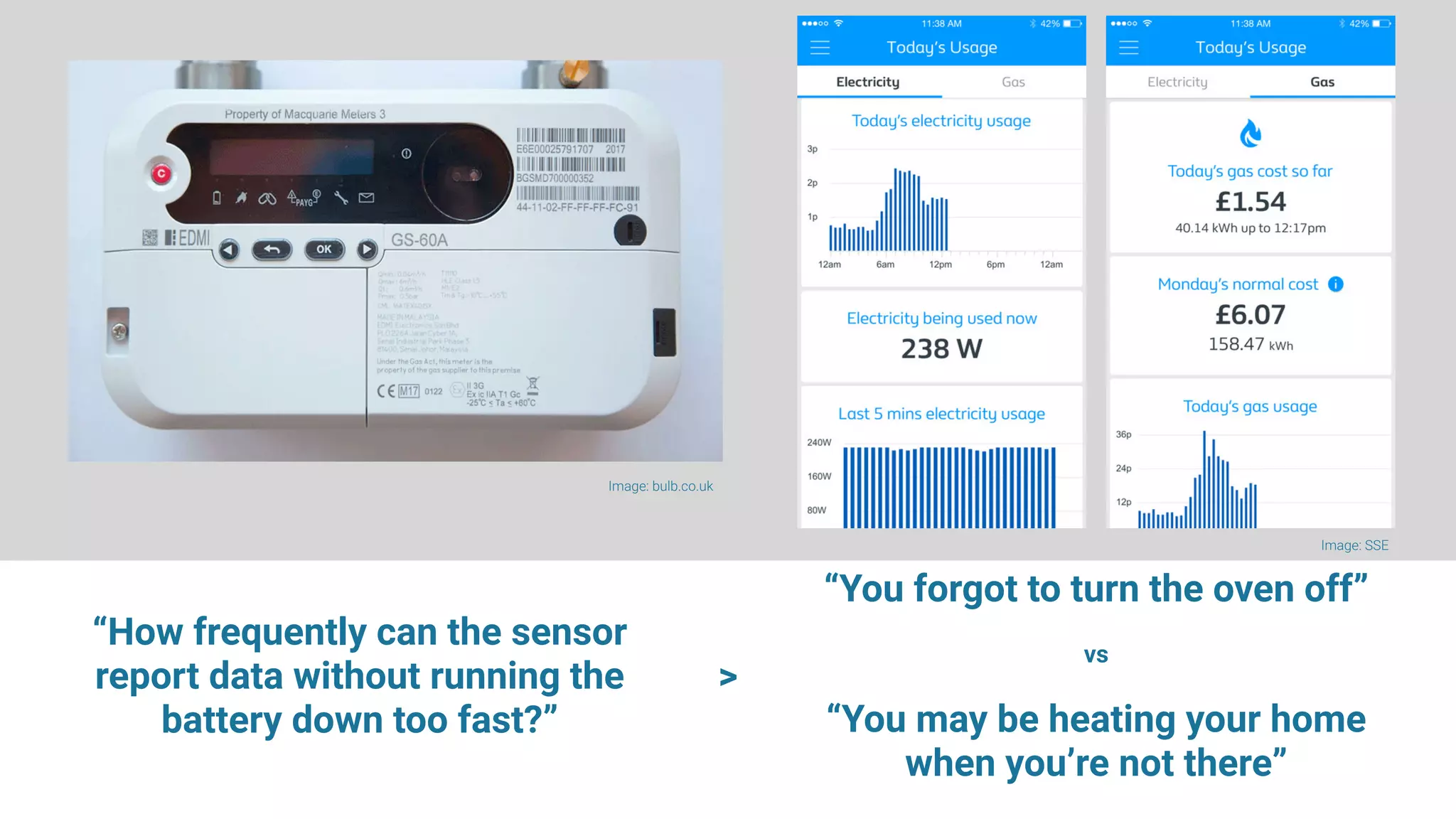
Image: bulb.co.uk
“How frequently can the sensor
report data without running the
battery down too fast?”
“You forgot to turn the oven off”
vs
“You may be heating your home
when you’re not there”
>
Image: SSE
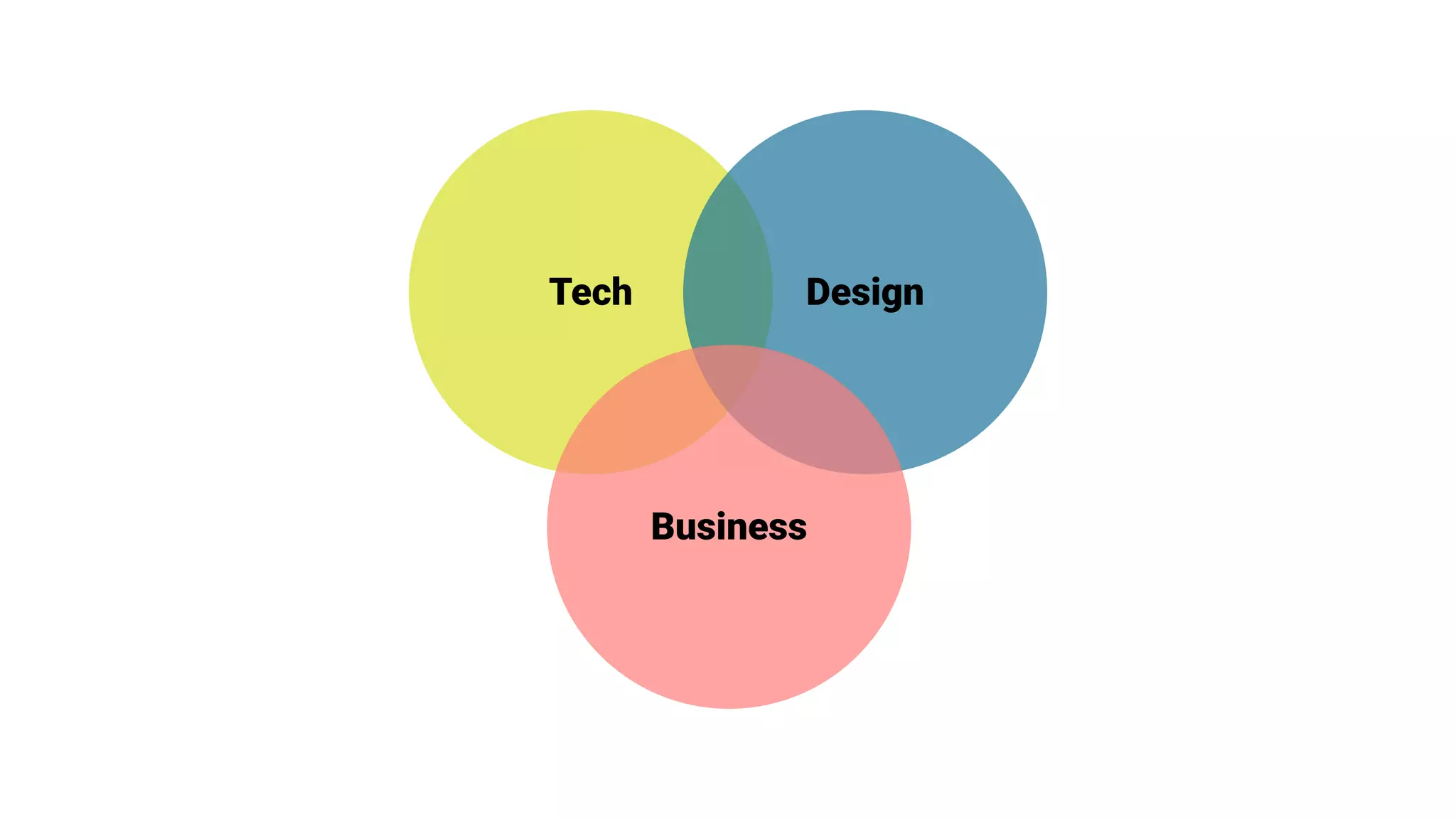
Tech Design
Business
UX for IoT is
not just app UI
and industrial
design
Industrial
design/
hardware UI
Software UI
System UX:
interusability
Service
design
Propositions
and business
models
Technical
enablers
(connectivity, APIs, data,
power…)
Tech:
Distributed systems
are different
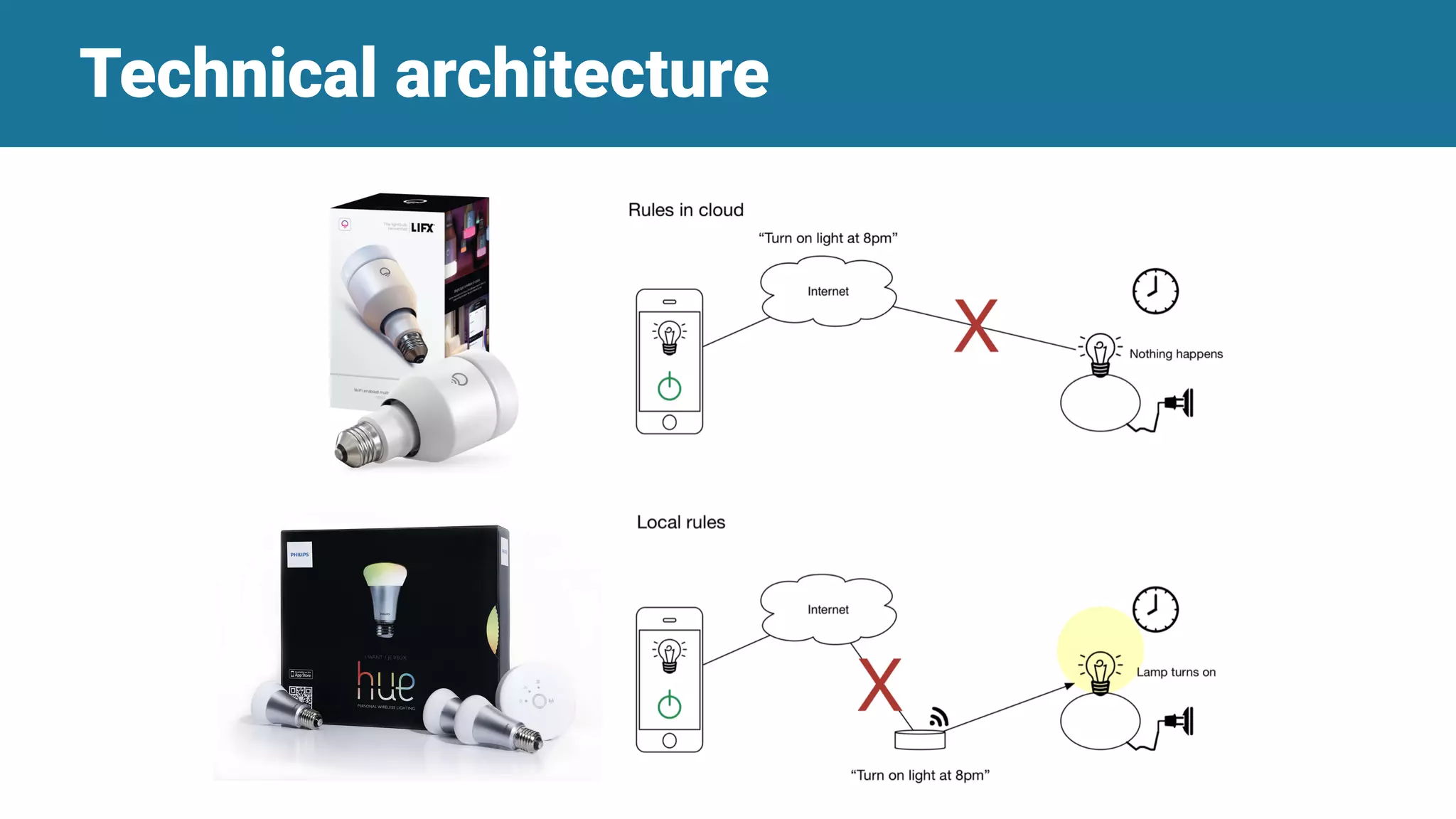
Technical architecture
Connectivity patterns
Images: Canary Care
How could it fail?
Image: Amazon
Proposition:
Balancing value and risk
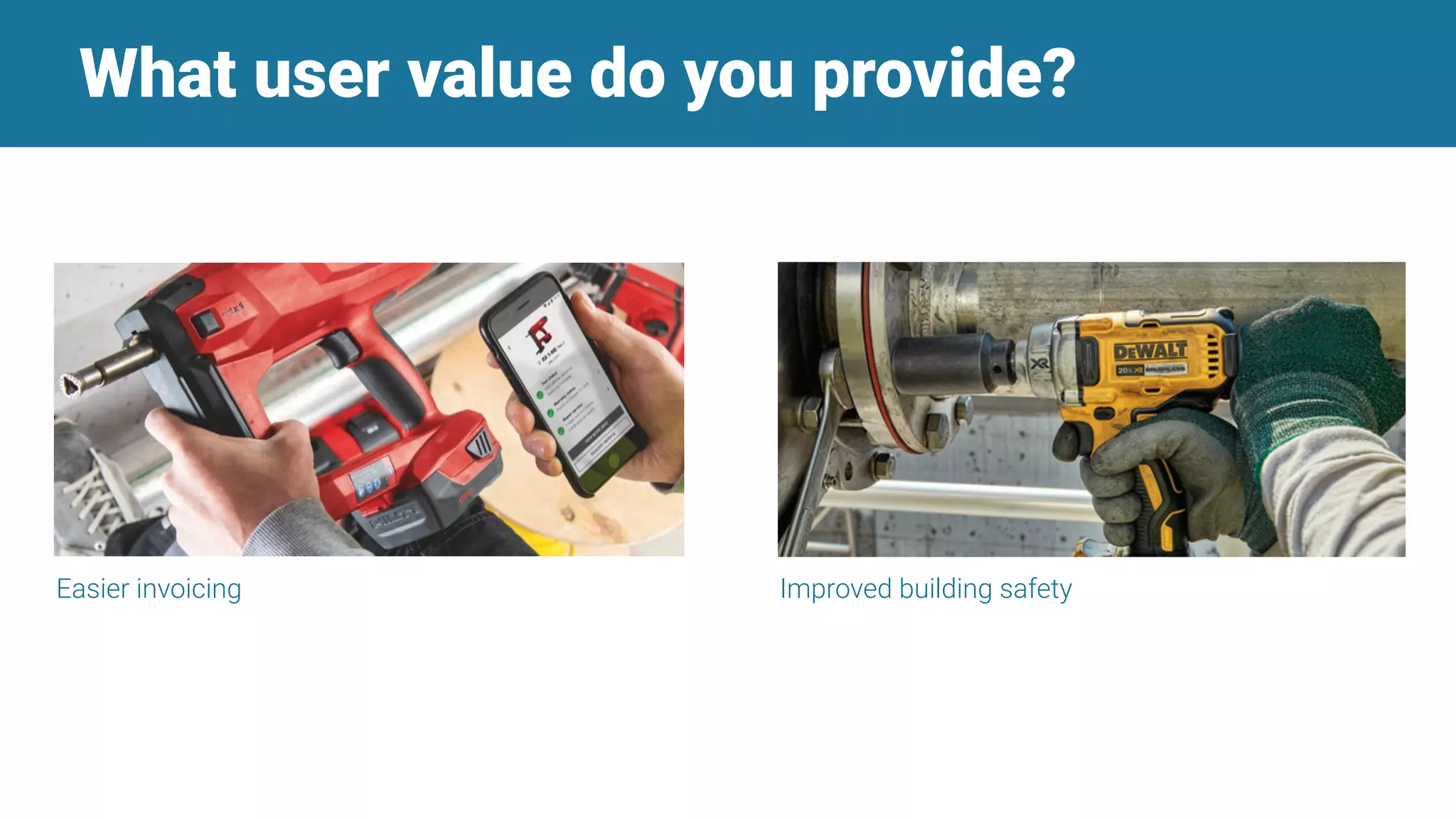
What user value do you provide?
Easier invoicing Improved building safety
What risks are you introducing?
Privacy/security Discrimination Burning the house down
Are you actually
solving the
problem… or just
creating new
ones?
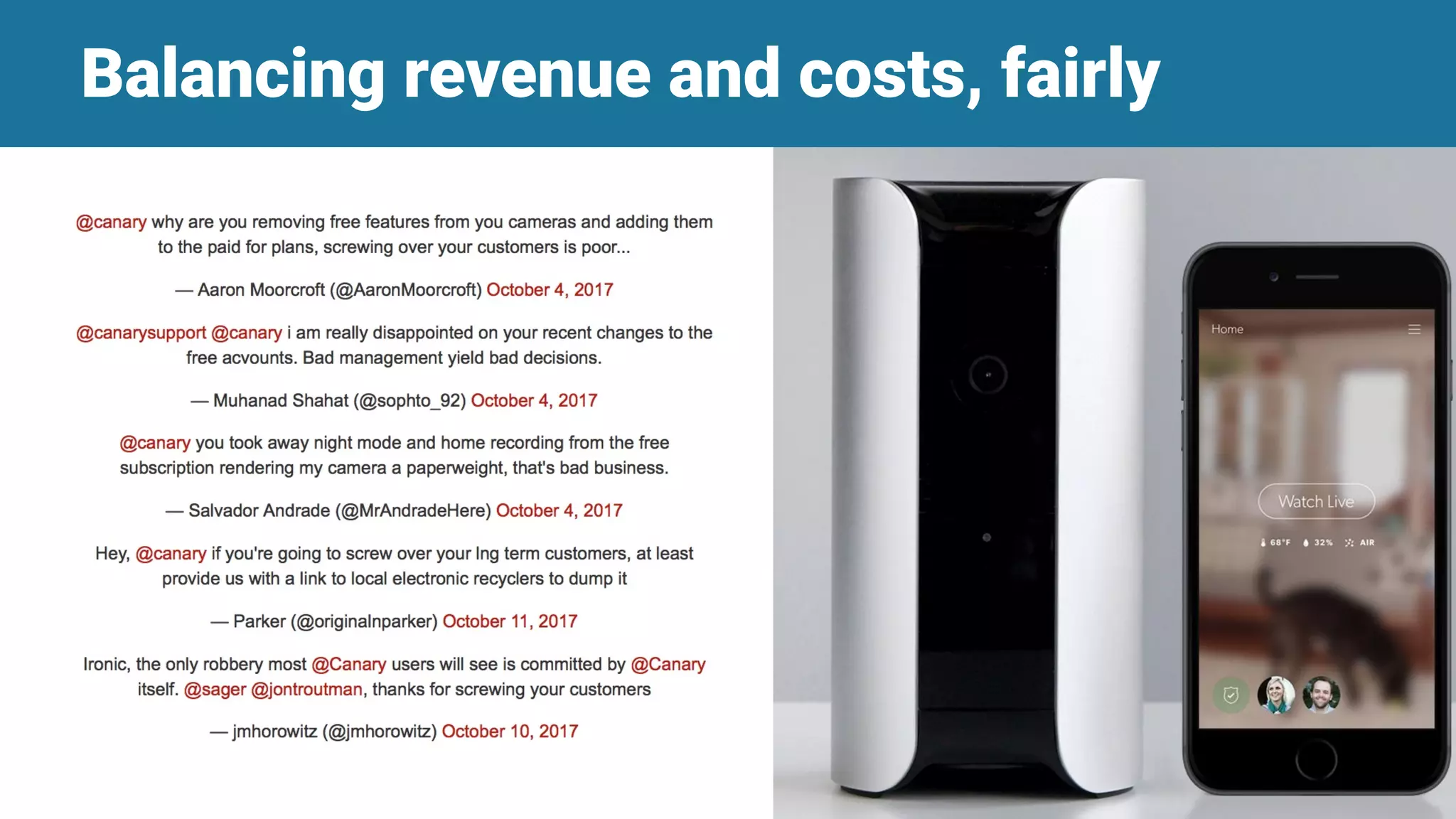
Balancing revenue and costs, fairly
Design:
Distributed UX
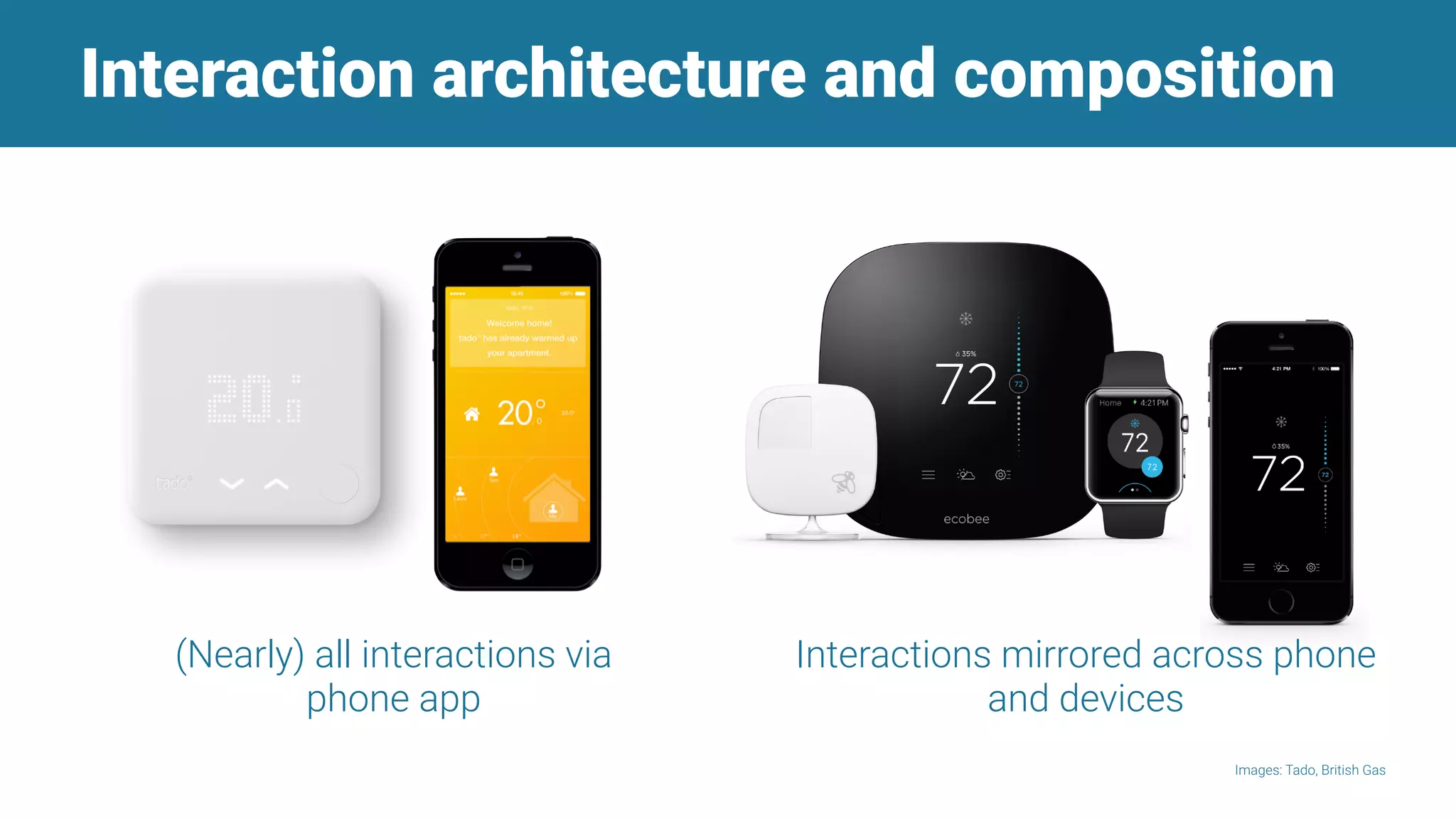
Interaction architecture and composition
Images: Tado, British Gas
(Nearly) all interactions via
phone app
Interactions mirrored across phone
and devices
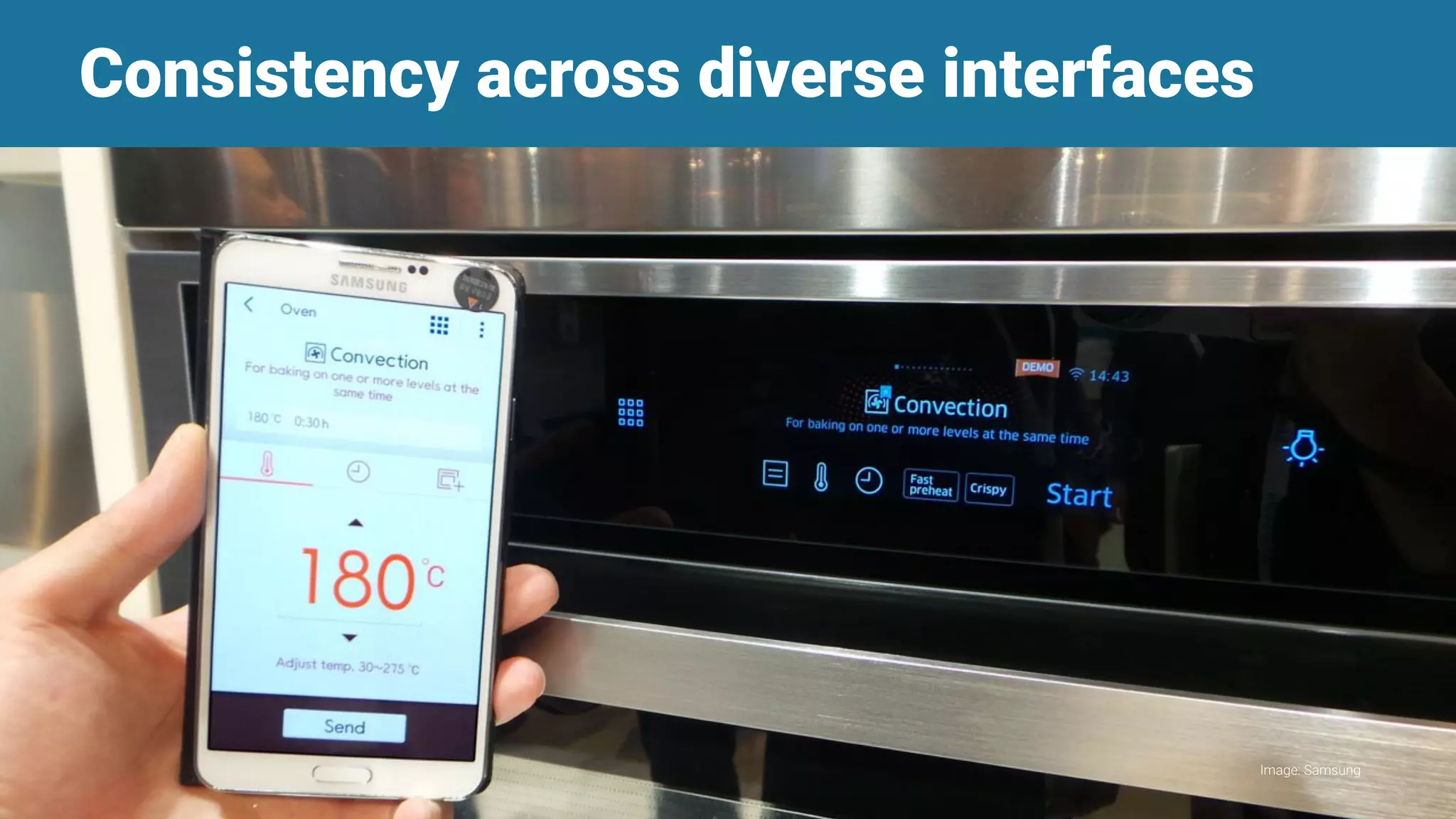
Consistency across diverse interfaces
Image: Samsung
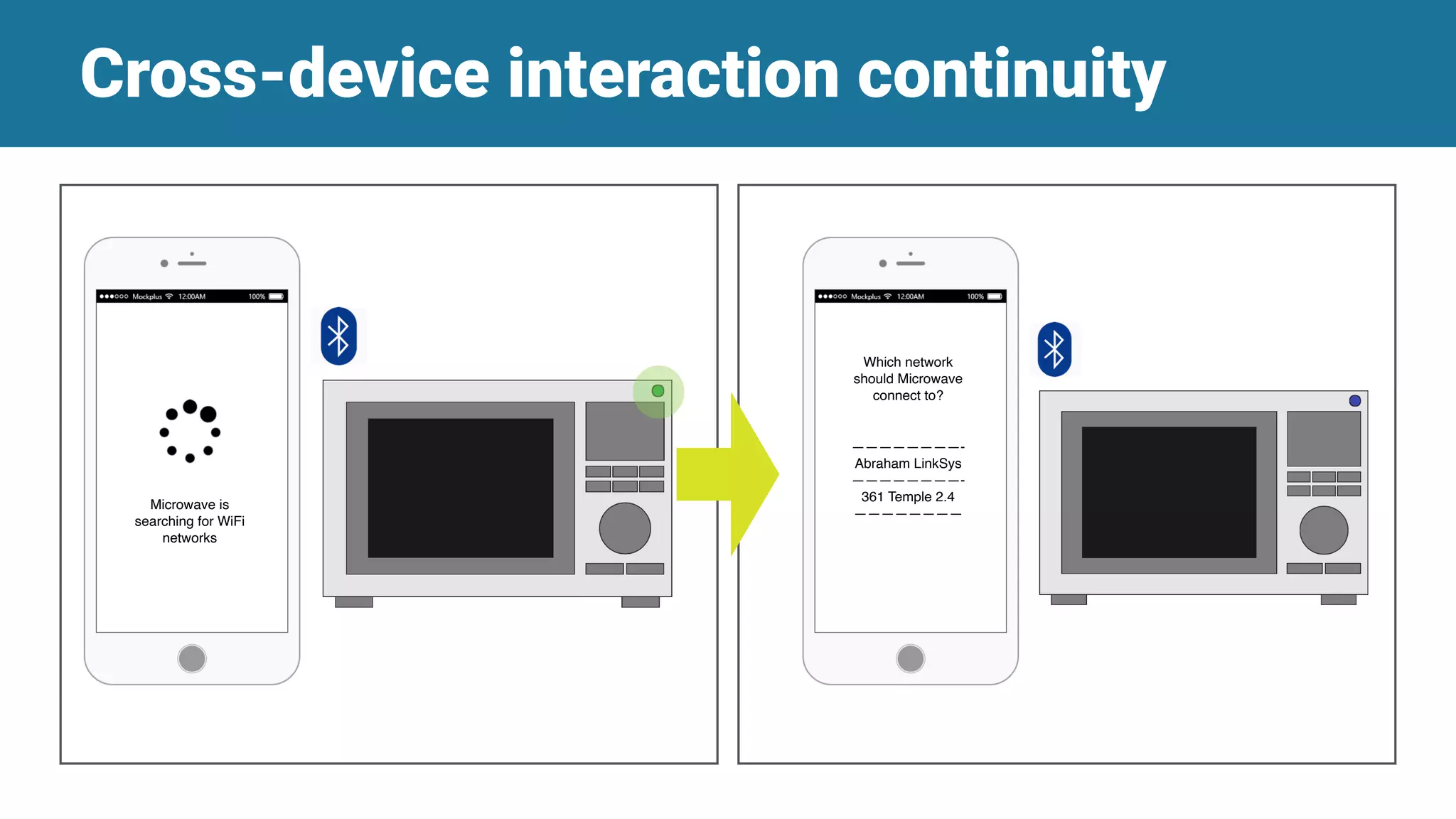
Cross-device interaction continuity
Microwave is
searching for WiFi
networks
Which network
should Microwave
connect to?
————————-
Abraham LinkSys
————————-
361 Temple 2.4
————————
…and the spaces in between
• Latency
• Reliability
• Intermittent
connectivity
• Responsiveness
of cloud service
Effective IoT teams
This image contains user experience decisions
Image: Marcio Granzotto on Github
It takes a lot of different skillsets to make a good IoT product
No one person can know everything
…but everyone needs to understand their teammates’ jobs
well enough to know when to talk to one another
How can you facilitate that?
• Everyone needs to know how their individual work aligns with user,
product and organisational goals
• Incentivise people to collaborate and share, not do their thing and hand
it over
• Whole team weekly meeting: What’s everyone working on? What issues
are you facing? Demos? Questions?
• Work through key use cases as a team
Tools
What individuals can do
• Be curious
• Be respectful, don’t pigeonhole others: no-one can know everything and
good ideas and valid suggestions can come from anywhere
• Be prepared to think up new ways to explore problems: conventional
software tools and approaches might not cut it
• Learn how to communicate what you are doing to others outside your
specialism, and make the effort to understand the way they
communicate
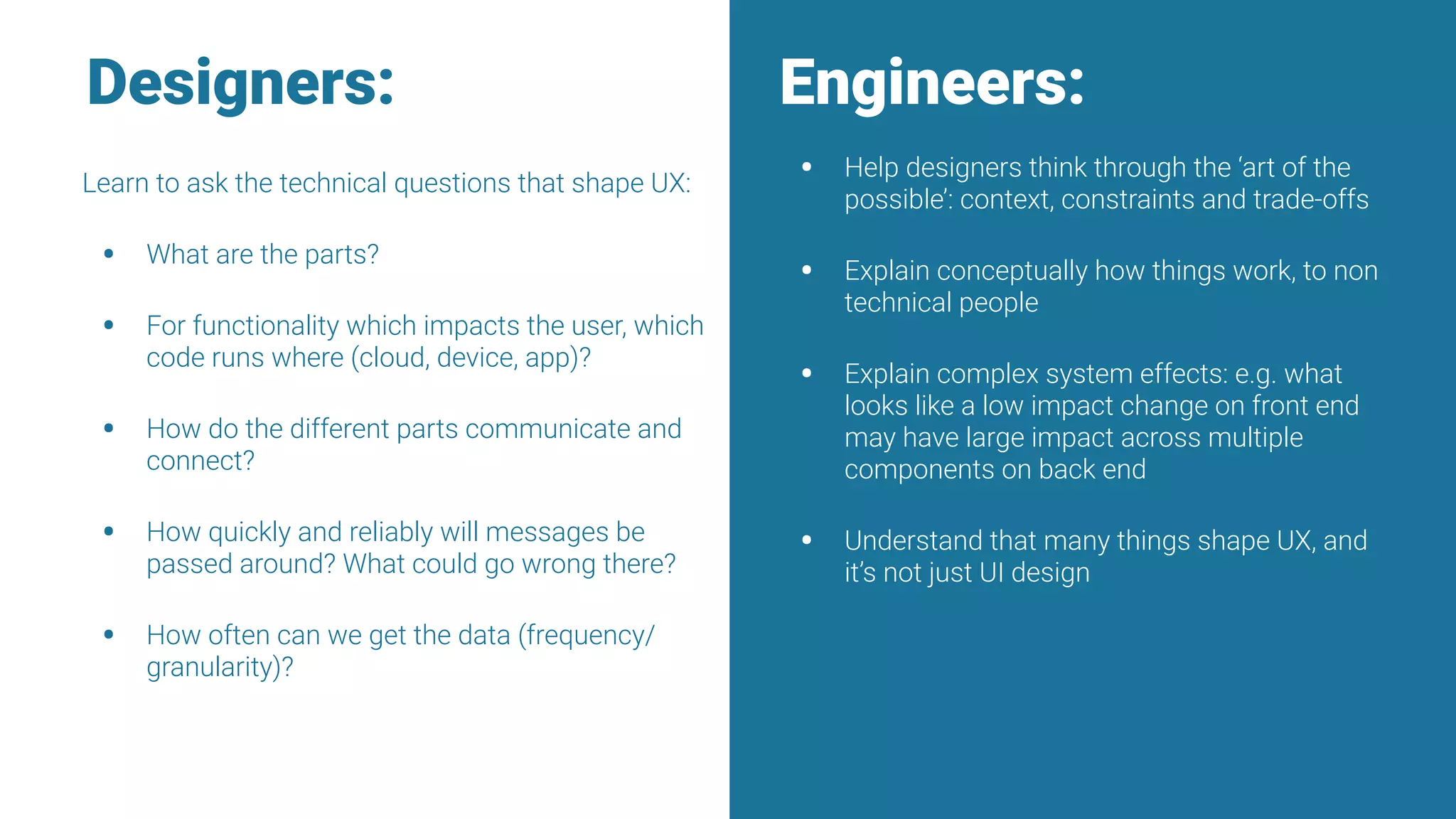
Learn to ask the technical questions that shape UX:
• What are the parts?
• For functionality which impacts the user, which
code runs where (cloud, device, app)?
• How do the different parts communicate and
connect?
• How quickly and reliably will messages be
passed around? What could go wrong there?
• How often can we get the data (frequency/
granularity)?
• Help designers think through the ‘art of the
possible’: context, constraints and trade-offs
• Explain conceptually how things work, to non
technical people
• Explain complex system effects: e.g. what
looks like a low impact change on front end
may have large impact across multiple
components on back end
• Understand that many things shape UX, and
it’s not just UI design
Engineers:Designers:
Want a book?
Tweet @thoughtworks_de
with
I want a book #YConf2020
First 2 win!
Thank you!
claire@clairerowland.com
www.clairerowland.com
@clurr

Hardware is hard(er)

  • 1.
    Hardware is hard(er) Designingfor distributed user experiences in IoT Copyright Claire Rowland
  • 2.
    Hello Product strategy, product discoveryand experience design for IoT, hardware- enabled services and energy tech
  • 3.
    What’s IoT, andwhy is it hard?
  • 4.
  • 5.
  • 6.
    Why is ithard? Software Always evolving Security, privacy and interoperability challenges Ongoing service relationship Hardware High upfront cost, hard to change once made Stringent design and testing Limited post-purchase relationship
  • 7.
    Image: bulb.co.uk “How frequentlycan the sensor report data without running the battery down too fast?” “You forgot to turn the oven off” vs “You may be heating your home when you’re not there” > Image: SSE
  • 8.
  • 9.
    UX for IoTis not just app UI and industrial design Industrial design/ hardware UI Software UI System UX: interusability Service design Propositions and business models Technical enablers (connectivity, APIs, data, power…)
  • 10.
  • 11.
  • 12.
  • 13.
    How could itfail? Image: Amazon
  • 14.
  • 15.
    What user valuedo you provide? Easier invoicing Improved building safety
  • 16.
    What risks areyou introducing? Privacy/security Discrimination Burning the house down
  • 17.
    Are you actually solvingthe problem… or just creating new ones?
  • 18.
    Balancing revenue andcosts, fairly
  • 19.
  • 20.
    Interaction architecture andcomposition Images: Tado, British Gas (Nearly) all interactions via phone app Interactions mirrored across phone and devices
  • 21.
    Consistency across diverseinterfaces Image: Samsung
  • 22.
    Cross-device interaction continuity Microwaveis searching for WiFi networks Which network should Microwave connect to? ————————- Abraham LinkSys ————————- 361 Temple 2.4 ————————
  • 23.
    …and the spacesin between • Latency • Reliability • Intermittent connectivity • Responsiveness of cloud service
  • 24.
  • 25.
    This image containsuser experience decisions Image: Marcio Granzotto on Github
  • 26.
    It takes alot of different skillsets to make a good IoT product No one person can know everything …but everyone needs to understand their teammates’ jobs well enough to know when to talk to one another
  • 27.
    How can youfacilitate that? • Everyone needs to know how their individual work aligns with user, product and organisational goals • Incentivise people to collaborate and share, not do their thing and hand it over • Whole team weekly meeting: What’s everyone working on? What issues are you facing? Demos? Questions? • Work through key use cases as a team
  • 28.
  • 29.
    What individuals cando • Be curious • Be respectful, don’t pigeonhole others: no-one can know everything and good ideas and valid suggestions can come from anywhere • Be prepared to think up new ways to explore problems: conventional software tools and approaches might not cut it • Learn how to communicate what you are doing to others outside your specialism, and make the effort to understand the way they communicate
  • 30.
    Learn to askthe technical questions that shape UX: • What are the parts? • For functionality which impacts the user, which code runs where (cloud, device, app)? • How do the different parts communicate and connect? • How quickly and reliably will messages be passed around? What could go wrong there? • How often can we get the data (frequency/ granularity)? • Help designers think through the ‘art of the possible’: context, constraints and trade-offs • Explain conceptually how things work, to non technical people • Explain complex system effects: e.g. what looks like a low impact change on front end may have large impact across multiple components on back end • Understand that many things shape UX, and it’s not just UI design Engineers:Designers:
  • 31.
    Want a book? Tweet@thoughtworks_de with I want a book #YConf2020 First 2 win!
  • 32.