InnovationHow to get the ball rolling?Zeist, 18 February 2010Michael de PaauwGartner Executive ProgramsModule Technology ManagementLeergang 2009-2011, Kerndocent Dick Pouw MBA
AgendaIntroduction 	15 minPresentation 	60 minDinner 	90 minPresentation 	60 min Break	15 minQ&A – discussions	45 minAbout GartnerGartner, Inc. is the world's leading information technology research andadvisory company. We deliver the technology-related insights necessary for our clients to make the right decisions, every day.Research – Events – Consulting – Executive Programs
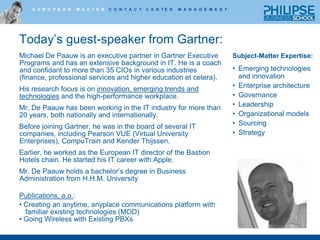
Today’s guest-speaker from Gartner:Michael De Paauw is an executive partner in Gartner Executive Programs and has an extensive background in IT. He is a coach and confidant to more than 35 CIOs in various industries (finance, professional services and higher education et cetera). His research focus is on innovation, emerging trends and technologies and the high-performance workplace.Mr. De Paauw has been working in the IT industry for more than 20 years, both nationally and internationally. Before joining Gartner, he was in the board of several IT companies, including Pearson VUE (Virtual University Enterprises), CompuTrain and Kender Thijssen.Earlier, he worked as the European IT director of the Bastion Hotels chain. He started his IT career with Apple.Mr. De Paauw holds a bachelor’s degree in Business Administration from H.H.M. UniversityPublications, a.o.:  Creating an anytime, anyplace communications platform with  	familiar existing technologies (MOD) Going Wireless with Existing PBXsSubject-Matter Expertise:Emerging technologies and innovationEnterprise architectureGovernanceLeadershipOrganizational modelsSourcingStrategy
Innovation – A definitionThe successful realization of novel ideas that create value for an organization, its business and economic environment, and its stakeholders — employees, customers or constituents, and suppliers or business partners.Incremental 	Step     change 	change
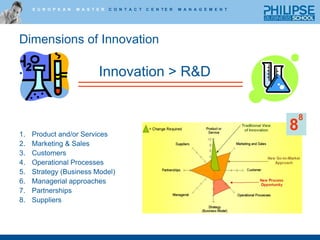
Dimensions of InnovationInnovation > R&DProduct and/or ServicesMarketing & SalesCustomersOperational ProcessesStrategy (Business Model)Managerial approachesPartnershipsSuppliers88
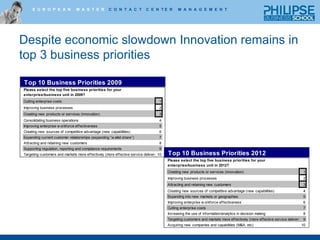
Despite economic slowdown Innovation remains in top 3 business priorities
The Bottleneck is at the Top of the Bottle
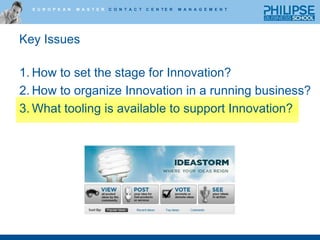
Key IssuesHow to set the stage for Innovation?How to organize Innovation in a running business?What tooling is available to support Innovation?
Where does innovation come from?Onder druk wordt alles vloeibaar “Necessity is the mother of invention” [Plato]“Invention arises from idleness” [Agatha Christie]Crisis forces you to make choices that you probably wouldn't have made otherwise.Extreme StressEmployees are expected to spend 20% of their time on innovation.Creativity features strongly in the recruiting process
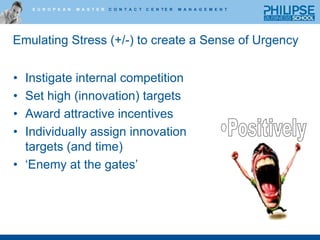
Emulating Stress (+/-) to create a Sense of UrgencyInstigate internal competitionSet high (innovation) targetsAward attractive incentivesIndividually assign innovation targets (and time)‘Enemy at the gates’Positively
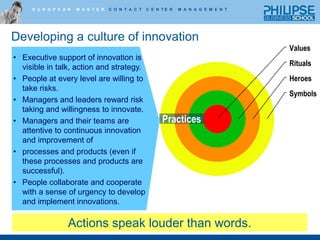
Developing a culture of innovationExecutive support of innovation is visible in talk, action and strategy.People at every level are willing to take risks.Managers and leaders reward risk taking and willingness to innovate.Managers and their teams are attentive to continuous innovation and improvement ofprocesses and products (even if these processes and products are successful).People collaborate and cooperate with a sense of urgency to develop and implement innovations.PracticesActions speak louder than words.
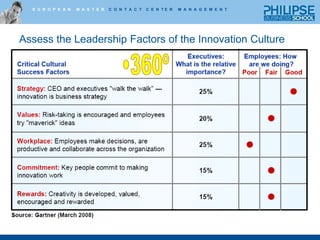
Five Pillars of an Innovation CultureStrategy:The CEO and executives put innovation on the agenda and "walk the talk."Values:Innovation as part of the strategy is communicated. Risk-taking is encouraged. Failure is tolerated. Employees try maverick ideas.Workplace:Employees work in an environment where they can:  Access people and information
 Analyze or evaluate information and make viable, fast decisions
 Develop and share ideasManagement Commitment:Important, influential people lead and manage innovation. They are committed to and accountable for making it work.Rewards:Creative thinking skills are developed and valued. Great ideas are encouraged, evaluated, funded and rewarded. Building on the ideas of others is rewarded.
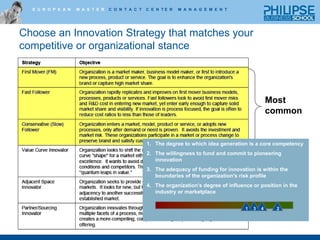
Choose an Innovation Strategy that matches your competitive or organizational stanceThe degree to which idea generation is a core competencyThe willingness to fund and commit to pioneering innovationThe adequacy of funding for innovation is within the boundaries of the organization's risk profileThe organization's degree of influence or position in the industry or marketplaceMost common4231
Focus Innovation on the Business:Five most common triggersImmediate business problemsDisruptive Business TrendsValue DisciplinePersistent business needsCore competencies
Assess the Leadership Factors of the Innovation Culture360º
Key IssuesHow to set the stage for Innovation?How to organize Innovation in a running business?What tooling is available to support Innovation?
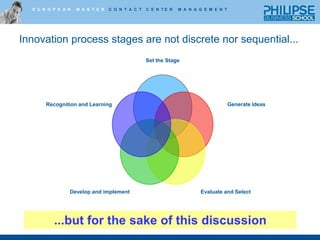
Innovation process stages are not discrete nor sequential......but for the sake of this discussion
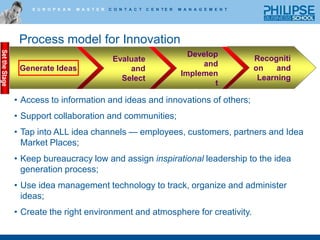
Process model for InnovationRecognition      and LearningGenerate IdeasEvaluate             and SelectDevelop and ImplementAccess to information and ideas and innovations of others;Support collaboration and communities;Tap into ALL idea channels — employees, customers, partners and Idea Market Places;Keep bureaucracy low and assign inspirational leadership to the idea generation process;Use idea management technology to track, organize and administer ideas;Create the right environment and atmosphere for creativity.Set the Stage
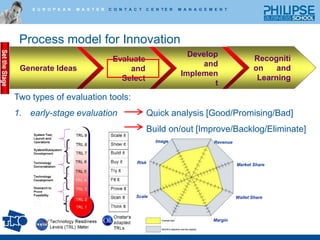
Process model for InnovationRecognition      and LearningGenerate IdeasEvaluate             and SelectDevelop and ImplementTwo types of evaluation tools:early-stage evaluation 	Quick analysis [Good/Promising/Bad]		Build on/out [Improve/Backlog/Eliminate]ImageRevenueRiskMarket ShareScaleWallet ShareMarginSet the Stage
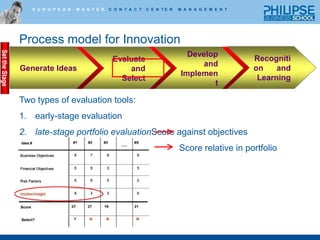
Process model for InnovationRecognition      and LearningGenerate IdeasEvaluate             and SelectDevelop and ImplementTwo types of evaluation tools:early-stage evaluation 	late-stage portfolio evaluation	Score against objectives			Score relative in portfolioSet the Stage
Process model for InnovationRecognition      and LearningGenerate IdeasEvaluate             and SelectDevelop and ImplementDevelopment transforms ideas into innovations;Skilled project management is vital for success;A sense of urgency is critical;Innovation team hands over to project team.Set the Stage
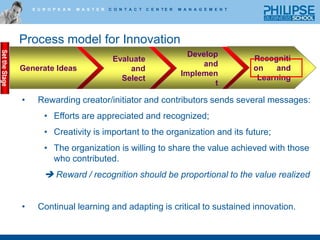
Process model for InnovationRecognition      and LearningGenerate IdeasEvaluate             and SelectDevelop and ImplementRewarding creator/initiator and contributors sends several messages:Efforts are appreciated and recognized;Creativity is important to the organization and its future;The organization is willing to share the value achieved with those who contributed. Reward / recognition should be proportional to the value realizedContinual learning and adapting is critical to sustained innovation.Set the Stage
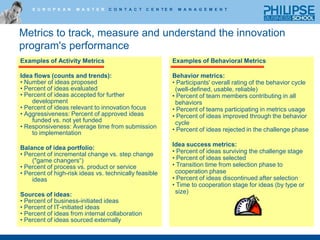
Metrics to track, measure and understand the innovation program's performance Examples of Activity MetricsIdea flows (counts and trends):• Number of ideas proposed• Percent of ideas evaluated• Percent of ideas accepted for further development• Percent of ideas relevant to innovation focus• Aggressiveness: Percent of approved ideas funded vs. not yet funded• Responsiveness: Average time from submission to implementationBalance of idea portfolio:• Percent of incremental change vs. step change ("game changers“)• Percent of process vs. product or service• Percent of high-risk ideas vs. technically feasible ideasSources of ideas:• Percent of business-initiated ideas• Percent of IT-initiated ideas• Percent of ideas from internal collaboration• Percent of ideas sourced externallyExamples of Behavioral MetricsBehavior metrics:• Participants' overall rating of the behavior cycle (well-defined, usable, reliable)• Percent of team members contributing in all behaviors• Percent of teams participating in metrics usage• Percent of ideas improved through the behavior cycle• Percent of ideas rejected in the challenge phaseIdea success metrics:• Percent of ideas surviving the challenge stage• Percent of ideas selected• Transition time from selection phase to cooperation phase• Percent of ideas discontinued after selection• Time to cooperation stage for ideas (by type or size)
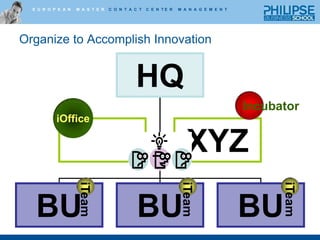
Organize to Accomplish InnovationIncubatoriOfficeiTeamiTeamiTeam
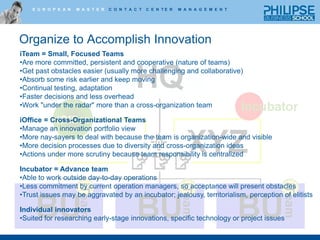
Organize to Accomplish InnovationiTeam = Small, Focused TeamsAre more committed, persistent and cooperative (nature of teams)Get past obstacles easier (usually more challenging and collaborative)Absorb some risk earlier and keep movingContinual testing, adaptationFaster decisions and less overheadWork "under the radar" more than a cross-organization teamiOffice = Cross-Organizational TeamsManage an innovation portfolio viewMore nay-sayers to deal with because the team is organization-wide and visibleMore decision processes due to diversity and cross-organization ideasActions under more scrutiny because team responsibility is centralizedIncubator = Advance teamAble to work outside day-to-day operationsLess commitment by current operation managers, so acceptance will present obstaclesTrust issues may be aggravated by an incubator; jealousy, territorialism, perception of elitistsIndividual innovatorsSuited for researching early-stage innovations, specific technology or project issues
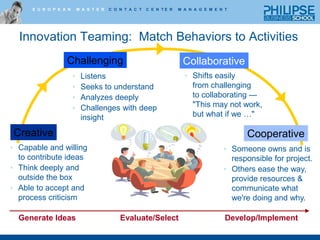
ChallengingCollaborativeShifts easily from challenging to collaborating — "This may not work, but what if we …"
Listens
Seeks to understand
Analyzes deeply
Challenges with deep insightCreativeCooperativeCapable and willing to contribute ideas
Think deeply and outside the box
Able to accept and process criticism
Someone owns and is responsible for project.
Others ease the way, provide resources & communicate what we're doing and why.Generate IdeasEvaluate/SelectDevelop/ImplementInnovation Teaming:  Match Behaviors to Activities
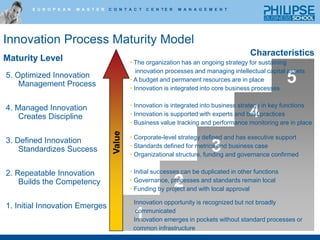
Characteristics Maturity Level The organization has an ongoing strategy for sustaining   innovation processes and managing intellectual capital assets A budget and permanent resources are in place Innovation is integrated into core business processes Innovation is integrated into business strategy in key functions Innovation is supported with experts and best practices Business value tracking and performance monitoring are in place Corporate-level strategy defined and has executive support Standards defined for metrics and business case Organizational structure, funding and governance confirmed Initial successes can be duplicated in other functions Governance, processes and standards remain local Funding by project and with local approval Innovation opportunity is recognized but not broadly    communicated Innovation emerges in pockets without standard processes or   common infrastructure55. Optimized Innovation Management Process4. Managed Innovation Creates Discipline3. Defined Innovation Standardizes Success  2. Repeatable Innovation Builds the Competency1. Initial Innovation Emerges4Value321Innovation Process Maturity Model
Key IssuesHow to set the stage for Innovation?How to organize Innovation in a running business?What tooling is available to support Innovation?
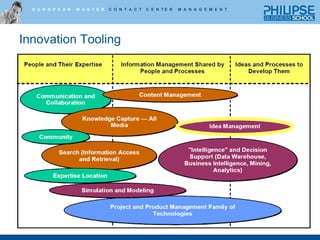
Innovation Tooling
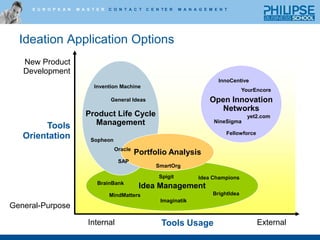
Ideation Application OptionsNew Product DevelopmentProduct Life CycleManagementOpen InnovationNetworksInnoCentiveInvention MachineYourEncoreGeneral Ideasyet2.comNineSigmaToolsOrientationFellowforcePortfolio AnalysisSopheonOracleSAPIdea ManagementSmartOrgSpigitIdea ChampionsBrainBankBrightIdeaMindMattersImaginatikGeneral-PurposeInternalTools UsageExternal
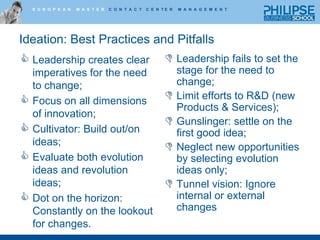
Ideation: Best Practices and PitfallsLeadership creates clear imperatives for the need to change;
Focus on all dimensions of innovation;
Cultivator: Build out/on ideas;
Evaluate both evolution ideas and revolution ideas;
Dot on the horizon: Constantly on the lookout for changes.

Innovation - how to get the ball rolling

  • 1.
    InnovationHow to getthe ball rolling?Zeist, 18 February 2010Michael de PaauwGartner Executive ProgramsModule Technology ManagementLeergang 2009-2011, Kerndocent Dick Pouw MBA
  • 2.
    AgendaIntroduction 15 minPresentation 60 minDinner 90 minPresentation 60 min Break 15 minQ&A – discussions 45 minAbout GartnerGartner, Inc. is the world's leading information technology research andadvisory company. We deliver the technology-related insights necessary for our clients to make the right decisions, every day.Research – Events – Consulting – Executive Programs
  • 3.
    Today’s guest-speaker fromGartner:Michael De Paauw is an executive partner in Gartner Executive Programs and has an extensive background in IT. He is a coach and confidant to more than 35 CIOs in various industries (finance, professional services and higher education et cetera). His research focus is on innovation, emerging trends and technologies and the high-performance workplace.Mr. De Paauw has been working in the IT industry for more than 20 years, both nationally and internationally. Before joining Gartner, he was in the board of several IT companies, including Pearson VUE (Virtual University Enterprises), CompuTrain and Kender Thijssen.Earlier, he worked as the European IT director of the Bastion Hotels chain. He started his IT career with Apple.Mr. De Paauw holds a bachelor’s degree in Business Administration from H.H.M. UniversityPublications, a.o.: Creating an anytime, anyplace communications platform with familiar existing technologies (MOD) Going Wireless with Existing PBXsSubject-Matter Expertise:Emerging technologies and innovationEnterprise architectureGovernanceLeadershipOrganizational modelsSourcingStrategy
  • 4.
    Innovation – AdefinitionThe successful realization of novel ideas that create value for an organization, its business and economic environment, and its stakeholders — employees, customers or constituents, and suppliers or business partners.Incremental Step change change
  • 5.
    Dimensions of InnovationInnovation> R&DProduct and/or ServicesMarketing & SalesCustomersOperational ProcessesStrategy (Business Model)Managerial approachesPartnershipsSuppliers88
  • 6.
    Despite economic slowdownInnovation remains in top 3 business priorities
  • 7.
    The Bottleneck isat the Top of the Bottle
  • 8.
    Key IssuesHow toset the stage for Innovation?How to organize Innovation in a running business?What tooling is available to support Innovation?
  • 9.
    Where does innovationcome from?Onder druk wordt alles vloeibaar “Necessity is the mother of invention” [Plato]“Invention arises from idleness” [Agatha Christie]Crisis forces you to make choices that you probably wouldn't have made otherwise.Extreme StressEmployees are expected to spend 20% of their time on innovation.Creativity features strongly in the recruiting process
  • 10.
    Emulating Stress (+/-)to create a Sense of UrgencyInstigate internal competitionSet high (innovation) targetsAward attractive incentivesIndividually assign innovation targets (and time)‘Enemy at the gates’Positively
  • 11.
    Developing a cultureof innovationExecutive support of innovation is visible in talk, action and strategy.People at every level are willing to take risks.Managers and leaders reward risk taking and willingness to innovate.Managers and their teams are attentive to continuous innovation and improvement ofprocesses and products (even if these processes and products are successful).People collaborate and cooperate with a sense of urgency to develop and implement innovations.PracticesActions speak louder than words.
  • 12.
    Five Pillars ofan Innovation CultureStrategy:The CEO and executives put innovation on the agenda and "walk the talk."Values:Innovation as part of the strategy is communicated. Risk-taking is encouraged. Failure is tolerated. Employees try maverick ideas.Workplace:Employees work in an environment where they can: Access people and information
  • 13.
    Analyze orevaluate information and make viable, fast decisions
  • 14.
    Develop andshare ideasManagement Commitment:Important, influential people lead and manage innovation. They are committed to and accountable for making it work.Rewards:Creative thinking skills are developed and valued. Great ideas are encouraged, evaluated, funded and rewarded. Building on the ideas of others is rewarded.
  • 15.
    Choose an InnovationStrategy that matches your competitive or organizational stanceThe degree to which idea generation is a core competencyThe willingness to fund and commit to pioneering innovationThe adequacy of funding for innovation is within the boundaries of the organization's risk profileThe organization's degree of influence or position in the industry or marketplaceMost common4231
  • 16.
    Focus Innovation onthe Business:Five most common triggersImmediate business problemsDisruptive Business TrendsValue DisciplinePersistent business needsCore competencies
  • 17.
    Assess the LeadershipFactors of the Innovation Culture360º
  • 18.
    Key IssuesHow toset the stage for Innovation?How to organize Innovation in a running business?What tooling is available to support Innovation?
  • 19.
    Innovation process stagesare not discrete nor sequential......but for the sake of this discussion
  • 20.
    Process model forInnovationRecognition and LearningGenerate IdeasEvaluate and SelectDevelop and ImplementAccess to information and ideas and innovations of others;Support collaboration and communities;Tap into ALL idea channels — employees, customers, partners and Idea Market Places;Keep bureaucracy low and assign inspirational leadership to the idea generation process;Use idea management technology to track, organize and administer ideas;Create the right environment and atmosphere for creativity.Set the Stage
  • 21.
    Process model forInnovationRecognition and LearningGenerate IdeasEvaluate and SelectDevelop and ImplementTwo types of evaluation tools:early-stage evaluation Quick analysis [Good/Promising/Bad] Build on/out [Improve/Backlog/Eliminate]ImageRevenueRiskMarket ShareScaleWallet ShareMarginSet the Stage
  • 22.
    Process model forInnovationRecognition and LearningGenerate IdeasEvaluate and SelectDevelop and ImplementTwo types of evaluation tools:early-stage evaluation late-stage portfolio evaluation Score against objectives Score relative in portfolioSet the Stage
  • 23.
    Process model forInnovationRecognition and LearningGenerate IdeasEvaluate and SelectDevelop and ImplementDevelopment transforms ideas into innovations;Skilled project management is vital for success;A sense of urgency is critical;Innovation team hands over to project team.Set the Stage
  • 24.
    Process model forInnovationRecognition and LearningGenerate IdeasEvaluate and SelectDevelop and ImplementRewarding creator/initiator and contributors sends several messages:Efforts are appreciated and recognized;Creativity is important to the organization and its future;The organization is willing to share the value achieved with those who contributed. Reward / recognition should be proportional to the value realizedContinual learning and adapting is critical to sustained innovation.Set the Stage
  • 25.
    Metrics to track,measure and understand the innovation program's performance Examples of Activity MetricsIdea flows (counts and trends):• Number of ideas proposed• Percent of ideas evaluated• Percent of ideas accepted for further development• Percent of ideas relevant to innovation focus• Aggressiveness: Percent of approved ideas funded vs. not yet funded• Responsiveness: Average time from submission to implementationBalance of idea portfolio:• Percent of incremental change vs. step change ("game changers“)• Percent of process vs. product or service• Percent of high-risk ideas vs. technically feasible ideasSources of ideas:• Percent of business-initiated ideas• Percent of IT-initiated ideas• Percent of ideas from internal collaboration• Percent of ideas sourced externallyExamples of Behavioral MetricsBehavior metrics:• Participants' overall rating of the behavior cycle (well-defined, usable, reliable)• Percent of team members contributing in all behaviors• Percent of teams participating in metrics usage• Percent of ideas improved through the behavior cycle• Percent of ideas rejected in the challenge phaseIdea success metrics:• Percent of ideas surviving the challenge stage• Percent of ideas selected• Transition time from selection phase to cooperation phase• Percent of ideas discontinued after selection• Time to cooperation stage for ideas (by type or size)
  • 26.
    Organize to AccomplishInnovationIncubatoriOfficeiTeamiTeamiTeam
  • 27.
    Organize to AccomplishInnovationiTeam = Small, Focused TeamsAre more committed, persistent and cooperative (nature of teams)Get past obstacles easier (usually more challenging and collaborative)Absorb some risk earlier and keep movingContinual testing, adaptationFaster decisions and less overheadWork "under the radar" more than a cross-organization teamiOffice = Cross-Organizational TeamsManage an innovation portfolio viewMore nay-sayers to deal with because the team is organization-wide and visibleMore decision processes due to diversity and cross-organization ideasActions under more scrutiny because team responsibility is centralizedIncubator = Advance teamAble to work outside day-to-day operationsLess commitment by current operation managers, so acceptance will present obstaclesTrust issues may be aggravated by an incubator; jealousy, territorialism, perception of elitistsIndividual innovatorsSuited for researching early-stage innovations, specific technology or project issues
  • 28.
    ChallengingCollaborativeShifts easily fromchallenging to collaborating — "This may not work, but what if we …"
  • 29.
  • 30.
  • 31.
  • 32.
    Challenges with deepinsightCreativeCooperativeCapable and willing to contribute ideas
  • 33.
    Think deeply andoutside the box
  • 34.
    Able to acceptand process criticism
  • 35.
    Someone owns andis responsible for project.
  • 36.
    Others ease theway, provide resources & communicate what we're doing and why.Generate IdeasEvaluate/SelectDevelop/ImplementInnovation Teaming: Match Behaviors to Activities
  • 37.
    Characteristics Maturity LevelThe organization has an ongoing strategy for sustaining innovation processes and managing intellectual capital assets A budget and permanent resources are in place Innovation is integrated into core business processes Innovation is integrated into business strategy in key functions Innovation is supported with experts and best practices Business value tracking and performance monitoring are in place Corporate-level strategy defined and has executive support Standards defined for metrics and business case Organizational structure, funding and governance confirmed Initial successes can be duplicated in other functions Governance, processes and standards remain local Funding by project and with local approval Innovation opportunity is recognized but not broadly communicated Innovation emerges in pockets without standard processes or common infrastructure55. Optimized Innovation Management Process4. Managed Innovation Creates Discipline3. Defined Innovation Standardizes Success 2. Repeatable Innovation Builds the Competency1. Initial Innovation Emerges4Value321Innovation Process Maturity Model
  • 38.
    Key IssuesHow toset the stage for Innovation?How to organize Innovation in a running business?What tooling is available to support Innovation?
  • 39.
  • 40.
    Ideation Application OptionsNewProduct DevelopmentProduct Life CycleManagementOpen InnovationNetworksInnoCentiveInvention MachineYourEncoreGeneral Ideasyet2.comNineSigmaToolsOrientationFellowforcePortfolio AnalysisSopheonOracleSAPIdea ManagementSmartOrgSpigitIdea ChampionsBrainBankBrightIdeaMindMattersImaginatikGeneral-PurposeInternalTools UsageExternal
  • 41.
    Ideation: Best Practicesand PitfallsLeadership creates clear imperatives for the need to change;
  • 42.
    Focus on alldimensions of innovation;
  • 43.
  • 44.
    Evaluate both evolutionideas and revolution ideas;
  • 45.
    Dot on thehorizon: Constantly on the lookout for changes.