HOW WE GIT
 Commits and Code Review
COMMIT EARLY,
COMMIT OFTEN
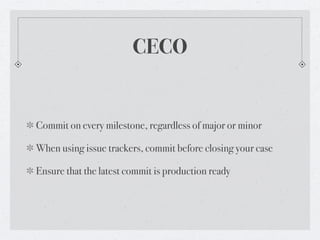
CECO


Commit on every milestone, regardless of major or minor

When using issue trackers, commit before closing your case

Ensure that the latest commit is production ready
BE A STORY TELLER
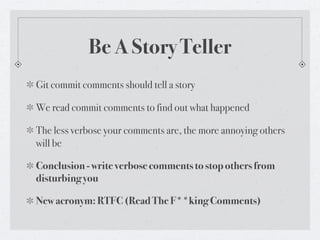
Be A Story Teller
Git commit comments should tell a story

We read commit comments to find out what happened

The less verbose your comments are, the more annoying others
will be

Conclusion - write verbose comments to stop others from
disturbing you

New acronym: RTFC (Read The F**king Comments)
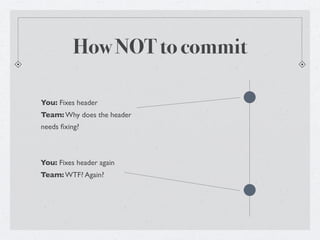
How NOT to commit

You: Fixes header
Team: Why does the header
needs fixing?


You: Fixes header again
Team: WTF? Again?
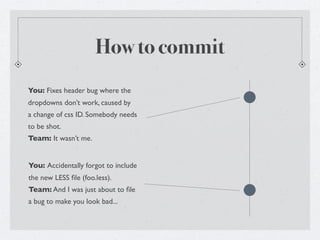
How to commit
You: Fixes header bug where the
dropdowns don’t work, caused by
a change of css ID. Somebody needs
to be shot.
Team: It wasn’t me.


You: Accidentally forgot to include
the new LESS file (foo.less).
Team: And I was just about to file
a bug to make you look bad...
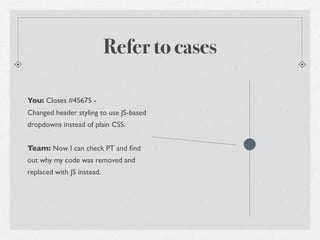
Refer to cases

You: Closes #45675 -
Changed header styling to use JS-based
dropdowns instead of plain CSS.


Team: Now I can check PT and find
out why my code was removed and
replaced with JS instead.
Benefits

CECO makes it possible to progressively rewind the commit
pointer to see which commit introduced the bug

Small commits allow for easier code review

Small commits make it easier to course correct during code
review

Verbose comments reduce the need to talk face-to-face (very
handy when it dealing with those working from home/remote)
Code Review Policies


Code review is not optional - it is a must for every tech lead

Code review should lead to refactors, not rejection

Make a distinction between convention and logic

Convention = Enforce it. Logic = Refactor it.
Code Review Policies


When reviewing code, take a high level perspective

Aim to reduce code (leaner codebase)

Aim to modularize reusable components
Code Review Pointers

Good code tend to reinforce current codebase

YAGNI is a good driving principle, but beware of bulimic code
too

Lean code = good base to continue adding features

Bulimic code = code that’s simple because it’s useless
Resolving Code Reviews


Code reviews should be part of the team nurturing process

Employee performance should NOT be affected by code reviews

Aim to improve, not to blame or humiliate

Codebase quality determines the morale of your team
~ the end ~

How we git - commit policy and code review

  • 1.
    HOW WE GIT Commits and Code Review
  • 2.
  • 3.
    CECO Commit on everymilestone, regardless of major or minor When using issue trackers, commit before closing your case Ensure that the latest commit is production ready
  • 4.
    BE A STORYTELLER
  • 5.
    Be A StoryTeller Git commit comments should tell a story We read commit comments to find out what happened The less verbose your comments are, the more annoying others will be Conclusion - write verbose comments to stop others from disturbing you New acronym: RTFC (Read The F**king Comments)
  • 6.
    How NOT tocommit You: Fixes header Team: Why does the header needs fixing? You: Fixes header again Team: WTF? Again?
  • 7.
    How to commit You:Fixes header bug where the dropdowns don’t work, caused by a change of css ID. Somebody needs to be shot. Team: It wasn’t me. You: Accidentally forgot to include the new LESS file (foo.less). Team: And I was just about to file a bug to make you look bad...
  • 8.
    Refer to cases You:Closes #45675 - Changed header styling to use JS-based dropdowns instead of plain CSS. Team: Now I can check PT and find out why my code was removed and replaced with JS instead.
  • 9.
    Benefits CECO makes itpossible to progressively rewind the commit pointer to see which commit introduced the bug Small commits allow for easier code review Small commits make it easier to course correct during code review Verbose comments reduce the need to talk face-to-face (very handy when it dealing with those working from home/remote)
  • 10.
  • 11.
    Code Review Policies Codereview is not optional - it is a must for every tech lead Code review should lead to refactors, not rejection Make a distinction between convention and logic Convention = Enforce it. Logic = Refactor it.
  • 12.
    Code Review Policies Whenreviewing code, take a high level perspective Aim to reduce code (leaner codebase) Aim to modularize reusable components
  • 13.
    Code Review Pointers Goodcode tend to reinforce current codebase YAGNI is a good driving principle, but beware of bulimic code too Lean code = good base to continue adding features Bulimic code = code that’s simple because it’s useless
  • 14.
    Resolving Code Reviews Codereviews should be part of the team nurturing process Employee performance should NOT be affected by code reviews Aim to improve, not to blame or humiliate Codebase quality determines the morale of your team
  • 15.