
BANKING
ON THE BLOCKCHAINS
PRESENTED BY


.
SLIDE #
RUBEN TAN
2
Co-Founder & CTO of Neuroware
Technologist at heart
Involved in distributed startups more than 5
years
Community-Creator & Technology EvangelistRuben Tan

ruben@neuroware.io
SLIDE #
NEUROWARE QUICK FACTS
3
1st Malaysian company to graduate from 500 Startups in Silicon Valley
1st company in Asia to provide public blockchain APIs and toolkits
1st startup to develop non-financial, blockchain-agnostic solutions
Helped the world’s 1st bank-backed Blockchain Hackathon in Singapore
Now working with Securities Exchange of Malaysia and Bank Negara
Planning to be first company in Asia to issue equity on blockchains
Blockchains
A layman’s introduction
SLIDE #
BLOCKCHAINS - WHERE TO START?
5
New Bandwagon?
Silver Bullet?
Snake oil?
The Answer to Everything?
Death of banking?
SLIDE #
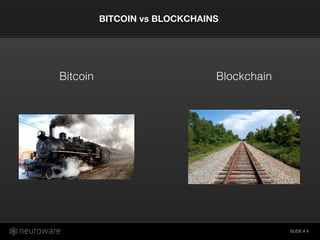
BITCOIN vs BLOCKCHAINS
6
Bitcoin Blockchain
SLIDE #
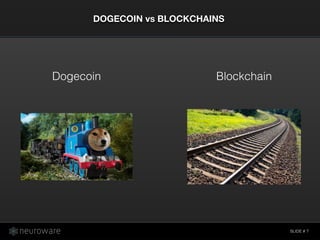
DOGECOIN vs BLOCKCHAINS
7
Dogecoin Blockchain
SLIDE #
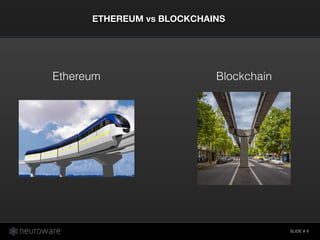
ETHEREUM vs BLOCKCHAINS
8
Ethereum Blockchain
SLIDE #
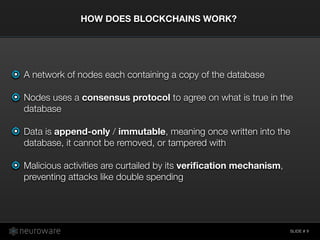
A network of nodes each containing a copy of the database
Nodes uses a consensus protocol to agree on what is true in the
database
Data is append-only / immutable, meaning once written into the
database, it cannot be removed, or tampered with
Malicious activities are curtailed by its verification mechanism,
preventing attacks like double spending
HOW DOES BLOCKCHAINS WORK?
9
Dissecting Bitcoin
Understanding its internals
SLIDE #
Bitcoin is the first digital currency that works
Traded at USD 13 in 2013, now USD 445 in 2016
Released by “Satoshi Nakamoto” in January 2009
Market capitalisation currently at USD 7 billion
Bitcoin’s blockchain is the first public blockchain
Uses Proof-of-work + Longest chain consensus model
Source code is open source - understanding how bitcoin works does
not mean you can attack it in any way
BITCOIN - BLOCKCHAIN AS DIGITAL CURRENCY
12
SLIDE #
BITCOIN BLOCKCHAIN OVERVIEW
13
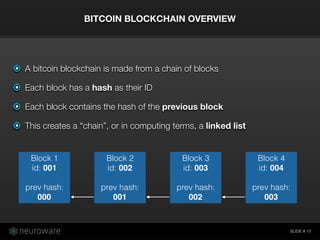
A bitcoin blockchain is made from a chain of blocks
Each block has a hash as their ID
Each block contains the hash of the previous block
This creates a “chain”, or in computing terms, a linked list
Block 1
id: 001
prev hash:
000
Block 2
id: 002
prev hash:
001
Block 3
id: 003
prev hash:
002
Block 4
id: 004
prev hash:
003
SLIDE #
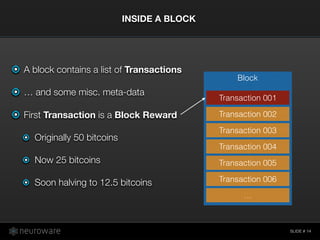
A block contains a list of Transactions
… and some misc. meta-data
First Transaction is a Block Reward
Originally 50 bitcoins
Now 25 bitcoins
Soon halving to 12.5 bitcoins
INSIDE A BLOCK
14
Block
Transaction 001
Transaction 002
Transaction 003
Transaction 004
Transaction 005
Transaction 006
…
SLIDE #
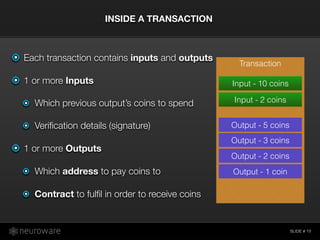
Each transaction contains inputs and outputs
1 or more Inputs
Which previous output’s coins to spend
Verification details (signature)
1 or more Outputs
Which address to pay coins to
Contract to fulfil in order to receive coins
INSIDE A TRANSACTION
15
Transaction
Input - 10 coins
Input - 2 coins
Output - 5 coins
Output - 3 coins
Output - 2 coins
Output - 1 coin
SLIDE #
Outputs describe x amount of coins paid to an address
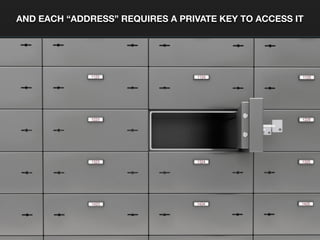
“Address” is essentially a key; if you have the key, you can unlock the
output and redeem the coins
Outputs can contain complex scripts - paving the pay for smart
contracts
REDEEMING OUTPUTS
16
SLIDE #
AND EACH “ADDRESS” REQUIRES A PRIVATE KEY TO ACCESS IT
17
SLIDE #
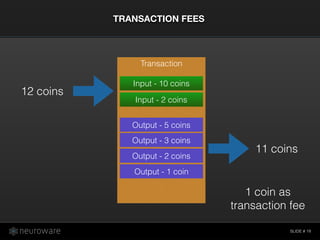
TRANSACTION FEES
18
Transaction
Input - 10 coins
Input - 2 coins
Output - 5 coins
Output - 3 coins
Output - 2 coins
Output - 1 coin
11 coins
12 coins
1 coin as
transaction fee
SLIDE #
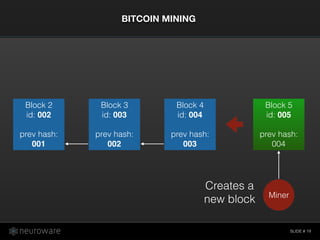
BITCOIN MINING
19
Block 2
id: 002
prev hash:
001
Block 3
id: 003
prev hash:
002
Block 4
id: 004
prev hash:
003
Block 5
id: 005
prev hash:
004
Miner
Creates a
new block
SLIDE #
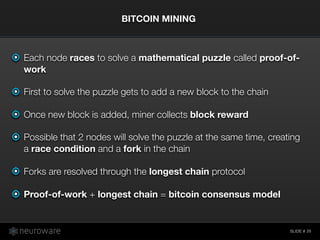
Each node races to solve a mathematical puzzle called proof-of-
work
First to solve the puzzle gets to add a new block to the chain
Once new block is added, miner collects block reward
Possible that 2 nodes will solve the puzzle at the same time, creating
a race condition and a fork in the chain
Forks are resolved through the longest chain protocol
Proof-of-work + longest chain = bitcoin consensus model
BITCOIN MINING
20
SLIDE #
Every transaction records:
How many bitcoins were created as block reward
How many bitcoins were transferred from address A to address
B - inputs to outputs
Great ledger because once a block is added, it cannot be removed or
changed
Attacking the network is extremely costly: electricity cost easily cost
more
BITCOIN AS A LEDGER
21
SLIDE #
Ledger is public and anybody can view it
Anybody can start a node and mine bitcoins
Anybody who owns a node has the entire ledger
Owning a node doesn’t mean you can tamper with it
Owning a node doesn’t mean you can attack the network
Owning a node doesn’t mean you can mine malicious blocks
BITCOIN AS A LEDGER
22
Beyond Bitcoin
Opening pandora’s box
SLIDE #
BLOCKCHAINS AS DISTRIBUTED LEDGERS
24
Immutable, tamper-proof audit-trail
Data easily shared and verified, forced transaction through protocol
Vastly increased security, less vulnerable to attack or outage
Programmable contracts that can radically reduce human errors and costs
“While Fintech Disrupts Banks,
the Blockchains Disrupt Fintech"
SLIDE #
Smart contracts that are immutable removes the need for a trusted
intermediary to facilitate any form of lending
Both peers agree on a contract, and trust the blockchain to execute
the contract once both sides fulfil their side of obligations
Possible implementations:
Executing wills
Escrow for digital goods trade
SMART CONTRACTS
25
SLIDE #
Since data stored on the blockchain is immutable, ownership
information can be stored on the blockchain
Example implementations
Property ownership
Car ownership
Commodities ownership (gold, silver, etc)
Creative products ownership (art, music, etc)
OWNERSHIP DATA
26
SLIDE #
Combines smart contract with ownership data to:
Play music on specific devices, embed contract into music file
Play games on specific machines, embed contract into game files
Operate software on specific machines, can expand to enterprises
and tie into their user database and authentication systems
And more?
Government services tied into smart contracts based on
biometric data
BLOCKCHAINS AND DIGITAL PRODUCTS
27
Current Landscape
Finance industry and blockchain technology
SLIDE #
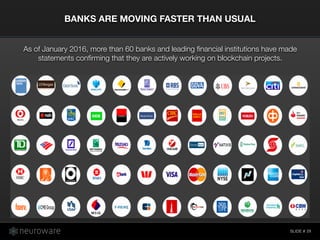
BANKS ARE MOVING FASTER THAN USUAL
29
As of January 2016, more than 60 banks and leading financial institutions have made
statements confirming that they are actively working on blockchain projects.
SLIDE #
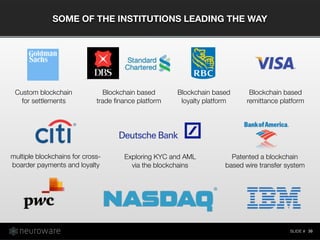
SOME OF THE INSTITUTIONS LEADING THE WAY
30
multiple blockchains for cross-
boarder payments and loyalty
Exploring KYC and AML
via the blockchains
Patented a blockchain
based wire transfer system
Blockchain based
loyalty platform
Blockchain based
remittance platform
Blockchain based
trade finance platform
Custom blockchain

for settlements
SLIDE #
HONG KONG
31
‘Government will encourage the industry and relevant
organisations to explore the application of “Blockchain”
technology in the financial services industry, with a view to
developing its potential to reduce suspicious transactions and
bring down transaction costs.’
63rd paragraph, 2016 Hong Kong Budget Plan
SLIDE #
ZUG, SWITZERLAND
32
The city of Zug, Switzerland, has announced it will pilot a
bitcoin payments project that will allow local citizens to pay for
public services using digital currency.
SLIDE #
SINGAPORE
33
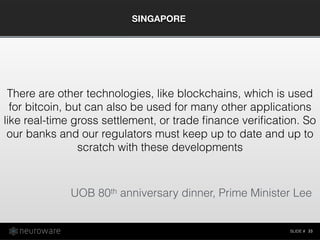
There are other technologies, like blockchains, which is used
for bitcoin, but can also be used for many other applications
like real-time gross settlement, or trade finance verification. So
our banks and our regulators must keep up to date and up to
scratch with these developments
UOB 80th anniversary dinner, Prime Minister Lee
Challenges
Roadblocks of blockchain startups
SLIDE #
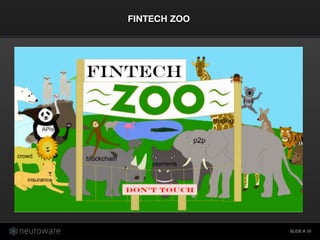
FINTECH ZOO
35
SLIDE #
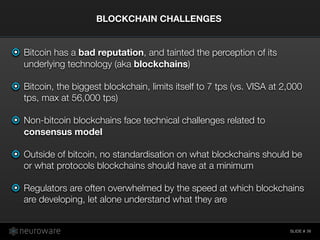
Bitcoin has a bad reputation, and tainted the perception of its
underlying technology (aka blockchains)
Bitcoin, the biggest blockchain, limits itself to 7 tps (vs. VISA at 2,000
tps, max at 56,000 tps)
Non-bitcoin blockchains face technical challenges related to
consensus model
Outside of bitcoin, no standardisation on what blockchains should be
or what protocols blockchains should have at a minimum
Regulators are often overwhelmed by the speed at which blockchains
are developing, let alone understand what they are
BLOCKCHAIN CHALLENGES
36
SLIDE #
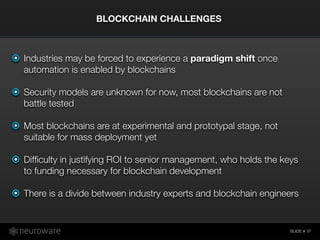
Industries may be forced to experience a paradigm shift once
automation is enabled by blockchains
Security models are unknown for now, most blockchains are not
battle tested
Most blockchains are at experimental and prototypal stage, not
suitable for mass deployment yet
Difficulty in justifying ROI to senior management, who holds the keys
to funding necessary for blockchain development
There is a divide between industry experts and blockchain engineers
BLOCKCHAIN CHALLENGES
37
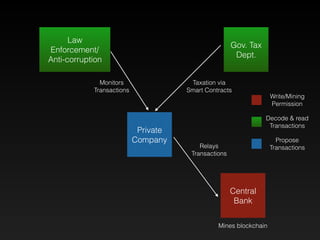
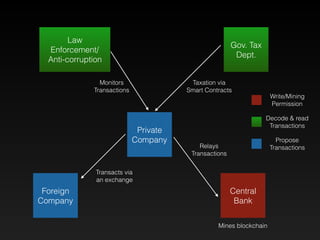
Thought Experiment
A possible “utopia”?
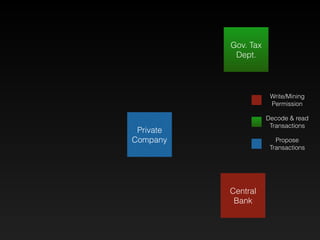
Private
Company
Gov. Tax
Dept.
Central
Bank
Write/Mining
Permission
Decode & read
Transactions
Propose
Transactions
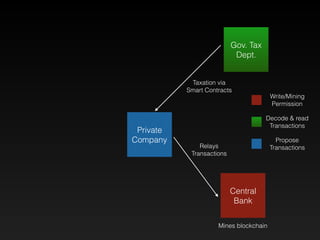
Private
Company
Gov. Tax
Dept.
Central
Bank
Relays
Transactions
Mines blockchain
Taxation via
Smart Contracts
Write/Mining
Permission
Decode & read
Transactions
Propose
Transactions
Private
Company
Gov. Tax
Dept.
Central
Bank
Law
Enforcement/
Anti-corruption
Relays
Transactions
Mines blockchain
Taxation via
Smart Contracts
Monitors
Transactions
Write/Mining
Permission
Decode & read
Transactions
Propose
Transactions
Private
Company
Gov. Tax
Dept.
Central
Bank
Law
Enforcement/
Anti-corruption
Foreign
Company
Relays
Transactions
Mines blockchain
Taxation via
Smart Contracts
Monitors
Transactions
Transacts via
an exchange
Write/Mining
Permission
Decode & read
Transactions
Propose
Transactions
THANK YOU
NOW IS THE TIME FOR QUESTIONS
LEARN MORE ABOUT
http://neuroware.io

Banking on blockchains

  • 1.
  • 2.
    SLIDE # RUBEN TAN 2 Co-Founder& CTO of Neuroware Technologist at heart Involved in distributed startups more than 5 years Community-Creator & Technology EvangelistRuben Tan
 ruben@neuroware.io
  • 3.
    SLIDE # NEUROWARE QUICKFACTS 3 1st Malaysian company to graduate from 500 Startups in Silicon Valley 1st company in Asia to provide public blockchain APIs and toolkits 1st startup to develop non-financial, blockchain-agnostic solutions Helped the world’s 1st bank-backed Blockchain Hackathon in Singapore Now working with Securities Exchange of Malaysia and Bank Negara Planning to be first company in Asia to issue equity on blockchains
  • 4.
  • 5.
    SLIDE # BLOCKCHAINS -WHERE TO START? 5 New Bandwagon? Silver Bullet? Snake oil? The Answer to Everything? Death of banking?
  • 6.
    SLIDE # BITCOIN vsBLOCKCHAINS 6 Bitcoin Blockchain
  • 7.
    SLIDE # DOGECOIN vsBLOCKCHAINS 7 Dogecoin Blockchain
  • 8.
    SLIDE # ETHEREUM vsBLOCKCHAINS 8 Ethereum Blockchain
  • 9.
    SLIDE # A networkof nodes each containing a copy of the database Nodes uses a consensus protocol to agree on what is true in the database Data is append-only / immutable, meaning once written into the database, it cannot be removed, or tampered with Malicious activities are curtailed by its verification mechanism, preventing attacks like double spending HOW DOES BLOCKCHAINS WORK? 9
  • 11.
  • 12.
    SLIDE # Bitcoin isthe first digital currency that works Traded at USD 13 in 2013, now USD 445 in 2016 Released by “Satoshi Nakamoto” in January 2009 Market capitalisation currently at USD 7 billion Bitcoin’s blockchain is the first public blockchain Uses Proof-of-work + Longest chain consensus model Source code is open source - understanding how bitcoin works does not mean you can attack it in any way BITCOIN - BLOCKCHAIN AS DIGITAL CURRENCY 12
  • 13.
    SLIDE # BITCOIN BLOCKCHAINOVERVIEW 13 A bitcoin blockchain is made from a chain of blocks Each block has a hash as their ID Each block contains the hash of the previous block This creates a “chain”, or in computing terms, a linked list Block 1 id: 001 prev hash: 000 Block 2 id: 002 prev hash: 001 Block 3 id: 003 prev hash: 002 Block 4 id: 004 prev hash: 003
  • 14.
    SLIDE # A blockcontains a list of Transactions … and some misc. meta-data First Transaction is a Block Reward Originally 50 bitcoins Now 25 bitcoins Soon halving to 12.5 bitcoins INSIDE A BLOCK 14 Block Transaction 001 Transaction 002 Transaction 003 Transaction 004 Transaction 005 Transaction 006 …
  • 15.
    SLIDE # Each transactioncontains inputs and outputs 1 or more Inputs Which previous output’s coins to spend Verification details (signature) 1 or more Outputs Which address to pay coins to Contract to fulfil in order to receive coins INSIDE A TRANSACTION 15 Transaction Input - 10 coins Input - 2 coins Output - 5 coins Output - 3 coins Output - 2 coins Output - 1 coin
  • 16.
    SLIDE # Outputs describex amount of coins paid to an address “Address” is essentially a key; if you have the key, you can unlock the output and redeem the coins Outputs can contain complex scripts - paving the pay for smart contracts REDEEMING OUTPUTS 16
  • 17.
    SLIDE # AND EACH“ADDRESS” REQUIRES A PRIVATE KEY TO ACCESS IT 17
  • 18.
    SLIDE # TRANSACTION FEES 18 Transaction Input- 10 coins Input - 2 coins Output - 5 coins Output - 3 coins Output - 2 coins Output - 1 coin 11 coins 12 coins 1 coin as transaction fee
  • 19.
    SLIDE # BITCOIN MINING 19 Block2 id: 002 prev hash: 001 Block 3 id: 003 prev hash: 002 Block 4 id: 004 prev hash: 003 Block 5 id: 005 prev hash: 004 Miner Creates a new block
  • 20.
    SLIDE # Each noderaces to solve a mathematical puzzle called proof-of- work First to solve the puzzle gets to add a new block to the chain Once new block is added, miner collects block reward Possible that 2 nodes will solve the puzzle at the same time, creating a race condition and a fork in the chain Forks are resolved through the longest chain protocol Proof-of-work + longest chain = bitcoin consensus model BITCOIN MINING 20
  • 21.
    SLIDE # Every transactionrecords: How many bitcoins were created as block reward How many bitcoins were transferred from address A to address B - inputs to outputs Great ledger because once a block is added, it cannot be removed or changed Attacking the network is extremely costly: electricity cost easily cost more BITCOIN AS A LEDGER 21
  • 22.
    SLIDE # Ledger ispublic and anybody can view it Anybody can start a node and mine bitcoins Anybody who owns a node has the entire ledger Owning a node doesn’t mean you can tamper with it Owning a node doesn’t mean you can attack the network Owning a node doesn’t mean you can mine malicious blocks BITCOIN AS A LEDGER 22
  • 23.
  • 24.
    SLIDE # BLOCKCHAINS ASDISTRIBUTED LEDGERS 24 Immutable, tamper-proof audit-trail Data easily shared and verified, forced transaction through protocol Vastly increased security, less vulnerable to attack or outage Programmable contracts that can radically reduce human errors and costs “While Fintech Disrupts Banks, the Blockchains Disrupt Fintech"
  • 25.
    SLIDE # Smart contractsthat are immutable removes the need for a trusted intermediary to facilitate any form of lending Both peers agree on a contract, and trust the blockchain to execute the contract once both sides fulfil their side of obligations Possible implementations: Executing wills Escrow for digital goods trade SMART CONTRACTS 25
  • 26.
    SLIDE # Since datastored on the blockchain is immutable, ownership information can be stored on the blockchain Example implementations Property ownership Car ownership Commodities ownership (gold, silver, etc) Creative products ownership (art, music, etc) OWNERSHIP DATA 26
  • 27.
    SLIDE # Combines smartcontract with ownership data to: Play music on specific devices, embed contract into music file Play games on specific machines, embed contract into game files Operate software on specific machines, can expand to enterprises and tie into their user database and authentication systems And more? Government services tied into smart contracts based on biometric data BLOCKCHAINS AND DIGITAL PRODUCTS 27
  • 28.
    Current Landscape Finance industryand blockchain technology
  • 29.
    SLIDE # BANKS AREMOVING FASTER THAN USUAL 29 As of January 2016, more than 60 banks and leading financial institutions have made statements confirming that they are actively working on blockchain projects.
  • 30.
    SLIDE # SOME OFTHE INSTITUTIONS LEADING THE WAY 30 multiple blockchains for cross- boarder payments and loyalty Exploring KYC and AML via the blockchains Patented a blockchain based wire transfer system Blockchain based loyalty platform Blockchain based remittance platform Blockchain based trade finance platform Custom blockchain
 for settlements
  • 31.
    SLIDE # HONG KONG 31 ‘Governmentwill encourage the industry and relevant organisations to explore the application of “Blockchain” technology in the financial services industry, with a view to developing its potential to reduce suspicious transactions and bring down transaction costs.’ 63rd paragraph, 2016 Hong Kong Budget Plan
  • 32.
    SLIDE # ZUG, SWITZERLAND 32 Thecity of Zug, Switzerland, has announced it will pilot a bitcoin payments project that will allow local citizens to pay for public services using digital currency.
  • 33.
    SLIDE # SINGAPORE 33 There areother technologies, like blockchains, which is used for bitcoin, but can also be used for many other applications like real-time gross settlement, or trade finance verification. So our banks and our regulators must keep up to date and up to scratch with these developments UOB 80th anniversary dinner, Prime Minister Lee
  • 34.
  • 35.
  • 36.
    SLIDE # Bitcoin hasa bad reputation, and tainted the perception of its underlying technology (aka blockchains) Bitcoin, the biggest blockchain, limits itself to 7 tps (vs. VISA at 2,000 tps, max at 56,000 tps) Non-bitcoin blockchains face technical challenges related to consensus model Outside of bitcoin, no standardisation on what blockchains should be or what protocols blockchains should have at a minimum Regulators are often overwhelmed by the speed at which blockchains are developing, let alone understand what they are BLOCKCHAIN CHALLENGES 36
  • 37.
    SLIDE # Industries maybe forced to experience a paradigm shift once automation is enabled by blockchains Security models are unknown for now, most blockchains are not battle tested Most blockchains are at experimental and prototypal stage, not suitable for mass deployment yet Difficulty in justifying ROI to senior management, who holds the keys to funding necessary for blockchain development There is a divide between industry experts and blockchain engineers BLOCKCHAIN CHALLENGES 37
  • 38.
  • 39.
  • 40.
    Private Company Gov. Tax Dept. Central Bank Relays Transactions Mines blockchain Taxationvia Smart Contracts Write/Mining Permission Decode & read Transactions Propose Transactions
  • 41.
    Private Company Gov. Tax Dept. Central Bank Law Enforcement/ Anti-corruption Relays Transactions Mines blockchain Taxationvia Smart Contracts Monitors Transactions Write/Mining Permission Decode & read Transactions Propose Transactions
  • 42.
    Private Company Gov. Tax Dept. Central Bank Law Enforcement/ Anti-corruption Foreign Company Relays Transactions Mines blockchain Taxationvia Smart Contracts Monitors Transactions Transacts via an exchange Write/Mining Permission Decode & read Transactions Propose Transactions
  • 43.
    THANK YOU NOW ISTHE TIME FOR QUESTIONS LEARN MORE ABOUT http://neuroware.io