

1
Trunk Based
Development for
Beginners
March 2019
2
Agenda
● Branching strategies
● Git concepts
● Trunk-Based Development Workflow
● Benefits of Trunk-Based Development
3
Software Development
What is your process?
4
Develop
Test
Integrate
Version Control System
5
Branching Strategy
● Strategy that helps developers collaborate and
develop new functionality while minimizing disruption
to the existing code base.
● What’s the most efficient, safe way we can develop
software.
6
Git Concepts
7
Git Concepts
commits
branches
tags
8
Commits
9
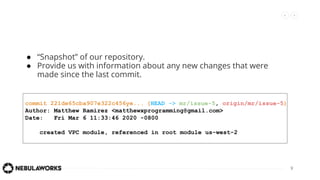
● “Snapshot” of our repository.
● Provide us with information about any new changes that were
made since the last commit.
commit 221de65cba907e322c456ye... (HEAD -> mr/issue-5, origin/mr/issue-5)
Author: Matthew Ramirez <matthewxprogramming@gmail.com>
Date: Fri Mar 6 11:33:46 2020 -0800
created VPC module, referenced in root module us-west-2
10
Branches
11
[master] mkgh278 Merge branch ‘branch-2’ into master - Mr. T
[branch 2] e99f104 Finish up my feature part 3 - Mr. T
[branch 2] e188fa9 Develop a feature part 2 - Mr. T
[branch 2] 3e893c8 Develop a feature part 1 - Mr.T
[master] mkgh278 Merge branch ‘branch-1’ into master - Betty
[branch-1] jkfl2113 Add a cool widget part 2 - Betty
[branch-1] adsf833 Add a cool widget part 1 - Betty
[master] 6c6faa4 Initialize repo with README.md - Bob
● Reference a specific git commit
● Allow for parallel iteration
12
Tags
13
● Another way to references a specific commit
● conventionally immutable
0.1.0
14
Trunk Based Development
15
● Developers iterate on a single branch. AKA “the trunk” or
master.
● Master is always in a deployable state.
● Releases are cut off from master (periodically or on an
add-need basis) and are used in production environments.
(Apps and infra!)
The “Trunk”
16
Developing New Functionality
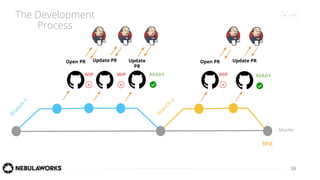
● Short-lived branches are created for feature development (couple of
days max).
● New branches are then merged back into master after a Pull Request
is opened and new functionality passes build automation/tests.
17
● Continuous Code Review
○ Makes current work visible
○ Triggers CI build/verification of branch
Pull Requests (PR)
● A PR must be opened for all feature branches that will be integrated into
master.
18
Master
branch-1
branch-2
The Development
Process
Open PR Update PR Update
PR
WIPWIP READY
Open PR Update PR
WIP READY
test
19
Masterbranch-1
branch-2
Rebasing
branch-2
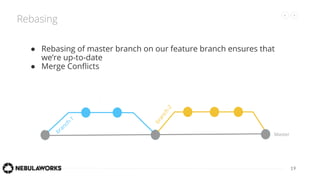
● Rebasing of master branch on our feature branch ensures that
we’re up-to-date
● Merge Conflicts
20
● This assumes that you have access to master, the process when
iterating on a forked repo is a little different.
1. Rebase remote master on local master :
git checkout master && git pull --rebase origin master
2. Rebase local master on feature branch :
git checkout my-branch && git rebase master
Rebasing
21
Releases and
Hotfixes
22
● Give us a “stable” version of our codebase to reference
○ NO developers are commiting to the release branch
○ The only way a commit can get on the release branch is a
hotfix.
○ Great for staging
● Allow master to keep moving forward
○ Should be created periodically and on an as-needed basis
Release Candidate Branches
23
● Release tags are cut from release candidate branches
● “Immutable”
○ Great for production
○ Give us a stable version of our codebase to reference
● Allow master to keep moving forward
○ Should be created periodically and on an as-needed basis
Release Tags
24
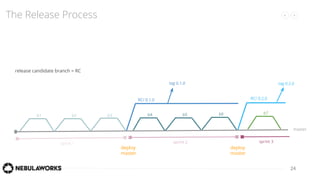
master
b1
The Release Process
b2 b3
RC/ 0.1.0
release candidate branch = RC
b4 b5 b6
RC/ 0.2.0
tag 0.1.0 tag 0.2.0
sprint 1 sprint 2
b7
sprint 3
deploy
master
deploy
master
25
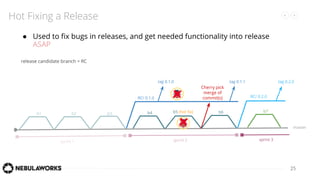
master
b1
Hot Fixing a Release
b2 b3
RC/ 0.1.0
release candidate branch = RC
b4 b6
RC/ 0.2.0
tag 0.1.0 tag 0.2.0
sprint 1 sprint 2
b7
sprint 3
b5 (hot fix)
Cherry pick
merge of
commit(s)
tag 0.1.1
● Used to fix bugs in releases, and get needed functionality into release
ASAP
26
The Benefits
27
● Increased development frequency
● Increased deployment frequency
● Increased collaboration and transparency of work in progress
The Benefits
28
Thank You!
https://www.nebulaworks.com/#subscribe
https://trunkbaseddevelopment.com

Trunk based development for Beginners

  • 1.
  • 2.
    2 Agenda ● Branching strategies ●Git concepts ● Trunk-Based Development Workflow ● Benefits of Trunk-Based Development
  • 3.
  • 4.
  • 5.
    5 Branching Strategy ● Strategythat helps developers collaborate and develop new functionality while minimizing disruption to the existing code base. ● What’s the most efficient, safe way we can develop software.
  • 6.
  • 7.
  • 8.
  • 9.
    9 ● “Snapshot” ofour repository. ● Provide us with information about any new changes that were made since the last commit. commit 221de65cba907e322c456ye... (HEAD -> mr/issue-5, origin/mr/issue-5) Author: Matthew Ramirez <matthewxprogramming@gmail.com> Date: Fri Mar 6 11:33:46 2020 -0800 created VPC module, referenced in root module us-west-2
  • 10.
  • 11.
    11 [master] mkgh278 Mergebranch ‘branch-2’ into master - Mr. T [branch 2] e99f104 Finish up my feature part 3 - Mr. T [branch 2] e188fa9 Develop a feature part 2 - Mr. T [branch 2] 3e893c8 Develop a feature part 1 - Mr.T [master] mkgh278 Merge branch ‘branch-1’ into master - Betty [branch-1] jkfl2113 Add a cool widget part 2 - Betty [branch-1] adsf833 Add a cool widget part 1 - Betty [master] 6c6faa4 Initialize repo with README.md - Bob ● Reference a specific git commit ● Allow for parallel iteration
  • 12.
  • 13.
    13 ● Another wayto references a specific commit ● conventionally immutable 0.1.0
  • 14.
  • 15.
    15 ● Developers iterateon a single branch. AKA “the trunk” or master. ● Master is always in a deployable state. ● Releases are cut off from master (periodically or on an add-need basis) and are used in production environments. (Apps and infra!) The “Trunk”
  • 16.
    16 Developing New Functionality ●Short-lived branches are created for feature development (couple of days max). ● New branches are then merged back into master after a Pull Request is opened and new functionality passes build automation/tests.
  • 17.
    17 ● Continuous CodeReview ○ Makes current work visible ○ Triggers CI build/verification of branch Pull Requests (PR) ● A PR must be opened for all feature branches that will be integrated into master.
  • 18.
    18 Master branch-1 branch-2 The Development Process Open PRUpdate PR Update PR WIPWIP READY Open PR Update PR WIP READY test
  • 19.
    19 Masterbranch-1 branch-2 Rebasing branch-2 ● Rebasing ofmaster branch on our feature branch ensures that we’re up-to-date ● Merge Conflicts
  • 20.
    20 ● This assumesthat you have access to master, the process when iterating on a forked repo is a little different. 1. Rebase remote master on local master : git checkout master && git pull --rebase origin master 2. Rebase local master on feature branch : git checkout my-branch && git rebase master Rebasing
  • 21.
  • 22.
    22 ● Give usa “stable” version of our codebase to reference ○ NO developers are commiting to the release branch ○ The only way a commit can get on the release branch is a hotfix. ○ Great for staging ● Allow master to keep moving forward ○ Should be created periodically and on an as-needed basis Release Candidate Branches
  • 23.
    23 ● Release tagsare cut from release candidate branches ● “Immutable” ○ Great for production ○ Give us a stable version of our codebase to reference ● Allow master to keep moving forward ○ Should be created periodically and on an as-needed basis Release Tags
  • 24.
    24 master b1 The Release Process b2b3 RC/ 0.1.0 release candidate branch = RC b4 b5 b6 RC/ 0.2.0 tag 0.1.0 tag 0.2.0 sprint 1 sprint 2 b7 sprint 3 deploy master deploy master
  • 25.
    25 master b1 Hot Fixing aRelease b2 b3 RC/ 0.1.0 release candidate branch = RC b4 b6 RC/ 0.2.0 tag 0.1.0 tag 0.2.0 sprint 1 sprint 2 b7 sprint 3 b5 (hot fix) Cherry pick merge of commit(s) tag 0.1.1 ● Used to fix bugs in releases, and get needed functionality into release ASAP
  • 26.
  • 27.
    27 ● Increased developmentfrequency ● Increased deployment frequency ● Increased collaboration and transparency of work in progress The Benefits
  • 28.