Code Reviews
@ Quatico
Jan Wloka
Quatico Solutions AG
Code Reviews, again?
Why do we review code?
• Find bugs
• Transfer knowledge
• Lower project cost
• [ Hiring a candidate ]
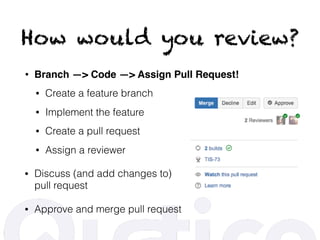
How would you review?
• Branch —> Code —> Assign Pull Request!
• Create a feature branch
• Implement the feature
• Create a pull request
• Assign a reviewer
• Discuss (and add changes to)

pull request
• Approve and merge pull request
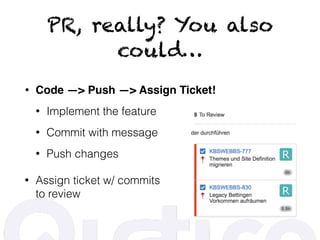
PR, really? You also
could…
• Code —> Push —> Assign Ticket!
• Implement the feature
• Commit with message
• Push changes
• Assign ticket w/ commits 

to review
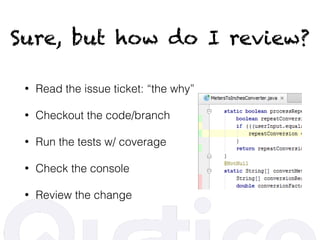
Sure, but how do I review?
• Read the issue ticket: “the why”
• Checkout the code/branch
• Run the tests w/ coverage
• Check the console
• Review the change
What should I be reviewing?
•Change
• Complexity: Shape of change = complex
• Test Coverage
•Code
• Naming, Functionality, Control Structures, Error Handling
• Tricky things (Thread Safety, Resource Leaks, Timezones)
• No obvious things: Performance, Security
•Design
• Single Responsibility Principle (Implicit dependencies)
• Data lifecycle (Cache invalidation, Reentrancy)
•Everything else: Tests, Builds, Deployment scripts, Configurations
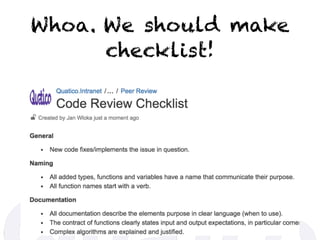
Whoa. We should make
checklist!
So, what’s hard about it?
• Process is more difficult than the result
• Discuss your code with your peers
• How to disagree?
• Don’t just agree on the issue —> Silent Commitment.
• No fear of conflict —> Be curious!
• Agree to disagree —> Ask and learn.
• Form a strong code review culture!
Okay, but what
can I do?
Authors: Provide Context!
• What problems are we solving?
• Pull Request / Commit message:
• Add 2 paragraphs of context.
• Annotate source code.
• Describe changes, defending reasons and
methods.
• Re-think and explain every change.
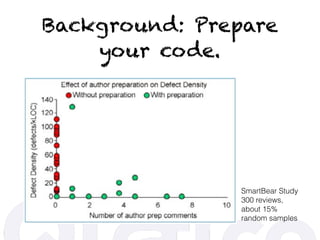
Background: Prepare
your code.
SmartBear Study
300 reviews,
about 15%
random samples
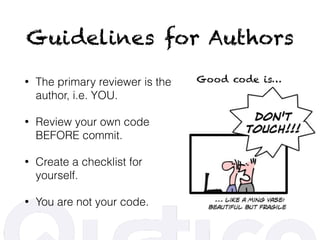
Guidelines for Authors
• The primary reviewer is the
author, i.e. YOU.
• Review your own code
BEFORE commit.
• Create a checklist for
yourself.
• You are not your code.
Good code is…
Reviewers: Ask don’t tell
• What have you learned?
• Critique the code, instead of people
• Ask questions, rather than make statements
• “What do you think …”
• “Did you consider …”
• “Can you clarify …”
• Avoid ‘why’ questions, be more specific!
• Don’t forget to praise.
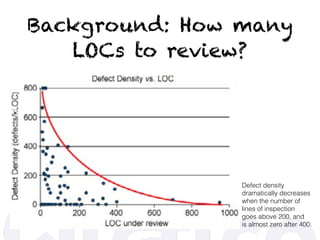
Background: How many
LOCs to review?
Defect density
dramatically decreases
when the number of
lines of inspection
goes above 200, and
is almost zero after 400.
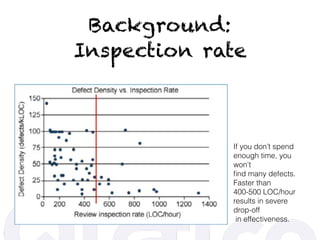
Background:
Inspection rate
If you don’t spend
enough time, you
won't
find many defects.
Faster than
400-500 LOC/hour
results in severe
drop-off
in effectiveness.
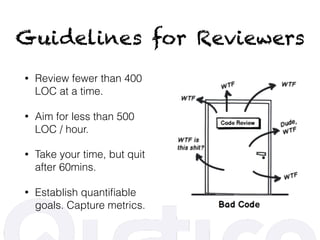
Guidelines for Reviewers
• Review fewer than 400
LOC at a time.
• Aim for less than 500
LOC / hour.
• Take your time, but quit
after 60mins.
• Establish quantifiable
goals. Capture metrics.
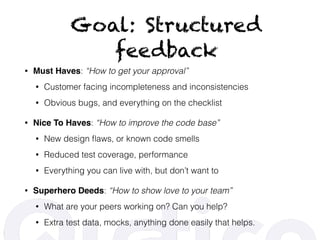
Goal: Structured
feedback
• Must Haves: “How to get your approval”
• Customer facing incompleteness and inconsistencies
• Obvious bugs, and everything on the checklist
• Nice To Haves: “How to improve the code base”
• New design flaws, or known code smells
• Reduced test coverage, performance
• Everything you can live with, but don’t want to
• Superhero Deeds: “How to show love to your team”
• What are your peers working on? Can you help?
• Extra test data, mocks, anything done easily that helps.
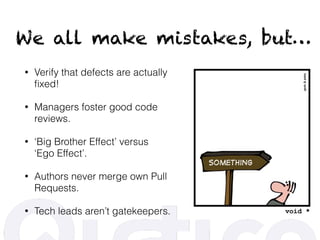
We all make mistakes, but…
• Verify that defects are actually
fixed!
• Managers foster good code
reviews.
• ‘Big Brother Effect’ versus

‘Ego Effect’.
• Authors never merge own Pull
Requests.
• Tech leads aren’t gatekeepers.
Next Steps
• Authors: “Provide more context”
• Favour pull requests, over direct commits.
• Annotate your change, explain the ‘why’
• Maintain a personal checklist.
• Review every modification, before push.
• Reviewers: “Provide structured feedback”
• Critique the code, not the coder.
• Use the checklist.
• Be specific, and helpful.
• Don’t forget to praise.
Goal: Strong Review
Culture
• Better code.
• Better developers.
• Team ownership > Code ownership.
• Healthy debate > No silent agreement.
Thank You.
jan.wloka@quatico.com
@crashtester
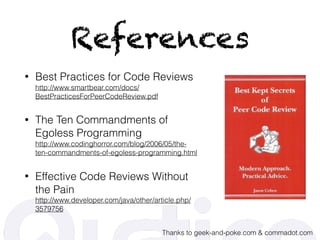
References
• Best Practices for Code Reviews

http://www.smartbear.com/docs/
BestPracticesForPeerCodeReview.pdf
• The Ten Commandments of
Egoless Programming

http://www.codinghorror.com/blog/2006/05/the-
ten-commandments-of-egoless-programming.html
• Effective Code Reviews Without
the Pain

http://www.developer.com/java/other/article.php/
3579756
Thanks to geek-and-poke.com & commadot.com

Code Reviews @ Quatico

  • 1.
    Code Reviews @ Quatico JanWloka Quatico Solutions AG
  • 2.
  • 3.
    Why do wereview code? • Find bugs • Transfer knowledge • Lower project cost • [ Hiring a candidate ]
  • 4.
    How would youreview? • Branch —> Code —> Assign Pull Request! • Create a feature branch • Implement the feature • Create a pull request • Assign a reviewer • Discuss (and add changes to)
 pull request • Approve and merge pull request
  • 5.
    PR, really? Youalso could… • Code —> Push —> Assign Ticket! • Implement the feature • Commit with message • Push changes • Assign ticket w/ commits 
 to review
  • 6.
    Sure, but howdo I review? • Read the issue ticket: “the why” • Checkout the code/branch • Run the tests w/ coverage • Check the console • Review the change
  • 7.
    What should Ibe reviewing? •Change • Complexity: Shape of change = complex • Test Coverage •Code • Naming, Functionality, Control Structures, Error Handling • Tricky things (Thread Safety, Resource Leaks, Timezones) • No obvious things: Performance, Security •Design • Single Responsibility Principle (Implicit dependencies) • Data lifecycle (Cache invalidation, Reentrancy) •Everything else: Tests, Builds, Deployment scripts, Configurations
  • 8.
    Whoa. We shouldmake checklist!
  • 9.
    So, what’s hardabout it? • Process is more difficult than the result • Discuss your code with your peers • How to disagree? • Don’t just agree on the issue —> Silent Commitment. • No fear of conflict —> Be curious! • Agree to disagree —> Ask and learn. • Form a strong code review culture!
  • 10.
  • 11.
    Authors: Provide Context! •What problems are we solving? • Pull Request / Commit message: • Add 2 paragraphs of context. • Annotate source code. • Describe changes, defending reasons and methods. • Re-think and explain every change.
  • 12.
    Background: Prepare your code. SmartBearStudy 300 reviews, about 15% random samples
  • 13.
    Guidelines for Authors •The primary reviewer is the author, i.e. YOU. • Review your own code BEFORE commit. • Create a checklist for yourself. • You are not your code. Good code is…
  • 14.
    Reviewers: Ask don’ttell • What have you learned? • Critique the code, instead of people • Ask questions, rather than make statements • “What do you think …” • “Did you consider …” • “Can you clarify …” • Avoid ‘why’ questions, be more specific! • Don’t forget to praise.
  • 15.
    Background: How many LOCsto review? Defect density dramatically decreases when the number of lines of inspection goes above 200, and is almost zero after 400.
  • 16.
    Background: Inspection rate If youdon’t spend enough time, you won't find many defects. Faster than 400-500 LOC/hour results in severe drop-off in effectiveness.
  • 17.
    Guidelines for Reviewers •Review fewer than 400 LOC at a time. • Aim for less than 500 LOC / hour. • Take your time, but quit after 60mins. • Establish quantifiable goals. Capture metrics.
  • 18.
    Goal: Structured feedback • MustHaves: “How to get your approval” • Customer facing incompleteness and inconsistencies • Obvious bugs, and everything on the checklist • Nice To Haves: “How to improve the code base” • New design flaws, or known code smells • Reduced test coverage, performance • Everything you can live with, but don’t want to • Superhero Deeds: “How to show love to your team” • What are your peers working on? Can you help? • Extra test data, mocks, anything done easily that helps.
  • 19.
    We all makemistakes, but… • Verify that defects are actually fixed! • Managers foster good code reviews. • ‘Big Brother Effect’ versus
 ‘Ego Effect’. • Authors never merge own Pull Requests. • Tech leads aren’t gatekeepers.
  • 20.
    Next Steps • Authors:“Provide more context” • Favour pull requests, over direct commits. • Annotate your change, explain the ‘why’ • Maintain a personal checklist. • Review every modification, before push. • Reviewers: “Provide structured feedback” • Critique the code, not the coder. • Use the checklist. • Be specific, and helpful. • Don’t forget to praise.
  • 21.
    Goal: Strong Review Culture •Better code. • Better developers. • Team ownership > Code ownership. • Healthy debate > No silent agreement.
  • 22.
  • 23.
    References • Best Practicesfor Code Reviews
 http://www.smartbear.com/docs/ BestPracticesForPeerCodeReview.pdf • The Ten Commandments of Egoless Programming
 http://www.codinghorror.com/blog/2006/05/the- ten-commandments-of-egoless-programming.html • Effective Code Reviews Without the Pain
 http://www.developer.com/java/other/article.php/ 3579756 Thanks to geek-and-poke.com & commadot.com