How to Write a
Research Paper?
Research
• It is a systematic investigation into reality to gain
knowledge.
• Simply put, research is the process of
discovering new knowledge. This knowledge can
be either the development of new concepts or
the advancement of existing knowledge and
theories, leading to a new understanding that
was not previously known.
Research Paper
• A research paper is a type of academic writing that
provides an in-depth analysis, evaluation, or
interpretation of a single topic, based on empirical
evidence.
• Research paper may refer to: Academic paper (also
called scholarly paper), which is in academic journals
and contains original research results or reviews
existing results or shows a totally new invention.
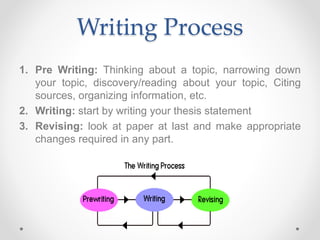
Writing Process
1. Pre Writing: Thinking about a topic, narrowing down
your topic, discovery/reading about your topic, Citing
sources, organizing information, etc.
2. Writing: start by writing your thesis statement
3. Revising: look at paper at last and make appropriate
changes required in any part.
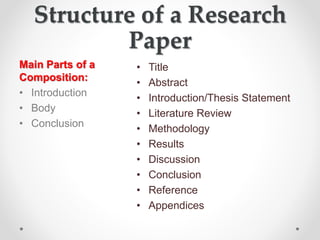
Structure of a Research
Paper
Main Parts of a
Composition:
• Introduction
• Body
• Conclusion
• Title
• Abstract
• Introduction/Thesis Statement
• Literature Review
• Methodology
• Results
• Discussion
• Conclusion
• Reference
• Appendices
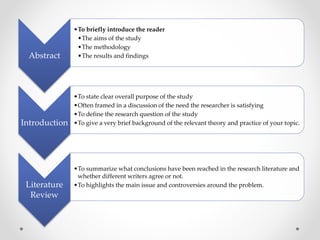
Abstract
•To briefly introduce the reader
•The aims of the study
•The methodology
•The results and findings
Introduction
•To state clear overall purpose of the study
•Often framed in a discussion of the need the researcher is satisfying
•To define the research question of the study
•To give a very brief background of the relevant theory and practice of your topic.
Literature
Review
•To summarize what conclusions have been reached in the research literature and
whether different writers agree or not.
•To highlights the main issue and controversies around the problem.
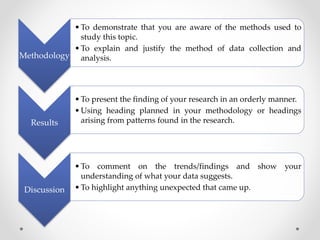
Methodology
•To demonstrate that you are aware of the methods used to
study this topic.
•To explain and justify the method of data collection and
analysis.
Results
•To present the finding of your research in an orderly manner.
•Using heading planned in your methodology or headings
arising from patterns found in the research.
Discussion
•To comment on the trends/findings and show your
understanding of what your data suggests.
•To highlight anything unexpected that came up.
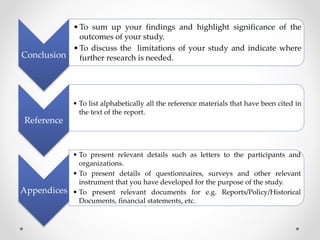
Conclusion
•To sum up your findings and highlight significance of the
outcomes of your study.
•To discuss the limitations of your study and indicate where
further research is needed.
Reference
• To list alphabetically all the reference materials that have been cited in
the text of the report.
Appendices
• To present relevant details such as letters to the participants and
organizations.
• To present details of questionnaires, surveys and other relevant
instrument that you have developed for the purpose of the study.
• To present relevant documents for e.g. Reports/Policy/Historical
Documents, financial statements, etc.
Title
The title
summarizes the
main idea or ideas
of the study.
A good title
contains the fewest
possible words that
adequately describe
the contents and/or
purpose of the
research paper.
If the title is too long it usually
contains too many unnecessary
words,
e.g., "A Study to Investigate the...." On
the other hand, a title which is too short
often uses words which are too general.
For example, “Indian Politics" could be
the title of a book, but it does not provide
any information on the focus of a
research paper.
The following parameters can be used
to help to formulate a suitable
research paper title:
• The purpose of the research
• The narrative tone of the paper [typically
defined by the type of the research]
Abstract
It is a summary of a
body of
information;
it expresses the
main claim and
argument of a
paper.
Questions that an abstract
answers:
• Why did you do this study?
• What did you do and how?
• What did you find?
• What do your findings mean?
Introduction
The primary
purpose of
introduction is to
frame the papers
for its readers.
• Brief description of the topic
• Statement as to why the topic is
worth researching or why it
could be found interesting.
• Statement of the research
objectives.
• Statement of the method/s and
scope of the study.
• An overview of the rest of the
paper.
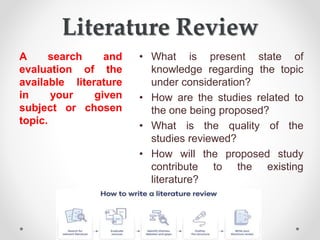
Literature Review
A search and
evaluation of the
available literature
in your given
subject or chosen
topic.
• What is present state of
knowledge regarding the topic
under consideration?
• How are the studies related to
the one being proposed?
• What is the quality of the
studies reviewed?
• How will the proposed study
contribute to the existing
literature?
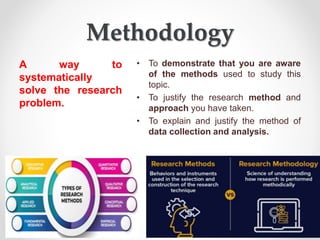
Methodology
A way to
systematically
solve the research
problem.
• To demonstrate that you are aware
of the methods used to study this
topic.
• To justify the research method and
approach you have taken.
• To explain and justify the method of
data collection and analysis.
How to write an effective methodology
section?
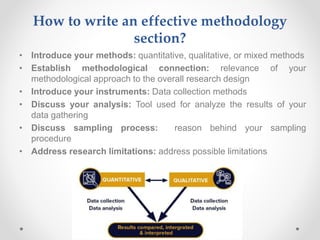
• Introduce your methods: quantitative, qualitative, or mixed methods
• Establish methodological connection: relevance of your
methodological approach to the overall research design
• Introduce your instruments: Data collection methods
• Discuss your analysis: Tool used for analyze the results of your
data gathering
• Discuss sampling process: reason behind your sampling
procedure
• Address research limitations: address possible limitations
Conclusion
The results and
discussion should
be the focus of this
part.
• To sum up your findings and
highlight the significance of
the outcomes of your study.
• To outline any implication or
recommendations indicated by
the findings.
Conclusion
The results and
discussion should
be the focus of this
part.
• Results: to present the findings
of your research in an orderly
manner, using heading planned
in your methodology or
headings arising from patterns
found in the research.
• Discussion: show your
understanding of what your
data suggests.
References
To list alphabetically
all the Reference
materials that have
been cited in the text
of the report.
• References need to contain
all the work cited in the next.
• Reference should
consistently need to follow
one recognizable system.
Appendices
Additional a section
at the end which
gives extra
information
• To present relevant details such
as letters to participants and
organizations.
• To present details of
questionnaires, surveys and
other relevant instrument that
you developed for the purpose
of the study.
• To present relevant documents,
e.g. Reports/policy/ historical
documents.
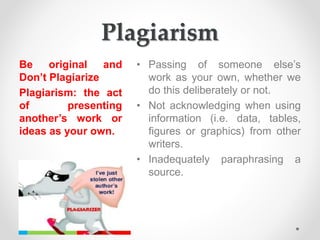
Plagiarism
Be original and
Don’t Plagiarize
Plagiarism: the act
of presenting
another’s work or
ideas as your own.
• Passing of someone else’s
work as your own, whether we
do this deliberately or not.
• Not acknowledging when using
information (i.e. data, tables,
figures or graphics) from other
writers.
• Inadequately paraphrasing a
source.
Plagiarism vs
Paraphrasing
Direct quote from research:
“Japan’s beautiful Mount
Fuji last erupted in 1707
and is now classified as
dormant. Dormant
volcanoes show no signs
of activity, but they may
erupt in the future.”
Non-plagiarized paraphrase:
Mount Fuji, the highest
mountain in Japan, is
actually a dormant volcano.
Dormant means that it is not
active. The last time Mount
Fuji erupted was in 1707, and
there is always the possibility
of a future eruption.
Formatting your
Research Paper?
MLA Format (Modern
Language Association) - is
the official guide to non-
fiction writing widely
adopted by schools,
academic departments,
and instructors
APA Format (American
Psychological Association) - is
an academic format commonly
used to cite sources within the
social sciences. Used by
various other scientific
journals (including medical
and public health journals),
textbooks, and academia.
Paper : Standard size (8.5 x 11" in the U.S.)
Page Margins : 1" on all sides (top, bottom, left, right)
Font : 12-pt. easily readable (e.g., Times Roman)
Spacing : Double-spaced
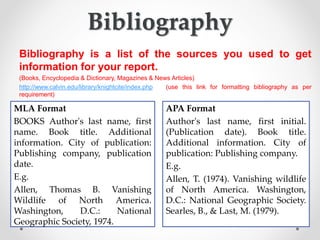
Bibliography
Bibliography is a list of the sources you used to get
information for your report.
(Books, Encyclopedia & Dictionary, Magazines & News Articles)
http://www.calvin.edu/library/knightcite/index.php (use this link for formatting bibliography as per
requirement)
APA Format
Author's last name, first initial.
(Publication date). Book title.
Additional information. City of
publication: Publishing company.
E.g.
Allen, T. (1974). Vanishing wildlife
of North America. Washington,
D.C.: National Geographic Society.
Searles, B., & Last, M. (1979).
MLA Format
BOOKS Author's last name, first
name. Book title. Additional
information. City of publication:
Publishing company, publication
date.
E.g.
Allen, Thomas B. Vanishing
Wildlife of North America.
Washington, D.C.: National
Geographic Society, 1974.
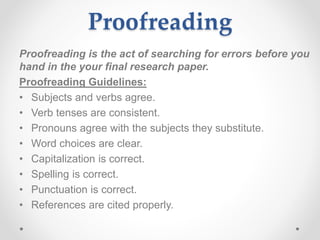
Proofreading
Proofreading is the act of searching for errors before you
hand in the your final research paper.
Proofreading Guidelines:
• Subjects and verbs agree.
• Verb tenses are consistent.
• Pronouns agree with the subjects they substitute.
• Word choices are clear.
• Capitalization is correct.
• Spelling is correct.
• Punctuation is correct.
• References are cited properly.
Contact Details:
Akash Gupta
Assistant Professor, BMS Department, Ramniranjan Jhunjhunwala College
(Autonomous), Mumbai, Maharashtra, India
Email : aakashg@rjcollege.edu.in

How to write research paper

  • 1.
    How to Writea Research Paper?
  • 2.
    Research • It isa systematic investigation into reality to gain knowledge. • Simply put, research is the process of discovering new knowledge. This knowledge can be either the development of new concepts or the advancement of existing knowledge and theories, leading to a new understanding that was not previously known.
  • 3.
    Research Paper • Aresearch paper is a type of academic writing that provides an in-depth analysis, evaluation, or interpretation of a single topic, based on empirical evidence. • Research paper may refer to: Academic paper (also called scholarly paper), which is in academic journals and contains original research results or reviews existing results or shows a totally new invention.
  • 4.
    Writing Process 1. PreWriting: Thinking about a topic, narrowing down your topic, discovery/reading about your topic, Citing sources, organizing information, etc. 2. Writing: start by writing your thesis statement 3. Revising: look at paper at last and make appropriate changes required in any part.
  • 5.
    Structure of aResearch Paper Main Parts of a Composition: • Introduction • Body • Conclusion • Title • Abstract • Introduction/Thesis Statement • Literature Review • Methodology • Results • Discussion • Conclusion • Reference • Appendices
  • 6.
    Abstract •To briefly introducethe reader •The aims of the study •The methodology •The results and findings Introduction •To state clear overall purpose of the study •Often framed in a discussion of the need the researcher is satisfying •To define the research question of the study •To give a very brief background of the relevant theory and practice of your topic. Literature Review •To summarize what conclusions have been reached in the research literature and whether different writers agree or not. •To highlights the main issue and controversies around the problem.
  • 7.
    Methodology •To demonstrate thatyou are aware of the methods used to study this topic. •To explain and justify the method of data collection and analysis. Results •To present the finding of your research in an orderly manner. •Using heading planned in your methodology or headings arising from patterns found in the research. Discussion •To comment on the trends/findings and show your understanding of what your data suggests. •To highlight anything unexpected that came up.
  • 8.
    Conclusion •To sum upyour findings and highlight significance of the outcomes of your study. •To discuss the limitations of your study and indicate where further research is needed. Reference • To list alphabetically all the reference materials that have been cited in the text of the report. Appendices • To present relevant details such as letters to the participants and organizations. • To present details of questionnaires, surveys and other relevant instrument that you have developed for the purpose of the study. • To present relevant documents for e.g. Reports/Policy/Historical Documents, financial statements, etc.
  • 9.
    Title The title summarizes the mainidea or ideas of the study. A good title contains the fewest possible words that adequately describe the contents and/or purpose of the research paper. If the title is too long it usually contains too many unnecessary words, e.g., "A Study to Investigate the...." On the other hand, a title which is too short often uses words which are too general. For example, “Indian Politics" could be the title of a book, but it does not provide any information on the focus of a research paper. The following parameters can be used to help to formulate a suitable research paper title: • The purpose of the research • The narrative tone of the paper [typically defined by the type of the research]
  • 10.
    Abstract It is asummary of a body of information; it expresses the main claim and argument of a paper. Questions that an abstract answers: • Why did you do this study? • What did you do and how? • What did you find? • What do your findings mean?
  • 11.
    Introduction The primary purpose of introductionis to frame the papers for its readers. • Brief description of the topic • Statement as to why the topic is worth researching or why it could be found interesting. • Statement of the research objectives. • Statement of the method/s and scope of the study. • An overview of the rest of the paper.
  • 12.
    Literature Review A searchand evaluation of the available literature in your given subject or chosen topic. • What is present state of knowledge regarding the topic under consideration? • How are the studies related to the one being proposed? • What is the quality of the studies reviewed? • How will the proposed study contribute to the existing literature?
  • 13.
    Methodology A way to systematically solvethe research problem. • To demonstrate that you are aware of the methods used to study this topic. • To justify the research method and approach you have taken. • To explain and justify the method of data collection and analysis.
  • 14.
    How to writean effective methodology section? • Introduce your methods: quantitative, qualitative, or mixed methods • Establish methodological connection: relevance of your methodological approach to the overall research design • Introduce your instruments: Data collection methods • Discuss your analysis: Tool used for analyze the results of your data gathering • Discuss sampling process: reason behind your sampling procedure • Address research limitations: address possible limitations
  • 15.
    Conclusion The results and discussionshould be the focus of this part. • To sum up your findings and highlight the significance of the outcomes of your study. • To outline any implication or recommendations indicated by the findings.
  • 16.
    Conclusion The results and discussionshould be the focus of this part. • Results: to present the findings of your research in an orderly manner, using heading planned in your methodology or headings arising from patterns found in the research. • Discussion: show your understanding of what your data suggests.
  • 17.
    References To list alphabetically allthe Reference materials that have been cited in the text of the report. • References need to contain all the work cited in the next. • Reference should consistently need to follow one recognizable system.
  • 18.
    Appendices Additional a section atthe end which gives extra information • To present relevant details such as letters to participants and organizations. • To present details of questionnaires, surveys and other relevant instrument that you developed for the purpose of the study. • To present relevant documents, e.g. Reports/policy/ historical documents.
  • 19.
    Plagiarism Be original and Don’tPlagiarize Plagiarism: the act of presenting another’s work or ideas as your own. • Passing of someone else’s work as your own, whether we do this deliberately or not. • Not acknowledging when using information (i.e. data, tables, figures or graphics) from other writers. • Inadequately paraphrasing a source.
  • 20.
    Plagiarism vs Paraphrasing Direct quotefrom research: “Japan’s beautiful Mount Fuji last erupted in 1707 and is now classified as dormant. Dormant volcanoes show no signs of activity, but they may erupt in the future.” Non-plagiarized paraphrase: Mount Fuji, the highest mountain in Japan, is actually a dormant volcano. Dormant means that it is not active. The last time Mount Fuji erupted was in 1707, and there is always the possibility of a future eruption.
  • 21.
    Formatting your Research Paper? MLAFormat (Modern Language Association) - is the official guide to non- fiction writing widely adopted by schools, academic departments, and instructors APA Format (American Psychological Association) - is an academic format commonly used to cite sources within the social sciences. Used by various other scientific journals (including medical and public health journals), textbooks, and academia. Paper : Standard size (8.5 x 11" in the U.S.) Page Margins : 1" on all sides (top, bottom, left, right) Font : 12-pt. easily readable (e.g., Times Roman) Spacing : Double-spaced
  • 22.
    Bibliography Bibliography is alist of the sources you used to get information for your report. (Books, Encyclopedia & Dictionary, Magazines & News Articles) http://www.calvin.edu/library/knightcite/index.php (use this link for formatting bibliography as per requirement) APA Format Author's last name, first initial. (Publication date). Book title. Additional information. City of publication: Publishing company. E.g. Allen, T. (1974). Vanishing wildlife of North America. Washington, D.C.: National Geographic Society. Searles, B., & Last, M. (1979). MLA Format BOOKS Author's last name, first name. Book title. Additional information. City of publication: Publishing company, publication date. E.g. Allen, Thomas B. Vanishing Wildlife of North America. Washington, D.C.: National Geographic Society, 1974.
  • 23.
    Proofreading Proofreading is theact of searching for errors before you hand in the your final research paper. Proofreading Guidelines: • Subjects and verbs agree. • Verb tenses are consistent. • Pronouns agree with the subjects they substitute. • Word choices are clear. • Capitalization is correct. • Spelling is correct. • Punctuation is correct. • References are cited properly.
  • 24.
    Contact Details: Akash Gupta AssistantProfessor, BMS Department, Ramniranjan Jhunjhunwala College (Autonomous), Mumbai, Maharashtra, India Email : aakashg@rjcollege.edu.in