HOW TO WRITE A
THESIS
M.Phil. scholar
ARSHA P.S.
M.Phil. research scholar
WHAT IS A THESIS ?
“A written work resulting from original research, especially one
submitted for higher degree in a university”
How to write a thesis
• A thesis statement focuses your ideas into one or two sentences. It
should present the topic of your paper and also make a comment
• A thesis statement should offer a way of understanding the topic.
• A thesis statement is a complete sentence that contains one main
idea.
STEPS TO WRITING A STRONG THESIS
• Research topic and create a research question
• Write a rough draft thesis statement that answers the research
question
• Re-write thesis statement to make sure that it addresses all of the
key points for a strong thesis.
• Make sure thesis is a road map for the rest of your essay.
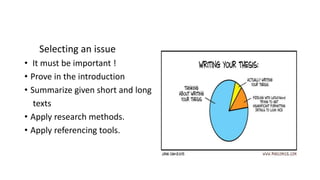
Selecting an issue
• It must be important !
• Prove in the introduction
• Summarize given short and long
texts
• Apply research methods.
• Apply referencing tools.
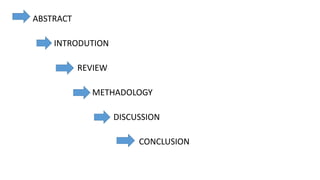
ABSTRACT
INTRODUTION
REVIEW
METHADOLOGY
DISCUSSION
CONCLUSION
Thesis structure
• Title page
Title(including subtitle) author, Institution ,department, date of
delivery, research mentor(s)and advisor, their institutions, and email
addresses.
Abstract
• A good abstract explains in one line why the paper is important.
• Abstracts generally do not have citations
• Answer to the questions should be found in abstract
• Table of contents
List all headings and subheading with page numbers
Indent subheadings
It will look something like this
List of Figures
List of Tables
Introduction
subheads...
What else belongs in the introductory
sections of your paper?
• A statement of the goal of the paper: why the study was undertaken,
or why the paper was written.
• Sufficient background information to allow the reader to understand
the context and significance of the question you are trying to address.
• Proper acknowledgement of the previous work on which you are
building.
• The introduction should be focused on the thesis question.
• Explain the scope of your work ,that will and will not be included.
What belongs in the methods section of a
scientific paper?
• Information to allow the reader to assess the believability of your
result.
• Information needed by another researcher to replicate your
experiment.
• Description of your materials ,procedure, equipment, and calibration
plots.
• Limitations,assumptions,and the range of validity .
• Description of your analytical methods, including reference to any
specialized statically software.
RESULTS
• The results are actual statement of observations, including statistics,
tables and graphs.
• Indicate information on range of variation.
• Mention negative results as well as positive. Do not interpret results
results-save that for the discussion.
• Break up your results into logical segments by using subheadings.
• Use S.I.units (m,s,kg,W.etc) through-out the thesis.
• Key results should be started in clear sentences at the beginning of
paragraphs.
DISCUSSION
The discussion section should be a brief essay in itself, answering the
following questions
• What are the major patterns in the observations?
• What are the relationship, trends and generalizations among results?
• Include the evidence or line of reasoning supporting each
interpretation.
• What is the implications of the present results for other unanswered
questions in earth sciences,ecology,environmental policy,etc…?
• what is the significance of the present results: Why should we care?
CONCLUSIONS
• What is the strongest and most important statement that you can
make from your observation?
• If you met the reader at a meeting six months from now, what do
you want them to remember about your paper?
• Refer back to the problem posed, and describe the conclusions that
you reached from carrying out this investigations and new
interpretations.
• Include broader implications of your results.
• Do not repeat word for word the abstract ,introduction or discussion
RECOMMENTATION
• Remedial action to solve the problem.
• Further research to fill in gaps in your understanding
• Directions for future investigation on this or related topics.
ACKNOWLEDGEMENTS
Advisor(s) and anyone who helped you?
1. Technically (including materials, supplies)
2. Intellectually (assistance ,advice)
3. Financially (for example ,departmental support , travel grand's)
REFERENCES
• Cite all ideas ,concepts,text,data that are not your own
• If you make a statement, back it up with your own data or a
reference
• All reference cited in the text must be listed
• Do not use footnotes
• List all reference cited in the text in alphabetical order
• Cite double author references by the surname of both authors
e.g. Simpson and Hays(1994)
FINAL THESIS
• Make 3 final copies 1 to mentor 2 to department ,so that we can have
three reader.
• Final thesis should be bound.
• Printed cleanly on white paper .
• Double spaced using 12-point font.
• 1- inch margins.
• Double –sided saves paper.
• Include page numbers
How to write a thesis

How to write a thesis

  • 1.
    HOW TO WRITEA THESIS M.Phil. scholar ARSHA P.S. M.Phil. research scholar
  • 2.
    WHAT IS ATHESIS ? “A written work resulting from original research, especially one submitted for higher degree in a university”
  • 3.
    How to writea thesis • A thesis statement focuses your ideas into one or two sentences. It should present the topic of your paper and also make a comment • A thesis statement should offer a way of understanding the topic. • A thesis statement is a complete sentence that contains one main idea.
  • 4.
    STEPS TO WRITINGA STRONG THESIS • Research topic and create a research question • Write a rough draft thesis statement that answers the research question • Re-write thesis statement to make sure that it addresses all of the key points for a strong thesis. • Make sure thesis is a road map for the rest of your essay.
  • 5.
    Selecting an issue •It must be important ! • Prove in the introduction • Summarize given short and long texts • Apply research methods. • Apply referencing tools.
  • 7.
  • 8.
    Thesis structure • Titlepage Title(including subtitle) author, Institution ,department, date of delivery, research mentor(s)and advisor, their institutions, and email addresses. Abstract • A good abstract explains in one line why the paper is important. • Abstracts generally do not have citations • Answer to the questions should be found in abstract
  • 9.
    • Table ofcontents List all headings and subheading with page numbers Indent subheadings It will look something like this List of Figures List of Tables Introduction subheads...
  • 10.
    What else belongsin the introductory sections of your paper? • A statement of the goal of the paper: why the study was undertaken, or why the paper was written. • Sufficient background information to allow the reader to understand the context and significance of the question you are trying to address. • Proper acknowledgement of the previous work on which you are building. • The introduction should be focused on the thesis question. • Explain the scope of your work ,that will and will not be included.
  • 11.
    What belongs inthe methods section of a scientific paper? • Information to allow the reader to assess the believability of your result. • Information needed by another researcher to replicate your experiment. • Description of your materials ,procedure, equipment, and calibration plots. • Limitations,assumptions,and the range of validity . • Description of your analytical methods, including reference to any specialized statically software.
  • 12.
    RESULTS • The resultsare actual statement of observations, including statistics, tables and graphs. • Indicate information on range of variation. • Mention negative results as well as positive. Do not interpret results results-save that for the discussion. • Break up your results into logical segments by using subheadings. • Use S.I.units (m,s,kg,W.etc) through-out the thesis. • Key results should be started in clear sentences at the beginning of paragraphs.
  • 13.
    DISCUSSION The discussion sectionshould be a brief essay in itself, answering the following questions • What are the major patterns in the observations? • What are the relationship, trends and generalizations among results? • Include the evidence or line of reasoning supporting each interpretation. • What is the implications of the present results for other unanswered questions in earth sciences,ecology,environmental policy,etc…? • what is the significance of the present results: Why should we care?
  • 14.
    CONCLUSIONS • What isthe strongest and most important statement that you can make from your observation? • If you met the reader at a meeting six months from now, what do you want them to remember about your paper? • Refer back to the problem posed, and describe the conclusions that you reached from carrying out this investigations and new interpretations. • Include broader implications of your results. • Do not repeat word for word the abstract ,introduction or discussion
  • 15.
    RECOMMENTATION • Remedial actionto solve the problem. • Further research to fill in gaps in your understanding • Directions for future investigation on this or related topics.
  • 16.
    ACKNOWLEDGEMENTS Advisor(s) and anyonewho helped you? 1. Technically (including materials, supplies) 2. Intellectually (assistance ,advice) 3. Financially (for example ,departmental support , travel grand's)
  • 17.
    REFERENCES • Cite allideas ,concepts,text,data that are not your own • If you make a statement, back it up with your own data or a reference • All reference cited in the text must be listed • Do not use footnotes • List all reference cited in the text in alphabetical order • Cite double author references by the surname of both authors e.g. Simpson and Hays(1994)
  • 18.
    FINAL THESIS • Make3 final copies 1 to mentor 2 to department ,so that we can have three reader. • Final thesis should be bound. • Printed cleanly on white paper . • Double spaced using 12-point font. • 1- inch margins. • Double –sided saves paper. • Include page numbers