

HOW TO
             organise
              an event


www.solargeneration.org
1
1
1
    HOW TO
    ORGANISE AN EVENT

    1. WHY?
                  Organising an event, however large or small, is an opportunity
                     for your group to meet people, especially students. As well
                         as the main purpose of the event (to educate, demon-
                           strate, suggest a project, facilitate meetings, etc), you
                             should bear in mind that this is the opportunity for
                               your association to prove itself and to get
                                yourselves known.
                                Essentially, it’s an opportunity to win over, not only
                                students, but also teachers, administrative staff
                                and the media.
                               It’s also the idea opportunity to bond the group,
                              share in the good times and, importantly,
                             strengthen the team spirit!
                          It is essential to organise different presentations for
                       each stage of your project so that your demands hit
                    home and you can explain the results you’ve achieved.

    Here are some tips for preparing properly and making your event a success.
    Don’t forget that your aims must guide your action. What matters is what you
    want to achieve.
to
                                                                            e time
                                                                       ke throles and
                                                                     Ta ne
                                                                     defi onsibilities
2. RECRUIT                                                           resp

   VOLUNTEERS
                                         While preparing the event, it is
 6         TIP draw up an
           organisation flowchart:
                                         essential to form a group of
                                         volunteers.
 Make a note of all operations,          You must therefore start by assess-
 preparations, people in charge,         ing your requirements (how many
 their responsibilities (cheques,        people and roles).
 accounts to check, people to con-       Organise an initial meeting, outlin-
 tact) and essential dates. This way,    ing your project to the team and ask-
 everybody feels responsible.            ing them to take part.
                                         Once the volunteers are on board,
 This should be regularly updated
                                         think about making time to brief
 (once a week) and everybody
                                         them on its aims, give everyone an
 should check it (it could be sent to
                                         individual role and start planning.
 an e-mail list).
                                         Representatives on stands must
                                         know their subject inside out so that
                                         they can answer any questions.

Assign one person to supervise the event and co-ordinate the team. In
addition to this person, several roles should be allocated:
      one person should be put in charge of administrative tasks:
      obtaining the necessary permits, collecting funds (see “Guide – how
      to secure funding”);
      another person should be put in charge of logistics: equipment,
      setting up and dismantling, tracking, posters, etc;
      one person should take care of communication: making posters
      and fliers, liaising with the media;
      finally you should appoint a spokesperson, who will be the main
      contact for the media (see Guide – talking to the media).
Other volunteers can organise activities in smaller groups.
3. DEFINE YOUR GOALS
      Goals should be aimed at a target audience and should focus on the issues
      you want to tackle. In order to achieve them, your goals must be clearly
      defined. The same event should be used to motivate group members,
      strengthen a sense of belonging, inform your target audience, socialise and
      meet people (through meals, workshops, etc), celebrate success, and put
      pressure on the university vice-chancellor to advance your needs.
      You will have a clearer picture of the type of event you want to organise
      after you have established your goals.


      4. DETERMINE THE
         TYPE OF EVENT
                           Answer the following questions: where, when,
                           how, what, (type of visual aids?), why? Think about
                           logistics – movements, equipment, and timing.
                           Next, think about your goals, the target audience and
                           the setting for your event. For example, if your aim is to
                           collect signatures to support a project, set up a stand
                           or a lively interactive demonstration (with photo-mes-
                           saging, for example). If your goal is to celebrate the fact
                           that the president has signed a charter, organise a
                           cocktail party, or a conference.
                           For more ideas and inspiration, check out the “Ideas for
                           your events” factsheet.
                           Set up a meeting with the aim of promoting the event.
                           Include contacts, the type of advertisements, fixing
                           important dates, press and PR.


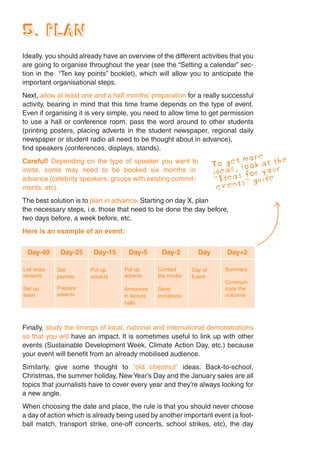
Flyer “Just a
Clic”used in more
than 50 campuses
5. PLAN
Ideally, you should already have an overview of the different activities that you
are going to organise throughout the year (see the “Setting a calendar” sec-
tion in the “Ten key points” booklet), which will allow you to anticipate the
important organisational steps.
Next, allow at least one and a half months’ preparation for a really successful
activity, bearing in mind that this time frame depends on the type of event.
Even if organising it is very simple, you need to allow time to get permission
to use a hall or conference room, pass the word around to other students
(printing posters, placing adverts in the student newspaper, regional daily
newspaper or student radio all need to be thought about in advance),
find speakers (conferences, displays, stands).
                                                                                  e he
Careful! Depending on the type of speaker you want to                      et mor
                                                                       To gs, look at tr
invite, some may need to be booked six months in                       idea as for you
advance (celebrity speakers, groups with existing commit-              “Idents” guide
ments, etc).                                                            eve
The best solution is to plan in advance. Starting on day X, plan
the necessary steps, i.e. those that need to be done the day before,
two days before, a week before, etc.
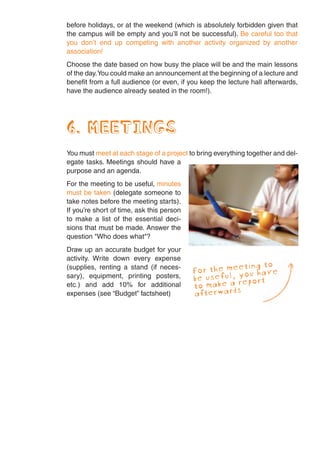
Here is an example of an event:


 Day-40        Day-25    Day-15      Day-5       Day-2          Day       Day+2

List requi-   Get       Put up     Put up       Contact       Day of      Summary
rements       permits   adverts    adverts      the media     Event
                                                                          Commun-
Set up        Prepare              Announce     Send                      icate the
team          adverts              in lecture   invitations               outcome
                                   halls


Finally, study the timings of local, national and international demonstrations
so that you will have an impact. It is sometimes useful to link up with other
events (Sustainable Development Week, Climate Action Day, etc.) because
your event will benefit from an already mobilised audience.
Similarly, give some thought to “old chestnut” ideas. Back-to-school,
Christmas, the summer holiday, New Year’s Day and the January sales are all
topics that journalists have to cover every year and they’re always looking for
a new angle.
When choosing the date and place, the rule is that you should never choose
a day of action which is already being used by another important event (a foot-
ball match, transport strike, one-off concerts, school strikes, etc), the day
before holidays, or at the weekend (which is absolutely forbidden given that
the campus will be empty and you’ll not be successful). Be careful too that
you don’t end up competing with another activity organized by another
association!
Choose the date based on how busy the place will be and the main lessons
of the day.You could make an announcement at the beginning of a lecture and
benefit from a full audience (or even, if you keep the lecture hall afterwards,
have the audience already seated in the room!).


6. MEETINGS
You must meet at each stage of a project to bring everything together and del-
egate tasks. Meetings should have a
purpose and an agenda.
For the meeting to be useful, minutes
must be taken (delegate someone to
take notes before the meeting starts).
If you’re short of time, ask this person
to make a list of the essential deci-
sions that must be made. Answer the
question "Who does what"?
Draw up an accurate budget for your
activity. Write down every expense
(supplies, renting a stand (if neces-                 eting to
                                           For the meyou have
sary), equipment, printing posters,        be useful, report
                                                    a
etc.) and add 10% for additional           to make rds
expenses (see “Budget” factsheet)          aft erwa
7. COMMUNICATE
Establish the message you want to convey.
Taking into account the timings for manufacturing and obtaining support
material, establish communication methods that are suited to the campus
in question.

 TIP think about                   Documents must be punchy and should
 communicating using a             attract attention. Images and text must
 “teaser” in two stages:           stand out. The event name should be strik-
                                   ing so that it sticks in people’s memories –
 First wave of posters – make
 it known that something is        make it attractive but mysterious, or simply
 going to happen, to whet          lucid. Visibility is an essential part of
 people’s appetite but without     communication.
 giving any details          The name, symbol and logo are essential
 Second stage – provide      pieces of information to help people
 details of the event.       remember an organisation and symbolise
                             its activities and spirit. Don’t forget the
Solar Generation logo, which should appear on all communication
documents.
Advice: making contact with the appropriate people in the early stages of the
project will familiarise you with the conditions for putting up posters.

             SOME TIPS


  Z          > Leaflets : hand out leaflets on Monday 10th for an
             event on Monday 17th, as well as the day before and
             the day itself.
             > Posters : they can be covered over with adverts, so
  you will need ample space (allow one poster for every 100
  students targeted).
  > Strategic positioning: phone boxes, coffee machines,
  libraries, corridors, behind toilet doors, student newspaper,
  student radio, free newspapers, town events listings, cafés,
  computer rooms, etc.
  > Ask teachers to mention events at the beginning of lectures, or
  do it yourselves.
  > Create a group e-mail address for important meetings.

Remember that good posters, visible communication, as well as talking to
students in the lecture theatres will help your association on campus! Don’t
forget to mention your Internet site, the names of those responsible, your local
office address, etc.
Think about advertising your event using the media; by drafting a press
release (see “Media” guide and additional sheets).
8. ASSESSMENT
Organising events will help to advance your Solar Generation project. It is
therefore essential that you write a summary afterwards to see what worked
and what didn’t, and to identify problems that you can learn from for next time.

Think about the following questions:

      How many students took part? How many leaflets were distributed?
      How many posters used? If applicable, how many signatures did
      you get?
      Had the students you targeted heard of Solar Generation and your
      project? Are they interested in helping to make the campus green?
      Were they receptive to this type of event?
      What were your organisational problems (timing, team issues,
      distributing roles, external relations)?
      What were the most commonly made comments? Did any questions
      catch you out? What did this action bring to your association? What did
      it bring to the Solar Generation project on your campus?
      What do you want to do next?

These answers will help you to build on your project and to consolidate your
association. Consider sending this report to Greenpeace.
Summary:


- Identify your goal and message.
- Define your target audience – who could be interested,
  whose awareness should be raised?
- Choose the most suitable type of event for the two previous
  answers – establish how long the event should last, where and
  how it should be held, how and with whom you’ll make it happen.
- Think about practicalities – permits, technical issues,
  support material, partners, budget, etc.
- Bring the event to life – use supporting material, prepare
  discussions and demonstrations, etc.
- Decide on a communication strategy so that your
  initiative gets heard.
- Prepare well for your event – there’s always the unexpected!
- Assess the outcome – discuss this with your new contacts
  and make your views known.
NOTES
TÉSTIMONY
                                                                                                                                                                       ‘EFFET PAPILLON’ (BUTTERFLY EFFECT) ON THE GRENOBLE CAMPUS, BY NATHALIE


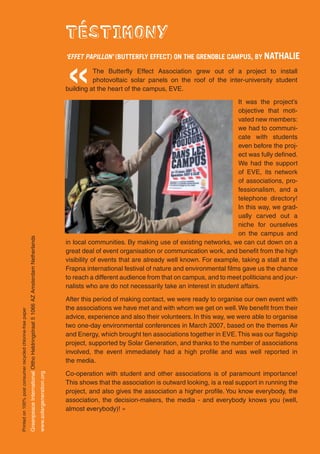
                                                                                                                                                                       «         The Butterfly Effect Association grew out of a project to install
                                                                                                                                                                                 photovoltaic solar panels on the roof of the inter-university student
                                                                                                                                                                       building at the heart of the campus, EVE.

                                                                                                                                                                                                                                     It was the project’s
                                                                                                                                                                                                                                     objective that moti-
                                                                                                                                                                                                                                     vated new members:
                                                                                                                                                                                                                                     we had to communi-
                                                                                                                                                                                                                                     cate with students
                                                                                                                                                                                                                                     even before the proj-
                                                                                                                                                                                                                                     ect was fully defined.
                                                                                                                                                                                                                                     We had the support
                                                                                                                                                                                                                                     of EVE, its network
                                                                                                                                                                                                                                     of associations, pro-
                                                                                                                                                                                                                                     fessionalism, and a
                                                                                                                                                                                                                                     telephone directory!
                                                                                                                                                                                                                                     In this way, we grad-
                                                                                                                                                                                                                                     ually carved out a
                                                                                                                                                                                                                                     niche for ourselves
                                                                                                                                                                                                                                     on the campus and
                                                             Greenpeace International Ottho Heldringstraat 5 1066 AZ Amsterdam Netherlands


                                                                                                                                                                       in local communities. By making use of existing networks, we can cut down on a
                                                                                                                                                                       great deal of event organisation or communication work, and benefit from the high
                                                                                                                                                                       visibility of events that are already well known. For example, taking a stall at the
                                                                                                                                                                       Frapna international festival of nature and environmental films gave us the chance
                                                                                                                                                                       to reach a different audience from that on campus, and to meet politicians and jour-
                                                                                                                                                                       nalists who are do not necessarily take an interest in student affairs.

                                                                                                                                                                       After this period of making contact, we were ready to organise our own event with
                                                                                                                                                                       the associations we have met and with whom we get on well. We benefit from their
Printed on 100% post consumer recycled chlorine-free paper


                                                                                                                                                                       advice, experience and also their volunteers. In this way, we were able to organise
                                                                                                                                                                       two one-day environmental conferences in March 2007, based on the themes Air
                                                                                                                                                                       and Energy, which brought ten associations together in EVE. This was our flagship
                                                                                                                                                                       project, supported by Solar Generation, and thanks to the number of associations
                                                                                                                                                                       involved, the event immediately had a high profile and was well reported in
                                                                                                                                                                       the media.
                                                                                                                                             www.solargeneration.org


                                                                                                                                                                       Co-operation with student and other associations is of paramount importance!
                                                                                                                                                                       This shows that the association is outward looking, is a real support in running the
                                                                                                                                                                       project, and also gives the association a higher profile. You know everybody, the
                                                                                                                                                                       association, the decision-makers, the media - and everybody knows you (well,
                                                                                                                                                                       almost everybody)! »

How to organize an event

  • 1.
    HOW TO organise an event www.solargeneration.org
  • 2.
    1 1 1 HOW TO ORGANISE AN EVENT 1. WHY? Organising an event, however large or small, is an opportunity for your group to meet people, especially students. As well as the main purpose of the event (to educate, demon- strate, suggest a project, facilitate meetings, etc), you should bear in mind that this is the opportunity for your association to prove itself and to get yourselves known. Essentially, it’s an opportunity to win over, not only students, but also teachers, administrative staff and the media. It’s also the idea opportunity to bond the group, share in the good times and, importantly, strengthen the team spirit! It is essential to organise different presentations for each stage of your project so that your demands hit home and you can explain the results you’ve achieved. Here are some tips for preparing properly and making your event a success. Don’t forget that your aims must guide your action. What matters is what you want to achieve.
  • 3.
    to e time ke throles and Ta ne defi onsibilities 2. RECRUIT resp VOLUNTEERS While preparing the event, it is 6 TIP draw up an organisation flowchart: essential to form a group of volunteers. Make a note of all operations, You must therefore start by assess- preparations, people in charge, ing your requirements (how many their responsibilities (cheques, people and roles). accounts to check, people to con- Organise an initial meeting, outlin- tact) and essential dates. This way, ing your project to the team and ask- everybody feels responsible. ing them to take part. Once the volunteers are on board, This should be regularly updated think about making time to brief (once a week) and everybody them on its aims, give everyone an should check it (it could be sent to individual role and start planning. an e-mail list). Representatives on stands must know their subject inside out so that they can answer any questions. Assign one person to supervise the event and co-ordinate the team. In addition to this person, several roles should be allocated: one person should be put in charge of administrative tasks: obtaining the necessary permits, collecting funds (see “Guide – how to secure funding”); another person should be put in charge of logistics: equipment, setting up and dismantling, tracking, posters, etc; one person should take care of communication: making posters and fliers, liaising with the media; finally you should appoint a spokesperson, who will be the main contact for the media (see Guide – talking to the media). Other volunteers can organise activities in smaller groups.
  • 4.
    3. DEFINE YOURGOALS Goals should be aimed at a target audience and should focus on the issues you want to tackle. In order to achieve them, your goals must be clearly defined. The same event should be used to motivate group members, strengthen a sense of belonging, inform your target audience, socialise and meet people (through meals, workshops, etc), celebrate success, and put pressure on the university vice-chancellor to advance your needs. You will have a clearer picture of the type of event you want to organise after you have established your goals. 4. DETERMINE THE TYPE OF EVENT Answer the following questions: where, when, how, what, (type of visual aids?), why? Think about logistics – movements, equipment, and timing. Next, think about your goals, the target audience and the setting for your event. For example, if your aim is to collect signatures to support a project, set up a stand or a lively interactive demonstration (with photo-mes- saging, for example). If your goal is to celebrate the fact that the president has signed a charter, organise a cocktail party, or a conference. For more ideas and inspiration, check out the “Ideas for your events” factsheet. Set up a meeting with the aim of promoting the event. Include contacts, the type of advertisements, fixing important dates, press and PR. Flyer “Just a Clic”used in more than 50 campuses
  • 5.
    5. PLAN Ideally, youshould already have an overview of the different activities that you are going to organise throughout the year (see the “Setting a calendar” sec- tion in the “Ten key points” booklet), which will allow you to anticipate the important organisational steps. Next, allow at least one and a half months’ preparation for a really successful activity, bearing in mind that this time frame depends on the type of event. Even if organising it is very simple, you need to allow time to get permission to use a hall or conference room, pass the word around to other students (printing posters, placing adverts in the student newspaper, regional daily newspaper or student radio all need to be thought about in advance), find speakers (conferences, displays, stands). e he Careful! Depending on the type of speaker you want to et mor To gs, look at tr invite, some may need to be booked six months in idea as for you advance (celebrity speakers, groups with existing commit- “Idents” guide ments, etc). eve The best solution is to plan in advance. Starting on day X, plan the necessary steps, i.e. those that need to be done the day before, two days before, a week before, etc. Here is an example of an event: Day-40 Day-25 Day-15 Day-5 Day-2 Day Day+2 List requi- Get Put up Put up Contact Day of Summary rements permits adverts adverts the media Event Commun- Set up Prepare Announce Send icate the team adverts in lecture invitations outcome halls Finally, study the timings of local, national and international demonstrations so that you will have an impact. It is sometimes useful to link up with other events (Sustainable Development Week, Climate Action Day, etc.) because your event will benefit from an already mobilised audience. Similarly, give some thought to “old chestnut” ideas. Back-to-school, Christmas, the summer holiday, New Year’s Day and the January sales are all topics that journalists have to cover every year and they’re always looking for a new angle. When choosing the date and place, the rule is that you should never choose a day of action which is already being used by another important event (a foot- ball match, transport strike, one-off concerts, school strikes, etc), the day
  • 6.
    before holidays, orat the weekend (which is absolutely forbidden given that the campus will be empty and you’ll not be successful). Be careful too that you don’t end up competing with another activity organized by another association! Choose the date based on how busy the place will be and the main lessons of the day.You could make an announcement at the beginning of a lecture and benefit from a full audience (or even, if you keep the lecture hall afterwards, have the audience already seated in the room!). 6. MEETINGS You must meet at each stage of a project to bring everything together and del- egate tasks. Meetings should have a purpose and an agenda. For the meeting to be useful, minutes must be taken (delegate someone to take notes before the meeting starts). If you’re short of time, ask this person to make a list of the essential deci- sions that must be made. Answer the question "Who does what"? Draw up an accurate budget for your activity. Write down every expense (supplies, renting a stand (if neces- eting to For the meyou have sary), equipment, printing posters, be useful, report a etc.) and add 10% for additional to make rds expenses (see “Budget” factsheet) aft erwa
  • 7.
    7. COMMUNICATE Establish themessage you want to convey. Taking into account the timings for manufacturing and obtaining support material, establish communication methods that are suited to the campus in question. TIP think about Documents must be punchy and should communicating using a attract attention. Images and text must “teaser” in two stages: stand out. The event name should be strik- ing so that it sticks in people’s memories – First wave of posters – make it known that something is make it attractive but mysterious, or simply going to happen, to whet lucid. Visibility is an essential part of people’s appetite but without communication. giving any details The name, symbol and logo are essential Second stage – provide pieces of information to help people details of the event. remember an organisation and symbolise its activities and spirit. Don’t forget the Solar Generation logo, which should appear on all communication documents. Advice: making contact with the appropriate people in the early stages of the project will familiarise you with the conditions for putting up posters. SOME TIPS Z > Leaflets : hand out leaflets on Monday 10th for an event on Monday 17th, as well as the day before and the day itself. > Posters : they can be covered over with adverts, so you will need ample space (allow one poster for every 100 students targeted). > Strategic positioning: phone boxes, coffee machines, libraries, corridors, behind toilet doors, student newspaper, student radio, free newspapers, town events listings, cafés, computer rooms, etc. > Ask teachers to mention events at the beginning of lectures, or do it yourselves. > Create a group e-mail address for important meetings. Remember that good posters, visible communication, as well as talking to students in the lecture theatres will help your association on campus! Don’t forget to mention your Internet site, the names of those responsible, your local office address, etc. Think about advertising your event using the media; by drafting a press release (see “Media” guide and additional sheets).
  • 8.
    8. ASSESSMENT Organising eventswill help to advance your Solar Generation project. It is therefore essential that you write a summary afterwards to see what worked and what didn’t, and to identify problems that you can learn from for next time. Think about the following questions: How many students took part? How many leaflets were distributed? How many posters used? If applicable, how many signatures did you get? Had the students you targeted heard of Solar Generation and your project? Are they interested in helping to make the campus green? Were they receptive to this type of event? What were your organisational problems (timing, team issues, distributing roles, external relations)? What were the most commonly made comments? Did any questions catch you out? What did this action bring to your association? What did it bring to the Solar Generation project on your campus? What do you want to do next? These answers will help you to build on your project and to consolidate your association. Consider sending this report to Greenpeace.
  • 9.
    Summary: - Identify yourgoal and message. - Define your target audience – who could be interested, whose awareness should be raised? - Choose the most suitable type of event for the two previous answers – establish how long the event should last, where and how it should be held, how and with whom you’ll make it happen. - Think about practicalities – permits, technical issues, support material, partners, budget, etc. - Bring the event to life – use supporting material, prepare discussions and demonstrations, etc. - Decide on a communication strategy so that your initiative gets heard. - Prepare well for your event – there’s always the unexpected! - Assess the outcome – discuss this with your new contacts and make your views known.
  • 10.
  • 12.
    TÉSTIMONY ‘EFFET PAPILLON’ (BUTTERFLY EFFECT) ON THE GRENOBLE CAMPUS, BY NATHALIE « The Butterfly Effect Association grew out of a project to install photovoltaic solar panels on the roof of the inter-university student building at the heart of the campus, EVE. It was the project’s objective that moti- vated new members: we had to communi- cate with students even before the proj- ect was fully defined. We had the support of EVE, its network of associations, pro- fessionalism, and a telephone directory! In this way, we grad- ually carved out a niche for ourselves on the campus and Greenpeace International Ottho Heldringstraat 5 1066 AZ Amsterdam Netherlands in local communities. By making use of existing networks, we can cut down on a great deal of event organisation or communication work, and benefit from the high visibility of events that are already well known. For example, taking a stall at the Frapna international festival of nature and environmental films gave us the chance to reach a different audience from that on campus, and to meet politicians and jour- nalists who are do not necessarily take an interest in student affairs. After this period of making contact, we were ready to organise our own event with the associations we have met and with whom we get on well. We benefit from their Printed on 100% post consumer recycled chlorine-free paper advice, experience and also their volunteers. In this way, we were able to organise two one-day environmental conferences in March 2007, based on the themes Air and Energy, which brought ten associations together in EVE. This was our flagship project, supported by Solar Generation, and thanks to the number of associations involved, the event immediately had a high profile and was well reported in the media. www.solargeneration.org Co-operation with student and other associations is of paramount importance! This shows that the association is outward looking, is a real support in running the project, and also gives the association a higher profile. You know everybody, the association, the decision-makers, the media - and everybody knows you (well, almost everybody)! »