Utilizing Partnerships and Earned
Media to Communicate Pool Safely
            Messaging


               Kathleen Reilly, CPSC
 Jim Luetkemeyer, Widmeyer Communications
   Christina Saull, Widmeyer Communications
Revised PSAs for 2013
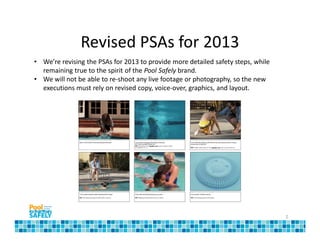
• We’re revising the PSAs for 2013 to provide more detailed safety steps, while
  remaining true to the spirit of the Pool Safely brand.
• We will not be able to re-shoot any live footage or photography, so the new
  executions must rely on revised copy, voice-over, graphics, and layout.


                                                                                  2
Revised PSAs for 2013
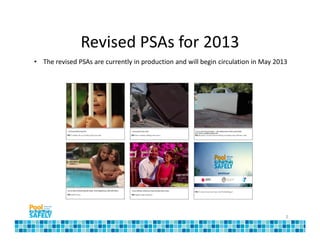
• The revised PSAs are currently in production and will begin circulation in May 2013


                                                                                    3
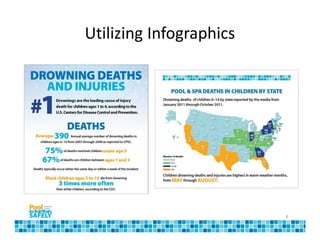
Utilizing Infographics


                         4
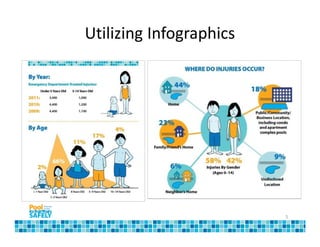
Utilizing Infographics


                         5
Generating Local Media Attention


                                   6
Developing a Local Media List
• Keep your list separated by media type.
• Do your research. Find out what reporters cover your issue.
• Create a list that includes the following information:
   o Name of outlet
   o Names of relevant editors, reporters, news directors, etc.
   o Telephone number and email for each contact
   o Additional information such as reporter preferences or
      deadlines
• Edit the list as you make pitch calls. Your media list is a living
  document that will evolve.
• Alert your local “events” calendar section, including print and
  broadcast media, to help publicize an upcoming event.


                                                                       7
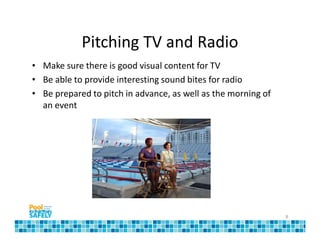
Pitching TV and Radio
• Make sure there is good visual content for TV
• Be able to provide interesting sound bites for radio
• Be prepared to pitch in advance, as well as the morning of
  an event


                                                               8
Pitching Local Print
• Customize your pitches to each reporter’s area of
  expertise.
• Research previous articles from reporters. Include a
  link to a recent story if it’s particularly relevant.
• Emphasize the local angle.
• Always have a timely news hook – answer the “why
  now?” question before it’s asked.


                                                          9
Answering Tough Questions
• You don’t have to answer negative or hostile
  questions.
• If you are asked a question to which you don’t have
  the answer, STOP. Tell them that you don’t have the
  facts in front of you and ask to follow up.
• Contact CPSC or Widmeyer for assistance.


                                                        10
Additional Media Tips
• Make yourself known as the “go-to” person for your
  organization to reporters, columnists and editors for health,
  parenting, education issues.
• Check in with your contacts on occasion. Journalists need a
  steady flow of story ideas, so make yourself a resource.
• Aim to be an asset for your contact. Offer to send information
  or graphics, arrange meetings and interviews, etc.


                                                               11
Organizing Events


                    12
The Basics of Your Event
When organizing your event, start by answering these
specific questions:

•   What are the goals/objectives of the event?
•   Who is the target audience?
•   What resources are available?
•   Is a high-profile personality available?
•   What type of event do you want to hold?
•   Where should the event be held and when?


                                                       13
Event Timeline

• Start with an event planning timeline, to track
  who is responsible for what tasks and completion
  dates.
• A timeline should include dates for execution and
  completion on logistics, partnership
  development, publicity and a program/agenda.


                                                      14
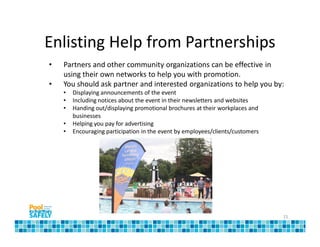
Enlisting Help from Partnerships
•   Partners and other community organizations can be effective in
    using their own networks to help you with promotion.
•   You should ask partner and interested organizations to help you by:
    •   Displaying announcements of the event
    •   Including notices about the event in their newsletters and websites
    •   Handing out/displaying promotional brochures at their workplaces and
        businesses
    •   Helping you pay for advertising
    •   Encouraging participation in the event by employees/clients/customers


                                                                                15
Event Day
• When your planning is complete and the event day
  has arrived, you should:
   •   Arrive at the venue early enough to ensure that it is set up
       properly and that all equipment is working
   •   Use a checklist to ensure that all tasks are complete
   •   Ensure that everyone working the event has an agenda
       and knows where they need to be and what is going on at
       all times
   •   Use a designated person to handle all questions from
       media, participants and volunteers; for large events,
       consider having an information booth


                                                                      16
Discussion
• Success Stories
• Missteps
• What do you have planned this year and how
  can Pool Safely help?


                                               17

Utilizing Parnerships to Communicate Pool Safely Messaging

  • 1.
    Utilizing Partnerships andEarned Media to Communicate Pool Safely Messaging Kathleen Reilly, CPSC Jim Luetkemeyer, Widmeyer Communications Christina Saull, Widmeyer Communications
  • 2.
    Revised PSAs for2013 • We’re revising the PSAs for 2013 to provide more detailed safety steps, while remaining true to the spirit of the Pool Safely brand. • We will not be able to re-shoot any live footage or photography, so the new executions must rely on revised copy, voice-over, graphics, and layout. 2
  • 3.
    Revised PSAs for2013 • The revised PSAs are currently in production and will begin circulation in May 2013 3
  • 4.
  • 5.
  • 6.
  • 7.
    Developing a LocalMedia List • Keep your list separated by media type. • Do your research. Find out what reporters cover your issue. • Create a list that includes the following information: o Name of outlet o Names of relevant editors, reporters, news directors, etc. o Telephone number and email for each contact o Additional information such as reporter preferences or deadlines • Edit the list as you make pitch calls. Your media list is a living document that will evolve. • Alert your local “events” calendar section, including print and broadcast media, to help publicize an upcoming event. 7
  • 8.
    Pitching TV andRadio • Make sure there is good visual content for TV • Be able to provide interesting sound bites for radio • Be prepared to pitch in advance, as well as the morning of an event 8
  • 9.
    Pitching Local Print •Customize your pitches to each reporter’s area of expertise. • Research previous articles from reporters. Include a link to a recent story if it’s particularly relevant. • Emphasize the local angle. • Always have a timely news hook – answer the “why now?” question before it’s asked. 9
  • 10.
    Answering Tough Questions •You don’t have to answer negative or hostile questions. • If you are asked a question to which you don’t have the answer, STOP. Tell them that you don’t have the facts in front of you and ask to follow up. • Contact CPSC or Widmeyer for assistance. 10
  • 11.
    Additional Media Tips •Make yourself known as the “go-to” person for your organization to reporters, columnists and editors for health, parenting, education issues. • Check in with your contacts on occasion. Journalists need a steady flow of story ideas, so make yourself a resource. • Aim to be an asset for your contact. Offer to send information or graphics, arrange meetings and interviews, etc. 11
  • 12.
  • 13.
    The Basics ofYour Event When organizing your event, start by answering these specific questions: • What are the goals/objectives of the event? • Who is the target audience? • What resources are available? • Is a high-profile personality available? • What type of event do you want to hold? • Where should the event be held and when? 13
  • 14.
    Event Timeline • Startwith an event planning timeline, to track who is responsible for what tasks and completion dates. • A timeline should include dates for execution and completion on logistics, partnership development, publicity and a program/agenda. 14
  • 15.
    Enlisting Help fromPartnerships • Partners and other community organizations can be effective in using their own networks to help you with promotion. • You should ask partner and interested organizations to help you by: • Displaying announcements of the event • Including notices about the event in their newsletters and websites • Handing out/displaying promotional brochures at their workplaces and businesses • Helping you pay for advertising • Encouraging participation in the event by employees/clients/customers 15
  • 16.
    Event Day • Whenyour planning is complete and the event day has arrived, you should: • Arrive at the venue early enough to ensure that it is set up properly and that all equipment is working • Use a checklist to ensure that all tasks are complete • Ensure that everyone working the event has an agenda and knows where they need to be and what is going on at all times • Use a designated person to handle all questions from media, participants and volunteers; for large events, consider having an information booth 16
  • 17.
    Discussion • Success Stories •Missteps • What do you have planned this year and how can Pool Safely help? 17