地理資訊系統於高中職社區化之應用 How to empower community by using GIS Lecturer: Yao-hui Wang
課程大綱 (Module outline) 地理資訊系統概論  (Frontiers of GIS) ArcGIS 程式集介紹與整合運作模式  (What is ArcGIS) 資料呈現  (Displaying Data) 資料諮詢  (Querying Data) 資料格式轉換與應用 (Converting Data)
圖層資料編譯  (Using Edit tools) 外部資料整合  (Data Plug-in) 3D 模式呈現技巧  (3D Presentation) 資料的錯誤與不確定性探討  (Errors and Uncertainties in GIS ) 地理資訊系統於社區化應用層面  (Application in empowering Community)
Module Aims  On completion of the module students should have: Familiarity with the use and application of the ArcGIS package; Knowledge of the use of GIS across a range of applications including education, public safety or welfare,  environmental management and community participation; and Knowledge of environmental issues, skills in the interpretation of spatial environmental data and an awareness of specific problems and issues relating to data quality, and correct interpolation of spatial data into project.
Students Learning Outcomes Demonstrate a clear knowledge and understanding of the key concepts concerning the application of GIS to problems in ‘‘students’ empowering community projects’’; Critique and evaluate the applicability of GIS in relation to empowering community applications; and Demonstrate a high level of skill in the application of GIS software to the solving of environmental problems
Lecture 1 Frontiers of GIS Lecture Outline 1.Elements of Cartography 2.Categories Features in GIS Software 3.Definition of GIS 4.How to choose suitable GIS software 5. Data structure
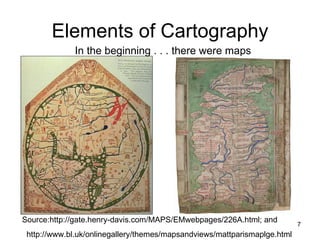
Elements of Cartography In the beginning . . . there were maps  Source:http://gate.henry-davis.com/MAPS/EMwebpages/226A.html; and http://www.bl.uk/onlinegallery/themes/mapsandviews/mattparismaplge.html
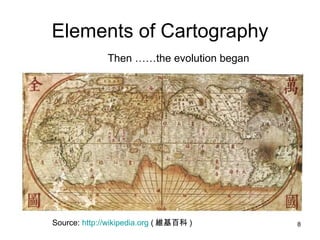
Elements of Cartography Then ……the evolution began   Source:  http://wikipedia.org  ( 維基百科 )
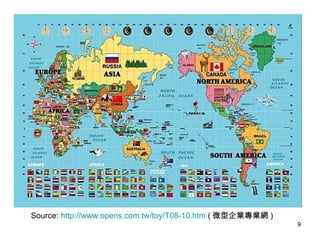
Source:  http://www.opens.com.tw/toy/T08-10.htm  ( 微型企業專業網 )
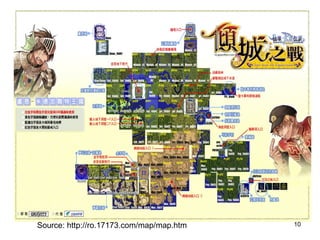
Source: http://ro.17173.com/map/map.htm
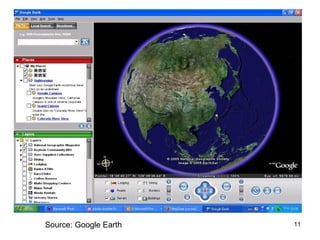
Source: Google Earth
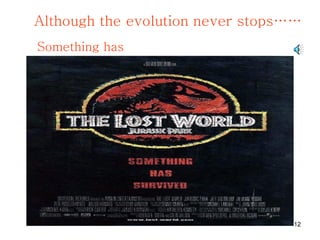
Although the evolution never stops…… Something has survived……………………….
Elements of Cartography Projection Scale  Grid Coordinate System Orientation Legend How to set them up in ArcGIS?
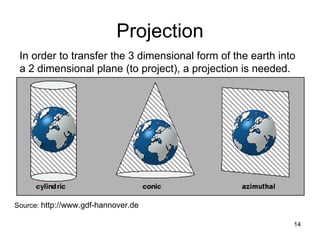
Projection In order to transfer the 3 dimensional form of the earth into a 2 dimensional plane (to project), a projection is needed.  Source:  http://www.gdf-hannover.de
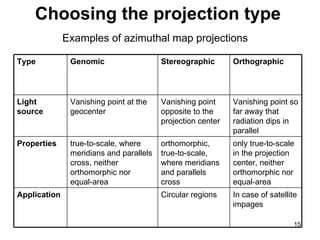
Choosing the projection type Examples of azimuthal map projections  In case of satellite impages  Circular regions  Application  only true-to-scale in the projection center, neither orthomorphic nor equal-area  orthomorphic, true-to-scale, where meridians and parallels cross  true-to-scale, where meridians and parallels cross, neither orthomorphic nor equal-area  Properties  Vanishing point so far away that radiation dips in parallel  Vanishing point opposite to the projection center  Vanishing point at the geocenter  Light source  Orthographic Stereographic Genomic Type
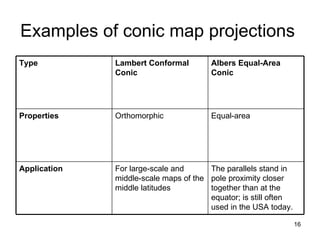
Examples of conic map projections  The parallels stand in pole proximity closer together than at the equator; is still often used in the USA today.  For large-scale and middle-scale maps of the middle latitudes  Application  Equal-area Orthomorphic Properties Albers Equal-Area Conic Lambert Conformal Conic Type
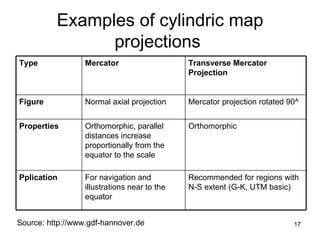
Examples of cylindric map projections  Source: http://www.gdf-hannover.de Recommended for regions with N-S extent (G-K, UTM basic) For navigation and illustrations near to the equator Pplication Orthomorphic Orthomorphic, parallel distances increase proportionally from the equator to the scale Properties Mercator projection rotated 90^ Normal axial projection Figure Transverse Mercator Projection Mercator Type
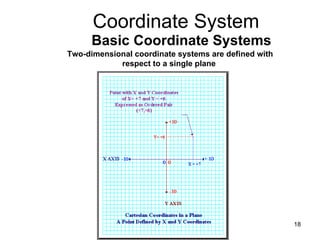
Two-dimensional coordinate systems are defined with respect to a single plane  Basic Coordinate Systems Coordinate System
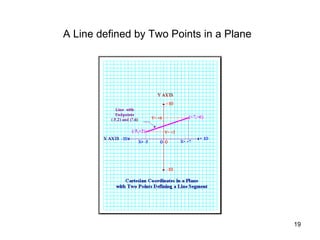
A Line defined by Two Points in a Plane
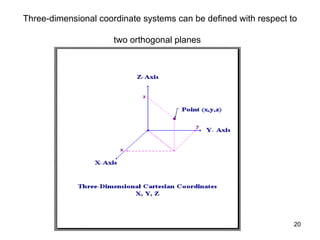
Three-dimensional coordinate systems can be defined with respect to two orthogonal planes


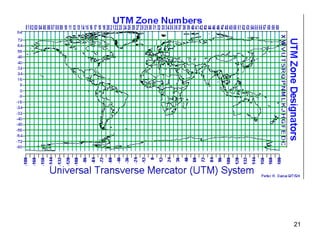
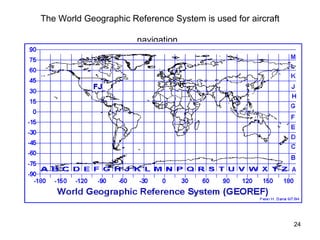
The World Geographic Reference System is used for aircraft navigation
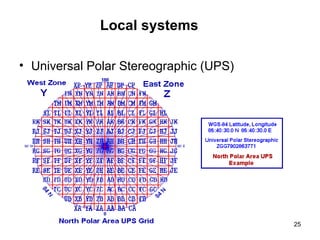
Universal Polar Stereographic (UPS)  Local systems
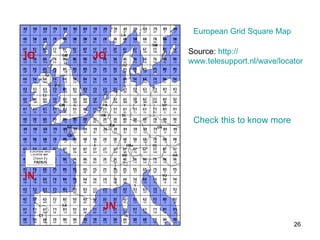
European Grid Square Map   Source:  http:// www.telesupport.nl/wave/locator.htm   Check this to know more
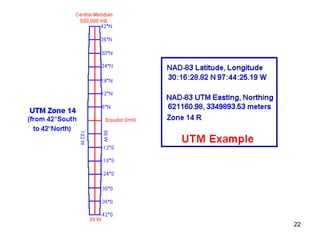
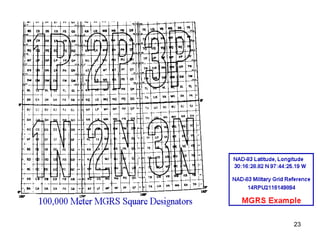
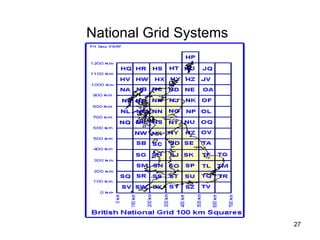
National Grid Systems
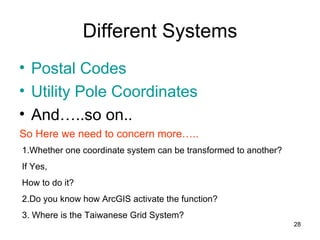
Different Systems Postal Codes Utility Pole Coordinates And…..so on..  So Here we need to concern more….. 1.Whether one coordinate system can be transformed to another?  If Yes, How to do it? 2.Do you know how ArcGIS activate the function? 3. Where is the Taiwanese Grid System?
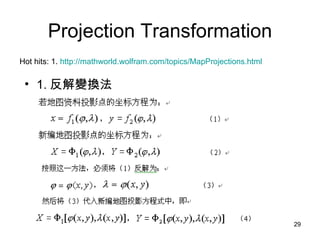
Projection Transformation 1. 反解變換法 Hot hits: 1.  http://mathworld.wolfram.com/topics/MapProjections.html
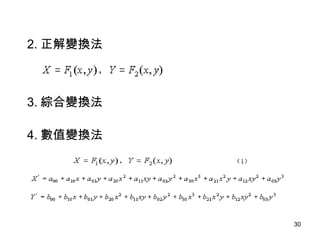
2. 正解變換法 3. 綜合變換法 4. 數值變換法
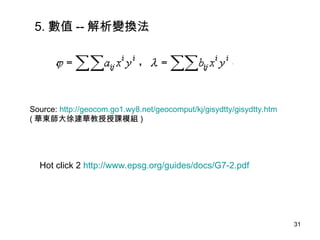
5. 數值 -- 解析變換法 Source:  http://geocom.go1.wy8.net/geocomput/kj/gisydtty/gisydtty.htm ( 華東師大徐建華教授授課模組 ) Hot click 2  http://www.epsg.org/guides/docs/G7-2.pdf
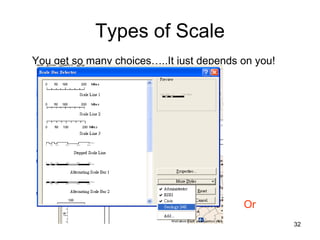
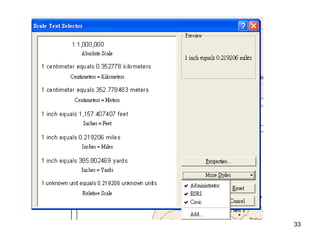
Types of Scale You get so many choices…..It just depends on you! Or
 
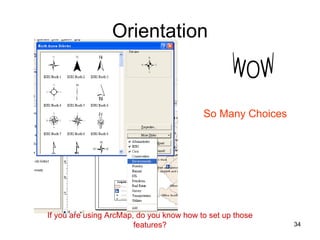
Orientation WOW So Many Choices If you are using ArcMap, do you know how to set up those features?
Definition of GIS GIS is 1. a computer system designed to allow users to collect, manage and analyze large volumes of spatially referenced information and associated attribute data. < www.for.gov.bc.ca/hfd/library/documents/glossary/G.htm >  2. An organized collection of computer hardware, software, geographic data, and personnel designed to efficiently capture, store, update, manipulate, analyze, and display all forms of geographically referenced information. www.fws.gov/data/IMADS/glossary.htm
3. 地理信息系統 又稱 GIS(Geographic information system) 系統,台灣則稱為地理資訊系統。  GIS  是一門綜合性學科 , 已經廣泛的應用在不同的領域 . ,是用於輸入、存儲、查詢、分析和顯示地理數據的電腦系統,可以分為以下五部分: • 人員,是 GIS 中最重要的組成部分。開發人員必須定義 GIS 中被執行的各種任務,開發處理程序。 熟練的操作人員通常可以剋服 GIS 軟體功能的不足,但是相反的情況就不成立。最好的軟體也無法彌補操作人員對 GIS 的一無所知所帶來的負作用。 •  數據,精確的可用的數據可以影響到查詢和分析的結果。 •  硬體,硬體的性能影響到處理速度,使用是否方便及可能的輸出方式。 •  軟體,不僅包含 GIS 軟體,還包括各種資料庫,繪圖、統計、影像處理及其它程序。 •  過程, GIS  要求明確定義,一致的方法來生成正確的可驗證的結果。 Source: http://zh.wikipedia.org
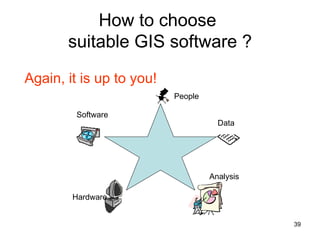
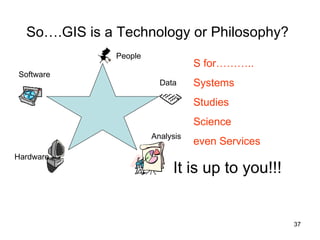
So….GIS is a Technology or Philosophy?   It is up to you!!! S for……….. Systems Studies Science even Services People Data Software Hardware Analysis
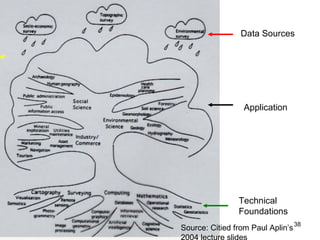
Data Sources Application Technical Foundations Source: Citied from Paul Aplin’s 2004 lecture slides
How to choose  suitable GIS software ? Again, it is up to you! People Data Software Hardware Analysis
A GIS Joke Why a customer purchase GIS software? Because His or her neighbor gets one!!! Citied from Reevs and Petch, Gis, Organisations and People: A Socio-Technical Approach, 1999
People Who would use it ? Can they use it effectively? What’s the aims and objectives they use it ? Benefit whom ? By which way (Process)?
Data What is it? Where is it? How expensive is it? How to get it? How to use it?
Hardware What hardware do we have? Can it run GIS software fluently? Analysis What is our analytical process? Does it agree with the ‘‘Standards’’? How to demonstrate the results? What’s the next of getting results?
How to choose  suitable GIS software ?
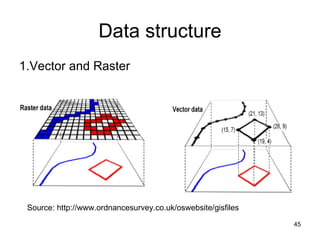
Data structure 1.Vector and Raster Source: http://www.ordnancesurvey.co.uk/oswebsite/gisfiles
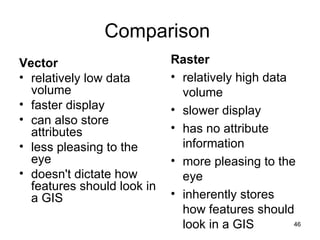
Comparison  Vector relatively low data volume faster display can also store attributes less pleasing to the eye doesn't dictate how features should look in a GIS Raster relatively high data volume slower display has no attribute information more pleasing to the eye inherently stores how features should look in a GIS
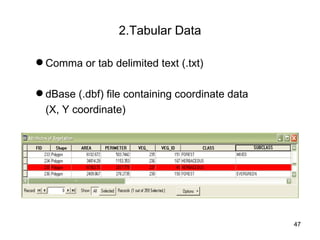
2.Tabular Data Comma or tab delimited text (.txt)  dBase (.dbf) file containing coordinate data  (X, Y coordinate)
Spatial Data Types Supported by ArcView ArcView supports a wide variety of data formats for direct read as well as data import and export. Direct read of vector data including shapefiles, coverages, VPF, and CAD (DXF, DWG, DGN)  Direct read of rasters (images) including ESRI GRID, ERDAS IMAGINE, BMP, IMG, GIF, JPEG 2000, NITF, MrSID, and TIFF  Direct read of other data including TIN, DBF, TXT, INFO, and ODBC  Export from image/raster to MrSID, GRID, IMAGINE, and TIFF  Export from shapefile to AGF, DXF, and the geodatabase  Source:  http://esri.com See  http://www.esri.com/library/fliers/pdfs/arcgis91-functionality.pdf  to get more
Assignments  1.How to set up Projection, Scale, Grid,Coordinate System, Orientation, Legend in ArcGIS? 2. Where is the Taiwanese Grid System? 3. Some additional files are generated by the creation of shapefiles. What are them and what function they offer?
Finally It’s time to begin it !!! Until one is committed, there is hesitancy, the chance to draw back, always ineffectiveness. Concerning all acts of initiative (and creation), there is one elementary truth, the ignorance of which kills countless ideas and splendid plans: that the moment one definitely commits oneself, then providence moves too. All sorts of things occur to help one that would never otherwise have occurred. A whole stream of events issues form the decision, raising in one’s favour all manner of unforeseen incidents and meetings and material assistance, which no man could have dreamed would have come his way. Whatever you do, or dream you can, begin it. Boldness has genius, power and magic in it. Begin it now. Goethe
Woops……Something has survived again… Our Forum and Database

How to empower community by using GIS lecture 1

  • 1.
    地理資訊系統於高中職社區化之應用 How toempower community by using GIS Lecturer: Yao-hui Wang
  • 2.
    課程大綱 (Module outline)地理資訊系統概論 (Frontiers of GIS) ArcGIS 程式集介紹與整合運作模式 (What is ArcGIS) 資料呈現 (Displaying Data) 資料諮詢 (Querying Data) 資料格式轉換與應用 (Converting Data)
  • 3.
    圖層資料編譯 (UsingEdit tools) 外部資料整合 (Data Plug-in) 3D 模式呈現技巧 (3D Presentation) 資料的錯誤與不確定性探討 (Errors and Uncertainties in GIS ) 地理資訊系統於社區化應用層面 (Application in empowering Community)
  • 4.
    Module Aims On completion of the module students should have: Familiarity with the use and application of the ArcGIS package; Knowledge of the use of GIS across a range of applications including education, public safety or welfare, environmental management and community participation; and Knowledge of environmental issues, skills in the interpretation of spatial environmental data and an awareness of specific problems and issues relating to data quality, and correct interpolation of spatial data into project.
  • 5.
    Students Learning OutcomesDemonstrate a clear knowledge and understanding of the key concepts concerning the application of GIS to problems in ‘‘students’ empowering community projects’’; Critique and evaluate the applicability of GIS in relation to empowering community applications; and Demonstrate a high level of skill in the application of GIS software to the solving of environmental problems
  • 6.
    Lecture 1 Frontiersof GIS Lecture Outline 1.Elements of Cartography 2.Categories Features in GIS Software 3.Definition of GIS 4.How to choose suitable GIS software 5. Data structure
  • 7.
    Elements of CartographyIn the beginning . . . there were maps Source:http://gate.henry-davis.com/MAPS/EMwebpages/226A.html; and http://www.bl.uk/onlinegallery/themes/mapsandviews/mattparismaplge.html
  • 8.
    Elements of CartographyThen ……the evolution began Source: http://wikipedia.org ( 維基百科 )
  • 9.
  • 10.
  • 11.
  • 12.
    Although the evolutionnever stops…… Something has survived……………………….
  • 13.
    Elements of CartographyProjection Scale Grid Coordinate System Orientation Legend How to set them up in ArcGIS?
  • 14.
    Projection In orderto transfer the 3 dimensional form of the earth into a 2 dimensional plane (to project), a projection is needed. Source: http://www.gdf-hannover.de
  • 15.
    Choosing the projectiontype Examples of azimuthal map projections In case of satellite impages Circular regions Application only true-to-scale in the projection center, neither orthomorphic nor equal-area orthomorphic, true-to-scale, where meridians and parallels cross true-to-scale, where meridians and parallels cross, neither orthomorphic nor equal-area Properties Vanishing point so far away that radiation dips in parallel Vanishing point opposite to the projection center Vanishing point at the geocenter Light source Orthographic Stereographic Genomic Type
  • 16.
    Examples of conicmap projections The parallels stand in pole proximity closer together than at the equator; is still often used in the USA today. For large-scale and middle-scale maps of the middle latitudes Application Equal-area Orthomorphic Properties Albers Equal-Area Conic Lambert Conformal Conic Type
  • 17.
    Examples of cylindricmap projections Source: http://www.gdf-hannover.de Recommended for regions with N-S extent (G-K, UTM basic) For navigation and illustrations near to the equator Pplication Orthomorphic Orthomorphic, parallel distances increase proportionally from the equator to the scale Properties Mercator projection rotated 90^ Normal axial projection Figure Transverse Mercator Projection Mercator Type
  • 18.
    Two-dimensional coordinate systemsare defined with respect to a single plane Basic Coordinate Systems Coordinate System
  • 19.
    A Line definedby Two Points in a Plane
  • 20.
    Three-dimensional coordinate systemscan be defined with respect to two orthogonal planes
  • 21.
  • 22.
  • 23.
  • 24.
    The World GeographicReference System is used for aircraft navigation
  • 25.
    Universal Polar Stereographic(UPS) Local systems
  • 26.
    European Grid SquareMap Source: http:// www.telesupport.nl/wave/locator.htm Check this to know more
  • 27.
  • 28.
    Different Systems PostalCodes Utility Pole Coordinates And…..so on.. So Here we need to concern more….. 1.Whether one coordinate system can be transformed to another? If Yes, How to do it? 2.Do you know how ArcGIS activate the function? 3. Where is the Taiwanese Grid System?
  • 29.
    Projection Transformation 1.反解變換法 Hot hits: 1. http://mathworld.wolfram.com/topics/MapProjections.html
  • 30.
    2. 正解變換法 3.綜合變換法 4. 數值變換法
  • 31.
    5. 數值 --解析變換法 Source: http://geocom.go1.wy8.net/geocomput/kj/gisydtty/gisydtty.htm ( 華東師大徐建華教授授課模組 ) Hot click 2 http://www.epsg.org/guides/docs/G7-2.pdf
  • 32.
    Types of ScaleYou get so many choices…..It just depends on you! Or
  • 33.
  • 34.
    Orientation WOW SoMany Choices If you are using ArcMap, do you know how to set up those features?
  • 35.
    Definition of GISGIS is 1. a computer system designed to allow users to collect, manage and analyze large volumes of spatially referenced information and associated attribute data. < www.for.gov.bc.ca/hfd/library/documents/glossary/G.htm > 2. An organized collection of computer hardware, software, geographic data, and personnel designed to efficiently capture, store, update, manipulate, analyze, and display all forms of geographically referenced information. www.fws.gov/data/IMADS/glossary.htm
  • 36.
    3. 地理信息系統 又稱GIS(Geographic information system) 系統,台灣則稱為地理資訊系統。 GIS 是一門綜合性學科 , 已經廣泛的應用在不同的領域 . ,是用於輸入、存儲、查詢、分析和顯示地理數據的電腦系統,可以分為以下五部分: • 人員,是 GIS 中最重要的組成部分。開發人員必須定義 GIS 中被執行的各種任務,開發處理程序。 熟練的操作人員通常可以剋服 GIS 軟體功能的不足,但是相反的情況就不成立。最好的軟體也無法彌補操作人員對 GIS 的一無所知所帶來的負作用。 • 數據,精確的可用的數據可以影響到查詢和分析的結果。 • 硬體,硬體的性能影響到處理速度,使用是否方便及可能的輸出方式。 • 軟體,不僅包含 GIS 軟體,還包括各種資料庫,繪圖、統計、影像處理及其它程序。 • 過程, GIS 要求明確定義,一致的方法來生成正確的可驗證的結果。 Source: http://zh.wikipedia.org
  • 37.
    So….GIS is aTechnology or Philosophy? It is up to you!!! S for……….. Systems Studies Science even Services People Data Software Hardware Analysis
  • 38.
    Data Sources ApplicationTechnical Foundations Source: Citied from Paul Aplin’s 2004 lecture slides
  • 39.
    How to choose suitable GIS software ? Again, it is up to you! People Data Software Hardware Analysis
  • 40.
    A GIS JokeWhy a customer purchase GIS software? Because His or her neighbor gets one!!! Citied from Reevs and Petch, Gis, Organisations and People: A Socio-Technical Approach, 1999
  • 41.
    People Who woulduse it ? Can they use it effectively? What’s the aims and objectives they use it ? Benefit whom ? By which way (Process)?
  • 42.
    Data What isit? Where is it? How expensive is it? How to get it? How to use it?
  • 43.
    Hardware What hardwaredo we have? Can it run GIS software fluently? Analysis What is our analytical process? Does it agree with the ‘‘Standards’’? How to demonstrate the results? What’s the next of getting results?
  • 44.
    How to choose suitable GIS software ?
  • 45.
    Data structure 1.Vectorand Raster Source: http://www.ordnancesurvey.co.uk/oswebsite/gisfiles
  • 46.
    Comparison Vectorrelatively low data volume faster display can also store attributes less pleasing to the eye doesn't dictate how features should look in a GIS Raster relatively high data volume slower display has no attribute information more pleasing to the eye inherently stores how features should look in a GIS
  • 47.
    2.Tabular Data Commaor tab delimited text (.txt) dBase (.dbf) file containing coordinate data (X, Y coordinate)
  • 48.
    Spatial Data TypesSupported by ArcView ArcView supports a wide variety of data formats for direct read as well as data import and export. Direct read of vector data including shapefiles, coverages, VPF, and CAD (DXF, DWG, DGN) Direct read of rasters (images) including ESRI GRID, ERDAS IMAGINE, BMP, IMG, GIF, JPEG 2000, NITF, MrSID, and TIFF Direct read of other data including TIN, DBF, TXT, INFO, and ODBC Export from image/raster to MrSID, GRID, IMAGINE, and TIFF Export from shapefile to AGF, DXF, and the geodatabase Source: http://esri.com See http://www.esri.com/library/fliers/pdfs/arcgis91-functionality.pdf to get more
  • 49.
    Assignments 1.Howto set up Projection, Scale, Grid,Coordinate System, Orientation, Legend in ArcGIS? 2. Where is the Taiwanese Grid System? 3. Some additional files are generated by the creation of shapefiles. What are them and what function they offer?
  • 50.
    Finally It’s timeto begin it !!! Until one is committed, there is hesitancy, the chance to draw back, always ineffectiveness. Concerning all acts of initiative (and creation), there is one elementary truth, the ignorance of which kills countless ideas and splendid plans: that the moment one definitely commits oneself, then providence moves too. All sorts of things occur to help one that would never otherwise have occurred. A whole stream of events issues form the decision, raising in one’s favour all manner of unforeseen incidents and meetings and material assistance, which no man could have dreamed would have come his way. Whatever you do, or dream you can, begin it. Boldness has genius, power and magic in it. Begin it now. Goethe
  • 51.
    Woops……Something has survivedagain… Our Forum and Database