Pitfalls of manuscript in scientific writings : how to avoid it
Dr Bhaskar Borgohain
MBBS (AMC), MS Ortho (Delhi Univ.), DNB Ortho (NAMS),
AO Trauma Fellow, (Germany), Arthroplasty Fellow (Computer Navigation)
Professor & HoD, Orthopaedics
NEIGRIHMS Shillong
www.neigrihms.gov.in
ublishing your dissertatio
Dr Murali Poduval
(Orth) DNB(Orth) PGDM
nt Engineering and Industrial Services
aConsultancy Services
Mumbai
or : Indian Journal of Orthopaedics
IJO-NILD-WBOA sponsored National workshop on Research Methodology and
scientific publication: Kolkata 29TH September, 2019
Why manuscript get selected
• The author is/are good communicators
• Clarity in language: points expressed explicitly
• Originality - novelty – thought provoking
• Scientific quality
• Good research methodology
• Depth of research- gap areas addressed
• Clarity of presenting data and results
• Depth of discussion
Why some manuscripts are rejected
• Repeat of previous studies
• Poor writing skills and poor command on language
• Target journal unsuitable for the paper
• Methodology flaw: Poor experimental design
• Discussion incoherent to results: Sending zero draft
• Conclusions inconsistent with the results
• Not following journal guidelines
• Plagiarism
Anatomy of a manuscript
IMReD
• What is it ? - Introduction
• What did you do? - Methods
• What did you find? – Results
• What dose that mean? - Discussion
“Be to the point” !
Plagiarism
• Imitation is no more the best form of flattery!
• Non‐native English speakers might wish to write
the text in their native language then have it
translated professionally.
• Let data speak for itself- reduce texts
• Let data determine the hypothesis not the other
way around – no cook ups
• Keep original data safely- authenticity
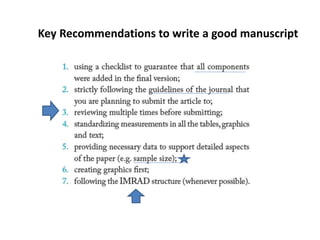
Key Recommendations to write a good manuscript
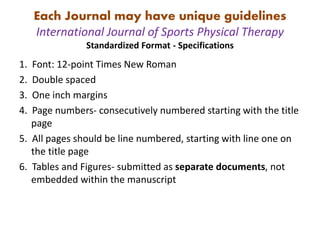
Each Journal may have unique guidelines
International Journal of Sports Physical Therapy
Standardized Format - Specifications
1. Font: 12-point Times New Roman
2. Double spaced
3. One inch margins
4. Page numbers- consecutively numbered starting with the title
page
5. All pages should be line numbered, starting with line one on
the title page
6. Tables and Figures- submitted as separate documents, not
embedded within the manuscript
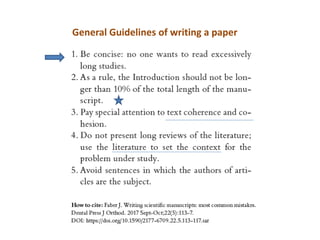
General Guidelines of writing a paper
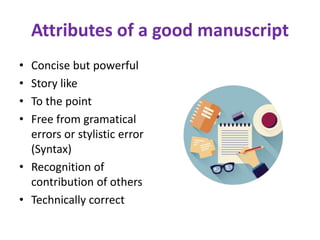
Attributes of a good manuscript
• Concise but powerful
• Story like
• To the point
• Free from gramatical
errors or stylistic error
(Syntax)
• Recognition of
contribution of others
• Technically correct
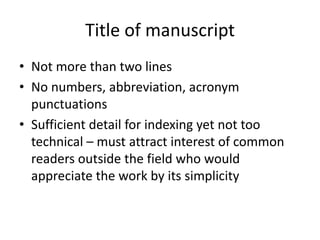
Title of manuscript
• Not more than two lines
• No numbers, abbreviation, acronym
punctuations
• Sufficient detail for indexing yet not too
technical – must attract interest of common
readers outside the field who would
appreciate the work by its simplicity
Abstract
• Most critical part of manuscript
• Clear crisp concise accurate
• Reflects the story in short
• Quick idea about the content
• What was done
• What was done
• Right Key Words- MeSH terms
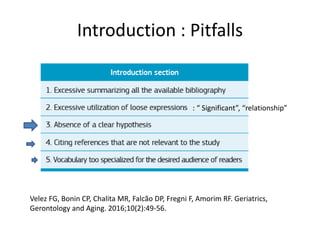
Introduction : Pitfalls
Velez FG, Bonin CP, Chalita MR, Falcão DP, Fregni F, Amorim RF. Geriatrics,
Gerontology and Aging. 2016;10(2):49-56.
: “ Significant”, “relationship”
Introduction of a manuscript
• Not too long
• Not too short
• Brief background
• Focused – introduce the topic, capture the
readers
• Integrated review of the pertinent work
• Importance-significance of current study
• Advancement needed- research gaps
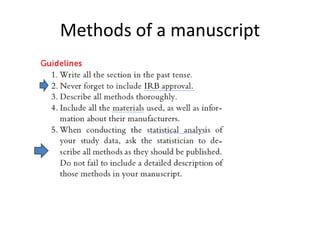
Methods of a manuscript
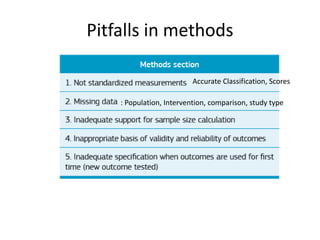
Pitfalls in methods
: Population, Intervention, comparison, study type
Accurate Classification, Scores
Pitfalls in Methodology
• Not adequately describing the study
population
• Interpretation and generalization is only
possible if the population under study is well
described for drawing bottom-lines later
Results of a manuscript shall
• Present Concise and accurate data
• Short and easy to understand
• Consistent with abstract and introduction
• Consistent with aim of the study
• Tables and figure were needed to minimize
text and clarify results visually
• Do not repeat same data in text and graphs
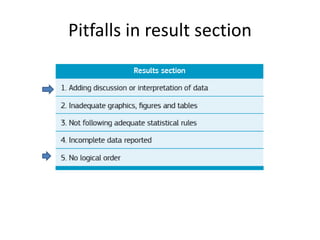
Pitfalls in result section
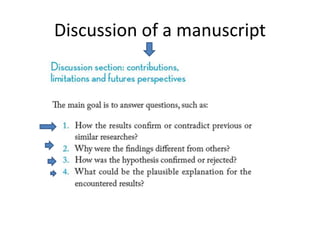
Discussion of a manuscript
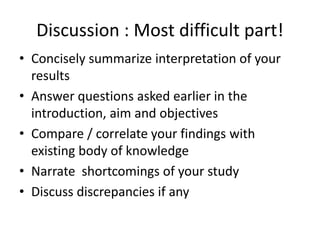
Discussion : Most difficult part!
• Concisely summarize interpretation of your
results
• Answer questions asked earlier in the
introduction, aim and objectives
• Compare / correlate your findings with
existing body of knowledge
• Narrate shortcomings of your study
• Discuss discrepancies if any
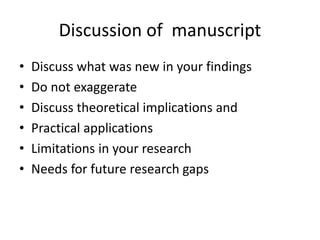
Discussion of manuscript
• Discuss what was new in your findings
• Do not exaggerate
• Discuss theoretical implications and
• Practical applications
• Limitations in your research
• Needs for future research gaps
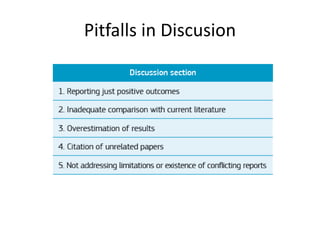
Pitfalls in Discusion
Conclusion of a manuscript
• Identify the key findings
• Very Short – its not abstract!
• Consistent with the paper
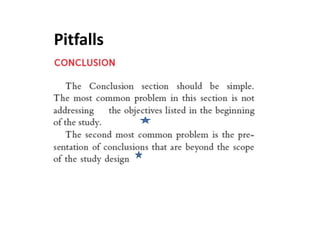
Pitfalls
References
• Current and up-to-date: not old or obsolete
• Citation must be accurate and complete
• Citation style a per author guidelines
• Correct style for the selected journal - e.g.
Vancouver style
• Avoid cross reference
• No irrelevant references
References
Use specific Style for each suggested by the journal
• Books
• Journals
• Abstract
• Proceedings
• Dictionary
• Encyclopedia
Revise –revise-revise is the Mantra
• All author should read the manuscript
• Give at least one person outside your field to
read it
• Read with deadline then leave it for sometime
• Read again!
• Grammar, spelling- proof reading
Copy right & Acknowledgement
• Obtain copyright
• IPR issues
• Figure tables, diagrams
• Ethical clearance from IEC copy
Ten Common Manuscript Mistakes.
1. Ignoring standardized format specifications of the journal
2. Introduction does not logically progress to a clear purpose
statement
3. Use of single sentence paragraphs or bullet points
4. Use of clinical jargon or terminology that may not be
understood by the average readers
5. Overuse of abbreviations or use of abbreviations that may not
be familiar to the Readers
Grindstaff, PhD, Susan PhD. Int J Sports Phys Ther. 2012 ; 7(5): 518–24.
Common pitfalls
6. Use of terminology reserved for discussing statistical
analyses (e.g. significant, relationship)
7. Formatting the introduction or discussion in a manner
consistent with that of an annotated bibliography
8. Not providing estimates of reliability, validity, or clinical
utility for outcome Measures
9. Not including a sample size estimate
10. Overgeneralization of findings
Grindstaff, PhD, Susan PhD. Int J Sports Phys Ther. 2012 ; 7(5): 518–24.
KISS
*
Box 1. Best practices in scientific
writing
• Ensure that every source used in your writing is referenced. If sections of text are
used, quotation marks should be included and the original source cited.
• Start adding provisional references at the very early writing stages.
• When referencing an article, take the time to fully read and understand it. The
better you understand the finding, the better you will be able to paraphrase the
study without duplicating the text.
• Do not assume authors on other papers have done as thorough a job on citing
their references. Always check the original reference before citing.
• Non‐native English speakers might wish to write the text in their native language
then have it translated professionally.
• Let data speak for itself
• Let data determine the hypothesis not the other way around
• Keep original data safely
• Let all images be of high quality when first submitted
Collins S, Gemayel R, Chenette EJ. Avoiding common pitfalls of manuscript and figure
preparation. The FEBS journal. 2017 May;284(9):1262-6.
• Let all images be of high quality when first submitted
• Keep records of the final manuscript
• Keep original images safely
• Keep relevant patient details in records
Keep records
Acknowledgement :
• Gratitude to all those who helped but not fit
to get authorship
• Name and their affiliation
Thank you

Pitfalls of manuscript how to avoid it

  • 1.
    Pitfalls of manuscriptin scientific writings : how to avoid it Dr Bhaskar Borgohain MBBS (AMC), MS Ortho (Delhi Univ.), DNB Ortho (NAMS), AO Trauma Fellow, (Germany), Arthroplasty Fellow (Computer Navigation) Professor & HoD, Orthopaedics NEIGRIHMS Shillong www.neigrihms.gov.in ublishing your dissertatio Dr Murali Poduval (Orth) DNB(Orth) PGDM nt Engineering and Industrial Services aConsultancy Services Mumbai or : Indian Journal of Orthopaedics IJO-NILD-WBOA sponsored National workshop on Research Methodology and scientific publication: Kolkata 29TH September, 2019
  • 3.
    Why manuscript getselected • The author is/are good communicators • Clarity in language: points expressed explicitly • Originality - novelty – thought provoking • Scientific quality • Good research methodology • Depth of research- gap areas addressed • Clarity of presenting data and results • Depth of discussion
  • 4.
    Why some manuscriptsare rejected • Repeat of previous studies • Poor writing skills and poor command on language • Target journal unsuitable for the paper • Methodology flaw: Poor experimental design • Discussion incoherent to results: Sending zero draft • Conclusions inconsistent with the results • Not following journal guidelines • Plagiarism
  • 5.
    Anatomy of amanuscript IMReD • What is it ? - Introduction • What did you do? - Methods • What did you find? – Results • What dose that mean? - Discussion “Be to the point” !
  • 6.
    Plagiarism • Imitation isno more the best form of flattery! • Non‐native English speakers might wish to write the text in their native language then have it translated professionally. • Let data speak for itself- reduce texts • Let data determine the hypothesis not the other way around – no cook ups • Keep original data safely- authenticity
  • 7.
    Key Recommendations towrite a good manuscript
  • 8.
    Each Journal mayhave unique guidelines International Journal of Sports Physical Therapy Standardized Format - Specifications 1. Font: 12-point Times New Roman 2. Double spaced 3. One inch margins 4. Page numbers- consecutively numbered starting with the title page 5. All pages should be line numbered, starting with line one on the title page 6. Tables and Figures- submitted as separate documents, not embedded within the manuscript
  • 9.
    General Guidelines ofwriting a paper
  • 10.
    Attributes of agood manuscript • Concise but powerful • Story like • To the point • Free from gramatical errors or stylistic error (Syntax) • Recognition of contribution of others • Technically correct
  • 11.
    Title of manuscript •Not more than two lines • No numbers, abbreviation, acronym punctuations • Sufficient detail for indexing yet not too technical – must attract interest of common readers outside the field who would appreciate the work by its simplicity
  • 12.
    Abstract • Most criticalpart of manuscript • Clear crisp concise accurate • Reflects the story in short • Quick idea about the content • What was done • What was done • Right Key Words- MeSH terms
  • 13.
    Introduction : Pitfalls VelezFG, Bonin CP, Chalita MR, Falcão DP, Fregni F, Amorim RF. Geriatrics, Gerontology and Aging. 2016;10(2):49-56. : “ Significant”, “relationship”
  • 14.
    Introduction of amanuscript • Not too long • Not too short • Brief background • Focused – introduce the topic, capture the readers • Integrated review of the pertinent work • Importance-significance of current study • Advancement needed- research gaps
  • 15.
    Methods of amanuscript
  • 16.
    Pitfalls in methods :Population, Intervention, comparison, study type Accurate Classification, Scores
  • 17.
    Pitfalls in Methodology •Not adequately describing the study population • Interpretation and generalization is only possible if the population under study is well described for drawing bottom-lines later
  • 18.
    Results of amanuscript shall • Present Concise and accurate data • Short and easy to understand • Consistent with abstract and introduction • Consistent with aim of the study • Tables and figure were needed to minimize text and clarify results visually • Do not repeat same data in text and graphs
  • 19.
  • 20.
    Discussion of amanuscript
  • 21.
    Discussion : Mostdifficult part! • Concisely summarize interpretation of your results • Answer questions asked earlier in the introduction, aim and objectives • Compare / correlate your findings with existing body of knowledge • Narrate shortcomings of your study • Discuss discrepancies if any
  • 22.
    Discussion of manuscript •Discuss what was new in your findings • Do not exaggerate • Discuss theoretical implications and • Practical applications • Limitations in your research • Needs for future research gaps
  • 23.
  • 24.
    Conclusion of amanuscript • Identify the key findings • Very Short – its not abstract! • Consistent with the paper
  • 25.
  • 26.
    References • Current andup-to-date: not old or obsolete • Citation must be accurate and complete • Citation style a per author guidelines • Correct style for the selected journal - e.g. Vancouver style • Avoid cross reference • No irrelevant references
  • 27.
    References Use specific Stylefor each suggested by the journal • Books • Journals • Abstract • Proceedings • Dictionary • Encyclopedia
  • 28.
    Revise –revise-revise isthe Mantra • All author should read the manuscript • Give at least one person outside your field to read it • Read with deadline then leave it for sometime • Read again! • Grammar, spelling- proof reading
  • 29.
    Copy right &Acknowledgement • Obtain copyright • IPR issues • Figure tables, diagrams • Ethical clearance from IEC copy
  • 30.
    Ten Common ManuscriptMistakes. 1. Ignoring standardized format specifications of the journal 2. Introduction does not logically progress to a clear purpose statement 3. Use of single sentence paragraphs or bullet points 4. Use of clinical jargon or terminology that may not be understood by the average readers 5. Overuse of abbreviations or use of abbreviations that may not be familiar to the Readers Grindstaff, PhD, Susan PhD. Int J Sports Phys Ther. 2012 ; 7(5): 518–24.
  • 31.
    Common pitfalls 6. Useof terminology reserved for discussing statistical analyses (e.g. significant, relationship) 7. Formatting the introduction or discussion in a manner consistent with that of an annotated bibliography 8. Not providing estimates of reliability, validity, or clinical utility for outcome Measures 9. Not including a sample size estimate 10. Overgeneralization of findings Grindstaff, PhD, Susan PhD. Int J Sports Phys Ther. 2012 ; 7(5): 518–24.
  • 32.
  • 33.
    Box 1. Bestpractices in scientific writing • Ensure that every source used in your writing is referenced. If sections of text are used, quotation marks should be included and the original source cited. • Start adding provisional references at the very early writing stages. • When referencing an article, take the time to fully read and understand it. The better you understand the finding, the better you will be able to paraphrase the study without duplicating the text. • Do not assume authors on other papers have done as thorough a job on citing their references. Always check the original reference before citing. • Non‐native English speakers might wish to write the text in their native language then have it translated professionally. • Let data speak for itself • Let data determine the hypothesis not the other way around • Keep original data safely • Let all images be of high quality when first submitted Collins S, Gemayel R, Chenette EJ. Avoiding common pitfalls of manuscript and figure preparation. The FEBS journal. 2017 May;284(9):1262-6.
  • 34.
    • Let allimages be of high quality when first submitted • Keep records of the final manuscript • Keep original images safely • Keep relevant patient details in records Keep records
  • 35.
    Acknowledgement : • Gratitudeto all those who helped but not fit to get authorship • Name and their affiliation
  • 36.