Dead weight loss and Tax
Presented by-
☺ Pooja goyal 13189
☺ Pooja sharma 13190
☺ Priyanka meena 13210
☺ Pia singh 13186
Dead weight loss occurs when
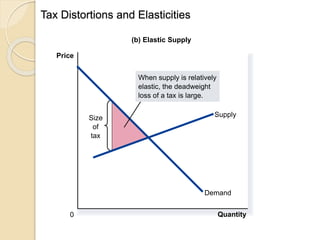
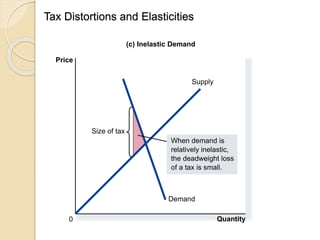
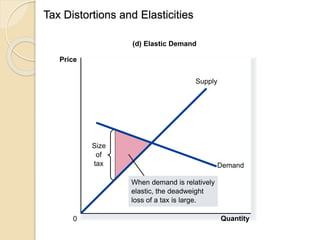
government imposes tax on commodity,
and both producer and consumer loose
part of their surplus, the loss suffers by
both producer and consumer is dead
weight loss.
TAX
Tax Wedge
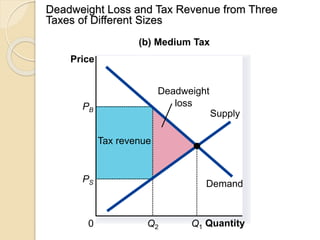
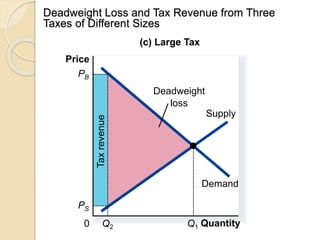
 A tax places a wedge between the
price buyers pay and the price
sellers receive.
 Because of this tax wedge, the
quantity sold falls below the level
that would be sold without a tax.
 The size of the market for that good
shrinks.
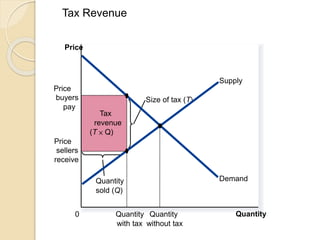
Tax Revenue
Copyright © 2004 South-Western
Tax
revenue
(T × Q)
Size of tax (T)
Quantity
sold (Q)
Quantity0
Price
Demand
Supply
Quantity
without tax
Quantity
with tax
Price
buyers
pay
Price
sellers
receive
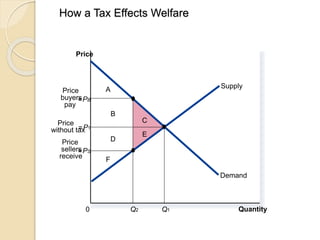
How a Tax Effects Welfare
Copyright © 2004 South-Western
A
F
B
D
C
E
Quantity0
Price
Demand
Supply
=PB
Q2
=PS
Price
buyers
pay
Price
sellers
receive
=P1
Q1
Price
without tax
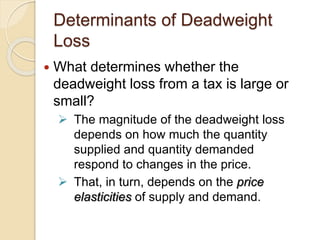
Determinants of Deadweight
Loss
 What determines whether the
deadweight loss from a tax is large or
small?
 The magnitude of the deadweight loss
depends on how much the quantity
supplied and quantity demanded
respond to changes in the price.
 That, in turn, depends on the price
elasticities of supply and demand.
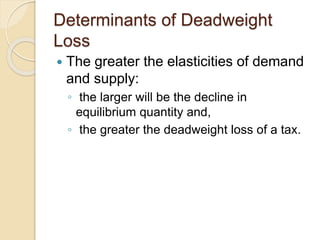
Determinants of Deadweight
Loss
 The greater the elasticities of demand
and supply:
◦ the larger will be the decline in
equilibrium quantity and,
◦ the greater the deadweight loss of a tax.
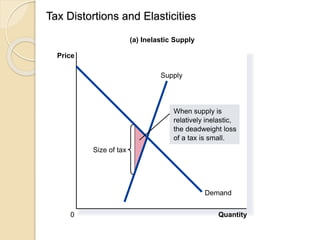
Tax Distortions and Elasticities
Copyright © 2004 South-Western
(a) Inelastic Supply
Price
0 Quantity
Demand
Supply
Size of tax
When supply is
relatively inelastic,
the deadweight loss
of a tax is small.
Tax Distortions and Elasticities
Copyright © 2004 South-Western
(b) Elastic Supply
Price
0 Quantity
Demand
SupplySize
of
tax
When supply is relatively
elastic, the deadweight
loss of a tax is large.
Tax Distortions and Elasticities
Copyright © 2004 South-Western
Demand
Supply
(c) Inelastic Demand
Price
0 Quantity
Size of tax
When demand is
relatively inelastic,
the deadweight loss
of a tax is small.
Tax Distortions and Elasticities
Copyright © 2004 South-Western
(d) Elastic Demand
Price
0 Quantity
Size
of
tax Demand
Supply
When demand is relatively
elastic, the deadweight
loss of a tax is large.
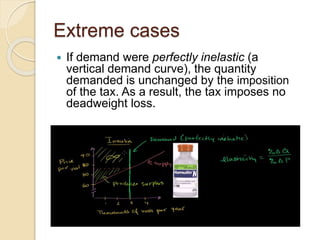
Extreme cases
 If demand were perfectly inelastic (a
vertical demand curve), the quantity
demanded is unchanged by the imposition
of the tax. As a result, the tax imposes no
deadweight loss.
 Similarly, if supply were perfectly
inelastic (a vertical supply curve), the
quantity supplied is unchanged by the
tax and there is also no deadweight loss.
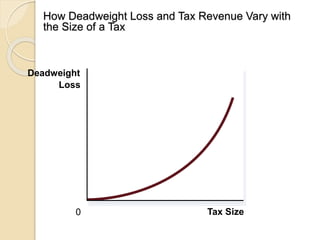
Deadweight Loss and Tax Rate
 With each increase in the tax rate, the
deadweight loss of the tax rises even
more rapidly than the size of the tax.
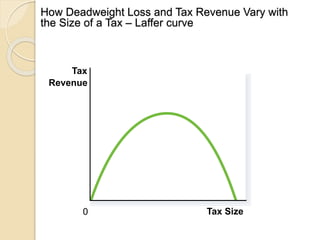
Tax Revenue and Tax Rate
 For the small tax, tax revenue is small.
 As the size of the tax rises, tax
revenue grows.
 But as the size of the tax continues to
rise, tax revenue falls because the
higher tax reduces the size of the
market.
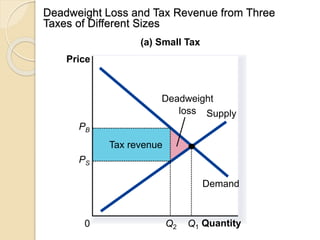
Deadweight Loss and Tax Revenue from Three
Taxes of Different Sizes
Copyright © 2004 South-Western
Tax revenue
Demand
Supply
Quantity0
Price
Q1
(a) Small Tax
Deadweight
loss
PB
Q2
PS
Deadweight Loss and Tax Revenue from Three
Taxes of Different Sizes
Copyright © 2004 South-Western
Tax revenue
Quantity0
Price
(b) Medium Tax
PB
Q2
PS
Supply
Demand
Q1
Deadweight
loss
Deadweight Loss and Tax Revenue from Three
Taxes of Different Sizes
Copyright © 2004 South-Western
Taxrevenue
Demand
Supply
Quantity0
Price
Q1
(c) Large Tax
PB
Q2
PS
Deadweight
loss
How Deadweight Loss and Tax Revenue Vary with
the Size of a Tax
Copyright © 2004 South-Western
Deadweight
Loss
0 Tax Size
How Deadweight Loss and Tax Revenue Vary with
the Size of a Tax – Laffer curve
Copyright © 2004 South-Western
Tax
Revenue
0 Tax Size
Laffer Curve
 The Laffer curve depicts the
relationship between tax rates and tax
revenue.
 Supply-side economics : refers to the
views of Reagan and Laffer who
proposed that a tax cut would induce
more people to work and thereby have
the potential to increase tax revenues.
IN MONOPOLY
The Deadweight Loss
 In monopoly, firm sets its price above
marginal cost, it places a wedge
between the consumer’s willingness to
pay and the producer’s cost.
◦ This wedge causes the quantity sold to
fall short of the social optimum.
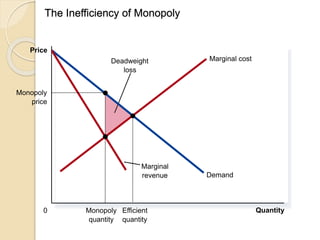
The Inefficiency of Monopoly
Quantity0
Price
Deadweight
loss
Demand
Marginal
revenue
Marginal cost
Efficient
quantity
Monopoly
price
Monopoly
quantity
The Deadweight Loss
 The deadweight loss caused by a
monopoly is similar to the deadweight
loss caused by a tax.
 The difference between the two cases
is that the government gets the
revenue from a tax, whereas a private
firm gets the monopoly profit.
 For reducing deadweight loss, in
monopoly, price discrimination is use.
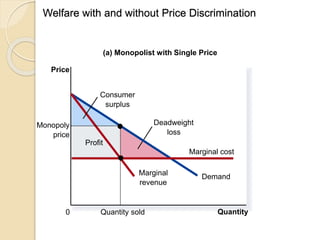
PRICE DISCRIMINATION
 Price discrimination is the business
practice of selling the same good at
different prices to different customers,
even though the costs for producing
for the two customers are the same.
PRICE DISCRIMINATION
 Price discrimination is not possible when
a good is sold in a competitive market
since there are many firms all selling at
the market price. In order to price
discriminate, the firm must have some
market power.
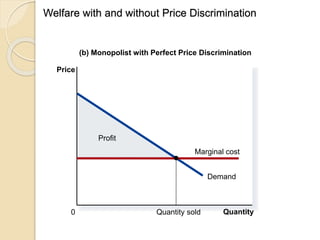
 Perfect Price Discrimination
◦ Perfect price discrimination refers to the
situation when the monopolist knows exactly
the willingness to pay of each customer and
can charge each customer a different price.
PRICE DISCRIMINATION
 Two important effects of price
discrimination:
◦ It can increase the monopolist’s profits.
◦ It can reduce deadweight loss.
Welfare with and without Price Discrimination
Copyright © 2004 South-Western
Profit
(a) Monopolist with Single Price
Price
0 Quantity
Deadweight
loss
DemandMarginal
revenue
Consumer
surplus
Quantity sold
Monopoly
price
Marginal cost
Welfare with and without Price Discrimination
Profit
(b) Monopolist with Perfect Price Discrimination
Price
0 Quantity
Demand
Marginal cost
Quantity sold
Estimating Dead Weight Loss Due
to Imperfectly Competitive Market
Structures
Economists are naturally interested in
estimating the size of dead weight losses
(DWLs) resulting from allocative inefficiency.
Estimating DWL is difficult because the
investigator will not normally know the true
value of marginal cost. Hence, DWL must be
estimated indirectly.
Harburger’s Approach
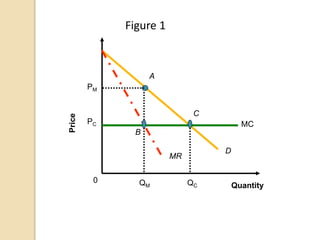
The ABH dead weight triangle is approximated by the
following equation (equation 4.1 in the text):
))((
2
1
MCCM QQPPDWL 
By algebraic manipulation it can be shown that:
**
2
1 2
QPdDWL  [1]
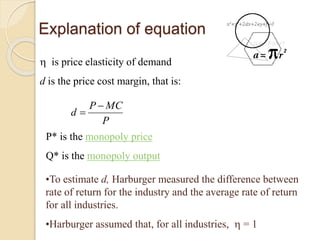
Explanation of equation
 is price elasticity of demand
d is the price cost margin, that is:
P
MCP
d


P* is the monopoly price
Q* is the monopoly output
•To estimate d, Harburger measured the difference between
rate of return for the industry and the average rate of return
for all industries.
•Harburger assumed that, for all industries,  = 1
Harburger’s estimates
Based on data for U.S. industries in the
1920s, Harburger estimated the DWL due
to monopoly to be equal to 1/10 of 1
percent of GNP. Hence, the welfare loss
due to pricing above marginal cost is very
small and would hardly justify the allocation
of substantial resources for antitrust
enforcement.
Cowling and Mueller’s Approach
above reveals that estimates of DWL are
sensitive to assumptions made about
elasticity of demand ( )Cowling and
Mueller made adjustments to the
methodology used by Harburger and , using
a sample of 734 U.S. firms for 1963-66,
reached radically different conclusions as
regards the magnitude of welfare losses.
•Cowling and Mueller changed a key
assumption of Harburger; namely, that for
all industries,  = 1.
To estimate industry-level price elasticities (),
Cowling and Mueller took advantage of the fact
that the firm’s profit maximizing price (P*)
satisfies the following condition:

MCP
P
*
* [2]
Recall that d is the price-cost margin . Thus we can
say:
MCP
P
d 

*
*1
[3]
Thus by equation [2], we can say:

d
1 Thus if you can
estimate d, you
can estimate 
Thus substitute 1/d for  in equation [1] and you
get:
**
2
1
**
1
2
1 2
QdPQPd
d
DWL 





 [4]
Substituting (P*- MC)/P* for d in equation [4] gives us:
*
2
1
*)*(
2
1
**
*
2
1





 
 QMCPQP
P
MCP
DWL [5]
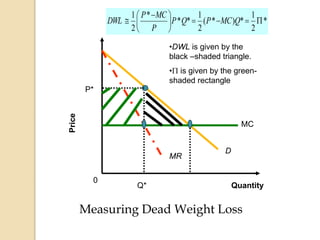
Thus, Cowling and Mueller showed that DWL for an
industry was equal to ½ of the economic profits () of
firms in the industry.
Price
Quantity
0
PM
QM
MC
D
MR
PC
QC
A
B
C
Figure 1
Price
Quantity
0
P*
Q*
MC
D
MR
*
2
1
*)*(
2
1
**
*
2
1





 
 QMCPQP
P
MCP
DWL
•DWL is given by the
black –shaded triangle.
• is given by the green-
shaded rectangle
Measuring Dead Weight Loss
Cowling and Mueller’s
results
Assuming that 12 percent is a "normal" rate
of return on capital, Cowling and Mueller
produced 2 estimates of DWL in the U.S.
economy:
• The low estimate, which does not include
advertising expenditures as a component of
the dead weight loss, was 4 percent of GNP
(about $403 billion in 2001).
• The high estimate, which reckoned
advertising expenditures as "wasted
resources," was 13 percent of GNP (about
$1.394 trillion in 2001).

Dead weight loss

  • 1.
    Dead weight lossand Tax Presented by- ☺ Pooja goyal 13189 ☺ Pooja sharma 13190 ☺ Priyanka meena 13210 ☺ Pia singh 13186
  • 2.
    Dead weight lossoccurs when government imposes tax on commodity, and both producer and consumer loose part of their surplus, the loss suffers by both producer and consumer is dead weight loss.
  • 3.
  • 4.
    Tax Wedge  Atax places a wedge between the price buyers pay and the price sellers receive.  Because of this tax wedge, the quantity sold falls below the level that would be sold without a tax.  The size of the market for that good shrinks.
  • 5.
    Tax Revenue Copyright ©2004 South-Western Tax revenue (T × Q) Size of tax (T) Quantity sold (Q) Quantity0 Price Demand Supply Quantity without tax Quantity with tax Price buyers pay Price sellers receive
  • 6.
    How a TaxEffects Welfare Copyright © 2004 South-Western A F B D C E Quantity0 Price Demand Supply =PB Q2 =PS Price buyers pay Price sellers receive =P1 Q1 Price without tax
  • 7.
    Determinants of Deadweight Loss What determines whether the deadweight loss from a tax is large or small?  The magnitude of the deadweight loss depends on how much the quantity supplied and quantity demanded respond to changes in the price.  That, in turn, depends on the price elasticities of supply and demand.
  • 8.
    Determinants of Deadweight Loss The greater the elasticities of demand and supply: ◦ the larger will be the decline in equilibrium quantity and, ◦ the greater the deadweight loss of a tax.
  • 9.
    Tax Distortions andElasticities Copyright © 2004 South-Western (a) Inelastic Supply Price 0 Quantity Demand Supply Size of tax When supply is relatively inelastic, the deadweight loss of a tax is small.
  • 10.
    Tax Distortions andElasticities Copyright © 2004 South-Western (b) Elastic Supply Price 0 Quantity Demand SupplySize of tax When supply is relatively elastic, the deadweight loss of a tax is large.
  • 11.
    Tax Distortions andElasticities Copyright © 2004 South-Western Demand Supply (c) Inelastic Demand Price 0 Quantity Size of tax When demand is relatively inelastic, the deadweight loss of a tax is small.
  • 12.
    Tax Distortions andElasticities Copyright © 2004 South-Western (d) Elastic Demand Price 0 Quantity Size of tax Demand Supply When demand is relatively elastic, the deadweight loss of a tax is large.
  • 13.
    Extreme cases  Ifdemand were perfectly inelastic (a vertical demand curve), the quantity demanded is unchanged by the imposition of the tax. As a result, the tax imposes no deadweight loss.
  • 14.
     Similarly, ifsupply were perfectly inelastic (a vertical supply curve), the quantity supplied is unchanged by the tax and there is also no deadweight loss.
  • 15.
    Deadweight Loss andTax Rate  With each increase in the tax rate, the deadweight loss of the tax rises even more rapidly than the size of the tax.
  • 16.
    Tax Revenue andTax Rate  For the small tax, tax revenue is small.  As the size of the tax rises, tax revenue grows.  But as the size of the tax continues to rise, tax revenue falls because the higher tax reduces the size of the market.
  • 17.
    Deadweight Loss andTax Revenue from Three Taxes of Different Sizes Copyright © 2004 South-Western Tax revenue Demand Supply Quantity0 Price Q1 (a) Small Tax Deadweight loss PB Q2 PS
  • 18.
    Deadweight Loss andTax Revenue from Three Taxes of Different Sizes Copyright © 2004 South-Western Tax revenue Quantity0 Price (b) Medium Tax PB Q2 PS Supply Demand Q1 Deadweight loss
  • 19.
    Deadweight Loss andTax Revenue from Three Taxes of Different Sizes Copyright © 2004 South-Western Taxrevenue Demand Supply Quantity0 Price Q1 (c) Large Tax PB Q2 PS Deadweight loss
  • 20.
    How Deadweight Lossand Tax Revenue Vary with the Size of a Tax Copyright © 2004 South-Western Deadweight Loss 0 Tax Size
  • 21.
    How Deadweight Lossand Tax Revenue Vary with the Size of a Tax – Laffer curve Copyright © 2004 South-Western Tax Revenue 0 Tax Size
  • 22.
    Laffer Curve  TheLaffer curve depicts the relationship between tax rates and tax revenue.  Supply-side economics : refers to the views of Reagan and Laffer who proposed that a tax cut would induce more people to work and thereby have the potential to increase tax revenues.
  • 23.
  • 24.
    The Deadweight Loss In monopoly, firm sets its price above marginal cost, it places a wedge between the consumer’s willingness to pay and the producer’s cost. ◦ This wedge causes the quantity sold to fall short of the social optimum.
  • 25.
    The Inefficiency ofMonopoly Quantity0 Price Deadweight loss Demand Marginal revenue Marginal cost Efficient quantity Monopoly price Monopoly quantity
  • 26.
    The Deadweight Loss The deadweight loss caused by a monopoly is similar to the deadweight loss caused by a tax.  The difference between the two cases is that the government gets the revenue from a tax, whereas a private firm gets the monopoly profit.  For reducing deadweight loss, in monopoly, price discrimination is use.
  • 27.
    PRICE DISCRIMINATION  Pricediscrimination is the business practice of selling the same good at different prices to different customers, even though the costs for producing for the two customers are the same.
  • 28.
    PRICE DISCRIMINATION  Pricediscrimination is not possible when a good is sold in a competitive market since there are many firms all selling at the market price. In order to price discriminate, the firm must have some market power.  Perfect Price Discrimination ◦ Perfect price discrimination refers to the situation when the monopolist knows exactly the willingness to pay of each customer and can charge each customer a different price.
  • 29.
    PRICE DISCRIMINATION  Twoimportant effects of price discrimination: ◦ It can increase the monopolist’s profits. ◦ It can reduce deadweight loss.
  • 30.
    Welfare with andwithout Price Discrimination Copyright © 2004 South-Western Profit (a) Monopolist with Single Price Price 0 Quantity Deadweight loss DemandMarginal revenue Consumer surplus Quantity sold Monopoly price Marginal cost
  • 31.
    Welfare with andwithout Price Discrimination Profit (b) Monopolist with Perfect Price Discrimination Price 0 Quantity Demand Marginal cost Quantity sold
  • 32.
    Estimating Dead WeightLoss Due to Imperfectly Competitive Market Structures Economists are naturally interested in estimating the size of dead weight losses (DWLs) resulting from allocative inefficiency. Estimating DWL is difficult because the investigator will not normally know the true value of marginal cost. Hence, DWL must be estimated indirectly.
  • 33.
    Harburger’s Approach The ABHdead weight triangle is approximated by the following equation (equation 4.1 in the text): ))(( 2 1 MCCM QQPPDWL  By algebraic manipulation it can be shown that: ** 2 1 2 QPdDWL  [1]
  • 34.
    Explanation of equation is price elasticity of demand d is the price cost margin, that is: P MCP d   P* is the monopoly price Q* is the monopoly output •To estimate d, Harburger measured the difference between rate of return for the industry and the average rate of return for all industries. •Harburger assumed that, for all industries,  = 1
  • 35.
    Harburger’s estimates Based ondata for U.S. industries in the 1920s, Harburger estimated the DWL due to monopoly to be equal to 1/10 of 1 percent of GNP. Hence, the welfare loss due to pricing above marginal cost is very small and would hardly justify the allocation of substantial resources for antitrust enforcement.
  • 36.
    Cowling and Mueller’sApproach above reveals that estimates of DWL are sensitive to assumptions made about elasticity of demand ( )Cowling and Mueller made adjustments to the methodology used by Harburger and , using a sample of 734 U.S. firms for 1963-66, reached radically different conclusions as regards the magnitude of welfare losses. •Cowling and Mueller changed a key assumption of Harburger; namely, that for all industries,  = 1.
  • 37.
    To estimate industry-levelprice elasticities (), Cowling and Mueller took advantage of the fact that the firm’s profit maximizing price (P*) satisfies the following condition:  MCP P * * [2] Recall that d is the price-cost margin . Thus we can say: MCP P d   * *1 [3] Thus by equation [2], we can say:  d 1 Thus if you can estimate d, you can estimate 
  • 38.
    Thus substitute 1/dfor  in equation [1] and you get: ** 2 1 ** 1 2 1 2 QdPQPd d DWL        [4] Substituting (P*- MC)/P* for d in equation [4] gives us: * 2 1 *)*( 2 1 ** * 2 1         QMCPQP P MCP DWL [5] Thus, Cowling and Mueller showed that DWL for an industry was equal to ½ of the economic profits () of firms in the industry.
  • 39.
  • 40.
    Price Quantity 0 P* Q* MC D MR * 2 1 *)*( 2 1 ** * 2 1         QMCPQP P MCP DWL •DWLis given by the black –shaded triangle. • is given by the green- shaded rectangle Measuring Dead Weight Loss
  • 41.
    Cowling and Mueller’s results Assumingthat 12 percent is a "normal" rate of return on capital, Cowling and Mueller produced 2 estimates of DWL in the U.S. economy: • The low estimate, which does not include advertising expenditures as a component of the dead weight loss, was 4 percent of GNP (about $403 billion in 2001). • The high estimate, which reckoned advertising expenditures as "wasted resources," was 13 percent of GNP (about $1.394 trillion in 2001).

Editor's Notes

  • #26 The Inefficiency of Monopoly The monopolist produces less than the socially efficient quantity of output.