Page  How PCI and PA DSS Will Change Enterprise Applications Presented by:  Ben Rothke, CISSP PCI QSA  and  Sushila Nair, CISSP PCI QSA  November 25, 2008
Agenda Overview of application security and its need PCI and Application Security PCI Application Security Requirements  Application Security Action Items Closing comments Page
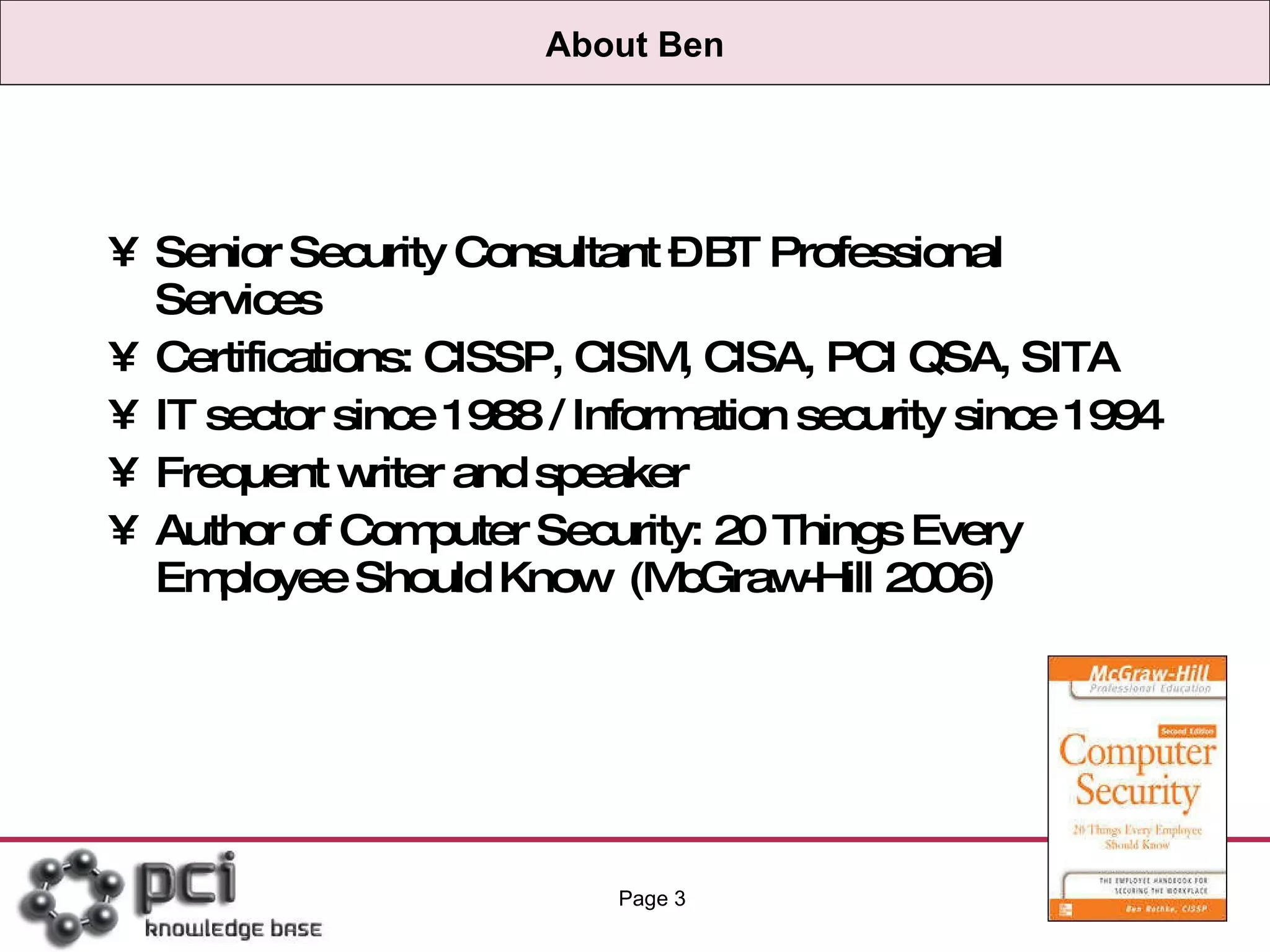
About Ben Senior Security Consultant – BT Professional Services Certifications: CISSP, CISM, CISA, PCI QSA, SITA IT sector since 1988 / Information security since 1994 Frequent writer and speaker Author of Computer Security: 20 Things Every Employee Should Know  (McGraw-Hill 2006) Page
About Sushila Product Manager - BT Professional Services Certifications: CISM, CISPP, PCI QSA, BSI 17799 Lead Auditor IT Sector since 1986 and security since 1995 Frequent writer and speaker Page
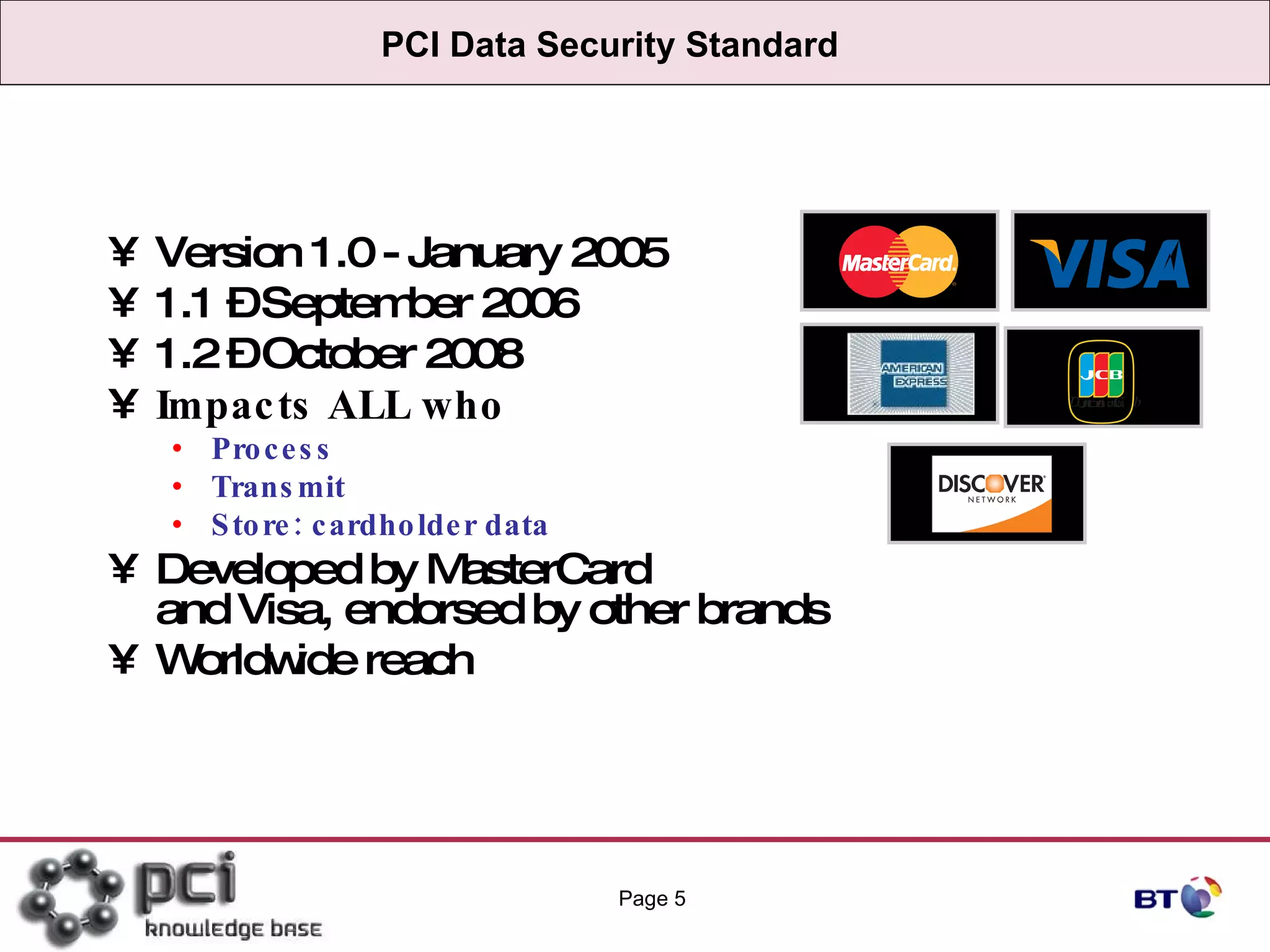
PCI Data Security Standard Version 1.0 - January 2005 1.1 – September 2006 1.2 – October 2008 Impacts ALL who Process Transmit Store: cardholder data Developed by MasterCard  and Visa, endorsed by other brands Worldwide reach Page
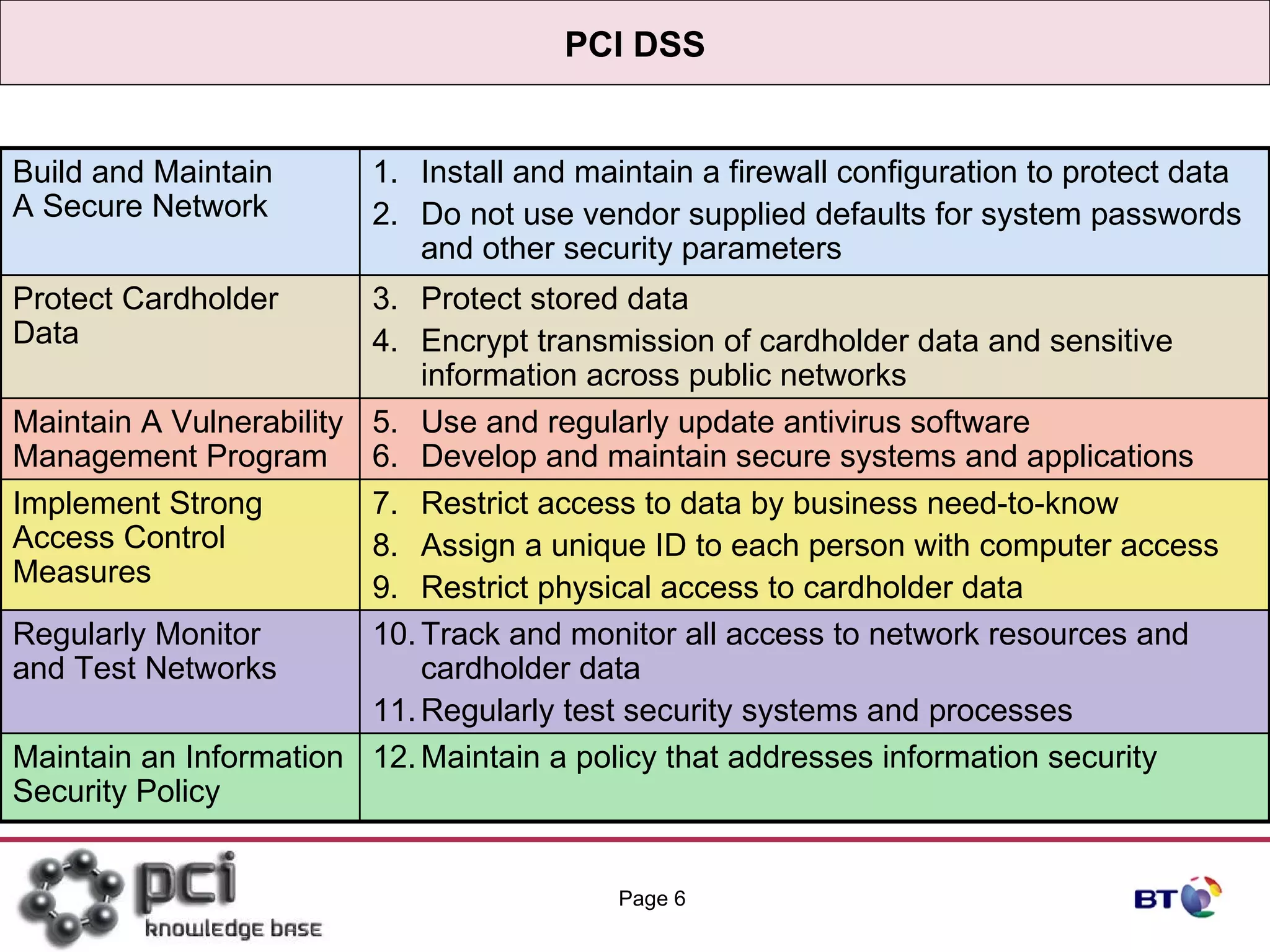
PCI DSS Page  Build and Maintain A Secure Network 1. Install and maintain a firewall configuration to protect data 2. Do not use vendor supplied defaults for system passwords and other security parameters Protect Cardholder Data 3. Protect stored data 4. Encrypt transmission of cardholder data and sensitive information across public networks Maintain A Vulnerability Management Program 5. Use and regularly update antivirus software 6. Develop and maintain secure systems and applications Implement Strong Access Control Measures 7. Restrict access to data by business need-to-know 8. Assign a unique ID to each person with computer access 9. Restrict physical access to cardholder data Regularly Monitor and Test Networks 10. Track and monitor all access to network resources and cardholder data 11. Regularly test security systems and processes Maintain an Information Security Policy 12. Maintain a policy that addresses information security
Software security is essential Software is the virtual equivalent of real-world infrastructure, yet there are no safeguards that the software we all depend upon is secure.  Growing number of global organizations and experts believe the enterprise is at great risk because the simplest application sitting on a user’s laptop can be an entry point for a potentially devastating hack or worm.  Because security is often retrofitted at the end of the SDLC as a response to a threat or after an exposure, higher production costs and delays can result.  Relative cost of fixing defects in production is as much as 100 times more expensive than if proper security had been implemented during the design phase. Page
The threats are real and constantly occur DSW Shoe Warehouse customer database hacked 1.4 million records stolen FTC fines Choice Point $10 million for failure to protect consumer data. TJ MAXX results in several states introducing new legislation to protect cardholder data. Card Systems International forced to sell operations at a loss. Ongoing compromises are driving changes in the DSS to include dual factor authentication and wireless security. Page
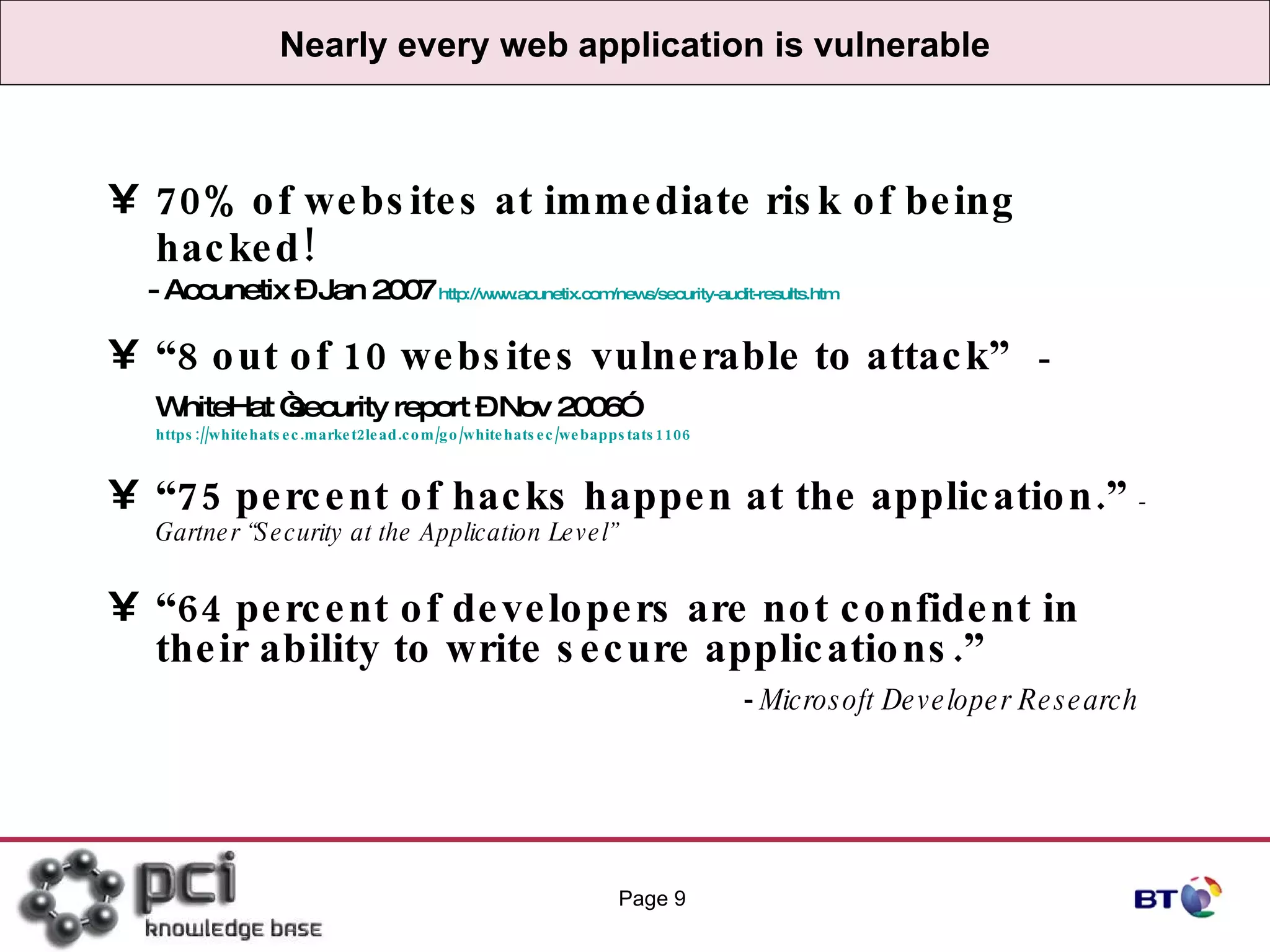
Nearly every web application is vulnerable 70% of websites at immediate risk of being hacked!  - Accunetix – Jan 2007   http://www.acunetix.com/news/security-audit-results.htm “ 8 out of 10 websites vulnerable to attack”  - WhiteHat “security report – Nov 2006”   https://whitehatsec.market2lead.com/go/whitehatsec/webappstats1106 “ 75 percent of hacks happen at the application.”  - Gartner “Security at the Application Level” “ 64 percent of developers are not confident in their ability to write secure applications.”  -  Microsoft Developer Research Page
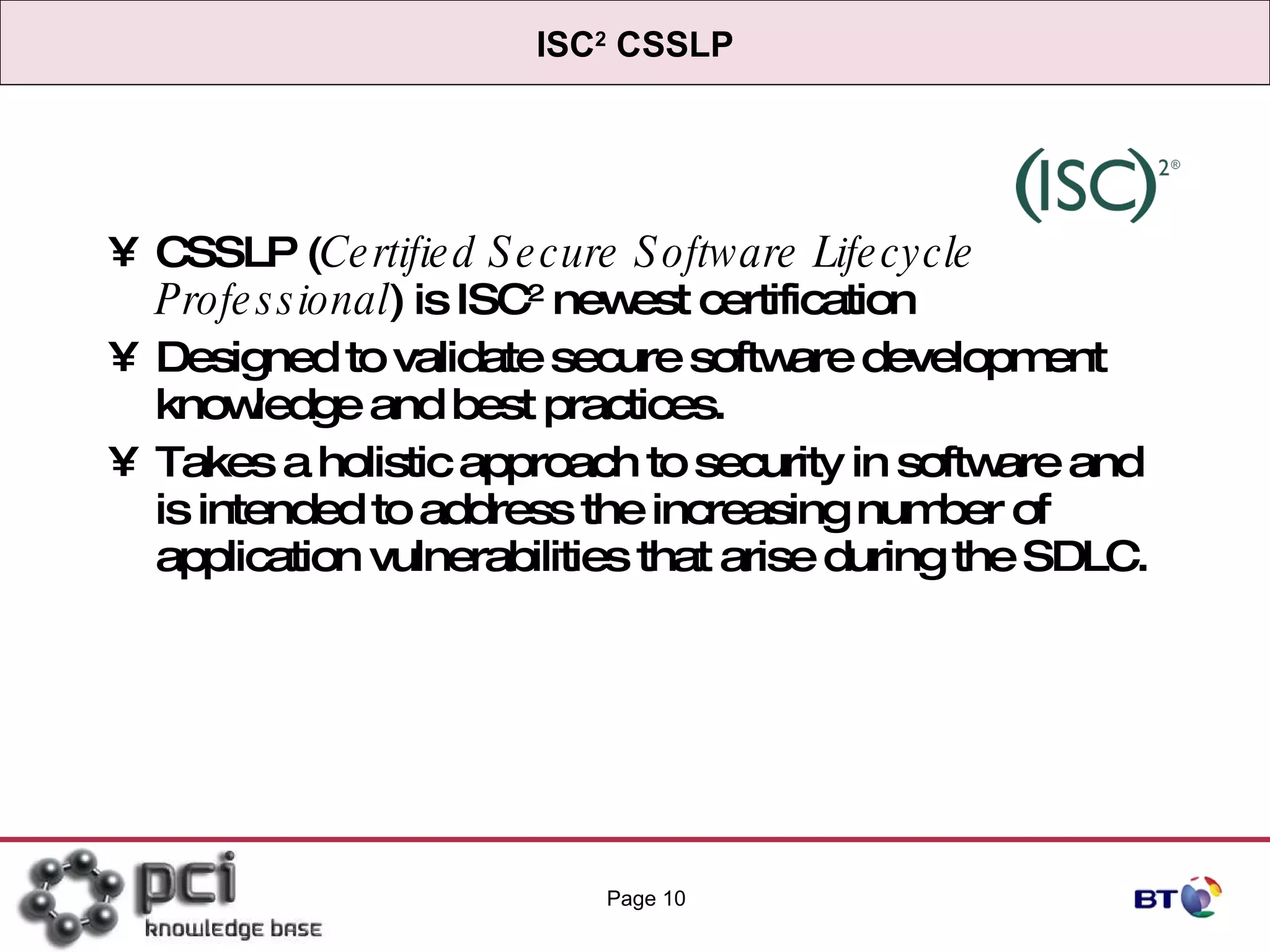
ISC 2  CSSLP CSSLP ( Certified Secure Software Lifecycle Professional ) is ISC 2  newest certification Designed to validate secure software development knowledge and best practices.  Takes a holistic approach to security in software and is intended to address the increasing number of application vulnerabilities that arise during the SDLC. Page
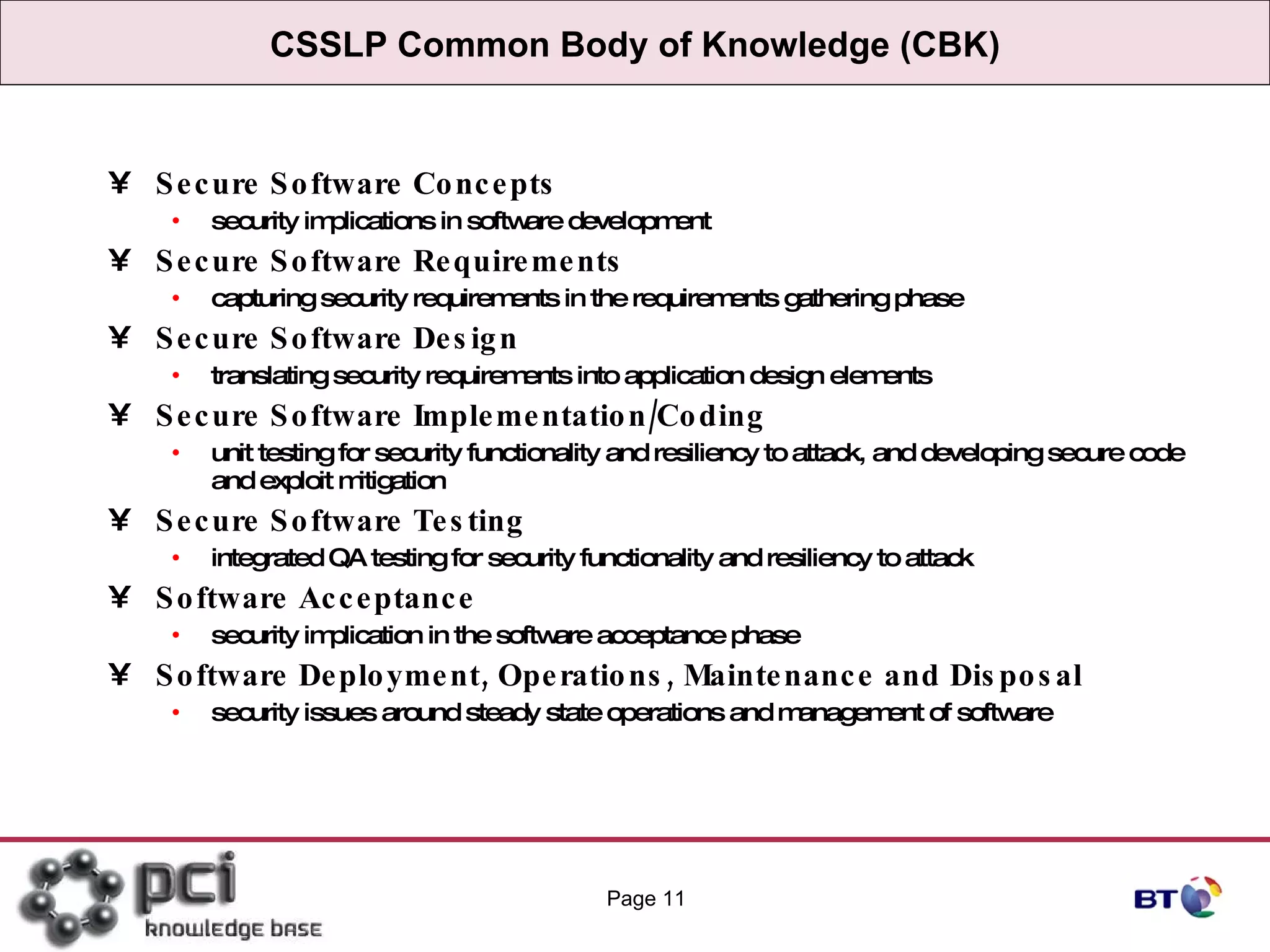
CSSLP Common Body of Knowledge (CBK) Secure Software Concepts security implications in software development  Secure Software Requirements capturing security requirements in the requirements gathering phase  Secure Software Design translating security requirements into application design elements  Secure Software Implementation/Coding unit testing for security functionality and resiliency to attack, and developing secure code and exploit mitigation  Secure Software Testing integrated QA testing for security functionality and resiliency to attack  Software Acceptance security implication in the software acceptance phase  Software Deployment, Operations, Maintenance and Disposal security issues around steady state operations and management of software  Page
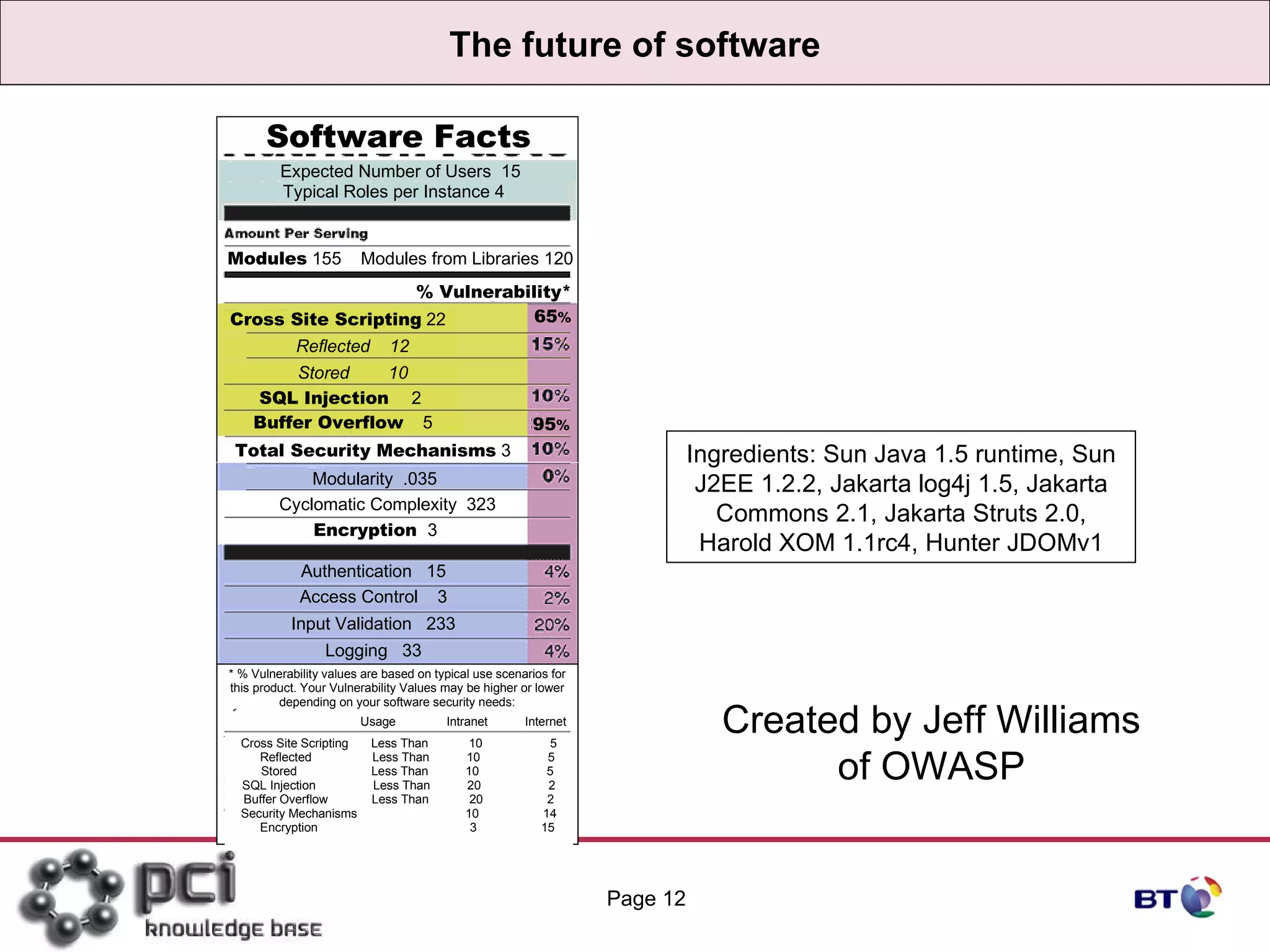
The future of software Page  Ingredients: Sun Java 1.5 runtime, Sun J2EE 1.2.2, Jakarta log4j 1.5, Jakarta Commons 2.1, Jakarta Struts 2.0, Harold XOM 1.1rc4, Hunter JDOMv1 Software Facts Modules  155  Modules from Libraries 120 % Vulnerability* * % Vulnerability values are based on typical use scenarios for this product. Your Vulnerability Values may be higher or lower depending on your software security needs: Cross Site Scripting  22 65 % SQL Injection  2 Buffer Overflow   5 Total Security Mechanisms  3 Encryption  3 Authentication  15 95 % Modularity  .035 Cyclomatic Complexity  323 Access Control  3 Input Validation  233 Logging  33 Expected Number of Users  15 Typical Roles per Instance 4 Reflected  12 Stored  10 Cross Site Scripting  Less Than  10  5 Reflected  Less Than  10  5 Stored  Less Than  10  5 SQL Injection  Less Than  20  2 Buffer Overflow  Less Than  20  2 Security Mechanisms  10  14 Encryption  3  15 Usage  Intranet  Internet Created by Jeff Williams of OWASP
PCI DSS requirement 6.6 Ensure that all web-facing applications are protected against known attacks by applying either of the following methods: Option 1: Have all custom application code reviewed for common vulnerabilities by an organization that specializes in application security Option 2: Install an application layer firewall in front of web-facing applications To be compliant, either option must result in prevention of attacks. Page
PCI Council clarification of 6.6 Properly implemented, one or more of these four alternatives could meet the intent of Option 1 and provide the minimum level of protection against common web application threats” Manual review of application source code Proper use of automated application source code analyzer (scanning) tools Manual web application security vulnerability  assessment Proper use of automated web application security vulnerability assessment (scanning) tools Source:  https://www.pcisecuritystandards.org/pdfs/infosupp_6_6_applicationfirewalls_codereviews.pdf   Page
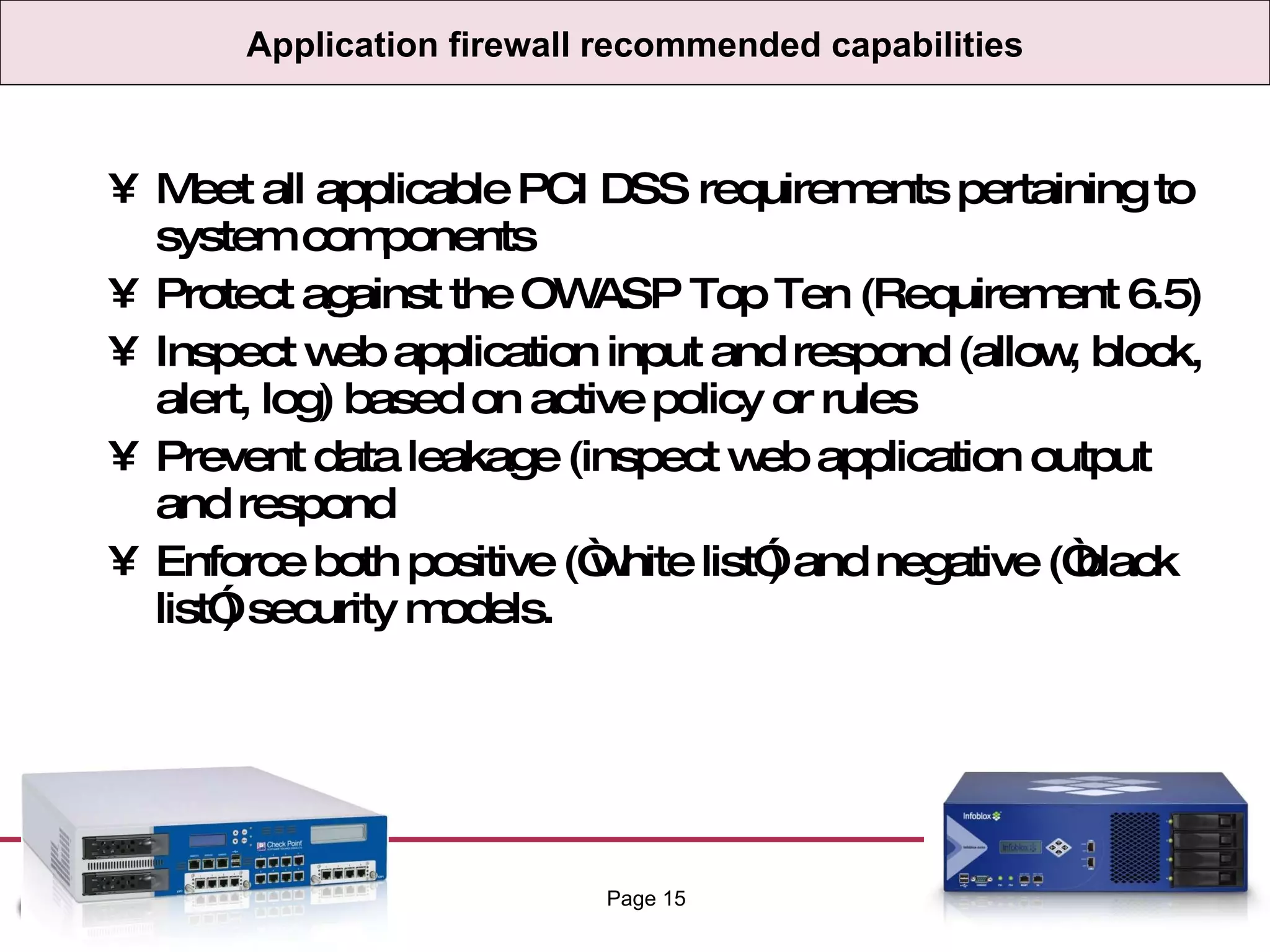
Application firewall recommended capabilities Meet all applicable PCI DSS requirements pertaining to system components Protect against the OWASP Top Ten (Requirement 6.5) Inspect web application input and respond (allow, block, alert, log) based on active policy or rules Prevent data leakage (inspect web application output and respond Enforce both positive (“white list”) and negative (“black list”) security models. Page
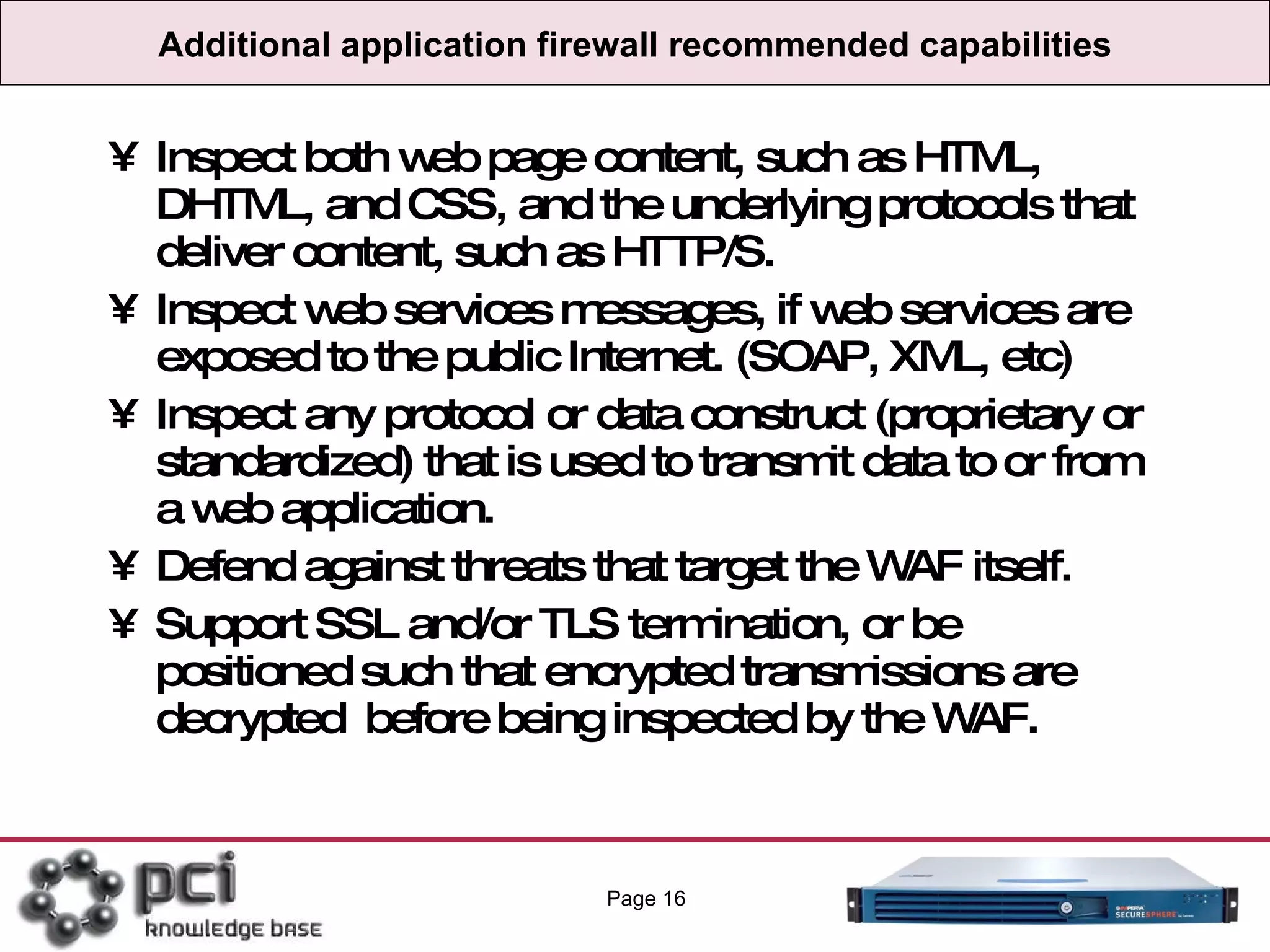
Additional application firewall recommended capabilities Inspect both web page content, such as HTML, DHTML, and CSS, and the underlying protocols that deliver content, such as HTTP/S. Inspect web services messages, if web services are exposed to the public Internet. (SOAP, XML, etc) Inspect any protocol or data construct (proprietary or standardized) that is used to transmit data to or from a web application. Defend against threats that target the WAF itself. Support SSL and/or TLS termination, or be positioned such that encrypted transmissions are decrypted  before being inspected by the WAF. Page
Application Security Action Items Update POS Applications Identify Poorly Coded Web Apps Perform Quarterly Vulnerability Scans  Perform Annual Penetration Testing Create formal SDLC Processes Page
The Challenge Functionality versus security Finding vulnerabilities Managing changes Understanding when there has been a breach Knowledge
Application requirements within PCI DSS 6.5 Develop all web applications based on secure coding guidelines such as the Open Web Application Security Project guidelines 6.6 1) Reviews of applications via manual or automated vulnerability assessment tools or methods, or  2)Installing an application-layer firewall in front of public-facing web applications. 11.3 Perform penetration testing
Understanding where the greatest risks are Half of all account compromises are a result of web-application data breaches  90% of web application data compromises are a result of the top 5 -10 web-application vulnerabilities   Most vulnerabilities are trivially exploitable
Manual Code review Review fewer than 200 - 400 lines of code at a time Aim for an inspection rate of less than 300 - 500 LOC per hour Take enough time for a proper, slow review, but not more than 60 - 90 minutes. Authors should annotate source code before the review begins. Checklists substantially improve results for both authors and reviewers. Extracted from  http://smartbear.com
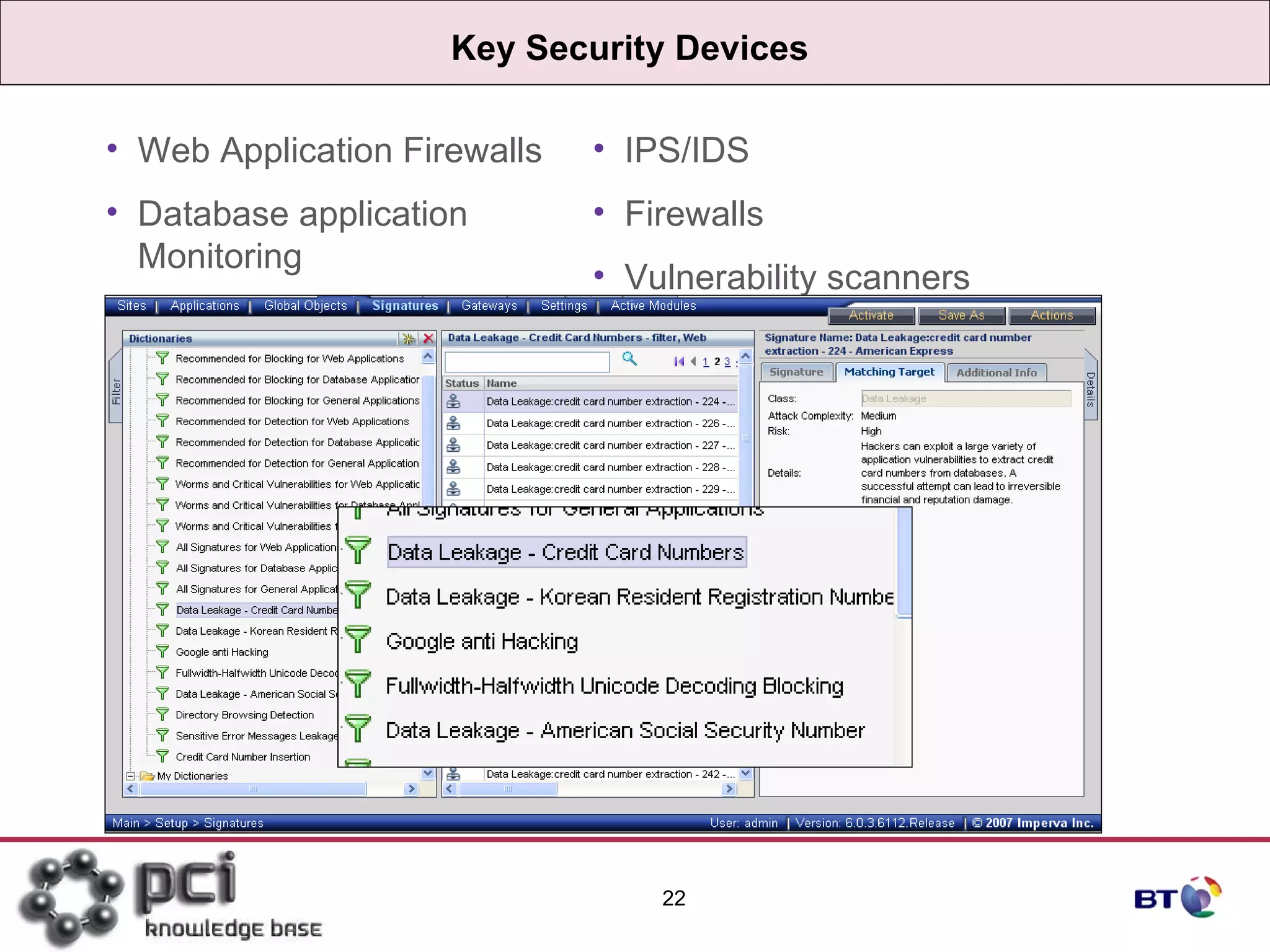
Key Security Devices IPS/IDS Firewalls Vulnerability scanners Web Application Firewalls Database application Monitoring
Application development Develop secure code SDLC Code Review Understand your vulnerabilities Penetration tests WAS Remediate and protect Test and test again Web application Firewall Monitor No one is infallible
Q/A  - Thank you for attending / contact information Ben Rothke, CISSP, QSA Senior Security Consultant BT Professional Services –  http://bt.ins.com   New York, NY USA [email_address]   Page  Sushila Nair Product Manager BT Professional Services – http://bt.ins.com   New York, NY USA [email_address]

How PCI And PA DSS will change enterprise applications

  • 1.
    Page HowPCI and PA DSS Will Change Enterprise Applications Presented by: Ben Rothke, CISSP PCI QSA and Sushila Nair, CISSP PCI QSA November 25, 2008
  • 2.
    Agenda Overview ofapplication security and its need PCI and Application Security PCI Application Security Requirements Application Security Action Items Closing comments Page
  • 3.
    About Ben SeniorSecurity Consultant – BT Professional Services Certifications: CISSP, CISM, CISA, PCI QSA, SITA IT sector since 1988 / Information security since 1994 Frequent writer and speaker Author of Computer Security: 20 Things Every Employee Should Know (McGraw-Hill 2006) Page
  • 4.
    About Sushila ProductManager - BT Professional Services Certifications: CISM, CISPP, PCI QSA, BSI 17799 Lead Auditor IT Sector since 1986 and security since 1995 Frequent writer and speaker Page
  • 5.
    PCI Data SecurityStandard Version 1.0 - January 2005 1.1 – September 2006 1.2 – October 2008 Impacts ALL who Process Transmit Store: cardholder data Developed by MasterCard and Visa, endorsed by other brands Worldwide reach Page
  • 6.
    PCI DSS Page Build and Maintain A Secure Network 1. Install and maintain a firewall configuration to protect data 2. Do not use vendor supplied defaults for system passwords and other security parameters Protect Cardholder Data 3. Protect stored data 4. Encrypt transmission of cardholder data and sensitive information across public networks Maintain A Vulnerability Management Program 5. Use and regularly update antivirus software 6. Develop and maintain secure systems and applications Implement Strong Access Control Measures 7. Restrict access to data by business need-to-know 8. Assign a unique ID to each person with computer access 9. Restrict physical access to cardholder data Regularly Monitor and Test Networks 10. Track and monitor all access to network resources and cardholder data 11. Regularly test security systems and processes Maintain an Information Security Policy 12. Maintain a policy that addresses information security
  • 7.
    Software security isessential Software is the virtual equivalent of real-world infrastructure, yet there are no safeguards that the software we all depend upon is secure. Growing number of global organizations and experts believe the enterprise is at great risk because the simplest application sitting on a user’s laptop can be an entry point for a potentially devastating hack or worm. Because security is often retrofitted at the end of the SDLC as a response to a threat or after an exposure, higher production costs and delays can result. Relative cost of fixing defects in production is as much as 100 times more expensive than if proper security had been implemented during the design phase. Page
  • 8.
    The threats arereal and constantly occur DSW Shoe Warehouse customer database hacked 1.4 million records stolen FTC fines Choice Point $10 million for failure to protect consumer data. TJ MAXX results in several states introducing new legislation to protect cardholder data. Card Systems International forced to sell operations at a loss. Ongoing compromises are driving changes in the DSS to include dual factor authentication and wireless security. Page
  • 9.
    Nearly every webapplication is vulnerable 70% of websites at immediate risk of being hacked! - Accunetix – Jan 2007 http://www.acunetix.com/news/security-audit-results.htm “ 8 out of 10 websites vulnerable to attack” - WhiteHat “security report – Nov 2006” https://whitehatsec.market2lead.com/go/whitehatsec/webappstats1106 “ 75 percent of hacks happen at the application.” - Gartner “Security at the Application Level” “ 64 percent of developers are not confident in their ability to write secure applications.” - Microsoft Developer Research Page
  • 10.
    ISC 2 CSSLP CSSLP ( Certified Secure Software Lifecycle Professional ) is ISC 2 newest certification Designed to validate secure software development knowledge and best practices. Takes a holistic approach to security in software and is intended to address the increasing number of application vulnerabilities that arise during the SDLC. Page
  • 11.
    CSSLP Common Bodyof Knowledge (CBK) Secure Software Concepts security implications in software development Secure Software Requirements capturing security requirements in the requirements gathering phase Secure Software Design translating security requirements into application design elements Secure Software Implementation/Coding unit testing for security functionality and resiliency to attack, and developing secure code and exploit mitigation Secure Software Testing integrated QA testing for security functionality and resiliency to attack Software Acceptance security implication in the software acceptance phase Software Deployment, Operations, Maintenance and Disposal security issues around steady state operations and management of software Page
  • 12.
    The future ofsoftware Page Ingredients: Sun Java 1.5 runtime, Sun J2EE 1.2.2, Jakarta log4j 1.5, Jakarta Commons 2.1, Jakarta Struts 2.0, Harold XOM 1.1rc4, Hunter JDOMv1 Software Facts Modules 155 Modules from Libraries 120 % Vulnerability* * % Vulnerability values are based on typical use scenarios for this product. Your Vulnerability Values may be higher or lower depending on your software security needs: Cross Site Scripting 22 65 % SQL Injection 2 Buffer Overflow 5 Total Security Mechanisms 3 Encryption 3 Authentication 15 95 % Modularity .035 Cyclomatic Complexity 323 Access Control 3 Input Validation 233 Logging 33 Expected Number of Users 15 Typical Roles per Instance 4 Reflected 12 Stored 10 Cross Site Scripting Less Than 10 5 Reflected Less Than 10 5 Stored Less Than 10 5 SQL Injection Less Than 20 2 Buffer Overflow Less Than 20 2 Security Mechanisms 10 14 Encryption 3 15 Usage Intranet Internet Created by Jeff Williams of OWASP
  • 13.
    PCI DSS requirement6.6 Ensure that all web-facing applications are protected against known attacks by applying either of the following methods: Option 1: Have all custom application code reviewed for common vulnerabilities by an organization that specializes in application security Option 2: Install an application layer firewall in front of web-facing applications To be compliant, either option must result in prevention of attacks. Page
  • 14.
    PCI Council clarificationof 6.6 Properly implemented, one or more of these four alternatives could meet the intent of Option 1 and provide the minimum level of protection against common web application threats” Manual review of application source code Proper use of automated application source code analyzer (scanning) tools Manual web application security vulnerability assessment Proper use of automated web application security vulnerability assessment (scanning) tools Source: https://www.pcisecuritystandards.org/pdfs/infosupp_6_6_applicationfirewalls_codereviews.pdf Page
  • 15.
    Application firewall recommendedcapabilities Meet all applicable PCI DSS requirements pertaining to system components Protect against the OWASP Top Ten (Requirement 6.5) Inspect web application input and respond (allow, block, alert, log) based on active policy or rules Prevent data leakage (inspect web application output and respond Enforce both positive (“white list”) and negative (“black list”) security models. Page
  • 16.
    Additional application firewallrecommended capabilities Inspect both web page content, such as HTML, DHTML, and CSS, and the underlying protocols that deliver content, such as HTTP/S. Inspect web services messages, if web services are exposed to the public Internet. (SOAP, XML, etc) Inspect any protocol or data construct (proprietary or standardized) that is used to transmit data to or from a web application. Defend against threats that target the WAF itself. Support SSL and/or TLS termination, or be positioned such that encrypted transmissions are decrypted before being inspected by the WAF. Page
  • 17.
    Application Security ActionItems Update POS Applications Identify Poorly Coded Web Apps Perform Quarterly Vulnerability Scans Perform Annual Penetration Testing Create formal SDLC Processes Page
  • 18.
    The Challenge Functionalityversus security Finding vulnerabilities Managing changes Understanding when there has been a breach Knowledge
  • 19.
    Application requirements withinPCI DSS 6.5 Develop all web applications based on secure coding guidelines such as the Open Web Application Security Project guidelines 6.6 1) Reviews of applications via manual or automated vulnerability assessment tools or methods, or 2)Installing an application-layer firewall in front of public-facing web applications. 11.3 Perform penetration testing
  • 20.
    Understanding where thegreatest risks are Half of all account compromises are a result of web-application data breaches 90% of web application data compromises are a result of the top 5 -10 web-application vulnerabilities  Most vulnerabilities are trivially exploitable
  • 21.
    Manual Code reviewReview fewer than 200 - 400 lines of code at a time Aim for an inspection rate of less than 300 - 500 LOC per hour Take enough time for a proper, slow review, but not more than 60 - 90 minutes. Authors should annotate source code before the review begins. Checklists substantially improve results for both authors and reviewers. Extracted from http://smartbear.com
  • 22.
    Key Security DevicesIPS/IDS Firewalls Vulnerability scanners Web Application Firewalls Database application Monitoring
  • 23.
    Application development Developsecure code SDLC Code Review Understand your vulnerabilities Penetration tests WAS Remediate and protect Test and test again Web application Firewall Monitor No one is infallible
  • 24.
    Q/A -Thank you for attending / contact information Ben Rothke, CISSP, QSA Senior Security Consultant BT Professional Services – http://bt.ins.com New York, NY USA [email_address] Page Sushila Nair Product Manager BT Professional Services – http://bt.ins.com New York, NY USA [email_address]