How does the infosphere
change the learning process?
Michal Cerny,
DoSE FoE MU Brno, Czech
CERNY@KISK.CZ
Hyperconnection era
Hyperconnection era
• Luciano Floridi concept.
• Human society is getting more and more connected; we are always online.
• Connections are built not only between people but also between technology and
technology and people with each other.
• Is it a new era (as is the Middle Ages, Modern Age or Prehistory)? Or is this time
just standard?
• The degree of connection goes beyond human experience.
• Technology can quickly work with cloud solutions and shared collective memory
(and one calculation over that memory).
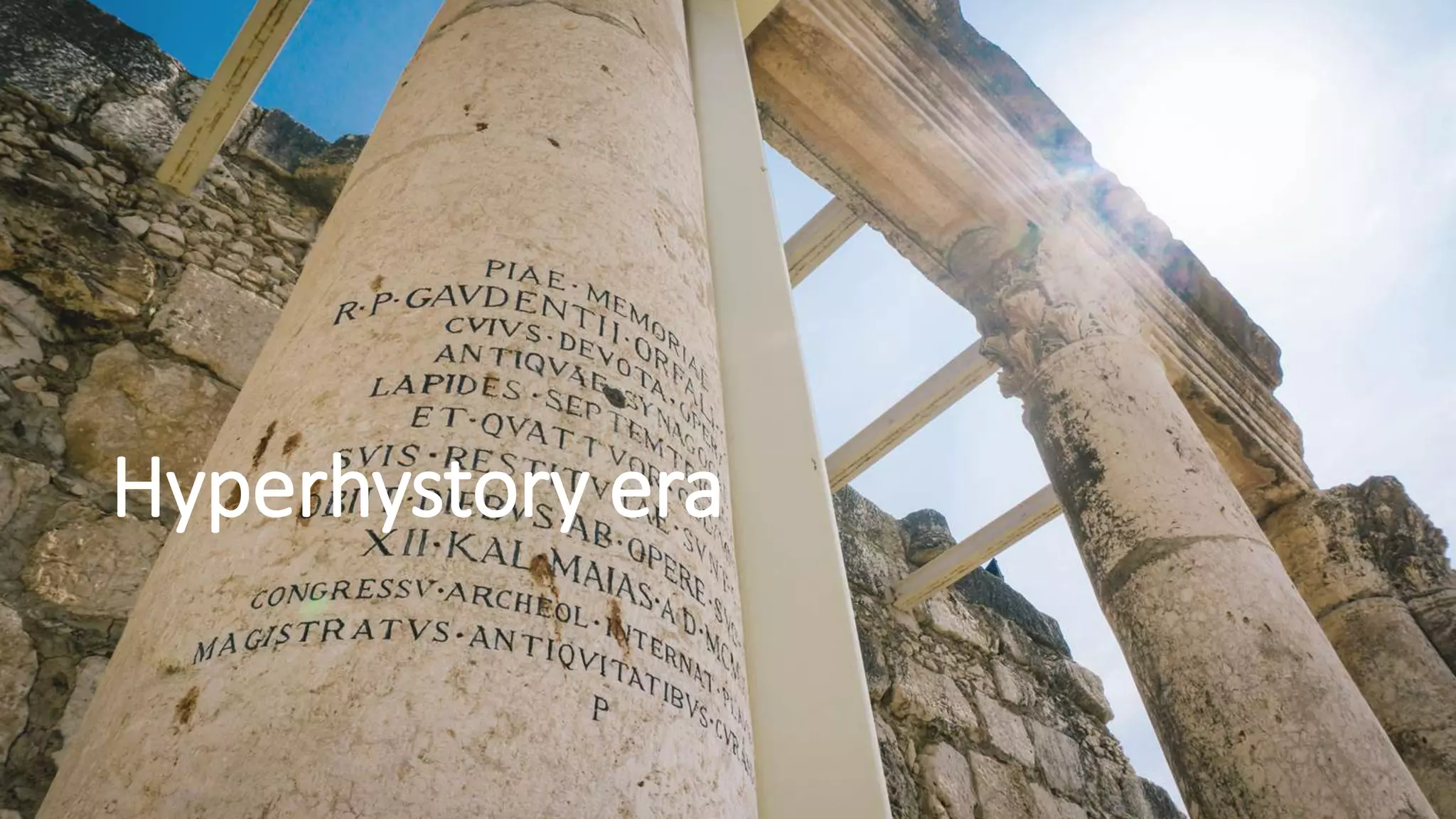
Hyperhystory era
Hyperhystory era
• Much of the information is permanently stored.
• This collective memory is used for learning algorithms (AI), but also other
applications and decision making of people.
• This information is partially objective. It does not have to be related to context and
situation.
• This information is easy to manipulate (deep fake news, disinformation, right to
forget).
Infosphere
Infosphere
• Space of information interactions.
• Information interactions can be between humans, machines, biotic entities.
• The focus is on the information.
• Information is the primary economic good; but also a communication tool; in the
way of being with others…. And resource for learning!
• Without the ability to move in the infosphere, it is not possible to learn adequately.
• We need to provide students with access to the infosphere, open information
interaction and information literacy.
Information literacy
• Ability to work with information: search for information, filter information,
evaluate information, organize information, use information,…
• It is an essential ability for active learning.
• From my research at secondary schools in the Czech Republic, information literacy
is the only way to learn competences.
• This competence must be developed throughout life.
HCI – human – technology hybrid
cognitive system
HCI – human – technology hybrid cognitive
system
• The future is in hybrid collaboration systems based on human-AI team interaction.
• We need to teach completely new competences.
• An individual, even the smartest in the world, cannot be successful without
cooperation.
What to learn?
What to learn?
• We cannot do with a robust curriculum as in the nineteenth and twentieth
centuries.
• We must move nationalism and its educational effects out of the focus of an
education.
• We must emphasize competences.
• We need to develop information literacy.
• We need to develop cooperation.
• We need to connect the school intensively with the surroundings.
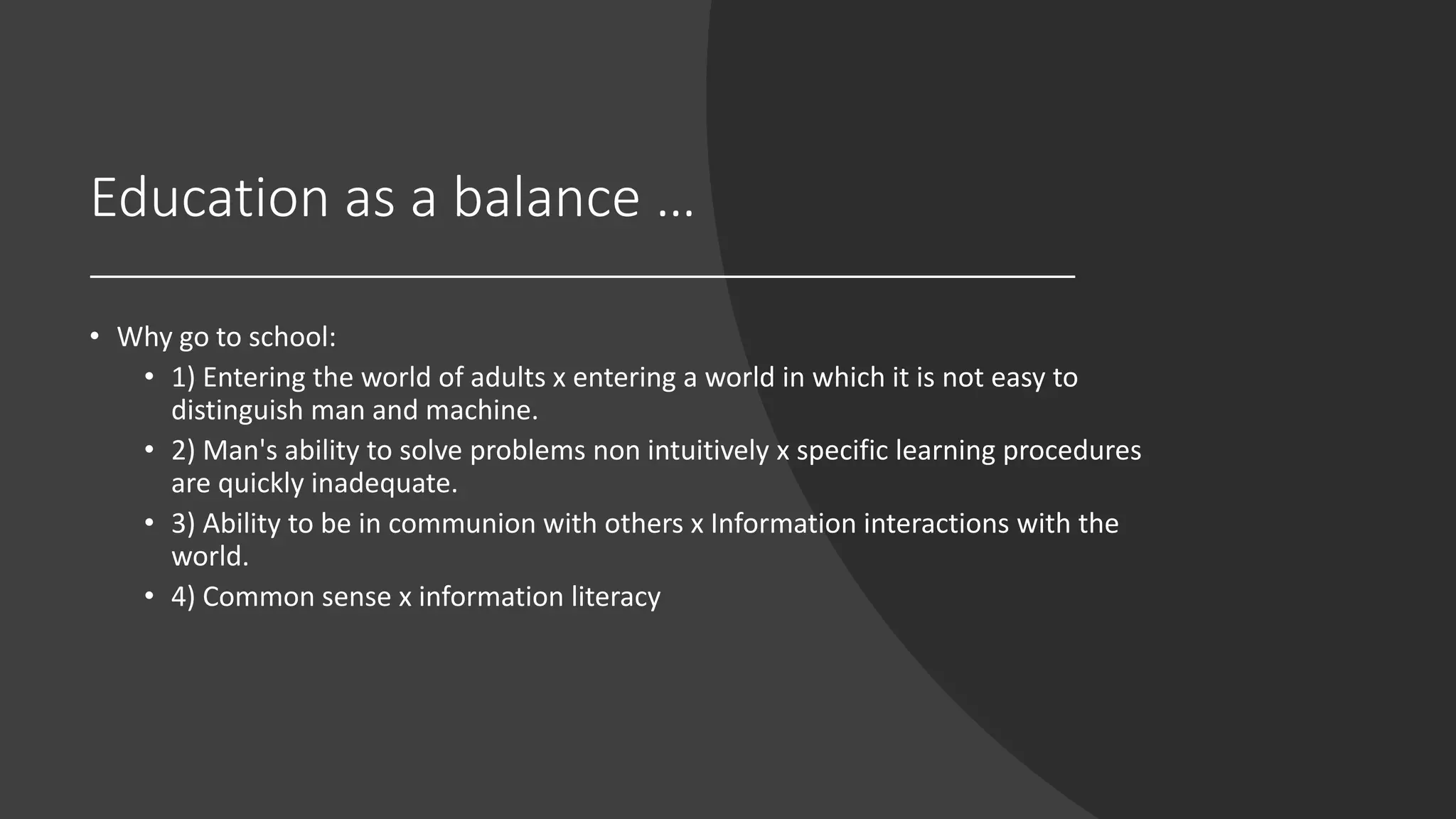
Education as a balance …
• Why go to school:
• 1) Entering the world of adults x entering a world in which it is not easy to
distinguish man and machine.
• 2) Man's ability to solve problems non intuitively x specific learning procedures
are quickly inadequate.
• 3) Ability to be in communion with others x Information interactions with the
world.
• 4) Common sense x information literacy
… in new dynamic open
environmental
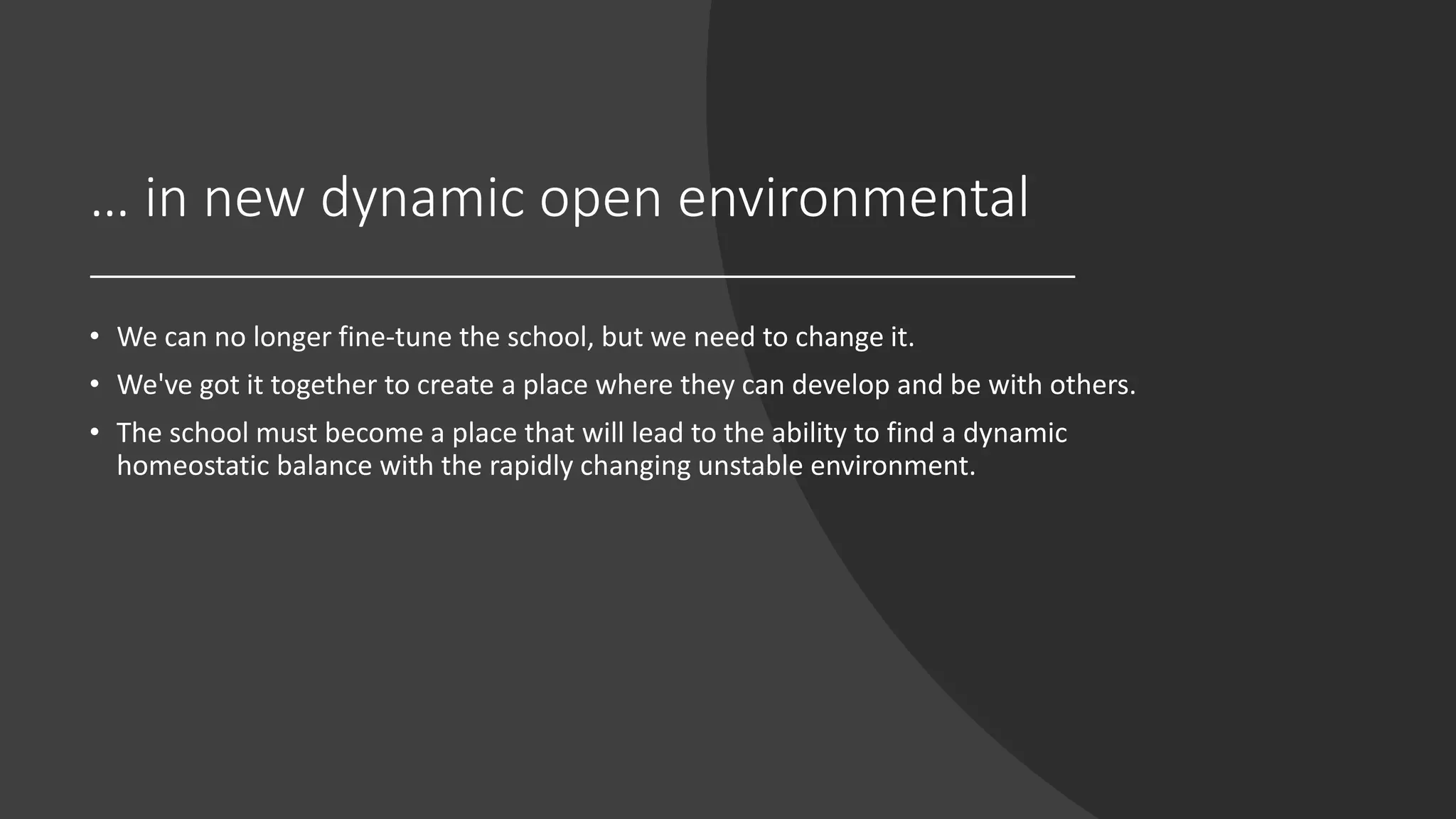
… in new dynamic open environmental
• We can no longer fine-tune the school, but we need to change it.
• We've got it together to create a place where they can develop and be with others.
• The school must become a place that will lead to the ability to find a dynamic
homeostatic balance with the rapidly changing unstable environment.
Thanks for your attention

How does the infosphere change the learning process?

  • 1.
    How does theinfosphere change the learning process? Michal Cerny, DoSE FoE MU Brno, Czech CERNY@KISK.CZ
  • 2.
  • 3.
    Hyperconnection era • LucianoFloridi concept. • Human society is getting more and more connected; we are always online. • Connections are built not only between people but also between technology and technology and people with each other. • Is it a new era (as is the Middle Ages, Modern Age or Prehistory)? Or is this time just standard? • The degree of connection goes beyond human experience. • Technology can quickly work with cloud solutions and shared collective memory (and one calculation over that memory).
  • 4.
  • 5.
    Hyperhystory era • Muchof the information is permanently stored. • This collective memory is used for learning algorithms (AI), but also other applications and decision making of people. • This information is partially objective. It does not have to be related to context and situation. • This information is easy to manipulate (deep fake news, disinformation, right to forget).
  • 6.
  • 7.
    Infosphere • Space ofinformation interactions. • Information interactions can be between humans, machines, biotic entities. • The focus is on the information. • Information is the primary economic good; but also a communication tool; in the way of being with others…. And resource for learning! • Without the ability to move in the infosphere, it is not possible to learn adequately. • We need to provide students with access to the infosphere, open information interaction and information literacy.
  • 8.
  • 9.
    Information literacy • Abilityto work with information: search for information, filter information, evaluate information, organize information, use information,… • It is an essential ability for active learning. • From my research at secondary schools in the Czech Republic, information literacy is the only way to learn competences. • This competence must be developed throughout life.
  • 10.
    HCI – human– technology hybrid cognitive system
  • 11.
    HCI – human– technology hybrid cognitive system • The future is in hybrid collaboration systems based on human-AI team interaction. • We need to teach completely new competences. • An individual, even the smartest in the world, cannot be successful without cooperation.
  • 12.
  • 13.
    What to learn? •We cannot do with a robust curriculum as in the nineteenth and twentieth centuries. • We must move nationalism and its educational effects out of the focus of an education. • We must emphasize competences. • We need to develop information literacy. • We need to develop cooperation. • We need to connect the school intensively with the surroundings.
  • 14.
    Education as abalance …
  • 15.
    Education as abalance … • Why go to school: • 1) Entering the world of adults x entering a world in which it is not easy to distinguish man and machine. • 2) Man's ability to solve problems non intuitively x specific learning procedures are quickly inadequate. • 3) Ability to be in communion with others x Information interactions with the world. • 4) Common sense x information literacy
  • 16.
    … in newdynamic open environmental
  • 17.
    … in newdynamic open environmental • We can no longer fine-tune the school, but we need to change it. • We've got it together to create a place where they can develop and be with others. • The school must become a place that will lead to the ability to find a dynamic homeostatic balance with the rapidly changing unstable environment.
  • 18.
    Thanks for yourattention