HOW DO ORGANISMS
REPRODUCE
3.1 INTRODUCTION
It is a process by which living organism produces young ones of
their own kind and species:
Reproduction may be
(i) Sexual
(ii)Asexual
Question based on basic knowledge required to understand this
chapter
1. Reproduction in Bryophyllum takes place by :
(A) root (B) stem
(C) leaf (D) none of the above
2. Other term for tissue culture is:
(A) callus (B) micropropagation
(C) sporulation (D) none of the above
3. In roses, the most common method used to produce new plants is:
(A) layering (B) tissue culture
(C) cutting (D) none of the above
4. Causal organism of AIDS is
(A) Trypnosoma
(B) Bacteria
(C) Human immuno deficiency virus
(D) All of these
5. Pollination by bats is called:
(A) cheiropterophily (B) ornithophily
(C) malacophily (D) entomophily
6. Flowers which are pollinated by insects are:
(A) colourless (B) small in size
(C) coloured and scented (D) very large in size
7. Self pollination can be found in
(A) Unisexual flower (B) Bisexual flower
(C) Male flower (D) None
8. Menopause is the stage in human female when:
(A) menstruation starts
(B) puberty begins
(C) menstruation stops and reproductive capacity is arrested
(D) none of the above
3.1 Introduction
3.2 Mode of Reproduction
used by single
organisms
3.3 Sexual Reproduction in
Plants
3.4 Reproduction in Human
Beings
All right copy reserved. No part of the material can be produced without prior permission
9. Gestation period is the duration:
(A) of fertilization (B) between egg growth and ovulation
(C) between fertilization and parturition (D) none of the above
10. The diploid number of chromosomes is restored in an organism by the process of:
(A) spermatogenesis (B) fertilization (C) oogenesis (D) reductional division.
3.2 MODE OF REPRODUCTION USED BY SINGLE ORGANISMS
Asexual
TYPES OF REPRODUCTION
Sexual
Spore
Formation
Regeneration
Vegetative
propagation
Natural Artificial
Budding
Multiple
Fission
Binary
Fission
Sperm (n) Ovum (n)
ZYGOTE (2N)
Male Female
Fragmentation
(i) Binary Fission: Unicellular animals (Binary means two)
Nucleus stretch and divides followed by division of cytoplasm.
(a) BINARY FISSION IN AMOEBA
When amoeba has reached to its maximum size of growth, the nucleus of amoeba stretch and divides into
two.After that the cytoplasm of amoeba divides into two part, one part around each nucleus. Other ex. of
Binary fission is seen in Leishmania (which causes Kala-azar)
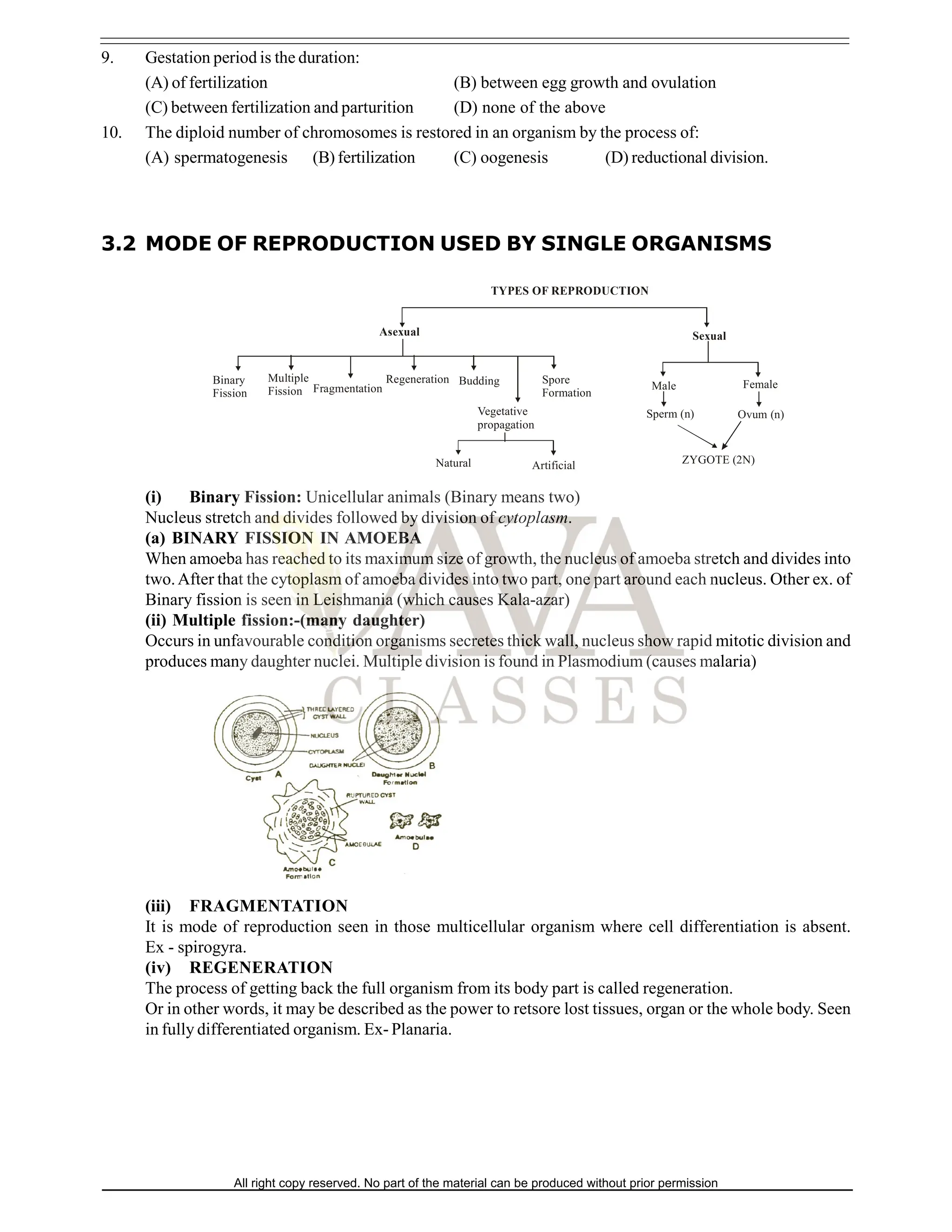
(ii) Multiple fission:-(many daughter)
Occurs in unfavourable condition organisms secretes thick wall, nucleus show rapid mitotic division and
produces many daughter nuclei. Multiple division is found in Plasmodium (causes malaria)
(iii) FRAGMENTATION
It is mode of reproduction seen in those multicellular organism where cell differentiation is absent.
Ex - spirogyra.
(iv) REGENERATION
The process of getting back the full organism from its body part is called regeneration.
Or in other words, it may be described as the power to retsore lost tissues, organ or the whole body. Seen
in fully differentiated organism. Ex- Planaria.
All right copy reserved. No part of the material can be produced without prior permission
(v) BUDDING
In this process, a daughter organism is formed from a small projection, the bud, which arises as an
outgrowth from the parent body. Ex.- Hydra.
(vi) VEGETATIVE PROPAGATION
Vegetative Propagation
Natural



By roots eg. sweet potato
By leafs eg. Bryophyllum
By stem
Artifical
Cutting
eg. Crotons
Bulb
eg. Onion
Stock-Part
with roots
Scion - Part
without roots
Tubers
eg. Potato
Rhizome
eg. Ginger
Layering
eg. Jasmine
Grafting
eg. Rose
(vii) SPORE FORMATION
In this process, the parent plant produces hundred of tiny spores which can then produce new plants.
Ex.-Rhizopus.
Micropropagation/Tissue culture
Tissue culture
The process is used to obtain desired variety of plant the production of new plant from isolated plant cell
or small piece of plant tissue in a synthetic media, is called as tissues culture process.
3.2.1 Various Steps Involved in Tissue Culture
(i) Plant cell + Synthetic media (sterile condition)

Callus (mass of cells)
All right copy reserved. No part of the material can be produced without prior permission
(ii) Callus + (2nd) medium (containing plant hormones that promote rooting)

development of roots
(iii) Callus with roots + (3rd) media (containing plant hormones which stimulate shoot development)

Callus having root and shoot (develop into tiny plantlets)

(iv) Plantlets are then transplanted into pots or soil.
Ex. Orchids, Dahlia can be grown by micropropagation
Try yourself
1. DNA is
(A) Deoxyribonucleic acid (B) Deoxynucleic acid
(C) Dioxyribonucleic acid (D) Dioxynucleic acid
2. Duringcell division
(A) Nucleus simply splits (B) Nuclear material replicate and then nucleus divide
(C) DNA reduction take place (D) None of these
3. Niches is
(A) an organism that reproduce quickly (B) Marshy area with no organism.
(C) a type of reproduction (D) a well defined place in the ecosystem.
4. Amoeba is a
(A) Bacteria (B) Fungus (C) Protozoan (D) None
5. Importance of variation can be seen when
(A) Common cold virus infects us
(B) Only few bacteria’s is survive in unfavourable condition.
(C) Roses are of different colour
(D) All of these
3.3 SEXUAL REPRODUCTION IN PLANTS
Sexual Reproduction is also called Amphimixis Asexual Reproduction is also called Apomixis.
The males produce ‘Male Gamete’ also called ‘Sperm’.
The females produce ‘female gamete’ also called ‘Egg’.
Both Gametes are haploid(n)
(Haploid  Possess half set of chromosomes)
Fertilization can be divided in following steps
(i) Pre-fertilization: Sperm is formed in male plant and ovum in female plant.
(ii) Fertilization: Male nuclie fuse with nuclie of egg, (after they come togather by pollination)
(iii) Post-fertilization:After fertilization following changes occurs.
Ovule– Seed, Ovary–Fruit
All right copy reserved. No part of the material can be produced without prior permission
IMPORTANT DIAGRAMS
FIGURE-1: PARTS OF FLOWER
FIGURE-1: TYPICAL OVULE
Egg Apparatus = 2 Synergids + 1 Egg
3.3.1 Pollination
The transfer of a Pollen grain from the anther of a stamen to the stigma of the carpel is called
pollination. POLLINATION
SELF POLLINATION CROSS POLLINATION
Self
Cross
All right copy reserved. No part of the material can be produced without prior permission
AGENCIES HELPING IN CROSS-POLLINATION
(I) Pollination by Wind c/a ANEMOPHILY
(II) Pollination by Water c/a HYDROPHILY
(III) Pollination by Insects c/a ENTOMOPHILY
(IV)Pollination by Birds c/a ORNITHOPHILY
(V) Pollination by Bats c/a CHIROPTEROPHILY
+
+
Egg cell
male gamete
Fusion
Zygote (2n)
called as SYNGAMY
Polar nuclei (Male gamete
Secondary
nucleus (2n)
Fusion
PRIMARY ENDOSPERM NUCLEUS
1st
Fusion of
Polar
nuclei
FERTILIZATION
Sincefertilization occurs twice inangiosperm(Syngamy+Triple fusion) it isknown as doublefertilization.
Triple fusion is termed used to denote.
2n + n  3n
secondary male primary
nucleus nuclie endosperm nucleus
“FERTILIZATION IN ANGIOSPERM”
3.3.2 Chart of Fertilization in Plants
POLLEN GRAINS (has Two Male gamete)

Falls on Stigma

Pollen Tubes moves Downward through the style

Pollen Tube Reaches to Ovary where Ovules are Present
All right copy reserved. No part of the material can be produced without prior permission

Usualy enters through Micropyle. (The Male Gametes Enters The Ovule).

One Male gamete fuses with Egg: SYNGAMY

Another male gamete fuses with secondary nucleus and form Primary Endosperm Nucleus (3n).
Triple Fusion
“SYNGAMY + TRIPLE FUSION” c/a DOUBLE FERTILIZATION.
Try yourself
6. Organism having whip like structure at one end of the cell is
(A) Amoeba (B) Leishmania (C) Plasmodium (D) Yeast
7. Double fertilization is seen in
(A) Dicot (B) Monocot (C) Both (D) All type of plants
8. Undiffrentiate group of cell formed during tissue culture
(A) Plantlets (B) Culture (C) Callus (D) Callose
9. Plant reproducing through leaf
(A) Bryophyllum (B) Lotus (C) Hydra (D) None of these
10. The thread like structures that develope on the bread if left in moist damp place is
(A) Tentacle (B) Buds (C) Notches (D) Hyphae
3.4 REPRODUCTION IN HUMANS BEINGS
(1) Male:
sperm
(2) Female:
ovum
(3) Zygote: sperm x ova (Fertilization)
Mitosis
Embryo
(4) Fertilization Fertilization
(5) Unisexual  Only one kind of Reproductive organ in one organism of humans male/female.
(6) Bisexual  both Reproductive organ present in one organism of earthworm.
(7) STEPS OF SEXUAL REPRODUCTION
(1) Male Parent Produces Sperm (meiosis)
Small cell with a larg tail/flagella for movement.
(2) Female Parent Produces Ovum
The Ovum is having a lot of Cytoplasm.
(3) Sperm enters into the Ovum and fuses with it to form a new cell c/a Zygote.
All right copy reserved. No part of the material can be produced without prior permission
This process is c/a Fertilization.
Zygote
fusion of both nuclei
Tail left out
.
.
(4) The Zygote then divides by Mitosis to form large no of cells. Ultimately zygote grows and develops to
become a new body.
(8) HUMAN REPRODUCTIVE SYSTEM
Male
Reproductive Organ
(MRS)
HUMAN REPRODUCTIVE SYSTEM
Female
Reproductive Organ
(FRS)
(9) MRS Testis {Seminiferous Tubules and Leydig cell}
Present in Scrotum (2 C Lower)
o
germinal
epithelium
sertoli
cells
Testosterone
Epididymis (coiled tube)
[Temprary storge and functional
maturation of spermatids to spermatozoa]
Vas deferens
Seminal Vesicle [storgae of sperm/ Fructose energy]
EJACULATORY DUCT (form by the union of duct from seminal
vesicle and vas deferens)
Urethra
Penis
Opens
Joins
Cowper's gland
Prostate
gland
(Male Sexual Organ)
(10)FRS
Ovaries [graffian follicle]
changes to ovum
Corpus Leuteum
Corpus albicans Progestrone
secretes
Oviduct/fallopian tube
[site of fertilization]
Uterus [Highly vascular and Muscular. Inner layer of uterus is
endometrium uterus is site of implantation]
Vagina
Labia Minora
[ Vulva]
Note: Vulva is external part of female genitalia. It comprise of labia minora, labia majora, pubis and glands
All right copy reserved. No part of the material can be produced without prior permission
(11)GAMETOGENESIS (formation of Gametes) – Occur in Primary sex organ i.e. tests (in male) &
ovaries (in females)
(12)SEXUAL CYCLE IN HUMAN FEMALE
In ovaries of female 1000 of immature ova are present which are contained in immature follicles.
When girls reaches puberty, then one follicle develops at a time to form a mature ovum. On
maturation, the follicle bursts and the ovum shoots out of the ovary. This is called OVULATION or in
other words the release of an ovum (or egg) from an ovary is called ovulation.
Ovulation takes place on 14 days of the begining of MENSTRUAL CYCLE of 28 days.
In human females the ovaries start realising ovum or egg once in every 28 days from the age of puberty.
MENSTRUATION: The break down and removal of the inner, thick and soft lining of the uterus along
with its blood vessels in the formof a vaginal bleeding is called MENSTRUALcycle or MENSTRUATION.
SEXUAL CYCLE IN FEMALE
LUTEAL
PHASE
MENSTRUAL
PHASE
PROLIFERATIVE
PHASE
OVULATION
Luteum degenerates causing
low level of progesterone
menstrual flow
Progesterone
secreated by c-luteum
maintain endometrium
maturation of
graffian follicle
Release of
ovum
 4 Phases
(i) Menstrual Phase: (c/a funeral of unfertilized egg or shedding tears of Lost Ovum.
 Phase of menstrual flow
 discharge of blood, blood clots, cell debris etc.
Ist
day of menstrual phase is also considered the Ist
day of menstrual cycle.
 Sudden Redn
in Oestrogen & Progestrone level
(ii) Proliferative Phase:
 6 to 13 day
 Proliferation occurs in endometriun and development of glands (uterine)
 Occur in control of oestrogen.
So c/a oestrogene phase
(iii) Ovulation / Ovulatory Phase:
 Ovulation occurs during this phase
 High level of leutinizing hormone causes the ovulation.
 Ovulation occur on 14 day.
Ovum remain viable for 48 hours.
(iv) Luteal Phase / under Progestrone secretory Phase: (by corpus luteum)
 Progesterone stimulates the uterine gland to produce increased amount of mucus.
Corpus Luteum  7 days viable so secrete progestrone.
Low level of oestrogen & Progestrone causes menses.
e.g. Man, Apes etc.
All right copy reserved. No part of the material can be produced without prior permission
(13)Fertilization (Internal)
2-3 ml semen  300 million of sperm is discharged into vagina by penis.
sperm fuse with ovum

Zygote 
 
Mitotis Foetus (implants in Utreus)
(1) Stopage of Menstrual cycle after implantation
(2) formation of Placenta
(14)Gestation Period  time period between the fertilization upto the birth of the body.
(Human  270 days)
(15)Parturition  process of giving birth
Placenta  Relaxin 

 
hormone [Relax Pubic symphysis]
Pitutary  Oxytocin (contraction and Relaxation in Uterus)
It occurs in 3 stages
(a) Dilation (b) Expulsion (c) Final contraction
(16)Population control
Population Control Methods
Mechanical Surgical Chemical
Vasectomy Tubectomy Abortion
Spermicide birth control
pills
(17)PARTHENOGENESIS
The process of Reproduction in which a new animal is produced from an unfertilized egg of the female is
c/a Parthenogenesis. e.g. Lizard – Sexicola
Try yourself
11. Female gonad and gamete are respectively
(A) DNA (B) Ova and Sperm (C) Ovary and Ova (D) Ova & Ovary
12. The major source of variations in populations of organism is due to
(A) Regeneration (B) Fragmentation
(C) Inaccuracy in DNA copying mechanism (D) All of these
13. The male reproductive part of angiosperm.
(A) Pistil (B) Carpel (C) Stamen (D) Sepal
14. Part of plant forming fruit
(A) Anther (B) Ovule (C) Ovary (D) Style
15. During puberty
(A) Sexual maturation take place.
(B) the rate of general body growth begins to slow down
(C) Both (A) and (B)
(D) None of these
*****
All right copy reserved. No part of the material can be produced without prior permission
EXERCISE-I
1. Define reproduction.
2. How does asexual reroduction differ from sexual reproduction?
3. Define totipotency.
4. What is the function of Leydig cells?
5. Define spermatogenesis.
6. Define oogenesis.
7. What is semen?
8. Define tissue culture.
9. What is syngamy?
10. Defien menopause.
11. Mention any two functions of human ovary.
12. What is the requirement for sexual reproduction?
13. Name two non-reproductive parts of the flower.
14. What is the function of fallopian tubes?
15. What is implantation?
16. What is menarche?
EXERCISE-II
1. Name various types of asexual reproduction. Explain any two.
2. Distinguish between fission and budding.
3. Which part of the following plants help in vegetative propagation:
(a) Sweetpotato (b) Bryophyllum (c) Onion?
4. Explain various types of pollination.
5. How is zygote formed?
6. How is AIDS transmitted?
7. What is pollination? Explain cross pollination.
8. Fertilization is possible if copulation has taken place during middle of the menstrual cycle. Give reason.
9. Distinguish between binary and multiple fission.
10. Why is sexual reproduction necessary for evolution?
11. Explain the terms implantation and placenta.
12. Why is cross pollination preferred over self pollination?
13. Define triple fusion. What is the product of this process?
14. What is ovulation? What is formed from the Graffian follicle after ovulation?
15. Discuss the role of hormones in the process of reproduction.
EXERCISE-III
SECTION-A
 Fill in the blanks
1. In ___________a bud develops as an outgrowth due to repeated cell division at one specific site.
2. After fertilisation the ___________divides several times to form an embryo within the ovule.
All right copy reserved. No part of the material can be produced without prior permission
3. The sperm formed in tests are delivered through the ___________which unites with a tube coming from
urinary bladder.
4. Child sex ratio is declining at an alaming rate in some sections of our society, due to female ___________.
5. Chromosomes in the nucleus of a cell contain information for inheritance of features from parents to next
generation in the form of ___________
SECTION-B
 Multiple choice question with one correct answers
1. Multiple fission is found in:
(A) Amoeba (B) Plasmodium (C) Both (D) None
2. Synergids are:
(A) haploid (B)diploid (C)triploid (D) tetraploid
3. Fertilization in angiosperms is the:
(A) fusion of two dissimilar flowers (B) union of stamens of unequal length
(C) fusion of dissimilar gametes (D) fusion of two similar spores.
4. Syngamy refers to:
(A) fusion of one of the sperms with secondary nucleus
(B) fusion of one of the sperms with the egg
(C) fusion of one of the sperms with the egg and other with the secondary nucleus
(D) fusion of one of the sperms with synergids.
5. Cowper’s glands are present in:
(A) female mammals (B) male mammals (C) both (A) and (B) (D) none of the above
6. When a mature egg leaves the ovary, it enters the:
(A) follicle (B) endometrium (C) interstitial cells (D) oviduct
7. The endometrium is the lining of :
(A) bladder (B) vagina (C) uterus (D) oviduct
8. Progesterone hormone is produced by:
(A) germinal epithelium of ovary (B) follicular cells
(C) corpus luteum (D) none of the above
9. After ovulation, endocrine part of the ovary is:
(A) corpus callosum (B) corpus albicans (C) corpus spongiosum (D) corpus luteum
10. Inner lining of uterus is
(A) Myometrium (B) Perimetrium (C) Endometrium (D) All of these
11. Which of the following is the correct sequence of hormonal increase beginning from menstruation?
(A) Estrogen, progestrone, FSH (B) FSH, progesterone, estrogen
(C) FSH, estrogen, progesterone (D) estrogen, FSH. progesterone.
SECTION-C
 Multiple choice question with one or more than one correct answers
1. Asexual reproduction takes place through budding in
(A) Amoeba (B) Yeast (C) Hydra (D) Plasmodium
2. Stamen contains
(A) Anther (B) Filament (C) Pollens (D) Carpel
3. Which of them are a type of fertilization
(A) Syngamy (B) Triplefusion (C) Apomixis (D) Tissue culture
All right copy reserved. No part of the material can be produced without prior permission
4. Following is a contraceptive
(A) Copper–T (B) Condom (C) Diaphragm (D) Ovulation
5. Agents of cross pollination are
(A) Air (B) Water (C) Insect (D) Animals
SECTION-D
 Assertion & Reason
Instructions: In the following questions as Assertion (A) is given followed by a Reason (R). Mark your
responses from the following options.
(A) Both Assertion and Reason are true and Reason is the correct explanation of ‘Assertion’
(B) Both Assertion and Reason are true and Reason is not the correct explanation of ‘Assertion’
(C) Assertion is true but Reason is false
(D) Assertion is false but Reason is true
1. Assertion: Bryophyllum show vegetative propogation
Reason: Propogation may be artificial or natural.
2. Assertion: If each new generation is to be the combination of the DNA copies from two pre-existing
individual, then each new generation will end up having twice the amount of DNA.
Reason: DNA is a genetic material in humans
SECTION-E
 Match the following (one to one)
Column-I and column-II contains four entries each. Entries of column-I are to be matched with some
entries of column-II. Only One entries of column-I may have the matching with the same entries of column-
II and one entry of column-II Only one matching with entries of column-I
1. Column I Column II
(A) Rhizobium (P) Multiple fission
(B) Rhizopus (Q) Roots
(C) Rhizoid (R) Bread mould
(D) Plasmodium (S) N2
fixing bacteria
2. Column I Column II
(A) Testis (P) Female gamete
(B) Ovary (Q) Male gonad
(C) Egg (R) Male gamete
(D) Sperm (S) Female gonad
SECTION-F
 Comprehension
Passage-1
DNAis the source of information for making proteins.Any change in the information lead to productionof
different proteins, which ultimately lead to altered body designs. Basic event in reproduction is production
of DNA copies in a reproducing cell. The process is called DNA replication. When the cell divides into two
each new cell gets a copy of along with the whole cellular apparatus.
1. Name the organelle of a cell having our main DNA?
(A) Nucleus (B) Vacuole
(C) Chromosome (D) Plasma membrane
All right copy reserved. No part of the material can be produced without prior permission
2. Which of the statement is correct
(A) Protein  DNA  RNA (B) DNA  Protein  RNA
(C) DNA  RNA  Protein (D) None of these
3. Sons are not exactly identical to their father due to
(A) Eating habit (B) Knowledge
(C) Error is DNA replication (D) All of these
Passage-2
Cyclic changes taking place in the reproductive organs of a non pregnant woman are termed as menstrual
cycle. They take place if the ovum is not fertilized important events in sexual cycle of females are release
of mature ovum from the ovary, degeneration and removal of inner thickest wall leaving the uterus along
with blood after every 28 days.
1. Release of ovum from the ovary is called
(A) Ovulation (B) Oogenesis (C) Disintegration (D) Puberty
2. If a woman become pregnant then
(A) Menstrual cycle stops (B) Ova is not produced for 9 month
(C) Removal of inner thickened living of uterus continues (D) Both (A) and (B)
SECTION-G
 Match the following (one to many)
Column-I and column-II contains four entries each. Entries of column-I are to be matched with some
entries of column-II. One or more than one entries of column-I may have the matching with the some entries
of column-II and one entry of column-II may have one or more than one matching with entries of column-I
1. Column I Column II
(A) Sugar cane (P) Binary fission
(B) Rose (Q) Endospore formation
(C) Bacteria (R) Vegetative propagation
(D) Plasmodium (S) Multiple fission
2. Column I Column II
(A) Amoeba (P) Binary fission
(B) Plasmodium (Q) Multiple fission
(C) Angiosperm (R)Triple fusion
(D) Ovulation (S) Menstrual cycle
All right copy reserved. No part of the material can be produced without prior permission
Answers
Knowledge base questions
1. (C) 2. (B) 3. (C) 4. (C) 5. (A)
6. (C) 7. (B) 8. (C) 9. (C) 10. (B)
Try Yourself
1. (A) 2. (B) 3. (D) 4. (C) 5. (B)
6. (B) 7. (C) 8. (C) 9. (A) 10. (D)
11. (C) 12. (C) 13. (C) 14. (C) 15. (C)
Exercise-III
Section-A
1. Hydra 2. Zygote
3. Vas defernes 4. foeticides
5. DNA
Section-B
1. (C) 2. (A) 3. (C) 4. (B) 5. (B)
6. (D) 7. (C) 8. (C) 9. (D) 10. (C)
11. (C)
Section-C
1. (B,C) 2. (A,B,C) 3. (A,B) 4. (A,B,C) 5. (A,B,C,D)
Section-D
1. (A) 2. (B)
Section-E
1. (A)-(S), (B)-(R), (C)-(Q),(D)-(P) 2. (A)-(Q), (B)-(S), (C)-(P), (D)-(R)
Section-F
Passage-1
1. (A) 2. (C) 3. (C)
Passage-2
1. (A) 2. (D)
Section-G
1. (A)-(R), (B)-(R), (C)-(P,Q),(D)-(S) 2. (A)-(PQ), (B)-(Q), (C)-(R), (D)-(S)
All right copy reserved. No part of the material can be produced without prior permission

how do organisms reproduce class 10 study material download pdf

  • 1.
    HOW DO ORGANISMS REPRODUCE 3.1INTRODUCTION It is a process by which living organism produces young ones of their own kind and species: Reproduction may be (i) Sexual (ii)Asexual Question based on basic knowledge required to understand this chapter 1. Reproduction in Bryophyllum takes place by : (A) root (B) stem (C) leaf (D) none of the above 2. Other term for tissue culture is: (A) callus (B) micropropagation (C) sporulation (D) none of the above 3. In roses, the most common method used to produce new plants is: (A) layering (B) tissue culture (C) cutting (D) none of the above 4. Causal organism of AIDS is (A) Trypnosoma (B) Bacteria (C) Human immuno deficiency virus (D) All of these 5. Pollination by bats is called: (A) cheiropterophily (B) ornithophily (C) malacophily (D) entomophily 6. Flowers which are pollinated by insects are: (A) colourless (B) small in size (C) coloured and scented (D) very large in size 7. Self pollination can be found in (A) Unisexual flower (B) Bisexual flower (C) Male flower (D) None 8. Menopause is the stage in human female when: (A) menstruation starts (B) puberty begins (C) menstruation stops and reproductive capacity is arrested (D) none of the above 3.1 Introduction 3.2 Mode of Reproduction used by single organisms 3.3 Sexual Reproduction in Plants 3.4 Reproduction in Human Beings All right copy reserved. No part of the material can be produced without prior permission
  • 2.
    9. Gestation periodis the duration: (A) of fertilization (B) between egg growth and ovulation (C) between fertilization and parturition (D) none of the above 10. The diploid number of chromosomes is restored in an organism by the process of: (A) spermatogenesis (B) fertilization (C) oogenesis (D) reductional division. 3.2 MODE OF REPRODUCTION USED BY SINGLE ORGANISMS Asexual TYPES OF REPRODUCTION Sexual Spore Formation Regeneration Vegetative propagation Natural Artificial Budding Multiple Fission Binary Fission Sperm (n) Ovum (n) ZYGOTE (2N) Male Female Fragmentation (i) Binary Fission: Unicellular animals (Binary means two) Nucleus stretch and divides followed by division of cytoplasm. (a) BINARY FISSION IN AMOEBA When amoeba has reached to its maximum size of growth, the nucleus of amoeba stretch and divides into two.After that the cytoplasm of amoeba divides into two part, one part around each nucleus. Other ex. of Binary fission is seen in Leishmania (which causes Kala-azar) (ii) Multiple fission:-(many daughter) Occurs in unfavourable condition organisms secretes thick wall, nucleus show rapid mitotic division and produces many daughter nuclei. Multiple division is found in Plasmodium (causes malaria) (iii) FRAGMENTATION It is mode of reproduction seen in those multicellular organism where cell differentiation is absent. Ex - spirogyra. (iv) REGENERATION The process of getting back the full organism from its body part is called regeneration. Or in other words, it may be described as the power to retsore lost tissues, organ or the whole body. Seen in fully differentiated organism. Ex- Planaria. All right copy reserved. No part of the material can be produced without prior permission
  • 3.
    (v) BUDDING In thisprocess, a daughter organism is formed from a small projection, the bud, which arises as an outgrowth from the parent body. Ex.- Hydra. (vi) VEGETATIVE PROPAGATION Vegetative Propagation Natural    By roots eg. sweet potato By leafs eg. Bryophyllum By stem Artifical Cutting eg. Crotons Bulb eg. Onion Stock-Part with roots Scion - Part without roots Tubers eg. Potato Rhizome eg. Ginger Layering eg. Jasmine Grafting eg. Rose (vii) SPORE FORMATION In this process, the parent plant produces hundred of tiny spores which can then produce new plants. Ex.-Rhizopus. Micropropagation/Tissue culture Tissue culture The process is used to obtain desired variety of plant the production of new plant from isolated plant cell or small piece of plant tissue in a synthetic media, is called as tissues culture process. 3.2.1 Various Steps Involved in Tissue Culture (i) Plant cell + Synthetic media (sterile condition)  Callus (mass of cells) All right copy reserved. No part of the material can be produced without prior permission
  • 4.
    (ii) Callus +(2nd) medium (containing plant hormones that promote rooting)  development of roots (iii) Callus with roots + (3rd) media (containing plant hormones which stimulate shoot development)  Callus having root and shoot (develop into tiny plantlets)  (iv) Plantlets are then transplanted into pots or soil. Ex. Orchids, Dahlia can be grown by micropropagation Try yourself 1. DNA is (A) Deoxyribonucleic acid (B) Deoxynucleic acid (C) Dioxyribonucleic acid (D) Dioxynucleic acid 2. Duringcell division (A) Nucleus simply splits (B) Nuclear material replicate and then nucleus divide (C) DNA reduction take place (D) None of these 3. Niches is (A) an organism that reproduce quickly (B) Marshy area with no organism. (C) a type of reproduction (D) a well defined place in the ecosystem. 4. Amoeba is a (A) Bacteria (B) Fungus (C) Protozoan (D) None 5. Importance of variation can be seen when (A) Common cold virus infects us (B) Only few bacteria’s is survive in unfavourable condition. (C) Roses are of different colour (D) All of these 3.3 SEXUAL REPRODUCTION IN PLANTS Sexual Reproduction is also called Amphimixis Asexual Reproduction is also called Apomixis. The males produce ‘Male Gamete’ also called ‘Sperm’. The females produce ‘female gamete’ also called ‘Egg’. Both Gametes are haploid(n) (Haploid  Possess half set of chromosomes) Fertilization can be divided in following steps (i) Pre-fertilization: Sperm is formed in male plant and ovum in female plant. (ii) Fertilization: Male nuclie fuse with nuclie of egg, (after they come togather by pollination) (iii) Post-fertilization:After fertilization following changes occurs. Ovule– Seed, Ovary–Fruit All right copy reserved. No part of the material can be produced without prior permission
  • 5.
    IMPORTANT DIAGRAMS FIGURE-1: PARTSOF FLOWER FIGURE-1: TYPICAL OVULE Egg Apparatus = 2 Synergids + 1 Egg 3.3.1 Pollination The transfer of a Pollen grain from the anther of a stamen to the stigma of the carpel is called pollination. POLLINATION SELF POLLINATION CROSS POLLINATION Self Cross All right copy reserved. No part of the material can be produced without prior permission
  • 6.
    AGENCIES HELPING INCROSS-POLLINATION (I) Pollination by Wind c/a ANEMOPHILY (II) Pollination by Water c/a HYDROPHILY (III) Pollination by Insects c/a ENTOMOPHILY (IV)Pollination by Birds c/a ORNITHOPHILY (V) Pollination by Bats c/a CHIROPTEROPHILY + + Egg cell male gamete Fusion Zygote (2n) called as SYNGAMY Polar nuclei (Male gamete Secondary nucleus (2n) Fusion PRIMARY ENDOSPERM NUCLEUS 1st Fusion of Polar nuclei FERTILIZATION Sincefertilization occurs twice inangiosperm(Syngamy+Triple fusion) it isknown as doublefertilization. Triple fusion is termed used to denote. 2n + n  3n secondary male primary nucleus nuclie endosperm nucleus “FERTILIZATION IN ANGIOSPERM” 3.3.2 Chart of Fertilization in Plants POLLEN GRAINS (has Two Male gamete)  Falls on Stigma  Pollen Tubes moves Downward through the style  Pollen Tube Reaches to Ovary where Ovules are Present All right copy reserved. No part of the material can be produced without prior permission
  • 7.
     Usualy enters throughMicropyle. (The Male Gametes Enters The Ovule).  One Male gamete fuses with Egg: SYNGAMY  Another male gamete fuses with secondary nucleus and form Primary Endosperm Nucleus (3n). Triple Fusion “SYNGAMY + TRIPLE FUSION” c/a DOUBLE FERTILIZATION. Try yourself 6. Organism having whip like structure at one end of the cell is (A) Amoeba (B) Leishmania (C) Plasmodium (D) Yeast 7. Double fertilization is seen in (A) Dicot (B) Monocot (C) Both (D) All type of plants 8. Undiffrentiate group of cell formed during tissue culture (A) Plantlets (B) Culture (C) Callus (D) Callose 9. Plant reproducing through leaf (A) Bryophyllum (B) Lotus (C) Hydra (D) None of these 10. The thread like structures that develope on the bread if left in moist damp place is (A) Tentacle (B) Buds (C) Notches (D) Hyphae 3.4 REPRODUCTION IN HUMANS BEINGS (1) Male: sperm (2) Female: ovum (3) Zygote: sperm x ova (Fertilization) Mitosis Embryo (4) Fertilization Fertilization (5) Unisexual  Only one kind of Reproductive organ in one organism of humans male/female. (6) Bisexual  both Reproductive organ present in one organism of earthworm. (7) STEPS OF SEXUAL REPRODUCTION (1) Male Parent Produces Sperm (meiosis) Small cell with a larg tail/flagella for movement. (2) Female Parent Produces Ovum The Ovum is having a lot of Cytoplasm. (3) Sperm enters into the Ovum and fuses with it to form a new cell c/a Zygote. All right copy reserved. No part of the material can be produced without prior permission
  • 8.
    This process isc/a Fertilization. Zygote fusion of both nuclei Tail left out . . (4) The Zygote then divides by Mitosis to form large no of cells. Ultimately zygote grows and develops to become a new body. (8) HUMAN REPRODUCTIVE SYSTEM Male Reproductive Organ (MRS) HUMAN REPRODUCTIVE SYSTEM Female Reproductive Organ (FRS) (9) MRS Testis {Seminiferous Tubules and Leydig cell} Present in Scrotum (2 C Lower) o germinal epithelium sertoli cells Testosterone Epididymis (coiled tube) [Temprary storge and functional maturation of spermatids to spermatozoa] Vas deferens Seminal Vesicle [storgae of sperm/ Fructose energy] EJACULATORY DUCT (form by the union of duct from seminal vesicle and vas deferens) Urethra Penis Opens Joins Cowper's gland Prostate gland (Male Sexual Organ) (10)FRS Ovaries [graffian follicle] changes to ovum Corpus Leuteum Corpus albicans Progestrone secretes Oviduct/fallopian tube [site of fertilization] Uterus [Highly vascular and Muscular. Inner layer of uterus is endometrium uterus is site of implantation] Vagina Labia Minora [ Vulva] Note: Vulva is external part of female genitalia. It comprise of labia minora, labia majora, pubis and glands All right copy reserved. No part of the material can be produced without prior permission
  • 9.
    (11)GAMETOGENESIS (formation ofGametes) – Occur in Primary sex organ i.e. tests (in male) & ovaries (in females) (12)SEXUAL CYCLE IN HUMAN FEMALE In ovaries of female 1000 of immature ova are present which are contained in immature follicles. When girls reaches puberty, then one follicle develops at a time to form a mature ovum. On maturation, the follicle bursts and the ovum shoots out of the ovary. This is called OVULATION or in other words the release of an ovum (or egg) from an ovary is called ovulation. Ovulation takes place on 14 days of the begining of MENSTRUAL CYCLE of 28 days. In human females the ovaries start realising ovum or egg once in every 28 days from the age of puberty. MENSTRUATION: The break down and removal of the inner, thick and soft lining of the uterus along with its blood vessels in the formof a vaginal bleeding is called MENSTRUALcycle or MENSTRUATION. SEXUAL CYCLE IN FEMALE LUTEAL PHASE MENSTRUAL PHASE PROLIFERATIVE PHASE OVULATION Luteum degenerates causing low level of progesterone menstrual flow Progesterone secreated by c-luteum maintain endometrium maturation of graffian follicle Release of ovum  4 Phases (i) Menstrual Phase: (c/a funeral of unfertilized egg or shedding tears of Lost Ovum.  Phase of menstrual flow  discharge of blood, blood clots, cell debris etc. Ist day of menstrual phase is also considered the Ist day of menstrual cycle.  Sudden Redn in Oestrogen & Progestrone level (ii) Proliferative Phase:  6 to 13 day  Proliferation occurs in endometriun and development of glands (uterine)  Occur in control of oestrogen. So c/a oestrogene phase (iii) Ovulation / Ovulatory Phase:  Ovulation occurs during this phase  High level of leutinizing hormone causes the ovulation.  Ovulation occur on 14 day. Ovum remain viable for 48 hours. (iv) Luteal Phase / under Progestrone secretory Phase: (by corpus luteum)  Progesterone stimulates the uterine gland to produce increased amount of mucus. Corpus Luteum  7 days viable so secrete progestrone. Low level of oestrogen & Progestrone causes menses. e.g. Man, Apes etc. All right copy reserved. No part of the material can be produced without prior permission
  • 10.
    (13)Fertilization (Internal) 2-3 mlsemen  300 million of sperm is discharged into vagina by penis. sperm fuse with ovum  Zygote    Mitotis Foetus (implants in Utreus) (1) Stopage of Menstrual cycle after implantation (2) formation of Placenta (14)Gestation Period  time period between the fertilization upto the birth of the body. (Human  270 days) (15)Parturition  process of giving birth Placenta  Relaxin     hormone [Relax Pubic symphysis] Pitutary  Oxytocin (contraction and Relaxation in Uterus) It occurs in 3 stages (a) Dilation (b) Expulsion (c) Final contraction (16)Population control Population Control Methods Mechanical Surgical Chemical Vasectomy Tubectomy Abortion Spermicide birth control pills (17)PARTHENOGENESIS The process of Reproduction in which a new animal is produced from an unfertilized egg of the female is c/a Parthenogenesis. e.g. Lizard – Sexicola Try yourself 11. Female gonad and gamete are respectively (A) DNA (B) Ova and Sperm (C) Ovary and Ova (D) Ova & Ovary 12. The major source of variations in populations of organism is due to (A) Regeneration (B) Fragmentation (C) Inaccuracy in DNA copying mechanism (D) All of these 13. The male reproductive part of angiosperm. (A) Pistil (B) Carpel (C) Stamen (D) Sepal 14. Part of plant forming fruit (A) Anther (B) Ovule (C) Ovary (D) Style 15. During puberty (A) Sexual maturation take place. (B) the rate of general body growth begins to slow down (C) Both (A) and (B) (D) None of these ***** All right copy reserved. No part of the material can be produced without prior permission
  • 11.
    EXERCISE-I 1. Define reproduction. 2.How does asexual reroduction differ from sexual reproduction? 3. Define totipotency. 4. What is the function of Leydig cells? 5. Define spermatogenesis. 6. Define oogenesis. 7. What is semen? 8. Define tissue culture. 9. What is syngamy? 10. Defien menopause. 11. Mention any two functions of human ovary. 12. What is the requirement for sexual reproduction? 13. Name two non-reproductive parts of the flower. 14. What is the function of fallopian tubes? 15. What is implantation? 16. What is menarche? EXERCISE-II 1. Name various types of asexual reproduction. Explain any two. 2. Distinguish between fission and budding. 3. Which part of the following plants help in vegetative propagation: (a) Sweetpotato (b) Bryophyllum (c) Onion? 4. Explain various types of pollination. 5. How is zygote formed? 6. How is AIDS transmitted? 7. What is pollination? Explain cross pollination. 8. Fertilization is possible if copulation has taken place during middle of the menstrual cycle. Give reason. 9. Distinguish between binary and multiple fission. 10. Why is sexual reproduction necessary for evolution? 11. Explain the terms implantation and placenta. 12. Why is cross pollination preferred over self pollination? 13. Define triple fusion. What is the product of this process? 14. What is ovulation? What is formed from the Graffian follicle after ovulation? 15. Discuss the role of hormones in the process of reproduction. EXERCISE-III SECTION-A  Fill in the blanks 1. In ___________a bud develops as an outgrowth due to repeated cell division at one specific site. 2. After fertilisation the ___________divides several times to form an embryo within the ovule. All right copy reserved. No part of the material can be produced without prior permission
  • 12.
    3. The spermformed in tests are delivered through the ___________which unites with a tube coming from urinary bladder. 4. Child sex ratio is declining at an alaming rate in some sections of our society, due to female ___________. 5. Chromosomes in the nucleus of a cell contain information for inheritance of features from parents to next generation in the form of ___________ SECTION-B  Multiple choice question with one correct answers 1. Multiple fission is found in: (A) Amoeba (B) Plasmodium (C) Both (D) None 2. Synergids are: (A) haploid (B)diploid (C)triploid (D) tetraploid 3. Fertilization in angiosperms is the: (A) fusion of two dissimilar flowers (B) union of stamens of unequal length (C) fusion of dissimilar gametes (D) fusion of two similar spores. 4. Syngamy refers to: (A) fusion of one of the sperms with secondary nucleus (B) fusion of one of the sperms with the egg (C) fusion of one of the sperms with the egg and other with the secondary nucleus (D) fusion of one of the sperms with synergids. 5. Cowper’s glands are present in: (A) female mammals (B) male mammals (C) both (A) and (B) (D) none of the above 6. When a mature egg leaves the ovary, it enters the: (A) follicle (B) endometrium (C) interstitial cells (D) oviduct 7. The endometrium is the lining of : (A) bladder (B) vagina (C) uterus (D) oviduct 8. Progesterone hormone is produced by: (A) germinal epithelium of ovary (B) follicular cells (C) corpus luteum (D) none of the above 9. After ovulation, endocrine part of the ovary is: (A) corpus callosum (B) corpus albicans (C) corpus spongiosum (D) corpus luteum 10. Inner lining of uterus is (A) Myometrium (B) Perimetrium (C) Endometrium (D) All of these 11. Which of the following is the correct sequence of hormonal increase beginning from menstruation? (A) Estrogen, progestrone, FSH (B) FSH, progesterone, estrogen (C) FSH, estrogen, progesterone (D) estrogen, FSH. progesterone. SECTION-C  Multiple choice question with one or more than one correct answers 1. Asexual reproduction takes place through budding in (A) Amoeba (B) Yeast (C) Hydra (D) Plasmodium 2. Stamen contains (A) Anther (B) Filament (C) Pollens (D) Carpel 3. Which of them are a type of fertilization (A) Syngamy (B) Triplefusion (C) Apomixis (D) Tissue culture All right copy reserved. No part of the material can be produced without prior permission
  • 13.
    4. Following isa contraceptive (A) Copper–T (B) Condom (C) Diaphragm (D) Ovulation 5. Agents of cross pollination are (A) Air (B) Water (C) Insect (D) Animals SECTION-D  Assertion & Reason Instructions: In the following questions as Assertion (A) is given followed by a Reason (R). Mark your responses from the following options. (A) Both Assertion and Reason are true and Reason is the correct explanation of ‘Assertion’ (B) Both Assertion and Reason are true and Reason is not the correct explanation of ‘Assertion’ (C) Assertion is true but Reason is false (D) Assertion is false but Reason is true 1. Assertion: Bryophyllum show vegetative propogation Reason: Propogation may be artificial or natural. 2. Assertion: If each new generation is to be the combination of the DNA copies from two pre-existing individual, then each new generation will end up having twice the amount of DNA. Reason: DNA is a genetic material in humans SECTION-E  Match the following (one to one) Column-I and column-II contains four entries each. Entries of column-I are to be matched with some entries of column-II. Only One entries of column-I may have the matching with the same entries of column- II and one entry of column-II Only one matching with entries of column-I 1. Column I Column II (A) Rhizobium (P) Multiple fission (B) Rhizopus (Q) Roots (C) Rhizoid (R) Bread mould (D) Plasmodium (S) N2 fixing bacteria 2. Column I Column II (A) Testis (P) Female gamete (B) Ovary (Q) Male gonad (C) Egg (R) Male gamete (D) Sperm (S) Female gonad SECTION-F  Comprehension Passage-1 DNAis the source of information for making proteins.Any change in the information lead to productionof different proteins, which ultimately lead to altered body designs. Basic event in reproduction is production of DNA copies in a reproducing cell. The process is called DNA replication. When the cell divides into two each new cell gets a copy of along with the whole cellular apparatus. 1. Name the organelle of a cell having our main DNA? (A) Nucleus (B) Vacuole (C) Chromosome (D) Plasma membrane All right copy reserved. No part of the material can be produced without prior permission
  • 14.
    2. Which ofthe statement is correct (A) Protein  DNA  RNA (B) DNA  Protein  RNA (C) DNA  RNA  Protein (D) None of these 3. Sons are not exactly identical to their father due to (A) Eating habit (B) Knowledge (C) Error is DNA replication (D) All of these Passage-2 Cyclic changes taking place in the reproductive organs of a non pregnant woman are termed as menstrual cycle. They take place if the ovum is not fertilized important events in sexual cycle of females are release of mature ovum from the ovary, degeneration and removal of inner thickest wall leaving the uterus along with blood after every 28 days. 1. Release of ovum from the ovary is called (A) Ovulation (B) Oogenesis (C) Disintegration (D) Puberty 2. If a woman become pregnant then (A) Menstrual cycle stops (B) Ova is not produced for 9 month (C) Removal of inner thickened living of uterus continues (D) Both (A) and (B) SECTION-G  Match the following (one to many) Column-I and column-II contains four entries each. Entries of column-I are to be matched with some entries of column-II. One or more than one entries of column-I may have the matching with the some entries of column-II and one entry of column-II may have one or more than one matching with entries of column-I 1. Column I Column II (A) Sugar cane (P) Binary fission (B) Rose (Q) Endospore formation (C) Bacteria (R) Vegetative propagation (D) Plasmodium (S) Multiple fission 2. Column I Column II (A) Amoeba (P) Binary fission (B) Plasmodium (Q) Multiple fission (C) Angiosperm (R)Triple fusion (D) Ovulation (S) Menstrual cycle All right copy reserved. No part of the material can be produced without prior permission
  • 15.
    Answers Knowledge base questions 1.(C) 2. (B) 3. (C) 4. (C) 5. (A) 6. (C) 7. (B) 8. (C) 9. (C) 10. (B) Try Yourself 1. (A) 2. (B) 3. (D) 4. (C) 5. (B) 6. (B) 7. (C) 8. (C) 9. (A) 10. (D) 11. (C) 12. (C) 13. (C) 14. (C) 15. (C) Exercise-III Section-A 1. Hydra 2. Zygote 3. Vas defernes 4. foeticides 5. DNA Section-B 1. (C) 2. (A) 3. (C) 4. (B) 5. (B) 6. (D) 7. (C) 8. (C) 9. (D) 10. (C) 11. (C) Section-C 1. (B,C) 2. (A,B,C) 3. (A,B) 4. (A,B,C) 5. (A,B,C,D) Section-D 1. (A) 2. (B) Section-E 1. (A)-(S), (B)-(R), (C)-(Q),(D)-(P) 2. (A)-(Q), (B)-(S), (C)-(P), (D)-(R) Section-F Passage-1 1. (A) 2. (C) 3. (C) Passage-2 1. (A) 2. (D) Section-G 1. (A)-(R), (B)-(R), (C)-(P,Q),(D)-(S) 2. (A)-(PQ), (B)-(Q), (C)-(R), (D)-(S) All right copy reserved. No part of the material can be produced without prior permission