[Type here]
All right copy reserved. No part of the material can be produced without prior permission
Key Features
 All-in one Study Material (for Boards/IIT/Medical/Olympiads)
 Multiple Choice Solved Questions for Boards & Entrance Examinations
 Concise, conceptual & trick – based theory
 Magic trick cards for quick revision & understanding
 NCERT & Advanced Level Solved Examples
All right copy reserved. No part of the material can be produced without prior permission
Chapter –

The term “equilibrium” in physical sense is defined as the ‘’no change of state of the body’’.
The state of the body can be either the state of rest or the state of uniform motion. Such static equilibrium
can be further categorized into stable and unstable equilibriums. Let us take an example to understand
these two type of equilibriums.
Consider a truncated cone resting on a horizontal surface in two different positions, (a) and (b)
shown in figure 1. Both the positions are said to be in equilibrium state.
Fig 1. (a) Fig 1. (b)
In position (a), if we displace cone slightly, it will retain its previous position while such a
displacement in position (b), allow cone to change its position. Thus position (a) is referred as stable
equilibrium while position (b) is termed as unstable equilibrium.
You all must be acquainted with another well known equilibrium, equilibrium between liquid
water and its vapour, H2O( H2O(g). When H2O(l) is taken in a closed container, some water
molecules go into the vapour phase (vaporization process) and simultaneously, water molecules return to
the liquid phase (condensation process). Initially, the rate of vaporization is greater than the rate of
condensation but after some time the rate of evaporation and the rate of condensation becomes equal. Thus,
the number of water molecules leaving and the number of water molecules returning to the liquid phase are
equal. At this stage, both the processes takes place but it seems that the changes are not occurring, as the
composition of the system does not change. Such processes in which forward and backward changes are
occurring at the same rate are referred as dynamic equilibrium. This H2)O( H2O(g) equilibrium
involving two phases of the same substance is called physical equilibrium because the changes that occur
are physical changes.
In this lesson, we will be more concerned with the state of equilibrium attained in chemical
reactions. Most of the chemical reactions are reversible in nature (i.e., occurs in both the directions). At the
start of a reversible process containing only reactants, the reaction proceeds toward the formation of
products. As soon as some product molecules are formed, theoretically the reverse process also begins to
take place and reactant molecules are formed from product molecules.
1 EQUILIBRIUM
CHEMICAL EQUILIBRIUM
1
All right copy reserved. No part of the material can be produced without prior permission
Chemical equilibrium is achieved when the rate of the forward and reverse reactions is equal
and the concentrations of the reactants and products remain constant. Chemical equilibria are stable
and dynamic in nature.
To understand chemical equilibrium, first we have to know about reversible reactions. The
reversible reaction occurs in forward as well as reverse directions. The forward and reverse reactions are
occurring in opposite direction. When the rates of two opposing reactions become equal, equilibrium is
established. At equilibrium, no further change in the system is observed. This does not mean that the
reaction has ceased, but a continuous cyclic situation result in which reactant gives product and products
react to give original reactant. Such equilibria are called dynamic equilibria.
Every chemical reaction has a tendency to attain equilibrium but there are certain chemical
reactions, which remain unidirectional only. Such reactions are called irreversible reactions. Thus, there
must be some criterion for a chemical reaction to become irreversible. When a chemical reaction follows
any of the given two criterions, the reaction would be irreversible.
(a) If any of the product is insoluble (or gets precipitated).
(b) If the reaction is carried out in an open vessel and any of the product is in gaseous state.
The reactions of type (b) can be made reversible, if allowed to react in a closed vessel but for
making reactions of type (a) to be reversible, we need very large excess of solvent to dissolve the insoluble
product for the reverse reaction to take place. Thus, theoretically reactions of type
(b) are always considered irreversible.
REVERSIBLE REACTIONS
If the products of a certain reaction can give back the reactants under the same or different
conditions, the reaction is said to be a reversible reaction. For example, when steam is passed over red hot
iron, ferrosoferric oxide and hydrogen are formed.
3Fe + 4H2O  Fe3O4 + 4H2
On the other hand, when hydrogen is passed over heated ferrosoferric oxide, iron and steam are
formed.
Fe3O4 + 4H2  3Fe + 4H2O
Now suppose, iron and steam are heated to a steady temperature in a closed vessel, the reaction
will not proceed to completion. To start with, we have only iron and steam and they would react to give
Fe3O4 and H2. As the concentrations of Fe and steam decrease with time, the rate of the reaction between
iron and steam would decrease with time. At the same time, the amounts of Fe3O4 and H2 increase with
time. They would begin to react and the rate of this reaction would increase with time. After a sufficiently
long time, it would be seen that the rate at which iron and steam react becomes equal to the rate at which
Fe3O4 and H2 react. Then we say that the system is in equilibrium. This equilibrium reaction is thus
represented by
3Fe + 4H2O Fe3O4 + 4H2
CHARACTERISTICS OF A CHEMICAL EQUILIBRIUM
 At equilibrium, the rate of the forward reaction is equal to the rate of the reverse reaction.
 Since both reactions take place at the same rate, the relative amounts of the reactants and
products present at equilibrium will not change with time.
 The equilibrium is dynamic, i.e., the reactions do not cease. Both the forward and reverse
reactions continue to take place, although at equal rates.
 Under the same conditions (temperature, pressure and concentration), the same state of
equilibrium is reached. Thus when an equimolar mixture of H2 and I2 is heated to 440C,
REVERSIBLE REACTIONS AND CHEMICAL EQUILIBRIUM
2
All right copy reserved. No part of the material can be produced without prior permission
80% of the mixture would be converted to HI. If HI is heated at 440C, only 20% would be
converted into H2 and I2. This is an unfailing criterion of a chemical equilibrium.
 If one of the conditions (temperature, pressure or concentration) under which an equilibrium
exists is altered, the equilibrium shifts and a new state of equilibrium is reached.
 A catalyst does not alter the position of equilibrium. It accelerates both the forward and
reverse reactions to the same extent and so the same state of equilibrium is reached but
quickly. So a catalyst hastens the attainment of equilibrium.
If the reactants and the products in a system are in the same phase, the equilibrium is said to be
homogeneous.
For example,
H2(g) + I2(g) 2HI(g)
represents a homogeneous equilibrium in gaseous phase and
CH3CO2H(l) + C2H5OH(l) CH3CO2C2H5(l) + H2O(l)
represents a homogeneous equilibrium in solution phase.
A phase is a homogeneous (same composition and properties throughout) part of a system,
separated from other phases (or homogeneous parts) by bounding surfaces.
 Any number of gases constitute only one phase.
 In liquid systems, the number of phases = number of layers in the system. Completely miscible
liquids such as ethanol and water constitute a single phase. On the other hand, benzene - water
system has 2 layers and so two phases.
 Each solid constitutes a separate phase, except in the case of solid solutions. [A solid solution, e.g.,
lead and silver, forms a homogeneous mixture.]
If more than one phase is present in a chemical equilibrium, it is said to be heterogeneous
equilibrium.
For example,
CaCO3(s) CaO(s) + CO2(g)
represents a heterogeneous equilibrium involving two solid phases and a gaseous phase.
The law of mass action (given by Guldberg and Waage) states that the rate of a chemical
reaction is proportional to the product of effective concentrations (active masses) of the reacting species,
each raised to a power that is equal to the corresponding stoichiometric number of the substance
appearing in the chemical reaction.
By the rate of a chemical reaction we mean the amount of reactant transformed into products in
unit time. It is represented by dx/dt.
Active mass means the molar concentration, i.e., the number of moles in
1 litre. Suppose 3 moles of nitrogen are present in a 4 litre vessel, the active mass of nitrogen
= 3/4 = 0.75 mole/litre. Active mass of a substance is represented by writing molar concentration in square
brackets.
Active mass of reactant  molarity
Active mass of reactant =   molarity
where  is the activity coefficient.
 a =   molarity
THE LAW OF MASS ACTION
3
All right copy reserved. No part of the material can be produced without prior permission
For very dilute solutions, the value of activity coefficient is unity.
 activity(a) = molarity.
Thus, in place of activity of any reactive species, molarity can be used for dilute solutions.
In IITJEE Syllabus, only dilute solutions are there, so everywhere we would be using the term molarity in
place of active mass of a species.
(i) Let us have an equilibrium reaction as
X(g) + Y(g) Z(g)
For this reaction, which is in equilibrium, there exist an equilibrium constant (Keq)
represented as
]
Y
[
]
X
[
]
Z
[
K eq 
For the given equilibrium, irrespective of the reacting species (i.e, either X + Y or Z or X +
Z or Y + Z or X + Y + Z) and their amount we start with, the ratio,
]
Y
[
]
X
[
]
Z
[
is always
constant at a given temperature. This really looks amazing. Isn’t it? Let us see, how such
a thing is possible.
We have learnt that at the equilibrium, rate of forward and reverse reactions are equal
and we also know the law of mass action. Using this, we can write
Rate of forward reaction  [X] [Y]
Rate of forward reaction = kf [X] [Y]
where kf is the rate constant for the forward reaction.
Similarly, rate of reverse reaction  [Z]
Rate of reverse reaction = kr [Z]
where kr is the rate constant for the reverse reaction.
At equilibrium,
Rate of forward reaction = Rate of reverse reaction.
 kf [X] [Y] = kr [Z]
]
Y
[
]
X
[
]
Z
[
k
k
r
f

Since, kf and kr are constants at a given temperature, so their ratio
r
f
k
k
would also be a
constant, referred as Keq.

]
Y
[
]
X
[
]
Z
[
Keq 
As Keq is the ratio of rate constants for forward and reverse reaction, so the value of Keq
would always be a constant and will not depend on the species we have started with and
their initial concentrations.
The given expression involves all variable terms (variable term means the concentration
of the involved species changes from the start of the reaction to the stage when
equilibrium is reached), so the ratio
]
Y
[
]
X
[
]
Z
[
can also be referred as KC.
EQUILIBRIUM CONSTANT, 𝑲𝒆𝒒 , 𝑲𝑪 , 𝑲𝑷 𝑨𝑵𝑫 𝑲𝑷𝑪
4
All right copy reserved. No part of the material can be produced without prior permission

]
Y
[
]
X
[
]
Z
[
KC 
Thus, for the given equilibrium, it seems that Keq and KC are same but in actual practice
for some other equilibrium, they are not same.
Assuming that the gases X, Y and Z behave ideally, we can use ideal gas equation for
them.
PV = nRT
cRT
RT
V
n
P 

RT
P
c 

RT
P
]
Z
[
and
RT
P
]
Y
[
;
RT
P
]
X
[ Z
y
x























RT
P
RT
P
RT
P
K
Y
X
Z
C =
Y
X
Z
P
P
RT
P


Y
X
Z
C
P
P
P
RT
K


The LHS of the above expression is a constant since KC , R and T, all are constant.
This implies that RHS is also a constant, which is represented by KP.

Y
X
Z
P
P
P
P
K


Thus, expression of KP involves partial pressures of all the involved species and
represents the ratio of partial pressures of products to reactants of an equilibrium
reaction.
(ii) Now, let us change the phase of reactant X from gaseous to pure solid. Then the
equilibrium reaction can be shown as
X(s) + Y(g) Z(g)
Its equilibrium constant (Keq) would be
]
Y
[
]
X
[
]
Z
[
Keq 
Concentration of Y and Z is their respective number of moles per unit volume of the
container (as the volume occupied by the gas is equal to the volume of the container).
The concentration of X is the number of moles of X per unit volume of solid. As we know,
the concentration of all pure solids (and pure liquids) is a constant as it is represented by
d/M (where d and M represents its density and molar mass). This ratio of d/M will be a
constant whether X is present initially or at equilibrium. This means that the concentration of X
is not varying, but is a constant, which can be merged with Keq to give another constant, called
KC.
]
Y
[
]
Z
[
]
X
[
Keq 
All right copy reserved. No part of the material can be produced without prior permission

]
Y
[
]
Z
[
KC 
Thus expression of KC involves only those species whose concentration changes during
the reaction.
The distinction between Keq and KC is that the expression of Keq involves all the
species (whether they are pure solids, pure liquids, gases, solvents or solutions)
while the KC expression involves only those species whose concentration is a
variable (like gases and solutions). Thus, expression of KC is devoid of pure
components (like pure solids and pure liquids) and solvents.
Y
Z
Y
Z
C
P
P
RT
P
RT
P
K 

Since, LHS of the expression is a constant, so the ratio
Y
Z
P
P
would also be a constant,
represented by KP.

Y
Z
P
P
P
K 
(iii)Now, let us change the phase of reactant X from pure solid to solution and add another
gaseous product. The equilibrium reaction can now be represented as
X(soln.) + Y(g) Z(g) + A(g)
]
Y
[
]
X
[
]
A
[
]
Z
[
Keq 
We have seen above that concentration of Y, Z and A is a variable but what about the
concentration of X now. Let us see. X in solution phase means some moles of X (solute)
are dissolved in a particular solvent. The concentration of X is thus given as the number
of moles of X per unit volume of solution(volume of the solution has major contribution
from the volume of solvent and the volume of solute hardly contributes to it). Let the
number of moles of X taken initially are ‘a’, which are dissolved in ‘V’ litre of solvent. So,
the initial concentration of X is
V
a
. Now at equilibrium, the moles of X reacted with Y be
‘x’. Thus the concentration of X now becomes 




 
V
a x
. This shows that the concentration
of X changes during the reaction and X is thus a variable.
Thus, given expression of Keq involve all variable terms, so the ratio
]
Y
[
]
X
[
]
A
[
]
Z
[
can also be
referred as KC.

]
Y
[
]
X
[
]
A
[
]
Z
[
KC 
Now, if we try to express the concentration of X, Y, Z and A in terms of partial pressures,
we would be able to do it only for Y, Z and A but not for X, since it is a solution. As the
concentration of X cannot be expressed in terms of its pressure or vapour pressure and
All right copy reserved. No part of the material can be produced without prior permission
constants, so it should be kept as concentration term only in the equilibrium constant
expression.

RT
P
]
X
[
P
P
RT
P
]
X
[
RT
P
RT
P
K
Y
A
Z
Y
A
Z
C






















Y
A
Z
C
P
]
X
[
P
P
)
RT
(
K


The LHS of the expression is a constant (as KC, R and T all are constant), which implies
that the RHS will also be a constant. But RHS of the expression can neither be called KP
(as all are not partial pressure terms) nor KC (as all are not concentration terms), so such
expression that involves partial pressure and concentration terms both are referred as
KPC.

Y
A
Z
C
P
P
]
X
[
P
P
K


Thus, KP can exist only for that equilibrium which satisfies these two conditions.
(a) At least one of the reactant or product should be in gaseous phase and
(b) No component of the equilibrium should be in solution phase (because when
solution is present, the equilibrium constant would be called KPC).
(iv)Let us consider a different equilibrium reaction of the type,
n1A(g) + n2B(g) m1C(g) + m2D(g)
The equilibrium constant, Keq would be
2
1
2
1
n
n
m
m
eq
]
B
[
]
A
[
]
D
[
]
C
[
K 
Since, in this expression all the terms involved are variables, so the ratio
2
1
2
1
n
n
m
m
]
B
[
]
A
[
]
D
[
]
C
[
would also be a constant called Kc.

2
1
2
1
n
n
m
m
C
]
B
[
]
A
[
]
D
[
]
C
[
K 
The concentration terms can be replaced by
RT
P
for each gaseous species.
Thus,
2
n
B
1
n
A
2
m
D
1
m
C
C
RT
P
RT
P
RT
P
RT
P
K

























Rearranging the expression gives
2
1
2
1
2
1
2
1
n
B
n
A
m
D
m
C
)
n
n
(
)
m
m
(
C
)
P
(
)
P
(
)
P
(
)
P
(
)
RT
(
K 



…..(i)
The LHS of the expression is a constant since KC, R, T and all stoichiometric coefficients
are constant. So, RHS of the expression would also be a constant called as KP (as the
RHS involved all partial pressure terms).
All right copy reserved. No part of the material can be produced without prior permission

2
n
B
1
n
A
2
m
D
1
m
C
P
)
P
(
)
P
(
)
P
(
)
P
(
K  …..(ii)
Using equation (i) and (ii), we can write
)
n
n
(
)
m
m
(
C
P
2
1
2
1
)
RT
(
K
K 



or KP = KC (RT)n
where n = sum of the number of moles of gaseous products  sum of the number of
moles of gaseous reactants.
R = gas constant
and T = absolute or Kelvin temperature at which equilibrium is established.
Since, partial pressures are generally noted in atm and concentrations are
measured in 





litre
moles
, so the value of R used in the given expression should be in
litreatm per mole per Kelvin.
(a) When n = 0, then KP = KC.
For example, H2(g) + I2(g) 2HI(g)
(b) When n > 0, then KP > KC.
For example, PCl5(g) PCl3(g) + Cl2(g)
where n = 2  1 = 1
and N4O4(g) 2NO2(g)
where n = 2  1 = 1
(c) When n < 0, then KP < KC.
For example, N2(g) + 3H2(g) 2NH3(g)
where n = 2  (3 + 1) = 2.
Although it is not customary to mention the units of equilibrium constants KP and KC but
when required, the unit of KC would be
n
litre
moles







as the concentration of a species is generally
expressed in moles/litre and the unit of KP would be (atm)n
as the partial pressure is generally
measured in atm.
 In problems, when the unit of KP and KC for equilibrium are given, do check that the
value (magnitude) of equilibrium constant is given for the equilibrium in forward
direction or reverse direction.
The equilibrium constant, Kc for the reaction between H2(g) and I2(g) to form HI(g)
H2(g) + I2(g) 2HI(g)
is 54.5 at 450°C.
Let the number of moles of H2, I2 and HI, taken in a 1 litre container at 450°C are 0.243, 0.146 and
1.98 respectively. Will there be a net reaction to form more H2 and I2 or more HI? This question can be
answered by first calculating reaction quotient.
UNITS OF 𝑲𝑷 𝑨𝑵𝑫 𝑲𝑪
5
PREDICTING THE DEIRECTION OF ATTAINMENT OF EQUILIBRIUM
6
All right copy reserved. No part of the material can be produced without prior permission
The reaction quotient is defined as the ratio of concentration of the reacting species at any point
of time other than the equilibrium stage. It is represented by Q. Thus, inserting the starting concentrations
of H2, I2 and HI in the equilibrium constant expression gives
)
146
.
0
(
)
243
.
0
(
)
98
.
1
(
]
[
]
H
[
]
H
[
Q
2
0
2
0
2
2
0


I
I
= 110.5
where the subscript 0 indicates initial concentrations (before equilibrium is reached).
As we know that every reaction has a tendency to attain equilibrium, so Q value should approach
Kc value. In the present case, Q value is greater than Kc value, so value of Q can approach Kc value only
when HI starts converting into H2 and I2. Thus, when Q > Kc, the net reaction proceeds from right to left to
reach equilibrium.
To determine the direction in which the net reaction will proceed to achieve equilibrium, we
compare the values of Q and Kc. The three possible cases are as follows:
(a) Q > Kc: For such a system, products must be converted to reactants to reach equilibrium. The
system proceeds from right to left (consuming products, forming reactants) to reach equilibrium.
(b) Q = Kc: The initial concentrations are the equilibrium concentrations. So, the system is already
at equilibrium.
(c) Qc < Kc: For such a system, reactants must be converted to products to reach equilibrium. The
system proceeds from left to right (consuming reactants, forming products) to attain equilibrium.
7.1 NATURE OF REACTANTS AND/OR PRODUCTS
The value of equilibrium constant depends on the nature of reactants as well as on the products. By
changing reactant(s) or product(s) of a reaction, the equilibrium constant of the reaction changes.
For example,
N2(g) + O2(g) 2NO(g) ;
]
O
[
]
N
[
]
NO
[
K
2
2
2
1
C 
N2(g) + 2O2 2NO2(g) ; 2
2
2
2
2
2
C
]
O
[
]
N
[
]
NO
[
K 
Although the reactants are same in the two reactions but the products being different, the value of
equilibrium constant for the two reactions will be different. If we start with ‘a’ and ‘b’ moles of N2 and O2
respectively in both the reactions, carried out in same vessel (V litre capacity), the extent of two reactions
occurring will be different and thus, the KC for the two reactions differ.
Similarly for reactions,
H2(g) + I2(g) 2HI(g)
H2(g) + Cl2(g) 2HCl(g)
The values of the equilibrium constant for the two reactions will be completely different as one of
the reactant in the two reactions is different.
7.2 TEMPERATURE
The variation of equilibrium constant with temperature is given by the relation
log .
T
1
T
1
R
303
.
2
H
K
K
2
1
1
2











This can be obtained by the help of Arrhenius equation.
The Arrhenius equation for the rate constant of forward reaction is
kf =
RT
/
)
f
(
a
E
f e
A

………(2)
FACTORS AFFECTING EQUILIBRIUM CONSTANT
7
All right copy reserved. No part of the material can be produced without prior permission
where, kf = rate constant for forward reaction, Af = Arrhenius constant for forward reaction, and f
a
E =
Energy of activation for forward reaction.
Similarly, Arrhenius equation for the rate constant of reverse reaction would be
kr =
RT
/
)
r
(
a
E
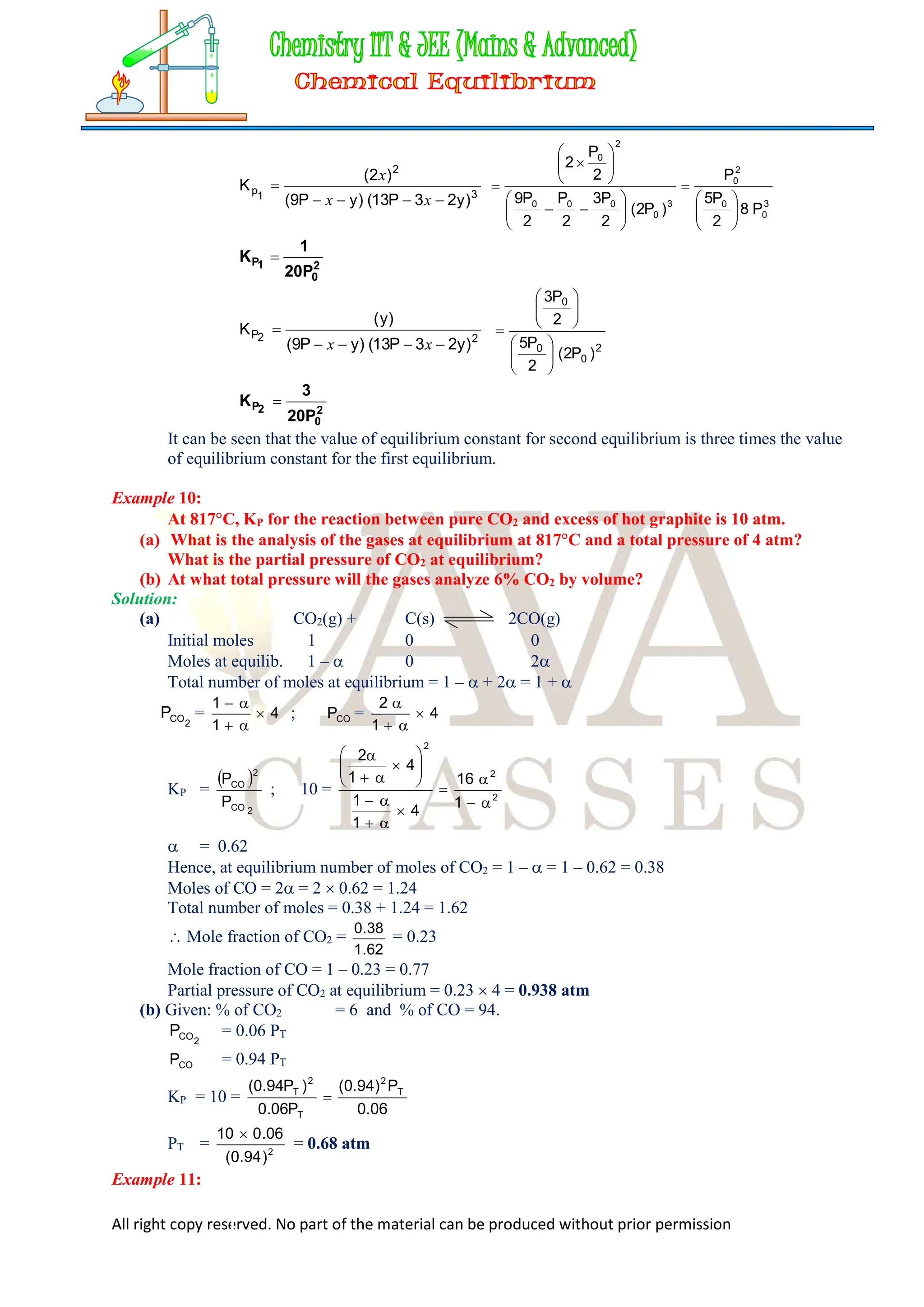
r e
A

………(3)
where, kr = rate constant for reverse reaction, Ar = Arrhenius constant for reverse reaction, and r
a
E =
Energy of activation for reverse reaction.
Dividing (2) by (3) we get,







 

RT
)
f
(
a
E
)
r
(
a
E
r
f
r
f
e
A
A
k
k
We know that K
k
k
r
f
 (equilibrium constant)
 K =







 

RT
)
f
(
a
E
)
r
(
a
E
r
f
r
f
e
A
A
k
k
At temperature T1,
1
T
K =







 
1
RT
)
f
(
a
E
)
r
(
a
E
r
f
e
A
A
………(4)
At temperature T2 (with the change of temperature, the Arrhenius constant and activation energies
of the forward and reverse reactions do not change),
2
T
K =







 
2
RT
)
f
(
a
E
)
r
(
a
E
r
f
e
A
A
………(5)
Dividing (5) by (4) we get
1
T
2
T
K
K
=
















 
1
T
1
2
T
1
R
)
f
(
a
E
)
r
(
a
E
e
Taking log of both the sides,
log
1
T
2
T
K
K
= 









1
2
)
f
(
a
)
r
(
a
T
1
T
1
R
303
.
2
E
E
The enthalpy of a reaction is defined in terms of activation energies of forward and reverse
reactions as )
f
(
a
)
r
(
a E
E  = H
 log
1
T
2
T
K
K
= 










1
2 T
1
T
1
R
303
.
2
H
 log
1
T
2
T
K
K
= 









2
1 T
1
T
1
R
303
.
2
H
………(6)
All right copy reserved. No part of the material can be produced without prior permission
(a) When H is positive (endothermic reactions), an increase in temperature (T2 > T1) will make
2
T
K > 1
T
K , i.e. the reaction goes more in the forward direction and with decrease in
temperature, reaction goes in reverse direction.
(b) When H is negative (exothermic reactions), an increase in temperature (T2 > T1), will take
2
T
K < 1
T
K i.e., the reaction goes in the reverse direction and with decrease in temperature,
reaction goes in the forward direction.
(c) The calculation of equilibrium constant from kinetic consideration is only one of the many
approaches. Since equilibrium constant is a thermodynamic quantity its definition and
calculation involve detailed thermodynamical consideration which is beyond the scope of IIT
JEE syllabus.
7.3 STOICHIOMETRY OF THE EQUILIBRIUM REACTION
The value of KP and KC depends upon the stoichiometry of reaction since the law of mass reaction
makes use of the given stoichiometric coefficients of the reaction.
N2(g) + 3H2(g) 2NH3(g)
KC =
 
  3
2
2
2
3
H
N
NH
………(i)
)
g
(
H
2
3
)
g
(
N
2
1
2
2  NH3(g)
C
K = 2
/
3
2
2
/
1
2
3
]
H
[
]
N
[
]
NH
[
………(ii)
From equation (i) and (ii)
C
C K
K 

Thus, in general if an equilibrium reaction is multiplied by ‘n’, the equilibrium constant of the new
reaction would become nth
power of the equilibrium constant of old reaction.
 (KC)new = n
old
C )
K
(
7.4 MODE OF WRITING A CHEMICAL EQUATION
The value of KP and KC also depend on the method of representing a chemical equation.
For example,
N2(g) + 3H2(g) 2NH3(g)
KC =
 
  3
2
2
2
3
H
N
NH
When the equilibrium reaction is reversed,
2NH3(g) N2(g) + 3H2(g)
C
K 
 =
C
2
3
3
2
2
K
1
]
NH
[
]
H
[
]
N
[

Now, if we write the equilibrium reaction as,
NH3(g) ½N2(g) + 3/2 H2(g)
C
K 

 =
C
3
2
/
3
2
2
/
1
2
K
1
]
NH
[
]
H
[
]
N
[

DEGREE OF DISSOCIATION
8
All right copy reserved. No part of the material can be produced without prior permission
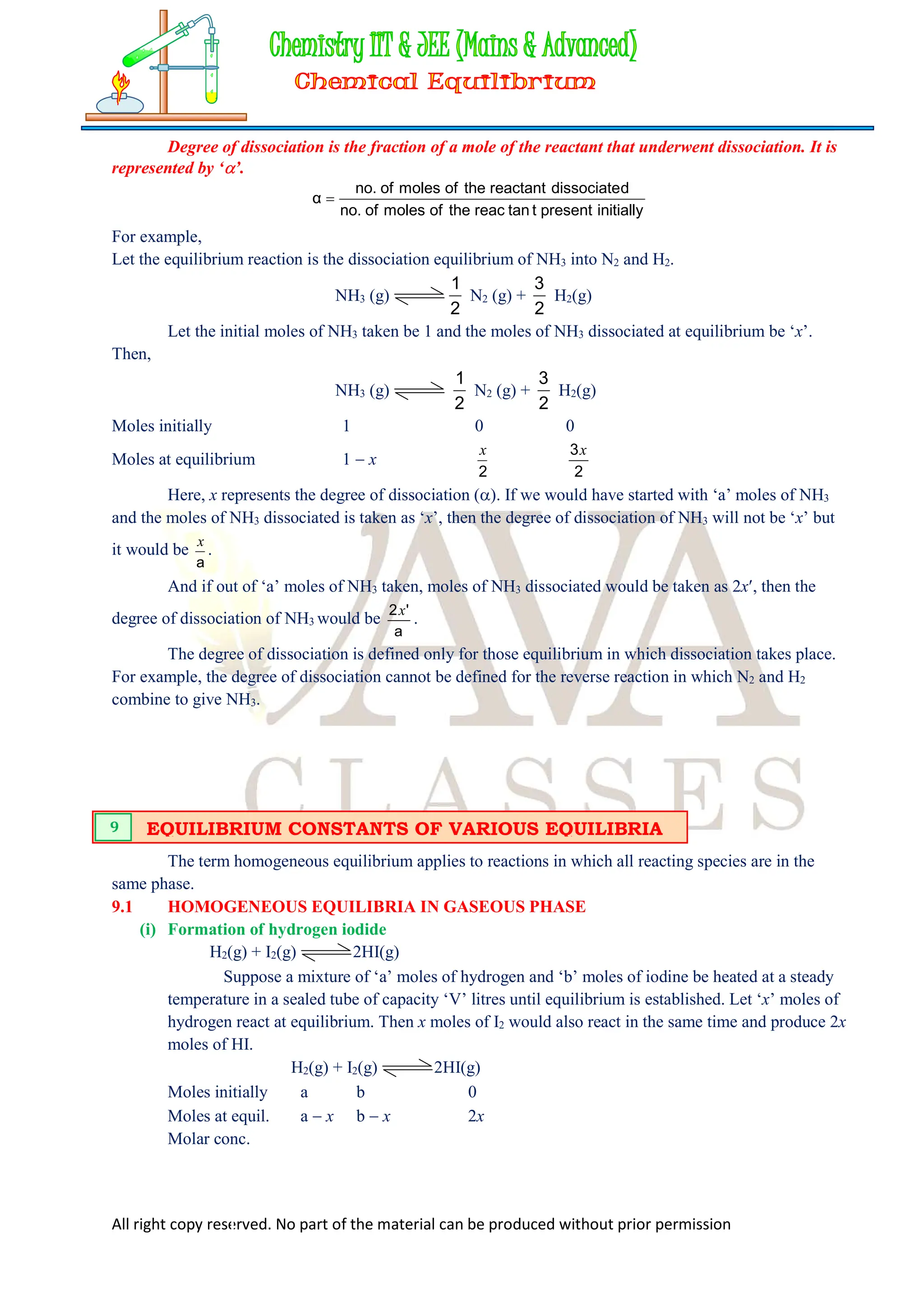
Degree of dissociation is the fraction of a mole of the reactant that underwent dissociation. It is
represented by ‘’.
initially
present
t
tan
reac
the
of
moles
of
no.
d
dissociate
reactant
the
of
moles
of
no.
α 
For example,
Let the equilibrium reaction is the dissociation equilibrium of NH3 into N2 and H2.
NH3 (g)
2
1
N2 (g) +
2
3
H2(g)
Let the initial moles of NH3 taken be 1 and the moles of NH3 dissociated at equilibrium be ‘x’.
Then,
NH3 (g)
2
1
N2 (g) +
2
3
H2(g)
Moles initially 1 0 0
Moles at equilibrium 1  x
2
x
2
3x
Here, x represents the degree of dissociation (). If we would have started with ‘a’ moles of NH3
and the moles of NH3 dissociated is taken as ‘x’, then the degree of dissociation of NH3 will not be ‘x’ but
it would be
a
x
.
And if out of ‘a’ moles of NH3 taken, moles of NH3 dissociated would be taken as 2x, then the
degree of dissociation of NH3 would be
a
'
2x
.
The degree of dissociation is defined only for those equilibrium in which dissociation takes place.
For example, the degree of dissociation cannot be defined for the reverse reaction in which N2 and H2
combine to give NH3.
The term homogeneous equilibrium applies to reactions in which all reacting species are in the
same phase.
9.1 HOMOGENEOUS EQUILIBRIA IN GASEOUS PHASE
(i) Formation of hydrogen iodide
H2(g) + I2(g) 2HI(g)
Suppose a mixture of ‘a’ moles of hydrogen and ‘b’ moles of iodine be heated at a steady
temperature in a sealed tube of capacity ‘V’ litres until equilibrium is established. Let ‘x’ moles of
hydrogen react at equilibrium. Then x moles of I2 would also react in the same time and produce 2x
moles of HI.
H2(g) + I2(g) 2HI(g)
Moles initially a b 0
Moles at equil. a  x b  x 2x
Molar conc.
EQUILIBRIUM CONSTANTS OF VARIOUS EQUILIBRIA
9
All right copy reserved. No part of the material can be produced without prior permission
at equil.
V
a x

V
b x

V
2x
KC =
  
x
x
x
x
x
x
2








 





 







b
a
4
V
b
V
a
V
2
]
[
]
H
[
]
H
[
2
2
2
2
I
I
Let PT be the total pressure at the equilibrium.




























T
T
2
T
2
2
H
2
H
P
P
b
a
b
P
b
a
a
P
b
a
2
)
P
(
)
P
(
)
P
(
K
x
x
x
I
I
=
  
x
x
x

 b
a
4 2
Thus, Kp = Kc
Also from the relation, Kp = Kc(RT)n
Since, n for this equilibrium reaction is zero,
 Kp = Kc
Illustration 1
Question: In an experiment it was found that when 20.55 moles of hydrogen were heated with
31.89 moles of iodine at 440C, the equilibrium mixture contained 2.06 moles of
hydrogen, 13.40 moles of iodine and 36.98 moles of HI. Calculate the equilibrium
constant for the reaction H2(g) + I2(g) 2HI(g).
Solution: In the problem, initial moles of H2 and I2 are given. The moles of H2, I2 and HI are also given
at equilibrium, so the initial moles are not needed in the problem to calculate Kc. Let the
volume of the container be ‘V’ litre.
KC =
 
  
40
.
13
06
.
2
98
.
36
V
40
.
13
V
06
.
2
V
98
.
36
]
[
]
H
[
]
H
[ 2
2
2
2




















2
I
I
= 49.54
Illustration 2
Question: A sample of HI was found to be 22% dissociated when equilibrium was reached. What
will be the degree of dissociation if hydrogen is added in the proportion of 1 mole for
every mole of HI originally present, the temperature and volume of the system being
kept constant?
Solution: The degree of dissociation () is the fraction of 1 mole of HI that has dissociated under the
given conditions. If the % dissociation of HI is 22, the degree of dissociation is
100
22
= 0.22.
2HI(g) H2(g) + I2(g)
Moles at equil. 1   /2 /2
1  0.22 = 0.78 0.11 0.11
KC =
 2
2
2
78
.
0
11
.
0
11
.
0
]
H
[
]
[
]
H
[ 

I
I2
= 0.0199
All right copy reserved. No part of the material can be produced without prior permission
Let us now add 1 mole of hydrogen when we start with 1 mole of HI. Let x be the
degree of dissociation.
2HI(g) H2(g) + I2(g)
Moles at equil. 1  x 





1
2
x
2
x
KC =
 2
2
2
1
2
1
2
]
H
[
]
[
]
H
[
x
x
x















I
I2
= 0.0199
x = 0.037 or –2.4 (not admissible)
Degree of dissociation = 0.037
% of dissociation = 3.7
(Introduction of H2 suppresses the dissociation of HI)
(ii) Thermal dissociation of PCl5
When PCl5 is heated in a closed vessel at a steady temperature (above 200C), the
following equilibrium is established.
PCl5(g) PCl3(g) + Cl2(g)
Moles at equil. 1    
Let  be the degree of dissociation. Then at equilibrium we will have (1 – ) mole of PCl5,
 mole of PCl3 and  mole of Cl2. If ‘V’ litres is the capacity of the vessel, then molar
concentration of various species would be
[PCl5] =
1 
V
; [PCl3] =

V
; [Cl2] =

V
KC =
V
1
V
V
]
PCl
[
]
Cl
[
]
PCl
[
5
2
3





 =


2
1
V( )

Let PT be the total pressure of the equilibrium system.
KP =
T
T
T
5
PCl
2
Cl
3
PCl
P
1
1
P
1
P
1
P
P
P





































= 2
T
2
1
P



 KP  KC (since n is not zero)
Illustration 3
Question: 0.1 mole of PCl5 is vapourized in a litre vessel at 200C. What will be the concentration
of chlorine at equilibrium if the equilibrium constant KC for the dissociation of PCl5 at
this temperature is 0.0414?
Solution: PCl5(g) PCl3(g) + Cl2(g)
Moles at equil. 1  x x x
Let x moles of chlorine be present at equilibrium
[PCl5] =
1
1
.
0 x

= 0.1 – x ; [PCl3] = x ; [Cl2] = x
KC = 0.0414 =
]
PCl
[
]
Cl
[
]
PCl
[
5
2
3
=
x
x

1
.
0
2
All right copy reserved. No part of the material can be produced without prior permission
x = 0.0469 moles/litre
[Cl2] = 0.0469 moles/litre
Illustration 4
Question: What will be the degree of dissociation of PCl5 when 0.1 mole of PCl5 is placed in a 3 L
vessel containing chlorine at 0.5 atm pressure and 250C? (KP = 1.78)
Solution: KP =
5
2
3
PCl
Cl
PCl
P
P
P 
= 1.78
Let x be the amount of PCl5 dissociated at equililbrium.
V
RT
P 3
PCl
x
 ;
V
RT
P 2
Cl
x
 + 0.5 ;
V
RT
)
1
.
0
(
P 5
PCl
x


 1.78 =
V
RT
)
1
.
0
(
5
.
0
V
RT
V
RT
x
x
x









=
 
x
x
x










1
.
0
5
.
0
3
523
082
.
0
x = 0.0574 mole
Degree of dissociation () of PCl5 is the fraction of 1 mole that has dissociated.
  =
1
.
0
0574
.
0
= 0.574.
(iii) Thermal dissociation of dinitrogen tetroxide
Between 22C and 150C, N2O4 undergoes thermal dissociation and the gas mixture
consists of N2O4 and NO2 in reversible equilibrium.
N2O4(g) 2NO2(g) (endothermic)
If 1 mol of N2O4 is enclosed in a vessel of volume ‘V’ litre and at equilibrium,  is the
degree of dissociation of N2O4, then
[N2O4] =
1 
V
; [NO2] =
2
V
KC =





 






 

V
1
V
2
]
O
N
[
]
NO
[
2
4
2
2
2


4
1
2


V( )



























T
2
T
4
O
2
N
2
2
NO
P
P
1
1
P
1
2
)
P
(
)
P
(
K = 2
T
2
1
P
4



where PT is the total equilibrium pressure.
 KP  KC (since n is not zero)
Illustration 5
Question: The equilibrium constant KP for the reaction N2O4(g) 2NO2(g) at 497C is found
to be 636 mm Hg. If the pressure of the gas mixture is 182 mm, calculate the percentage
dissociation of N2O4. At what pressure will it be half dissociated?
Solution: KP = 2
T
2
1
P
4



All right copy reserved. No part of the material can be produced without prior permission
636 = 2
2
1
182
4




636 – 6362
= 7282
13642
= 636
2
=
636
1364
= 0.4663 ;  = 4663
.
0 = 0.6829
% dissociation of N2O4 = 0.6829  100 = 68.29
When the gas is half dissociated,  = 0.5
Let the pressure be T
P mm Hg.
636 =
2
T
2
)
5
.
0
(
1
P
)
5
.
0
(
4




T
P = 477 mm
(iv) Synthesis of ammonia (Haber’s process)
N2(g) + 3H2(g) 2NH3(g) ; H = 46 kJ mol1
Suppose we start with 1 mole of nitrogen and 3 moles of H2 in a vessel of capacity ‘V’
litres and heat the mixture at a steady temperature (250C) under pressure.
Let x moles of N2 react. Then
N2(g) + 3H2(g) 2NH3(g)
Molar conc. at
V
1 x

V
)
1
(
3 x

V
2x
equilibrium
KC = 3
2
3
2
2
2
3
V
)
1
(
3
V
1
V
2
]
H
[
]
N
[
]
NH
[





 









x
x
x
= 4
2
2
)
1
(
27
V
4
x
x

KP =
 
   3
2
H
2
N
2
3
NH
P
P
P

= 3
T
T
2
T
P
2
4
)
1
(
3
P
2
4
)
1
(
P
2
4
2
































x
x
x
x
x
x
=
 2
T
4
2
2
P
)
1
(
27
)
2
4
(
4
x
x


x
where PT is the total pressure at equilibrium.
 KP  KC (as n is nonzero)
Illustration 6
Question: For the reaction
N2(g) + 3H2(g) 2NH3(g) ; H =  46 kJ mol1
Calculate the value of KP. Given KC = 0.5 lit2
mol2
at 400C.
Solution: KP = KC(RT)n
n = 2 – 4 = 2
All right copy reserved. No part of the material can be produced without prior permission
KP = 0.5(0.082  673)2
= 2
)
673
082
.
0
(
5
.
0

= 1.641  104
.
Illustration 7
Question: 1 mole of nitrogen is mixed with 3 moles of hydrogen in a 4 L container. If 0.25% of N2
is converted into ammonia by the following reaction
N2(g) + 3H2(g) 2NH3(g)
Calculate the equilibrium constant KC in concentration units. What will be the value of
KC for the following equilibrium?
1
2
N2(g) +
3
2
H2(g) NH3(g)
Solution: N2 + 3H2 2NH3
Initial 1 3 0 moles
Let x moles of N2 react at equilibrium.
Then 1 – x 3 – 3x 2x moles at equilibrium
KC =
3
2
V
3
3
V
1
V
2





 





 






x
x
x
=
4
2
2
)
1
(
27
V
4
x
x

=
4
2
2
)
0025
.
0
1
(
27
4
)
0025
.
0
(
4



KC = 1.496  105
litre2
mole2
KC =
3
2
2
2
3
]
H
[
]
N
[
]
NH
[
For the equilibrium 2
2 H
2
3
N
2
1
 NH3, the equilibrium constant would be
2
/
3
2
2
/
1
2
3
c
]
H
[
]
N
[
]
NH
[
K 
 = 

c
K 5
c 10
496
.
1
K 


= 3.86  103
litre mol1
9.2 HOMOGENEOUS EQUILIBRIA IN SOLUTION PHASE
Formation of ethyl acetate
This equilibrium can be represented by the equation
C2H5OH(l) + CH3COOH(l) CH3COOC2H5(l) + H2O(l)
Although for each species, we write l in the parenthesis but they are not pure liquids. Once
the liquids are mixed, they form a homogeneous solution. Thus, the concentration of each species
changes during establishment of equilibrium. If the system behaved ideally,
]
COOH
CH
[
]
OH
H
C
[
]
O
H
[
]
H
COOC
CH
[
K
3
5
2
2
5
2
3
c 
Let the total volume of the solution be ‘V’ litre and the initial number of moles of acetic
acid and that of ethanol be ‘a’ and ‘b’ respectively.
Let ‘x’ moles of acetic acid react at equilibrium. Then ‘x’ moles of ethyl acetate and ‘x’
moles of water would be formed. At equilibrium,
[CH3COOH] =
V
a x

; [C2H5OH] =
V
b x

; [CH3COOC2H5] =
V
x
; [H2O] =
V
x
All right copy reserved. No part of the material can be produced without prior permission
KC =
)
b
(
)
a
(
V
)
b
(
V
)
a
(
V
V
2
x
x
x
x
x
x
x







Illustration 8
Question: Determine the amount of ester present under equilibrium when 3 moles of ethyl alcohol
react with 1 mole of acetic acid, when equilibrium constant of the reaction is 4.
Solution: CH3COOH + C2H5OH CH3COOC2H5 + H2O
1 – x 3 – x x x
KC = 4 =
)
3
(
)
1
( x
x
x
x



= 2
2
4
3 x
x
x


3x2
– 16x + 12 = 0
x = 0.903 or 4.43 (inadmissible)
 Amount of ester at equilibrium = 0.903 mole.
9.3 EQUILIBRIUM CONSTANT FOR VARIOUS HETEROGENEOUS EQUILIBRIA
Heterogeneous equilibrium results from a reversible reaction involving reactants and products that
are in different phases. The law of mass action applicable to a homogeneous equilibrium is also
applicable to a heterogeneous system.
(a) Decomposition of solid CaCO3 into solid CaO and gaseous CO2
Let ‘a’ moles of CaCO3 are taken in a vessel of volume ‘V’ litre at temperature ‘T’ K.
CaCO3(s) CaO(s) + CO2(g)
Moles initially a 0 0
Moles at equilibrium a  x x x
Keq =
]
CaCO
[
]
CO
[
]
CaO
[
3
2

As CaCO3 and CaO(s) are pure solids, so their d/M is a constant and their concentrations do not
change as long as they are present. Thus the equilibrium expression can be rearranged as
Keq ]
CO
[
]
CaO
[
]
CaCO
[
2
3

It can be seen that left hand side of the equation is a constant represented by Kc.
 Kc = [CO2] =
V
x
……..(i)
Assuming CO2 gas to behave ideally at the temperature & pressure of the reaction, the molar
concentration of CO2 can be written using ideal gas equation as
RT
P 2
CO
.
 Kc =
RT
P 2
CO
Kc(RT) = 2
CO
P
Since Kc, R and T are constants, their product will also be a constant referred as Kp.
 Kp = 2
CO
P =
V
RT
x
……..(ii)
From equation (i) and (ii), it is clear that whenever the equilibrium would be attained at ‘T’
K, in a vessel of volume ‘V’ litre, the moles of CO2 present at equilibrium should be
x (which can exert a pressure equal to )
P 2
CO If rather than starting with ‘a’ mole of CaCO3, we
All right copy reserved. No part of the material can be produced without prior permission
start with x moles of CaCO3 in the vessel of volume ‘V’ at ‘T’K, then the entire CaCO3 would
have decomposed to give CO2 but the equilibrium can not be maintained as there would be no
CaCO3 left. Further if the moles of CaCO3 taken in the same vessel at same temperature were less
than x, the equilibrium would never be attained. Thus, any amount (moles) of CaCO3 more than x
would be sufficient to establish the equilibrium. So the minimum moles of CaCO3 required would
be x, as any moles more than this would be sufficient to establish the equilibrium. So the minimum
moles of CaCO3 required to attain equilibrium under given conditions would be x.
The given equilibrium can be made to move in the forward direction by either removing
some moles of CO2 or by increasing the volume of the container or by increasing the temperature
of the reaction (as the reaction is endothermic). Addition of solid CaCO3 or CaO to the equilibrium
mixture will not affect the equilibrium at all.
For such equilibria, at any temperature, there will be a fixed value of the pressure of CO2,
which is called as dissociation pressure. The dissociation pressure of heterogeneous equilibria is
defined as the total pressure exerted by the gaseous species in equilibrium with the solid species.
The relation giving the variation of Kp with temperature is
log 








2
1
1
T
p
2
T
p
T
1
T
1
R
303
.
2
H
)
K
(
)
K
(
Illustration 9
Question: Consider the following heterogeneous equilibrium,
CaCO3(s) CaO(s) + CO2(g).
At 800°C, the pressure of CO2 is 0.236 atm. Calculate
(a) Kp and (b) Kc for the equilibrium reaction at this temperature.
Solution: For the given equilibrium, partial pressure of CO2 is nothing but equal to Kp.
 Kp = 2
CO
p = 0.236 atm
For an equilibrium reaction,
Kp = Kc(RT)n
As n = 1, so Kc =
1073
0821
.
0
236
.
0
RT
Kp


 Kc = 2.68  103
moles/litre
(b) Reaction of solid phosphorous with gaseous Cl2 to form liquid PCl3
P4(s) + 6Cl2(g) 4PCl3(l)
The equilibrium constant is given by
 
  6
2
4
4
3
eq
Cl
P
PCl
K 
Since, pure solids and pure liquids do not appear in the equilibrium constant expression, thus
expression can be rearranged as
 
   6
2
4
3
4
eq
Cl
1
PCl
P
K 
 Kc = 6
2 ]
Cl
[
1
Alternatively, we can express the equilibrium constant in terms of the pressure of Cl2.
Kp = 6
2
Cl )
p
(
1
(iii) Dissociation of ammonium hydrogen sulfide
All right copy reserved. No part of the material can be produced without prior permission
Let the moles of NH4HS(s) taken in a vessel of volume ‘V’ litre be ‘a’ at temperature ‘T’K.
At equilibrium, x moles of NH4HS dissociates to give NH3(g) and H2S(g).
NH4HS(s) NH3(g) + H2S(g)
Moles initially a 0 0
Moles of equilibrium a  x x x
Keq =
]
HS
NH
[
]
S
H
[
]
NH
[
4
2
3
As the concentration of NH4HS is a constant, so it can be merged with Keq to get KC.
Keq [NH4HS] = [NH3] [H2S]
 KC = [NH3] [H2S] =
2
V
V
V



















 x
x
x
Assuming H2S and NH3 to behave ideally at the given temperature and pressure of the
reaction, the molar concentration of the gas can be written as .
RT
P
 [NH3] = [H2S] =
RT
P
RT
P S
2
H
3
NH

 KC = 
















RT
P
RT
P S
2
H
3
NH
KC(RT)2
= S
2
H
3
NH P
P 
Since, LHS of the expression is a constant, it can be represented by another constant, KP.
 KP = .
P
P S
H
NH 2
3

If the dissociation pressure measured for NH4HS be PT atm, then
S
H
NH 2
3
P
P  =
2
PT
 KP =
 
4
P
2
P
2
P
2
T
T
T














We have so far considered relatively simple equilibrium reactions. Let us take a slightly
complicated situation, in which the product molecules(s) in one equilibrium system are involved in a
second equilibrium process.
A(g) + B(g) C(g) + D(g) ;
]
B
[
]
A
[
]
D
[
]
C
[
K 1
C 
C(g) + E(g) F(g) + G(g) ;
]
E
[
]
C
[
]
G
[
]
F
[
K 2
C 
Overall reaction: A(g) + B(g) + E(g) D(g) + F(g) + G(g) ;
]
E
[
]
B
[
]
A
[
]
G
[
]
F
[
]
D
[
K 3
C 
In this case, one of the product molecule, C(g) of the first equilibrium reaction combines with E(g)
to give F(g) and G(g) in another equilibrium reaction, so in the overall reaction, C(g) will not appear on
either side.
MULTIPLE EQUILIBRIA
10
All right copy reserved. No part of the material can be produced without prior permission
The equilibrium constant )
K
( 3
C of the overall reaction can be obtained if we take the product of the
expressions of )
K
( 1
C and )
K
( 2
C .
]
E
[
]
B
[
]
A
[
]
G
[
]
F
[
]
D
[
]
E
[
]
C
[
]
G
[
]
F
[
]
B
[
]
A
[
]
D
[
]
C
[
K
K 2
C
1
C 



 3
C
2
C
1
C K
K
K 

Thus, if a equilibrium reaction can be expressed as the sum of two or more equilibrium
reactions, then the equilibrium constant for the overall reaction is given by the product of the
equilibrium constants of the individual reactions.
When more than one equilibrium are established in a vessel at the same time and any one of the
reactant or product is common in more than one equilibrium, then the equilibrium concentration of the
common species in all the equilibrium would be same.
For example, if we take CaCO3(s) and C(s) together in a vessel of capacity ‘V’ litre and heat it at
temperature ‘T’ K, then CaCO3 decomposes to CaO(s) and CO2(g). Further, evolved CO2 combines with
the C(s) to give carbon monoxide. Let the moles of CaCO3 and carbon taken initially be ‘a’ and ‘b’
respectively.
CaCO3(s) CaO(s) + CO2(g)
Moles at equilibrium a  x x (x  y)
CO2(g) + C(s) 2CO(g)
Moles at equilibrium (x  y) (b  y) 2y
Thus, as CO2 is common in both the equilibrium so its concentration is same in both the
equilibrium constant expressions.
Equilibrium constant for first equilibrium, 1
C
K = [CO2] =
V
y

x
Equilibrium constant for second equilibrium, 2
C
K =
 
 
2
2
CO
CO
=
)
y
V
V
2
(
2

(x
y)2
=
y)
V(x
4y2

POINTS TO BE REMEMBERED FOR WRITING EQUILIBRIUM CONSTANT EXPRESSIONS
 The concentration of the reacting species in the solution phase is expressed in mol/litre.
 The concentration of the reacting species in the gaseous phase can be expressed either in mol/litre
or in atm.
 The concentration of pure solid, pure liquids (in heterogeneous equilibria) and solvents
(in homogeneous equilibria) are constant and do not appear in the equilibrium constant expression
of a reaction.
 Kp and Kc are related as, Kp = Kc(RT)n
where n = number of moles of gaseous product number
of moles of gaseous reactant.
 It is not customary to write units of equilibrium constants (Kp and Kc) but when mentioned, the
units of Kp are (atm)n
and units of Kc are .
litre
moles
n







 In quoting the value of equilibrium constant, we must specify the balanced equation and the
temperature at which equilibrium is established.
 If a reaction can be expressed as the sum of two or more reactions, the product of the equilibrium
constants of the individual reactions gives the equilibrium constant for the overall reaction.
SIMULTANEOUS EQUILIBRIA
11
All right copy reserved. No part of the material can be produced without prior permission
 If two equilibria have been established in a vessel and any reactant or product is common to both
the equilibria, then the equilibrium concentration of the common species will be same in both the
equilibria.
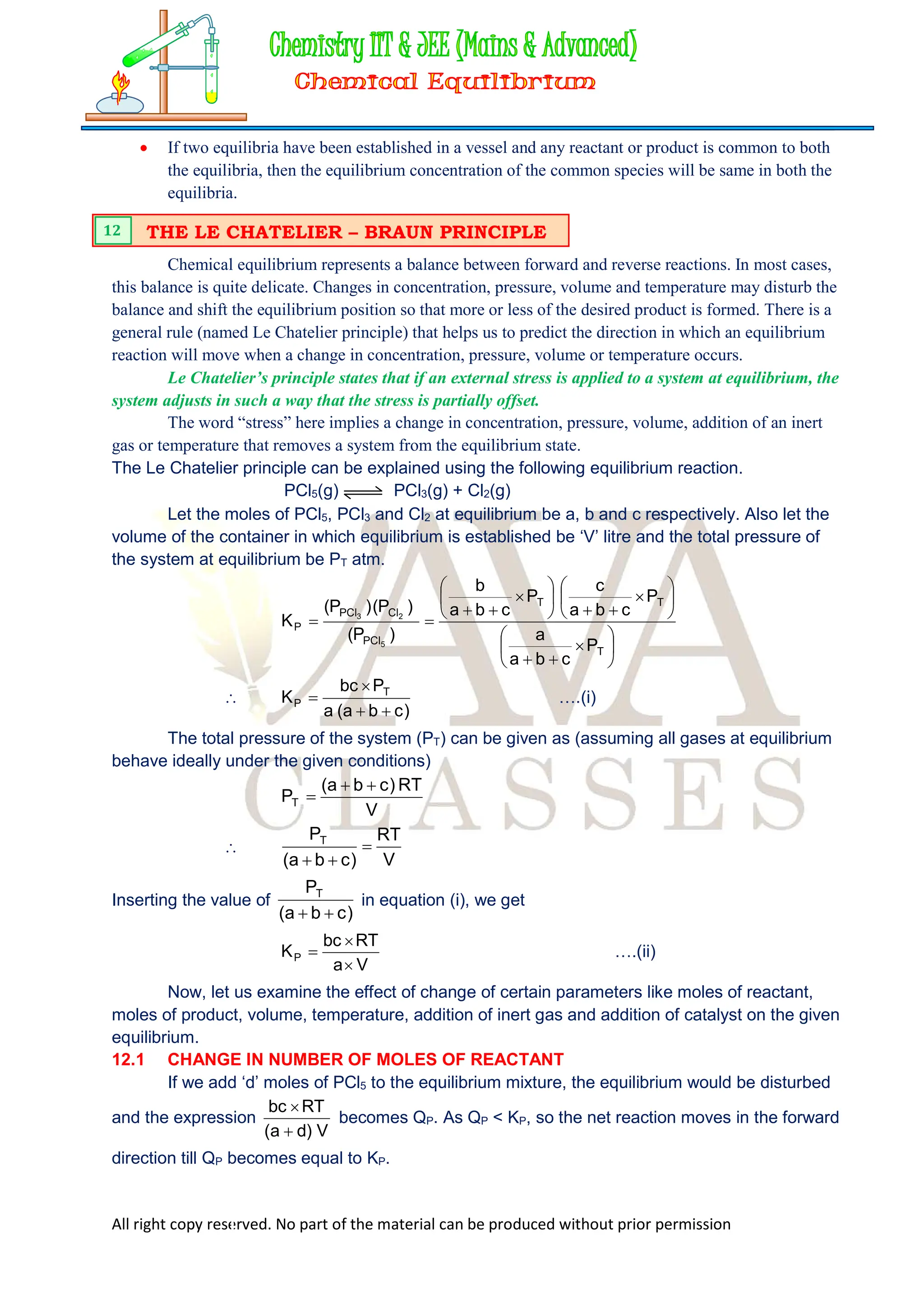
Chemical equilibrium represents a balance between forward and reverse reactions. In most cases,
this balance is quite delicate. Changes in concentration, pressure, volume and temperature may disturb the
balance and shift the equilibrium position so that more or less of the desired product is formed. There is a
general rule (named Le Chatelier principle) that helps us to predict the direction in which an equilibrium
reaction will move when a change in concentration, pressure, volume or temperature occurs.
Le Chatelier’s principle states that if an external stress is applied to a system at equilibrium, the
system adjusts in such a way that the stress is partially offset.
The word “stress” here implies a change in concentration, pressure, volume, addition of an inert
gas or temperature that removes a system from the equilibrium state.
The Le Chatelier principle can be explained using the following equilibrium reaction.
PCl5(g) PCl3(g) + Cl2(g)
Let the moles of PCl5, PCl3 and Cl2 at equilibrium be a, b and c respectively. Also let the
volume of the container in which equilibrium is established be ‘V’ litre and the total pressure of
the system at equilibrium be PT atm.





























T
T
T
PCl
Cl
PCl
P
P
c
b
a
a
P
c
b
a
c
P
c
b
a
b
)
P
(
)
P
(
)
P
(
K
5
2
3

)
c
b
a
(
a
P
bc
K T
P



 ….(i)
The total pressure of the system (PT) can be given as (assuming all gases at equilibrium
behave ideally under the given conditions)
V
RT
)
c
b
a
(
PT




V
RT
)
c
b
a
(
PT



Inserting the value of
)
c
b
a
(
PT


in equation (i), we get
V
a
RT
bc
KP


 ….(ii)
Now, let us examine the effect of change of certain parameters like moles of reactant,
moles of product, volume, temperature, addition of inert gas and addition of catalyst on the given
equilibrium.
12.1 CHANGE IN NUMBER OF MOLES OF REACTANT
If we add ‘d’ moles of PCl5 to the equilibrium mixture, the equilibrium would be disturbed
and the expression
V
)
d
a
(
RT
bc


becomes QP. As QP < KP, so the net reaction moves in the forward
direction till QP becomes equal to KP.
THE LE CHATELIER – BRAUN PRINCIPLE
12
All right copy reserved. No part of the material can be produced without prior permission
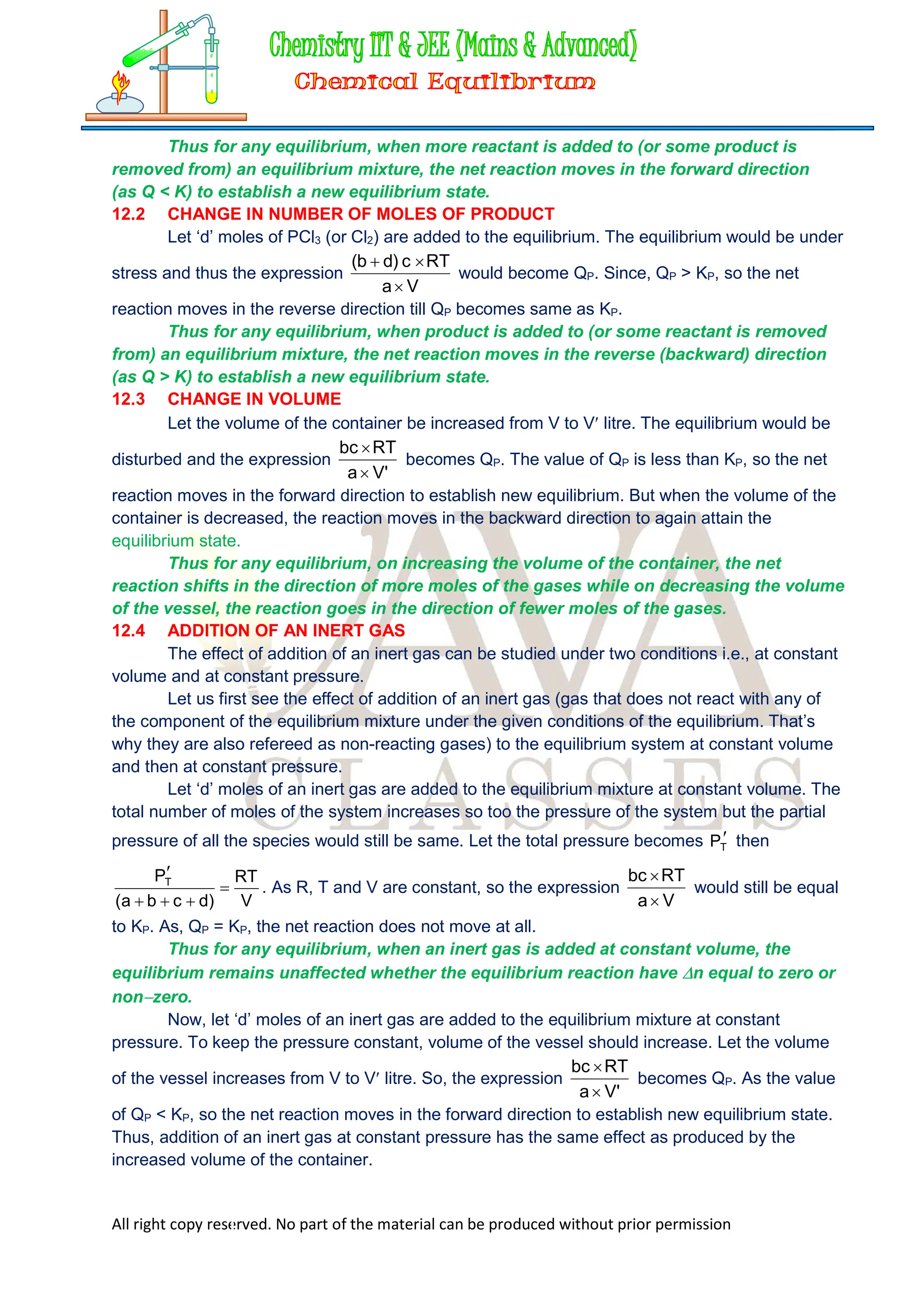
Thus for any equilibrium, when more reactant is added to (or some product is
removed from) an equilibrium mixture, the net reaction moves in the forward direction
(as Q < K) to establish a new equilibrium state.
12.2 CHANGE IN NUMBER OF MOLES OF PRODUCT
Let ‘d’ moles of PCl3 (or Cl2) are added to the equilibrium. The equilibrium would be under
stress and thus the expression
V
a
RT
c
)
d
b
(



would become QP. Since, QP > KP, so the net
reaction moves in the reverse direction till QP becomes same as KP.
Thus for any equilibrium, when product is added to (or some reactant is removed
from) an equilibrium mixture, the net reaction moves in the reverse (backward) direction
(as Q > K) to establish a new equilibrium state.
12.3 CHANGE IN VOLUME
Let the volume of the container be increased from V to V litre. The equilibrium would be
disturbed and the expression
'
V
a
RT
bc


becomes QP. The value of QP is less than KP, so the net
reaction moves in the forward direction to establish new equilibrium. But when the volume of the
container is decreased, the reaction moves in the backward direction to again attain the
equilibrium state.
Thus for any equilibrium, on increasing the volume of the container, the net
reaction shifts in the direction of more moles of the gases while on decreasing the volume
of the vessel, the reaction goes in the direction of fewer moles of the gases.
12.4 ADDITION OF AN INERT GAS
The effect of addition of an inert gas can be studied under two conditions i.e., at constant
volume and at constant pressure.
Let us first see the effect of addition of an inert gas (gas that does not react with any of
the component of the equilibrium mixture under the given conditions of the equilibrium. That’s
why they are also refereed as non-reacting gases) to the equilibrium system at constant volume
and then at constant pressure.
Let ‘d’ moles of an inert gas are added to the equilibrium mixture at constant volume. The
total number of moles of the system increases so too the pressure of the system but the partial
pressure of all the species would still be same. Let the total pressure becomes 
T
P then
V
RT
)
d
c
b
a
(
PT





. As R, T and V are constant, so the expression
V
a
RT
bc


would still be equal
to KP. As, QP = KP, the net reaction does not move at all.
Thus for any equilibrium, when an inert gas is added at constant volume, the
equilibrium remains unaffected whether the equilibrium reaction have n equal to zero or
nonzero.
Now, let ‘d’ moles of an inert gas are added to the equilibrium mixture at constant
pressure. To keep the pressure constant, volume of the vessel should increase. Let the volume
of the vessel increases from V to V litre. So, the expression
'
V
a
RT
bc


becomes QP. As the value
of QP < KP, so the net reaction moves in the forward direction to establish new equilibrium state.
Thus, addition of an inert gas at constant pressure has the same effect as produced by the
increased volume of the container.
All right copy reserved. No part of the material can be produced without prior permission
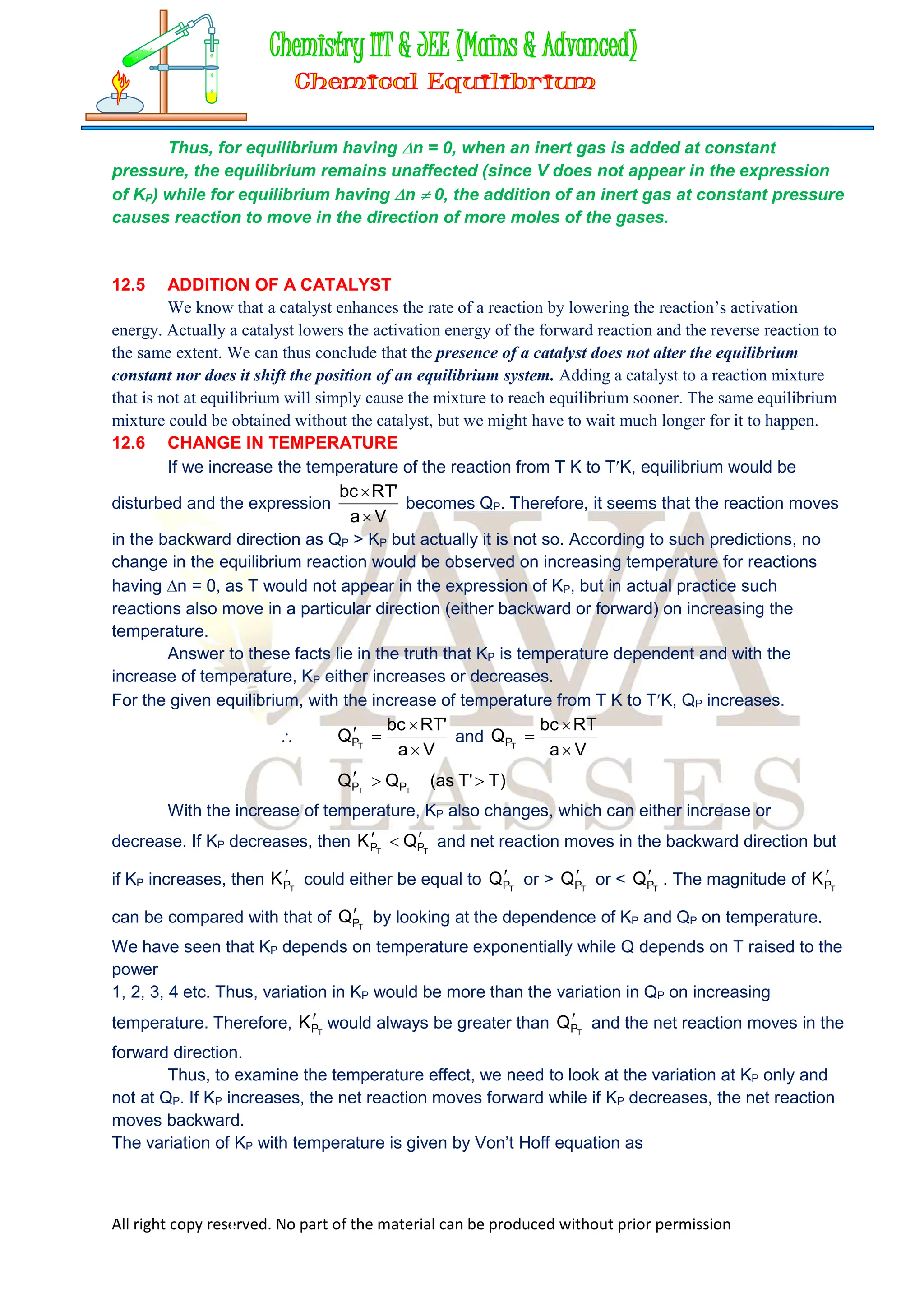
Thus, for equilibrium having n = 0, when an inert gas is added at constant
pressure, the equilibrium remains unaffected (since V does not appear in the expression
of KP) while for equilibrium having n  0, the addition of an inert gas at constant pressure
causes reaction to move in the direction of more moles of the gases.
12.5 ADDITION OF A CATALYST
We know that a catalyst enhances the rate of a reaction by lowering the reaction’s activation
energy. Actually a catalyst lowers the activation energy of the forward reaction and the reverse reaction to
the same extent. We can thus conclude that the presence of a catalyst does not alter the equilibrium
constant nor does it shift the position of an equilibrium system. Adding a catalyst to a reaction mixture
that is not at equilibrium will simply cause the mixture to reach equilibrium sooner. The same equilibrium
mixture could be obtained without the catalyst, but we might have to wait much longer for it to happen.
12.6 CHANGE IN TEMPERATURE
If we increase the temperature of the reaction from T K to TK, equilibrium would be
disturbed and the expression
V
a
'
RT
bc


becomes QP. Therefore, it seems that the reaction moves
in the backward direction as QP > KP but actually it is not so. According to such predictions, no
change in the equilibrium reaction would be observed on increasing temperature for reactions
having n = 0, as T would not appear in the expression of KP, but in actual practice such
reactions also move in a particular direction (either backward or forward) on increasing the
temperature.
Answer to these facts lie in the truth that KP is temperature dependent and with the
increase of temperature, KP either increases or decreases.
For the given equilibrium, with the increase of temperature from T K to TK, QP increases.

V
a
'
RT
bc
Q T
P



 and
V
a
RT
bc
Q T
P



)
T
'
T
as
(
Q
Q T
T P
P 


With the increase of temperature, KP also changes, which can either increase or
decrease. If KP decreases, then 
  T
T P
P Q
K and net reaction moves in the backward direction but
if KP increases, then T
P
K could either be equal to T
P
Q or > T
P
Q or < T
P
Q . The magnitude of T
P
K
can be compared with that of T
P
Q by looking at the dependence of KP and QP on temperature.
We have seen that KP depends on temperature exponentially while Q depends on T raised to the
power
1, 2, 3, 4 etc. Thus, variation in KP would be more than the variation in QP on increasing
temperature. Therefore, T
P
K would always be greater than T
P
Q and the net reaction moves in the
forward direction.
Thus, to examine the temperature effect, we need to look at the variation at KP only and
not at QP. If KP increases, the net reaction moves forward while if KP decreases, the net reaction
moves backward.
The variation of KP with temperature is given by Von’t Hoff equation as
All right copy reserved. No part of the material can be produced without prior permission










'
T
1
T
1
R
303
.
2
H
K
K
log
T
T
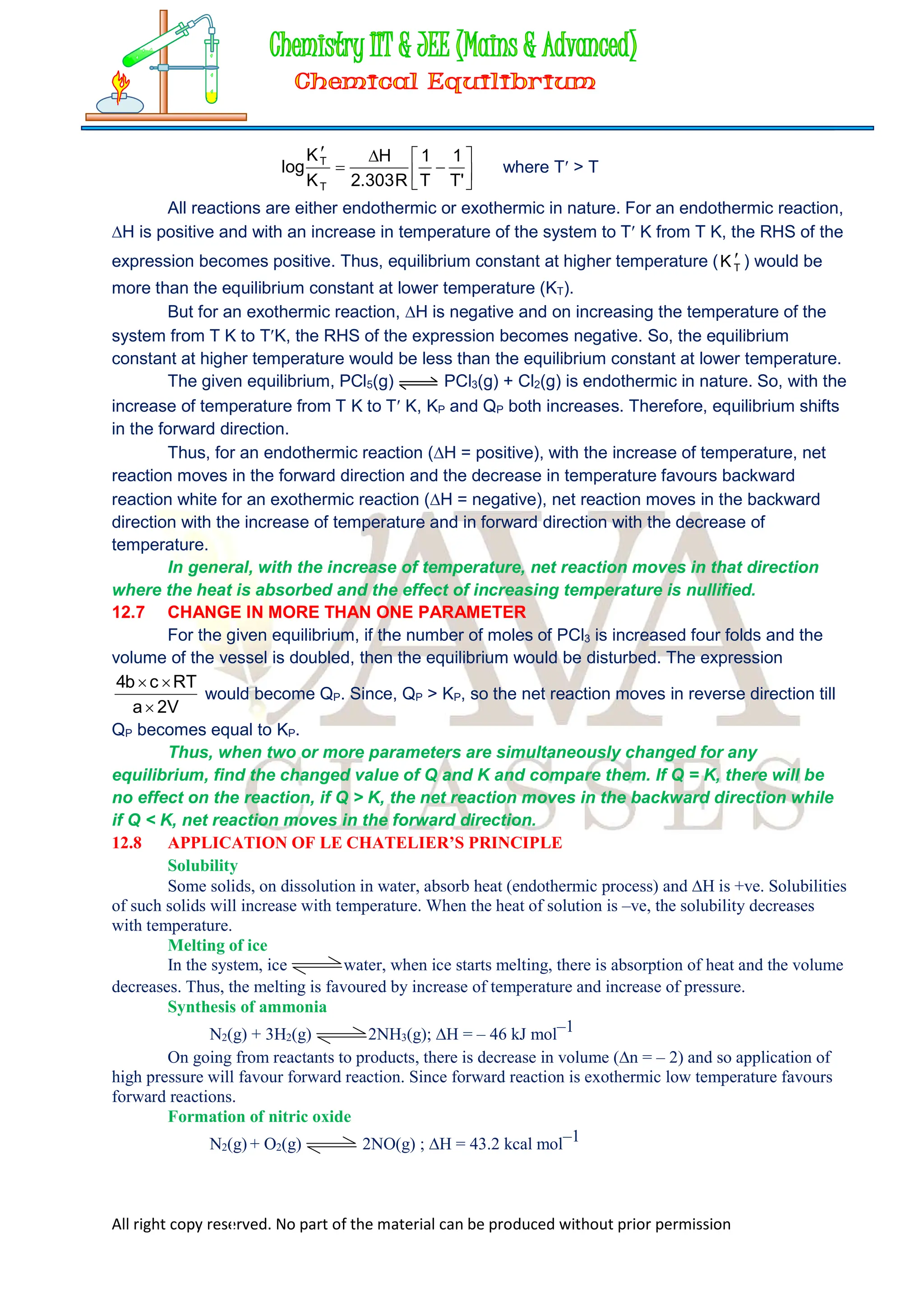
where T > T
All reactions are either endothermic or exothermic in nature. For an endothermic reaction,
H is positive and with an increase in temperature of the system to T K from T K, the RHS of the
expression becomes positive. Thus, equilibrium constant at higher temperature ( 
T
K ) would be
more than the equilibrium constant at lower temperature (KT).
But for an exothermic reaction, H is negative and on increasing the temperature of the
system from T K to TK, the RHS of the expression becomes negative. So, the equilibrium
constant at higher temperature would be less than the equilibrium constant at lower temperature.
The given equilibrium, PCl5(g) PCl3(g) + Cl2(g) is endothermic in nature. So, with the
increase of temperature from T K to T K, KP and QP both increases. Therefore, equilibrium shifts
in the forward direction.
Thus, for an endothermic reaction (H = positive), with the increase of temperature, net
reaction moves in the forward direction and the decrease in temperature favours backward
reaction white for an exothermic reaction (H = negative), net reaction moves in the backward
direction with the increase of temperature and in forward direction with the decrease of
temperature.
In general, with the increase of temperature, net reaction moves in that direction
where the heat is absorbed and the effect of increasing temperature is nullified.
12.7 CHANGE IN MORE THAN ONE PARAMETER
For the given equilibrium, if the number of moles of PCl3 is increased four folds and the
volume of the vessel is doubled, then the equilibrium would be disturbed. The expression
V
2
a
RT
c
b
4



would become QP. Since, QP > KP, so the net reaction moves in reverse direction till
QP becomes equal to KP.
Thus, when two or more parameters are simultaneously changed for any
equilibrium, find the changed value of Q and K and compare them. If Q = K, there will be
no effect on the reaction, if Q > K, the net reaction moves in the backward direction while
if Q < K, net reaction moves in the forward direction.
12.8 APPLICATION OF LE CHATELIER’S PRINCIPLE
Solubility
Some solids, on dissolution in water, absorb heat (endothermic process) and H is +ve. Solubilities
of such solids will increase with temperature. When the heat of solution is –ve, the solubility decreases
with temperature.
Melting of ice
In the system, ice water, when ice starts melting, there is absorption of heat and the volume
decreases. Thus, the melting is favoured by increase of temperature and increase of pressure.
Synthesis of ammonia
N2(g) + 3H2(g) 2NH3(g); H = – 46 kJ mol–1
On going from reactants to products, there is decrease in volume (n = – 2) and so application of
high pressure will favour forward reaction. Since forward reaction is exothermic low temperature favours
forward reactions.
Formation of nitric oxide
N2(g) + O2(g) 2NO(g) ; H = 43.2 kcal mol–1
All right copy reserved. No part of the material can be produced without prior permission
Since n = 0, there is no effect on changing the pressure. High temperature favours forward
reaction.
Dissociation of PCl5
PCl5(g) PCl3(g) + Cl2(g) ; H = +ve
Conditions favourable for forward reactions are (i) low pressure, (ii) high temperature. Oxidation
of carbon monoxide by steam:
CO(g) + H2O(g) CO2(g) + H2(g) ; H = –ve
n = 0 and so pressure has no effect. Low temperature favours forward reaction and so by
employing excess of steam.
Illustration 10
Question:For the gaseous equilibrium at high temperature,
PCl5(g) PCl3(g) + Cl2(g); H = 87.9 kJ
explain the effect upon the material distribution of (a) increased temperature (b)
increased pressure (c) higher concentration of Cl2 (d) higher concentration of PCl5 and
(e) presence of a catalyst.
Solution:(a) When the temperature of a system in equilibrium is raised (by addition of heat), the
equilibrium is displaced in the direction which absorbs heat. Hence increasing the
temperature will cause more PCl5 to dissociate.
(b) When the pressure of a system in equilibrium is increased, the equilibrium is displaced in the
direction of the smaller volume. One volume each of PCl3 and Cl2, a total of 2 gas volumes
(on the product side) from only 1 volume of PCl5. Hence a pressure increase will promote
the reaction to form more PCl5.
(c) Increasing the concentration of any component will displace the equilibrium in the direction
which tends to lower the concentration of the component added. Increasing the concentration
of Cl2 will result in the consumption of more PCl3 and the formation of more PCl5 and this
action will tend to offset the increased concentration of Cl2.
(d) Increasing the concentration of PCl5 will result in the formation of more PCl3 and Cl2 or
more dissociation of PCl5.
(e) A catalyst accelerates both forward and backward reactions equally. It speeds up the
approach to equilibrium but does not favor reaction in either direction.
The relation between vapour density and the degree of dissociation can be established only for a
gaseous equilibrium whose KP exists. For example,
A(g) nB (g)
Initial conc. c 0
Conc. at equilibrium c(1  ) nc
Total concentration at equilibrium = c  c + nc = c [1   + n] = c [1 +  (n – 1)]
Assuming that all the gaseous components at equilibrium behave ideally, we can apply ideal gas
equation.
RT
M
w
nRT
PV 


P
RT
P
RT
V
w
M




 V.D =
P
2
RT

….(i) [since molar mass = 2  V.D]
RELATION BETWEEN VAPOUR DENSITY AND DEGREE OF DISSOCIATION
13
All right copy reserved. No part of the material can be produced without prior permission
As pressure of the system is given by,
V
nRT
P  , so putting the value of P in equation (i) gives
V.D =
n
2
V
V
nRT
2
RT 



where  is the density of the gas or gaseous mixture expressed in g/litre.
If the equilibrium reaction is established in a closed vessel, then vapour density will be inversely
proportional to the number of moles of the gaseous species as the density of the gaseous mixture () is a
constant.

reactant
gaseous
of
moles
Initial
m
equilibriu
at
gases
of
moles
Total
m
equilibriu
at
density
Vapour
density
vapour
Initial

Let the initial vapour density and vapour density at equilibrium be ‘D’ and ‘d’ respectively, then
for the given equilibrium
c
)]
1
n
(
1
[
c
d
D 



or )]
1
n
(
1
[
d
D




or )
1
n
(
1
d
D





d
n
d
D
)
1
(
)
(




where ‘n’ represents the number of moles of gaseous product given by 1 mole of the gaseous reactant.
Knowing D, d and n, the degree of dissociation () can be calculated.
The vapour density measurement is used for the determination of degree of dissociation of only
those equilibria in which 1 mole of the gaseous reactant gives more than one mole of gaseous products.
Because when one mole of the gaseous reactant gives only one mole of gaseous product, then ‘D’ and ‘d’
would be same and ‘’ can not be determined.
As you might be aware, every process in nature occurs in order to reduce the energy of a system.
This is because reduced energy state has fewer tendencies to undergo change thereby it brings stability.
When an object falls from a certain height, the process reduces the potential energy of the system. Where
as, if the object is to be taken to a certain height the potential energy increases. That’s why the former
occurs on its own, while for the latter work has to be done.
Chemical reactions too occur with decrease in energy. One might of course wonder how does an
endothermic reaction occur? Well, even endothermic reactions occur with decrease in energy! This
statement may contradict the very definition of endothermic reactions. Not so if you read on.
The energy that decreases in a chemical reaction, which brings about stability, is called Free
Energy. It is the decrease in free energy that causes a reaction to happen. For endothermic reactions also,
the free energy decreases, even though the total energy increases. This can be understood by figuring out
what is free energy?
Free energy of a system, say for example a molecule like CH4, is the total intrinsic electrostatic
potential energy of the system. In a CH4 molecule, there are in total 10 protons
(6 of C and 1 each of H) and 10 electrons (6 of C and 1 each of H). If we were to calculate the total
electrostatic potential energy of the system by calculating the potential energy of all charges due to all
other charges and adding the sum, the result would be the free energy of CH4 molecule.
For this, one needs to know the distance between all the charges, which is not practically possible. But the
concept of free energy is very useful to understand the direction of reactions. Free energy represents the
RELATION BETWEEN FREE ENERGY CHANGE & EQUILIBRIUM CONSTANT
14
All right copy reserved. No part of the material can be produced without prior permission
stability of a system. Lower the value of free energy; more are the attractive forces in the system and
consequently more is the stability. If one were to ask why methane is a tetrahedron then a safe answer
would be that it is the tetrahedral shape that allows methane to have the least possible free energy. With
temperature free energy is likely to change as bond distances and angles may get altered.
Let us consider a reaction,
A + B C + D
Free Energy per mole 3 6 2 5
(in kJ)
No. of mole 2 3 4 1
If we look at this reaction we can see that the total Free Energy on the left is
[2  (3)] + [3  (6)] = 24. On the other hand, the free energy on the right side is [4  (2)] + [1  (5)] = 13.
This means that the left side of the reaction has greater instability than the right side. So to bring about
stability, the free energy lowers itself by moving the reaction to the forward direction. The corollary of this
is that the reverse reaction does not occur because this would bring about instability. As the forward
reaction occurs the number of mole of A & B decreases while that of
C & D increases. This makes the number on the left side smaller and that of the right side bigger. Finally a
stage is reached when the free energy of the left and the right become equal. This is the stage when
equilibrium is established. At this juncture the reverse reaction starts to occur (because free energy while
going reverse is not taking the reaction to the side of instability) with the same speed as that of the forward
reaction.
Therefore, free energy change is zero when the reaction is at equilibrium (G = 0).
When the concentration of all reactants and products is 1 mole/litre, the change in Free Energy is
represented as
0
G
 . For the reaction shown
0
G
 = 2.
Thus, G is the free energy change at any given concentration of reactants and products.
If all the reactants and products are taken at a concentration of one mol per litre, the free energy change of
the reaction is called
0
G
 (standard free energy change). Remember that
0
G
 is not necessarily the free
energy change at equilibrium.
G° =  0
f
G
 of products   0
f
G
 of reactants
and G = Gf of products   Gf of reactants.
If G = ve, reaction goes in the forward direction
G = +ve, reaction goes in the backward direction
G = 0, reaction is at equilibrium
It has been proved (proof not required) that
0
G
 = RT ln K.
where T is always in Kelvin, and if R is in joules,
0
G
 will be in joules, and if R is calories then
0
G
 will
be in calories.
[Note: K may either be KC or KP or any other equilibrium constant. The use of this relation between
0
G

and equilibrium constant (K) will also be seen in the lesson “Electrochemistry”.]
All right copy reserved. No part of the material can be produced without prior permission
SOLVED OBJECTIVE EXAMPLES
Example 1:
The equilibrium constant for the reaction, 2SO2(g) + O2(g) 2SO3(g) at 1000 K is 3.5.
What would be the partial pressure of oxygen gas, if the equilibrium is found to have equal
moles of SO2 and SO3?
(a) 0.285 atm (b) 3.5 atm
(c) 0.35 atm (d) 1.87 atm
Solution:
2
2
2
3
O
O
2
SO
2
SO
p
P
1
P
)
P
(
)
P
(
K 

Because the number of moles of SO3 and SO2 are same, thus their partial pressures are also same at
equilibrium.
p
2
O
K
1
P  =
5
.
3
1
= 0.285
 (a)
Example 2:
For the reaction,
2HI(g) H2(g) + I2(g)
the degree of dissociation () of HI(g) is related to the equilibrium constant, Kp by expression
(a)
p
p
K
2
K
2
1
(b)
2
2K
1 p

(c)
p
p
2K
1
2K

(d)
p
p
K
2
1
K
2

Solution:
2HI(g) H2(g) + I2(g)
1  
2

2

All right copy reserved. No part of the material can be produced without prior permission
2
T
2
2
T
p
P
)
1
(
P
2
K











p
K
2
1




p
p
K
2
1
K
2



 (d)
Example 3:
In a reversible reaction, study of its mechanism says that both the forward and reverse
reaction follows first order kinetics. If the half life of forward reaction, (t1/2)f is 400 sec and
that of reverse reaction, (t1/2)r is 250 sec. The equilibrium constant (Keq) of the reaction is
(a) 1.6 (b) 0.433
(c) 0.625 (d) 1.109
Solution:
1
r
1
f sec
250
693
.
0
k
;
sec
400
693
.
0
k 



625
.
0
400
250
k
k
K
r
f
eq 


 (c)
Example 4:
For an equilibrium reaction involving gases, the forward reaction is Ist order while the
reverse reaction is IInd order. The units of Kp for the forward equilibrium is,
(a) atm (b) atm2
(c) atm1
(d) atm2
Solution:
The equilibrium reaction should be such that one mole of reactant and two moles of product are
involved. For instance,
A(g) 2B(g)
For this equilibrium, n = (2  1) = 1
 Unit of KP for forward equilibrium = (atm)
 (a)
Example 5:
At temperature T, a compound AB2(g) dissociates according to the reaction
2AB2(g) 2AB(g) + B2(g) with degree of dissociation , which is small as compared to
unity. The expression for Kp, in terms of  and the total pressure, PT is
(a)
2
α
P 3
T
(b)
3
α
P 2
T
(c)
3
α
P 3
T
(d)
2
α
P 2
T
Solution:
For the given equilibrium, the equilibrium concentrations are
2AB2(g) 2AB(g) + B2(g)
Equilib. conc. c(1  ) c
2
c
All right copy reserved. No part of the material can be produced without prior permission
 KP =
  
 
 
)]
2
1
(
c
[
)]
1
(
c
[
P
c
2
c
P
P
P
2
T
2
2
2
AB
2
AB
2
B









KP =





 





2
1
)
1
(
2
P
2
T
3
Since,  is small as compared to unity, so 1   ~ 1 and
2
1

 ~1.
 KP =
2
PT
3


 (a)
Example 6:
For the equilibrium,
H2O(s) H2O(l)
which of the following statement is true?
(a) The pressure changes do not affect the equilibrium.
(b) More of ice melts, if pressure on the system is increased.
(c) More of liquid freezes, if pressure on the system is increased.
(d) The pressure changes may increase or decrease the degree of advancement of the reaction
depending upon the temperature of the system.
Solution:
For heterogeneous physical equilibrium, with the increase of pressure, equilibrium shifts
in the direction of physical state having higher density. This means that for the equilibrium,
H2O(s) H2O(l), more ice would melt on increasing the pressure of the system as density of
water is more than ice.
 (b)
Example 7:
For the reaction,
NH2COONH4(s) 2NH3(g) + CO2(g)
The equilibrium constant Kp = 2. 9  105
atm3
at T K. The total pressure of gases at
equilibrium when 1.0 mole of reactant was heated at T K will be
(a) 0.0194 atm (b) 0.0388 atm
(c) 0.058 atm (d) 0.0667 atm
Solution:
NH2COONH4(s) 2NH3(g) + CO2(g)
Moles initially 1 0 0
Moles at equib. (1  x) 2x x
Total moles of gaseous species at equilibrium = 3x
Equilibrium pressure = PT
3
P
P
,
P
3
2
P T
2
CO
T
3
NH 

2
CO
2
3
NH
p P
)
P
(
K  = 













3
P
P
3
2 T
2
T
 
27
P
4
10
9
.
2
3
T
5

 
PT = 0.058 atm
All right copy reserved. No part of the material can be produced without prior permission
(c)
Example 8:
In an equilibrium reaction, x moles of the gaseous reactant ‘A’ decompose to give 1 mole
each of gaseous ‘C’ and ‘D’. If the fraction of A decomposed at equilibrium is independent of
the initial concentration, then the value of x would be
(a) 1 (b) 2 (c) 3 (d) 4
Solution:
The fraction of A decomposed at equilibrium is independent of initial concentration means the
equilibrium constant expression is free from concentration term. The equilibrium reaction is
xA(g) C(g) + D(g)
Initial conc. c 0 0
Conc. at. equil. c(1  )
x

c
x

c
 KC =
  
   x
x
x
x
)
1
(
c
c
c
A
D
C






 






 


=
 
 x
2
x α)
c(1
c
2


The expression of KC would be free from concentration term only when value of x is 2 as the
power of concentration term in the numerator is 2.
Thus, putting x = 2, gives
 2
2
2
C
α)
c(1
4
c
K


 = 2
2
α)
(1
4 

 (b)
Example 9:
At a certain temperature the following equilibrium is established,
CO(g) + NO2(g) CO2(g) + NO(g).
One mole of each of the four gases is mixed in one litre container and the reaction is allowed
to reach equilibrium state. When excess of baryta water is added to the equilibrium mixture,
the weight of white precipitate obtained is 236.4 g. The equilibrium constant, Kc of the
reaction is
(a) 1.2 (b) 2.25
(c) 2.1 (d) 3.6
Solution:
CO(g) + NO2(g) CO2(g) + NO(g)
Moles initially 1 1 1 1
Moles at equib. 1  x 1  x 1 + x 1 + x
CO2 + Ba(OH)2  BaCO3 + H2O
Moles of BaCO3 =
197
4
.
236
= 1.2
Moles of CO2 at equilibrium = 1.2
or, 1 + x = 1.2 ; x = 0.2
 25
.
2
8
.
0
2
.
1
1
1
K
2
2
c 
















x
x
 (b)
Example 10:
The approach to the following equilibrium was observed kinetically from both directions.
[PtCl4]2
+ H2O [Pt(H2O)Cl3]
+ Cl
At 25°C, it was found that
All right copy reserved. No part of the material can be produced without prior permission
 
Δt
PtCl
Δ
2
4

 = (3.9  105
s1
) [PtCl4]2
 (2.1  103
L mol1
. s1
) [Pt(H2O)Cl3]
[Cl
]
The value of Kc (equilibrium constant) for the complexation of the fourth Cl
by Pt(II) is
(a) 53.8 (b) 50 (c) 60 (d) 63.8
Solution:
At equilibrium, the rate of change of concentration of any species (reactant or product) is zero.
The equilibrium reaction for the complexation of the fourth Cl
by Pt(II) is
[Pt(H2O)Cl3]
+ [Cl
] [PtCl4]2
+ H2O
Keq =
   
   



Cl
Cl
)
O
H
(
Pt
O
H
PtCl
3
2
2
2
4
Since, water is a solvent in the given reaction, so its concentration remains constant.

 
O
H
K
2
eq
=
 
   



Cl
Cl
)
O
H
(
Pt
PtCl
3
2
2
4
= KC
In the problem, expression of rate of change of concentration of   
2
4
PtCl is given, which at
equilibrium is zero.
 
t
PtCl
2
4




= (3.9  105
) [PtCl4]2
 (2.1  103
) [Pt(H2O)Cl3]
[Cl
] = 0
 (3.9  105
) [PtCl4]2
= (2.1  103
) [Pt(H2O)Cl3]
[Cl
]
 
   



Cl
Cl
)
O
H
(
Pt
PtCl
3
2
2
4
= KC = 5
3
10
9
.
3
10
1
.
2




= 53.8
 (a)
Example 11:
Enough solid NH4HS and LiCl.3NH3 are heated in a closed vessel at 100°C and the following
equilibria are established.
LiCl.3NH3(s) LiCl.NH3(s) + 2NH3(g)
NH4HS(s) NH3(g) + H2S(g)
If Kp for the first equilibrium at 100°C is 9 atm2
and the total pressure of the system is 12
atm, then the Kp for second equilibrium would be
(a)9 atm2
(b) 27 atm2
(c)3 atm2
(d) 81 atm2
Solution:
LiCl.3NH3(s) LiCl.NH3(s) + 2NH3(g)
NH4HS(s) NH3(g) + H2S(g)
Since both equilibria are attained simultaneously, thus
2
NH3
P = 9  3
NH
P = 3 atm
3
NH
P + S
H2
P = 12
 S
H2
P = 9 atm
For second equilibrium reaction,
Kp = 3
NH
P  S
H2
P = 9  3 = 27 atm2
.
 (b)
Example 12:
All right copy reserved. No part of the material can be produced without prior permission
When 800 ml of 1 M AgNO3 solution is mixed with 127 g Cu taken in a vessel of 2 L capacity,
the equilibrium established is 2Ag+
+ Cu(s) 2Ag(s) + Cu2+
. The moles of Cu2+
at
equilibrium are 0.2. The value of equilibrium constant (Kc) would be
(a)1.25 (b)1
(c)0.5 (d)0.4
Solution:
2Ag+
+ Cu(s) 2Ag(s) + Cu2+
Moles initially 0.8 2 0 0
Moles at equilib. 0.8  2x 2  x 2x x
Kc = 2
2
]
Ag
[
]
Cu
[


= 2
V
2
8
.
0
V





  x
x
= 2
)
2
(0.8 x
x

V
Kc = 2
)
4
.
0
8
.
0
(
8
.
0
2
.
0


=
4
.
0
4
.
0
8
.
0
2
.
0


= 1.
 (b)
Example 13:
A reaction has Kp = 0.33 atm. On decreasing the volume of the container, the reaction would
(a) move forward to reach equilibrium (b) move reverse to reach equilibrium
(c) remain in equilibrium (d) cannot be predicted
Solution:
Kp = 0.33 atm
The unit of Kp shows that reaction is of the type nA(g) (n + 1)B(g)
and Kc =
1
n
B
V
n







n
A
n
V








= n
A
1
n
B
)
n
(
V
)
n
( 
and on decreasing the volume of the container, the value of Qc increases and reaction moves in
backward direction.
 (b)
Example 14:
For the equilibrium reaction 2HI(g) H2 (g) + I2(g), the degree of dissociation
(a) is constant at a given temperature
(b) depends upon the total pressure of the system
(c) depends upon the initial mole of HI
(d) none of these
Solution:
2HI(g) H2(g) + I2(g)
c
c(1  ) c/2 c/2
Kc = 2
2
2
2
)
α
1
(
c
4
α
c

= 2
2
)
α
1
(
4
α

At constant T, Kc is a constant, so  will remain constant.
 (a)
Example 15:
In an equilibrium mixture containing N2O4(g) and NO2(g) at a certain temperature, the NO2
is found to be 25% by volume. The molecular weight of the equilibrium mixture is
All right copy reserved. No part of the material can be produced without prior permission
(a) 40.25 (b) 80.5
(c) 70.4 (d) 46.0
Solution:
N2O4(g) 2NO2(g)
Here, ,
X 2
NO mole fraction of NO2 = 0.25
Molecular weight of equilibrium mixture = XiMi = (0.75  92) + (0.25  46) = 80.5
Example 16:
For the equilibrium of the reaction AB(g) A(g) + B(g), the numerical value of Kp is four
times that of the total pressure. The number of moles of A formed at equilibrium on starting
with 1 mole of AB would be
(a) 0.1 (b) 0.09
(c) 0.05 (d) 0.9
Solution:
AB(g) A(g) + B(g)
(1  x) x x
Let the total equilibrium pressure is P.
PAB(g) = P
)
1
(
)
1
(



x
x
; PA(g) = P
)
1
(

 x
x
; PB(g) = P
)
1
(

 x
x
Kp =
P
)
1
(
)
1
(
)
1
(
P
2
2
2




 x
x
x
x
4P = P
)
1
( 2
2

 x
x
; or 4 =
)
1
( 2
2
x
x

x2
= 4  4x2
; 5x2
= 4
x =
5
4
; x ~
= 0.90
Hence, the number of moles of A formed at equilibrium = 0.9.
 (d)
Example 17:
The reactions,
PCl5(g) PCl3(g) + Cl2(g) and COCl2(g) CO(g) + Cl2(g)
are simultaneously in equilibrium in an equilibrium box at constant volume. A few moles of
CO(g) are later introduced into the vessel. After some time, the new equilibrium
concentration of
(a) PCl5 will remain unchanged (b) PCl3 will become less
(c) PCl5 will become less (d) COCl2 will become less
Solution:
PCl5(g) PCl3(g) + Cl2(g) …(i)
COCl2(g) CO(g) + Cl2(g) …(ii)
If some CO is added, the reaction (ii) will move in backward direction, this results in the decrease
in concentration of Cl2 and reaction (i) will move in forward direction, hence concentration of PCl5
will definitely decrease. Concentration of COCl2 will increase and so will be the concentration of
PCl3.
 (c)
Example 18:
Which of the following graph represents an exothermic reaction?
All right copy reserved. No part of the material can be produced without prior permission
(a)
InKp
T
1
(b)
InKp
T
1
(c)
InKp
T
1
(d)
InKp
T
1
Solution:
ln Kp = ln 







r
f
A
A

RT
)
E
E
( r
f a
a 
= ln 







r
f
A
A

RT
H

For exothermic H = ve, (as r
a
E > )
E f
a
 ln Kp = ln 







r
f
A
A
+
RT
H

y = c + mx
Since the slope is positive hence the correct option is (d).
 (d)
Example 19:
For the equilibrium reactions,
(i) PCl5(g) PCl3(g) + Cl2(g)
(ii) N2O4(g) 2NO2(g)
the addition of an inert gas at constant volume
(a) will increase the dissociation of PCl5 as well as N2O4.
(b) will reduce the dissociation of PCl5 as well as N2O4.
(c) will increase the dissociation of PCl5 and decrease the dissociation of N2O4.
(d) will not disturb the equilibrium of any of the reaction.
Solution:
The addition of an inert gas at constant volume to any equilibrium, whether it has n = 0 or n  0
will not disturb the equilibrium.
 (d)
Example 20:
Consider the following reaction,
C(s, diamond) C(s, graphite) + heat
and choose the correct option.
(a) An increase in temperature will shift the equilibrium to the right, and so will an increase
in pressure.
(b) An increase in temperature and pressure will shift the equilibrium to the left.
(c) An increase in temperature will shift the equilibrium to the left and on increase in
pressure to the right.
(d) Any increase in temperature and pressure will not shift the equilibrium.
All right copy reserved. No part of the material can be produced without prior permission
Solution:
The increase in temperature will favour the backward reaction, as the reaction is exothermic. With
the increase of pressure on physical equilibria, the equilibrium will shift in that direction where the
density is more. As the density of diamond is greater than graphite, thus increase in pressure will
also favour backward reaction.
 (b)
All right copy reserved. No part of the material can be produced without prior permission
SOLVED SUBJECTIVE EXAMPLES
Example 1:
PCl5(g) PCl3(g) + Cl2(g). Calculate the moles of Cl2 produced at equilibrium when
1.00 mol of PCl5 is heated at 250°C in a vessel having a capacity of 10.0 L. At 250°C,
KC = 0.041 for this dissociation.
Solution:
The equilibrium reaction is
PCl5(g) PCl3(g) + Cl2(g)
Initial conc.
10
1
= 0.1 0 0
Conc. at equilib. 0.1  x x x
 KC =
]
PCl
[
]
Cl
[
]
PCl
[
5
2
3
=
)
1
.
0
( x
x
x


= 0.041

2
)
0041
.
0
(
4
)
041
.
0
(
041
.
0 2



x = 0.047
 Moles of Cl2 produced at equilibrium = 0.047  10 = 0.47
Example 2:
At 46°C, Kp for the reaction,
N2O4(g) 2NO2(g)
is 0.66 atm. Compute the percent dissociation of N2O4 at 46°C and a total pressure of
380 torr. What are the partial pressures of N2O4 and NO2 at equilibrium?
Solution:
At equilibrium, let the partial pressure of NO2 be P atm and the total pressure be PT atm. Then the
partial pressure of N2O4 would be (PT  P) atm.
N2O4(g) 2NO2(g)
KP =
P
P
P
)
P
(
)
P
(
T
2
4
O
2
N
2
2
NO


PT = atm
5
.
0
760
380

 0.66 =
P
5
.
0
P2

P2
+ 0.66P  0.33 = 0
Solving quadratic equation in P gives,
P = 0.332 atm.
 4
O
2
N
P = 0.5  0.332 = 0.168 atm
2
NO
P = 0.332 atm
Since each mole of N2O4, which dissociates produces 2 mole of NO2, the percent dissociation of
N2O4 is given by
100
2
332
.
0
168
.
0
2
332
.
0
100
O
N
of
pressure
Initial
decreased
O
N
of
pressure
4
2
4
2









 = 50%
All right copy reserved. No part of the material can be produced without prior permission
Example 3:
For the gaseous reaction of XO with O2 to form XO2, the equilibrium constant at 398 K is
1.0  104
lit/mole. If 1.0 mole of XO and 2.0 mole of O2 are placed in a 1.0 L vessel and
allowed to come to equilibrium, what will be the equilibrium concentration of each of the
species?
Solution:
The equilibrium reaction is
2XO(g) + O2(g) 2XO2(g)
since the unit of Kc given is lit/mole.
2XO(g) + O2(g) 2XO2(g)
Initial conc.
V
1
V
2
0
Conc. at equilib.
V
2
1 x

V
2 x

V
2x
 KC =
2
)
2
1
(
V
4
V
2
V
2
1
V
2
]
O
[
]
XO
[
]
XO
[
2
2
2
2
2
2
2
x
x
x
x
2














 







1  104
=
2
)
2
1
(
1
4
2
x
x2


Since, the value of equilibrium constant is very small (1  104
), so 2x can be ignored with respect to 1.
 1  2x ~ 1
 1  104
= 2
4 2
x
x = 7.07  103
We can see that the value of x is very small, so the assumption made was correct as it is within
1.4% of the actual value. Thus, the assumption made is correct and acceptable.
 [XO] = 1  0.01414 = 0.985 M
[O2] = 2  0.00707 = 1.992 M
[XO2] = 0.0141 M
Example 4:
At a certain temperature, the equilibrium constant for the gaseous reaction of CO with O2 to
produce CO2 is 5.0  103
lit/mole. Calculate [CO] at equilibrium, if 1.0 mol each of CO and
O2 are placed in a 2.0 L vessel and allowed to come to equilibrium.
Solution:
The equilibrium reaction would involve 2 moles of CO, 1 mole of O2 and 2 moles of CO2 as the
unit of KC is lit/mole.
So the equilibrium equation is
2CO(g) + O2(g) 2CO2(g)
The equation, CO(g) + ½ O2(g) CO2(g) would have an equilibrium constant with units
(lit/mole)1/2
.
2CO(g) + O2(g) 2CO2(g)
Initial conc.
2
1
= 0.5
2
1
= 0.5 0
Conc. at equilib. 0.5  x 0.5 
2
x
x
All right copy reserved. No part of the material can be produced without prior permission
 KC =
]
O
[
]
CO
[
]
CO
[
2
2
2
2
= 5  103
 5  103
=








2
5
.
0
)
5
.
0
( 2
x
x
x2
Since, the value of equilibrium constant is pretty high so we can assume that almost entire CO goes
to CO2. Thus, value of x would be close to 0.5. But concentration of CO, (0.5  x) would not be
zero but would be a small value. Let this value be y. Then the concentration of O2 at equilibrium
would be 






2
y
25
.
0 .
 5  103
=







2
y
25
.
0
y
)
5
.
0
(
2
2
As value of y is very small,
2
y
can be easily ignored with respect to 0.25.
5  103
=
25
.
0
y
)
5
.
0
(
2
2

y = 1.4  102
[CO] = y = 1.4  102
M
Example 5:
In a study of the gaseous reaction,
A(g) + 2B(g) 2C(g) + D(g),
A and B are mixed in a reaction vessel kept at 25C. The initial concentration of B is 1.5
times the initial concentration of A. After the equilibrium has been established, the
equilibrium concentrations of A and D were equal. Calculate the equilibrium constant at
25C.
Solution:
Let the initial mole of A be 1, so the initial moles of B would be 1.5.
Let x moles of A reacted at equilibrium and ‘V’ be the total volume of the system.
A(g) + 2B(g) 2C(g) + D(g)
At equilibrium (1 – x) (1.5 – 2x) 2x x
At equilibrium, [A] = [D], 1 – x = x, 1 = 2x;  x =
1
2
KC = 2
2
2
2
2
1
2
1
2
1
1
]
B
[
]
A
[
]
D
[
]
C
[








 = 4
Example 6:
In a mixture of N2 and H2 in molar ratio of 1: 3 at 30 atm and 300°C, the percentage of
ammonia by volume under the equilibrium is 17.8. Calculate the equilibrium constant (Kp)
for the reaction,
N2(g) + 3H2(g) 2NH3(g)
Solution:
Let the initial number of moles of N2 and H2 be 1 and 3 respectively. (This assumption is valid as
Kp will not depend on the exact number of moles of N2 and H2, taken initially. One can start even
with x and 3x).
All right copy reserved. No part of the material can be produced without prior permission
N2(g) + 3H2(g) 2NH3(g)
Initially 1 3 0
At equi. 1  x 3  3x 2x
Since % by volume of a gas is same as the % by mole.
 178
.
0
2
4
2

 x
x
x = 0.302
 Mole fraction of H2 at equilibrium = 6165
.
0
2
4
3
3



x
x
Mole fraction of N2 at equilibrium = 1  (0.6165  0.178) = 0.2055
 







 3
2
3
T
2
H
T
2
N
2
T
3
NH
p
)
30
6165
.
0
(
)
30
2055
.
0
(
)
30
178
.
0
(
)
P
X
(
)
P
X
(
)
P
X
(
K 7.31  104
atm2
Alternatively,
N2(g) + 3H2(g) 2NH3(g)
Initially x 3x 0
At equi. x  a 3x  3a 2a
 178
.
0
a
2
4
a
2


x
 178
.
0
/
a
2
4
/
a
2

 x
x
 302
.
0
a

x
Similarly, we can calculate the mole fraction of N2(g) and H2(g) at equilibrium and then the
equilibrium constant (KP).
Example 7:
At 27C and 1 atmosphere, N2O4 is 20% dissociated into NO2. Find (a) KP for the dissociation
of N2O4, (b) % dissociation at 27C and total pressure of 0.1 atm. (c) What is the extent of
dissociation in a 69 g sample of N2O4 confined to 20 litre vessel at 27C?
Solution:
(a) N2O4(g) 2NO2(g)
Moles initial 1 0
Moles at equilibrium 1 – 0.2 = 0.8 0.4 (as  = 0.2)
Total number of moles at equilibrium = 0.8 + 0.4 = 1.2
Mole fraction of N2O4 =
2
.
1
8
.
0
= 0.66
Mole fraction of NO2 =
2
.
1
4
.
0
= 0.33
)
P
(
)
P
(
K
4
O
2
N
2
2
NO
P 
66
.
0
)
33
.
0
( 2
 = 0.165 (since total pressure is 1 atm)
(b) Let  be the degree of dissociation of N2O4 at a total pressure of 0.1 atm.
1
.
0
1
1
P 4
O
2
N 




 ; 1
.
0
1
2
P 2
NO 




All right copy reserved. No part of the material can be produced without prior permission



























1
.
0
1
1
1
.
0
1
2
)
P
(
)
P
(
K
2
4
O
2
N
2
2
NO
P 2
2
1
4
.
0



 = 0.165
0.42
= 0.165(1 – 2
) = 0.165 – 0.1652
0.5652
= 0.165
  = 0.54
Percentage dissociation of N2O4 = 54%
(c) Moles of N2O4 =
92
69
= 0.75
Let  be the degree of dissociation of N2O4 at 27°C.
N2O4(g) 2NO2(g)
Initial moles 0.75 0
Moles at equilibrium 0.75(1 –  ) 2  
75
.
0 = 
50
.
1
Total number of moles at equilibrium = 0.75(1 –  ) + 
5
.
1 = 0.75(1 + )
T
2
NO
T
4
O
2
N P
1
2
P
;
P
1
1
P 










Total pressure of the system
PT = atm
)
1
(
9225
.
0
20
300
082
.
0
)
1
(
75
.
0
V
nRT




































T
2
T
4
O
2
N
2
2
NO
P
P
1
1
P
1
2
)
P
(
)
P
(
K = 2
T
2
1
P
4



= 2
2
1
)
1
(
9225
.
0
4






= 0.17
 = +0.19 or  0.24 (inadmissible)
% dissociation = 0.19  100 = 19%
Example 8:
Initially 1 mole each of acetic acid, ethanol, ester and water are present in a vessel.
If equilibrium constant for the given reaction is 4, then find the amount in grams of all the
constituents of the equilibrium mixture. The equilibrium reaction is
CH3COOH(l) + C2H5OH(l) CH3COOC2H5(l) + H2O(l).
Solution:
We have learnt that for equilibrium having a constituent in solution phase, KP would not exist.
Thus, the equilibrium constant given is KC.
CH3COOH(l) + C2H5OH(l) CH3COOC2H5(l) + H2O(l)
Moles Initially 1 1 1 1
Moles at equilibrium (1 – x) (1 – x) (1 + x) (1 + x)
Equilibrium constant, KC =
)
1
(
)
1
(
)
1
(
)
1
(
x
x
x
x




3
1
;
1
1
2
;
1
1
4
2












 x
x
x
x
x
 Amount of acetic acid at equilibrium = 60
3
1
1 






 = 40 g
All right copy reserved. No part of the material can be produced without prior permission
Amount of ethanol at equilibrium = 46
3
1
1 






 = 30.67 g
Amount of ester at equilibrium = 88
3
1
1 






 = 117.33 g
And amount of water at equilibrium = 18
3
1
1 






 = 24 g
Example 9:
In a vessel, two equilibrium are simultaneously established at the same temperature
as follows,
N2(g) + 3H2(g) 2NH3(g) …..(1)
N2(g) + 2H2(g) N2H4(g) .….(2)
Initially the vessel contains N2 and H2 in the molar ratio of 9 : 13. The equilibrium pressure is
7P0, in which pressure due to ammonia is P0 and due to hydrogen is 2P0. Find the values of
equilibrium constants (KP’s) for both the reactions.
Solution
Let the initial pressure of N2 and H2 is 9P and 13P respectively.
N2(g) + 3H2(g) 2NH3(g)
9P – x – y 13P – 3x – 2y 2x
N2(g) + 2H2(g) N2H4(g)
9P – x – y 13P – 3x – 2y y
Pressure due to NH3 = 2x = P0
2
P0

x …..(i)
Pressure due to H2 = 13P  3x – 2y = 2P0
13P –
2
3
P0 – 2y = 2P0
13P – 2y =
2
7
P0 …..(ii)
Total pressure at equilibrium
9P  x  y + 13P  3x  2y + 2x + y = 7P0
9P 
2
P0
+
2
P
2
P
7 0
0
 = 7P0 [Putting the value from equation (i) and (ii)]
9P = 7P0 
2
5
P0
9P =
2
9
P0
P =
2
P0
Inserting the value of P in equation (ii) gives
2
P
7
y
2
2
P
13 0
0


2
P
3
y 0

All right copy reserved. No part of the material can be produced without prior permission
3
2
1
p
)
y
2
3
P
13
(
)
y
P
9
(
)
2
(
K





x
x
x
3
0
0
2
0
3
0
0
0
0
2
0
P
8
2
P
5
P
)
P
2
(
2
P
3
2
P
2
P
9
2
P
2





























2
0
1
P
20P
1
K 
2
2
P
)
y
2
3
P
13
(
)
y
P
9
(
)
y
(
K





x
x 2
0
0
0
)
P
2
(
2
P
5
2
P
3

















2
0
2
P
20P
3
K 
It can be seen that the value of equilibrium constant for second equilibrium is three times the value
of equilibrium constant for the first equilibrium.
Example 10:
At 817C, KP for the reaction between pure CO2 and excess of hot graphite is 10 atm.
(a) What is the analysis of the gases at equilibrium at 817C and a total pressure of 4 atm?
What is the partial pressure of CO2 at equilibrium?
(b) At what total pressure will the gases analyze 6% CO2 by volume?
Solution:
(a) CO2(g) + C(s) 2CO(g)
Initial moles 1 0 0
Moles at equilib. 1 –  0 2
Total number of moles at equilibrium = 1 –  + 2 = 1 + 
2
CO
P = 4
1
1





; CO
P = 4
1
2




KP =
 
2
CO
2
CO
P
P
; 10 = 2
2
2
1
16
4
1
1
4
1
2





















 = 0.62
Hence, at equilibrium number of moles of CO2 = 1 –  = 1 – 0.62 = 0.38
Moles of CO = 2 = 2  0.62 = 1.24
Total number of moles = 0.38 + 1.24 = 1.62
 Mole fraction of CO2 =
62
.
1
38
.
0
= 0.23
Mole fraction of CO = 1 – 0.23 = 0.77
Partial pressure of CO2 at equilibrium = 0.23  4 = 0.938 atm
(b) Given: % of CO2 = 6 and % of CO = 94.
2
CO
P = 0.06 PT
CO
P = 0.94 PT
KP = 10 =
06
.
0
P
)
94
.
0
(
P
06
.
0
)
P
94
.
0
( T
2
T
2
T

PT = 2
)
94
.
0
(
06
.
0
10 
= 0.68 atm
Example 11:
All right copy reserved. No part of the material can be produced without prior permission
A sample of air consisting of N2 and O2 was heated to 2500 K until the equilibrium
N2(g) + O2(g) 2NO(g)
was established with an equilibrium constant KC = 2.1  103
. At equilibrium, the mole % of
NO was 1.8. Estimate the initial composition of air in terms of mole fraction of N2 and O2.
Solution
N2(g) + O2(g) 2NO(g)
Initial moles a (100  a) 0
Final moles (a – x) (100  a – x) 2x
Given
100
2x
=
100
8
.
1
 x = 0.9
Also, KP = KC =
]
O
[
]
N
[
]
NO
[
2
2
2
=
)
a
100
(
)
a
(
)
2
( 2
x
x
x



= 2.1  103
 a = 79% ; (100  a) = 21%.
Example 12:
The degree of dissociation of HI at a particular temperature is 0.8. Calculate the volume of
2 M Na2S2O3 solution required to neutralise the iodine present in a equilibrium mixture of a
reaction when 2 mole each of H2 and I2 are heated in a closed vessel of 2 litre capacity and the
equilibrium mixture is freezed.
Solution
2HI(g) + H2(g) + I2(g)
Before dissociation 1 0 0
After dissociation (1 – )
2

2

 KC = 2
2
)
1
(
4 


= 2
2
)
8
.
0
1
(
4
)
8
.
0
(

= 4 (since,  = 0.8)
Now, H2(g) + I2(g) 2HI(g)
Initial moles 2 2 0
Moles after reaction (2 – x) (2 – x) 2x
 C
K =
C
K
1
= 2
2
)
2
(
)
2
(
x
x

or 2
2
)
2
(
)
2
(
x
x

=
4
1
;
x
x

2
2
=
2
1
or x =
5
2
Thus, moles of I2 left =
5
2
2  =
5
8
Equivalents of Na2S2O3 = Equivalents of I2 left at equilibrium (where V is the volume in L)
2  V =
5
8
 2
V = 1.6 litre.
Example 13:
The activation energy of H2(g) + I2(g) 2HI(g) in equilibrium for the forward reaction
is 167 kJ mol1
whereas for the reverse reaction is 180 kJ mol1
. The presence of catalyst
lowers the activation energy by 80 kJ mol1
. Assuming that the reactions are made at 27°C
and the frequency factor for forward and backward reactions are 4  104
and 2  103
respectively, calculate KC.
All right copy reserved. No part of the material can be produced without prior permission
Solution
A catalyst lowers the activation energy for forward reaction as well as for backward reaction by
equal amount.
Thus, in presence of catalyst,
Energy of activation for forward reaction )
E
( 1
a = 167  80 = 87 kJ mol1
Energy of activation for backward reaction )
E
( 2
a = 180  80 = 100 kJ mol1
 For forward reaction, k1 =
RT
/
E
1
1
a
e
A

For backward reaction, k2 =
RT
/
E
2
2
a
e
A

where A1 and A2 are frequency factors and 1
a
E and 2
a
E are energies of activation after addition of
catalyst.
 KC =
2
1
k
k
=
]
)
RT
/
E
(
)
RT
/
E
(
[
2
1 2
a
1
a
e
A
A 

 = 






 
RT
E
E
2
1
1
a
2
a
e
.
A
A
= 




3
4
10
2
10
4 









300
10
314
.
8
)
87
100
(
3
e
The difference of )
E
E
( 1
2 a
a  can also be taken before the addition of catalyst.
KC = 2  ]
)
10
300
314
.
8
/(
13
[
1 3
e
10





KC = 36.8.
Example 14:
For the equilibrium,
LiCl.3NH3(s) LiCl.NH3(s) + 2NH3(g), Kp = 9 atm2
at 40°C. A 5 litre vessel contains 0.1 mole of LiCl.NH3(s). How many moles of NH3 should be
added to the flask at this temperature to drive the backward reaction to completion?
Solution
 LiCl.3NH3(s) LiCl.NH3(s) + 2NH3(g) ; Kp = 9 atm2
 LiCl.NH3(s) + 2NH3(g) LiCl.3NH3(s) ; 1
p
K = 2
)
atm
(
9
1 
Initial moles 0.1 a 
Final moles at equilib. 0 (a  0.2) 0.1
Let the initial mole of NH3 be ‘a’ to bring in completion of reaction.
At equilibrium, 1
p
K = 2
NH )
P
(
1
3

;
9
1
= 2
NH )
P
(
1
3

 3
NH
P = 3 atm
 3
NH
P  V= nRT
3  5 = n  0.0821  313 ; n = 0.5837
Total moles at equilibrium = (a  0.2) = 0.5837
Initial mole of NH3 = a = (0.5837 + 0.2) = 0.7837 mole.
Example 15:
Under what pressure conditions CuSO4.5H2O(s) be efflorescent at 25°C? How good a drying
agent is CuSO4.3H2O(s) at the same temperature? Given:
CuSO4.5H2O(s) CuSO4.3H2O(s) + 2H2O()
Kp = 1.086  104
atm2
at 25°C and vapour pressure of water at 25°C is 23.8 mm of Hg.
Solution
An efflorescent salt is the one that loses H2O when brought in contact with the atmosphere.
For the reaction,
CuSO4.5H2O(s) CuSO4.3H2O(s) + 2H2O()
Kp = 2
O
H )
P
( 2
 = 1.086  104
 O
H2
P = 1.042  102
atm = 7.92 mm Hg
All right copy reserved. No part of the material can be produced without prior permission
 Given O
H2
P at 25°C, (i.e. 23.8) > 7.92 mm Hg and thus, reaction will proceed in backward
direction, i.e.,
CuSO4.3H2O(s) + 2H2O() CuSO4.5H2O(s)
Thus, CuSO4.5H2O will not act as efflorescent but on the contrary CuSO4.3H2O will absorb
moisture from the atmosphere under given conditions. The salt CuSO4.5H2O will effloresce
only on a dry day when the aqueous tension or partial pressure of moisture in the air is lesser
than
7.92 mm Hg or if relative humidity of air at 25°C =
8
.
23
92
.
7
= 0.333 or 33.3%.
MIND MAP
All right copy reserved. No part of the material can be produced without prior permission
2. Equilibrium constant is the ratio of rate
constant for forward reaction to that of the
reverse reaction. There are two types of
equilibrium constants generally used, Kp and
Kc. They are related as Kp = Kc(RT)n
.
4. If a reaction can be expressed as the sum of
two or more reactions, the equilibrium
constant for the overall reaction is given by
the product of the equilibrium constants of
the individual reactions.
6. The reaction quotient (Q) has the same
form as the equilibrium constant but it
applies to a reaction that may not be at
equilibrium. If Q > K, the reaction will
proceed from right to left to achieve
equilibrium. If Q < K, the reaction will
proceed from left to right to attain
equilibrium.
8. Only a change in temperature changes the
value of equilibrium constant of a particular
reaction. Changes in concentration,
pressure, or volume may change the
equilibrium concentrations of reactants and
products. The addition of a catalyst hastens
the attainment of equilibrium but does not
affect the equilibrium concentrations of
reactants and products.
7. Le Chatelier’s principle state that if an
external stress is applied to a system at
chemical equilibrium, the system will
adjust to partially offset the stress.
CHEMICAL
EQUILIBRIUM
5. Degree of dissociation is the fraction of a
mole of the reactant that underwent
dissociation. It is represented by ‘’. If we
start with ‘a’ moles of NH3 and the moles of
NH3 dissociated is taken as ‘x’, then the
degree of dissociation of NH3 will not be ‘x’
but it would be x/a.
9. The relation between

G
 and equilibrium
constant (K) is given by

G
 = RT ln K
where T is always in Kelvin, and if R is in
joules,

G
 will also be in joules, and if R
is in calories, then

G
 will also be in
calories. K may either be KC or KP or any
other equilibrium constant.
3. The concentrations of pure solids, pure
liquids and solvents are constant and do
not appear in the equilibrium constant
expression of a reaction.
1. Chemical equilibrium is a reversible process
in which the rates of forward and reverse
reactions are equal and the concentration of
reactants and products do not change with
time.
IMPORTANT PRACTICE QUESTION SERIES FOR IIT-JEE EXAM – 1
All right copy reserved. No part of the material can be produced without prior permission
1. Which may be added to one litre of water to act as a buffer?
a) One mole of HC H O and one mole of HCl
b)One mole of NH OH and one mole of NaOH
c) One mole of NH Cl and one mole of HCl
d)One mole of HC H O and 0.5 mole of NaOH
2. An aqueous solution of 1 M NaCl and 1 M HCl is
a) not a buffer but pH < 7 b) not a buffer but pH > 7
c) a buffer with pH < 7 d) a buffer with pH > 7
3. In the following reversible reaction,
2SO + O ⇌ 2SO + 𝑄 cal
Most suitable condition for the higher production of SO is
a) Low temperature and high pressure b)Low temperature and low pressure
c) High temperature and high pressure d)High temperature and low pressure
4. Select the p𝐾 value of the strongest acid from the following
a) 1.0 b)3.0 c) 2.0 d)4.5
5. The pH of a 0.1 M solution of NH OH (having 𝐾 = 1.0 × 10 ) is equal to
a) 10 b)6 c) 11 d)12
6. In the reaction, H (g) + Cl (g) ⇌ 2HCl(g)
a) 𝐾 ≠ 𝐾 b) 𝐾 = 𝐾 c) 𝐾 > 𝐾 d) 𝐾 < 𝐾
7. The total number of different kind of buffers obtained during the titration of H PO with NaOH
are:
a) 3 b)1 c) 2 d)Zero
8. Which will not affect the degree of ionisation?
a) Temperature b)Concentration c) Type of solvent d)Current
9. Which of the following has highest pH?
a) M
4
KOH
b) M
4
NaOH
c) M
4
NH OH
d) M
4
Ca(OH)
10. Solubility product constant [𝐾 ] of salts of types 𝑀𝑋, 𝑀𝑋 and𝑀 𝑋 at temperature ‘𝑇’
are 4.0 × 10 , 3.2 × 10 and 2.7 × 10 respectively. Solubilities (mol, dm ) of the
salts at temperature ‘𝑇’ are in the order
a) 𝑀𝑋 > 𝑀𝑋 > 𝑀 𝑋 b) 𝑀 𝑋 > 𝑀𝑋 > 𝑀𝑋 c) 𝑀𝑋 > 𝑀 𝑋 > 𝑀𝑋 d) 𝑀𝑋 > 𝑀 𝑋 > 𝑀𝑋
All right copy reserved. No part of the material can be produced without prior permission
11. Which of the following base is weakest?
a) NH OH; 𝐾 = 1.6 × 10 b) C H NH ; 𝐾 = 3.8 × 10
c) C H NH ; 𝐾 = 5.6 × 10 d) C H N; 𝐾 = 6.3 × 10
12. One litre of water contains 10 mole H ions. Degree of ionisation of water is:
a) 1.8 × 10 % b)1.8 × 10 % c) 3.6 × 10 % d)3.6 × 10 %
13. A precipitate is formed when
a) The ionic product is nearly equal to the solubility product
b)A solution becomes saturated
c) The ionic product exceeds the solubility product
d)The ionic product is less than solubility product
14. The precipitation is noticed when an aqueous solution of HCl is added to an aqueous solution of:
a) NaNO b)Ba(NO ) c) ZnSO d)HgNO
15. Which of the following is not a Lewis base?
a) NH b) H O c) AlCl d)None of these
16. Solubility of BaF in a solution of Ba(NO ) will be represented by the concentration term
a) [Ba ] b)[F ] c) 1
2
[F ] d)2[NO ]
17. Which of the following is a buffer?
a) NaOH + CH COOH b)NaOH + Na SO c) K SO + H SO d)NH OH + NaOH
18. For the following three reactions I, II and III, equilibrium constants are given
I. CO(g) + H O(g) ⇌ CO (g) + H (g); 𝐾
II. CH (g) + H O(g) ⇌ CO(g) + 3H (g); 𝐾
III. CH (g) + 2H O(g) ⇌ CO (g) + 4H (g); 𝐾
Which of the following relations is correct?
a) 𝐾 𝐾 = 𝐾 b) 𝐾 𝐾 = 𝐾 c) 𝐾 = 𝐾 𝐾 d) 𝐾 𝐾 = 𝐾
19. 0.1 mole of N O (g) was sealed in a tube under one atmospheric conditions at 25℃. Calculate
the number of moles of NO (g) present, if the equilibrium N O (g) ⇌ 2NO (g)(𝐾 = 0.14) is
reached after some time
a) 0.036 b)36.00 c) 360.0 d)3.600
20. A buffer solution is prepared by mixing 0.1 M ammonia and 1.0 M ammonium chloride.
At 298 K, the p𝐾 of NH OH is 5.0.The pH of the buffer is
All right copy reserved. No part of the material can be produced without prior permission
a) 10.0 b)9.0 c) 6.0 d)8.0
21. Which of the following molecules acts as a Lewis acid?
a) (CH ) N b)(CH ) B c) (CH ) O d)(CH ) P
22. Which among the following is an electron deficient compound?
a) NF b) PF c) BF d) AsF
23. Identify the correct order of acidic strength of CO , CuO, CaO, H O:
a) CaO < 𝐶𝑢𝑂 < H O < 𝐶O
b)H O < 𝐶𝑢𝑂 < 𝐶𝑎𝑂 < H O
c) CaO < H O < 𝐶𝑢𝑂 < 𝐶O
d)H O < 𝐶O < 𝐶𝑎𝑂 < 𝐶𝑢𝑂
24. Which of the following is a strong acid?
a) HClO b)HBrO c) HIO d)HNO
25. According to Arrhenius concept the, strength of an acid depends on:
a) Hydrolysis
b)Concentration of acid
c) H ions furnished by acid
d)Number of mole of base used for neutralization
26. H + I ⇌ 2HI
In the above equilibrium system, if the concentration of the reactants at 25℃ is increased, the
value of 𝐾 will
a) Increase b)Decrease
c) Remains the same d)Depends on the nature of the reactants
27. 0.04 g of pure NaOH is dissolved in 10 litre of distilled water. The pH of the solution is:
a) 9 b)10 c) 11 d)12
28. What is the equilibrium expression for the reaction, P (𝑠) + 5O (g) ⇌ P O (𝑠)?
a) 𝐾 =
1
[O ]
b)𝐾 = [O ] c) 𝐾 =
[P O ]
5[P ][O ]
d)𝐾 =
[P O ]
[P ][O ]
29. When 10 mole of HCl is dissolved in one litre of water, the pH of the solution will be:
a) 8 b)7 c) Above 8 d)Below 7
All right copy reserved. No part of the material can be produced without prior permission
30. A physician wishes to prepare a buffer solution at pH = 3.58 that efficiently resists a change in
pH yet contains only small conc. of the buffering agents. Which one of the following weak acid
together with its sodium salt would be best to use?
a) 𝑚-chloro benzoic acid (p𝐾 = 3.98)
b)𝑝-chlorocinnamic acid (p𝐾 = 4.41)
c) 2,5-dihydroxy benzoic acid (p𝐾 = 2.97)
d)Acetoacetic acid (p𝐾 = 3.58)
31. The pH of 10 M HCl solution is
a) 8 b)More than 8
c) Between 6 and 7 d)Slightly more than 7
32. A certain buffer solution contains equal concentration of 𝑋 and H𝑋. The 𝐾 for H𝑋 is 10. The pH
of the buffer is:
a) 7 b)8 c) 11 d)14
33. 100 mL of 0.01 M solution of NaOH is diluted to 1 dm . What is the pH of the diluted
solution?
a) 12 b)11 c) 2 d)3
34. Which of the following salt does not get hydrolysed in water?
a) KClO b) NH Cl c) CH COONa d)None of these
35. A higher value for equilibrium constant, 𝐾 shows that:
a) The reaction has gone to near completion towards right
b)The reaction has not yet started
c) The reaction has gone to near completion towards left
d)None of the above
36. Which one is least basic?
a) CH NH b)NH c) C H NH d)C H NH
37. The aqueous solution of disodium hydrogen phosphate is:
a) Acidic b)Neutral c) Basic d)None of these
38. 3.2 moles of hydrogen iodide were heated in a sealed bulb at 444℃ till the equilibrium state was
reached. Its degree of dissociation at this temperature was found to be 22%. The number of
moles of hydrogen iodide present at equilibrium are
a) 1.876 b)2.496 c) 3.235 d)4.126
All right copy reserved. No part of the material can be produced without prior permission
39. In the reactions, PCl ⇌ PCl + Cl , the amounts of PCl , PCl and Cl at equilibrium are 2 mole
each and the total pressure is 3 am. The equilibrium constant 𝐾 is :
a) 1.0 atm b)2.0 atm c) 3.0 atm d)6.0 atm
40. Which of the following is correct for the reaction?
N (g) + 3H (g) ⇌ 2NH (g)
a) 𝐾 = 𝐾
b) 𝐾 < 𝐾
c) 𝐾 > 𝐾
d)Pressure is required to predict the correlation
41. The graph relates ln 𝐾 𝑣𝑠 for a reaction. The reaction must be :
a) Exothermic
b)Endothermic
c) ∆𝐻 is negligible
d)Highly spontaneous at ordinary temperature
42. 0.1 millimole of CdSO are present in 10 mL acid solution of 0.08 𝑁HCl. Now H S is passed to
precipitate all the Cd ions. The pH of the solution after filtering off precipitate, boiling of H S
and making the solution 100 mL by adding H O is:
a) 2 b)4 c) 6 d)8
43. Calculate the pH of a solution in which hydrogen ion concentration is 0.005 g-equi/L?
a) 2.3 b) 2.8 c) 2.9 d) 2.6
44. In 1L saturated solution of AgCl [𝐾 (AgCl)1.6 10 ], 0.1 mole of CuCl [𝐾 (CuCl)1.0 10 ]
is added. The resultant concentration of Ag in the solution is 1.6 10 . The value of ′𝑥′ is
a) 3 b)5 c) 7 d)9
45. Eight mole of a gas 𝐴𝐵 attain equilibrium in a closed container of volume 1 dm as, 2𝐴𝐵 ⇌
𝐴 (g) + 3𝐵 (g). If at equilibrium 2 mole of 𝐴 are present then, equilibrium constant is :
All right copy reserved. No part of the material can be produced without prior permission
a) 72 mol L b)36 mol L c) 3 mol L d)27 mol L
46. Which of the following is most soluble in water?
a) MnS(𝐾 = 8 × 10 )
b)ZnS(𝐾 = 7 × 10 )
c) Bi S (𝐾 = 1 × 10 )
d)Ag S(𝐾 = 6 × 10 )
47. At a given temperature the 𝐾 for the reaction, PCl (g) ⇌ PCl (g) + Cl (g) is 2.4 × 10 . At the
same temperature, the 𝐾 for the reaction
PCl (g) + Cl (g) ⇌ PCl (g) is :
a) 2.4 × 10 b)−2.4 × 10 c) 4.2 × 10 d)4.8 × 10
48. If the solubility of lithium sodium hexafluoroaluminate, Li Na (AlF ) is ′𝑎 mol/litre, its
solubility product is equal to:
a) 𝑎
b)12𝑎
c) 18𝑎
d)2916𝑎
49. Approximate relationship between dissociation constant of water (𝐾) and ionic product
of water (𝐾 ) is
a) 𝐾 = 𝐾 b) 𝐾 = 55.6 × 𝐾 c) 𝐾 = 18 × 𝐾 d) 𝐾 = 14 × 𝐾
50. Degree of dissociation of 0.1 N CH COOH is (dissociation constant = 1 × 10 )
a) 10 b)10 c) 10 d)10
51.
If the solubility of Ca(OH) is √3. The solubility product of Ca(OH) is:
a) 3
b)27
c)
√3
d)
12 √3
52. pH of 0.1 𝑀Na HPO and 0.2 𝑀NaH PO solutions are respectively. p𝐾 for H PO are 2.12, 7.21
and 12.0 for respective dissociation to H PO , HPO and PO .
a) 4.67, 9.61 b)9.61, 4.67 c) 4.67, 5.61 d)5.61, 4.67
All right copy reserved. No part of the material can be produced without prior permission
53. N (g) + 3H (g) ⇌ 2NH (g)
In the reaction given above, the addition of small amount of an inert gs at constant
pressure will shift the equilibrium towards which side?
a) LHS (Left hand side) b)RHS(Right hand side)
c) Neither side d)Either side
54. Which one is hard base?
a) Ag b)Cr c) I d)F
55. Which species acts as an acid and also a conjugate base of another acid?
a) HSO b)CO c) SO d)H O
56. Predict the conditions for forward reaction on the basis of Le-Chatelier’s principle for :
2SO (g) + O (g) ⇌ 2SO (g); ∆𝐻 = −198 kJ.
a) Lowering the temperature and increasing pressure
b)Any value of temperature and pressure
c) Lowering of temperature as well as pressure
d)Increasing temperature as well as pressure
57. The solubility of AgCl in water at 10℃ is 6.2 × 10 mol/litre. The 𝐾 of AgCl is:
a) [6.2 × 10 ] / b)6.2 × (10 ) c) (6.2) × 10 d)[6.2 × 10 ]
58. When pressure is applied to the equilibrium system ice r water. Which of the following
phenomenon will happen?
a) More ice will be formed b)Water will evaporate
c) More water will be formed d)Equilibrium will not be formed
59. At constant temperature in one litre vessel, when the reaction,
2SO (g) ⇌ 2SO (g) + O (g) is at equilibrium, the SO concentration is 0.6 𝑀, initial
concentration of SO is 1𝑀. The equilibrium constant is :
a) 2.7 b)1.36 c) 0.34 d)0.675
60. When 20g of CaCO were put into 10 litre flask and heated to 800C, 35% of CaCO remained
unreacted at equilibrium. 𝐾 for decomposition of CaCO is :
a) 1.145 atm b)0.145 atm c) 2.145 atm d)3.145 atm
61. For the reaction equilibrium,
2NOBr(g) ⇌ 2NO(g) + Br (g), if 𝑃 = at equilibrium and 𝑃 is total pressure. The ratio 𝐾 /𝑃
is equal to:
a) 1/9 b)1/81 c) 1/27 d)1/3
All right copy reserved. No part of the material can be produced without prior permission
62. 𝐾 = 1.2 × 10 of 𝑀 SO (𝑀 is monovalent metal ion) at 298 K. The maximum concentration
of 𝑀 ions that could be attained in a saturated solution of this solid at 298 K is:
a) 3.46 × 10 𝑀 b)7.0 × 10 𝑀 c) 2.88 × 10 𝑀 d)14.4 × 10 𝑀
63. Which of the following describes correct sequence for decreasing Lewis acid nature?
a) BCl > 𝐵F > 𝐵𝐵r b)BBr > 𝐵𝐶l > 𝐵F c) BBr > 𝐵F > 𝐵𝐶l d)BF > 𝐵𝐶l > 𝐵𝐵r
64. What should be the pH of solution to dissolve the Cr(OH) precipitate?
[Given, [Cr ] = 1.0 mol L
⁄ , 𝐾 = 6 × 10 )
a) 2.0 b)3.0 c) 5.0 d)4.0
65. Which one of the following salts on being dissolved in water gives pH>7 at 25℃?
a) KCN b) KNO c) NH Cl d) NH CN
66. Aqueous solution of which salt has the lowest pH?
a) NaOH b)NH Cl c) Na CO d)NaCl
67. In a gaseous reversible reaction,
N + O ⇌ 2NO + heat
If pressure is increased then the equilibrium constant would be
a) Unchanged
b)Increased
c) Decreased
d)Sometimes increased, sometimes decreased
68. Glycine is:
a) Arrhenius acid b)Lewis base c) Simplest amino acid d)All of these
69. On a given condition, the equilibrium concentration of HI, H and I are 0.80, 0.10 and 0.10
mol/L. The equilibrium constant for the reaction, H + I ⇌ 2HI, will be
a) 8 b)16 c) 32 d)64
70. If pH of the solution is one, what weight of HCl present in one litre of solution?
a) 3.65 g b)36.5 g c) 0.365 g d)0.0365 g
71. The concentration of hydroxyl ion in a solution left after mixing 100 mL of 0.1 𝑀MgCl and
100 mL of 0.2 𝑀NaOH 𝐾 of Mg(OH ) = 1.2 × 10 is:
a) 2.8 × 10 b)2.8 × 10 c) 2.8 × 10 d)2.8 × 10
72. For a reaction and equilibrium which of the following is correct?
a) Concentration of reactant=concentration of product
All right copy reserved. No part of the material can be produced without prior permission
b)Concentration of reactant is always greater than product
c) Rate of forward reaction=rate of backward reaction
d) 𝑄 = 𝑘
73. The correct order of increasing basic nature of the given conjugate bases is:
a)
RCOO < 𝐻𝐶 ≡ C < NH < R
b)
RCOO < 𝐻𝐶 ≡ C < R < NH
c)
R < 𝐻𝐶 ≡ C < 𝑅𝐶𝑂O < NH
d)
RCOO < NH < 𝐻𝐶 ≡ C < R
74. What is the equilibrium expression for the reaction
P (𝑠) + 5O (g) ⇌ P O (𝑠) ?
a) 𝐾 =
[P O ]
[P ][O ]
b) 𝐾 =
[P O ]
5[P ][O ]
c) 𝐾 = [O ] d) 𝐾 =
1
[O ]
75. A characteristic feature of reversible reaction is that :
a) They never proceed to completion
b)They proceed to completion
c) They are not complete unless the reactants are removed from the sphere of reaction mixture
d)None of the above
76.
The concentration of CO be in equilibrium with 2.5 × 10 mol litre of COat100C for the
reaction : FeO(𝑠) + CO(g) ⇌ Fe(𝑠) + CO (g); 𝐾 = 5.0
a) 5 M b)1.25 M c) 12.5 M d)0.125 M
77. In the reaction, H + I ⇌ 2HI
In a 2 I flask 0.4 moles of each H and I are taken. At equilibrium 0.5 moles of HI are
formed. What will be the value of equilibrium constant 𝐾 ?
a) 20.2 b)25.4 c) 0.284 d)11.1
78. 0.005 M acid solution has 5 pH. The percentage ionisation of acid is
a) 0.8% b)0.6 % c) 0.4 % d)0.2 %
79. A solution of pH 8 is … basic than a solution of pH 12.
a) Less b)More c) Equally d)None of these
80. Which statement is/are correct?
All right copy reserved. No part of the material can be produced without prior permission
a) All Arrhenius acids are Bronsted acids
b)All Arrhenius bases are not Bronsted base
c) H ion in solution exists as H O
d)All of the above
81. The concentration of fluroacetic acid (𝐾 of acid = 2.6 × 10 ) which is required to get [H ] =
1.50 × 10 𝑀 is:
a) 0.865 𝑀
b)2.37 × 10 𝑀
c) 2.37 × 10 𝑀
d)2.37 × 10 𝑀
82. Which among the following is the strongest acid?
a) H(ClO)O b)H(ClO)O c) H(ClO)O d)H(ClO)
83. Which one of the following is not an amphoteric substance?
a) HNO b) HCO c) H O d) NH
84. For the chemical reaction 3𝑋(g) + 𝑌(g) ⇌ 𝑋 𝑌(g), that amount of X Y at equilibrium is
affected by
a) Temperature and pressure b)Temperature only
c) Pressure only d)Temperature, pressure and catalyst
85. 𝐾 /𝐾 for the reaction,
CO(g) +
1
2
O (g) ⇌ CO (g)is:
a) 𝑅𝑇 b)
1/ √𝑅𝑇
c)
√𝑅𝑇
d)1
86. Densities of diamond and graphite are 3.5 and 2.3 g/mL respectively. Increase of pressure on
the equilibrium C ⇌ C :
a) Favours backward reaction
b)Favours forward reaction
c) Have no effect
d)Increases the reaction rate
87. The solubility product of BaCl is 4 × 10 . Its solubility in mol/L is
a) 4 × 10 b) 4 × 10 c) 1 × 10 d) 1 × 10
All right copy reserved. No part of the material can be produced without prior permission
88. Addition of sodium acetate to 0.1 M acetic acid will cause
a) Increase in pH b)Decrease in pH
c) No change in pH d)Change in pH that cannot be predicted
89. The solubility in water of a sparingly soluble salt A Bis 1.0 × 10 mol L . Its solubility product
will be
a) 4 × 10 b)4 × 10 c) 1 × 10 d)1 × 10
90. NaHCO and NaOH can not co-exist in a solution because of:
a) Common ion effect
b)Acid-base neutralisation
c) Le − Chatelier′s principle
d)Redox change
91. Formation of SO from SO and O is favoured by
a) Increase in pressure b)Decrease in pressure
c) Increase in temperature d)Decrease in temperature
92. A definite amount of solid NH HS is placed in a flask already containing NH gas at certain
temperature and 0.50 atm pressure. NH HS decomposes to give NH and H S and total
equilibrium pressure in flask is 0.84 atm. The equilibrium constant for the reaction is :
a) 0.30 b)0.18 c) 0.17 d)0.11
93. Hydroxyl ion concentration of 10 M HCl is
a) 1 × 10 mol dm b) 1 × 10 mol dm c) 1 × 10 mol dm d) 1
× 10 mol dm
94. For a reaction in equilibrium :
a) There is no volume change
b)The reaction has stopped completely
c) The rate of forward reaction is equal to the rate of backward reaction
d)The forward reaction is faster than reverse reaction
95. A solution of CuSO in water will:
a) Turn red litmus blue
b)Turn blue litmus red
c) Show no effect on litmus
All right copy reserved. No part of the material can be produced without prior permission
d)Decolourize litmus
96. At constant temperature, the equilibrium constant (𝐾 ) for the decomposition reaction
N O (g) ⇌ 2NO (g) is expressed by 𝐾 =
( )
( )
Where, 𝑝= pressure, 𝑥 =extent of decomposition. Which one of the following statements is true?
a) 𝐾 increases with increase of 𝑝 b)𝐾 remains constant with change in 𝑝 and 𝑥
c) 𝐾 increases with increase of 𝑥 d)None of the above
97. The pH of a solution is 5.0. To this solution sufficient acid is added to decrease the pH to 2.0. The
increase in hydrogen ion concentration is:
a) 1000 times b)5/2 times c) 100 times d)5 times
98. Which of the following is a Lewis acid?
a) AlCl b) Cl c) CO d) C H
99. The solubility of AgCl is 1 × 10 mol L
⁄ . Its solubility in 0.1 molar sodium chloride
solution is
a) 1 × 10 b) 1 × 10 c) 1 × 10 d) 1 × 10
100.In which of the following reaction 𝐾 > 𝐾 ?
a) N + 3H ⇌ 2NH b)H + I ⇌ 2HI c) 2SO ⇌ O + 2SO d)PCl + Cl ⇌ PCl
1) d 2) a 3) a 4) a
5) c 6) b 7) a 8) d
9) d 10) d 11) b 12) a
13) c 14) d 15) c 16) c
17) a 18) c 19) a 20) d
21) b 22) c 23) a 24) a
25) c 26) c 27) b 28) a
29) d 30) d 31) c 32) b
33) b 34) a 35) a 36) d
37) c 38) b 39) a 40) b
41) a 42) a 43) a 44) c
IMPORTANT PRACTICE QUESTION SERIES FOR IIT-JEE EXAM – 1 (ANSWERS)
All right copy reserved. No part of the material can be produced without prior permission
45) d 46) b 47) c 48) d
49) b 50) d 51) d 52) a
53) a 54) d 55) a 56) a
57) d 58) c 59) d 60) a
61) b 62) c 63) b 64) c
65) a 66) b 67) a 68) d
69) d 70) a 71) d 72) c
73) a 74) d 75) a 76) d
77) d 78) d 79) a 80) d
81) b 82) b 83) a 84) a
85) b 86) c 87) c 88) a
89) a 90) b 91) a 92) d
93) b 94) c 95) b 96) b
97) a 98) a 99) c 100) c
1 (d)
HC H O + NaOH ⟶ C H O Na + H O
1 0.5 0 0
0.5 0 0.5 0.5
The solution contains weak acid + its conjugate base
0.5 Mol 0.5 Mol
and thus, acts as buffer.
2 (a)
Aqueous solution of 1M NaCl and 1M HCl is not a buffer but pH<7.
3 (a)
Reaction is exothermic and volume is decreasing from left to right, so for higher production
of SO , there should be low temperature and high pressure
4 (a)
The acid is called strong acid when it ionise up to great extent
All right copy reserved. No part of the material can be produced without prior permission
𝑖. 𝑒., if its 𝐾 value is large.
We know that,
p𝐾 = log
5 (c)
[OH ] = 𝐾 × C
= 1 × 10 × 10
= 10 = 10
𝐾 = [H ][OH ]
10 = [H ][10 ]
[H ] = 10
Hence, pH = − log H
= − log(1 × 10 ) = 11
6 (b)
H (g) + Cl (g) ⇌ 2HCl(g)
We know that,
𝐾 = 𝐾 . (𝑅𝑇)∆
∆𝑛 = no. of moles of gaseous products – no. of moles of gaseous reactants
=2-2=0
𝐾 = 𝐾 . (𝑅𝑇)
𝐾 = 𝐾
7 (a)
NaH PO + H PO ; NaH PO + Na HPO ; Na HPO + Na PO .
9 (d)
pH of a solution ∝ [OH ] Ca(OH) solution will give highest concentration of
All right copy reserved. No part of the material can be produced without prior permission
[OH ]. Hence, it has highest pH.
10 (d)
Salt Solubility
product
Solubility
𝑀𝑋 𝑆
= 4.0 × 10
𝑆
= 2
× 10
𝑀𝑋 4𝑆
= 3.2
× 10
𝑆
= 2
× 10
𝑀 𝑋 27𝑆
= 2.7
× 10
𝑆
= 1
× 10
Thus, solubility order=𝑀𝑋 > 𝑀 𝑋 > 𝑀𝑋
11 (b)
Basic strength ∝ dissociation constant of base (𝐾 ).
So, smaller the value of 𝐾 weaker will be the base.
The weakest base will have smallest value of 𝐾 .
∵ C H NH (aniline) has smallest value of 𝐾 .
∴ It is weakest base.
12 (a)
𝛼 =
number of mole dissociated
total mole present
=
10
1000/18
= 1.8 × 10 = 1.8 × 10 %
Total mole of H O in 1 litre =
13 (c)
A precipitate is formed when the ionic product exceeds the solubility product.
i.e.,[𝐴 ][𝐵 ] > 𝐾
All right copy reserved. No part of the material can be produced without prior permission
14 (d)
2HgNO + 2HCl ⟶ Hg Cl + 2HNO ;
Hg Cl in insoluble in water.
15 (c)
Lewis bases are electrons rich compounds.
(i) are Lewis bases because they have lone pair of electron.
(ii)AlCl is Lewis acid because it can accept electrons.
16 (c)
Ba(NO ) givesNO , Ba ions, hence Ba ion increases. To keep 𝐾 constant, [F ]
decreases. Thus, it is represented as [F ]
18 (c)
As equation ‘III’ is obtained on adding equation ‘I’ and equation ‘II’, so 𝐾 = 𝐾 . 𝐾 .
19 (a)
N O ⇌ 2NO
0.1 0 initialy
(0.1 − α) 2α at equilibrium
0.1 − α
0.1 + α
𝑝
2α
0.1 + α
𝑝at𝑝
𝐾 =
[NO ]
[N O ]
0.14 =
2α × 𝑝
0.1 + α
×
0.1 + α
0.1 − α
𝑝
=
4α
(0.1 + α)(0.1 − α)
𝑝
=
4α
0.01 − α
× 1
or α = 0.018
Thus, [NO ] = 2 × 0.018 = 0.036 mol
20 (d)
All right copy reserved. No part of the material can be produced without prior permission
From Henderson equation
pOH = p𝐾 + log
[salt]
[base]
pH + pOH = 14
pOH = 5.0 + log
[1.0]
[0.1]
= 5 + log 10 = 5 + 1
pOH = 6
pH + pOH = 14
pH + 6 = 14
pH = 14 − 6 = 8
21 (b)
It has sextet of electron and can accept lone pair of electron.
22 (c)
BF is electron deficient compound because B has six electrons in outermost orbit. It
has incomplete octet. So,it is an electron deficient molecule.
23 (a)
Metal oxides are basic, non-metal oxides are acidic. CaO is more basic than CuO. Water
(H O) is amphoteric.
24 (a)
The acidic character of oxy-acids decreases down the group and increases along the period.
Also higher ox.no. of non-metal in oxy-acid shows more acidic nature.
25 (c)
Follow Arrhenius concept.
27 (b)
𝑁 =
0.04
40 × 10
= 10 𝑁
∴ pOH = 4
∴ pH = 10
28 (a)
All right copy reserved. No part of the material can be produced without prior permission
P (𝑠) + 5O (g) ⇌ P O (𝑠)
𝐾 =
[P O (𝑠)]
[P (𝑠)][O (g)]
We know that concentration of a solid component is always taken as unity
𝐾 =
1
[O ]
29 (d)
[HCl] = 10 𝑀, Being very dilute pH < 7.
New concentration of,
HCl =
10
100
= 10 𝑀
∴ [H ] = 10 + 10
= 1.1 × 10 𝑀
∴ pH ≈ 7
30 (d)
A buffer solution is more effective in the pH range of p𝐾 ± 1.
31 (c)
From H O, [H ] = 1 × 10 M
From HCl[H ] = 1 × 10 M
Total [H ] = (1 × 10 + 1 × 10 )M
= (1 × 10 + 0.1 × 10 )M
= 1.1 × 10 M
pH = − log(1.1 × 10 ) = 6.9586
32 (b)
pH = − log 𝐾 + log
[Conjugate base]
[Acid]
33 (b)
100 mL of 0.01 M NaOH solution is diluted to 1 dm (𝑖. 𝑒., 10 times diluted hence, the
All right copy reserved. No part of the material can be produced without prior permission
resultant solution will be 0.001 M)
[OH ] = 0.001 = 10
[H ] =
10
[OH ]
=
10
10
= 10
pH = − log[H ]
= − log[10 ]
pH=11
34 (a)
Only salts of (weak acid+ strong base) and (strong acid + weak base) get
hydrolysed (𝑖. 𝑒., show alkalinity or acidity in water). KClO a salt of strong acid and
strong base, therefore, it does not get hydrolysed in water.
KClO ⇌ K + ClO
35 (a)
Higher is the value of 𝐾 or 𝐾 more is feasibility for reaction to show forward reaction.
36 (d)
A +ve inductive effect of C H intensifies +ve charge on N atom and thus, availability of co-
ordination for electron pair decreases; The basic character order is
C H NH > 𝐶H NH > 𝑁H > C H − NH
37 (c)
Na HPO on hydrolysis of HPO ion produces free OH ion in solution.
38 (b)
2HI ⇌ H + I
3.2 0 0 initially
All right copy reserved. No part of the material can be produced without prior permission
3.2 − 𝑥𝑥𝑥 at equilibrium
𝑥 = 22% of 3.2
=
22 × 3.2
100
= 0.704
Hence, number of moles of HI present at equilibrium
= 3.2 − 𝑥
= 3.2 − 0.704
= 2.496
40 (b)
N (g) + 3H (g) ⇌ 2NH (g)
∆𝑛 = 𝑛 − 𝑛
= 2 − 4
= −2
∴ 𝐾 = 𝐾 (𝑅𝑇)
or 𝐾 = ( )
𝐾 < 𝐾
41 (a)
𝐼𝑛
𝐾
𝐾
=
∆𝐻
𝑅
𝑇 − 𝑇
𝑇 𝑇
𝐾 increase with or decreases with 𝑇 it is decided by ∆𝐻.
Here, 𝐾 decrease with 𝑇. Thus, ∆𝐻 = −ve.
43 (a)
pH = − log[H ] = − log[0.005]
= − log[5 × 10 ] = 2.3
All right copy reserved. No part of the material can be produced without prior permission
44 (c)
It is a case of simultaneous solubility of salts with a common ion. Here solubility
product of CuCl is much greater than that of AgCl, it can be assumed that Cl in
solution comes mainly from CuCl.
⇒ [Cl ] = 𝐾 (CuCl) = 10 M
Now for AgCl ∶ 𝐾 = 1.6 × 10
= [Ag ][Cl ]
= [Ag ] × 10
⇒ [Ag ] = 1.6 × 10
46 (b)
Find solubility for each separately by 𝑠 = 𝐾 for MnS and ZnS, 108𝑠 = 𝐾 for Bi S and
4 𝑠 = 𝐾 for Ag S.
47 (c)
𝐾 =
1
𝐾
=
1
2.4 × 10
= 4.2 × 10
48 (d)
Li Na (AlF ) = 3Li + 3Na + 2AlF
∴ 𝐾 = (3𝑎) (3𝑎) (2𝑎 ) = 2916a .
49 (b)
Dissociation constant
H O ⇌ H + OH : [H ] = OH = 1 × 10 M
And [H O]=1 g/mL = 1000 gL
=
1000
18
mol L = 55.56 M
𝐾 =
[H ][OH ]
H O
=
10
55.6
𝐾 = 1 × 10
So, 𝐾 = 55.6 × 𝐾
All right copy reserved. No part of the material can be produced without prior permission
50 (d)
𝐾 = 𝐶α and α =
α =
10
10
= 10
51 (d)
𝐾 = 4𝑠 = 4 × √3 = 12√3.
52 (a)
pH = p𝐾 + p𝐾 and pH = p𝐾 + p𝐾 .
53 (a)
In the given equilibrium reaction, if inert gas is added at constant pressure, it will
result in increased volume. Due to which, the equilibrium will shift towards the left
hand side (LHS) i.e., reaction goes in back direction.
54 (d)
Hard base is that anion which is small and difficult to polarise.
55 (a)
HSO is an acid and conjugate base of H SO .
56 (a)
An increase in temperature favours endothermic reaction whereas an increase in pressure
favours the reaction showing decrease in mole or volume.
57 (d)
𝐾 for AgCl = 𝑠 .
58 (c)
According to Le-Chatelier’s principle when a system at equilibrium is subjected to
change in pressure, temperature or concentration then the equilibrium is disturbed
and shifts in a direction where the effect of change is annuled.
Ice ⇌ water
When pressure is increased in this system, the melting point of ice is decreased 𝑖. 𝑒.,
more ice melts and more water is formed.
All right copy reserved. No part of the material can be produced without prior permission
61 (b)
2NOBr(g) ⇌ 2NO + Br
6𝑃
9
2𝑃
9
𝑃
9
Total pressure = + + = P
𝐾 =
(𝑃 ) (𝑃 )
(𝑃 )
=
(2𝑃/9) (𝑃/9)
6𝑃
9
=
𝑃
81
62 (c)
𝐾 = 4𝑠
or 𝑠 =
1.2 × 10
4
/
= 1.44 × 10
∴ [𝑀 ] = 1.44 × 10 × 2
= 2.88 × 10 𝑀.
63 (b)
Due to back bonding (BF shows maximum tendency due to small size of F).
64 (c)
Cr(OH) ⇌ Cr + 3OH
For precipitate to be dissolved,
𝐾 ≤ [Cr ][OH ]
or 6 × 10 ≤ [0.1][OH ]
∴ [OH ] ≥ 1.79 × 10
So, [H ] ≤ . ×
≤ 5.59 × 10
pH ≥ − log(5.59 × 10 ) or pH ≥ 4.253
65 (a)
KCN is a salt of weak acid and strong base hence, on being dissolved in water gives
basic solution 𝑖. 𝑒., pH > 7 at 25℃ .
66 (b)
All right copy reserved. No part of the material can be produced without prior permission
NH Cl is acidic due to hydrolysis of NH ;
NH + H O ⇌ NH OH + H ; pH < 7.
67 (a)
When the number of moles of gaseous reactants and products is same, then
equilibrium is not affected by pressure and hence, the equilibrium constant is
unaffected.
68 (d)
Glycine, the simplest amino acid (CH NH COOH) has the tendency to donate H by −COOH
gp. and the tendency to donate lone pair by N-atom of −NH gp. and also exists as Zwitter
ion.
H NCH ∙ COOH ⇌ H N CH COO
69 (d)
H + I ⇌ 2HI
[HI] = 0.80, [H ] = 0.10, [I ] = 0.10
𝐾 =
[HI]
[H ][I ]
=
0.80 × 0.80
0.10 × 0.10
= 64
70 (a)
[H ] = 10 𝑀
∴
𝑤
36.5
= 10
or 𝑤 = 36.5 × 10 = 3.65 g
72 (c)
At chemical equilibrium, rate of forward reaction is equal to the rate of backward
reaction.
73 (a)
Acidic nature is
𝑅COOH > 𝐶𝐻 ≡ 𝐶𝐻 > NH > 𝑅H
Stronger is acid, weaker is its conjugate base.
74 (d)
In the expression for equilibrium constant (𝐾 or𝐾 ) species in solid state are not
All right copy reserved. No part of the material can be produced without prior permission
written (𝑖. 𝑒., their molar concentrations are taken as 1)
P (𝑠) + 5O (g) ⇌ P O (𝑠)
Thus, 𝐾 = [ ]
75 (a)
Reversible reaction always attains equilibrium and never go for completion.
76 (d)
𝐾 =
[CO ]
[CO]
∴ 5 =
[CO ]
2.5 × 10-
∴ [CO ] = 0.125 𝑀
77 (d)
H + I ⇌ 2HI
Initial 0.4 0.4 0
At equilibrium 0.4-0.25 0.4-0.25 0.05
=0.15 =0.15
𝐾 =
[HI]
[H ][I ]
=
0.50
2
0.15
2
0.15
2
=
0.5 × 0.5
0.15 × 0.15
= 11.11
78 (d)
We know that,
[H ] = 10 = 10
α =
actual concentration
molar concentration
=
10
0.005
= 0.2 × 10
∴Percentage ionisation = 0.2 × 10 × 100
All right copy reserved. No part of the material can be produced without prior permission
= 0.2%
79 (a)
More is pH, more basic is solution.
80 (d)
Both Arrhenius and Bronsted bases are source of H Arrhenius base (OH furnish) may not
be capable of accepting proton (𝑖. 𝑒., Bronsted based). H exists as H O .
82 (b)
For oxoacids of the same element, the acidic strength increases with increase in the
oxidation number of the element
83 (a)
HNO (nitric acid) is generally not an amphoteric substance. It is a strong acid
(proton-donating) though sometimes, in presence of stronger acid, it also acts as a
base (e.g., in nitration of atomic compounds, it acts as a base and accept proton from
H SO ). However HCO , H O and NH frequently act both as an acid as well as a
base (i.e., amphoteric in nature).
85 (b)
𝐾 = 𝐾 (𝑅𝑇) /
∵∆𝑛 = −1/2
86 (c)
Le-Chatelier’s principle is not valid for solid-solid equilibrium.
87 (c)
BaCl ⟶ Ba + 2Cl
Let the solubility of BaCl is𝑥 mol/L
∴ 𝐾 = [Ba ][Cl ]
= (𝑥) × (2𝑥)
= 𝑥 × 4𝑥 = 4𝑥
All right copy reserved. No part of the material can be produced without prior permission
or solubility of BaCl =
( ) ⁄
=
(4 × 10 ) ⁄
4
= 10 mol/L
88 (a)
Addition of sodium acetate in acetic acid solution, due to common ion NH the
ionisation of acetic acid is supressed so concentration of [H ] decreases. Hence, pH
of solution increases.
89 (a)
AB ⇌ A + 2B
1 × 10 2 × 10
K = [1 × 10 ][2 × 10 ] = 4 × 10
91 (a)
Formation of SO (sulphur trioxide)from SO andO is accompanied by decrease in
volume. So, increase in pressure favours SO formation (also due to Le-Chatelier’s
principle).
93 (b)
[H ][OH ] = 10
[10 ][OH ] = 10
[OH ] =
10
10
= 10 mol dm
94 (c)
It is condition for chemical equilibrium.
95 (b)
Solution of CuSO is acidic due to hydrolysis of Cu ion.
All right copy reserved. No part of the material can be produced without prior permission
97 (a)
[H ] = 10
[H ] = 10
Thus, increase in [H ] = = 1000 times.
98 (a)
According to Lewis acid is any species (molecule, radial or ion) that can accept an
electron pair to form a coordinate covalent bond. Thus, acid is an electron deficient
species e.g., BF , AlCl , SO and all cations etc.
Or AlCl
99 (c)
𝐾 of AgCl = (solubility of AgCl)
= (1 × 10 ) = 1 × 10
Suppose its solubility in 0.1 M NaCl is 𝑥 mol L
⁄
AgCl ⇌ Ag + Cl
𝑥𝑥
NaCl ⇌ Na + Cl
0.1M 0.1M
[Cl ] = (𝑥 + 0.1)M
𝐾 ofAgCl = [Ag ][Cl ]
= 𝑥 × (𝑥 + 0.1)
1 × 10 = 𝑥 + 0.1𝑥
Higher power of 𝑥 are neglecated
1 × 10 = 0.1𝑥
𝑥 = 1 × 10 M
100 (c)
All right copy reserved. No part of the material can be produced without prior permission
For reaction, 2SO ⇌ O + 2SO
Here, ∆𝑛 = 3 − 2 = 1, 𝑖𝑒, +ve, thus, 𝐾 is more than 𝐾 [∵ 𝐾 = 𝐾 (𝑅𝑇)∆
]

Equilibrium in Physical Processes Class 11 Free Study Material PDF

  • 1.
    [Type here] All rightcopy reserved. No part of the material can be produced without prior permission Key Features  All-in one Study Material (for Boards/IIT/Medical/Olympiads)  Multiple Choice Solved Questions for Boards & Entrance Examinations  Concise, conceptual & trick – based theory  Magic trick cards for quick revision & understanding  NCERT & Advanced Level Solved Examples
  • 2.
    All right copyreserved. No part of the material can be produced without prior permission Chapter –  The term “equilibrium” in physical sense is defined as the ‘’no change of state of the body’’. The state of the body can be either the state of rest or the state of uniform motion. Such static equilibrium can be further categorized into stable and unstable equilibriums. Let us take an example to understand these two type of equilibriums. Consider a truncated cone resting on a horizontal surface in two different positions, (a) and (b) shown in figure 1. Both the positions are said to be in equilibrium state. Fig 1. (a) Fig 1. (b) In position (a), if we displace cone slightly, it will retain its previous position while such a displacement in position (b), allow cone to change its position. Thus position (a) is referred as stable equilibrium while position (b) is termed as unstable equilibrium. You all must be acquainted with another well known equilibrium, equilibrium between liquid water and its vapour, H2O( H2O(g). When H2O(l) is taken in a closed container, some water molecules go into the vapour phase (vaporization process) and simultaneously, water molecules return to the liquid phase (condensation process). Initially, the rate of vaporization is greater than the rate of condensation but after some time the rate of evaporation and the rate of condensation becomes equal. Thus, the number of water molecules leaving and the number of water molecules returning to the liquid phase are equal. At this stage, both the processes takes place but it seems that the changes are not occurring, as the composition of the system does not change. Such processes in which forward and backward changes are occurring at the same rate are referred as dynamic equilibrium. This H2)O( H2O(g) equilibrium involving two phases of the same substance is called physical equilibrium because the changes that occur are physical changes. In this lesson, we will be more concerned with the state of equilibrium attained in chemical reactions. Most of the chemical reactions are reversible in nature (i.e., occurs in both the directions). At the start of a reversible process containing only reactants, the reaction proceeds toward the formation of products. As soon as some product molecules are formed, theoretically the reverse process also begins to take place and reactant molecules are formed from product molecules. 1 EQUILIBRIUM CHEMICAL EQUILIBRIUM 1
  • 3.
    All right copyreserved. No part of the material can be produced without prior permission Chemical equilibrium is achieved when the rate of the forward and reverse reactions is equal and the concentrations of the reactants and products remain constant. Chemical equilibria are stable and dynamic in nature. To understand chemical equilibrium, first we have to know about reversible reactions. The reversible reaction occurs in forward as well as reverse directions. The forward and reverse reactions are occurring in opposite direction. When the rates of two opposing reactions become equal, equilibrium is established. At equilibrium, no further change in the system is observed. This does not mean that the reaction has ceased, but a continuous cyclic situation result in which reactant gives product and products react to give original reactant. Such equilibria are called dynamic equilibria. Every chemical reaction has a tendency to attain equilibrium but there are certain chemical reactions, which remain unidirectional only. Such reactions are called irreversible reactions. Thus, there must be some criterion for a chemical reaction to become irreversible. When a chemical reaction follows any of the given two criterions, the reaction would be irreversible. (a) If any of the product is insoluble (or gets precipitated). (b) If the reaction is carried out in an open vessel and any of the product is in gaseous state. The reactions of type (b) can be made reversible, if allowed to react in a closed vessel but for making reactions of type (a) to be reversible, we need very large excess of solvent to dissolve the insoluble product for the reverse reaction to take place. Thus, theoretically reactions of type (b) are always considered irreversible. REVERSIBLE REACTIONS If the products of a certain reaction can give back the reactants under the same or different conditions, the reaction is said to be a reversible reaction. For example, when steam is passed over red hot iron, ferrosoferric oxide and hydrogen are formed. 3Fe + 4H2O  Fe3O4 + 4H2 On the other hand, when hydrogen is passed over heated ferrosoferric oxide, iron and steam are formed. Fe3O4 + 4H2  3Fe + 4H2O Now suppose, iron and steam are heated to a steady temperature in a closed vessel, the reaction will not proceed to completion. To start with, we have only iron and steam and they would react to give Fe3O4 and H2. As the concentrations of Fe and steam decrease with time, the rate of the reaction between iron and steam would decrease with time. At the same time, the amounts of Fe3O4 and H2 increase with time. They would begin to react and the rate of this reaction would increase with time. After a sufficiently long time, it would be seen that the rate at which iron and steam react becomes equal to the rate at which Fe3O4 and H2 react. Then we say that the system is in equilibrium. This equilibrium reaction is thus represented by 3Fe + 4H2O Fe3O4 + 4H2 CHARACTERISTICS OF A CHEMICAL EQUILIBRIUM  At equilibrium, the rate of the forward reaction is equal to the rate of the reverse reaction.  Since both reactions take place at the same rate, the relative amounts of the reactants and products present at equilibrium will not change with time.  The equilibrium is dynamic, i.e., the reactions do not cease. Both the forward and reverse reactions continue to take place, although at equal rates.  Under the same conditions (temperature, pressure and concentration), the same state of equilibrium is reached. Thus when an equimolar mixture of H2 and I2 is heated to 440C, REVERSIBLE REACTIONS AND CHEMICAL EQUILIBRIUM 2
  • 4.
    All right copyreserved. No part of the material can be produced without prior permission 80% of the mixture would be converted to HI. If HI is heated at 440C, only 20% would be converted into H2 and I2. This is an unfailing criterion of a chemical equilibrium.  If one of the conditions (temperature, pressure or concentration) under which an equilibrium exists is altered, the equilibrium shifts and a new state of equilibrium is reached.  A catalyst does not alter the position of equilibrium. It accelerates both the forward and reverse reactions to the same extent and so the same state of equilibrium is reached but quickly. So a catalyst hastens the attainment of equilibrium. If the reactants and the products in a system are in the same phase, the equilibrium is said to be homogeneous. For example, H2(g) + I2(g) 2HI(g) represents a homogeneous equilibrium in gaseous phase and CH3CO2H(l) + C2H5OH(l) CH3CO2C2H5(l) + H2O(l) represents a homogeneous equilibrium in solution phase. A phase is a homogeneous (same composition and properties throughout) part of a system, separated from other phases (or homogeneous parts) by bounding surfaces.  Any number of gases constitute only one phase.  In liquid systems, the number of phases = number of layers in the system. Completely miscible liquids such as ethanol and water constitute a single phase. On the other hand, benzene - water system has 2 layers and so two phases.  Each solid constitutes a separate phase, except in the case of solid solutions. [A solid solution, e.g., lead and silver, forms a homogeneous mixture.] If more than one phase is present in a chemical equilibrium, it is said to be heterogeneous equilibrium. For example, CaCO3(s) CaO(s) + CO2(g) represents a heterogeneous equilibrium involving two solid phases and a gaseous phase. The law of mass action (given by Guldberg and Waage) states that the rate of a chemical reaction is proportional to the product of effective concentrations (active masses) of the reacting species, each raised to a power that is equal to the corresponding stoichiometric number of the substance appearing in the chemical reaction. By the rate of a chemical reaction we mean the amount of reactant transformed into products in unit time. It is represented by dx/dt. Active mass means the molar concentration, i.e., the number of moles in 1 litre. Suppose 3 moles of nitrogen are present in a 4 litre vessel, the active mass of nitrogen = 3/4 = 0.75 mole/litre. Active mass of a substance is represented by writing molar concentration in square brackets. Active mass of reactant  molarity Active mass of reactant =   molarity where  is the activity coefficient.  a =   molarity THE LAW OF MASS ACTION 3
  • 5.
    All right copyreserved. No part of the material can be produced without prior permission For very dilute solutions, the value of activity coefficient is unity.  activity(a) = molarity. Thus, in place of activity of any reactive species, molarity can be used for dilute solutions. In IITJEE Syllabus, only dilute solutions are there, so everywhere we would be using the term molarity in place of active mass of a species. (i) Let us have an equilibrium reaction as X(g) + Y(g) Z(g) For this reaction, which is in equilibrium, there exist an equilibrium constant (Keq) represented as ] Y [ ] X [ ] Z [ K eq  For the given equilibrium, irrespective of the reacting species (i.e, either X + Y or Z or X + Z or Y + Z or X + Y + Z) and their amount we start with, the ratio, ] Y [ ] X [ ] Z [ is always constant at a given temperature. This really looks amazing. Isn’t it? Let us see, how such a thing is possible. We have learnt that at the equilibrium, rate of forward and reverse reactions are equal and we also know the law of mass action. Using this, we can write Rate of forward reaction  [X] [Y] Rate of forward reaction = kf [X] [Y] where kf is the rate constant for the forward reaction. Similarly, rate of reverse reaction  [Z] Rate of reverse reaction = kr [Z] where kr is the rate constant for the reverse reaction. At equilibrium, Rate of forward reaction = Rate of reverse reaction.  kf [X] [Y] = kr [Z] ] Y [ ] X [ ] Z [ k k r f  Since, kf and kr are constants at a given temperature, so their ratio r f k k would also be a constant, referred as Keq.  ] Y [ ] X [ ] Z [ Keq  As Keq is the ratio of rate constants for forward and reverse reaction, so the value of Keq would always be a constant and will not depend on the species we have started with and their initial concentrations. The given expression involves all variable terms (variable term means the concentration of the involved species changes from the start of the reaction to the stage when equilibrium is reached), so the ratio ] Y [ ] X [ ] Z [ can also be referred as KC. EQUILIBRIUM CONSTANT, 𝑲𝒆𝒒 , 𝑲𝑪 , 𝑲𝑷 𝑨𝑵𝑫 𝑲𝑷𝑪 4
  • 6.
    All right copyreserved. No part of the material can be produced without prior permission  ] Y [ ] X [ ] Z [ KC  Thus, for the given equilibrium, it seems that Keq and KC are same but in actual practice for some other equilibrium, they are not same. Assuming that the gases X, Y and Z behave ideally, we can use ideal gas equation for them. PV = nRT cRT RT V n P   RT P c   RT P ] Z [ and RT P ] Y [ ; RT P ] X [ Z y x                        RT P RT P RT P K Y X Z C = Y X Z P P RT P   Y X Z C P P P RT K   The LHS of the above expression is a constant since KC , R and T, all are constant. This implies that RHS is also a constant, which is represented by KP.  Y X Z P P P P K   Thus, expression of KP involves partial pressures of all the involved species and represents the ratio of partial pressures of products to reactants of an equilibrium reaction. (ii) Now, let us change the phase of reactant X from gaseous to pure solid. Then the equilibrium reaction can be shown as X(s) + Y(g) Z(g) Its equilibrium constant (Keq) would be ] Y [ ] X [ ] Z [ Keq  Concentration of Y and Z is their respective number of moles per unit volume of the container (as the volume occupied by the gas is equal to the volume of the container). The concentration of X is the number of moles of X per unit volume of solid. As we know, the concentration of all pure solids (and pure liquids) is a constant as it is represented by d/M (where d and M represents its density and molar mass). This ratio of d/M will be a constant whether X is present initially or at equilibrium. This means that the concentration of X is not varying, but is a constant, which can be merged with Keq to give another constant, called KC. ] Y [ ] Z [ ] X [ Keq 
  • 7.
    All right copyreserved. No part of the material can be produced without prior permission  ] Y [ ] Z [ KC  Thus expression of KC involves only those species whose concentration changes during the reaction. The distinction between Keq and KC is that the expression of Keq involves all the species (whether they are pure solids, pure liquids, gases, solvents or solutions) while the KC expression involves only those species whose concentration is a variable (like gases and solutions). Thus, expression of KC is devoid of pure components (like pure solids and pure liquids) and solvents. Y Z Y Z C P P RT P RT P K   Since, LHS of the expression is a constant, so the ratio Y Z P P would also be a constant, represented by KP.  Y Z P P P K  (iii)Now, let us change the phase of reactant X from pure solid to solution and add another gaseous product. The equilibrium reaction can now be represented as X(soln.) + Y(g) Z(g) + A(g) ] Y [ ] X [ ] A [ ] Z [ Keq  We have seen above that concentration of Y, Z and A is a variable but what about the concentration of X now. Let us see. X in solution phase means some moles of X (solute) are dissolved in a particular solvent. The concentration of X is thus given as the number of moles of X per unit volume of solution(volume of the solution has major contribution from the volume of solvent and the volume of solute hardly contributes to it). Let the number of moles of X taken initially are ‘a’, which are dissolved in ‘V’ litre of solvent. So, the initial concentration of X is V a . Now at equilibrium, the moles of X reacted with Y be ‘x’. Thus the concentration of X now becomes        V a x . This shows that the concentration of X changes during the reaction and X is thus a variable. Thus, given expression of Keq involve all variable terms, so the ratio ] Y [ ] X [ ] A [ ] Z [ can also be referred as KC.  ] Y [ ] X [ ] A [ ] Z [ KC  Now, if we try to express the concentration of X, Y, Z and A in terms of partial pressures, we would be able to do it only for Y, Z and A but not for X, since it is a solution. As the concentration of X cannot be expressed in terms of its pressure or vapour pressure and
  • 8.
    All right copyreserved. No part of the material can be produced without prior permission constants, so it should be kept as concentration term only in the equilibrium constant expression.  RT P ] X [ P P RT P ] X [ RT P RT P K Y A Z Y A Z C                       Y A Z C P ] X [ P P ) RT ( K   The LHS of the expression is a constant (as KC, R and T all are constant), which implies that the RHS will also be a constant. But RHS of the expression can neither be called KP (as all are not partial pressure terms) nor KC (as all are not concentration terms), so such expression that involves partial pressure and concentration terms both are referred as KPC.  Y A Z C P P ] X [ P P K   Thus, KP can exist only for that equilibrium which satisfies these two conditions. (a) At least one of the reactant or product should be in gaseous phase and (b) No component of the equilibrium should be in solution phase (because when solution is present, the equilibrium constant would be called KPC). (iv)Let us consider a different equilibrium reaction of the type, n1A(g) + n2B(g) m1C(g) + m2D(g) The equilibrium constant, Keq would be 2 1 2 1 n n m m eq ] B [ ] A [ ] D [ ] C [ K  Since, in this expression all the terms involved are variables, so the ratio 2 1 2 1 n n m m ] B [ ] A [ ] D [ ] C [ would also be a constant called Kc.  2 1 2 1 n n m m C ] B [ ] A [ ] D [ ] C [ K  The concentration terms can be replaced by RT P for each gaseous species. Thus, 2 n B 1 n A 2 m D 1 m C C RT P RT P RT P RT P K                          Rearranging the expression gives 2 1 2 1 2 1 2 1 n B n A m D m C ) n n ( ) m m ( C ) P ( ) P ( ) P ( ) P ( ) RT ( K     …..(i) The LHS of the expression is a constant since KC, R, T and all stoichiometric coefficients are constant. So, RHS of the expression would also be a constant called as KP (as the RHS involved all partial pressure terms).
  • 9.
    All right copyreserved. No part of the material can be produced without prior permission  2 n B 1 n A 2 m D 1 m C P ) P ( ) P ( ) P ( ) P ( K  …..(ii) Using equation (i) and (ii), we can write ) n n ( ) m m ( C P 2 1 2 1 ) RT ( K K     or KP = KC (RT)n where n = sum of the number of moles of gaseous products  sum of the number of moles of gaseous reactants. R = gas constant and T = absolute or Kelvin temperature at which equilibrium is established. Since, partial pressures are generally noted in atm and concentrations are measured in       litre moles , so the value of R used in the given expression should be in litreatm per mole per Kelvin. (a) When n = 0, then KP = KC. For example, H2(g) + I2(g) 2HI(g) (b) When n > 0, then KP > KC. For example, PCl5(g) PCl3(g) + Cl2(g) where n = 2  1 = 1 and N4O4(g) 2NO2(g) where n = 2  1 = 1 (c) When n < 0, then KP < KC. For example, N2(g) + 3H2(g) 2NH3(g) where n = 2  (3 + 1) = 2. Although it is not customary to mention the units of equilibrium constants KP and KC but when required, the unit of KC would be n litre moles        as the concentration of a species is generally expressed in moles/litre and the unit of KP would be (atm)n as the partial pressure is generally measured in atm.  In problems, when the unit of KP and KC for equilibrium are given, do check that the value (magnitude) of equilibrium constant is given for the equilibrium in forward direction or reverse direction. The equilibrium constant, Kc for the reaction between H2(g) and I2(g) to form HI(g) H2(g) + I2(g) 2HI(g) is 54.5 at 450°C. Let the number of moles of H2, I2 and HI, taken in a 1 litre container at 450°C are 0.243, 0.146 and 1.98 respectively. Will there be a net reaction to form more H2 and I2 or more HI? This question can be answered by first calculating reaction quotient. UNITS OF 𝑲𝑷 𝑨𝑵𝑫 𝑲𝑪 5 PREDICTING THE DEIRECTION OF ATTAINMENT OF EQUILIBRIUM 6
  • 10.
    All right copyreserved. No part of the material can be produced without prior permission The reaction quotient is defined as the ratio of concentration of the reacting species at any point of time other than the equilibrium stage. It is represented by Q. Thus, inserting the starting concentrations of H2, I2 and HI in the equilibrium constant expression gives ) 146 . 0 ( ) 243 . 0 ( ) 98 . 1 ( ] [ ] H [ ] H [ Q 2 0 2 0 2 2 0   I I = 110.5 where the subscript 0 indicates initial concentrations (before equilibrium is reached). As we know that every reaction has a tendency to attain equilibrium, so Q value should approach Kc value. In the present case, Q value is greater than Kc value, so value of Q can approach Kc value only when HI starts converting into H2 and I2. Thus, when Q > Kc, the net reaction proceeds from right to left to reach equilibrium. To determine the direction in which the net reaction will proceed to achieve equilibrium, we compare the values of Q and Kc. The three possible cases are as follows: (a) Q > Kc: For such a system, products must be converted to reactants to reach equilibrium. The system proceeds from right to left (consuming products, forming reactants) to reach equilibrium. (b) Q = Kc: The initial concentrations are the equilibrium concentrations. So, the system is already at equilibrium. (c) Qc < Kc: For such a system, reactants must be converted to products to reach equilibrium. The system proceeds from left to right (consuming reactants, forming products) to attain equilibrium. 7.1 NATURE OF REACTANTS AND/OR PRODUCTS The value of equilibrium constant depends on the nature of reactants as well as on the products. By changing reactant(s) or product(s) of a reaction, the equilibrium constant of the reaction changes. For example, N2(g) + O2(g) 2NO(g) ; ] O [ ] N [ ] NO [ K 2 2 2 1 C  N2(g) + 2O2 2NO2(g) ; 2 2 2 2 2 2 C ] O [ ] N [ ] NO [ K  Although the reactants are same in the two reactions but the products being different, the value of equilibrium constant for the two reactions will be different. If we start with ‘a’ and ‘b’ moles of N2 and O2 respectively in both the reactions, carried out in same vessel (V litre capacity), the extent of two reactions occurring will be different and thus, the KC for the two reactions differ. Similarly for reactions, H2(g) + I2(g) 2HI(g) H2(g) + Cl2(g) 2HCl(g) The values of the equilibrium constant for the two reactions will be completely different as one of the reactant in the two reactions is different. 7.2 TEMPERATURE The variation of equilibrium constant with temperature is given by the relation log . T 1 T 1 R 303 . 2 H K K 2 1 1 2            This can be obtained by the help of Arrhenius equation. The Arrhenius equation for the rate constant of forward reaction is kf = RT / ) f ( a E f e A  ………(2) FACTORS AFFECTING EQUILIBRIUM CONSTANT 7
  • 11.
    All right copyreserved. No part of the material can be produced without prior permission where, kf = rate constant for forward reaction, Af = Arrhenius constant for forward reaction, and f a E = Energy of activation for forward reaction. Similarly, Arrhenius equation for the rate constant of reverse reaction would be kr = RT / ) r ( a E r e A  ………(3) where, kr = rate constant for reverse reaction, Ar = Arrhenius constant for reverse reaction, and r a E = Energy of activation for reverse reaction. Dividing (2) by (3) we get,           RT ) f ( a E ) r ( a E r f r f e A A k k We know that K k k r f  (equilibrium constant)  K =           RT ) f ( a E ) r ( a E r f r f e A A k k At temperature T1, 1 T K =          1 RT ) f ( a E ) r ( a E r f e A A ………(4) At temperature T2 (with the change of temperature, the Arrhenius constant and activation energies of the forward and reverse reactions do not change), 2 T K =          2 RT ) f ( a E ) r ( a E r f e A A ………(5) Dividing (5) by (4) we get 1 T 2 T K K =                   1 T 1 2 T 1 R ) f ( a E ) r ( a E e Taking log of both the sides, log 1 T 2 T K K =           1 2 ) f ( a ) r ( a T 1 T 1 R 303 . 2 E E The enthalpy of a reaction is defined in terms of activation energies of forward and reverse reactions as ) f ( a ) r ( a E E  = H  log 1 T 2 T K K =            1 2 T 1 T 1 R 303 . 2 H  log 1 T 2 T K K =           2 1 T 1 T 1 R 303 . 2 H ………(6)
  • 12.
    All right copyreserved. No part of the material can be produced without prior permission (a) When H is positive (endothermic reactions), an increase in temperature (T2 > T1) will make 2 T K > 1 T K , i.e. the reaction goes more in the forward direction and with decrease in temperature, reaction goes in reverse direction. (b) When H is negative (exothermic reactions), an increase in temperature (T2 > T1), will take 2 T K < 1 T K i.e., the reaction goes in the reverse direction and with decrease in temperature, reaction goes in the forward direction. (c) The calculation of equilibrium constant from kinetic consideration is only one of the many approaches. Since equilibrium constant is a thermodynamic quantity its definition and calculation involve detailed thermodynamical consideration which is beyond the scope of IIT JEE syllabus. 7.3 STOICHIOMETRY OF THE EQUILIBRIUM REACTION The value of KP and KC depends upon the stoichiometry of reaction since the law of mass reaction makes use of the given stoichiometric coefficients of the reaction. N2(g) + 3H2(g) 2NH3(g) KC =     3 2 2 2 3 H N NH ………(i) ) g ( H 2 3 ) g ( N 2 1 2 2  NH3(g) C K = 2 / 3 2 2 / 1 2 3 ] H [ ] N [ ] NH [ ………(ii) From equation (i) and (ii) C C K K   Thus, in general if an equilibrium reaction is multiplied by ‘n’, the equilibrium constant of the new reaction would become nth power of the equilibrium constant of old reaction.  (KC)new = n old C ) K ( 7.4 MODE OF WRITING A CHEMICAL EQUATION The value of KP and KC also depend on the method of representing a chemical equation. For example, N2(g) + 3H2(g) 2NH3(g) KC =     3 2 2 2 3 H N NH When the equilibrium reaction is reversed, 2NH3(g) N2(g) + 3H2(g) C K   = C 2 3 3 2 2 K 1 ] NH [ ] H [ ] N [  Now, if we write the equilibrium reaction as, NH3(g) ½N2(g) + 3/2 H2(g) C K    = C 3 2 / 3 2 2 / 1 2 K 1 ] NH [ ] H [ ] N [  DEGREE OF DISSOCIATION 8
  • 13.
    All right copyreserved. No part of the material can be produced without prior permission Degree of dissociation is the fraction of a mole of the reactant that underwent dissociation. It is represented by ‘’. initially present t tan reac the of moles of no. d dissociate reactant the of moles of no. α  For example, Let the equilibrium reaction is the dissociation equilibrium of NH3 into N2 and H2. NH3 (g) 2 1 N2 (g) + 2 3 H2(g) Let the initial moles of NH3 taken be 1 and the moles of NH3 dissociated at equilibrium be ‘x’. Then, NH3 (g) 2 1 N2 (g) + 2 3 H2(g) Moles initially 1 0 0 Moles at equilibrium 1  x 2 x 2 3x Here, x represents the degree of dissociation (). If we would have started with ‘a’ moles of NH3 and the moles of NH3 dissociated is taken as ‘x’, then the degree of dissociation of NH3 will not be ‘x’ but it would be a x . And if out of ‘a’ moles of NH3 taken, moles of NH3 dissociated would be taken as 2x, then the degree of dissociation of NH3 would be a ' 2x . The degree of dissociation is defined only for those equilibrium in which dissociation takes place. For example, the degree of dissociation cannot be defined for the reverse reaction in which N2 and H2 combine to give NH3. The term homogeneous equilibrium applies to reactions in which all reacting species are in the same phase. 9.1 HOMOGENEOUS EQUILIBRIA IN GASEOUS PHASE (i) Formation of hydrogen iodide H2(g) + I2(g) 2HI(g) Suppose a mixture of ‘a’ moles of hydrogen and ‘b’ moles of iodine be heated at a steady temperature in a sealed tube of capacity ‘V’ litres until equilibrium is established. Let ‘x’ moles of hydrogen react at equilibrium. Then x moles of I2 would also react in the same time and produce 2x moles of HI. H2(g) + I2(g) 2HI(g) Moles initially a b 0 Moles at equil. a  x b  x 2x Molar conc. EQUILIBRIUM CONSTANTS OF VARIOUS EQUILIBRIA 9
  • 14.
    All right copyreserved. No part of the material can be produced without prior permission at equil. V a x  V b x  V 2x KC =    x x x x x x 2                         b a 4 V b V a V 2 ] [ ] H [ ] H [ 2 2 2 2 I I Let PT be the total pressure at the equilibrium.                             T T 2 T 2 2 H 2 H P P b a b P b a a P b a 2 ) P ( ) P ( ) P ( K x x x I I =    x x x   b a 4 2 Thus, Kp = Kc Also from the relation, Kp = Kc(RT)n Since, n for this equilibrium reaction is zero,  Kp = Kc Illustration 1 Question: In an experiment it was found that when 20.55 moles of hydrogen were heated with 31.89 moles of iodine at 440C, the equilibrium mixture contained 2.06 moles of hydrogen, 13.40 moles of iodine and 36.98 moles of HI. Calculate the equilibrium constant for the reaction H2(g) + I2(g) 2HI(g). Solution: In the problem, initial moles of H2 and I2 are given. The moles of H2, I2 and HI are also given at equilibrium, so the initial moles are not needed in the problem to calculate Kc. Let the volume of the container be ‘V’ litre. KC =      40 . 13 06 . 2 98 . 36 V 40 . 13 V 06 . 2 V 98 . 36 ] [ ] H [ ] H [ 2 2 2 2                     2 I I = 49.54 Illustration 2 Question: A sample of HI was found to be 22% dissociated when equilibrium was reached. What will be the degree of dissociation if hydrogen is added in the proportion of 1 mole for every mole of HI originally present, the temperature and volume of the system being kept constant? Solution: The degree of dissociation () is the fraction of 1 mole of HI that has dissociated under the given conditions. If the % dissociation of HI is 22, the degree of dissociation is 100 22 = 0.22. 2HI(g) H2(g) + I2(g) Moles at equil. 1   /2 /2 1  0.22 = 0.78 0.11 0.11 KC =  2 2 2 78 . 0 11 . 0 11 . 0 ] H [ ] [ ] H [   I I2 = 0.0199
  • 15.
    All right copyreserved. No part of the material can be produced without prior permission Let us now add 1 mole of hydrogen when we start with 1 mole of HI. Let x be the degree of dissociation. 2HI(g) H2(g) + I2(g) Moles at equil. 1  x       1 2 x 2 x KC =  2 2 2 1 2 1 2 ] H [ ] [ ] H [ x x x                I I2 = 0.0199 x = 0.037 or –2.4 (not admissible) Degree of dissociation = 0.037 % of dissociation = 3.7 (Introduction of H2 suppresses the dissociation of HI) (ii) Thermal dissociation of PCl5 When PCl5 is heated in a closed vessel at a steady temperature (above 200C), the following equilibrium is established. PCl5(g) PCl3(g) + Cl2(g) Moles at equil. 1     Let  be the degree of dissociation. Then at equilibrium we will have (1 – ) mole of PCl5,  mole of PCl3 and  mole of Cl2. If ‘V’ litres is the capacity of the vessel, then molar concentration of various species would be [PCl5] = 1  V ; [PCl3] =  V ; [Cl2] =  V KC = V 1 V V ] PCl [ ] Cl [ ] PCl [ 5 2 3       =   2 1 V( )  Let PT be the total pressure of the equilibrium system. KP = T T T 5 PCl 2 Cl 3 PCl P 1 1 P 1 P 1 P P P                                      = 2 T 2 1 P     KP  KC (since n is not zero) Illustration 3 Question: 0.1 mole of PCl5 is vapourized in a litre vessel at 200C. What will be the concentration of chlorine at equilibrium if the equilibrium constant KC for the dissociation of PCl5 at this temperature is 0.0414? Solution: PCl5(g) PCl3(g) + Cl2(g) Moles at equil. 1  x x x Let x moles of chlorine be present at equilibrium [PCl5] = 1 1 . 0 x  = 0.1 – x ; [PCl3] = x ; [Cl2] = x KC = 0.0414 = ] PCl [ ] Cl [ ] PCl [ 5 2 3 = x x  1 . 0 2
  • 16.
    All right copyreserved. No part of the material can be produced without prior permission x = 0.0469 moles/litre [Cl2] = 0.0469 moles/litre Illustration 4 Question: What will be the degree of dissociation of PCl5 when 0.1 mole of PCl5 is placed in a 3 L vessel containing chlorine at 0.5 atm pressure and 250C? (KP = 1.78) Solution: KP = 5 2 3 PCl Cl PCl P P P  = 1.78 Let x be the amount of PCl5 dissociated at equililbrium. V RT P 3 PCl x  ; V RT P 2 Cl x  + 0.5 ; V RT ) 1 . 0 ( P 5 PCl x    1.78 = V RT ) 1 . 0 ( 5 . 0 V RT V RT x x x          =   x x x           1 . 0 5 . 0 3 523 082 . 0 x = 0.0574 mole Degree of dissociation () of PCl5 is the fraction of 1 mole that has dissociated.   = 1 . 0 0574 . 0 = 0.574. (iii) Thermal dissociation of dinitrogen tetroxide Between 22C and 150C, N2O4 undergoes thermal dissociation and the gas mixture consists of N2O4 and NO2 in reversible equilibrium. N2O4(g) 2NO2(g) (endothermic) If 1 mol of N2O4 is enclosed in a vessel of volume ‘V’ litre and at equilibrium,  is the degree of dissociation of N2O4, then [N2O4] = 1  V ; [NO2] = 2 V KC =                 V 1 V 2 ] O N [ ] NO [ 2 4 2 2 2   4 1 2   V( )                            T 2 T 4 O 2 N 2 2 NO P P 1 1 P 1 2 ) P ( ) P ( K = 2 T 2 1 P 4    where PT is the total equilibrium pressure.  KP  KC (since n is not zero) Illustration 5 Question: The equilibrium constant KP for the reaction N2O4(g) 2NO2(g) at 497C is found to be 636 mm Hg. If the pressure of the gas mixture is 182 mm, calculate the percentage dissociation of N2O4. At what pressure will it be half dissociated? Solution: KP = 2 T 2 1 P 4   
  • 17.
    All right copyreserved. No part of the material can be produced without prior permission 636 = 2 2 1 182 4     636 – 6362 = 7282 13642 = 636 2 = 636 1364 = 0.4663 ;  = 4663 . 0 = 0.6829 % dissociation of N2O4 = 0.6829  100 = 68.29 When the gas is half dissociated,  = 0.5 Let the pressure be T P mm Hg. 636 = 2 T 2 ) 5 . 0 ( 1 P ) 5 . 0 ( 4     T P = 477 mm (iv) Synthesis of ammonia (Haber’s process) N2(g) + 3H2(g) 2NH3(g) ; H = 46 kJ mol1 Suppose we start with 1 mole of nitrogen and 3 moles of H2 in a vessel of capacity ‘V’ litres and heat the mixture at a steady temperature (250C) under pressure. Let x moles of N2 react. Then N2(g) + 3H2(g) 2NH3(g) Molar conc. at V 1 x  V ) 1 ( 3 x  V 2x equilibrium KC = 3 2 3 2 2 2 3 V ) 1 ( 3 V 1 V 2 ] H [ ] N [ ] NH [                 x x x = 4 2 2 ) 1 ( 27 V 4 x x  KP =      3 2 H 2 N 2 3 NH P P P  = 3 T T 2 T P 2 4 ) 1 ( 3 P 2 4 ) 1 ( P 2 4 2                                 x x x x x x =  2 T 4 2 2 P ) 1 ( 27 ) 2 4 ( 4 x x   x where PT is the total pressure at equilibrium.  KP  KC (as n is nonzero) Illustration 6 Question: For the reaction N2(g) + 3H2(g) 2NH3(g) ; H =  46 kJ mol1 Calculate the value of KP. Given KC = 0.5 lit2 mol2 at 400C. Solution: KP = KC(RT)n n = 2 – 4 = 2
  • 18.
    All right copyreserved. No part of the material can be produced without prior permission KP = 0.5(0.082  673)2 = 2 ) 673 082 . 0 ( 5 . 0  = 1.641  104 . Illustration 7 Question: 1 mole of nitrogen is mixed with 3 moles of hydrogen in a 4 L container. If 0.25% of N2 is converted into ammonia by the following reaction N2(g) + 3H2(g) 2NH3(g) Calculate the equilibrium constant KC in concentration units. What will be the value of KC for the following equilibrium? 1 2 N2(g) + 3 2 H2(g) NH3(g) Solution: N2 + 3H2 2NH3 Initial 1 3 0 moles Let x moles of N2 react at equilibrium. Then 1 – x 3 – 3x 2x moles at equilibrium KC = 3 2 V 3 3 V 1 V 2                     x x x = 4 2 2 ) 1 ( 27 V 4 x x  = 4 2 2 ) 0025 . 0 1 ( 27 4 ) 0025 . 0 ( 4    KC = 1.496  105 litre2 mole2 KC = 3 2 2 2 3 ] H [ ] N [ ] NH [ For the equilibrium 2 2 H 2 3 N 2 1  NH3, the equilibrium constant would be 2 / 3 2 2 / 1 2 3 c ] H [ ] N [ ] NH [ K   =   c K 5 c 10 496 . 1 K    = 3.86  103 litre mol1 9.2 HOMOGENEOUS EQUILIBRIA IN SOLUTION PHASE Formation of ethyl acetate This equilibrium can be represented by the equation C2H5OH(l) + CH3COOH(l) CH3COOC2H5(l) + H2O(l) Although for each species, we write l in the parenthesis but they are not pure liquids. Once the liquids are mixed, they form a homogeneous solution. Thus, the concentration of each species changes during establishment of equilibrium. If the system behaved ideally, ] COOH CH [ ] OH H C [ ] O H [ ] H COOC CH [ K 3 5 2 2 5 2 3 c  Let the total volume of the solution be ‘V’ litre and the initial number of moles of acetic acid and that of ethanol be ‘a’ and ‘b’ respectively. Let ‘x’ moles of acetic acid react at equilibrium. Then ‘x’ moles of ethyl acetate and ‘x’ moles of water would be formed. At equilibrium, [CH3COOH] = V a x  ; [C2H5OH] = V b x  ; [CH3COOC2H5] = V x ; [H2O] = V x
  • 19.
    All right copyreserved. No part of the material can be produced without prior permission KC = ) b ( ) a ( V ) b ( V ) a ( V V 2 x x x x x x x        Illustration 8 Question: Determine the amount of ester present under equilibrium when 3 moles of ethyl alcohol react with 1 mole of acetic acid, when equilibrium constant of the reaction is 4. Solution: CH3COOH + C2H5OH CH3COOC2H5 + H2O 1 – x 3 – x x x KC = 4 = ) 3 ( ) 1 ( x x x x    = 2 2 4 3 x x x   3x2 – 16x + 12 = 0 x = 0.903 or 4.43 (inadmissible)  Amount of ester at equilibrium = 0.903 mole. 9.3 EQUILIBRIUM CONSTANT FOR VARIOUS HETEROGENEOUS EQUILIBRIA Heterogeneous equilibrium results from a reversible reaction involving reactants and products that are in different phases. The law of mass action applicable to a homogeneous equilibrium is also applicable to a heterogeneous system. (a) Decomposition of solid CaCO3 into solid CaO and gaseous CO2 Let ‘a’ moles of CaCO3 are taken in a vessel of volume ‘V’ litre at temperature ‘T’ K. CaCO3(s) CaO(s) + CO2(g) Moles initially a 0 0 Moles at equilibrium a  x x x Keq = ] CaCO [ ] CO [ ] CaO [ 3 2  As CaCO3 and CaO(s) are pure solids, so their d/M is a constant and their concentrations do not change as long as they are present. Thus the equilibrium expression can be rearranged as Keq ] CO [ ] CaO [ ] CaCO [ 2 3  It can be seen that left hand side of the equation is a constant represented by Kc.  Kc = [CO2] = V x ……..(i) Assuming CO2 gas to behave ideally at the temperature & pressure of the reaction, the molar concentration of CO2 can be written using ideal gas equation as RT P 2 CO .  Kc = RT P 2 CO Kc(RT) = 2 CO P Since Kc, R and T are constants, their product will also be a constant referred as Kp.  Kp = 2 CO P = V RT x ……..(ii) From equation (i) and (ii), it is clear that whenever the equilibrium would be attained at ‘T’ K, in a vessel of volume ‘V’ litre, the moles of CO2 present at equilibrium should be x (which can exert a pressure equal to ) P 2 CO If rather than starting with ‘a’ mole of CaCO3, we
  • 20.
    All right copyreserved. No part of the material can be produced without prior permission start with x moles of CaCO3 in the vessel of volume ‘V’ at ‘T’K, then the entire CaCO3 would have decomposed to give CO2 but the equilibrium can not be maintained as there would be no CaCO3 left. Further if the moles of CaCO3 taken in the same vessel at same temperature were less than x, the equilibrium would never be attained. Thus, any amount (moles) of CaCO3 more than x would be sufficient to establish the equilibrium. So the minimum moles of CaCO3 required would be x, as any moles more than this would be sufficient to establish the equilibrium. So the minimum moles of CaCO3 required to attain equilibrium under given conditions would be x. The given equilibrium can be made to move in the forward direction by either removing some moles of CO2 or by increasing the volume of the container or by increasing the temperature of the reaction (as the reaction is endothermic). Addition of solid CaCO3 or CaO to the equilibrium mixture will not affect the equilibrium at all. For such equilibria, at any temperature, there will be a fixed value of the pressure of CO2, which is called as dissociation pressure. The dissociation pressure of heterogeneous equilibria is defined as the total pressure exerted by the gaseous species in equilibrium with the solid species. The relation giving the variation of Kp with temperature is log          2 1 1 T p 2 T p T 1 T 1 R 303 . 2 H ) K ( ) K ( Illustration 9 Question: Consider the following heterogeneous equilibrium, CaCO3(s) CaO(s) + CO2(g). At 800°C, the pressure of CO2 is 0.236 atm. Calculate (a) Kp and (b) Kc for the equilibrium reaction at this temperature. Solution: For the given equilibrium, partial pressure of CO2 is nothing but equal to Kp.  Kp = 2 CO p = 0.236 atm For an equilibrium reaction, Kp = Kc(RT)n As n = 1, so Kc = 1073 0821 . 0 236 . 0 RT Kp    Kc = 2.68  103 moles/litre (b) Reaction of solid phosphorous with gaseous Cl2 to form liquid PCl3 P4(s) + 6Cl2(g) 4PCl3(l) The equilibrium constant is given by     6 2 4 4 3 eq Cl P PCl K  Since, pure solids and pure liquids do not appear in the equilibrium constant expression, thus expression can be rearranged as      6 2 4 3 4 eq Cl 1 PCl P K   Kc = 6 2 ] Cl [ 1 Alternatively, we can express the equilibrium constant in terms of the pressure of Cl2. Kp = 6 2 Cl ) p ( 1 (iii) Dissociation of ammonium hydrogen sulfide
  • 21.
    All right copyreserved. No part of the material can be produced without prior permission Let the moles of NH4HS(s) taken in a vessel of volume ‘V’ litre be ‘a’ at temperature ‘T’K. At equilibrium, x moles of NH4HS dissociates to give NH3(g) and H2S(g). NH4HS(s) NH3(g) + H2S(g) Moles initially a 0 0 Moles of equilibrium a  x x x Keq = ] HS NH [ ] S H [ ] NH [ 4 2 3 As the concentration of NH4HS is a constant, so it can be merged with Keq to get KC. Keq [NH4HS] = [NH3] [H2S]  KC = [NH3] [H2S] = 2 V V V                     x x x Assuming H2S and NH3 to behave ideally at the given temperature and pressure of the reaction, the molar concentration of the gas can be written as . RT P  [NH3] = [H2S] = RT P RT P S 2 H 3 NH   KC =                  RT P RT P S 2 H 3 NH KC(RT)2 = S 2 H 3 NH P P  Since, LHS of the expression is a constant, it can be represented by another constant, KP.  KP = . P P S H NH 2 3  If the dissociation pressure measured for NH4HS be PT atm, then S H NH 2 3 P P  = 2 PT  KP =   4 P 2 P 2 P 2 T T T               We have so far considered relatively simple equilibrium reactions. Let us take a slightly complicated situation, in which the product molecules(s) in one equilibrium system are involved in a second equilibrium process. A(g) + B(g) C(g) + D(g) ; ] B [ ] A [ ] D [ ] C [ K 1 C  C(g) + E(g) F(g) + G(g) ; ] E [ ] C [ ] G [ ] F [ K 2 C  Overall reaction: A(g) + B(g) + E(g) D(g) + F(g) + G(g) ; ] E [ ] B [ ] A [ ] G [ ] F [ ] D [ K 3 C  In this case, one of the product molecule, C(g) of the first equilibrium reaction combines with E(g) to give F(g) and G(g) in another equilibrium reaction, so in the overall reaction, C(g) will not appear on either side. MULTIPLE EQUILIBRIA 10
  • 22.
    All right copyreserved. No part of the material can be produced without prior permission The equilibrium constant ) K ( 3 C of the overall reaction can be obtained if we take the product of the expressions of ) K ( 1 C and ) K ( 2 C . ] E [ ] B [ ] A [ ] G [ ] F [ ] D [ ] E [ ] C [ ] G [ ] F [ ] B [ ] A [ ] D [ ] C [ K K 2 C 1 C      3 C 2 C 1 C K K K   Thus, if a equilibrium reaction can be expressed as the sum of two or more equilibrium reactions, then the equilibrium constant for the overall reaction is given by the product of the equilibrium constants of the individual reactions. When more than one equilibrium are established in a vessel at the same time and any one of the reactant or product is common in more than one equilibrium, then the equilibrium concentration of the common species in all the equilibrium would be same. For example, if we take CaCO3(s) and C(s) together in a vessel of capacity ‘V’ litre and heat it at temperature ‘T’ K, then CaCO3 decomposes to CaO(s) and CO2(g). Further, evolved CO2 combines with the C(s) to give carbon monoxide. Let the moles of CaCO3 and carbon taken initially be ‘a’ and ‘b’ respectively. CaCO3(s) CaO(s) + CO2(g) Moles at equilibrium a  x x (x  y) CO2(g) + C(s) 2CO(g) Moles at equilibrium (x  y) (b  y) 2y Thus, as CO2 is common in both the equilibrium so its concentration is same in both the equilibrium constant expressions. Equilibrium constant for first equilibrium, 1 C K = [CO2] = V y  x Equilibrium constant for second equilibrium, 2 C K =     2 2 CO CO = ) y V V 2 ( 2  (x y)2 = y) V(x 4y2  POINTS TO BE REMEMBERED FOR WRITING EQUILIBRIUM CONSTANT EXPRESSIONS  The concentration of the reacting species in the solution phase is expressed in mol/litre.  The concentration of the reacting species in the gaseous phase can be expressed either in mol/litre or in atm.  The concentration of pure solid, pure liquids (in heterogeneous equilibria) and solvents (in homogeneous equilibria) are constant and do not appear in the equilibrium constant expression of a reaction.  Kp and Kc are related as, Kp = Kc(RT)n where n = number of moles of gaseous product number of moles of gaseous reactant.  It is not customary to write units of equilibrium constants (Kp and Kc) but when mentioned, the units of Kp are (atm)n and units of Kc are . litre moles n         In quoting the value of equilibrium constant, we must specify the balanced equation and the temperature at which equilibrium is established.  If a reaction can be expressed as the sum of two or more reactions, the product of the equilibrium constants of the individual reactions gives the equilibrium constant for the overall reaction. SIMULTANEOUS EQUILIBRIA 11
  • 23.
    All right copyreserved. No part of the material can be produced without prior permission  If two equilibria have been established in a vessel and any reactant or product is common to both the equilibria, then the equilibrium concentration of the common species will be same in both the equilibria. Chemical equilibrium represents a balance between forward and reverse reactions. In most cases, this balance is quite delicate. Changes in concentration, pressure, volume and temperature may disturb the balance and shift the equilibrium position so that more or less of the desired product is formed. There is a general rule (named Le Chatelier principle) that helps us to predict the direction in which an equilibrium reaction will move when a change in concentration, pressure, volume or temperature occurs. Le Chatelier’s principle states that if an external stress is applied to a system at equilibrium, the system adjusts in such a way that the stress is partially offset. The word “stress” here implies a change in concentration, pressure, volume, addition of an inert gas or temperature that removes a system from the equilibrium state. The Le Chatelier principle can be explained using the following equilibrium reaction. PCl5(g) PCl3(g) + Cl2(g) Let the moles of PCl5, PCl3 and Cl2 at equilibrium be a, b and c respectively. Also let the volume of the container in which equilibrium is established be ‘V’ litre and the total pressure of the system at equilibrium be PT atm.                              T T T PCl Cl PCl P P c b a a P c b a c P c b a b ) P ( ) P ( ) P ( K 5 2 3  ) c b a ( a P bc K T P     ….(i) The total pressure of the system (PT) can be given as (assuming all gases at equilibrium behave ideally under the given conditions) V RT ) c b a ( PT     V RT ) c b a ( PT    Inserting the value of ) c b a ( PT   in equation (i), we get V a RT bc KP    ….(ii) Now, let us examine the effect of change of certain parameters like moles of reactant, moles of product, volume, temperature, addition of inert gas and addition of catalyst on the given equilibrium. 12.1 CHANGE IN NUMBER OF MOLES OF REACTANT If we add ‘d’ moles of PCl5 to the equilibrium mixture, the equilibrium would be disturbed and the expression V ) d a ( RT bc   becomes QP. As QP < KP, so the net reaction moves in the forward direction till QP becomes equal to KP. THE LE CHATELIER – BRAUN PRINCIPLE 12
  • 24.
    All right copyreserved. No part of the material can be produced without prior permission Thus for any equilibrium, when more reactant is added to (or some product is removed from) an equilibrium mixture, the net reaction moves in the forward direction (as Q < K) to establish a new equilibrium state. 12.2 CHANGE IN NUMBER OF MOLES OF PRODUCT Let ‘d’ moles of PCl3 (or Cl2) are added to the equilibrium. The equilibrium would be under stress and thus the expression V a RT c ) d b (    would become QP. Since, QP > KP, so the net reaction moves in the reverse direction till QP becomes same as KP. Thus for any equilibrium, when product is added to (or some reactant is removed from) an equilibrium mixture, the net reaction moves in the reverse (backward) direction (as Q > K) to establish a new equilibrium state. 12.3 CHANGE IN VOLUME Let the volume of the container be increased from V to V litre. The equilibrium would be disturbed and the expression ' V a RT bc   becomes QP. The value of QP is less than KP, so the net reaction moves in the forward direction to establish new equilibrium. But when the volume of the container is decreased, the reaction moves in the backward direction to again attain the equilibrium state. Thus for any equilibrium, on increasing the volume of the container, the net reaction shifts in the direction of more moles of the gases while on decreasing the volume of the vessel, the reaction goes in the direction of fewer moles of the gases. 12.4 ADDITION OF AN INERT GAS The effect of addition of an inert gas can be studied under two conditions i.e., at constant volume and at constant pressure. Let us first see the effect of addition of an inert gas (gas that does not react with any of the component of the equilibrium mixture under the given conditions of the equilibrium. That’s why they are also refereed as non-reacting gases) to the equilibrium system at constant volume and then at constant pressure. Let ‘d’ moles of an inert gas are added to the equilibrium mixture at constant volume. The total number of moles of the system increases so too the pressure of the system but the partial pressure of all the species would still be same. Let the total pressure becomes  T P then V RT ) d c b a ( PT      . As R, T and V are constant, so the expression V a RT bc   would still be equal to KP. As, QP = KP, the net reaction does not move at all. Thus for any equilibrium, when an inert gas is added at constant volume, the equilibrium remains unaffected whether the equilibrium reaction have n equal to zero or nonzero. Now, let ‘d’ moles of an inert gas are added to the equilibrium mixture at constant pressure. To keep the pressure constant, volume of the vessel should increase. Let the volume of the vessel increases from V to V litre. So, the expression ' V a RT bc   becomes QP. As the value of QP < KP, so the net reaction moves in the forward direction to establish new equilibrium state. Thus, addition of an inert gas at constant pressure has the same effect as produced by the increased volume of the container.
  • 25.
    All right copyreserved. No part of the material can be produced without prior permission Thus, for equilibrium having n = 0, when an inert gas is added at constant pressure, the equilibrium remains unaffected (since V does not appear in the expression of KP) while for equilibrium having n  0, the addition of an inert gas at constant pressure causes reaction to move in the direction of more moles of the gases. 12.5 ADDITION OF A CATALYST We know that a catalyst enhances the rate of a reaction by lowering the reaction’s activation energy. Actually a catalyst lowers the activation energy of the forward reaction and the reverse reaction to the same extent. We can thus conclude that the presence of a catalyst does not alter the equilibrium constant nor does it shift the position of an equilibrium system. Adding a catalyst to a reaction mixture that is not at equilibrium will simply cause the mixture to reach equilibrium sooner. The same equilibrium mixture could be obtained without the catalyst, but we might have to wait much longer for it to happen. 12.6 CHANGE IN TEMPERATURE If we increase the temperature of the reaction from T K to TK, equilibrium would be disturbed and the expression V a ' RT bc   becomes QP. Therefore, it seems that the reaction moves in the backward direction as QP > KP but actually it is not so. According to such predictions, no change in the equilibrium reaction would be observed on increasing temperature for reactions having n = 0, as T would not appear in the expression of KP, but in actual practice such reactions also move in a particular direction (either backward or forward) on increasing the temperature. Answer to these facts lie in the truth that KP is temperature dependent and with the increase of temperature, KP either increases or decreases. For the given equilibrium, with the increase of temperature from T K to TK, QP increases.  V a ' RT bc Q T P     and V a RT bc Q T P    ) T ' T as ( Q Q T T P P    With the increase of temperature, KP also changes, which can either increase or decrease. If KP decreases, then    T T P P Q K and net reaction moves in the backward direction but if KP increases, then T P K could either be equal to T P Q or > T P Q or < T P Q . The magnitude of T P K can be compared with that of T P Q by looking at the dependence of KP and QP on temperature. We have seen that KP depends on temperature exponentially while Q depends on T raised to the power 1, 2, 3, 4 etc. Thus, variation in KP would be more than the variation in QP on increasing temperature. Therefore, T P K would always be greater than T P Q and the net reaction moves in the forward direction. Thus, to examine the temperature effect, we need to look at the variation at KP only and not at QP. If KP increases, the net reaction moves forward while if KP decreases, the net reaction moves backward. The variation of KP with temperature is given by Von’t Hoff equation as
  • 26.
    All right copyreserved. No part of the material can be produced without prior permission           ' T 1 T 1 R 303 . 2 H K K log T T where T > T All reactions are either endothermic or exothermic in nature. For an endothermic reaction, H is positive and with an increase in temperature of the system to T K from T K, the RHS of the expression becomes positive. Thus, equilibrium constant at higher temperature (  T K ) would be more than the equilibrium constant at lower temperature (KT). But for an exothermic reaction, H is negative and on increasing the temperature of the system from T K to TK, the RHS of the expression becomes negative. So, the equilibrium constant at higher temperature would be less than the equilibrium constant at lower temperature. The given equilibrium, PCl5(g) PCl3(g) + Cl2(g) is endothermic in nature. So, with the increase of temperature from T K to T K, KP and QP both increases. Therefore, equilibrium shifts in the forward direction. Thus, for an endothermic reaction (H = positive), with the increase of temperature, net reaction moves in the forward direction and the decrease in temperature favours backward reaction white for an exothermic reaction (H = negative), net reaction moves in the backward direction with the increase of temperature and in forward direction with the decrease of temperature. In general, with the increase of temperature, net reaction moves in that direction where the heat is absorbed and the effect of increasing temperature is nullified. 12.7 CHANGE IN MORE THAN ONE PARAMETER For the given equilibrium, if the number of moles of PCl3 is increased four folds and the volume of the vessel is doubled, then the equilibrium would be disturbed. The expression V 2 a RT c b 4    would become QP. Since, QP > KP, so the net reaction moves in reverse direction till QP becomes equal to KP. Thus, when two or more parameters are simultaneously changed for any equilibrium, find the changed value of Q and K and compare them. If Q = K, there will be no effect on the reaction, if Q > K, the net reaction moves in the backward direction while if Q < K, net reaction moves in the forward direction. 12.8 APPLICATION OF LE CHATELIER’S PRINCIPLE Solubility Some solids, on dissolution in water, absorb heat (endothermic process) and H is +ve. Solubilities of such solids will increase with temperature. When the heat of solution is –ve, the solubility decreases with temperature. Melting of ice In the system, ice water, when ice starts melting, there is absorption of heat and the volume decreases. Thus, the melting is favoured by increase of temperature and increase of pressure. Synthesis of ammonia N2(g) + 3H2(g) 2NH3(g); H = – 46 kJ mol–1 On going from reactants to products, there is decrease in volume (n = – 2) and so application of high pressure will favour forward reaction. Since forward reaction is exothermic low temperature favours forward reactions. Formation of nitric oxide N2(g) + O2(g) 2NO(g) ; H = 43.2 kcal mol–1
  • 27.
    All right copyreserved. No part of the material can be produced without prior permission Since n = 0, there is no effect on changing the pressure. High temperature favours forward reaction. Dissociation of PCl5 PCl5(g) PCl3(g) + Cl2(g) ; H = +ve Conditions favourable for forward reactions are (i) low pressure, (ii) high temperature. Oxidation of carbon monoxide by steam: CO(g) + H2O(g) CO2(g) + H2(g) ; H = –ve n = 0 and so pressure has no effect. Low temperature favours forward reaction and so by employing excess of steam. Illustration 10 Question:For the gaseous equilibrium at high temperature, PCl5(g) PCl3(g) + Cl2(g); H = 87.9 kJ explain the effect upon the material distribution of (a) increased temperature (b) increased pressure (c) higher concentration of Cl2 (d) higher concentration of PCl5 and (e) presence of a catalyst. Solution:(a) When the temperature of a system in equilibrium is raised (by addition of heat), the equilibrium is displaced in the direction which absorbs heat. Hence increasing the temperature will cause more PCl5 to dissociate. (b) When the pressure of a system in equilibrium is increased, the equilibrium is displaced in the direction of the smaller volume. One volume each of PCl3 and Cl2, a total of 2 gas volumes (on the product side) from only 1 volume of PCl5. Hence a pressure increase will promote the reaction to form more PCl5. (c) Increasing the concentration of any component will displace the equilibrium in the direction which tends to lower the concentration of the component added. Increasing the concentration of Cl2 will result in the consumption of more PCl3 and the formation of more PCl5 and this action will tend to offset the increased concentration of Cl2. (d) Increasing the concentration of PCl5 will result in the formation of more PCl3 and Cl2 or more dissociation of PCl5. (e) A catalyst accelerates both forward and backward reactions equally. It speeds up the approach to equilibrium but does not favor reaction in either direction. The relation between vapour density and the degree of dissociation can be established only for a gaseous equilibrium whose KP exists. For example, A(g) nB (g) Initial conc. c 0 Conc. at equilibrium c(1  ) nc Total concentration at equilibrium = c  c + nc = c [1   + n] = c [1 +  (n – 1)] Assuming that all the gaseous components at equilibrium behave ideally, we can apply ideal gas equation. RT M w nRT PV    P RT P RT V w M      V.D = P 2 RT  ….(i) [since molar mass = 2  V.D] RELATION BETWEEN VAPOUR DENSITY AND DEGREE OF DISSOCIATION 13
  • 28.
    All right copyreserved. No part of the material can be produced without prior permission As pressure of the system is given by, V nRT P  , so putting the value of P in equation (i) gives V.D = n 2 V V nRT 2 RT     where  is the density of the gas or gaseous mixture expressed in g/litre. If the equilibrium reaction is established in a closed vessel, then vapour density will be inversely proportional to the number of moles of the gaseous species as the density of the gaseous mixture () is a constant.  reactant gaseous of moles Initial m equilibriu at gases of moles Total m equilibriu at density Vapour density vapour Initial  Let the initial vapour density and vapour density at equilibrium be ‘D’ and ‘d’ respectively, then for the given equilibrium c )] 1 n ( 1 [ c d D     or )] 1 n ( 1 [ d D     or ) 1 n ( 1 d D      d n d D ) 1 ( ) (     where ‘n’ represents the number of moles of gaseous product given by 1 mole of the gaseous reactant. Knowing D, d and n, the degree of dissociation () can be calculated. The vapour density measurement is used for the determination of degree of dissociation of only those equilibria in which 1 mole of the gaseous reactant gives more than one mole of gaseous products. Because when one mole of the gaseous reactant gives only one mole of gaseous product, then ‘D’ and ‘d’ would be same and ‘’ can not be determined. As you might be aware, every process in nature occurs in order to reduce the energy of a system. This is because reduced energy state has fewer tendencies to undergo change thereby it brings stability. When an object falls from a certain height, the process reduces the potential energy of the system. Where as, if the object is to be taken to a certain height the potential energy increases. That’s why the former occurs on its own, while for the latter work has to be done. Chemical reactions too occur with decrease in energy. One might of course wonder how does an endothermic reaction occur? Well, even endothermic reactions occur with decrease in energy! This statement may contradict the very definition of endothermic reactions. Not so if you read on. The energy that decreases in a chemical reaction, which brings about stability, is called Free Energy. It is the decrease in free energy that causes a reaction to happen. For endothermic reactions also, the free energy decreases, even though the total energy increases. This can be understood by figuring out what is free energy? Free energy of a system, say for example a molecule like CH4, is the total intrinsic electrostatic potential energy of the system. In a CH4 molecule, there are in total 10 protons (6 of C and 1 each of H) and 10 electrons (6 of C and 1 each of H). If we were to calculate the total electrostatic potential energy of the system by calculating the potential energy of all charges due to all other charges and adding the sum, the result would be the free energy of CH4 molecule. For this, one needs to know the distance between all the charges, which is not practically possible. But the concept of free energy is very useful to understand the direction of reactions. Free energy represents the RELATION BETWEEN FREE ENERGY CHANGE & EQUILIBRIUM CONSTANT 14
  • 29.
    All right copyreserved. No part of the material can be produced without prior permission stability of a system. Lower the value of free energy; more are the attractive forces in the system and consequently more is the stability. If one were to ask why methane is a tetrahedron then a safe answer would be that it is the tetrahedral shape that allows methane to have the least possible free energy. With temperature free energy is likely to change as bond distances and angles may get altered. Let us consider a reaction, A + B C + D Free Energy per mole 3 6 2 5 (in kJ) No. of mole 2 3 4 1 If we look at this reaction we can see that the total Free Energy on the left is [2  (3)] + [3  (6)] = 24. On the other hand, the free energy on the right side is [4  (2)] + [1  (5)] = 13. This means that the left side of the reaction has greater instability than the right side. So to bring about stability, the free energy lowers itself by moving the reaction to the forward direction. The corollary of this is that the reverse reaction does not occur because this would bring about instability. As the forward reaction occurs the number of mole of A & B decreases while that of C & D increases. This makes the number on the left side smaller and that of the right side bigger. Finally a stage is reached when the free energy of the left and the right become equal. This is the stage when equilibrium is established. At this juncture the reverse reaction starts to occur (because free energy while going reverse is not taking the reaction to the side of instability) with the same speed as that of the forward reaction. Therefore, free energy change is zero when the reaction is at equilibrium (G = 0). When the concentration of all reactants and products is 1 mole/litre, the change in Free Energy is represented as 0 G  . For the reaction shown 0 G  = 2. Thus, G is the free energy change at any given concentration of reactants and products. If all the reactants and products are taken at a concentration of one mol per litre, the free energy change of the reaction is called 0 G  (standard free energy change). Remember that 0 G  is not necessarily the free energy change at equilibrium. G° =  0 f G  of products   0 f G  of reactants and G = Gf of products   Gf of reactants. If G = ve, reaction goes in the forward direction G = +ve, reaction goes in the backward direction G = 0, reaction is at equilibrium It has been proved (proof not required) that 0 G  = RT ln K. where T is always in Kelvin, and if R is in joules, 0 G  will be in joules, and if R is calories then 0 G  will be in calories. [Note: K may either be KC or KP or any other equilibrium constant. The use of this relation between 0 G  and equilibrium constant (K) will also be seen in the lesson “Electrochemistry”.]
  • 30.
    All right copyreserved. No part of the material can be produced without prior permission SOLVED OBJECTIVE EXAMPLES Example 1: The equilibrium constant for the reaction, 2SO2(g) + O2(g) 2SO3(g) at 1000 K is 3.5. What would be the partial pressure of oxygen gas, if the equilibrium is found to have equal moles of SO2 and SO3? (a) 0.285 atm (b) 3.5 atm (c) 0.35 atm (d) 1.87 atm Solution: 2 2 2 3 O O 2 SO 2 SO p P 1 P ) P ( ) P ( K   Because the number of moles of SO3 and SO2 are same, thus their partial pressures are also same at equilibrium. p 2 O K 1 P  = 5 . 3 1 = 0.285  (a) Example 2: For the reaction, 2HI(g) H2(g) + I2(g) the degree of dissociation () of HI(g) is related to the equilibrium constant, Kp by expression (a) p p K 2 K 2 1 (b) 2 2K 1 p  (c) p p 2K 1 2K  (d) p p K 2 1 K 2  Solution: 2HI(g) H2(g) + I2(g) 1   2  2 
  • 31.
    All right copyreserved. No part of the material can be produced without prior permission 2 T 2 2 T p P ) 1 ( P 2 K            p K 2 1     p p K 2 1 K 2     (d) Example 3: In a reversible reaction, study of its mechanism says that both the forward and reverse reaction follows first order kinetics. If the half life of forward reaction, (t1/2)f is 400 sec and that of reverse reaction, (t1/2)r is 250 sec. The equilibrium constant (Keq) of the reaction is (a) 1.6 (b) 0.433 (c) 0.625 (d) 1.109 Solution: 1 r 1 f sec 250 693 . 0 k ; sec 400 693 . 0 k     625 . 0 400 250 k k K r f eq     (c) Example 4: For an equilibrium reaction involving gases, the forward reaction is Ist order while the reverse reaction is IInd order. The units of Kp for the forward equilibrium is, (a) atm (b) atm2 (c) atm1 (d) atm2 Solution: The equilibrium reaction should be such that one mole of reactant and two moles of product are involved. For instance, A(g) 2B(g) For this equilibrium, n = (2  1) = 1  Unit of KP for forward equilibrium = (atm)  (a) Example 5: At temperature T, a compound AB2(g) dissociates according to the reaction 2AB2(g) 2AB(g) + B2(g) with degree of dissociation , which is small as compared to unity. The expression for Kp, in terms of  and the total pressure, PT is (a) 2 α P 3 T (b) 3 α P 2 T (c) 3 α P 3 T (d) 2 α P 2 T Solution: For the given equilibrium, the equilibrium concentrations are 2AB2(g) 2AB(g) + B2(g) Equilib. conc. c(1  ) c 2 c
  • 32.
    All right copyreserved. No part of the material can be produced without prior permission  KP =        )] 2 1 ( c [ )] 1 ( c [ P c 2 c P P P 2 T 2 2 2 AB 2 AB 2 B          KP =             2 1 ) 1 ( 2 P 2 T 3 Since,  is small as compared to unity, so 1   ~ 1 and 2 1   ~1.  KP = 2 PT 3    (a) Example 6: For the equilibrium, H2O(s) H2O(l) which of the following statement is true? (a) The pressure changes do not affect the equilibrium. (b) More of ice melts, if pressure on the system is increased. (c) More of liquid freezes, if pressure on the system is increased. (d) The pressure changes may increase or decrease the degree of advancement of the reaction depending upon the temperature of the system. Solution: For heterogeneous physical equilibrium, with the increase of pressure, equilibrium shifts in the direction of physical state having higher density. This means that for the equilibrium, H2O(s) H2O(l), more ice would melt on increasing the pressure of the system as density of water is more than ice.  (b) Example 7: For the reaction, NH2COONH4(s) 2NH3(g) + CO2(g) The equilibrium constant Kp = 2. 9  105 atm3 at T K. The total pressure of gases at equilibrium when 1.0 mole of reactant was heated at T K will be (a) 0.0194 atm (b) 0.0388 atm (c) 0.058 atm (d) 0.0667 atm Solution: NH2COONH4(s) 2NH3(g) + CO2(g) Moles initially 1 0 0 Moles at equib. (1  x) 2x x Total moles of gaseous species at equilibrium = 3x Equilibrium pressure = PT 3 P P , P 3 2 P T 2 CO T 3 NH   2 CO 2 3 NH p P ) P ( K  =               3 P P 3 2 T 2 T   27 P 4 10 9 . 2 3 T 5    PT = 0.058 atm
  • 33.
    All right copyreserved. No part of the material can be produced without prior permission (c) Example 8: In an equilibrium reaction, x moles of the gaseous reactant ‘A’ decompose to give 1 mole each of gaseous ‘C’ and ‘D’. If the fraction of A decomposed at equilibrium is independent of the initial concentration, then the value of x would be (a) 1 (b) 2 (c) 3 (d) 4 Solution: The fraction of A decomposed at equilibrium is independent of initial concentration means the equilibrium constant expression is free from concentration term. The equilibrium reaction is xA(g) C(g) + D(g) Initial conc. c 0 0 Conc. at. equil. c(1  ) x  c x  c  KC =       x x x x ) 1 ( c c c A D C                   =    x 2 x α) c(1 c 2   The expression of KC would be free from concentration term only when value of x is 2 as the power of concentration term in the numerator is 2. Thus, putting x = 2, gives  2 2 2 C α) c(1 4 c K    = 2 2 α) (1 4    (b) Example 9: At a certain temperature the following equilibrium is established, CO(g) + NO2(g) CO2(g) + NO(g). One mole of each of the four gases is mixed in one litre container and the reaction is allowed to reach equilibrium state. When excess of baryta water is added to the equilibrium mixture, the weight of white precipitate obtained is 236.4 g. The equilibrium constant, Kc of the reaction is (a) 1.2 (b) 2.25 (c) 2.1 (d) 3.6 Solution: CO(g) + NO2(g) CO2(g) + NO(g) Moles initially 1 1 1 1 Moles at equib. 1  x 1  x 1 + x 1 + x CO2 + Ba(OH)2  BaCO3 + H2O Moles of BaCO3 = 197 4 . 236 = 1.2 Moles of CO2 at equilibrium = 1.2 or, 1 + x = 1.2 ; x = 0.2  25 . 2 8 . 0 2 . 1 1 1 K 2 2 c                  x x  (b) Example 10: The approach to the following equilibrium was observed kinetically from both directions. [PtCl4]2 + H2O [Pt(H2O)Cl3] + Cl At 25°C, it was found that
  • 34.
    All right copyreserved. No part of the material can be produced without prior permission   Δt PtCl Δ 2 4   = (3.9  105 s1 ) [PtCl4]2  (2.1  103 L mol1 . s1 ) [Pt(H2O)Cl3] [Cl ] The value of Kc (equilibrium constant) for the complexation of the fourth Cl by Pt(II) is (a) 53.8 (b) 50 (c) 60 (d) 63.8 Solution: At equilibrium, the rate of change of concentration of any species (reactant or product) is zero. The equilibrium reaction for the complexation of the fourth Cl by Pt(II) is [Pt(H2O)Cl3] + [Cl ] [PtCl4]2 + H2O Keq =            Cl Cl ) O H ( Pt O H PtCl 3 2 2 2 4 Since, water is a solvent in the given reaction, so its concentration remains constant.    O H K 2 eq =          Cl Cl ) O H ( Pt PtCl 3 2 2 4 = KC In the problem, expression of rate of change of concentration of    2 4 PtCl is given, which at equilibrium is zero.   t PtCl 2 4     = (3.9  105 ) [PtCl4]2  (2.1  103 ) [Pt(H2O)Cl3] [Cl ] = 0  (3.9  105 ) [PtCl4]2 = (2.1  103 ) [Pt(H2O)Cl3] [Cl ]          Cl Cl ) O H ( Pt PtCl 3 2 2 4 = KC = 5 3 10 9 . 3 10 1 . 2     = 53.8  (a) Example 11: Enough solid NH4HS and LiCl.3NH3 are heated in a closed vessel at 100°C and the following equilibria are established. LiCl.3NH3(s) LiCl.NH3(s) + 2NH3(g) NH4HS(s) NH3(g) + H2S(g) If Kp for the first equilibrium at 100°C is 9 atm2 and the total pressure of the system is 12 atm, then the Kp for second equilibrium would be (a)9 atm2 (b) 27 atm2 (c)3 atm2 (d) 81 atm2 Solution: LiCl.3NH3(s) LiCl.NH3(s) + 2NH3(g) NH4HS(s) NH3(g) + H2S(g) Since both equilibria are attained simultaneously, thus 2 NH3 P = 9  3 NH P = 3 atm 3 NH P + S H2 P = 12  S H2 P = 9 atm For second equilibrium reaction, Kp = 3 NH P  S H2 P = 9  3 = 27 atm2 .  (b) Example 12:
  • 35.
    All right copyreserved. No part of the material can be produced without prior permission When 800 ml of 1 M AgNO3 solution is mixed with 127 g Cu taken in a vessel of 2 L capacity, the equilibrium established is 2Ag+ + Cu(s) 2Ag(s) + Cu2+ . The moles of Cu2+ at equilibrium are 0.2. The value of equilibrium constant (Kc) would be (a)1.25 (b)1 (c)0.5 (d)0.4 Solution: 2Ag+ + Cu(s) 2Ag(s) + Cu2+ Moles initially 0.8 2 0 0 Moles at equilib. 0.8  2x 2  x 2x x Kc = 2 2 ] Ag [ ] Cu [   = 2 V 2 8 . 0 V        x x = 2 ) 2 (0.8 x x  V Kc = 2 ) 4 . 0 8 . 0 ( 8 . 0 2 . 0   = 4 . 0 4 . 0 8 . 0 2 . 0   = 1.  (b) Example 13: A reaction has Kp = 0.33 atm. On decreasing the volume of the container, the reaction would (a) move forward to reach equilibrium (b) move reverse to reach equilibrium (c) remain in equilibrium (d) cannot be predicted Solution: Kp = 0.33 atm The unit of Kp shows that reaction is of the type nA(g) (n + 1)B(g) and Kc = 1 n B V n        n A n V         = n A 1 n B ) n ( V ) n (  and on decreasing the volume of the container, the value of Qc increases and reaction moves in backward direction.  (b) Example 14: For the equilibrium reaction 2HI(g) H2 (g) + I2(g), the degree of dissociation (a) is constant at a given temperature (b) depends upon the total pressure of the system (c) depends upon the initial mole of HI (d) none of these Solution: 2HI(g) H2(g) + I2(g) c c(1  ) c/2 c/2 Kc = 2 2 2 2 ) α 1 ( c 4 α c  = 2 2 ) α 1 ( 4 α  At constant T, Kc is a constant, so  will remain constant.  (a) Example 15: In an equilibrium mixture containing N2O4(g) and NO2(g) at a certain temperature, the NO2 is found to be 25% by volume. The molecular weight of the equilibrium mixture is
  • 36.
    All right copyreserved. No part of the material can be produced without prior permission (a) 40.25 (b) 80.5 (c) 70.4 (d) 46.0 Solution: N2O4(g) 2NO2(g) Here, , X 2 NO mole fraction of NO2 = 0.25 Molecular weight of equilibrium mixture = XiMi = (0.75  92) + (0.25  46) = 80.5 Example 16: For the equilibrium of the reaction AB(g) A(g) + B(g), the numerical value of Kp is four times that of the total pressure. The number of moles of A formed at equilibrium on starting with 1 mole of AB would be (a) 0.1 (b) 0.09 (c) 0.05 (d) 0.9 Solution: AB(g) A(g) + B(g) (1  x) x x Let the total equilibrium pressure is P. PAB(g) = P ) 1 ( ) 1 (    x x ; PA(g) = P ) 1 (   x x ; PB(g) = P ) 1 (   x x Kp = P ) 1 ( ) 1 ( ) 1 ( P 2 2 2      x x x x 4P = P ) 1 ( 2 2   x x ; or 4 = ) 1 ( 2 2 x x  x2 = 4  4x2 ; 5x2 = 4 x = 5 4 ; x ~ = 0.90 Hence, the number of moles of A formed at equilibrium = 0.9.  (d) Example 17: The reactions, PCl5(g) PCl3(g) + Cl2(g) and COCl2(g) CO(g) + Cl2(g) are simultaneously in equilibrium in an equilibrium box at constant volume. A few moles of CO(g) are later introduced into the vessel. After some time, the new equilibrium concentration of (a) PCl5 will remain unchanged (b) PCl3 will become less (c) PCl5 will become less (d) COCl2 will become less Solution: PCl5(g) PCl3(g) + Cl2(g) …(i) COCl2(g) CO(g) + Cl2(g) …(ii) If some CO is added, the reaction (ii) will move in backward direction, this results in the decrease in concentration of Cl2 and reaction (i) will move in forward direction, hence concentration of PCl5 will definitely decrease. Concentration of COCl2 will increase and so will be the concentration of PCl3.  (c) Example 18: Which of the following graph represents an exothermic reaction?
  • 37.
    All right copyreserved. No part of the material can be produced without prior permission (a) InKp T 1 (b) InKp T 1 (c) InKp T 1 (d) InKp T 1 Solution: ln Kp = ln         r f A A  RT ) E E ( r f a a  = ln         r f A A  RT H  For exothermic H = ve, (as r a E > ) E f a  ln Kp = ln         r f A A + RT H  y = c + mx Since the slope is positive hence the correct option is (d).  (d) Example 19: For the equilibrium reactions, (i) PCl5(g) PCl3(g) + Cl2(g) (ii) N2O4(g) 2NO2(g) the addition of an inert gas at constant volume (a) will increase the dissociation of PCl5 as well as N2O4. (b) will reduce the dissociation of PCl5 as well as N2O4. (c) will increase the dissociation of PCl5 and decrease the dissociation of N2O4. (d) will not disturb the equilibrium of any of the reaction. Solution: The addition of an inert gas at constant volume to any equilibrium, whether it has n = 0 or n  0 will not disturb the equilibrium.  (d) Example 20: Consider the following reaction, C(s, diamond) C(s, graphite) + heat and choose the correct option. (a) An increase in temperature will shift the equilibrium to the right, and so will an increase in pressure. (b) An increase in temperature and pressure will shift the equilibrium to the left. (c) An increase in temperature will shift the equilibrium to the left and on increase in pressure to the right. (d) Any increase in temperature and pressure will not shift the equilibrium.
  • 38.
    All right copyreserved. No part of the material can be produced without prior permission Solution: The increase in temperature will favour the backward reaction, as the reaction is exothermic. With the increase of pressure on physical equilibria, the equilibrium will shift in that direction where the density is more. As the density of diamond is greater than graphite, thus increase in pressure will also favour backward reaction.  (b)
  • 39.
    All right copyreserved. No part of the material can be produced without prior permission SOLVED SUBJECTIVE EXAMPLES Example 1: PCl5(g) PCl3(g) + Cl2(g). Calculate the moles of Cl2 produced at equilibrium when 1.00 mol of PCl5 is heated at 250°C in a vessel having a capacity of 10.0 L. At 250°C, KC = 0.041 for this dissociation. Solution: The equilibrium reaction is PCl5(g) PCl3(g) + Cl2(g) Initial conc. 10 1 = 0.1 0 0 Conc. at equilib. 0.1  x x x  KC = ] PCl [ ] Cl [ ] PCl [ 5 2 3 = ) 1 . 0 ( x x x   = 0.041  2 ) 0041 . 0 ( 4 ) 041 . 0 ( 041 . 0 2    x = 0.047  Moles of Cl2 produced at equilibrium = 0.047  10 = 0.47 Example 2: At 46°C, Kp for the reaction, N2O4(g) 2NO2(g) is 0.66 atm. Compute the percent dissociation of N2O4 at 46°C and a total pressure of 380 torr. What are the partial pressures of N2O4 and NO2 at equilibrium? Solution: At equilibrium, let the partial pressure of NO2 be P atm and the total pressure be PT atm. Then the partial pressure of N2O4 would be (PT  P) atm. N2O4(g) 2NO2(g) KP = P P P ) P ( ) P ( T 2 4 O 2 N 2 2 NO   PT = atm 5 . 0 760 380   0.66 = P 5 . 0 P2  P2 + 0.66P  0.33 = 0 Solving quadratic equation in P gives, P = 0.332 atm.  4 O 2 N P = 0.5  0.332 = 0.168 atm 2 NO P = 0.332 atm Since each mole of N2O4, which dissociates produces 2 mole of NO2, the percent dissociation of N2O4 is given by 100 2 332 . 0 168 . 0 2 332 . 0 100 O N of pressure Initial decreased O N of pressure 4 2 4 2           = 50%
  • 40.
    All right copyreserved. No part of the material can be produced without prior permission Example 3: For the gaseous reaction of XO with O2 to form XO2, the equilibrium constant at 398 K is 1.0  104 lit/mole. If 1.0 mole of XO and 2.0 mole of O2 are placed in a 1.0 L vessel and allowed to come to equilibrium, what will be the equilibrium concentration of each of the species? Solution: The equilibrium reaction is 2XO(g) + O2(g) 2XO2(g) since the unit of Kc given is lit/mole. 2XO(g) + O2(g) 2XO2(g) Initial conc. V 1 V 2 0 Conc. at equilib. V 2 1 x  V 2 x  V 2x  KC = 2 ) 2 1 ( V 4 V 2 V 2 1 V 2 ] O [ ] XO [ ] XO [ 2 2 2 2 2 2 2 x x x x 2                        1  104 = 2 ) 2 1 ( 1 4 2 x x2   Since, the value of equilibrium constant is very small (1  104 ), so 2x can be ignored with respect to 1.  1  2x ~ 1  1  104 = 2 4 2 x x = 7.07  103 We can see that the value of x is very small, so the assumption made was correct as it is within 1.4% of the actual value. Thus, the assumption made is correct and acceptable.  [XO] = 1  0.01414 = 0.985 M [O2] = 2  0.00707 = 1.992 M [XO2] = 0.0141 M Example 4: At a certain temperature, the equilibrium constant for the gaseous reaction of CO with O2 to produce CO2 is 5.0  103 lit/mole. Calculate [CO] at equilibrium, if 1.0 mol each of CO and O2 are placed in a 2.0 L vessel and allowed to come to equilibrium. Solution: The equilibrium reaction would involve 2 moles of CO, 1 mole of O2 and 2 moles of CO2 as the unit of KC is lit/mole. So the equilibrium equation is 2CO(g) + O2(g) 2CO2(g) The equation, CO(g) + ½ O2(g) CO2(g) would have an equilibrium constant with units (lit/mole)1/2 . 2CO(g) + O2(g) 2CO2(g) Initial conc. 2 1 = 0.5 2 1 = 0.5 0 Conc. at equilib. 0.5  x 0.5  2 x x
  • 41.
    All right copyreserved. No part of the material can be produced without prior permission  KC = ] O [ ] CO [ ] CO [ 2 2 2 2 = 5  103  5  103 =         2 5 . 0 ) 5 . 0 ( 2 x x x2 Since, the value of equilibrium constant is pretty high so we can assume that almost entire CO goes to CO2. Thus, value of x would be close to 0.5. But concentration of CO, (0.5  x) would not be zero but would be a small value. Let this value be y. Then the concentration of O2 at equilibrium would be        2 y 25 . 0 .  5  103 =        2 y 25 . 0 y ) 5 . 0 ( 2 2 As value of y is very small, 2 y can be easily ignored with respect to 0.25. 5  103 = 25 . 0 y ) 5 . 0 ( 2 2  y = 1.4  102 [CO] = y = 1.4  102 M Example 5: In a study of the gaseous reaction, A(g) + 2B(g) 2C(g) + D(g), A and B are mixed in a reaction vessel kept at 25C. The initial concentration of B is 1.5 times the initial concentration of A. After the equilibrium has been established, the equilibrium concentrations of A and D were equal. Calculate the equilibrium constant at 25C. Solution: Let the initial mole of A be 1, so the initial moles of B would be 1.5. Let x moles of A reacted at equilibrium and ‘V’ be the total volume of the system. A(g) + 2B(g) 2C(g) + D(g) At equilibrium (1 – x) (1.5 – 2x) 2x x At equilibrium, [A] = [D], 1 – x = x, 1 = 2x;  x = 1 2 KC = 2 2 2 2 2 1 2 1 2 1 1 ] B [ ] A [ ] D [ ] C [          = 4 Example 6: In a mixture of N2 and H2 in molar ratio of 1: 3 at 30 atm and 300°C, the percentage of ammonia by volume under the equilibrium is 17.8. Calculate the equilibrium constant (Kp) for the reaction, N2(g) + 3H2(g) 2NH3(g) Solution: Let the initial number of moles of N2 and H2 be 1 and 3 respectively. (This assumption is valid as Kp will not depend on the exact number of moles of N2 and H2, taken initially. One can start even with x and 3x).
  • 42.
    All right copyreserved. No part of the material can be produced without prior permission N2(g) + 3H2(g) 2NH3(g) Initially 1 3 0 At equi. 1  x 3  3x 2x Since % by volume of a gas is same as the % by mole.  178 . 0 2 4 2   x x x = 0.302  Mole fraction of H2 at equilibrium = 6165 . 0 2 4 3 3    x x Mole fraction of N2 at equilibrium = 1  (0.6165  0.178) = 0.2055           3 2 3 T 2 H T 2 N 2 T 3 NH p ) 30 6165 . 0 ( ) 30 2055 . 0 ( ) 30 178 . 0 ( ) P X ( ) P X ( ) P X ( K 7.31  104 atm2 Alternatively, N2(g) + 3H2(g) 2NH3(g) Initially x 3x 0 At equi. x  a 3x  3a 2a  178 . 0 a 2 4 a 2   x  178 . 0 / a 2 4 / a 2   x x  302 . 0 a  x Similarly, we can calculate the mole fraction of N2(g) and H2(g) at equilibrium and then the equilibrium constant (KP). Example 7: At 27C and 1 atmosphere, N2O4 is 20% dissociated into NO2. Find (a) KP for the dissociation of N2O4, (b) % dissociation at 27C and total pressure of 0.1 atm. (c) What is the extent of dissociation in a 69 g sample of N2O4 confined to 20 litre vessel at 27C? Solution: (a) N2O4(g) 2NO2(g) Moles initial 1 0 Moles at equilibrium 1 – 0.2 = 0.8 0.4 (as  = 0.2) Total number of moles at equilibrium = 0.8 + 0.4 = 1.2 Mole fraction of N2O4 = 2 . 1 8 . 0 = 0.66 Mole fraction of NO2 = 2 . 1 4 . 0 = 0.33 ) P ( ) P ( K 4 O 2 N 2 2 NO P  66 . 0 ) 33 . 0 ( 2  = 0.165 (since total pressure is 1 atm) (b) Let  be the degree of dissociation of N2O4 at a total pressure of 0.1 atm. 1 . 0 1 1 P 4 O 2 N       ; 1 . 0 1 2 P 2 NO     
  • 43.
    All right copyreserved. No part of the material can be produced without prior permission                            1 . 0 1 1 1 . 0 1 2 ) P ( ) P ( K 2 4 O 2 N 2 2 NO P 2 2 1 4 . 0     = 0.165 0.42 = 0.165(1 – 2 ) = 0.165 – 0.1652 0.5652 = 0.165   = 0.54 Percentage dissociation of N2O4 = 54% (c) Moles of N2O4 = 92 69 = 0.75 Let  be the degree of dissociation of N2O4 at 27°C. N2O4(g) 2NO2(g) Initial moles 0.75 0 Moles at equilibrium 0.75(1 –  ) 2   75 . 0 =  50 . 1 Total number of moles at equilibrium = 0.75(1 –  ) +  5 . 1 = 0.75(1 + ) T 2 NO T 4 O 2 N P 1 2 P ; P 1 1 P            Total pressure of the system PT = atm ) 1 ( 9225 . 0 20 300 082 . 0 ) 1 ( 75 . 0 V nRT                                     T 2 T 4 O 2 N 2 2 NO P P 1 1 P 1 2 ) P ( ) P ( K = 2 T 2 1 P 4    = 2 2 1 ) 1 ( 9225 . 0 4       = 0.17  = +0.19 or  0.24 (inadmissible) % dissociation = 0.19  100 = 19% Example 8: Initially 1 mole each of acetic acid, ethanol, ester and water are present in a vessel. If equilibrium constant for the given reaction is 4, then find the amount in grams of all the constituents of the equilibrium mixture. The equilibrium reaction is CH3COOH(l) + C2H5OH(l) CH3COOC2H5(l) + H2O(l). Solution: We have learnt that for equilibrium having a constituent in solution phase, KP would not exist. Thus, the equilibrium constant given is KC. CH3COOH(l) + C2H5OH(l) CH3COOC2H5(l) + H2O(l) Moles Initially 1 1 1 1 Moles at equilibrium (1 – x) (1 – x) (1 + x) (1 + x) Equilibrium constant, KC = ) 1 ( ) 1 ( ) 1 ( ) 1 ( x x x x     3 1 ; 1 1 2 ; 1 1 4 2              x x x x x  Amount of acetic acid at equilibrium = 60 3 1 1         = 40 g
  • 44.
    All right copyreserved. No part of the material can be produced without prior permission Amount of ethanol at equilibrium = 46 3 1 1         = 30.67 g Amount of ester at equilibrium = 88 3 1 1         = 117.33 g And amount of water at equilibrium = 18 3 1 1         = 24 g Example 9: In a vessel, two equilibrium are simultaneously established at the same temperature as follows, N2(g) + 3H2(g) 2NH3(g) …..(1) N2(g) + 2H2(g) N2H4(g) .….(2) Initially the vessel contains N2 and H2 in the molar ratio of 9 : 13. The equilibrium pressure is 7P0, in which pressure due to ammonia is P0 and due to hydrogen is 2P0. Find the values of equilibrium constants (KP’s) for both the reactions. Solution Let the initial pressure of N2 and H2 is 9P and 13P respectively. N2(g) + 3H2(g) 2NH3(g) 9P – x – y 13P – 3x – 2y 2x N2(g) + 2H2(g) N2H4(g) 9P – x – y 13P – 3x – 2y y Pressure due to NH3 = 2x = P0 2 P0  x …..(i) Pressure due to H2 = 13P  3x – 2y = 2P0 13P – 2 3 P0 – 2y = 2P0 13P – 2y = 2 7 P0 …..(ii) Total pressure at equilibrium 9P  x  y + 13P  3x  2y + 2x + y = 7P0 9P  2 P0 + 2 P 2 P 7 0 0  = 7P0 [Putting the value from equation (i) and (ii)] 9P = 7P0  2 5 P0 9P = 2 9 P0 P = 2 P0 Inserting the value of P in equation (ii) gives 2 P 7 y 2 2 P 13 0 0   2 P 3 y 0 
  • 45.
    All right copyreserved. No part of the material can be produced without prior permission 3 2 1 p ) y 2 3 P 13 ( ) y P 9 ( ) 2 ( K      x x x 3 0 0 2 0 3 0 0 0 0 2 0 P 8 2 P 5 P ) P 2 ( 2 P 3 2 P 2 P 9 2 P 2                              2 0 1 P 20P 1 K  2 2 P ) y 2 3 P 13 ( ) y P 9 ( ) y ( K      x x 2 0 0 0 ) P 2 ( 2 P 5 2 P 3                  2 0 2 P 20P 3 K  It can be seen that the value of equilibrium constant for second equilibrium is three times the value of equilibrium constant for the first equilibrium. Example 10: At 817C, KP for the reaction between pure CO2 and excess of hot graphite is 10 atm. (a) What is the analysis of the gases at equilibrium at 817C and a total pressure of 4 atm? What is the partial pressure of CO2 at equilibrium? (b) At what total pressure will the gases analyze 6% CO2 by volume? Solution: (a) CO2(g) + C(s) 2CO(g) Initial moles 1 0 0 Moles at equilib. 1 –  0 2 Total number of moles at equilibrium = 1 –  + 2 = 1 +  2 CO P = 4 1 1      ; CO P = 4 1 2     KP =   2 CO 2 CO P P ; 10 = 2 2 2 1 16 4 1 1 4 1 2                       = 0.62 Hence, at equilibrium number of moles of CO2 = 1 –  = 1 – 0.62 = 0.38 Moles of CO = 2 = 2  0.62 = 1.24 Total number of moles = 0.38 + 1.24 = 1.62  Mole fraction of CO2 = 62 . 1 38 . 0 = 0.23 Mole fraction of CO = 1 – 0.23 = 0.77 Partial pressure of CO2 at equilibrium = 0.23  4 = 0.938 atm (b) Given: % of CO2 = 6 and % of CO = 94. 2 CO P = 0.06 PT CO P = 0.94 PT KP = 10 = 06 . 0 P ) 94 . 0 ( P 06 . 0 ) P 94 . 0 ( T 2 T 2 T  PT = 2 ) 94 . 0 ( 06 . 0 10  = 0.68 atm Example 11:
  • 46.
    All right copyreserved. No part of the material can be produced without prior permission A sample of air consisting of N2 and O2 was heated to 2500 K until the equilibrium N2(g) + O2(g) 2NO(g) was established with an equilibrium constant KC = 2.1  103 . At equilibrium, the mole % of NO was 1.8. Estimate the initial composition of air in terms of mole fraction of N2 and O2. Solution N2(g) + O2(g) 2NO(g) Initial moles a (100  a) 0 Final moles (a – x) (100  a – x) 2x Given 100 2x = 100 8 . 1  x = 0.9 Also, KP = KC = ] O [ ] N [ ] NO [ 2 2 2 = ) a 100 ( ) a ( ) 2 ( 2 x x x    = 2.1  103  a = 79% ; (100  a) = 21%. Example 12: The degree of dissociation of HI at a particular temperature is 0.8. Calculate the volume of 2 M Na2S2O3 solution required to neutralise the iodine present in a equilibrium mixture of a reaction when 2 mole each of H2 and I2 are heated in a closed vessel of 2 litre capacity and the equilibrium mixture is freezed. Solution 2HI(g) + H2(g) + I2(g) Before dissociation 1 0 0 After dissociation (1 – ) 2  2   KC = 2 2 ) 1 ( 4    = 2 2 ) 8 . 0 1 ( 4 ) 8 . 0 (  = 4 (since,  = 0.8) Now, H2(g) + I2(g) 2HI(g) Initial moles 2 2 0 Moles after reaction (2 – x) (2 – x) 2x  C K = C K 1 = 2 2 ) 2 ( ) 2 ( x x  or 2 2 ) 2 ( ) 2 ( x x  = 4 1 ; x x  2 2 = 2 1 or x = 5 2 Thus, moles of I2 left = 5 2 2  = 5 8 Equivalents of Na2S2O3 = Equivalents of I2 left at equilibrium (where V is the volume in L) 2  V = 5 8  2 V = 1.6 litre. Example 13: The activation energy of H2(g) + I2(g) 2HI(g) in equilibrium for the forward reaction is 167 kJ mol1 whereas for the reverse reaction is 180 kJ mol1 . The presence of catalyst lowers the activation energy by 80 kJ mol1 . Assuming that the reactions are made at 27°C and the frequency factor for forward and backward reactions are 4  104 and 2  103 respectively, calculate KC.
  • 47.
    All right copyreserved. No part of the material can be produced without prior permission Solution A catalyst lowers the activation energy for forward reaction as well as for backward reaction by equal amount. Thus, in presence of catalyst, Energy of activation for forward reaction ) E ( 1 a = 167  80 = 87 kJ mol1 Energy of activation for backward reaction ) E ( 2 a = 180  80 = 100 kJ mol1  For forward reaction, k1 = RT / E 1 1 a e A  For backward reaction, k2 = RT / E 2 2 a e A  where A1 and A2 are frequency factors and 1 a E and 2 a E are energies of activation after addition of catalyst.  KC = 2 1 k k = ] ) RT / E ( ) RT / E ( [ 2 1 2 a 1 a e A A    =          RT E E 2 1 1 a 2 a e . A A =      3 4 10 2 10 4           300 10 314 . 8 ) 87 100 ( 3 e The difference of ) E E ( 1 2 a a  can also be taken before the addition of catalyst. KC = 2  ] ) 10 300 314 . 8 /( 13 [ 1 3 e 10      KC = 36.8. Example 14: For the equilibrium, LiCl.3NH3(s) LiCl.NH3(s) + 2NH3(g), Kp = 9 atm2 at 40°C. A 5 litre vessel contains 0.1 mole of LiCl.NH3(s). How many moles of NH3 should be added to the flask at this temperature to drive the backward reaction to completion? Solution  LiCl.3NH3(s) LiCl.NH3(s) + 2NH3(g) ; Kp = 9 atm2  LiCl.NH3(s) + 2NH3(g) LiCl.3NH3(s) ; 1 p K = 2 ) atm ( 9 1  Initial moles 0.1 a  Final moles at equilib. 0 (a  0.2) 0.1 Let the initial mole of NH3 be ‘a’ to bring in completion of reaction. At equilibrium, 1 p K = 2 NH ) P ( 1 3  ; 9 1 = 2 NH ) P ( 1 3   3 NH P = 3 atm  3 NH P  V= nRT 3  5 = n  0.0821  313 ; n = 0.5837 Total moles at equilibrium = (a  0.2) = 0.5837 Initial mole of NH3 = a = (0.5837 + 0.2) = 0.7837 mole. Example 15: Under what pressure conditions CuSO4.5H2O(s) be efflorescent at 25°C? How good a drying agent is CuSO4.3H2O(s) at the same temperature? Given: CuSO4.5H2O(s) CuSO4.3H2O(s) + 2H2O() Kp = 1.086  104 atm2 at 25°C and vapour pressure of water at 25°C is 23.8 mm of Hg. Solution An efflorescent salt is the one that loses H2O when brought in contact with the atmosphere. For the reaction, CuSO4.5H2O(s) CuSO4.3H2O(s) + 2H2O() Kp = 2 O H ) P ( 2  = 1.086  104  O H2 P = 1.042  102 atm = 7.92 mm Hg
  • 48.
    All right copyreserved. No part of the material can be produced without prior permission  Given O H2 P at 25°C, (i.e. 23.8) > 7.92 mm Hg and thus, reaction will proceed in backward direction, i.e., CuSO4.3H2O(s) + 2H2O() CuSO4.5H2O(s) Thus, CuSO4.5H2O will not act as efflorescent but on the contrary CuSO4.3H2O will absorb moisture from the atmosphere under given conditions. The salt CuSO4.5H2O will effloresce only on a dry day when the aqueous tension or partial pressure of moisture in the air is lesser than 7.92 mm Hg or if relative humidity of air at 25°C = 8 . 23 92 . 7 = 0.333 or 33.3%. MIND MAP
  • 49.
    All right copyreserved. No part of the material can be produced without prior permission 2. Equilibrium constant is the ratio of rate constant for forward reaction to that of the reverse reaction. There are two types of equilibrium constants generally used, Kp and Kc. They are related as Kp = Kc(RT)n . 4. If a reaction can be expressed as the sum of two or more reactions, the equilibrium constant for the overall reaction is given by the product of the equilibrium constants of the individual reactions. 6. The reaction quotient (Q) has the same form as the equilibrium constant but it applies to a reaction that may not be at equilibrium. If Q > K, the reaction will proceed from right to left to achieve equilibrium. If Q < K, the reaction will proceed from left to right to attain equilibrium. 8. Only a change in temperature changes the value of equilibrium constant of a particular reaction. Changes in concentration, pressure, or volume may change the equilibrium concentrations of reactants and products. The addition of a catalyst hastens the attainment of equilibrium but does not affect the equilibrium concentrations of reactants and products. 7. Le Chatelier’s principle state that if an external stress is applied to a system at chemical equilibrium, the system will adjust to partially offset the stress. CHEMICAL EQUILIBRIUM 5. Degree of dissociation is the fraction of a mole of the reactant that underwent dissociation. It is represented by ‘’. If we start with ‘a’ moles of NH3 and the moles of NH3 dissociated is taken as ‘x’, then the degree of dissociation of NH3 will not be ‘x’ but it would be x/a. 9. The relation between  G  and equilibrium constant (K) is given by  G  = RT ln K where T is always in Kelvin, and if R is in joules,  G  will also be in joules, and if R is in calories, then  G  will also be in calories. K may either be KC or KP or any other equilibrium constant. 3. The concentrations of pure solids, pure liquids and solvents are constant and do not appear in the equilibrium constant expression of a reaction. 1. Chemical equilibrium is a reversible process in which the rates of forward and reverse reactions are equal and the concentration of reactants and products do not change with time. IMPORTANT PRACTICE QUESTION SERIES FOR IIT-JEE EXAM – 1
  • 50.
    All right copyreserved. No part of the material can be produced without prior permission 1. Which may be added to one litre of water to act as a buffer? a) One mole of HC H O and one mole of HCl b)One mole of NH OH and one mole of NaOH c) One mole of NH Cl and one mole of HCl d)One mole of HC H O and 0.5 mole of NaOH 2. An aqueous solution of 1 M NaCl and 1 M HCl is a) not a buffer but pH < 7 b) not a buffer but pH > 7 c) a buffer with pH < 7 d) a buffer with pH > 7 3. In the following reversible reaction, 2SO + O ⇌ 2SO + 𝑄 cal Most suitable condition for the higher production of SO is a) Low temperature and high pressure b)Low temperature and low pressure c) High temperature and high pressure d)High temperature and low pressure 4. Select the p𝐾 value of the strongest acid from the following a) 1.0 b)3.0 c) 2.0 d)4.5 5. The pH of a 0.1 M solution of NH OH (having 𝐾 = 1.0 × 10 ) is equal to a) 10 b)6 c) 11 d)12 6. In the reaction, H (g) + Cl (g) ⇌ 2HCl(g) a) 𝐾 ≠ 𝐾 b) 𝐾 = 𝐾 c) 𝐾 > 𝐾 d) 𝐾 < 𝐾 7. The total number of different kind of buffers obtained during the titration of H PO with NaOH are: a) 3 b)1 c) 2 d)Zero 8. Which will not affect the degree of ionisation? a) Temperature b)Concentration c) Type of solvent d)Current 9. Which of the following has highest pH? a) M 4 KOH b) M 4 NaOH c) M 4 NH OH d) M 4 Ca(OH) 10. Solubility product constant [𝐾 ] of salts of types 𝑀𝑋, 𝑀𝑋 and𝑀 𝑋 at temperature ‘𝑇’ are 4.0 × 10 , 3.2 × 10 and 2.7 × 10 respectively. Solubilities (mol, dm ) of the salts at temperature ‘𝑇’ are in the order a) 𝑀𝑋 > 𝑀𝑋 > 𝑀 𝑋 b) 𝑀 𝑋 > 𝑀𝑋 > 𝑀𝑋 c) 𝑀𝑋 > 𝑀 𝑋 > 𝑀𝑋 d) 𝑀𝑋 > 𝑀 𝑋 > 𝑀𝑋
  • 51.
    All right copyreserved. No part of the material can be produced without prior permission 11. Which of the following base is weakest? a) NH OH; 𝐾 = 1.6 × 10 b) C H NH ; 𝐾 = 3.8 × 10 c) C H NH ; 𝐾 = 5.6 × 10 d) C H N; 𝐾 = 6.3 × 10 12. One litre of water contains 10 mole H ions. Degree of ionisation of water is: a) 1.8 × 10 % b)1.8 × 10 % c) 3.6 × 10 % d)3.6 × 10 % 13. A precipitate is formed when a) The ionic product is nearly equal to the solubility product b)A solution becomes saturated c) The ionic product exceeds the solubility product d)The ionic product is less than solubility product 14. The precipitation is noticed when an aqueous solution of HCl is added to an aqueous solution of: a) NaNO b)Ba(NO ) c) ZnSO d)HgNO 15. Which of the following is not a Lewis base? a) NH b) H O c) AlCl d)None of these 16. Solubility of BaF in a solution of Ba(NO ) will be represented by the concentration term a) [Ba ] b)[F ] c) 1 2 [F ] d)2[NO ] 17. Which of the following is a buffer? a) NaOH + CH COOH b)NaOH + Na SO c) K SO + H SO d)NH OH + NaOH 18. For the following three reactions I, II and III, equilibrium constants are given I. CO(g) + H O(g) ⇌ CO (g) + H (g); 𝐾 II. CH (g) + H O(g) ⇌ CO(g) + 3H (g); 𝐾 III. CH (g) + 2H O(g) ⇌ CO (g) + 4H (g); 𝐾 Which of the following relations is correct? a) 𝐾 𝐾 = 𝐾 b) 𝐾 𝐾 = 𝐾 c) 𝐾 = 𝐾 𝐾 d) 𝐾 𝐾 = 𝐾 19. 0.1 mole of N O (g) was sealed in a tube under one atmospheric conditions at 25℃. Calculate the number of moles of NO (g) present, if the equilibrium N O (g) ⇌ 2NO (g)(𝐾 = 0.14) is reached after some time a) 0.036 b)36.00 c) 360.0 d)3.600 20. A buffer solution is prepared by mixing 0.1 M ammonia and 1.0 M ammonium chloride. At 298 K, the p𝐾 of NH OH is 5.0.The pH of the buffer is
  • 52.
    All right copyreserved. No part of the material can be produced without prior permission a) 10.0 b)9.0 c) 6.0 d)8.0 21. Which of the following molecules acts as a Lewis acid? a) (CH ) N b)(CH ) B c) (CH ) O d)(CH ) P 22. Which among the following is an electron deficient compound? a) NF b) PF c) BF d) AsF 23. Identify the correct order of acidic strength of CO , CuO, CaO, H O: a) CaO < 𝐶𝑢𝑂 < H O < 𝐶O b)H O < 𝐶𝑢𝑂 < 𝐶𝑎𝑂 < H O c) CaO < H O < 𝐶𝑢𝑂 < 𝐶O d)H O < 𝐶O < 𝐶𝑎𝑂 < 𝐶𝑢𝑂 24. Which of the following is a strong acid? a) HClO b)HBrO c) HIO d)HNO 25. According to Arrhenius concept the, strength of an acid depends on: a) Hydrolysis b)Concentration of acid c) H ions furnished by acid d)Number of mole of base used for neutralization 26. H + I ⇌ 2HI In the above equilibrium system, if the concentration of the reactants at 25℃ is increased, the value of 𝐾 will a) Increase b)Decrease c) Remains the same d)Depends on the nature of the reactants 27. 0.04 g of pure NaOH is dissolved in 10 litre of distilled water. The pH of the solution is: a) 9 b)10 c) 11 d)12 28. What is the equilibrium expression for the reaction, P (𝑠) + 5O (g) ⇌ P O (𝑠)? a) 𝐾 = 1 [O ] b)𝐾 = [O ] c) 𝐾 = [P O ] 5[P ][O ] d)𝐾 = [P O ] [P ][O ] 29. When 10 mole of HCl is dissolved in one litre of water, the pH of the solution will be: a) 8 b)7 c) Above 8 d)Below 7
  • 53.
    All right copyreserved. No part of the material can be produced without prior permission 30. A physician wishes to prepare a buffer solution at pH = 3.58 that efficiently resists a change in pH yet contains only small conc. of the buffering agents. Which one of the following weak acid together with its sodium salt would be best to use? a) 𝑚-chloro benzoic acid (p𝐾 = 3.98) b)𝑝-chlorocinnamic acid (p𝐾 = 4.41) c) 2,5-dihydroxy benzoic acid (p𝐾 = 2.97) d)Acetoacetic acid (p𝐾 = 3.58) 31. The pH of 10 M HCl solution is a) 8 b)More than 8 c) Between 6 and 7 d)Slightly more than 7 32. A certain buffer solution contains equal concentration of 𝑋 and H𝑋. The 𝐾 for H𝑋 is 10. The pH of the buffer is: a) 7 b)8 c) 11 d)14 33. 100 mL of 0.01 M solution of NaOH is diluted to 1 dm . What is the pH of the diluted solution? a) 12 b)11 c) 2 d)3 34. Which of the following salt does not get hydrolysed in water? a) KClO b) NH Cl c) CH COONa d)None of these 35. A higher value for equilibrium constant, 𝐾 shows that: a) The reaction has gone to near completion towards right b)The reaction has not yet started c) The reaction has gone to near completion towards left d)None of the above 36. Which one is least basic? a) CH NH b)NH c) C H NH d)C H NH 37. The aqueous solution of disodium hydrogen phosphate is: a) Acidic b)Neutral c) Basic d)None of these 38. 3.2 moles of hydrogen iodide were heated in a sealed bulb at 444℃ till the equilibrium state was reached. Its degree of dissociation at this temperature was found to be 22%. The number of moles of hydrogen iodide present at equilibrium are a) 1.876 b)2.496 c) 3.235 d)4.126
  • 54.
    All right copyreserved. No part of the material can be produced without prior permission 39. In the reactions, PCl ⇌ PCl + Cl , the amounts of PCl , PCl and Cl at equilibrium are 2 mole each and the total pressure is 3 am. The equilibrium constant 𝐾 is : a) 1.0 atm b)2.0 atm c) 3.0 atm d)6.0 atm 40. Which of the following is correct for the reaction? N (g) + 3H (g) ⇌ 2NH (g) a) 𝐾 = 𝐾 b) 𝐾 < 𝐾 c) 𝐾 > 𝐾 d)Pressure is required to predict the correlation 41. The graph relates ln 𝐾 𝑣𝑠 for a reaction. The reaction must be : a) Exothermic b)Endothermic c) ∆𝐻 is negligible d)Highly spontaneous at ordinary temperature 42. 0.1 millimole of CdSO are present in 10 mL acid solution of 0.08 𝑁HCl. Now H S is passed to precipitate all the Cd ions. The pH of the solution after filtering off precipitate, boiling of H S and making the solution 100 mL by adding H O is: a) 2 b)4 c) 6 d)8 43. Calculate the pH of a solution in which hydrogen ion concentration is 0.005 g-equi/L? a) 2.3 b) 2.8 c) 2.9 d) 2.6 44. In 1L saturated solution of AgCl [𝐾 (AgCl)1.6 10 ], 0.1 mole of CuCl [𝐾 (CuCl)1.0 10 ] is added. The resultant concentration of Ag in the solution is 1.6 10 . The value of ′𝑥′ is a) 3 b)5 c) 7 d)9 45. Eight mole of a gas 𝐴𝐵 attain equilibrium in a closed container of volume 1 dm as, 2𝐴𝐵 ⇌ 𝐴 (g) + 3𝐵 (g). If at equilibrium 2 mole of 𝐴 are present then, equilibrium constant is :
  • 55.
    All right copyreserved. No part of the material can be produced without prior permission a) 72 mol L b)36 mol L c) 3 mol L d)27 mol L 46. Which of the following is most soluble in water? a) MnS(𝐾 = 8 × 10 ) b)ZnS(𝐾 = 7 × 10 ) c) Bi S (𝐾 = 1 × 10 ) d)Ag S(𝐾 = 6 × 10 ) 47. At a given temperature the 𝐾 for the reaction, PCl (g) ⇌ PCl (g) + Cl (g) is 2.4 × 10 . At the same temperature, the 𝐾 for the reaction PCl (g) + Cl (g) ⇌ PCl (g) is : a) 2.4 × 10 b)−2.4 × 10 c) 4.2 × 10 d)4.8 × 10 48. If the solubility of lithium sodium hexafluoroaluminate, Li Na (AlF ) is ′𝑎 mol/litre, its solubility product is equal to: a) 𝑎 b)12𝑎 c) 18𝑎 d)2916𝑎 49. Approximate relationship between dissociation constant of water (𝐾) and ionic product of water (𝐾 ) is a) 𝐾 = 𝐾 b) 𝐾 = 55.6 × 𝐾 c) 𝐾 = 18 × 𝐾 d) 𝐾 = 14 × 𝐾 50. Degree of dissociation of 0.1 N CH COOH is (dissociation constant = 1 × 10 ) a) 10 b)10 c) 10 d)10 51. If the solubility of Ca(OH) is √3. The solubility product of Ca(OH) is: a) 3 b)27 c) √3 d) 12 √3 52. pH of 0.1 𝑀Na HPO and 0.2 𝑀NaH PO solutions are respectively. p𝐾 for H PO are 2.12, 7.21 and 12.0 for respective dissociation to H PO , HPO and PO . a) 4.67, 9.61 b)9.61, 4.67 c) 4.67, 5.61 d)5.61, 4.67
  • 56.
    All right copyreserved. No part of the material can be produced without prior permission 53. N (g) + 3H (g) ⇌ 2NH (g) In the reaction given above, the addition of small amount of an inert gs at constant pressure will shift the equilibrium towards which side? a) LHS (Left hand side) b)RHS(Right hand side) c) Neither side d)Either side 54. Which one is hard base? a) Ag b)Cr c) I d)F 55. Which species acts as an acid and also a conjugate base of another acid? a) HSO b)CO c) SO d)H O 56. Predict the conditions for forward reaction on the basis of Le-Chatelier’s principle for : 2SO (g) + O (g) ⇌ 2SO (g); ∆𝐻 = −198 kJ. a) Lowering the temperature and increasing pressure b)Any value of temperature and pressure c) Lowering of temperature as well as pressure d)Increasing temperature as well as pressure 57. The solubility of AgCl in water at 10℃ is 6.2 × 10 mol/litre. The 𝐾 of AgCl is: a) [6.2 × 10 ] / b)6.2 × (10 ) c) (6.2) × 10 d)[6.2 × 10 ] 58. When pressure is applied to the equilibrium system ice r water. Which of the following phenomenon will happen? a) More ice will be formed b)Water will evaporate c) More water will be formed d)Equilibrium will not be formed 59. At constant temperature in one litre vessel, when the reaction, 2SO (g) ⇌ 2SO (g) + O (g) is at equilibrium, the SO concentration is 0.6 𝑀, initial concentration of SO is 1𝑀. The equilibrium constant is : a) 2.7 b)1.36 c) 0.34 d)0.675 60. When 20g of CaCO were put into 10 litre flask and heated to 800C, 35% of CaCO remained unreacted at equilibrium. 𝐾 for decomposition of CaCO is : a) 1.145 atm b)0.145 atm c) 2.145 atm d)3.145 atm 61. For the reaction equilibrium, 2NOBr(g) ⇌ 2NO(g) + Br (g), if 𝑃 = at equilibrium and 𝑃 is total pressure. The ratio 𝐾 /𝑃 is equal to: a) 1/9 b)1/81 c) 1/27 d)1/3
  • 57.
    All right copyreserved. No part of the material can be produced without prior permission 62. 𝐾 = 1.2 × 10 of 𝑀 SO (𝑀 is monovalent metal ion) at 298 K. The maximum concentration of 𝑀 ions that could be attained in a saturated solution of this solid at 298 K is: a) 3.46 × 10 𝑀 b)7.0 × 10 𝑀 c) 2.88 × 10 𝑀 d)14.4 × 10 𝑀 63. Which of the following describes correct sequence for decreasing Lewis acid nature? a) BCl > 𝐵F > 𝐵𝐵r b)BBr > 𝐵𝐶l > 𝐵F c) BBr > 𝐵F > 𝐵𝐶l d)BF > 𝐵𝐶l > 𝐵𝐵r 64. What should be the pH of solution to dissolve the Cr(OH) precipitate? [Given, [Cr ] = 1.0 mol L ⁄ , 𝐾 = 6 × 10 ) a) 2.0 b)3.0 c) 5.0 d)4.0 65. Which one of the following salts on being dissolved in water gives pH>7 at 25℃? a) KCN b) KNO c) NH Cl d) NH CN 66. Aqueous solution of which salt has the lowest pH? a) NaOH b)NH Cl c) Na CO d)NaCl 67. In a gaseous reversible reaction, N + O ⇌ 2NO + heat If pressure is increased then the equilibrium constant would be a) Unchanged b)Increased c) Decreased d)Sometimes increased, sometimes decreased 68. Glycine is: a) Arrhenius acid b)Lewis base c) Simplest amino acid d)All of these 69. On a given condition, the equilibrium concentration of HI, H and I are 0.80, 0.10 and 0.10 mol/L. The equilibrium constant for the reaction, H + I ⇌ 2HI, will be a) 8 b)16 c) 32 d)64 70. If pH of the solution is one, what weight of HCl present in one litre of solution? a) 3.65 g b)36.5 g c) 0.365 g d)0.0365 g 71. The concentration of hydroxyl ion in a solution left after mixing 100 mL of 0.1 𝑀MgCl and 100 mL of 0.2 𝑀NaOH 𝐾 of Mg(OH ) = 1.2 × 10 is: a) 2.8 × 10 b)2.8 × 10 c) 2.8 × 10 d)2.8 × 10 72. For a reaction and equilibrium which of the following is correct? a) Concentration of reactant=concentration of product
  • 58.
    All right copyreserved. No part of the material can be produced without prior permission b)Concentration of reactant is always greater than product c) Rate of forward reaction=rate of backward reaction d) 𝑄 = 𝑘 73. The correct order of increasing basic nature of the given conjugate bases is: a) RCOO < 𝐻𝐶 ≡ C < NH < R b) RCOO < 𝐻𝐶 ≡ C < R < NH c) R < 𝐻𝐶 ≡ C < 𝑅𝐶𝑂O < NH d) RCOO < NH < 𝐻𝐶 ≡ C < R 74. What is the equilibrium expression for the reaction P (𝑠) + 5O (g) ⇌ P O (𝑠) ? a) 𝐾 = [P O ] [P ][O ] b) 𝐾 = [P O ] 5[P ][O ] c) 𝐾 = [O ] d) 𝐾 = 1 [O ] 75. A characteristic feature of reversible reaction is that : a) They never proceed to completion b)They proceed to completion c) They are not complete unless the reactants are removed from the sphere of reaction mixture d)None of the above 76. The concentration of CO be in equilibrium with 2.5 × 10 mol litre of COat100C for the reaction : FeO(𝑠) + CO(g) ⇌ Fe(𝑠) + CO (g); 𝐾 = 5.0 a) 5 M b)1.25 M c) 12.5 M d)0.125 M 77. In the reaction, H + I ⇌ 2HI In a 2 I flask 0.4 moles of each H and I are taken. At equilibrium 0.5 moles of HI are formed. What will be the value of equilibrium constant 𝐾 ? a) 20.2 b)25.4 c) 0.284 d)11.1 78. 0.005 M acid solution has 5 pH. The percentage ionisation of acid is a) 0.8% b)0.6 % c) 0.4 % d)0.2 % 79. A solution of pH 8 is … basic than a solution of pH 12. a) Less b)More c) Equally d)None of these 80. Which statement is/are correct?
  • 59.
    All right copyreserved. No part of the material can be produced without prior permission a) All Arrhenius acids are Bronsted acids b)All Arrhenius bases are not Bronsted base c) H ion in solution exists as H O d)All of the above 81. The concentration of fluroacetic acid (𝐾 of acid = 2.6 × 10 ) which is required to get [H ] = 1.50 × 10 𝑀 is: a) 0.865 𝑀 b)2.37 × 10 𝑀 c) 2.37 × 10 𝑀 d)2.37 × 10 𝑀 82. Which among the following is the strongest acid? a) H(ClO)O b)H(ClO)O c) H(ClO)O d)H(ClO) 83. Which one of the following is not an amphoteric substance? a) HNO b) HCO c) H O d) NH 84. For the chemical reaction 3𝑋(g) + 𝑌(g) ⇌ 𝑋 𝑌(g), that amount of X Y at equilibrium is affected by a) Temperature and pressure b)Temperature only c) Pressure only d)Temperature, pressure and catalyst 85. 𝐾 /𝐾 for the reaction, CO(g) + 1 2 O (g) ⇌ CO (g)is: a) 𝑅𝑇 b) 1/ √𝑅𝑇 c) √𝑅𝑇 d)1 86. Densities of diamond and graphite are 3.5 and 2.3 g/mL respectively. Increase of pressure on the equilibrium C ⇌ C : a) Favours backward reaction b)Favours forward reaction c) Have no effect d)Increases the reaction rate 87. The solubility product of BaCl is 4 × 10 . Its solubility in mol/L is a) 4 × 10 b) 4 × 10 c) 1 × 10 d) 1 × 10
  • 60.
    All right copyreserved. No part of the material can be produced without prior permission 88. Addition of sodium acetate to 0.1 M acetic acid will cause a) Increase in pH b)Decrease in pH c) No change in pH d)Change in pH that cannot be predicted 89. The solubility in water of a sparingly soluble salt A Bis 1.0 × 10 mol L . Its solubility product will be a) 4 × 10 b)4 × 10 c) 1 × 10 d)1 × 10 90. NaHCO and NaOH can not co-exist in a solution because of: a) Common ion effect b)Acid-base neutralisation c) Le − Chatelier′s principle d)Redox change 91. Formation of SO from SO and O is favoured by a) Increase in pressure b)Decrease in pressure c) Increase in temperature d)Decrease in temperature 92. A definite amount of solid NH HS is placed in a flask already containing NH gas at certain temperature and 0.50 atm pressure. NH HS decomposes to give NH and H S and total equilibrium pressure in flask is 0.84 atm. The equilibrium constant for the reaction is : a) 0.30 b)0.18 c) 0.17 d)0.11 93. Hydroxyl ion concentration of 10 M HCl is a) 1 × 10 mol dm b) 1 × 10 mol dm c) 1 × 10 mol dm d) 1 × 10 mol dm 94. For a reaction in equilibrium : a) There is no volume change b)The reaction has stopped completely c) The rate of forward reaction is equal to the rate of backward reaction d)The forward reaction is faster than reverse reaction 95. A solution of CuSO in water will: a) Turn red litmus blue b)Turn blue litmus red c) Show no effect on litmus
  • 61.
    All right copyreserved. No part of the material can be produced without prior permission d)Decolourize litmus 96. At constant temperature, the equilibrium constant (𝐾 ) for the decomposition reaction N O (g) ⇌ 2NO (g) is expressed by 𝐾 = ( ) ( ) Where, 𝑝= pressure, 𝑥 =extent of decomposition. Which one of the following statements is true? a) 𝐾 increases with increase of 𝑝 b)𝐾 remains constant with change in 𝑝 and 𝑥 c) 𝐾 increases with increase of 𝑥 d)None of the above 97. The pH of a solution is 5.0. To this solution sufficient acid is added to decrease the pH to 2.0. The increase in hydrogen ion concentration is: a) 1000 times b)5/2 times c) 100 times d)5 times 98. Which of the following is a Lewis acid? a) AlCl b) Cl c) CO d) C H 99. The solubility of AgCl is 1 × 10 mol L ⁄ . Its solubility in 0.1 molar sodium chloride solution is a) 1 × 10 b) 1 × 10 c) 1 × 10 d) 1 × 10 100.In which of the following reaction 𝐾 > 𝐾 ? a) N + 3H ⇌ 2NH b)H + I ⇌ 2HI c) 2SO ⇌ O + 2SO d)PCl + Cl ⇌ PCl 1) d 2) a 3) a 4) a 5) c 6) b 7) a 8) d 9) d 10) d 11) b 12) a 13) c 14) d 15) c 16) c 17) a 18) c 19) a 20) d 21) b 22) c 23) a 24) a 25) c 26) c 27) b 28) a 29) d 30) d 31) c 32) b 33) b 34) a 35) a 36) d 37) c 38) b 39) a 40) b 41) a 42) a 43) a 44) c IMPORTANT PRACTICE QUESTION SERIES FOR IIT-JEE EXAM – 1 (ANSWERS)
  • 62.
    All right copyreserved. No part of the material can be produced without prior permission 45) d 46) b 47) c 48) d 49) b 50) d 51) d 52) a 53) a 54) d 55) a 56) a 57) d 58) c 59) d 60) a 61) b 62) c 63) b 64) c 65) a 66) b 67) a 68) d 69) d 70) a 71) d 72) c 73) a 74) d 75) a 76) d 77) d 78) d 79) a 80) d 81) b 82) b 83) a 84) a 85) b 86) c 87) c 88) a 89) a 90) b 91) a 92) d 93) b 94) c 95) b 96) b 97) a 98) a 99) c 100) c 1 (d) HC H O + NaOH ⟶ C H O Na + H O 1 0.5 0 0 0.5 0 0.5 0.5 The solution contains weak acid + its conjugate base 0.5 Mol 0.5 Mol and thus, acts as buffer. 2 (a) Aqueous solution of 1M NaCl and 1M HCl is not a buffer but pH<7. 3 (a) Reaction is exothermic and volume is decreasing from left to right, so for higher production of SO , there should be low temperature and high pressure 4 (a) The acid is called strong acid when it ionise up to great extent
  • 63.
    All right copyreserved. No part of the material can be produced without prior permission 𝑖. 𝑒., if its 𝐾 value is large. We know that, p𝐾 = log 5 (c) [OH ] = 𝐾 × C = 1 × 10 × 10 = 10 = 10 𝐾 = [H ][OH ] 10 = [H ][10 ] [H ] = 10 Hence, pH = − log H = − log(1 × 10 ) = 11 6 (b) H (g) + Cl (g) ⇌ 2HCl(g) We know that, 𝐾 = 𝐾 . (𝑅𝑇)∆ ∆𝑛 = no. of moles of gaseous products – no. of moles of gaseous reactants =2-2=0 𝐾 = 𝐾 . (𝑅𝑇) 𝐾 = 𝐾 7 (a) NaH PO + H PO ; NaH PO + Na HPO ; Na HPO + Na PO . 9 (d) pH of a solution ∝ [OH ] Ca(OH) solution will give highest concentration of
  • 64.
    All right copyreserved. No part of the material can be produced without prior permission [OH ]. Hence, it has highest pH. 10 (d) Salt Solubility product Solubility 𝑀𝑋 𝑆 = 4.0 × 10 𝑆 = 2 × 10 𝑀𝑋 4𝑆 = 3.2 × 10 𝑆 = 2 × 10 𝑀 𝑋 27𝑆 = 2.7 × 10 𝑆 = 1 × 10 Thus, solubility order=𝑀𝑋 > 𝑀 𝑋 > 𝑀𝑋 11 (b) Basic strength ∝ dissociation constant of base (𝐾 ). So, smaller the value of 𝐾 weaker will be the base. The weakest base will have smallest value of 𝐾 . ∵ C H NH (aniline) has smallest value of 𝐾 . ∴ It is weakest base. 12 (a) 𝛼 = number of mole dissociated total mole present = 10 1000/18 = 1.8 × 10 = 1.8 × 10 % Total mole of H O in 1 litre = 13 (c) A precipitate is formed when the ionic product exceeds the solubility product. i.e.,[𝐴 ][𝐵 ] > 𝐾
  • 65.
    All right copyreserved. No part of the material can be produced without prior permission 14 (d) 2HgNO + 2HCl ⟶ Hg Cl + 2HNO ; Hg Cl in insoluble in water. 15 (c) Lewis bases are electrons rich compounds. (i) are Lewis bases because they have lone pair of electron. (ii)AlCl is Lewis acid because it can accept electrons. 16 (c) Ba(NO ) givesNO , Ba ions, hence Ba ion increases. To keep 𝐾 constant, [F ] decreases. Thus, it is represented as [F ] 18 (c) As equation ‘III’ is obtained on adding equation ‘I’ and equation ‘II’, so 𝐾 = 𝐾 . 𝐾 . 19 (a) N O ⇌ 2NO 0.1 0 initialy (0.1 − α) 2α at equilibrium 0.1 − α 0.1 + α 𝑝 2α 0.1 + α 𝑝at𝑝 𝐾 = [NO ] [N O ] 0.14 = 2α × 𝑝 0.1 + α × 0.1 + α 0.1 − α 𝑝 = 4α (0.1 + α)(0.1 − α) 𝑝 = 4α 0.01 − α × 1 or α = 0.018 Thus, [NO ] = 2 × 0.018 = 0.036 mol 20 (d)
  • 66.
    All right copyreserved. No part of the material can be produced without prior permission From Henderson equation pOH = p𝐾 + log [salt] [base] pH + pOH = 14 pOH = 5.0 + log [1.0] [0.1] = 5 + log 10 = 5 + 1 pOH = 6 pH + pOH = 14 pH + 6 = 14 pH = 14 − 6 = 8 21 (b) It has sextet of electron and can accept lone pair of electron. 22 (c) BF is electron deficient compound because B has six electrons in outermost orbit. It has incomplete octet. So,it is an electron deficient molecule. 23 (a) Metal oxides are basic, non-metal oxides are acidic. CaO is more basic than CuO. Water (H O) is amphoteric. 24 (a) The acidic character of oxy-acids decreases down the group and increases along the period. Also higher ox.no. of non-metal in oxy-acid shows more acidic nature. 25 (c) Follow Arrhenius concept. 27 (b) 𝑁 = 0.04 40 × 10 = 10 𝑁 ∴ pOH = 4 ∴ pH = 10 28 (a)
  • 67.
    All right copyreserved. No part of the material can be produced without prior permission P (𝑠) + 5O (g) ⇌ P O (𝑠) 𝐾 = [P O (𝑠)] [P (𝑠)][O (g)] We know that concentration of a solid component is always taken as unity 𝐾 = 1 [O ] 29 (d) [HCl] = 10 𝑀, Being very dilute pH < 7. New concentration of, HCl = 10 100 = 10 𝑀 ∴ [H ] = 10 + 10 = 1.1 × 10 𝑀 ∴ pH ≈ 7 30 (d) A buffer solution is more effective in the pH range of p𝐾 ± 1. 31 (c) From H O, [H ] = 1 × 10 M From HCl[H ] = 1 × 10 M Total [H ] = (1 × 10 + 1 × 10 )M = (1 × 10 + 0.1 × 10 )M = 1.1 × 10 M pH = − log(1.1 × 10 ) = 6.9586 32 (b) pH = − log 𝐾 + log [Conjugate base] [Acid] 33 (b) 100 mL of 0.01 M NaOH solution is diluted to 1 dm (𝑖. 𝑒., 10 times diluted hence, the
  • 68.
    All right copyreserved. No part of the material can be produced without prior permission resultant solution will be 0.001 M) [OH ] = 0.001 = 10 [H ] = 10 [OH ] = 10 10 = 10 pH = − log[H ] = − log[10 ] pH=11 34 (a) Only salts of (weak acid+ strong base) and (strong acid + weak base) get hydrolysed (𝑖. 𝑒., show alkalinity or acidity in water). KClO a salt of strong acid and strong base, therefore, it does not get hydrolysed in water. KClO ⇌ K + ClO 35 (a) Higher is the value of 𝐾 or 𝐾 more is feasibility for reaction to show forward reaction. 36 (d) A +ve inductive effect of C H intensifies +ve charge on N atom and thus, availability of co- ordination for electron pair decreases; The basic character order is C H NH > 𝐶H NH > 𝑁H > C H − NH 37 (c) Na HPO on hydrolysis of HPO ion produces free OH ion in solution. 38 (b) 2HI ⇌ H + I 3.2 0 0 initially
  • 69.
    All right copyreserved. No part of the material can be produced without prior permission 3.2 − 𝑥𝑥𝑥 at equilibrium 𝑥 = 22% of 3.2 = 22 × 3.2 100 = 0.704 Hence, number of moles of HI present at equilibrium = 3.2 − 𝑥 = 3.2 − 0.704 = 2.496 40 (b) N (g) + 3H (g) ⇌ 2NH (g) ∆𝑛 = 𝑛 − 𝑛 = 2 − 4 = −2 ∴ 𝐾 = 𝐾 (𝑅𝑇) or 𝐾 = ( ) 𝐾 < 𝐾 41 (a) 𝐼𝑛 𝐾 𝐾 = ∆𝐻 𝑅 𝑇 − 𝑇 𝑇 𝑇 𝐾 increase with or decreases with 𝑇 it is decided by ∆𝐻. Here, 𝐾 decrease with 𝑇. Thus, ∆𝐻 = −ve. 43 (a) pH = − log[H ] = − log[0.005] = − log[5 × 10 ] = 2.3
  • 70.
    All right copyreserved. No part of the material can be produced without prior permission 44 (c) It is a case of simultaneous solubility of salts with a common ion. Here solubility product of CuCl is much greater than that of AgCl, it can be assumed that Cl in solution comes mainly from CuCl. ⇒ [Cl ] = 𝐾 (CuCl) = 10 M Now for AgCl ∶ 𝐾 = 1.6 × 10 = [Ag ][Cl ] = [Ag ] × 10 ⇒ [Ag ] = 1.6 × 10 46 (b) Find solubility for each separately by 𝑠 = 𝐾 for MnS and ZnS, 108𝑠 = 𝐾 for Bi S and 4 𝑠 = 𝐾 for Ag S. 47 (c) 𝐾 = 1 𝐾 = 1 2.4 × 10 = 4.2 × 10 48 (d) Li Na (AlF ) = 3Li + 3Na + 2AlF ∴ 𝐾 = (3𝑎) (3𝑎) (2𝑎 ) = 2916a . 49 (b) Dissociation constant H O ⇌ H + OH : [H ] = OH = 1 × 10 M And [H O]=1 g/mL = 1000 gL = 1000 18 mol L = 55.56 M 𝐾 = [H ][OH ] H O = 10 55.6 𝐾 = 1 × 10 So, 𝐾 = 55.6 × 𝐾
  • 71.
    All right copyreserved. No part of the material can be produced without prior permission 50 (d) 𝐾 = 𝐶α and α = α = 10 10 = 10 51 (d) 𝐾 = 4𝑠 = 4 × √3 = 12√3. 52 (a) pH = p𝐾 + p𝐾 and pH = p𝐾 + p𝐾 . 53 (a) In the given equilibrium reaction, if inert gas is added at constant pressure, it will result in increased volume. Due to which, the equilibrium will shift towards the left hand side (LHS) i.e., reaction goes in back direction. 54 (d) Hard base is that anion which is small and difficult to polarise. 55 (a) HSO is an acid and conjugate base of H SO . 56 (a) An increase in temperature favours endothermic reaction whereas an increase in pressure favours the reaction showing decrease in mole or volume. 57 (d) 𝐾 for AgCl = 𝑠 . 58 (c) According to Le-Chatelier’s principle when a system at equilibrium is subjected to change in pressure, temperature or concentration then the equilibrium is disturbed and shifts in a direction where the effect of change is annuled. Ice ⇌ water When pressure is increased in this system, the melting point of ice is decreased 𝑖. 𝑒., more ice melts and more water is formed.
  • 72.
    All right copyreserved. No part of the material can be produced without prior permission 61 (b) 2NOBr(g) ⇌ 2NO + Br 6𝑃 9 2𝑃 9 𝑃 9 Total pressure = + + = P 𝐾 = (𝑃 ) (𝑃 ) (𝑃 ) = (2𝑃/9) (𝑃/9) 6𝑃 9 = 𝑃 81 62 (c) 𝐾 = 4𝑠 or 𝑠 = 1.2 × 10 4 / = 1.44 × 10 ∴ [𝑀 ] = 1.44 × 10 × 2 = 2.88 × 10 𝑀. 63 (b) Due to back bonding (BF shows maximum tendency due to small size of F). 64 (c) Cr(OH) ⇌ Cr + 3OH For precipitate to be dissolved, 𝐾 ≤ [Cr ][OH ] or 6 × 10 ≤ [0.1][OH ] ∴ [OH ] ≥ 1.79 × 10 So, [H ] ≤ . × ≤ 5.59 × 10 pH ≥ − log(5.59 × 10 ) or pH ≥ 4.253 65 (a) KCN is a salt of weak acid and strong base hence, on being dissolved in water gives basic solution 𝑖. 𝑒., pH > 7 at 25℃ . 66 (b)
  • 73.
    All right copyreserved. No part of the material can be produced without prior permission NH Cl is acidic due to hydrolysis of NH ; NH + H O ⇌ NH OH + H ; pH < 7. 67 (a) When the number of moles of gaseous reactants and products is same, then equilibrium is not affected by pressure and hence, the equilibrium constant is unaffected. 68 (d) Glycine, the simplest amino acid (CH NH COOH) has the tendency to donate H by −COOH gp. and the tendency to donate lone pair by N-atom of −NH gp. and also exists as Zwitter ion. H NCH ∙ COOH ⇌ H N CH COO 69 (d) H + I ⇌ 2HI [HI] = 0.80, [H ] = 0.10, [I ] = 0.10 𝐾 = [HI] [H ][I ] = 0.80 × 0.80 0.10 × 0.10 = 64 70 (a) [H ] = 10 𝑀 ∴ 𝑤 36.5 = 10 or 𝑤 = 36.5 × 10 = 3.65 g 72 (c) At chemical equilibrium, rate of forward reaction is equal to the rate of backward reaction. 73 (a) Acidic nature is 𝑅COOH > 𝐶𝐻 ≡ 𝐶𝐻 > NH > 𝑅H Stronger is acid, weaker is its conjugate base. 74 (d) In the expression for equilibrium constant (𝐾 or𝐾 ) species in solid state are not
  • 74.
    All right copyreserved. No part of the material can be produced without prior permission written (𝑖. 𝑒., their molar concentrations are taken as 1) P (𝑠) + 5O (g) ⇌ P O (𝑠) Thus, 𝐾 = [ ] 75 (a) Reversible reaction always attains equilibrium and never go for completion. 76 (d) 𝐾 = [CO ] [CO] ∴ 5 = [CO ] 2.5 × 10- ∴ [CO ] = 0.125 𝑀 77 (d) H + I ⇌ 2HI Initial 0.4 0.4 0 At equilibrium 0.4-0.25 0.4-0.25 0.05 =0.15 =0.15 𝐾 = [HI] [H ][I ] = 0.50 2 0.15 2 0.15 2 = 0.5 × 0.5 0.15 × 0.15 = 11.11 78 (d) We know that, [H ] = 10 = 10 α = actual concentration molar concentration = 10 0.005 = 0.2 × 10 ∴Percentage ionisation = 0.2 × 10 × 100
  • 75.
    All right copyreserved. No part of the material can be produced without prior permission = 0.2% 79 (a) More is pH, more basic is solution. 80 (d) Both Arrhenius and Bronsted bases are source of H Arrhenius base (OH furnish) may not be capable of accepting proton (𝑖. 𝑒., Bronsted based). H exists as H O . 82 (b) For oxoacids of the same element, the acidic strength increases with increase in the oxidation number of the element 83 (a) HNO (nitric acid) is generally not an amphoteric substance. It is a strong acid (proton-donating) though sometimes, in presence of stronger acid, it also acts as a base (e.g., in nitration of atomic compounds, it acts as a base and accept proton from H SO ). However HCO , H O and NH frequently act both as an acid as well as a base (i.e., amphoteric in nature). 85 (b) 𝐾 = 𝐾 (𝑅𝑇) / ∵∆𝑛 = −1/2 86 (c) Le-Chatelier’s principle is not valid for solid-solid equilibrium. 87 (c) BaCl ⟶ Ba + 2Cl Let the solubility of BaCl is𝑥 mol/L ∴ 𝐾 = [Ba ][Cl ] = (𝑥) × (2𝑥) = 𝑥 × 4𝑥 = 4𝑥
  • 76.
    All right copyreserved. No part of the material can be produced without prior permission or solubility of BaCl = ( ) ⁄ = (4 × 10 ) ⁄ 4 = 10 mol/L 88 (a) Addition of sodium acetate in acetic acid solution, due to common ion NH the ionisation of acetic acid is supressed so concentration of [H ] decreases. Hence, pH of solution increases. 89 (a) AB ⇌ A + 2B 1 × 10 2 × 10 K = [1 × 10 ][2 × 10 ] = 4 × 10 91 (a) Formation of SO (sulphur trioxide)from SO andO is accompanied by decrease in volume. So, increase in pressure favours SO formation (also due to Le-Chatelier’s principle). 93 (b) [H ][OH ] = 10 [10 ][OH ] = 10 [OH ] = 10 10 = 10 mol dm 94 (c) It is condition for chemical equilibrium. 95 (b) Solution of CuSO is acidic due to hydrolysis of Cu ion.
  • 77.
    All right copyreserved. No part of the material can be produced without prior permission 97 (a) [H ] = 10 [H ] = 10 Thus, increase in [H ] = = 1000 times. 98 (a) According to Lewis acid is any species (molecule, radial or ion) that can accept an electron pair to form a coordinate covalent bond. Thus, acid is an electron deficient species e.g., BF , AlCl , SO and all cations etc. Or AlCl 99 (c) 𝐾 of AgCl = (solubility of AgCl) = (1 × 10 ) = 1 × 10 Suppose its solubility in 0.1 M NaCl is 𝑥 mol L ⁄ AgCl ⇌ Ag + Cl 𝑥𝑥 NaCl ⇌ Na + Cl 0.1M 0.1M [Cl ] = (𝑥 + 0.1)M 𝐾 ofAgCl = [Ag ][Cl ] = 𝑥 × (𝑥 + 0.1) 1 × 10 = 𝑥 + 0.1𝑥 Higher power of 𝑥 are neglecated 1 × 10 = 0.1𝑥 𝑥 = 1 × 10 M 100 (c)
  • 78.
    All right copyreserved. No part of the material can be produced without prior permission For reaction, 2SO ⇌ O + 2SO Here, ∆𝑛 = 3 − 2 = 1, 𝑖𝑒, +ve, thus, 𝐾 is more than 𝐾 [∵ 𝐾 = 𝐾 (𝑅𝑇)∆ ]