Carbon dioxide
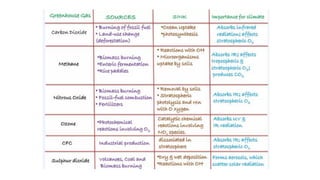
Accounting foralmost 80 percent of global human-caused emissions, carbon dioxide sticks around for quite a while. Once
it’s emitted into the atmosphere, 40 percent still remains after 100 years, 20 percent after 1,000 years, and 10 percent as long
as 10,000 years later. (Carbon dioxide’s lifetime cannot be represented with a single value because the gas is not destroyed
over time, but instead moves among different parts of the ocean, atmosphere, and land. Some carbon dioxide is absorbed
quickly, but some will remain in the atmosphere for thousands of years.
Fluorinated gases
Emitted from a variety of manufacturing and industrial processes, fluorinated gases are man-made. There are four main
categories: hydrofluorocarbons (HFCs), perfluorocarbons (PFCs), sulfur hexafluoride (SF6), and nitrogen trifluoride
(NF3).
Although fluorinated gases are emitted in smaller quantities than other greenhouse gases (they account for 3 percent of
U.S. emissions, per the EPA), they trap substantially more heat. Indeed, the GWP for these gases can be in the thousands
to tens of thousands, and they have long atmospheric lifetimes, in some cases lasting tens of thousands of years.
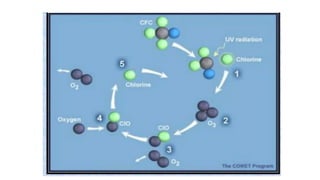
HFCs are used as a replacement for ozone-depleting chlorofluorocarbons (CFCs) and hydrochlorofluorocarbons
(HCFCs), usually in air conditioners and refrigerators, but some are being phased out because of their high GWP.
Replacing these HFCs and properly disposing of them is considered to be one of the most important climate actions the
world can take
Green House Gases
2.
Methane
Methane (CH4) persistsin the atmosphere for around 12 years, which is less time than carbon dioxide, but it is much more
potent in terms of the greenhouse effect. In fact, pound for pound, its global warming impact is almost 30 times greater than
that of carbon dioxide over a 100-year period. In the United States, according to the U.S. Environmental Protection Agency
(EPA), methane accounted for more than 12 percent of human-generated greenhouse gas emissions in 2021. While methane
can come from natural sources like wetlands, more than half of all global methane emissions come from human activities
like natural gas production and livestock-based agriculture.
Water vapor
The most abundant greenhouse gas overall, water vapor differs from other greenhouse gases in that changes in its
atmospheric concentrations are linked not to human activities directly, but rather to the warming that results from the
other greenhouse gases we emit. Warmer air holds more water. And since water vapor is a greenhouse gas, more water
absorbs more heat, inducing even greater warming and perpetuating a positive feedback loop. (It’s worth noting, however,
that the net impact of this feedback loop is still uncertain, as increased water vapor also increases cloud cover that reflects
the sun’s energy away from the earth but holds heat in at night.
4.
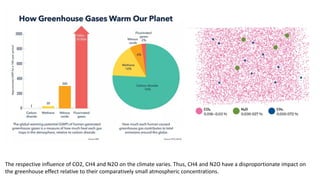
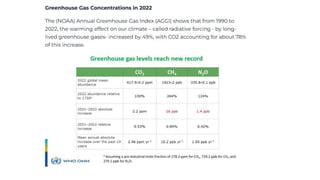
The respective influenceof CO2, CH4 and N2O on the climate varies. Thus, CH4 and N2O have a disproportionate impact on
the greenhouse effect relative to their comparatively small atmospheric concentrations.
8.
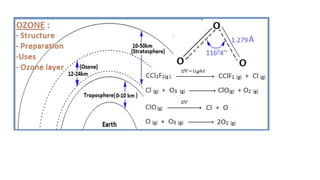
Ozone
8
a gas composedof three atoms of oxygen
• bluish gas that is harmful to breathe
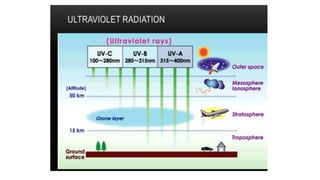
• Approximately 90% ozone is present in stratosphere at the height of
10 to 17 kilometer and is called ozone layer while remaining 10% is
present in troposphere. Medium frequency UV radiations (200 nm to
315 nm) are absorbed 97 to 99% by the ozone layer.
• Ozone (O3) is colourless just like oxygen (O2) but it has very harsh
odour. It is very rare as compared to oxygen.
• Ozone absorbs a band of ultraviolet radiation called UVB
10.
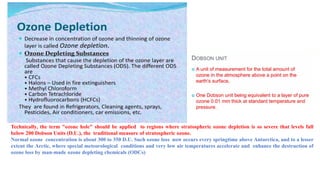
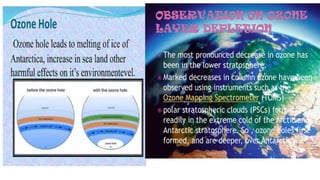
Technically, the term"ozone hole" should be applied to regions where stratospheric ozone depletion is so severe that levels fall
below 200 Dobson Units (D.U.), the traditional measure of stratospheric ozone.
Normal ozone concentration is about 300 to 350 D.U. Such ozone loss now occurs every springtime above Antarctica, and to a lesser
extent the Arctic, where special meteorological conditions and very low air temperatures accelerate and enhance the destruction of
ozone loss by man-made ozone depleting chemicals (ODCs)
16.
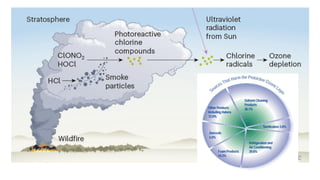
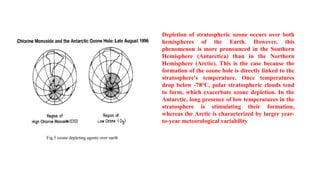
Depletion of stratosphericozone occurs over both
hemispheres of the Earth. However, this
phenomenon is more pronounced in the Southern
Hemisphere (Antarctica) than in the Northern
Hemisphere (Arctic). This is the case because the
formation of the ozone hole is directly linked to the
stratosphere's temperature. Once temperatures
drop below -78°C, polar stratospheric clouds tend
to form, which exacerbate ozone depletion. In the
Antarctic, long presence of low temperatures in the
stratosphere is stimulating their formation,
whereas the Arctic is characterized by larger year-
to-year meteorological variability
17.
Effects on AirQuality
Reduction of stratospheric ozone and increased penetration of UV-B radiation result in higher photo
dissociation rates of key trace gases that control the chemical reactivity of the troposphere.
This can increase both production and destruction of ozone and related oxidants such as hydrogen
peroxide which are known to have adverse effects on human health, terrestrial plants and outdoor
materials. Changes in the atmospheric concentrations of the hydroxyl radical (OH) may change the
atmospheric lifetimes of important gases such as methane and substitutes of chlorofluoro carbons (CFCs).
Increased troposphere reactivity could also lead to increased production of particulates such as cloud
condensation nuclei from the oxidation and subsequent nucleation of sulphur of both anthropogenic and
natural origin.