B Y ; S U R A K S H Y A P O U D E L
B P H 1 S T Y E A R , 2 N D B A T C H
U N I V E R S A L C O L L E G E O F M E D I C A L
S C I E N C E S ( U C M S )
HOUSING STANDARD
CRITERIA AND EFFECTS OF
POOR HOUSING
Housing
“Housing” in the modern concept includes not only the
‘physical infrastructure’ but also the immediate
surroundings and the related community services
and facilities.
It has became part of the concept of “human
settlement”,which is defined as “all places in which a
group of people reside and pursue their life goals;the
size of the settlement may vary from a single family
to millions of people”.
Healthy Housing
Aa A Stable
Home is at
the center of
our lives
and our
happiness.
Standards of housing
The following standards of housing are considered to
be a minimum requirement in Nepal:
SITE
 It should be elevated from its surrounding.
 It should be away from breeding places of arthropods
and insects.
 It should be in pleasing environment.
 The subsoil water should be below 3m.
Materials
 There should be provision of aqequate quality
building materials.
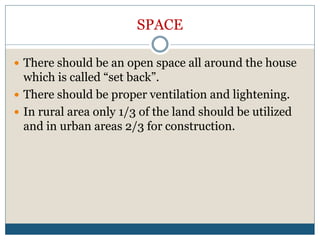
SPACE
 There should be an open space all around the house
which is called “set back”.
 There should be proper ventilation and lightening.
 In rural area only 1/3 of the land should be utilized
and in urban areas 2/3 for construction.
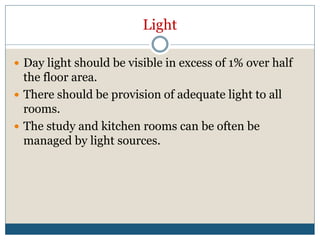
Light
 Day light should be visible in excess of 1% over half
the floor area.
 There should be provision of adequate light to all
rooms.
 The study and kitchen rooms can be often be
managed by light sources.
Ventilation
 There should be adequate cross ventilation in each
room.
Windows and doors
 Ratio of doors and windows should be 1/7 of the
floor area and never less than 1/10
Waste disposal facilities
 Waste material should be removed from the dwelling
at least daily and disposed of in a sanitary manner.
 The sewage should be collected and disposed of in a
sanitary manner.
Water supply
 Safe,adequate and easily available water should be
provided.
Wall
 There should be strong walls with low heat capacity
and weather resistance.
 The walls should be at least 25cm thick brick/stone
made with cement, plastered and coloured.
Roof and floor
 The height of the roof should not be less than 3m in
the absence of air conditioning for comfort.
 The floor on the house should be at least 11sq.m for
occupancy by more than one person and 9sq.m for a
single person.
 The floor area should be impermeable , smooth and
damp proof.
 Plinth (slab) level should be 50-100 cm from the
ground and road levels.
CRITERIA FOR HEALTHFUL HOUSING
An Expert committee of the WHO recommended the following criteria
for healthful housing similar to the basic principles of Healthful
Housing published by an American Public Health Association:
1. Healthful housing provides physical protection and shelter.
2.Provides adequately for cooking ,eating ,washing and excretory
functions.
3.Is designed ,constructed maintained and used in a manner such as
to prevent the spread of communicable diseases.
4.Provides for protection from hazards of exposure to noise and
pollution.
5.Is free of unsafe physical arrangements due to construction and
maintainence and from toxic,or harmful materials.
6.Encourage personal and community development ,promotes social
relationships , reflects a regard for ecological principles and by the
means promotes mental health.
Healthy housing
HOUSING AND HEALTH
Housing is part of the total environment of man and
being a part , it is to some extent responsible for the
status of man’s health and wellbeing.
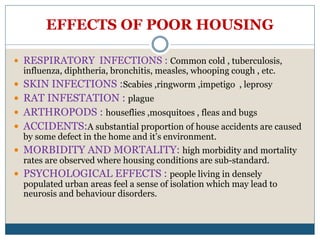
EFFECTS OF POOR HOUSING
 RESPIRATORY INFECTIONS : Common cold , tuberculosis,
influenza, diphtheria, bronchitis, measles, whooping cough , etc.
 SKIN INFECTIONS :Scabies ,ringworm ,impetigo , leprosy
 RAT INFESTATION : plague
 ARTHROPODS : houseflies ,mosquitoes , fleas and bugs
 ACCIDENTS:A substantial proportion of house accidents are caused
by some defect in the home and it’s environment.
 MORBIDITY AND MORTALITY: high morbidity and mortality
rates are observed where housing conditions are sub-standard.
 PSYCHOLOGICAL EFFECTS : people living in densely
populated urban areas feel a sense of isolation which may lead to
neurosis and behaviour disorders.
OVERCROWDING
OVERCROW
DING IS A
HEALTH
PROBLEM
IN HUMAN
DWELLINGS
POOR HOUSING CONDITION
FOR YOUR ATTENTON
THANKYOU

Housing standard

  • 1.
    B Y ;S U R A K S H Y A P O U D E L B P H 1 S T Y E A R , 2 N D B A T C H U N I V E R S A L C O L L E G E O F M E D I C A L S C I E N C E S ( U C M S ) HOUSING STANDARD CRITERIA AND EFFECTS OF POOR HOUSING
  • 2.
    Housing “Housing” in themodern concept includes not only the ‘physical infrastructure’ but also the immediate surroundings and the related community services and facilities. It has became part of the concept of “human settlement”,which is defined as “all places in which a group of people reside and pursue their life goals;the size of the settlement may vary from a single family to millions of people”.
  • 3.
    Healthy Housing Aa AStable Home is at the center of our lives and our happiness.
  • 4.
    Standards of housing Thefollowing standards of housing are considered to be a minimum requirement in Nepal: SITE  It should be elevated from its surrounding.  It should be away from breeding places of arthropods and insects.  It should be in pleasing environment.  The subsoil water should be below 3m.
  • 5.
    Materials  There shouldbe provision of aqequate quality building materials.
  • 6.
    SPACE  There shouldbe an open space all around the house which is called “set back”.  There should be proper ventilation and lightening.  In rural area only 1/3 of the land should be utilized and in urban areas 2/3 for construction.
  • 7.
    Light  Day lightshould be visible in excess of 1% over half the floor area.  There should be provision of adequate light to all rooms.  The study and kitchen rooms can be often be managed by light sources.
  • 8.
    Ventilation  There shouldbe adequate cross ventilation in each room.
  • 9.
    Windows and doors Ratio of doors and windows should be 1/7 of the floor area and never less than 1/10
  • 10.
    Waste disposal facilities Waste material should be removed from the dwelling at least daily and disposed of in a sanitary manner.  The sewage should be collected and disposed of in a sanitary manner.
  • 11.
    Water supply  Safe,adequateand easily available water should be provided.
  • 12.
    Wall  There shouldbe strong walls with low heat capacity and weather resistance.  The walls should be at least 25cm thick brick/stone made with cement, plastered and coloured.
  • 13.
    Roof and floor The height of the roof should not be less than 3m in the absence of air conditioning for comfort.  The floor on the house should be at least 11sq.m for occupancy by more than one person and 9sq.m for a single person.  The floor area should be impermeable , smooth and damp proof.  Plinth (slab) level should be 50-100 cm from the ground and road levels.
  • 14.
    CRITERIA FOR HEALTHFULHOUSING An Expert committee of the WHO recommended the following criteria for healthful housing similar to the basic principles of Healthful Housing published by an American Public Health Association: 1. Healthful housing provides physical protection and shelter. 2.Provides adequately for cooking ,eating ,washing and excretory functions. 3.Is designed ,constructed maintained and used in a manner such as to prevent the spread of communicable diseases. 4.Provides for protection from hazards of exposure to noise and pollution. 5.Is free of unsafe physical arrangements due to construction and maintainence and from toxic,or harmful materials. 6.Encourage personal and community development ,promotes social relationships , reflects a regard for ecological principles and by the means promotes mental health.
  • 15.
  • 16.
    HOUSING AND HEALTH Housingis part of the total environment of man and being a part , it is to some extent responsible for the status of man’s health and wellbeing.
  • 17.
    EFFECTS OF POORHOUSING  RESPIRATORY INFECTIONS : Common cold , tuberculosis, influenza, diphtheria, bronchitis, measles, whooping cough , etc.  SKIN INFECTIONS :Scabies ,ringworm ,impetigo , leprosy  RAT INFESTATION : plague  ARTHROPODS : houseflies ,mosquitoes , fleas and bugs  ACCIDENTS:A substantial proportion of house accidents are caused by some defect in the home and it’s environment.  MORBIDITY AND MORTALITY: high morbidity and mortality rates are observed where housing conditions are sub-standard.  PSYCHOLOGICAL EFFECTS : people living in densely populated urban areas feel a sense of isolation which may lead to neurosis and behaviour disorders.
  • 18.
  • 19.
  • 21.