HOUSKEEPING NC II
436 HRS.
MARIEL P. ARIDEDON
Trainer
Clean and Prepare rooms for
incoming guests
•Set up equipment and trolleys
•Access rooms for servicing
•Make up beds
•Clean and clear rooms
•Clean and store trolleys and equipment
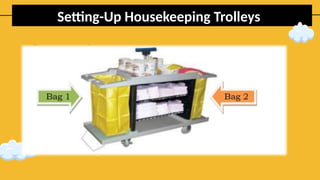
Setting-Up Housekeeping Trolleys
The hotel housekeeping trolley is a portable
/rolling open shelf cabinet –like container to place
all the necessary cleaning materials and
chemicals , room amenities , and linens during
housekeeping activities . The trolley is suitable
for service up to 14 rooms and comes with 4 large
shelves and 2 bag holder.
Setting-Up Housekeeping Trolleys
Key points to remember when stocking or handling
trolleys:
When identified, immediately report any
damage or faults with the trolley – all
housekeeping departments should have
periodical checks done on equipment by
Maintenance department.
Always push the trolley, don't pull it - it is
important for you to see where you are going
Key points to remember when stocking or handling
trolleys:
Always stock items in their designated place on
the trolley - it is best to position heavy items on
the bottom to prevent the trolley from
overturning. If you are not sure where things go,
ask.
Never lift anything on your own that weighs
over 16 kg – this is a recommendation from OHS
authorities.
Key points to remember when stocking or handling
trolleys:
There are no maximum weight restrictions as
the current approach is to assess every lifting
need on an individual basis and use the most
appropriate technique depending on the type of
load, how far it has to be moved or the size of
the load.
Key points to remember when stocking or handling
trolleys:
Be prepared to ask for help when needed – this
may be a request for help such as to do a „team
lift‟ or a request for information. You must also
be prepared to provide help when required.
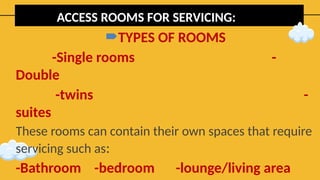
ACCESS ROOMS FOR SERVICING:
TYPES OF ROOMS
-Single rooms -
Double
-twins -
suites
These rooms can contain their own spaces that require
servicing such as:
-Bathroom -bedroom -lounge/living area
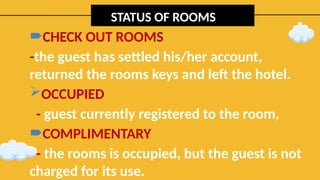
STATUS OF ROOMS
CHECK OUT ROOMS
-the guest has settled his/her account,
returned the rooms keys and left the hotel.
OCCUPIED
- guest currently registered to the room,
COMPLIMENTARY
- the rooms is occupied, but the guest is not
charged for its use.
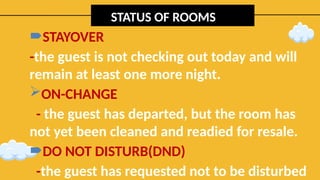
STATUS OF ROOMS
STAYOVER
-the guest is not checking out today and will
remain at least one more night.
ON-CHANGE
- the guest has departed, but the room has
not yet been cleaned and readied for resale.
DO NOT DISTURB(DND)
-the guest has requested not to be disturbed
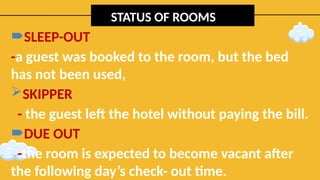
STATUS OF ROOMS
SLEEP-OUT
-a guest was booked to the room, but the bed
has not been used,
SKIPPER
- the guest left the hotel without paying the bill.
DUE OUT
-the room is expected to become vacant after
the following day’s check- out time.
STATUS OF ROOMS
LATE CHECKOUT
-the guest has requested and is being allowed to
check-out later than the standard check-out time.
EARLY CHECK-IN
- the guest has requested and is being allowed
to check-in later than the standard check-in time.
STATUS OF ROOMS
VACANT AND READY
-the room has been cleaned and inspected and is
ready for an arriving guest.
OUT OF ORDER(OOO)
- cannot be assigned to a guest and is blocked
for maintenance activity.
STATUS OF ROOMS
LOCK-OUT
-the room has been locked so that the guest
cannot re-enter until they are cleared by the
front desk
DID NOT CHECK OUT(DNCO)
- the guest made arrangements to settle his/her
account but has left without informing the front
desk.
STANDARDS OF CLEANING
PHYSICALLY CLEAN
-the area or surface is supposed to be free from
apparent dust & dirt, as when wiped by the
hand.
CHEMICALLY CLEAN
- this means that the area should be free from
harmful chemicals on the surfaces & in the
surrounding air.
STANDARDS OF CLEANING
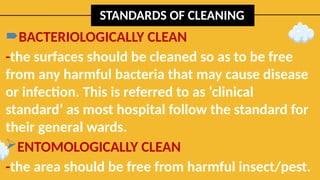
BACTERIOLOGICALLY CLEAN
-the surfaces should be cleaned so as to be free
from any harmful bacteria that may cause disease
or infection. This is referred to as ‘clinical
standard’ as most hospital follow the standard for
their general wards.
ENTOMOLOGICALLY CLEAN
-the area should be free from harmful insect/pest.
STANDARDS OF CLEANING
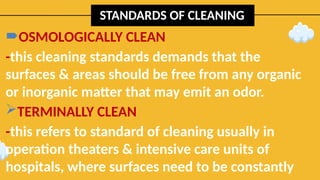
OSMOLOGICALLY CLEAN
-this cleaning standards demands that the
surfaces & areas should be free from any organic
or inorganic matter that may emit an odor.
TERMINALLY CLEAN
-this refers to standard of cleaning usually in
operation theaters & intensive care units of
hospitals, where surfaces need to be constantly
STANDARDS OF CLEANING
-sanitized against all kinds of pathogenic
microbes.
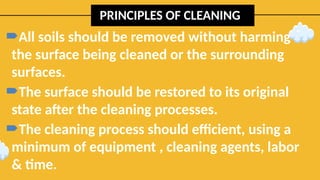
PRINCIPLES OF CLEANING
All soils should be removed without harming
the surface being cleaned or the surrounding
surfaces.
The surface should be restored to its original
state after the cleaning processes.
The cleaning process should efficient, using a
minimum of equipment , cleaning agents, labor
& time.
PRINCIPLES OF CLEANING
The simplest cleaning method should be tried
first, along with using the mildest cleaning agent.
Always use the cleaning methods least harmful
to the surface should be used.
The cleaning should proceed from high area to
low wherever possible.
Always start with the cleaner surfaces & then go
on to clean the more heavily soiled ones.
PRINCIPLES OF CLEANING
While wet cleaning an area or polishing the
floor, the cleaner should walk backwards while
cleaning in front of him.
Use of the suction/vacuum cleaning should be
preferred over sweeping wherever possible
Sweeping should be done before dusting,
dusting before suction cleaning.
PRINCIPLES OF CLEANING
The noise levels while cleaning should be kept
as low as possible.
Try to remove stains as soon as they occur using
the correct methods.
The cleaner should take all safety precautions
while cleaning.
The cleaning agents & equipment should be
stacked neatly to one side after each use.
PRINCIPLES OF CLEANING
The cleaner should start cleaning from the
farthest end of an area, working towards the
exit.
After the cleaning process is over, all
equipment should be washed or wiped as
applicable , dried & stored properly.
Cleaning agents should be replenished & stored
properly.
PRINCIPLES OF CLEANING
All waste need to be discarded & the working
area should be always left neat & tidy.
STANDARD PROCEDURE TO
ACCESS ROOMS
Knock on door (quite loudly) – use knuckles not keys or any
other item as it could mark the door and call out,
“Housekeeping!”
Count one to five
If no answer, knock again, and then use your key to enter
Take one step into the room and announce out “Good
morning/afternoon, Housekeeping to service your room.”
STANDARD PROCEDURE TO
ACCESS ROOMS
If the guest is still in bed, undressed or distressed,
quickly and quietly leave the room
If the guest is awake and up, say “Housekeeping, would you
like your room serviced?”
 Comply with their request – you may be invited to service the
room, just do a quick tidy, replace the towels, soap and leave,
or asked to come back at a later time
STANDARD PROCEDURE TO
ACCESS ROOMS
Once you have gained access to the room, the door
should be left wide open – to provide notice to a returning
guest that someone is in their room
The trolley should be parked across the entrance, or near the
entrance to the room (according to house policy). This allows
the Floor Housekeeper or other management staff to identify
where room attendants are and makes it easier to obtain
items from the trolley
STANDARD PROCEDURE TO
ACCESS ROOMS
It is standard procedure in the majority of
establishments for trolleys to be left outside the
room being cleaned, and never to be taken inside a
guest room
STANDARD PROCEDURE TO
ACCESS ROOMS
Where the trolley is allowed to be taken into the
room, a large sign should be placed outside the
door, reading „Cleaning in Progress‟. This prevents
the guest from returning to their room and being
startled to find an employee in there and again to
enable easy location of staff by management.
SERVICNG OF OCCUPIED ROOM
All occupied rooms are serviced twice daily and as an when
requested by the guest.
Enter the room according to the procedure of entry to
guestrooms
Clear the garbage according to the procedure of removal
garbage from dustbins.
Collect the soiled linen and throw in the linen bag.
Make the bed, follow the bed making procedure.
Perform dusting in the room.
Clean bathroom
SERVICNG OF OCCUPIED ROOM
All amenities are replenished in bathroom .
(maintain photograph for standard amenity
replacement)
After servicing the room following facilities
function to be checked.
television
All telephones
All bulbs
SERVICNG OF VACANT ROOM
Room has to be spic and span at every given time.
Knock the door
Switch on all the lights
Open heavy and sheer curtains
Remove turndown service
Put bed cover
Do the dusting
SERVICNG OF VACANT ROOM
Mop bathroom flooring with disinfectant.
Vacuum the carpet if necessary.
Close sheer curtain
Heavy curtain should be closed
Give final looks
Put off all the lights and shuts the door.
SERVICNG OF VACANT DIRTY
ROOM
Vacant dirty rooms cleaned thoroughly and all used
items/amenities are changed with fresh ones . Left guest
items to be deposited at housekeeping control desk.
Knock and enter the room
All drawers and cupboards are checked for any lost
and found of guest.
All dustbins are cleared of garbage
Soiled linen to be removed
SERVICNG OF VACANT DIRTY
ROOM
Bed is made according to procedure for bed
making.
Dusting of room is done
All glassware and ashtrays have to be cleaned
All guest amenities in room have to be
replenished
Bathroom is cleaned according to procedure
SERVICNG OF VACANT DIRTY
ROOM
All items use by previous guest are change with
fresh ones
All maintenances are noted and given to the
engineering department
Inform room status to the housekeeping
control desk
MAKE UP BEDS
Usually one of the first tasks of room attendant or
housekeeper is to make the beds.
Beds will need to be stripped in all departing rooms
and at nominated intervals for staying guests.
Bed making tasks give rise to many injuries to staff and
some properties use two room attendants to service
each room so that, amongst other things, bed-making
tasks can be completed with less chance of injury.
MAKE UP BEDS
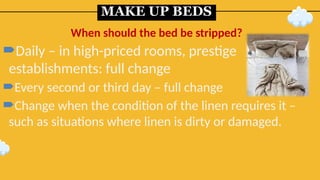
Daily – in high-priced rooms, prestige
establishments: full change
Every second or third day – full change
Change when the condition of the linen requires it –
such as situations where linen is dirty or damaged.
When should the bed be stripped?
MAKE UP BEDS
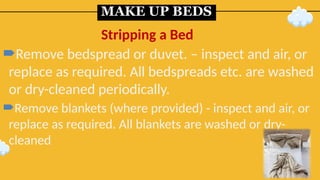
Remove bedspread or duvet. – inspect and air, or
replace as required. All bedspreads etc. are washed
or dry-cleaned periodically.
Remove blankets (where provided) - inspect and air, or
replace as required. All blankets are washed or dry-
cleaned
Stripping a Bed
MAKE UP BEDS
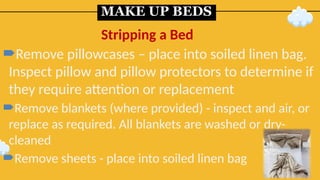
Remove pillowcases – place into soiled linen bag.
Inspect pillow and pillow protectors to determine if
they require attention or replacement
Remove blankets (where provided) - inspect and air, or
replace as required. All blankets are washed or dry-
cleaned
Remove sheets - place into soiled linen bag
Stripping a Bed
MAKE UP BEDS
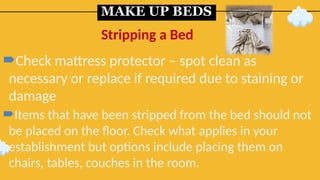
Check mattress protector – spot clean as
necessary or replace if required due to staining or
damage
Items that have been stripped from the bed should not
be placed on the floor. Check what applies in your
establishment but options include placing them on
chairs, tables, couches in the room.
Stripping a Bed
MAKE UP BEDS
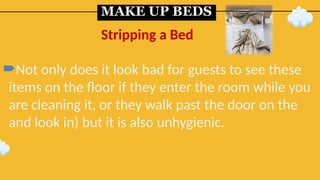
Not only does it look bad for guests to see these
items on the floor if they enter the room while you
are cleaning it, or they walk past the door on the
and look in) but it is also unhygienic.
Stripping a Bed
MAKE UP BEDS
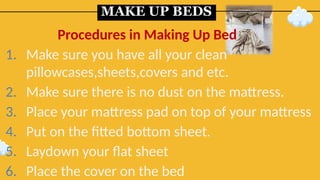
1. Make sure you have all your clean
pillowcases,sheets,covers and etc.
2. Make sure there is no dust on the mattress.
3. Place your mattress pad on top of your mattress
4. Put on the fitted bottom sheet.
5. Laydown your flat sheet
6. Place the cover on the bed
Procedures in Making Up Bed
MAKE UP BEDS
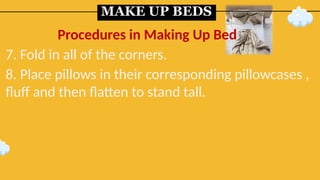
7. Fold in all of the corners.
8. Place pillows in their corresponding pillowcases ,
fluff and then flatten to stand tall.
Procedures in Making Up Bed
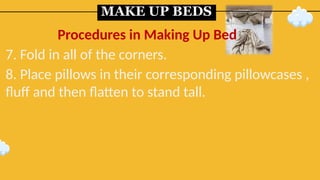
MAKE UP BEDS
7. Fold in all of the corners.
8. Place pillows in their corresponding pillowcases ,
fluff and then flatten to stand tall.
Procedures in Making Up Bed
Report and remedy room defects and
damaged items
Regardless of how well a room is maintained,
general wear and tear will happen, equipment will
break down and other problems will occur.
It is natural and while it may be annoying, guests
will have a level of understanding. That said any
problems with a room should be identified and
rectified before a room is allocated to a guest.
Report and remedy room defects and
damaged items
Every property wants their current guests to
return to them as repeat guests and to tell their
friends about how great their stay with us was so
that their friends become guests who are referred
to us.
Report and remedy room defects and
damaged items
Defects or damage can result from normal wear-
and-tear, accidental damage or deliberate and
malicious action by guests.
Where you suspect damage has been intentionally
caused by guests and even guests that have already
checked-out,
What are defects, what is damage?
Report and remedy room defects and
damaged items
you should reports your beliefs to your supervisor
and ask them to view the damage for themselves to
make a decision about what action or claims may
need to be made.
What are defects, what is damage?
Report and remedy room defects and
damaged items
In some cases, guests may be charged for the
damage and clean up costs and placed on a „Do Not
Room List‟ that automatically flags a guest for
refusal when their name is entered into the
reservation system as a result of a query or a
booking.
What are defects, what is damage?
1. The item must be taken out of service
immediately and replaced if possible – for example,
it may be possible in the immediate short-term to
replace a hair dryer that is not working (or is missing)
in an occupied room with one from the floor
housekeeping store or from another room that
shows as vacant on your room list
When a defect or damage to fixtures
or fittings is identified
, three courses of action present themselves:
2. The item is reported on a maintenance report and
submitted to the appropriate person for action to be
taken – where the item presents a physical danger to
guests it must be removed from the room, tagged as
„Out Of Service‟ according to house procedures and
stored appropriately so that it will not be returned to
service before being serviced.
When a defect or damage to fixtures
or fittings is identified
, two courses of action present themselves:
3. Damaged items need to be recorded for many
operational reasons. Every property will have its own
procedures for recording damaged items and room
attendants are expected to comply with these where
they identify such items in any guest room, and
regardless of who damaged the items and how they
were damaged.
When a defect or damage to fixtures
or fittings is identified
, two courses of action present themselves:
Monitoring costs
Determining supplies that need to be ordered
Evaluating the usefulness of products - and
determining whether or not to continue using a
certain item or whether a better alternative needs
to be sourced
Properties need
to be aware of damaged items
for the following reasons:
Identifying high damage products – to develop
policies and procedures to reduce and prevent
damage
Removing them from service for OHS and duty of
care reasons.
Properties need
to be aware of damaged items
for the following reasons:
THAT'S A
WRAP!
THANK YOU FOR
YOUR
PARTICIPATION
TRAINEES!!