HospitalHospital
OrganizationalOrganizational
StructuresStructures
By
MATHANKUMAR.S
CLASSIFICATIONS OFCLASSIFICATIONS OF
HEALTH CAREHEALTH CARE
 Primary Care
 Secondary Care
 Tertiary Care
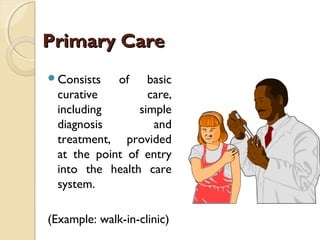
Primary CarePrimary Care
Consists of basic
curative care,
including simple
diagnosis and
treatment, provided
at the point of entry
into the health care
system.
(Example: walk-in-clinic)
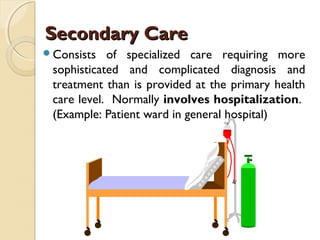
Secondary CareSecondary Care
Consists of specialized care requiring more
sophisticated and complicated diagnosis and
treatment than is provided at the primary health
care level. Normally involves hospitalization.
(Example: Patient ward in general hospital)
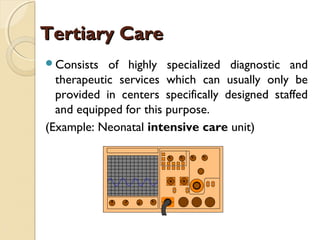
Tertiary CareTertiary Care
Consists of highly specialized diagnostic and
therapeutic services which can usually only be
provided in centers specifically designed staffed
and equipped for this purpose.
(Example: Neonatal intensive care unit)
CLASSIFICATIONS OFCLASSIFICATIONS OF
SERVICESERVICE
GENERAL HOSPITAL
SPECIALITY HOSPITAL
REHABILITATION HOSPITAL
LONG-TERM CARE HOSPITAL
(AUXILIARY)
NURSING HOME
GENERAL HOSPITALGENERAL HOSPITAL
Provides primarily for the diagnosis and
short-term treatment of patients for a
wide range of diseases or injuries.
SPECIALITY HOSPITALSPECIALITY HOSPITAL
Provides primarily for the diagnosis and
short-term treatment of patients for a
limited range of diseases or injuries.
REHABILITATIONREHABILITATION
HOSPITALHOSPITAL
Provides for the continuing assessment
and treatment of patients whose
condition is expected to improve
significantly.
LONG-TERM CARELONG-TERM CARE
HOSPITALHOSPITAL
Provides primarily for the continuing
treatment of patients with long-term
illness or with a low potential for
recovery.
NURSING HOMENURSING HOME
Institution where residents are
accommodated who require nursing and
personal care on a continuing basis.
REGULATORY AGENCIESREGULATORY AGENCIES
Provincial hospital authorities responsible for:
◦ Approving hospital budgets
◦ Licensing and inspecting hospitals
◦ Health and safety of hospital workers
Agencies regulating the various health
professions
Agencies approving various hospital based
training programs
REGULATORY AGENCIESREGULATORY AGENCIES
Review committees within hospitals
Hospital administration and regulations
Canadian Council on Healthcare Facility
Accreditation (CCHFA), representing:
◦ Canadian Hospital Association
◦ Canadian Medical Association
◦ Royal College of Physicians and Surgeons of Canada
◦ L'Association des Medecins de Langue Francaise du
Canada
◦ The Canadian Nurses Association
A hospital is perhaps theA hospital is perhaps the
most complexmost complex
organization in our society.organization in our society.
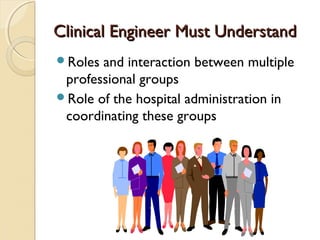
Clinical Engineer Must UnderstandClinical Engineer Must Understand
Roles and interaction between multiple
professional groups
Role of the hospital administration in
coordinating these groups
WELL DEVELOPEDWELL DEVELOPED
INTERPERSONAL SKILLSINTERPERSONAL SKILLS
ARE ESSENTIAL TOARE ESSENTIAL TO
CLINICAL ENGINEERING!CLINICAL ENGINEERING!
Impact of TechnologyImpact of Technology
Advancements in medical technology have had
an enormous impact on hospital management.
Each new development has given birth to
another discrete body of knowledge.
◦ Ultrasound, CT, MRI
◦ Lithotrity
◦ Nuclear Medicine
◦ Laser Surgery
◦ Laparoscopic Surgery
Each technology has its own:Each technology has its own:
Professional Group
Cherished Role
Diversified Nomenclature
Self Image.
Professional GroupsProfessional Groups
Medical Specialties
Nursing Specialties
Clinical Technicians (i.e., Lab Techs, X-Ray
Techs, Respiratory Therapists, Physiotherapists,
etc.)
There are more than 200 health
occupations!
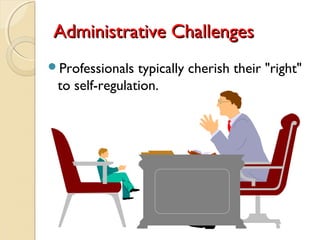
Administrative ChallengesAdministrative Challenges
Professionals typically cherish their "right"
to self-regulation.
Administrative ChallengesAdministrative Challenges
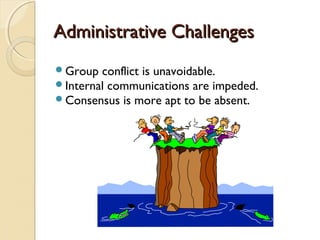
Group conflict is unavoidable.
Internal communications are impeded.
Consensus is more apt to be absent.
Administrative ChallengesAdministrative Challenges
Internal
◦ Medical Staff
◦ Competition Between Health Professions
◦ Unions
◦ Physical Resources
◦ Size and Complexity of Organization
External
◦ Government
◦ Funding
◦ Regulatory Agencies
◦ Public Demands
Hospital Administrators Require:Hospital Administrators Require:
Interpersonal skills
Effective communications skills.
Leadership skills.
THE HOSPITAL AS A DELIVERYTHE HOSPITAL AS A DELIVERY
SYSTEMSYSTEM
Primarily a non-profit system.
A third party (government) financed system.
Demand for services can bear no direct
relationship to societal needs or the available
supply of necessary resources.
The rate of hospital admissions has increased,
but the average length of stay has decreased.
The health care system is presently undergoing
rapid, radical change.
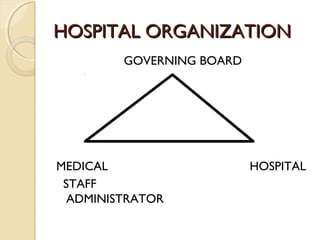
HOSPITAL ORGANIZATIONHOSPITAL ORGANIZATION
GOVERNING BOARD
MEDICAL HOSPITAL
STAFF
ADMINISTRATOR
Hospital Management ModelHospital Management Model
Governing Board (government
appointed)
Chief Executive Officer (Hospital
Administrator)
Medical Staff Organization.
Functions of the Governing BoardFunctions of the Governing Board
To determine the policies of the institution
within the context of community needs.
To provide equipment and facilities to conduct
patient care programs.
To see that proper professional standards are
defined and maintained.
To co-ordinate professional interests with
administrative, financial and community needs.
Functions of the Governing BoardFunctions of the Governing Board
To provide adequate financing by securing
sufficient income and by enforcing business like
control of expenditures.
To provide for the safe administration of funds
given in trust, (e.g., gifts and contributions).
To maintain accurate records of its finances and
activities.
To surround the patient with a safe
environment.
THE HOSPITAL ADMINISTRATORTHE HOSPITAL ADMINISTRATOR
Function is identical to that of the
president of any corporation.
Individual styles are judged to be
successful if the determined results
further the organization toward its goals.
Being a hospitalBeing a hospital
administrator places more ofadministrator places more of
a strain on character than ona strain on character than on
intellect.intellect.
Functions of the HospitalFunctions of the Hospital
AdministratorAdministrator
Submitting for board approval a plan of
organization and recommending changes when
necessary.
Preparing a plan for accomplishing the
institutional objectives as approved by the board
and periodically reviewing and evaluating it.
Selecting, employing, controlling, and discharging
employees.
Submitting for board approval an annual budget.
Functions of the HospitalFunctions of the Hospital
AdministratorAdministrator
Safeguarding the operating funds of the
enterprise.
Maintaining all physical properties (plant and
equipment) in safe operating condition.
Representing the hospital in its relationships
with the community and other health agencies.
Serving as liaison between the board or its
committees and the medical staff.
Functions of the HospitalFunctions of the Hospital
AdministratorAdministrator
Assisting the medical staff with its
organizational and administrative
responsibilities.
Submitting to the board annual reports
which describe the nature and volume of
the services delivered during the past
year.
Advising the governing board on matters
of policy formulation.
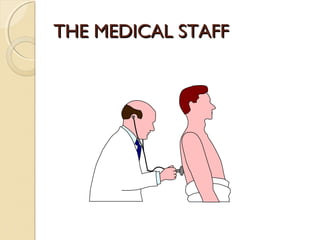
THE MEDICAL STAFFTHE MEDICAL STAFF
Doctors represent theDoctors represent the
initiators of every action thatinitiators of every action that
results in the direct provisionresults in the direct provision
of patient care services.of patient care services.
Doctors determine:Doctors determine:
Who Will Be Admitted
When
Where
What Medical Services Are to Be
Provided, in What Sequence, in What
Dosage, With What Equipment and
Supplies When, Where and by Whom
Who Is Discharged and When.
The doctor is not anThe doctor is not an
employee of the hospital,employee of the hospital,
he/she is outside of thehe/she is outside of the
hospital organization.hospital organization.
Doctors control, yet are notDoctors control, yet are not
accountable, for nearly 90accountable, for nearly 90
percent of hospitalpercent of hospital
expenditures.expenditures.
Medical StaffMedical Staff
Participation by the medical staff in the
decision-making process is in the best
interest of both the hospital and the
patients.
Physician involvement leads to physician
accountability.
The physician may view theThe physician may view the
problems of medical practiceproblems of medical practice
from afrom a personalpersonal rather thanrather than
anan organizationalorganizational perspective.perspective.
The administrator isThe administrator is
primarily concerned with theprimarily concerned with the
maximum utilization ofmaximum utilization of
available health resources andavailable health resources and
personnel.personnel.
Organization of medicalOrganization of medical
resources may require aresources may require a
degree of control anddegree of control and
surveillance over the doctor'ssurveillance over the doctor's
work which maybework which maybe
unattractive to him/her.unattractive to him/her.
Medical StaffMedical Staff
The chief of medical staff is the elected
representative of the medical staff.
The chief of staff appoints all of the
committees other than the executive
committee whose members are elected
by the staff or appointed by the board
administrator.
Functions of the Medical StaffFunctions of the Medical Staff
To advise the governing body on medical affairs.
To accept accountability for the quality of care
rendered to patients in the hospital.
To request, review and act upon reports of
medical staff committees.
To scrutinize the professional ethics of its
members and to initiate corrective action as
indicated.
To develop, implement, and review medical staff
policies.
Functions of the Medical StaffFunctions of the Medical Staff
To recommend action to the
administrator on all medical-
administrative matters.
To assure that the standards of the
Canadian Council on Healthcare Facility
Accreditation (CCHFA) are followed as a
basic guideline for standards of care.
INTERRELATIONSHIPSINTERRELATIONSHIPS
AMONG HEALTHAMONG HEALTH
WORKERSWORKERS
The complex tasks of highlyThe complex tasks of highly
skilled professionals demand askilled professionals demand a
participatory decision-makingparticipatory decision-making
structure while the repetitivestructure while the repetitive
tasks performed by unskilledtasks performed by unskilled
workers require a moreworkers require a more
formal hierarchical structure.formal hierarchical structure.
Organizational StructuresOrganizational Structures
Highly structured and routine tasks can
lead to worker alienation and boredom.
Loosely knit, associational activities of
highly skilled professionals results in
personal gratification to the individual
employee but works against the
centralized control and co-ordination
needs of management.

Hospital organizational structures

  • 1.
  • 2.
    CLASSIFICATIONS OFCLASSIFICATIONS OF HEALTHCAREHEALTH CARE  Primary Care  Secondary Care  Tertiary Care
  • 3.
    Primary CarePrimary Care Consistsof basic curative care, including simple diagnosis and treatment, provided at the point of entry into the health care system. (Example: walk-in-clinic)
  • 4.
    Secondary CareSecondary Care Consistsof specialized care requiring more sophisticated and complicated diagnosis and treatment than is provided at the primary health care level. Normally involves hospitalization. (Example: Patient ward in general hospital)
  • 5.
    Tertiary CareTertiary Care Consistsof highly specialized diagnostic and therapeutic services which can usually only be provided in centers specifically designed staffed and equipped for this purpose. (Example: Neonatal intensive care unit)
  • 6.
    CLASSIFICATIONS OFCLASSIFICATIONS OF SERVICESERVICE GENERALHOSPITAL SPECIALITY HOSPITAL REHABILITATION HOSPITAL LONG-TERM CARE HOSPITAL (AUXILIARY) NURSING HOME
  • 7.
    GENERAL HOSPITALGENERAL HOSPITAL Providesprimarily for the diagnosis and short-term treatment of patients for a wide range of diseases or injuries.
  • 8.
    SPECIALITY HOSPITALSPECIALITY HOSPITAL Providesprimarily for the diagnosis and short-term treatment of patients for a limited range of diseases or injuries.
  • 9.
    REHABILITATIONREHABILITATION HOSPITALHOSPITAL Provides for thecontinuing assessment and treatment of patients whose condition is expected to improve significantly.
  • 10.
    LONG-TERM CARELONG-TERM CARE HOSPITALHOSPITAL Providesprimarily for the continuing treatment of patients with long-term illness or with a low potential for recovery.
  • 11.
    NURSING HOMENURSING HOME Institutionwhere residents are accommodated who require nursing and personal care on a continuing basis.
  • 12.
    REGULATORY AGENCIESREGULATORY AGENCIES Provincialhospital authorities responsible for: ◦ Approving hospital budgets ◦ Licensing and inspecting hospitals ◦ Health and safety of hospital workers Agencies regulating the various health professions Agencies approving various hospital based training programs
  • 13.
    REGULATORY AGENCIESREGULATORY AGENCIES Reviewcommittees within hospitals Hospital administration and regulations Canadian Council on Healthcare Facility Accreditation (CCHFA), representing: ◦ Canadian Hospital Association ◦ Canadian Medical Association ◦ Royal College of Physicians and Surgeons of Canada ◦ L'Association des Medecins de Langue Francaise du Canada ◦ The Canadian Nurses Association
  • 14.
    A hospital isperhaps theA hospital is perhaps the most complexmost complex organization in our society.organization in our society.
  • 15.
    Clinical Engineer MustUnderstandClinical Engineer Must Understand Roles and interaction between multiple professional groups Role of the hospital administration in coordinating these groups
  • 16.
    WELL DEVELOPEDWELL DEVELOPED INTERPERSONALSKILLSINTERPERSONAL SKILLS ARE ESSENTIAL TOARE ESSENTIAL TO CLINICAL ENGINEERING!CLINICAL ENGINEERING!
  • 17.
    Impact of TechnologyImpactof Technology Advancements in medical technology have had an enormous impact on hospital management. Each new development has given birth to another discrete body of knowledge. ◦ Ultrasound, CT, MRI ◦ Lithotrity ◦ Nuclear Medicine ◦ Laser Surgery ◦ Laparoscopic Surgery
  • 18.
    Each technology hasits own:Each technology has its own: Professional Group Cherished Role Diversified Nomenclature Self Image.
  • 19.
    Professional GroupsProfessional Groups MedicalSpecialties Nursing Specialties Clinical Technicians (i.e., Lab Techs, X-Ray Techs, Respiratory Therapists, Physiotherapists, etc.) There are more than 200 health occupations!
  • 20.
    Administrative ChallengesAdministrative Challenges Professionalstypically cherish their "right" to self-regulation.
  • 21.
    Administrative ChallengesAdministrative Challenges Groupconflict is unavoidable. Internal communications are impeded. Consensus is more apt to be absent.
  • 22.
    Administrative ChallengesAdministrative Challenges Internal ◦Medical Staff ◦ Competition Between Health Professions ◦ Unions ◦ Physical Resources ◦ Size and Complexity of Organization External ◦ Government ◦ Funding ◦ Regulatory Agencies ◦ Public Demands
  • 23.
    Hospital Administrators Require:HospitalAdministrators Require: Interpersonal skills Effective communications skills. Leadership skills.
  • 24.
    THE HOSPITAL ASA DELIVERYTHE HOSPITAL AS A DELIVERY SYSTEMSYSTEM Primarily a non-profit system. A third party (government) financed system. Demand for services can bear no direct relationship to societal needs or the available supply of necessary resources. The rate of hospital admissions has increased, but the average length of stay has decreased. The health care system is presently undergoing rapid, radical change.
  • 25.
    HOSPITAL ORGANIZATIONHOSPITAL ORGANIZATION GOVERNINGBOARD MEDICAL HOSPITAL STAFF ADMINISTRATOR
  • 26.
    Hospital Management ModelHospitalManagement Model Governing Board (government appointed) Chief Executive Officer (Hospital Administrator) Medical Staff Organization.
  • 27.
    Functions of theGoverning BoardFunctions of the Governing Board To determine the policies of the institution within the context of community needs. To provide equipment and facilities to conduct patient care programs. To see that proper professional standards are defined and maintained. To co-ordinate professional interests with administrative, financial and community needs.
  • 28.
    Functions of theGoverning BoardFunctions of the Governing Board To provide adequate financing by securing sufficient income and by enforcing business like control of expenditures. To provide for the safe administration of funds given in trust, (e.g., gifts and contributions). To maintain accurate records of its finances and activities. To surround the patient with a safe environment.
  • 29.
    THE HOSPITAL ADMINISTRATORTHEHOSPITAL ADMINISTRATOR Function is identical to that of the president of any corporation. Individual styles are judged to be successful if the determined results further the organization toward its goals.
  • 30.
    Being a hospitalBeinga hospital administrator places more ofadministrator places more of a strain on character than ona strain on character than on intellect.intellect.
  • 31.
    Functions of theHospitalFunctions of the Hospital AdministratorAdministrator Submitting for board approval a plan of organization and recommending changes when necessary. Preparing a plan for accomplishing the institutional objectives as approved by the board and periodically reviewing and evaluating it. Selecting, employing, controlling, and discharging employees. Submitting for board approval an annual budget.
  • 32.
    Functions of theHospitalFunctions of the Hospital AdministratorAdministrator Safeguarding the operating funds of the enterprise. Maintaining all physical properties (plant and equipment) in safe operating condition. Representing the hospital in its relationships with the community and other health agencies. Serving as liaison between the board or its committees and the medical staff.
  • 33.
    Functions of theHospitalFunctions of the Hospital AdministratorAdministrator Assisting the medical staff with its organizational and administrative responsibilities. Submitting to the board annual reports which describe the nature and volume of the services delivered during the past year. Advising the governing board on matters of policy formulation.
  • 34.
    THE MEDICAL STAFFTHEMEDICAL STAFF
  • 35.
    Doctors represent theDoctorsrepresent the initiators of every action thatinitiators of every action that results in the direct provisionresults in the direct provision of patient care services.of patient care services.
  • 36.
    Doctors determine:Doctors determine: WhoWill Be Admitted When Where What Medical Services Are to Be Provided, in What Sequence, in What Dosage, With What Equipment and Supplies When, Where and by Whom Who Is Discharged and When.
  • 37.
    The doctor isnot anThe doctor is not an employee of the hospital,employee of the hospital, he/she is outside of thehe/she is outside of the hospital organization.hospital organization.
  • 38.
    Doctors control, yetare notDoctors control, yet are not accountable, for nearly 90accountable, for nearly 90 percent of hospitalpercent of hospital expenditures.expenditures.
  • 39.
    Medical StaffMedical Staff Participationby the medical staff in the decision-making process is in the best interest of both the hospital and the patients. Physician involvement leads to physician accountability.
  • 40.
    The physician mayview theThe physician may view the problems of medical practiceproblems of medical practice from afrom a personalpersonal rather thanrather than anan organizationalorganizational perspective.perspective.
  • 41.
    The administrator isTheadministrator is primarily concerned with theprimarily concerned with the maximum utilization ofmaximum utilization of available health resources andavailable health resources and personnel.personnel.
  • 42.
    Organization of medicalOrganizationof medical resources may require aresources may require a degree of control anddegree of control and surveillance over the doctor'ssurveillance over the doctor's work which maybework which maybe unattractive to him/her.unattractive to him/her.
  • 43.
    Medical StaffMedical Staff Thechief of medical staff is the elected representative of the medical staff. The chief of staff appoints all of the committees other than the executive committee whose members are elected by the staff or appointed by the board administrator.
  • 44.
    Functions of theMedical StaffFunctions of the Medical Staff To advise the governing body on medical affairs. To accept accountability for the quality of care rendered to patients in the hospital. To request, review and act upon reports of medical staff committees. To scrutinize the professional ethics of its members and to initiate corrective action as indicated. To develop, implement, and review medical staff policies.
  • 45.
    Functions of theMedical StaffFunctions of the Medical Staff To recommend action to the administrator on all medical- administrative matters. To assure that the standards of the Canadian Council on Healthcare Facility Accreditation (CCHFA) are followed as a basic guideline for standards of care.
  • 46.
  • 47.
    The complex tasksof highlyThe complex tasks of highly skilled professionals demand askilled professionals demand a participatory decision-makingparticipatory decision-making structure while the repetitivestructure while the repetitive tasks performed by unskilledtasks performed by unskilled workers require a moreworkers require a more formal hierarchical structure.formal hierarchical structure.
  • 48.
    Organizational StructuresOrganizational Structures Highlystructured and routine tasks can lead to worker alienation and boredom. Loosely knit, associational activities of highly skilled professionals results in personal gratification to the individual employee but works against the centralized control and co-ordination needs of management.