11/22/2022 1
DEFINATION:
 The Hospital is an instrumentation through
which professionals are able to provide
health to the sick and treatment or cure to
ill or injured patients.
11/22/2022 2
FUNCTION:
1. TEACHING
2. RESEARCH
3. PUBLIC HEALTH
4. PATIENT CARE
11/22/2022 3
CLASSIFICATION:
A) ON THE BASIS OF TYPE OF SERVICES:
1) GENERAL: Which provide treatment to all.
2) SPECIAL: Which are restrict for special patient
care like T.B. Cardiology, Cancer, Psychiatry and
Eye etc.
B) ON THE BASIS OF LENGTH OF STAY:
1) SHORT TERM STAY: In which the stay is less than
30 days as an emergency condition.
2) LONG TERM STAY: In which the stay is 30 days or
more i.e. T.B., Cancer, Psychiatry etc.
11/22/2022 4
C) ON THE BASIS OF OWNERSHIP:
1) GOVT. HOSPITALS:
i) Federal ii) Armed Forces iii) State
iv) District Hosp. and v) Municipal Hosp.
2) NON GOVT. HOSPITALS:
i) Non-Profitable: Such as Mission Hospitals and LRBT
etc.
ii) Profitable: Such as i) Corporation ii) Partnership
and iii) Individual Hospitals.
D) ON THE BASIS OF BED CAPICITY:
1) Less than 50 beds 2) 50 To 99 beds 3) 100 To 199
beds 4) 200 To 299 beds 5) 300 To 399 & so on.
11/22/2022 5
The organizational pattern of a Hospital.
OR
The organizational structure of a Hospital.
OR
The Administrative organization chart of a
Hospital.
11/22/2022 6
The organizational pattern of a hospital is the same
as an organizational pattern of an Industry.
The only difference is that the head of organization
is director where as the head of the industry is
president.
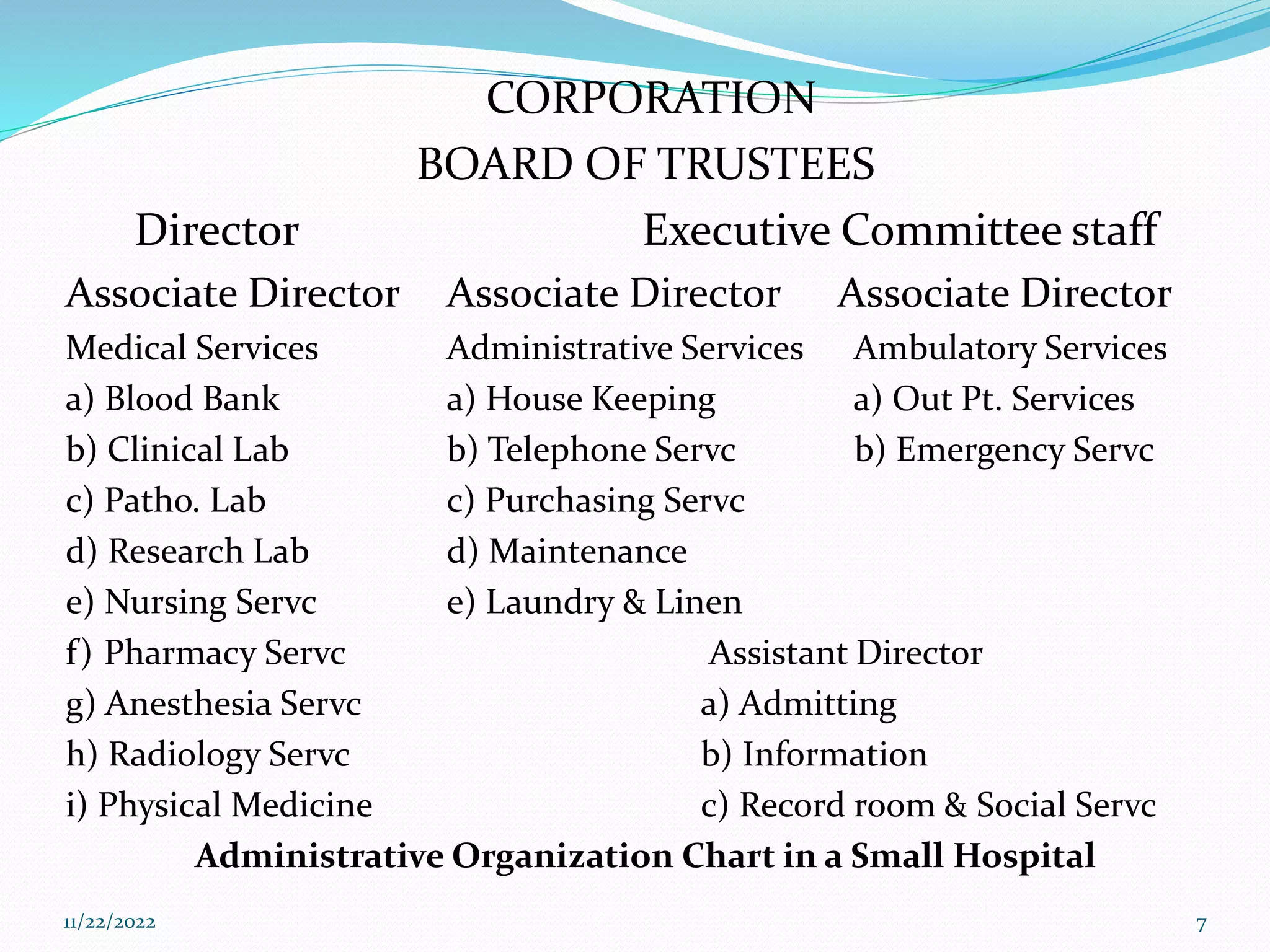
CORPORATION
BOARD OF TRUSTEES
Director Executive Committee staff
Associate Director Associate Director Associate Director
Medical Services Administrative Services Ambulatory Services
a) Blood Bank a) House Keeping a) Out Pt. Services
b) Clinical Lab b) Telephone Servc b) Emergency Servc
c) Patho. Lab c) Purchasing Servc
d) Research Lab d) Maintenance
e) Nursing Servc e) Laundry & Linen
f) Pharmacy Servc Assistant Director
g) Anesthesia Servc a) Admitting
h) Radiology Servc b) Information
i) Physical Medicine c) Record room & Social Servc
Administrative Organization Chart in a Small Hospital
11/22/2022 7
CORPORATION
1. BOARD OF TRUSTEES
Personnel 2. Director 3. Chief of Services
4. A.D. Prof. Serv. 5. A.D. Special Serv. 6. A.D. Finance 7. A.D. Nursing 8. A.D. Develop
9. Assistant Director 10. Assistant Director 11. Assistant Director
Ambulatory Serv. Admin Community Serv. Medical Ambul. Service
12. Assistant Director 13. Assistant Director
Surgidical Ambul. Service Plant Services
Administrative Organization Chart in a large Hospital
11/22/2022 8
1- Board of Trustees:
The complex organization chart for large hospital is
shown.
The large hospital on account of its function is termed as
the corporation. This is according to the corporate law of a
state in which they operate. Some of these privately
owned unites are still functioning under a partnership
because the corporation may consist of a large number of
people from widely scattered areas.
A representative group from within the corporation
membership is elected to a board of trustees. This group is
also known as the governing board, board of governors
and board of directors.
11/22/2022 9
2- Director:
The director in the hospital is the person who is the
boss of three to five associate directors. Three to five
assistant directors and chief of services.
3- Chief of Services:
Chief of services is rendered in the hospital for the
benefits of the patients.
4- Associate Director Professional Services:
This is responsible to supervise and maintain
ambulatory services administration, dialysis,
transplant unit, medical records, physiotherapy, social
services and respiratory therapy.
11/22/2022 10
5- Associate Director Special Services:
This is responsible to look after and maintenance of
the blood bank, data processing, Pharmacy lab
control, radiology and pathology lab etc.
6- Associate Director Finance:
This is responsible for accounting, credit control,
admitting and treasurer office activities.
7- Associate Director Nursing Services:
This is responsible for the administration of nursing
activities i.e. trainings of the nurses and their
recruitment etc.
11/22/2022 11
8- Associate Director Development:
Associate director development is responsible for
chaplaincy services, public relation and volunteer
services.
9- Assistant Director Ambulatory Services Admin:
This is responsible for the administration of
ambulatory services.
10- Assistant Director Community Services:
This is responsible for the home care program and
medical care program etc in the community.
11- Assistant Director Medical Ambulatory Service:
This is responsible for the maintenance of medical
clinics and communication between medical staff.
11/22/2022 12
12- Assistant Director Surgical Ambulatory
Service:
This is responsible for the administration of
emergency wards, surgical clinics and industrial
accident clinics.
13- Assistant Director Plant Services:
This is responsible for the engineering services,
house keeping services, linen and laundry, escort
and messenger services, security services, parking
and motor poll etc.
11/22/2022 13
Services Provided by a hospital.
OR
Working Pattern of a hospital.
I- Administration:
II- Medical Staff:
Sub divisions of medical staff are:
a) Active medical staff. b) Courtesy medical staff.
c) Consultant medical staff. d) Honorary Medical staff.
e) Associate medical staff.
III- The Clinical Departments:
In small hospitals one would expect two major types of
departments:
11/22/2022 14
a) Medicines.
b) Surgery.
 Supportive services such as radiology, pathology and
blood bank are also offered but are generally limited.
 The departments of medicines include the following
sub-divisions in a large hospital:
1. Internal medicines 2. Allergy
3. Cardiology 4. Dermatology
5. Infectious diseases 6. Endocrinology
7. Geriatrics/Urology 8. Pediatrics
9. Gastroenterology 10. Neurology
11. Psychiatry 12. Pulmonary diseases
11/22/2022 15
 The departments of surgery include the following sub-
divisions:
1. General surgery 2. Orthopedic
3. Neurological surgery 4. Obstetrics & gynecology
5. Ophthalmology 6. Dental & oral surgery
7. Thoracic surgery 8. Urology
9. Plastic surgery 10. Otolaryngology
Each of them usually have a chief of service who in
turn is responsible for report to the departmental
chief.
11/22/2022 16
IV- The Supportive Services:
These include:
1. Nursing department 2. The dietary service
3. laboratory services 4. Medical records dept.
5. Blood bank 6. The central sterile supply
7. Social service dept. 8. Anesthesia service
V- Pharmacy’s Role in Hospital:
11/22/2022 17
I- ADMINISTRATION:
 The active management of hospital is delegated power by the
board of trustees than to the administrator, the staff of
associates, assistants, supervisors and departmental heads. i.e.
the head of the Pharmacy reports to the assistant or associate
director responsible for the clinical services of the hospital.
 The administrator of the hospital is specially trained for his
position. For a hospital administrator, he or she must have a
master degree in hospital administration.
 The function of the administrator is to enforce the trustee
policies in the daily management routine.
 In addition, he or she should play role in community public
relationship as well as relation b/w staff and board of trustees
11/22/2022 18
II- MEDICAL STAFF:
 Medical staff membership is limited to individuals who
are fully licensed to practice medicine or dentistry. The
medical staff is further sub-divided into:
a) Active medical staff:
They do the organizational and administrative duties
pertaining to medical staff.
b) Courtesy medical staff:
Those practitioners who are eligible for staff
membership and who have authority to admit
occasional patients in the hospital.
11/22/2022 19
c) Consultant medical staff:
These are medical practitioners of recognized
medical ability and who are not members of the
preceding categories of staff membership.
d) Honorary medical staff:
These consists of former staff members and of other
practitioners whom the medical staff choices to
honor.
11/22/2022 20
III- CLINICAL DEPARTMENTS:
 In small hospitals one would expect two major types of
departments:
a) Medicines.
b) Surgery.
Where as the departments in a large hospital are also
discussed earlier. (The list is given above).
11/22/2022 21
IV- THE SUPPORTIVE SERVICES:
1. Nursing department:
 The nursing team made up of workers with degrees
of nursing skill and directed by professional nurse
who did every needful for the patient.
 There is at its head a director of nursing who is
generally an experienced nurse with administrative
talent.
 The administrative nursing service participates in all
activities essential to the development of
professional skills of nurses and better for good
patient health care system.
11/22/2022 22
2. The dietary service:
 The services are generally directed by a qualified
person who can provide diet of good nutritional
value to the patients.
 The dietitian is generally responsible for recording
the dietary histories of patients such as those with
food allergies and those to accept a limited diet etc.
 He or she is responsible for interviewing the patients
regarding their food habits and counseling then
regarding normal and modified food regimens.
11/22/2022 23
3. laboratory services:
Research, pathology and clinical labs are directed by
a physician member of health care team staffed with
a number of personnel having such training and
experience that they can run and supervise such
laboratories.
4. Medical records department:
The purpose of the medical record are:
 To serve as a basis for planning and for continuity of
patient care.
 To provide a mean of communication among the
physicians.
 To furnish the documentary evidence for the course
of patients illness and treatment during each stay.
11/22/2022 24
 To provide data for use in research and education.
 To serve as a basis for review, study and evaluation of
the care rendered to the patient.
Every hospital is required by the law to maintain
adequate medical records of their patients. These
records must be accurately documented and readily
available and accessible at all the times.
These medical records must contain all sufficient clinical
information.
11/22/2022 25
5. Blood bank:
A blood bank works with most of the hospitals. It is
directed by a qualified physician who has special
interest in hematology.
6. The central sterile supply:
It is a centralized unit in a hospital. It provides
professional supplies and equipments to all the
specialized departments.
7. Social service department:
The social service department is a link between the
hospital , the patient and community. In this
department well qualified social workers are
appointed. Social service provide information related
to medical social study of appropriate patients, social
therapy and rehabilitation of patients.
11/22/2022 26
Home environmental investigation for attending
physician cooperative activities with community
agencies, social service summaries and follow-up
reports of discharged patients.
8. Anesthesia service:
The anesthesia service of a hospital is generally
provided by the specialist in anesthesia and he or she
is responsible for:
 Quality of anesthesia care rendered by anesthetist in
the surgical and obstetrical areas.
 Availability of equipments necessary for
administering anesthesia.
 Development of regulations regarding anesthetic
safety.
11/22/2022 27
V- PHARMACY’S ROLE IN HOSPITAL:
 The pharmacy department plays an important role in
the hospital because all activities of dispensing and
preparation of pharmaceuticals are done by the
pharmacy department.
 Moreover recent information related to the drug use
and action are supplied by the pharmacy department.
 The Pharmacist is also responsible for the evaluation
of pharmaceuticals so as to check the stability of the
products and to check any sort of contamination in
liquid preparations and injectables.
11/22/2022 28
VI- HOSPITAL FINANCES:
 Although a pharmacist is not very well subjected with
the hospital finances.
 In reality the finances of a hospital affect every patient,
employee, staff member, trustee and the community at
large.
 The finance department is staffed by accounts and
financial personnel and a well trained and qualified
individual supervisor.
 This department is responsible for the financing of all
the operations of a hospital.
11/22/2022 29
 The following are the sources from which the income
may be derived to meet operating expenses.
1. Billing of patients.
2. Reimbursement from third party coverage system.
THE END
11/22/2022 30

HOSPITAL AND IT'S ORGANIZATION (Hospital pharmacy) .pptx

  • 1.
  • 2.
    DEFINATION:  The Hospitalis an instrumentation through which professionals are able to provide health to the sick and treatment or cure to ill or injured patients. 11/22/2022 2
  • 3.
    FUNCTION: 1. TEACHING 2. RESEARCH 3.PUBLIC HEALTH 4. PATIENT CARE 11/22/2022 3
  • 4.
    CLASSIFICATION: A) ON THEBASIS OF TYPE OF SERVICES: 1) GENERAL: Which provide treatment to all. 2) SPECIAL: Which are restrict for special patient care like T.B. Cardiology, Cancer, Psychiatry and Eye etc. B) ON THE BASIS OF LENGTH OF STAY: 1) SHORT TERM STAY: In which the stay is less than 30 days as an emergency condition. 2) LONG TERM STAY: In which the stay is 30 days or more i.e. T.B., Cancer, Psychiatry etc. 11/22/2022 4
  • 5.
    C) ON THEBASIS OF OWNERSHIP: 1) GOVT. HOSPITALS: i) Federal ii) Armed Forces iii) State iv) District Hosp. and v) Municipal Hosp. 2) NON GOVT. HOSPITALS: i) Non-Profitable: Such as Mission Hospitals and LRBT etc. ii) Profitable: Such as i) Corporation ii) Partnership and iii) Individual Hospitals. D) ON THE BASIS OF BED CAPICITY: 1) Less than 50 beds 2) 50 To 99 beds 3) 100 To 199 beds 4) 200 To 299 beds 5) 300 To 399 & so on. 11/22/2022 5
  • 6.
    The organizational patternof a Hospital. OR The organizational structure of a Hospital. OR The Administrative organization chart of a Hospital. 11/22/2022 6 The organizational pattern of a hospital is the same as an organizational pattern of an Industry. The only difference is that the head of organization is director where as the head of the industry is president.
  • 7.
    CORPORATION BOARD OF TRUSTEES DirectorExecutive Committee staff Associate Director Associate Director Associate Director Medical Services Administrative Services Ambulatory Services a) Blood Bank a) House Keeping a) Out Pt. Services b) Clinical Lab b) Telephone Servc b) Emergency Servc c) Patho. Lab c) Purchasing Servc d) Research Lab d) Maintenance e) Nursing Servc e) Laundry & Linen f) Pharmacy Servc Assistant Director g) Anesthesia Servc a) Admitting h) Radiology Servc b) Information i) Physical Medicine c) Record room & Social Servc Administrative Organization Chart in a Small Hospital 11/22/2022 7
  • 8.
    CORPORATION 1. BOARD OFTRUSTEES Personnel 2. Director 3. Chief of Services 4. A.D. Prof. Serv. 5. A.D. Special Serv. 6. A.D. Finance 7. A.D. Nursing 8. A.D. Develop 9. Assistant Director 10. Assistant Director 11. Assistant Director Ambulatory Serv. Admin Community Serv. Medical Ambul. Service 12. Assistant Director 13. Assistant Director Surgidical Ambul. Service Plant Services Administrative Organization Chart in a large Hospital 11/22/2022 8
  • 9.
    1- Board ofTrustees: The complex organization chart for large hospital is shown. The large hospital on account of its function is termed as the corporation. This is according to the corporate law of a state in which they operate. Some of these privately owned unites are still functioning under a partnership because the corporation may consist of a large number of people from widely scattered areas. A representative group from within the corporation membership is elected to a board of trustees. This group is also known as the governing board, board of governors and board of directors. 11/22/2022 9
  • 10.
    2- Director: The directorin the hospital is the person who is the boss of three to five associate directors. Three to five assistant directors and chief of services. 3- Chief of Services: Chief of services is rendered in the hospital for the benefits of the patients. 4- Associate Director Professional Services: This is responsible to supervise and maintain ambulatory services administration, dialysis, transplant unit, medical records, physiotherapy, social services and respiratory therapy. 11/22/2022 10
  • 11.
    5- Associate DirectorSpecial Services: This is responsible to look after and maintenance of the blood bank, data processing, Pharmacy lab control, radiology and pathology lab etc. 6- Associate Director Finance: This is responsible for accounting, credit control, admitting and treasurer office activities. 7- Associate Director Nursing Services: This is responsible for the administration of nursing activities i.e. trainings of the nurses and their recruitment etc. 11/22/2022 11
  • 12.
    8- Associate DirectorDevelopment: Associate director development is responsible for chaplaincy services, public relation and volunteer services. 9- Assistant Director Ambulatory Services Admin: This is responsible for the administration of ambulatory services. 10- Assistant Director Community Services: This is responsible for the home care program and medical care program etc in the community. 11- Assistant Director Medical Ambulatory Service: This is responsible for the maintenance of medical clinics and communication between medical staff. 11/22/2022 12
  • 13.
    12- Assistant DirectorSurgical Ambulatory Service: This is responsible for the administration of emergency wards, surgical clinics and industrial accident clinics. 13- Assistant Director Plant Services: This is responsible for the engineering services, house keeping services, linen and laundry, escort and messenger services, security services, parking and motor poll etc. 11/22/2022 13
  • 14.
    Services Provided bya hospital. OR Working Pattern of a hospital. I- Administration: II- Medical Staff: Sub divisions of medical staff are: a) Active medical staff. b) Courtesy medical staff. c) Consultant medical staff. d) Honorary Medical staff. e) Associate medical staff. III- The Clinical Departments: In small hospitals one would expect two major types of departments: 11/22/2022 14
  • 15.
    a) Medicines. b) Surgery. Supportive services such as radiology, pathology and blood bank are also offered but are generally limited.  The departments of medicines include the following sub-divisions in a large hospital: 1. Internal medicines 2. Allergy 3. Cardiology 4. Dermatology 5. Infectious diseases 6. Endocrinology 7. Geriatrics/Urology 8. Pediatrics 9. Gastroenterology 10. Neurology 11. Psychiatry 12. Pulmonary diseases 11/22/2022 15
  • 16.
     The departmentsof surgery include the following sub- divisions: 1. General surgery 2. Orthopedic 3. Neurological surgery 4. Obstetrics & gynecology 5. Ophthalmology 6. Dental & oral surgery 7. Thoracic surgery 8. Urology 9. Plastic surgery 10. Otolaryngology Each of them usually have a chief of service who in turn is responsible for report to the departmental chief. 11/22/2022 16
  • 17.
    IV- The SupportiveServices: These include: 1. Nursing department 2. The dietary service 3. laboratory services 4. Medical records dept. 5. Blood bank 6. The central sterile supply 7. Social service dept. 8. Anesthesia service V- Pharmacy’s Role in Hospital: 11/22/2022 17
  • 18.
    I- ADMINISTRATION:  Theactive management of hospital is delegated power by the board of trustees than to the administrator, the staff of associates, assistants, supervisors and departmental heads. i.e. the head of the Pharmacy reports to the assistant or associate director responsible for the clinical services of the hospital.  The administrator of the hospital is specially trained for his position. For a hospital administrator, he or she must have a master degree in hospital administration.  The function of the administrator is to enforce the trustee policies in the daily management routine.  In addition, he or she should play role in community public relationship as well as relation b/w staff and board of trustees 11/22/2022 18
  • 19.
    II- MEDICAL STAFF: Medical staff membership is limited to individuals who are fully licensed to practice medicine or dentistry. The medical staff is further sub-divided into: a) Active medical staff: They do the organizational and administrative duties pertaining to medical staff. b) Courtesy medical staff: Those practitioners who are eligible for staff membership and who have authority to admit occasional patients in the hospital. 11/22/2022 19
  • 20.
    c) Consultant medicalstaff: These are medical practitioners of recognized medical ability and who are not members of the preceding categories of staff membership. d) Honorary medical staff: These consists of former staff members and of other practitioners whom the medical staff choices to honor. 11/22/2022 20
  • 21.
    III- CLINICAL DEPARTMENTS: In small hospitals one would expect two major types of departments: a) Medicines. b) Surgery. Where as the departments in a large hospital are also discussed earlier. (The list is given above). 11/22/2022 21
  • 22.
    IV- THE SUPPORTIVESERVICES: 1. Nursing department:  The nursing team made up of workers with degrees of nursing skill and directed by professional nurse who did every needful for the patient.  There is at its head a director of nursing who is generally an experienced nurse with administrative talent.  The administrative nursing service participates in all activities essential to the development of professional skills of nurses and better for good patient health care system. 11/22/2022 22
  • 23.
    2. The dietaryservice:  The services are generally directed by a qualified person who can provide diet of good nutritional value to the patients.  The dietitian is generally responsible for recording the dietary histories of patients such as those with food allergies and those to accept a limited diet etc.  He or she is responsible for interviewing the patients regarding their food habits and counseling then regarding normal and modified food regimens. 11/22/2022 23
  • 24.
    3. laboratory services: Research,pathology and clinical labs are directed by a physician member of health care team staffed with a number of personnel having such training and experience that they can run and supervise such laboratories. 4. Medical records department: The purpose of the medical record are:  To serve as a basis for planning and for continuity of patient care.  To provide a mean of communication among the physicians.  To furnish the documentary evidence for the course of patients illness and treatment during each stay. 11/22/2022 24
  • 25.
     To providedata for use in research and education.  To serve as a basis for review, study and evaluation of the care rendered to the patient. Every hospital is required by the law to maintain adequate medical records of their patients. These records must be accurately documented and readily available and accessible at all the times. These medical records must contain all sufficient clinical information. 11/22/2022 25
  • 26.
    5. Blood bank: Ablood bank works with most of the hospitals. It is directed by a qualified physician who has special interest in hematology. 6. The central sterile supply: It is a centralized unit in a hospital. It provides professional supplies and equipments to all the specialized departments. 7. Social service department: The social service department is a link between the hospital , the patient and community. In this department well qualified social workers are appointed. Social service provide information related to medical social study of appropriate patients, social therapy and rehabilitation of patients. 11/22/2022 26
  • 27.
    Home environmental investigationfor attending physician cooperative activities with community agencies, social service summaries and follow-up reports of discharged patients. 8. Anesthesia service: The anesthesia service of a hospital is generally provided by the specialist in anesthesia and he or she is responsible for:  Quality of anesthesia care rendered by anesthetist in the surgical and obstetrical areas.  Availability of equipments necessary for administering anesthesia.  Development of regulations regarding anesthetic safety. 11/22/2022 27
  • 28.
    V- PHARMACY’S ROLEIN HOSPITAL:  The pharmacy department plays an important role in the hospital because all activities of dispensing and preparation of pharmaceuticals are done by the pharmacy department.  Moreover recent information related to the drug use and action are supplied by the pharmacy department.  The Pharmacist is also responsible for the evaluation of pharmaceuticals so as to check the stability of the products and to check any sort of contamination in liquid preparations and injectables. 11/22/2022 28
  • 29.
    VI- HOSPITAL FINANCES: Although a pharmacist is not very well subjected with the hospital finances.  In reality the finances of a hospital affect every patient, employee, staff member, trustee and the community at large.  The finance department is staffed by accounts and financial personnel and a well trained and qualified individual supervisor.  This department is responsible for the financing of all the operations of a hospital. 11/22/2022 29
  • 30.
     The followingare the sources from which the income may be derived to meet operating expenses. 1. Billing of patients. 2. Reimbursement from third party coverage system. THE END 11/22/2022 30