BIOMEDICAL ENGINEERING – BCS – UNIT I - SHORT QUESTIONS AND ANSWERS
MATHANKUMAR.S, COORDINATOR/BME, V.M.K.V.E.C
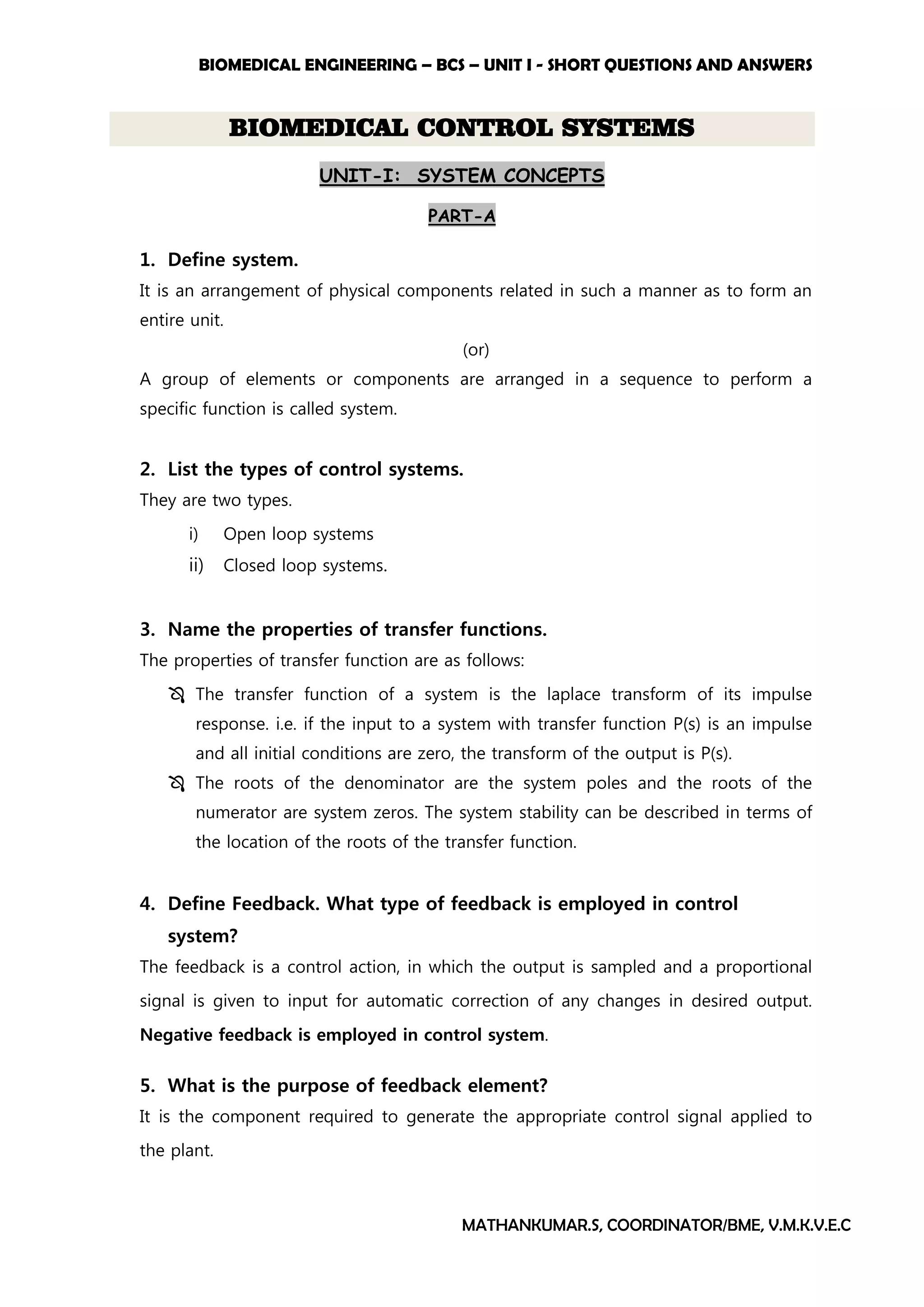
BIOMEDICAL CONTROL SYSTEMS
UNIT-I: SYSTEM CONCEPTS
PART-A
1. Define system.
It is an arrangement of physical components related in such a manner as to form an
entire unit.
(or)
A group of elements or components are arranged in a sequence to perform a
specific function is called system.
2. List the types of control systems.
They are two types.
i) Open loop systems
ii) Closed loop systems.
3. Name the properties of transfer functions.
The properties of transfer function are as follows:
 The transfer function of a system is the laplace transform of its impulse
response. i.e. if the input to a system with transfer function P(s) is an impulse
and all initial conditions are zero, the transform of the output is P(s).
 The roots of the denominator are the system poles and the roots of the
numerator are system zeros. The system stability can be described in terms of
the location of the roots of the transfer function.
4. Define Feedback. What type of feedback is employed in control
system?
The feedback is a control action, in which the output is sampled and a proportional
signal is given to input for automatic correction of any changes in desired output.
Negative feedback is employed in control system.
5. What is the purpose of feedback element?
It is the component required to generate the appropriate control signal applied to
the plant.
BIOMEDICAL ENGINEERING – BCS – UNIT I - SHORT QUESTIONS AND ANSWERS
MATHANKUMAR.S, COORDINATOR/BME, V.M.K.V.E.C
6. Give the important characteristics of open loop control system.
Their ability to perform accurately is determined by their calibration, which implies to
establish the input-output relation to obtain a desired system accuracy.
7. What is the need for block diagram reduction?
Block diagrams of some of the control systems turn out to be complex. Such that the
evaluation of their performance requires simplification (or reduction) of block
diagrams which is carried out by block diagram rearrangements.
8. Mention the types of feedback.
 Negative feedback
 Positive feedback.
9. Write the Mason’s gain formula.
Mason’s gain formula states that the overall gain of the system as follows,
Overall gain,
T = T(s) = Transfer function of the system
K = Number of forward paths in the signal flow graph
Pk = Forward path gain of kth
forward path
Δ = 1-[sum of individual loop gains] + [sum of gain product of all possible
combinations of two non-touching loops] – [sum of gain product of all
possible combinations of three non-touching loops] + ……………
Δk= Δ for that part of the graph which is not touching kth
forward path.
10. When will feedback exist in a system?
Feedback is said to exist in a system, when a closed sequence, of cause and effect
relations exist between systems available.
11. Define signal flow graph.
The graphical representation of the variables of a set of linear algebraic equations
representing the system is called signal flow graph.
(or)
A signal flow graph is a graphical representation of the relationship between
variables of a set of linear algebraic equations.
BIOMEDICAL ENGINEERING – BCS – UNIT I - SHORT QUESTIONS AND ANSWERS
MATHANKUMAR.S, COORDINATOR/BME, V.M.K.V.E.C
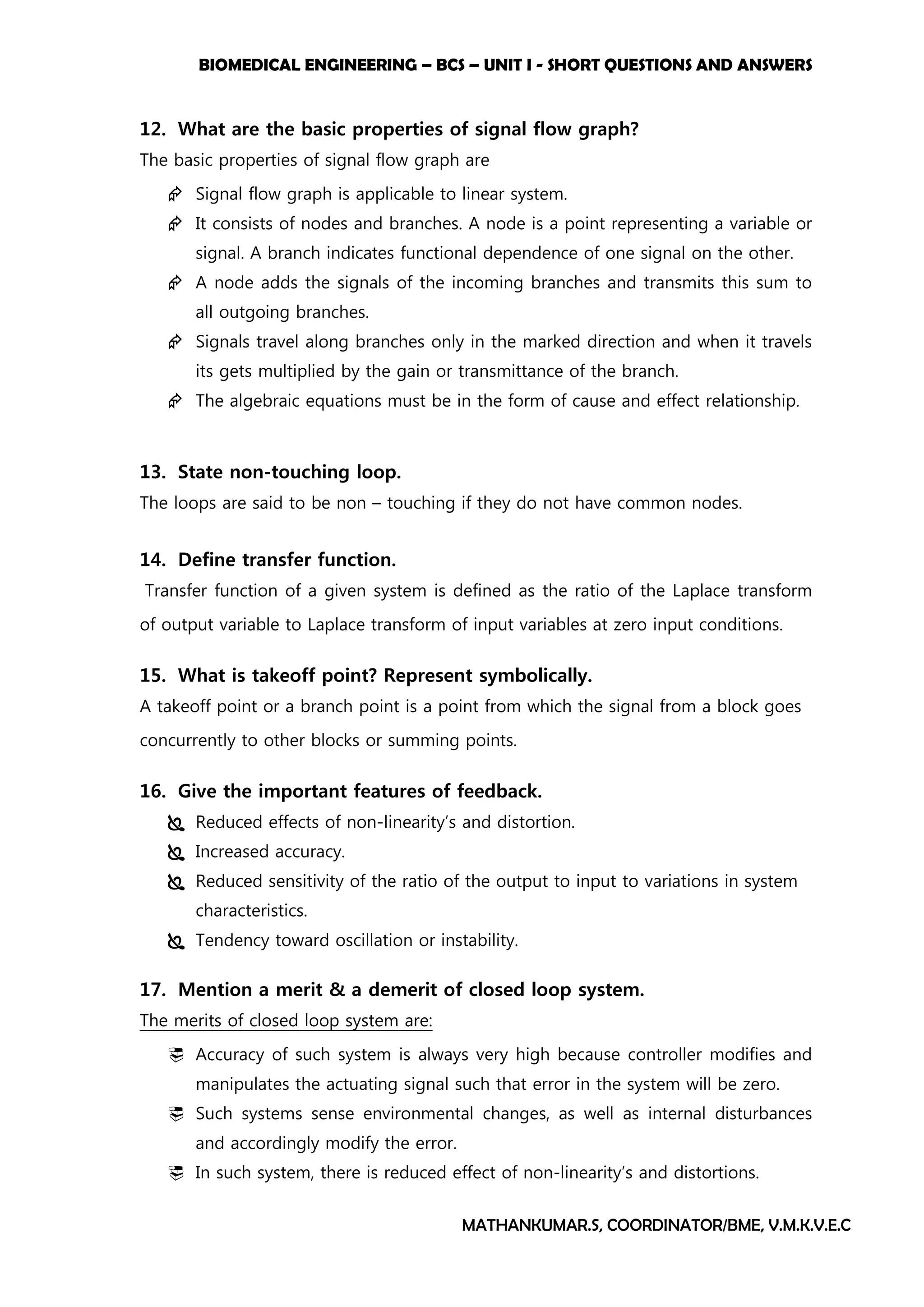
12. What are the basic properties of signal flow graph?
The basic properties of signal flow graph are
 Signal flow graph is applicable to linear system.
 It consists of nodes and branches. A node is a point representing a variable or
signal. A branch indicates functional dependence of one signal on the other.
 A node adds the signals of the incoming branches and transmits this sum to
all outgoing branches.
 Signals travel along branches only in the marked direction and when it travels
its gets multiplied by the gain or transmittance of the branch.
 The algebraic equations must be in the form of cause and effect relationship.
13. State non-touching loop.
The loops are said to be non – touching if they do not have common nodes.
14. Define transfer function.
Transfer function of a given system is defined as the ratio of the Laplace transform
of output variable to Laplace transform of input variables at zero input conditions.
15. What is takeoff point? Represent symbolically.
A takeoff point or a branch point is a point from which the signal from a block goes
concurrently to other blocks or summing points.
16. Give the important features of feedback.
 Reduced effects of non-linearity’s and distortion.
 Increased accuracy.
 Reduced sensitivity of the ratio of the output to input to variations in system
characteristics.
 Tendency toward oscillation or instability.
17. Mention a merit & a demerit of closed loop system.
The merits of closed loop system are:
 Accuracy of such system is always very high because controller modifies and
manipulates the actuating signal such that error in the system will be zero.
 Such systems sense environmental changes, as well as internal disturbances
and accordingly modify the error.
 In such system, there is reduced effect of non-linearity’s and distortions.
BIOMEDICAL ENGINEERING – BCS – UNIT I - SHORT QUESTIONS AND ANSWERS
MATHANKUMAR.S, COORDINATOR/BME, V.M.K.V.E.C
The demerits of closed loop system are:
 Closed loop system is less stable than an open loop system.
 The overall gain of the system is reduced due to feedback.
18. Define block diagram. What are the basic components of block diagram?
 A block diagram of a system is a pictorial representation of the functions
performed by each component of the system and shows the flow of signals.
 The basic components of block diagram are block (forward block & feedback
block), branch point, summing point and arrows.
19. What is transmittance?
The transmittance is the gain acquired by the signal when it travels from one node
to another node in signal flow graph.
20. List the steps involved in obtaining the transfer function.
 To write the differential equations governing the system.
 To Laplace transform the equations i.e. to replace the terms involving d/dt by
s, and integral of dt by 1/s.
 To obtain the ratio of transformed output to the input variables.

Biomedical Control Systems - SYSTEM CONCEPTS (Short Questions & Answers)

  • 1.
    BIOMEDICAL ENGINEERING –BCS – UNIT I - SHORT QUESTIONS AND ANSWERS MATHANKUMAR.S, COORDINATOR/BME, V.M.K.V.E.C BIOMEDICAL CONTROL SYSTEMS UNIT-I: SYSTEM CONCEPTS PART-A 1. Define system. It is an arrangement of physical components related in such a manner as to form an entire unit. (or) A group of elements or components are arranged in a sequence to perform a specific function is called system. 2. List the types of control systems. They are two types. i) Open loop systems ii) Closed loop systems. 3. Name the properties of transfer functions. The properties of transfer function are as follows:  The transfer function of a system is the laplace transform of its impulse response. i.e. if the input to a system with transfer function P(s) is an impulse and all initial conditions are zero, the transform of the output is P(s).  The roots of the denominator are the system poles and the roots of the numerator are system zeros. The system stability can be described in terms of the location of the roots of the transfer function. 4. Define Feedback. What type of feedback is employed in control system? The feedback is a control action, in which the output is sampled and a proportional signal is given to input for automatic correction of any changes in desired output. Negative feedback is employed in control system. 5. What is the purpose of feedback element? It is the component required to generate the appropriate control signal applied to the plant.
  • 2.
    BIOMEDICAL ENGINEERING –BCS – UNIT I - SHORT QUESTIONS AND ANSWERS MATHANKUMAR.S, COORDINATOR/BME, V.M.K.V.E.C 6. Give the important characteristics of open loop control system. Their ability to perform accurately is determined by their calibration, which implies to establish the input-output relation to obtain a desired system accuracy. 7. What is the need for block diagram reduction? Block diagrams of some of the control systems turn out to be complex. Such that the evaluation of their performance requires simplification (or reduction) of block diagrams which is carried out by block diagram rearrangements. 8. Mention the types of feedback.  Negative feedback  Positive feedback. 9. Write the Mason’s gain formula. Mason’s gain formula states that the overall gain of the system as follows, Overall gain, T = T(s) = Transfer function of the system K = Number of forward paths in the signal flow graph Pk = Forward path gain of kth forward path Δ = 1-[sum of individual loop gains] + [sum of gain product of all possible combinations of two non-touching loops] – [sum of gain product of all possible combinations of three non-touching loops] + …………… Δk= Δ for that part of the graph which is not touching kth forward path. 10. When will feedback exist in a system? Feedback is said to exist in a system, when a closed sequence, of cause and effect relations exist between systems available. 11. Define signal flow graph. The graphical representation of the variables of a set of linear algebraic equations representing the system is called signal flow graph. (or) A signal flow graph is a graphical representation of the relationship between variables of a set of linear algebraic equations.
  • 3.
    BIOMEDICAL ENGINEERING –BCS – UNIT I - SHORT QUESTIONS AND ANSWERS MATHANKUMAR.S, COORDINATOR/BME, V.M.K.V.E.C 12. What are the basic properties of signal flow graph? The basic properties of signal flow graph are  Signal flow graph is applicable to linear system.  It consists of nodes and branches. A node is a point representing a variable or signal. A branch indicates functional dependence of one signal on the other.  A node adds the signals of the incoming branches and transmits this sum to all outgoing branches.  Signals travel along branches only in the marked direction and when it travels its gets multiplied by the gain or transmittance of the branch.  The algebraic equations must be in the form of cause and effect relationship. 13. State non-touching loop. The loops are said to be non – touching if they do not have common nodes. 14. Define transfer function. Transfer function of a given system is defined as the ratio of the Laplace transform of output variable to Laplace transform of input variables at zero input conditions. 15. What is takeoff point? Represent symbolically. A takeoff point or a branch point is a point from which the signal from a block goes concurrently to other blocks or summing points. 16. Give the important features of feedback.  Reduced effects of non-linearity’s and distortion.  Increased accuracy.  Reduced sensitivity of the ratio of the output to input to variations in system characteristics.  Tendency toward oscillation or instability. 17. Mention a merit & a demerit of closed loop system. The merits of closed loop system are:  Accuracy of such system is always very high because controller modifies and manipulates the actuating signal such that error in the system will be zero.  Such systems sense environmental changes, as well as internal disturbances and accordingly modify the error.  In such system, there is reduced effect of non-linearity’s and distortions.
  • 4.
    BIOMEDICAL ENGINEERING –BCS – UNIT I - SHORT QUESTIONS AND ANSWERS MATHANKUMAR.S, COORDINATOR/BME, V.M.K.V.E.C The demerits of closed loop system are:  Closed loop system is less stable than an open loop system.  The overall gain of the system is reduced due to feedback. 18. Define block diagram. What are the basic components of block diagram?  A block diagram of a system is a pictorial representation of the functions performed by each component of the system and shows the flow of signals.  The basic components of block diagram are block (forward block & feedback block), branch point, summing point and arrows. 19. What is transmittance? The transmittance is the gain acquired by the signal when it travels from one node to another node in signal flow graph. 20. List the steps involved in obtaining the transfer function.  To write the differential equations governing the system.  To Laplace transform the equations i.e. to replace the terms involving d/dt by s, and integral of dt by 1/s.  To obtain the ratio of transformed output to the input variables.