HOSPITAL COMMITTEES
PRESENTED BY:
SIDDHARTH SINGH
PGDM (HEAD) INLEAD
What is a Committee?
A Group of people appointed for a specific
function by larger group and typically consisting of
members of that group.

A person or group of persons elected or appointed
to perform some service or function so as to
investigate, report on, act upon a particular matter.
Hospital Committees
Hospital committees are regular standing
committees prescribed by regulatory agencies and
deemed necessary by hospital administration in
formulating policies, coordinating and monitoring
hospital-wide activities that are considered critical in
delivery of quality health care services.
Types of Committee
Execom (Executive Committee)

Mancom (Management Committee)

Committee of Medical Services

Bioethics Committee

Pharmacy and Therapeutic Committee

Infection Control Committee
Quality Council

Waste Management Committee

Medical Audit and Tissue Committee

Tumour Board

Medical Records Committee

Credentials committee

Blood Transfusion Committee
Function of Committees
Fulfil tasks effectively and efficiently that will lead to quality
outcome and excellent results with near-zero complaint from
internal as well as external customers

Provide training and education to promote goal achievement

Conduct research to promote goal achievement

Policy formulation

Coordination

Monitoring
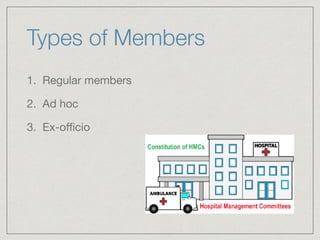
Types of Members
1. Regular members

2. Ad hoc

3. Ex-officio
Function Attendance Membership Tenure
Regular
Fullfil
prescribed
tasks
Regular Appointed
Yearly
subject to
renewal
Ad hoc Assist As needed
Invited by
regular
members
Yearly
subject to
renewal
Ex-officio Advise As needed
Invited or
designated
Yearly
subject to
renewal
Execom Committee
Area of responsibility: Quality services and
organisational direction

Report to: Board of Directors

Output: Effective and efficient governance
policies, decision-making and oversight producing
quality service and financial stability
Mancom Committee
Area of responsibility: Quality services and
operational management

Report to: Execom

Output: Effective and efficient operational
strategies producing quality service and financial
stability
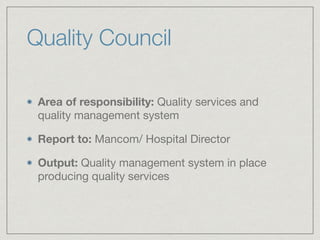
Quality Council
Area of responsibility: Quality services and
quality management system

Report to: Mancom/ Hospital Director

Output: Quality management system in place
producing quality services
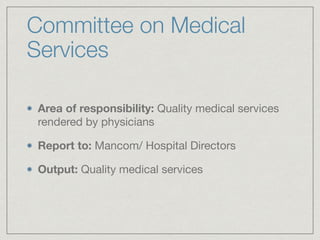
Committee on Medical
Services
Area of responsibility: Quality medical services
rendered by physicians

Report to: Mancom/ Hospital Directors

Output: Quality medical services
Bioethics Committee
Area of responsibility: Bioethical matters in
patient care

Report to: Medical Director

Output: Quality management system on bioethical
matters in patient care
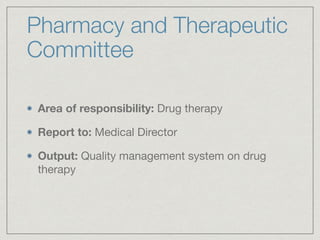
Pharmacy and Therapeutic
Committee
Area of responsibility: Drug therapy

Report to: Medical Director

Output: Quality management system on drug
therapy
Infection Control
Committee
Area of responsibility: Infection control

Report to: Medical Director

Output: Quality management system on infection
control
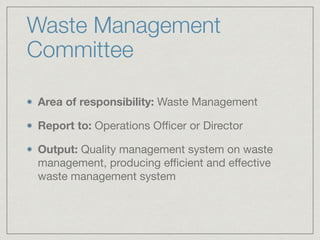
Waste Management
Committee
Area of responsibility: Waste Management

Report to: Operations Officer or Director

Output: Quality management system on waste
management, producing efficient and effective
waste management system
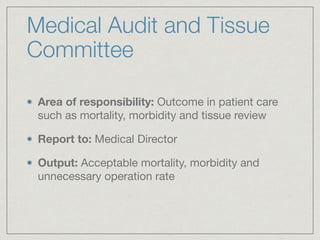
Medical Audit and Tissue
Committee
Area of responsibility: Outcome in patient care
such as mortality, morbidity and tissue review

Report to: Medical Director

Output: Acceptable mortality, morbidity and
unnecessary operation rate
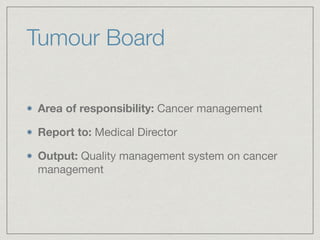
Tumour Board
Area of responsibility: Cancer management

Report to: Medical Director

Output: Quality management system on cancer
management
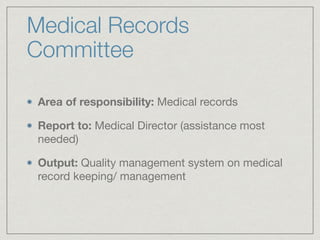
Medical Records
Committee
Area of responsibility: Medical records

Report to: Medical Director (assistance most
needed)

Output: Quality management system on medical
record keeping/ management
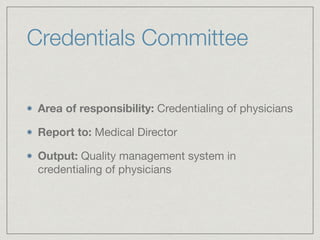
Credentials Committee
Area of responsibility: Credentialing of physicians

Report to: Medical Director

Output: Quality management system in
credentialing of physicians
Blood Transfusion
Committee
Area of responsibility: Blood transfusion

Report to: Medical Director

Output: Quality management system in blood
transfusion
Quality Management
System
A Quality Management System (QMS) is set of
policies, process and procedures required for
planning and execution (production/ development/
Service) in the core business area of an organization.
(i.e. areas that can impact the organisation’s ability
to meet customer requirements.)
System of Functioning
Documents and data needed.
1. Minutes of meetings

2. Organizational primer with quality management system manual

3. Mid-year and annual report based on management action plan

4. Performance reports

System of inter-office communication.
Information Dissemination.
Management review - once a year
Thank You

Hospital committees

  • 1.
  • 2.
    What is aCommittee? A Group of people appointed for a specific function by larger group and typically consisting of members of that group. A person or group of persons elected or appointed to perform some service or function so as to investigate, report on, act upon a particular matter.
  • 3.
    Hospital Committees Hospital committeesare regular standing committees prescribed by regulatory agencies and deemed necessary by hospital administration in formulating policies, coordinating and monitoring hospital-wide activities that are considered critical in delivery of quality health care services.
  • 4.
    Types of Committee Execom(Executive Committee) Mancom (Management Committee) Committee of Medical Services Bioethics Committee Pharmacy and Therapeutic Committee Infection Control Committee
  • 5.
    Quality Council Waste ManagementCommittee Medical Audit and Tissue Committee Tumour Board Medical Records Committee Credentials committee Blood Transfusion Committee
  • 6.
    Function of Committees Fulfiltasks effectively and efficiently that will lead to quality outcome and excellent results with near-zero complaint from internal as well as external customers Provide training and education to promote goal achievement Conduct research to promote goal achievement Policy formulation Coordination Monitoring
  • 7.
    Types of Members 1.Regular members 2. Ad hoc 3. Ex-officio
  • 8.
    Function Attendance MembershipTenure Regular Fullfil prescribed tasks Regular Appointed Yearly subject to renewal Ad hoc Assist As needed Invited by regular members Yearly subject to renewal Ex-officio Advise As needed Invited or designated Yearly subject to renewal
  • 9.
    Execom Committee Area ofresponsibility: Quality services and organisational direction Report to: Board of Directors Output: Effective and efficient governance policies, decision-making and oversight producing quality service and financial stability
  • 10.
    Mancom Committee Area ofresponsibility: Quality services and operational management Report to: Execom Output: Effective and efficient operational strategies producing quality service and financial stability
  • 11.
    Quality Council Area ofresponsibility: Quality services and quality management system Report to: Mancom/ Hospital Director Output: Quality management system in place producing quality services
  • 12.
    Committee on Medical Services Areaof responsibility: Quality medical services rendered by physicians Report to: Mancom/ Hospital Directors Output: Quality medical services
  • 13.
    Bioethics Committee Area ofresponsibility: Bioethical matters in patient care Report to: Medical Director Output: Quality management system on bioethical matters in patient care
  • 14.
    Pharmacy and Therapeutic Committee Areaof responsibility: Drug therapy Report to: Medical Director Output: Quality management system on drug therapy
  • 15.
    Infection Control Committee Area ofresponsibility: Infection control Report to: Medical Director Output: Quality management system on infection control
  • 16.
    Waste Management Committee Area ofresponsibility: Waste Management Report to: Operations Officer or Director Output: Quality management system on waste management, producing efficient and effective waste management system
  • 17.
    Medical Audit andTissue Committee Area of responsibility: Outcome in patient care such as mortality, morbidity and tissue review Report to: Medical Director Output: Acceptable mortality, morbidity and unnecessary operation rate
  • 18.
    Tumour Board Area ofresponsibility: Cancer management Report to: Medical Director Output: Quality management system on cancer management
  • 19.
    Medical Records Committee Area ofresponsibility: Medical records Report to: Medical Director (assistance most needed) Output: Quality management system on medical record keeping/ management
  • 20.
    Credentials Committee Area ofresponsibility: Credentialing of physicians Report to: Medical Director Output: Quality management system in credentialing of physicians
  • 21.
    Blood Transfusion Committee Area ofresponsibility: Blood transfusion Report to: Medical Director Output: Quality management system in blood transfusion
  • 22.
    Quality Management System A QualityManagement System (QMS) is set of policies, process and procedures required for planning and execution (production/ development/ Service) in the core business area of an organization. (i.e. areas that can impact the organisation’s ability to meet customer requirements.)
  • 23.
    System of Functioning Documentsand data needed. 1. Minutes of meetings 2. Organizational primer with quality management system manual 3. Mid-year and annual report based on management action plan 4. Performance reports System of inter-office communication. Information Dissemination. Management review - once a year
  • 24.