1
HOSPITAL INCIDENT
COMMAND SYSTEM
Incident Action
Planning
This material has been developed for training purposes; do not share, distribute, transmit or reproduce without prior written consent of California Hospital Association This course was
developed by the CHA Hospital Preparedness Program with grant funds provided by the U.S. Department of Health & Human Services Assistant Secretary for Preparedness & Response
Hospital Preparedness Program and awarded by the California Department of Public Health. No part of this course or its materials shall be copied or utilized for monetary gain.
2
OBJECTIVES
• Understand the 9 steps of the Incident
Action Planning process
• Identify Incident Action Plan
components
• Exercise the development of an
Incident Action Plan
3
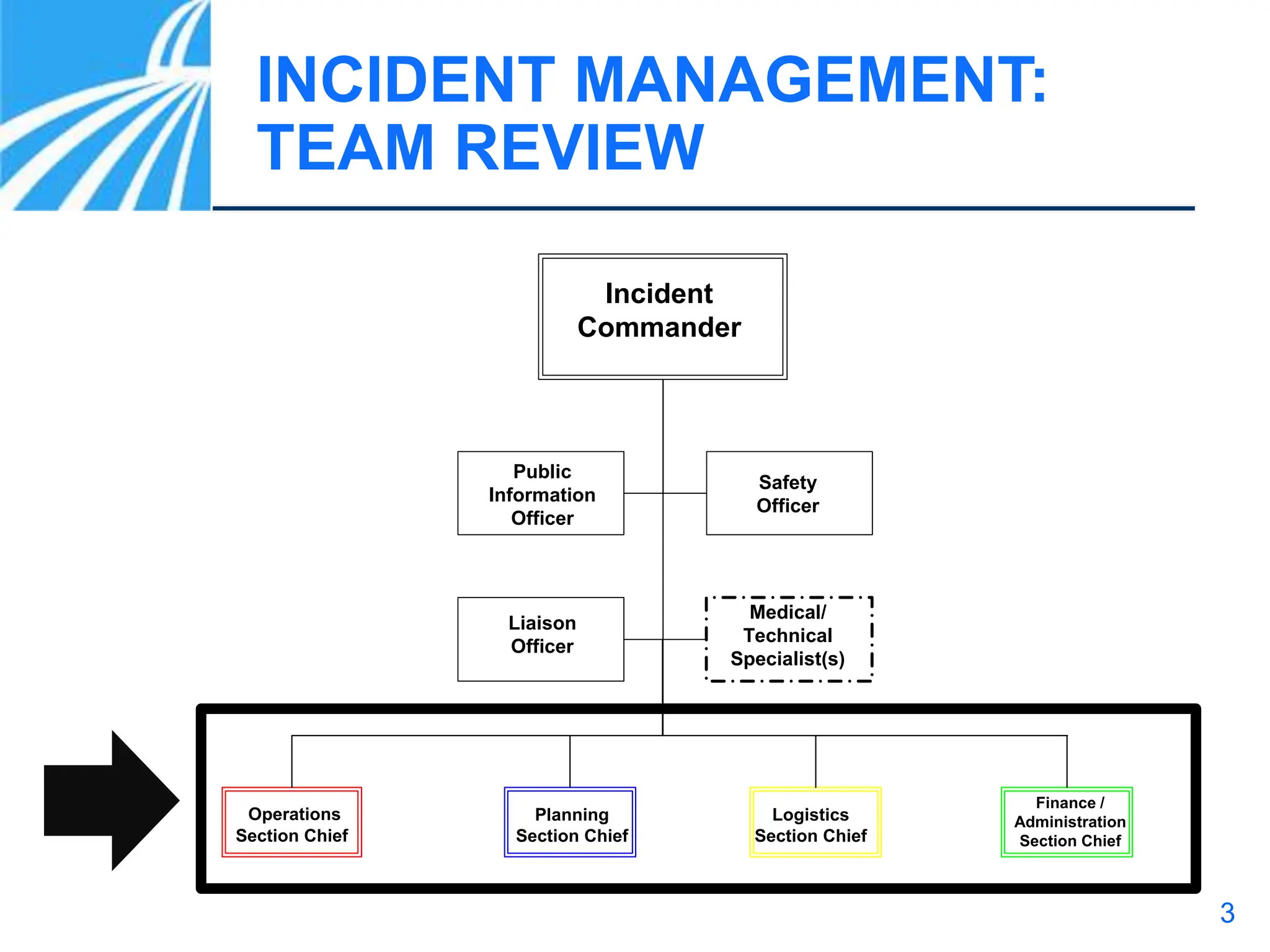
INCIDENT MANAGEMENT:
TEAM REVIEW
Operations
Section Chief
Planning
Section Chief
Logistics
Section Chief
Finance /
Administration
Section Chief
Incident
Commander
Public
Information
Officer
Liaison
Officer
Medical/
Technical
Specialist(s)
Safety
Officer
4
HOSPITAL INCIDENT ACTION
PLANNING
Key to Effective
Response and Recovery
5
1. Assess the Situation
2. Set the Operational Period
3. Determine Safety Priorities & Establish Incident
Objectives
4. Determine Branch/Section Objectives
5. Determine Strategies & Tactics
6. Determine Needed Resources
7. Issue Assignments
8. Implement Actions
9. Reassess & Adjust Plans
INCIDENT ACTION PLANNING
6
• Type of incident, location, magnitude, and
possible duration
• Ongoing hazards and safety concerns
• Determines initial priorities based on:
1) Life saving
2) Incident stabilization
3) Property preservation
• Establishes the Hospital Command Center
The Incident Commander conducts the
initial incident assessment from the
information gathered:
1) ASSESS THE SITUATION
7
An Operational Period is:
• The period of time scheduled for execution of a
given set of tactical actions in the Incident
Action Plan
• Set by the Incident Commander
The Operational Period is usually set
in hours:
• Does not have to conform to shift times
• Can be long or short, depending on the intensity
of the incident or amount of information
available
2) SET THE OPERATIONAL
PERIOD
8
General Command Objectives are:
• Broad organizational objectives that are
foundational and do not change during response
and recovery. These objectives define where the
system wants to be at the end of the response
• Not limited to an Operational Period
Examples:
• Provide adequate care to all patients who present
as a result of the incident
• Provide for the safety of staff, patients and visitors
3) DETERMINE SAFETY
PRIORITIES & ESTABLISH
INCIDENT OBJECTIVES
9
Section/Branch Objectives are:
• More specific objectives to achieve overall
incident objectives
• Steps during the defined Operational Period
• Should be tangible and measurable
Example:
• Provide prophylaxis to 75% of hospital staff in
this operational period
• Decontaminate 25 victims in 2 hours
4) DETERMINE SECTION/BRANCH
OBJECTIVES
10
5) DETERMINE STRATEGIES
AND TACTICS
Strategy Defined:
• The general direction selected to accomplish
incident objectives (NIMS)
• The approach to achieving the objectives
Tactics Defined:
• Specific actions, sequence of actions,
procedures, tasks, assignments to meet
strategies and objectives
• The “boots on the ground” or “doers”
11
• Tactical resources may include:
 Personnel
 Equipment
 Supplies
 Pharmaceuticals
 Vehicles
• Available and needed resources to meet the
tactical objectives must be identified
6) DETERMINE NEEDED
RESOURCES
12
• Additional HICS positions are activated according to
incident needs
• Staff are assigned to conduct incident specific
operations:
 Evacuation
 Decontamination
 Triage and treatment
 Safety measures
Once the tactical objectives and
necessary resources are identified,
assignments are issued:
7) ISSUE ASSIGNMENTS
13
THE INCIDENT ACTION
PLANNING MEETING
The Incident Action Planning
Meeting is:
• Led by the Planning Chief
• Defines and finalizes branch/section
objectives, strategies, tactics, and resources
as determined by each section for the next
operational period
• The Section Chiefs submit completed HICS
Form 204 Branch Assignment List and the
Safety Officer submits completed HICS
Form 215A IAP Safety Analysis
14
Direct, monitor and evaluate response
efforts:
• Constant monitoring of strategies and tactics
for effectiveness
• Assess the Operational Period Objectives
 Are the objectives being achieved?
 Is the strategy/tactics safe?
 Is the strategy/tactics effective?
• Evaluation is an ongoing process throughout
response and recovery
8) IMPLEMENT ACTIONS
15
9) REASSESS & ADJUST PLANS
Conduct a Current Situation Assessment:
 Update situation/incident information
 Assess the impact on the hospital
 Length and duration of continued/resolving
incident
 Resource availability
• Assess the Incident Objectives
• Make sure they are achieved in a safe and
timely manner
• Revise objectives, strategies, tactics and
resource needs for the upcoming operational
period
16
INCIDENT ACTION PLAN
RESPONSIBILITIES
The Incident Commander:
• Provides general Command and
Control Objectives (HICS 202 Incident
Objectives)
• Sets the Operational Period
• Develops major strategies (priorities)
• Activates Incident Management Team positions
• Establishes policy for resource orders
• Approves initial actions and the completed
Incident Action Plan
17
The Safety Officer:
• Advises the Incident Commander and Section
Chiefs on safety issues and measures
• Develops the Safety Plan (HICS 215A
Incident Action Safety Plan Analysis)
• Oversees the safety of operations and tactics
INCIDENT ACTION PLAN
RESPONSIBILITIES
18
The Planning Section Chief:
• Prepares for the Planning Meetings
 Gathers information for the Incident Action Plan
(HICS 201, 202, 203, 204’s and 215A)
 Develops demobilization plan
• Conducts the Planning Meeting
• Coordinates and submits the Incident Action
Plan to the Incident Commander for approval
• Disseminates the Incident Action Plan
INCIDENT ACTION PLAN
RESPONSIBILITIES
19
The Operations Section Chief:
• Determines/assesses areas of operation
• Advises Incident Commander of activated
Operations positions and work assignments
• Determines tactics (HICS 204)
• Determines resource requirements (HICS
204) and communicates needs with Logistics
INCIDENT ACTION PLAN
RESPONSIBILITIES
20
The Logistics Section Chief:
• Ensures resource ordering meets the needs
• Advises Incident Commander on activated
Logistics positions
• Ensures resources to support the Incident
Action Plan
• Develops plans that support the Incident Action
Plan
 Communications Plans
 Transportation Plans
INCIDENT ACTION PLAN
RESPONSIBILITIES
21
The Finance/Administration Section
Chief:
• Provides cost implications of the Command
and Control, and Operational Period
Objectives
• Ensures the Incident Action Plan is within
cost limitations
• Advises the Incident Commander on
Finance/Admin activated positions
INCIDENT ACTION PLAN
RESPONSIBILITIES
22
The Incident Action Plan:
• Provides Incident Management Team
personnel with direction for the Operational
Period
• Incident Action Planning is a process of
Management by Objectives
• Essential for effective response and recovery
INCIDENT ACTION PLAN
SECTION REVIEW
23
QUESTIONS?
24
Incident Response Guides
• Active Shooter
• Chemical Incident
• Earthquake
• Evacuation, Shelter-in-Place, & Hospital
Abandonment
• Explosive Incident
• Hostage or Barricade Incident
• Infectious Disease
There are 16 Scenario-based Incident
Response Guides :
25
Incident Response Guides
(continued)
• Information Technology (IT) Failure
• Mass Casualty Incident
• Missing Person
• Radiation Incident
• Severe Weather with Warning
• Staff Shortage
• Tornado
• Utility Failure
• Wildland Fire
26
Provides Incident-specific:
• Directions
• Incident Objectives
• Management tasks by function and timeframes
• Sample Hospital Incident Management Teams
Should compliment:
• Emergency Operations Plan and Job Action
Sheets
Can be used as documentation
Incident Response Guides
27
HICS FORMS USED IN THE
INCIDENT ACTION PLAN
28
HICS Form 200
Incident Action Plan Cover Sheet
• Purpose: Provides a cover sheet and a checklist
for HICS Forms and other documents included in
the operational period Incident Action Plan
• Origination: Incident Commander or Planning
Section Chief
• Copies to: Command and General Staff and
Documentation Unit Leader
• Helpful Tips: Additions may be made to the
form to meet the organization’s needs
29
HICS Form 201
Incident Briefing
• Purpose: Documents initial response information &
actions at start-up
• Origination: Incident Commander
• Copies to: Command Staff, Section Chiefs, and
Documentation Unit Leader
• When to Complete: Prior to briefing the current
operational period
• Helpful Tips: Distribute to all staff before initial
briefing
30
HICS Form 201
Incident Briefing
31
• Purpose: Defines incident objectives
• Instructions: Include -
 Weather/Environmental Implications
 General Safety/Safety Messages
 Attachments
 Prepared by Planning Section Chief
Approved by: Incident Commander
HICS Form 202
Incident Objectives
32
HICS Form 202
Incident Objectives
33
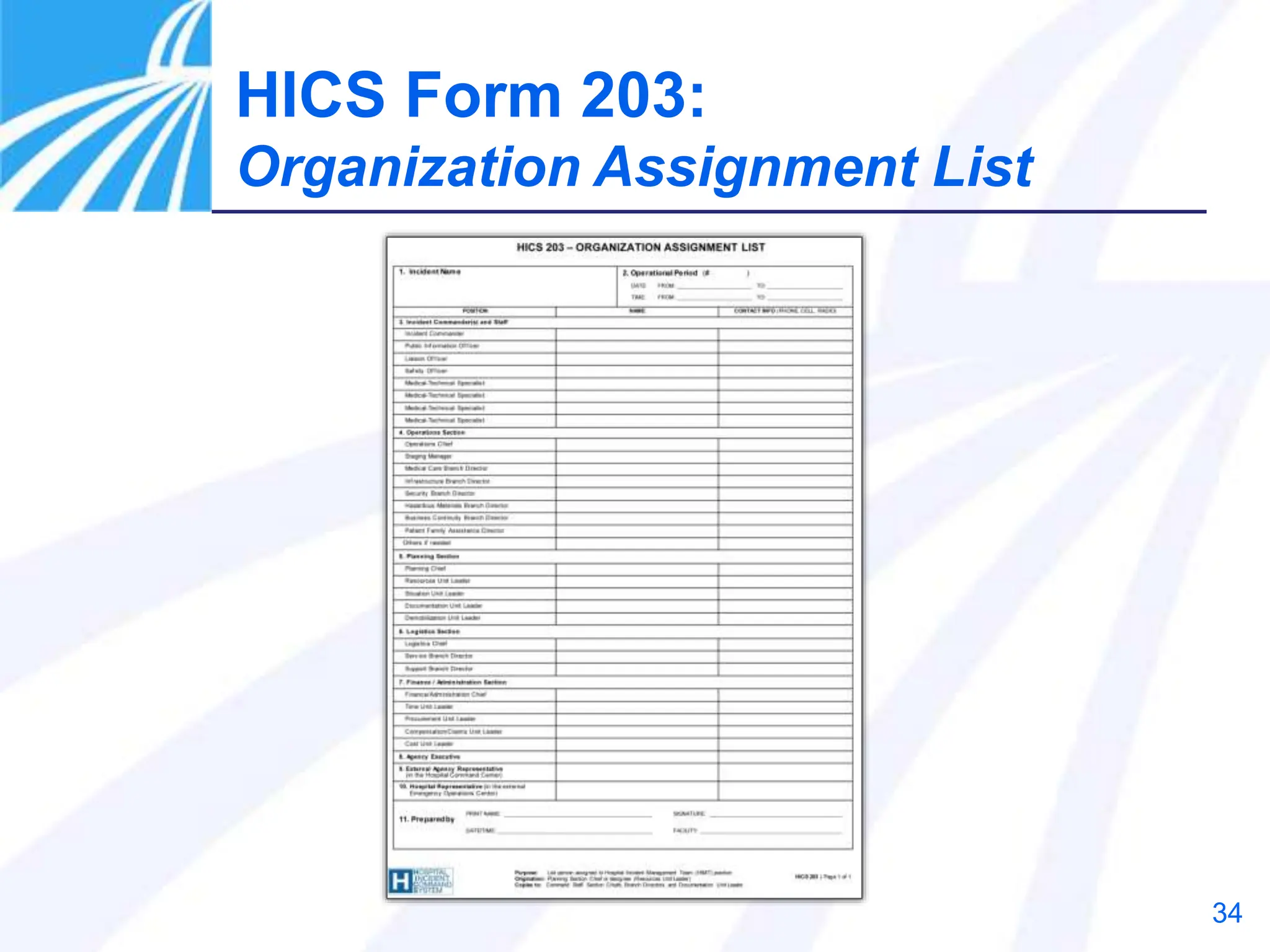
• Purpose: To document Hospital Command
Center staffing
• Origination: The Planning Section Chief or
designee (Resources Unit Leader)
• Copies to:
 Command Staff and General Staff
 Branch Directors and Agency Staff
 Documentation Unit Leader
HICS Form 203:
Organizational Assignment List
34
HICS Form 203:
Organization Assignment List
35
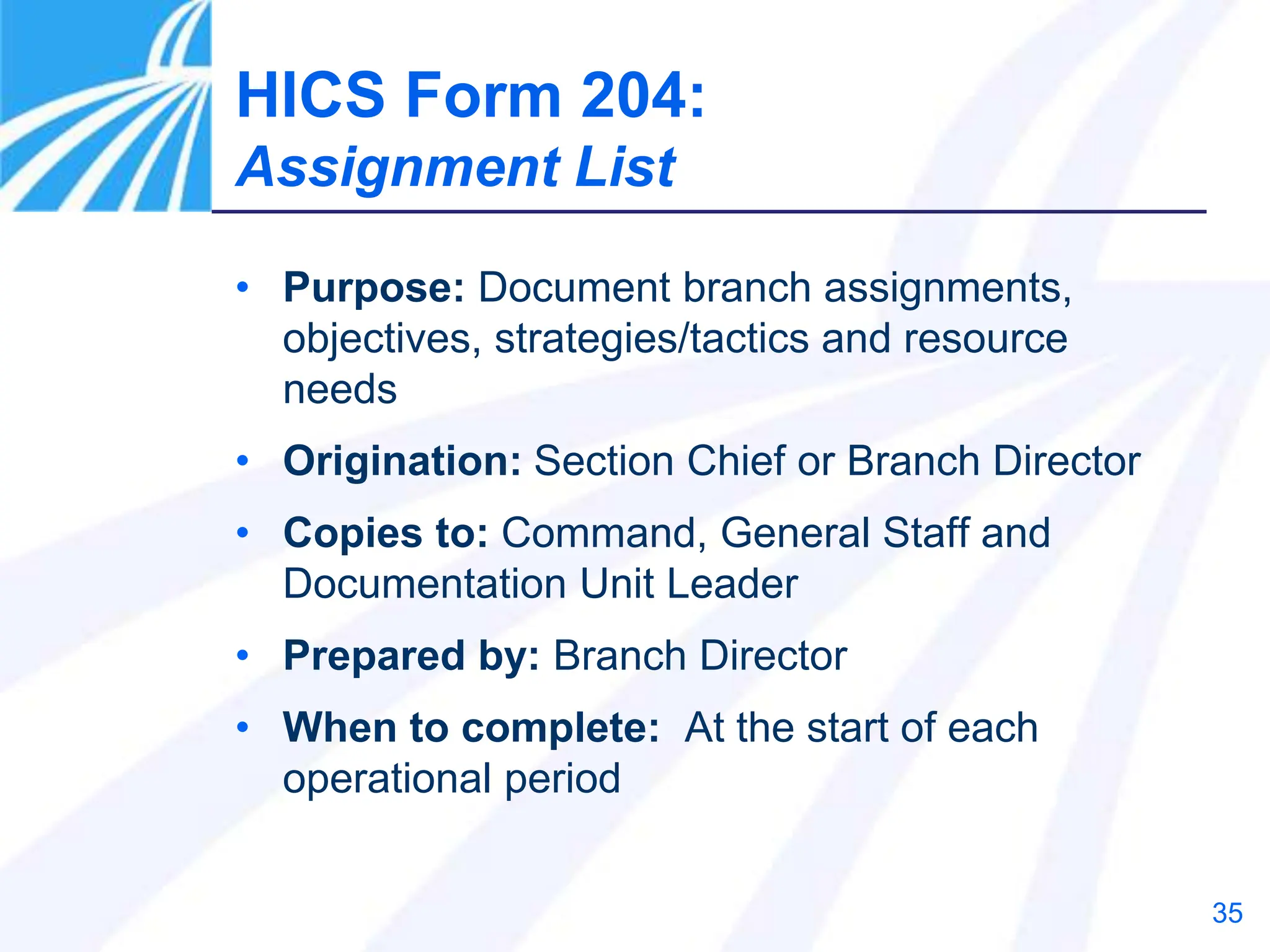
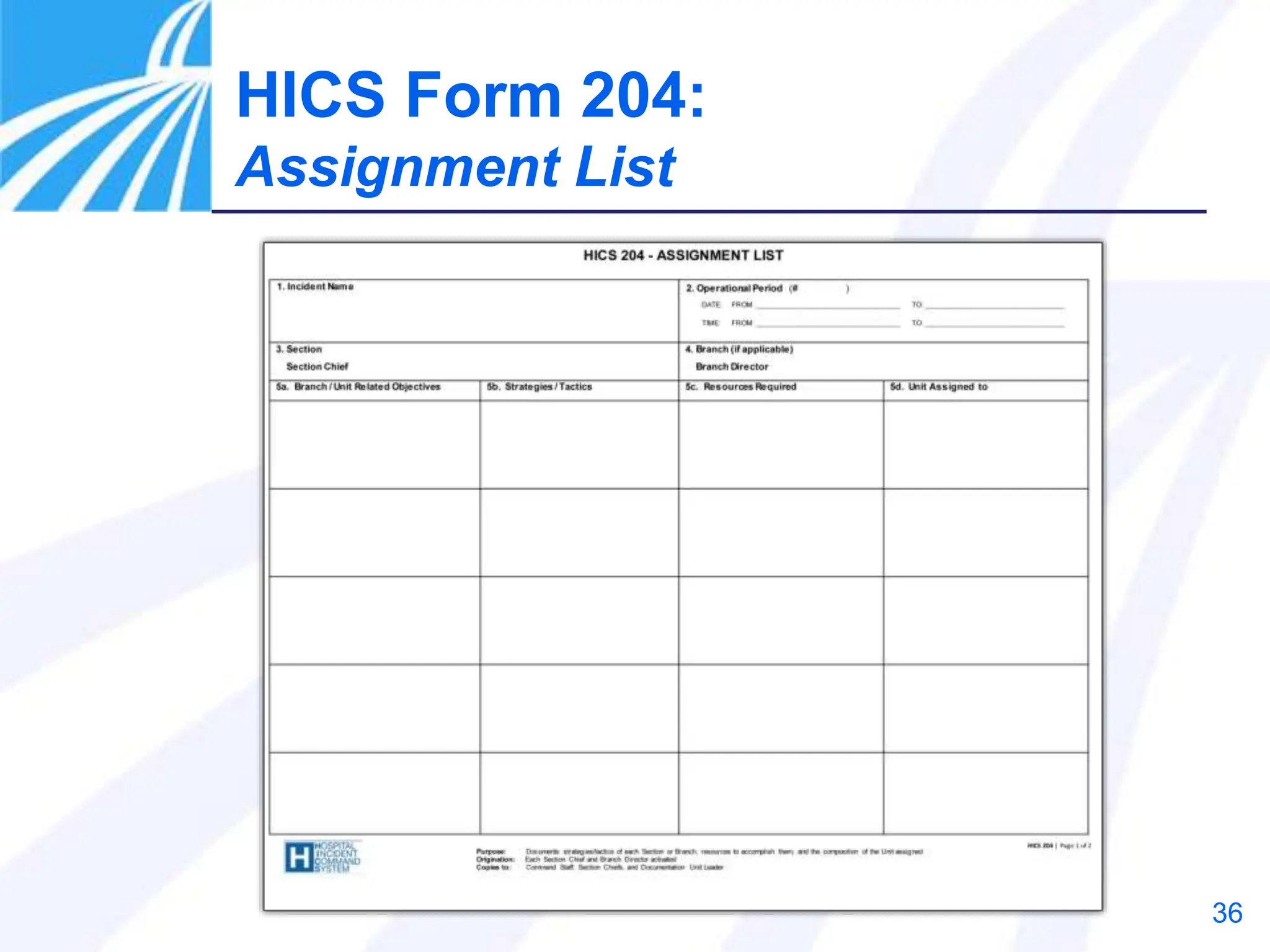
• Purpose: Document branch assignments,
objectives, strategies/tactics and resource
needs
• Origination: Section Chief or Branch Director
• Copies to: Command, General Staff and
Documentation Unit Leader
• Prepared by: Branch Director
• When to complete: At the start of each
operational period
HICS Form 204:
Assignment List
36
HICS Form 204:
Assignment List
37
HICS Form 215A:
Incident Action Plan Safety Plan Analysis
• Purpose: Document hazards and mitigation
• Origination: Safety Officer
• Copies to: Command and General Staff,
Sections, and Branches
• Prepared by: Safety Officer
• Approved by: Incident Commander
• When to complete: Prior to safety briefing
during the Operations Briefing and at transfer of
role
38
HICS Form 215A:
Incident Action Plan Safety Plan Analysis
39
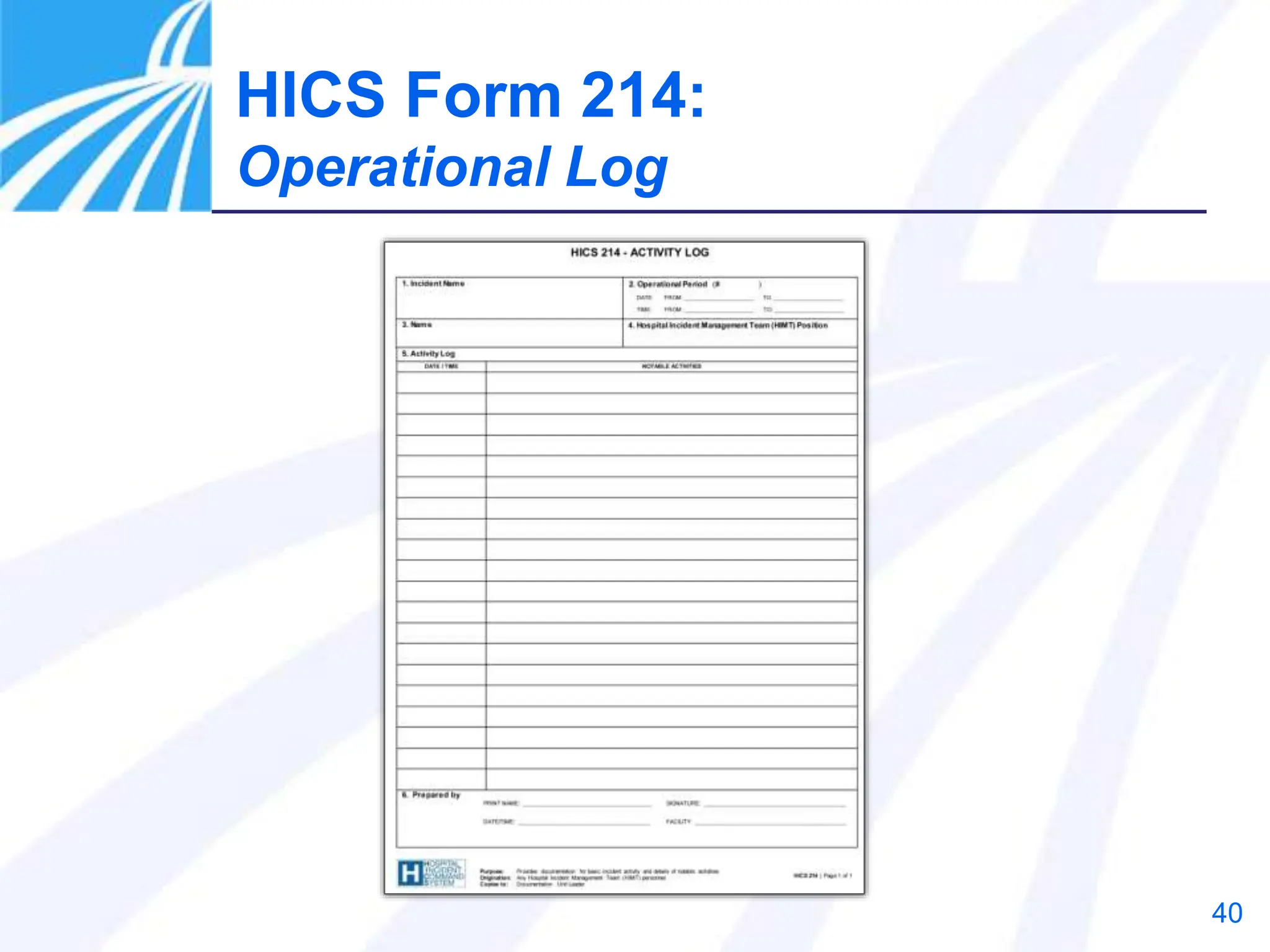
• Purpose: Document
 Incident issues encountered
 Decisions made
 Notifications conveyed
• Origination: Command and General Staff
• When to complete:
 Continuously, from activation through
demobilization
HICS Form 214:
Activity Log
40
HICS Form 214:
Operational Log
41
Purpose: A short form combining forms 201,
202, 203, 204 and 215A. May be used in
place of full forms to document initial actions
or short incidents, and can expand to the full
forms as needed.
Origination: Incident Commander or
Planning Section Chief
HICS Form IAP Quick Start
42
HICS Form IAP Quick Start
43
Application of
Incident Action Plan –
Infectious Disease
Hospital Incident
Command System
This material has been developed for training purposes; do not share, distribute, transmit or reproduce without prior written consent of California Hospital Association
This course was developed by the CHA Hospital Preparedness Program with grant funds provided by the U.S. Department of Health & Human Services Assistant
Secretary for Preparedness & Response Hospital Preparedness Program and awarded by the California Department of Public Health. No part of this course or its
materials shall be copied or utilized for monetary gain.
44
Incident Action Planning
1. Assess the Situation
2. Set the Operational Period
3. Determine Safety Priorities & Establish Incident Objectives
4. Determine Branch/Section Objectives
5. Determine Strategies & Tactics
6. Determine Needed Resources
7. Issue Assignments
8. Implement Actions
9. Reassess & Adjust Plans
45
• Influenza season has begun and hospitals and
primary care see an increase in the number of
influenza-like illness (ILI) cases presenting for
care including a family of 5 with symptoms of ILI.
• Emergency departments and community health
centers see a surge in ILI cases presenting, and
admissions increase over 10% with acute
respiratory illnesses.
• PHD is stating there is evidence of an emerging
infectious disease with respiratory spread and
that hospitals should prepare for significant
surge.
Scenario
46
First Actions
• Time: 0900
• Weather: Clear, 68º F, no winds
 Is this an incident?
 What are your first actions?
 Who is in charge?
47
• Use HICS form 214: Operational Log
• Complete HICS form 201: Incident Briefing
 Event History and Current Actions Summary
• Begin form 202: Incident Objectives
 Weather/environmental implications for period
Step 1: Assess the Situation
Incident Action Planning
48
Which Positions to Activate?
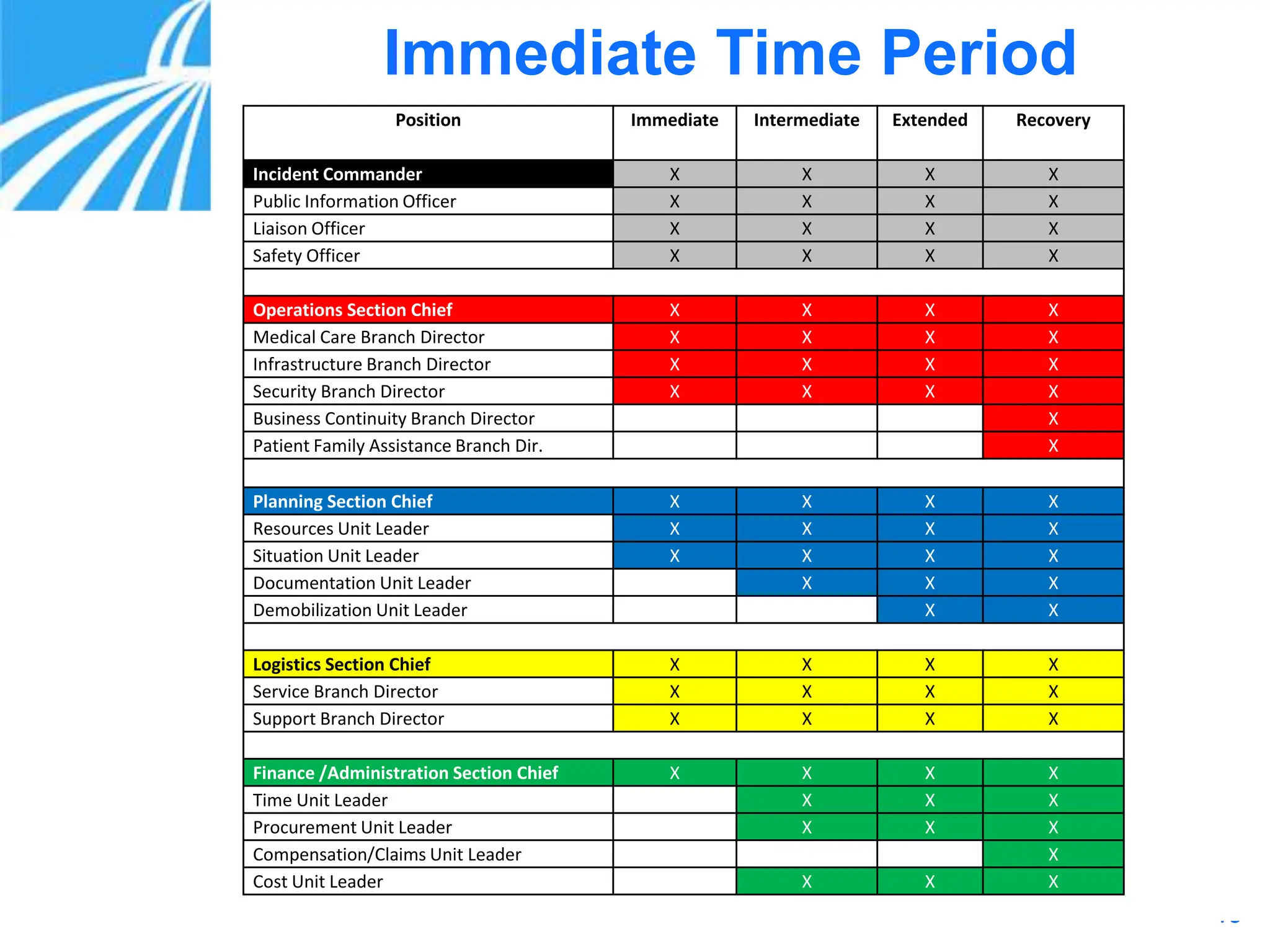
49
Immediate Time Period
Position Immediate Intermediate Extended Recovery
Incident Commander X X X X
Public Information Officer X X X X
Liaison Officer X X X X
Safety Officer X X X X
Operations Section Chief X X X X
Medical Care Branch Director X X X X
Infrastructure Branch Director X X X X
Security Branch Director X X X X
Business Continuity Branch Director X
Patient Family Assistance Branch Dir. X
Planning Section Chief X X X X
Resources Unit Leader X X X X
Situation Unit Leader X X X X
Documentation Unit Leader X X X
Demobilization Unit Leader X X
Logistics Section Chief X X X X
Service Branch Director X X X X
Support Branch Director X X X X
Finance /Administration Section Chief X X X X
Time Unit Leader X X X
Procurement Unit Leader X X X
Compensation/Claims Unit Leader X
Cost Unit Leader X X X
50
• The Incident Commander names the
incident
• If the incident is a community-based
incident, the appropriate jurisdiction will
name the incident (e.g., county, city, EMS)
• The incident name should be documented
on all forms
Naming the Incident
51
• HICS form 202: Incident Objectives
 Operational Period Date/Time
• Incident Commander sets the Operational
Period
o Based on number of simultaneous activities
o How quickly the situation is changing
• An Operational Period breaks the incident
down into manageable timeframes
Step 2: Set the Operational Period
Incident Action Planning
52
• Identify the Incident Objectives (these are
the broad objectives that will last throughout
the response or are the priorities)
• HICS form 202: Incident Objectives
Step 3: Determine Safety Priorities &
Establish Incident Objectives
Incident Action Planning
53
Utilize the Incident Response Guide
Infectious Disease:
• Identify, triage, isolate and treat infectious
patients
• Protect patients and staff from exposure and
injury
• Assure safety and security for patients, staff,
visitors and the hospital
• Admit a large number of infectious patients
while protecting other (uninfected) patients
Incident Objectives
54
• It is reported the several of the patients
with ILI symptoms in your hospital are
requiring ICU level care and ventilator
support.
Scenario Update #1
55
• Assess the Safety issues
• What hazards exist and what precautions
need to be taken
• Complete the 215A – Incident Action Plan
Safety Analysis
Side Note:
Safety Officer Tasks
56
• Prepare a statement for the media
• Prepare a statement for the staff, patients
and visitors (e.g., situation, status, safety
precautions, next update time)
• The statements need approval from the
Incident Commander
• Coordinate consistent messaging with the
Joint Information Center (JIC)
Side Note:
Public Information Officer task
57
• Make contact with the Public Health
Department, EMS Agency or through the local
EOC (MHOAC) if activated
• Who should be notified?
• Who is the source of resources in your local
plan? (e.g., local EMS Department
Operations Center, PHD Department
Operations Center, County/City Emergency
Operations Center)
• These contacts/processes should be
identified prior to any incident
Side Note:
Liaison Officer
58
• Utilize HICS forms
• 214 - Operational Log
Side Note:
Documenting your Actions
59
• Document on HICS 204 – Assignment List
• They are based on the Incident Objectives
• These are based on what is desired to be
achieved by the Branch/Section in that
operational period
• Objectives need to be SMART (Simple,
Measurable, Achievable, Realistic, Time
Sensitive & Task Oriented)
Incident Action Planning
Step 4: Determine Branch/Section
Objectives
60
• Review IRG
Branch/Section Objectives
61
• Strategies & tactics are how your Branch/Section
is going to achieve the objectives
• What actions do you need to take?
• Use your facility response plans and Incident
Response Guides
• Record strategies & tactics on form 204 –
Assignment List
Incident Action Planning
Step 5: Determine Strategies & Tactics
62
• What space resources are needed?
• What personnel resources do you need?
• What equipment and/or supplies do you need?
• What resources do you need in the patient
collection/holding area?
• What transport resources do you need?
• Document resource activities:
 Resources assigned (form 204)
 Resource requests (form 213)
 Actions taken to utilize and obtain resources (form 214)
Step 6: Determine Needed Resources
Incident Action Planning
63
• Who will be assigned to the units?
• Fill in assignments on form 204 –
Assignment List
• Are there other branches or units that need
activated?
Step 7: Issue Assignments
Incident Action Planning
64
• For the first Operational Period the Incident
Action Plan should be done within 30-45
minutes
• What makes up the Incident Action Plan?
 201 - Incident Briefing
 202 - Incident Objectives
 203 - Incident Assignments
 204 - Branch Assignments
 215A - Incident Action Plan Safety Analysis
• The Planning Section compiles the forms to
create the Incident Action Plans
Incident Action Planning
65
IAP Quick Start
• New form
• Can be used for small incidents
• Or for a rapid start to a large incident and
then expand out on individual HICS forms
• Great for smaller pre-planned events
66
• Put your activities / plans into action
• What are some of these activities?
Step 8: Implement Actions
Incident Action Planning
67
• Your hospitals ICU is at full capacity.
Patients will ILI symptoms continue to arrive
at a high rate. There are only 3 ventilators
left available in the hospital.
Scenario Update #2
68
• Towards the end of the operational period,
you will need to evaluate status
• Repeat steps 1-8
• Update the forms
• Evaluate and/or update your Branch/Section
Objectives
• This creates your Incident Action Plan
(game plan) for the next operational period
Step 9: Reassess & Adjust Plans
Incident Action Planning
69
What are things we need to remember to do?
Share information
Recovery / Restoration
After Action Report
Corrective Actions Plan
How are we doing?
70
Questions?

hospital incident command system PRESENTATION

  • 1.
    1 HOSPITAL INCIDENT COMMAND SYSTEM IncidentAction Planning This material has been developed for training purposes; do not share, distribute, transmit or reproduce without prior written consent of California Hospital Association This course was developed by the CHA Hospital Preparedness Program with grant funds provided by the U.S. Department of Health & Human Services Assistant Secretary for Preparedness & Response Hospital Preparedness Program and awarded by the California Department of Public Health. No part of this course or its materials shall be copied or utilized for monetary gain.
  • 2.
    2 OBJECTIVES • Understand the9 steps of the Incident Action Planning process • Identify Incident Action Plan components • Exercise the development of an Incident Action Plan
  • 3.
    3 INCIDENT MANAGEMENT: TEAM REVIEW Operations SectionChief Planning Section Chief Logistics Section Chief Finance / Administration Section Chief Incident Commander Public Information Officer Liaison Officer Medical/ Technical Specialist(s) Safety Officer
  • 4.
    4 HOSPITAL INCIDENT ACTION PLANNING Keyto Effective Response and Recovery
  • 5.
    5 1. Assess theSituation 2. Set the Operational Period 3. Determine Safety Priorities & Establish Incident Objectives 4. Determine Branch/Section Objectives 5. Determine Strategies & Tactics 6. Determine Needed Resources 7. Issue Assignments 8. Implement Actions 9. Reassess & Adjust Plans INCIDENT ACTION PLANNING
  • 6.
    6 • Type ofincident, location, magnitude, and possible duration • Ongoing hazards and safety concerns • Determines initial priorities based on: 1) Life saving 2) Incident stabilization 3) Property preservation • Establishes the Hospital Command Center The Incident Commander conducts the initial incident assessment from the information gathered: 1) ASSESS THE SITUATION
  • 7.
    7 An Operational Periodis: • The period of time scheduled for execution of a given set of tactical actions in the Incident Action Plan • Set by the Incident Commander The Operational Period is usually set in hours: • Does not have to conform to shift times • Can be long or short, depending on the intensity of the incident or amount of information available 2) SET THE OPERATIONAL PERIOD
  • 8.
    8 General Command Objectivesare: • Broad organizational objectives that are foundational and do not change during response and recovery. These objectives define where the system wants to be at the end of the response • Not limited to an Operational Period Examples: • Provide adequate care to all patients who present as a result of the incident • Provide for the safety of staff, patients and visitors 3) DETERMINE SAFETY PRIORITIES & ESTABLISH INCIDENT OBJECTIVES
  • 9.
    9 Section/Branch Objectives are: •More specific objectives to achieve overall incident objectives • Steps during the defined Operational Period • Should be tangible and measurable Example: • Provide prophylaxis to 75% of hospital staff in this operational period • Decontaminate 25 victims in 2 hours 4) DETERMINE SECTION/BRANCH OBJECTIVES
  • 10.
    10 5) DETERMINE STRATEGIES ANDTACTICS Strategy Defined: • The general direction selected to accomplish incident objectives (NIMS) • The approach to achieving the objectives Tactics Defined: • Specific actions, sequence of actions, procedures, tasks, assignments to meet strategies and objectives • The “boots on the ground” or “doers”
  • 11.
    11 • Tactical resourcesmay include:  Personnel  Equipment  Supplies  Pharmaceuticals  Vehicles • Available and needed resources to meet the tactical objectives must be identified 6) DETERMINE NEEDED RESOURCES
  • 12.
    12 • Additional HICSpositions are activated according to incident needs • Staff are assigned to conduct incident specific operations:  Evacuation  Decontamination  Triage and treatment  Safety measures Once the tactical objectives and necessary resources are identified, assignments are issued: 7) ISSUE ASSIGNMENTS
  • 13.
    13 THE INCIDENT ACTION PLANNINGMEETING The Incident Action Planning Meeting is: • Led by the Planning Chief • Defines and finalizes branch/section objectives, strategies, tactics, and resources as determined by each section for the next operational period • The Section Chiefs submit completed HICS Form 204 Branch Assignment List and the Safety Officer submits completed HICS Form 215A IAP Safety Analysis
  • 14.
    14 Direct, monitor andevaluate response efforts: • Constant monitoring of strategies and tactics for effectiveness • Assess the Operational Period Objectives  Are the objectives being achieved?  Is the strategy/tactics safe?  Is the strategy/tactics effective? • Evaluation is an ongoing process throughout response and recovery 8) IMPLEMENT ACTIONS
  • 15.
    15 9) REASSESS &ADJUST PLANS Conduct a Current Situation Assessment:  Update situation/incident information  Assess the impact on the hospital  Length and duration of continued/resolving incident  Resource availability • Assess the Incident Objectives • Make sure they are achieved in a safe and timely manner • Revise objectives, strategies, tactics and resource needs for the upcoming operational period
  • 16.
    16 INCIDENT ACTION PLAN RESPONSIBILITIES TheIncident Commander: • Provides general Command and Control Objectives (HICS 202 Incident Objectives) • Sets the Operational Period • Develops major strategies (priorities) • Activates Incident Management Team positions • Establishes policy for resource orders • Approves initial actions and the completed Incident Action Plan
  • 17.
    17 The Safety Officer: •Advises the Incident Commander and Section Chiefs on safety issues and measures • Develops the Safety Plan (HICS 215A Incident Action Safety Plan Analysis) • Oversees the safety of operations and tactics INCIDENT ACTION PLAN RESPONSIBILITIES
  • 18.
    18 The Planning SectionChief: • Prepares for the Planning Meetings  Gathers information for the Incident Action Plan (HICS 201, 202, 203, 204’s and 215A)  Develops demobilization plan • Conducts the Planning Meeting • Coordinates and submits the Incident Action Plan to the Incident Commander for approval • Disseminates the Incident Action Plan INCIDENT ACTION PLAN RESPONSIBILITIES
  • 19.
    19 The Operations SectionChief: • Determines/assesses areas of operation • Advises Incident Commander of activated Operations positions and work assignments • Determines tactics (HICS 204) • Determines resource requirements (HICS 204) and communicates needs with Logistics INCIDENT ACTION PLAN RESPONSIBILITIES
  • 20.
    20 The Logistics SectionChief: • Ensures resource ordering meets the needs • Advises Incident Commander on activated Logistics positions • Ensures resources to support the Incident Action Plan • Develops plans that support the Incident Action Plan  Communications Plans  Transportation Plans INCIDENT ACTION PLAN RESPONSIBILITIES
  • 21.
    21 The Finance/Administration Section Chief: •Provides cost implications of the Command and Control, and Operational Period Objectives • Ensures the Incident Action Plan is within cost limitations • Advises the Incident Commander on Finance/Admin activated positions INCIDENT ACTION PLAN RESPONSIBILITIES
  • 22.
    22 The Incident ActionPlan: • Provides Incident Management Team personnel with direction for the Operational Period • Incident Action Planning is a process of Management by Objectives • Essential for effective response and recovery INCIDENT ACTION PLAN SECTION REVIEW
  • 23.
  • 24.
    24 Incident Response Guides •Active Shooter • Chemical Incident • Earthquake • Evacuation, Shelter-in-Place, & Hospital Abandonment • Explosive Incident • Hostage or Barricade Incident • Infectious Disease There are 16 Scenario-based Incident Response Guides :
  • 25.
    25 Incident Response Guides (continued) •Information Technology (IT) Failure • Mass Casualty Incident • Missing Person • Radiation Incident • Severe Weather with Warning • Staff Shortage • Tornado • Utility Failure • Wildland Fire
  • 26.
    26 Provides Incident-specific: • Directions •Incident Objectives • Management tasks by function and timeframes • Sample Hospital Incident Management Teams Should compliment: • Emergency Operations Plan and Job Action Sheets Can be used as documentation Incident Response Guides
  • 27.
    27 HICS FORMS USEDIN THE INCIDENT ACTION PLAN
  • 28.
    28 HICS Form 200 IncidentAction Plan Cover Sheet • Purpose: Provides a cover sheet and a checklist for HICS Forms and other documents included in the operational period Incident Action Plan • Origination: Incident Commander or Planning Section Chief • Copies to: Command and General Staff and Documentation Unit Leader • Helpful Tips: Additions may be made to the form to meet the organization’s needs
  • 29.
    29 HICS Form 201 IncidentBriefing • Purpose: Documents initial response information & actions at start-up • Origination: Incident Commander • Copies to: Command Staff, Section Chiefs, and Documentation Unit Leader • When to Complete: Prior to briefing the current operational period • Helpful Tips: Distribute to all staff before initial briefing
  • 30.
  • 31.
    31 • Purpose: Definesincident objectives • Instructions: Include -  Weather/Environmental Implications  General Safety/Safety Messages  Attachments  Prepared by Planning Section Chief Approved by: Incident Commander HICS Form 202 Incident Objectives
  • 32.
  • 33.
    33 • Purpose: Todocument Hospital Command Center staffing • Origination: The Planning Section Chief or designee (Resources Unit Leader) • Copies to:  Command Staff and General Staff  Branch Directors and Agency Staff  Documentation Unit Leader HICS Form 203: Organizational Assignment List
  • 34.
  • 35.
    35 • Purpose: Documentbranch assignments, objectives, strategies/tactics and resource needs • Origination: Section Chief or Branch Director • Copies to: Command, General Staff and Documentation Unit Leader • Prepared by: Branch Director • When to complete: At the start of each operational period HICS Form 204: Assignment List
  • 36.
  • 37.
    37 HICS Form 215A: IncidentAction Plan Safety Plan Analysis • Purpose: Document hazards and mitigation • Origination: Safety Officer • Copies to: Command and General Staff, Sections, and Branches • Prepared by: Safety Officer • Approved by: Incident Commander • When to complete: Prior to safety briefing during the Operations Briefing and at transfer of role
  • 38.
    38 HICS Form 215A: IncidentAction Plan Safety Plan Analysis
  • 39.
    39 • Purpose: Document Incident issues encountered  Decisions made  Notifications conveyed • Origination: Command and General Staff • When to complete:  Continuously, from activation through demobilization HICS Form 214: Activity Log
  • 40.
  • 41.
    41 Purpose: A shortform combining forms 201, 202, 203, 204 and 215A. May be used in place of full forms to document initial actions or short incidents, and can expand to the full forms as needed. Origination: Incident Commander or Planning Section Chief HICS Form IAP Quick Start
  • 42.
    42 HICS Form IAPQuick Start
  • 43.
    43 Application of Incident ActionPlan – Infectious Disease Hospital Incident Command System This material has been developed for training purposes; do not share, distribute, transmit or reproduce without prior written consent of California Hospital Association This course was developed by the CHA Hospital Preparedness Program with grant funds provided by the U.S. Department of Health & Human Services Assistant Secretary for Preparedness & Response Hospital Preparedness Program and awarded by the California Department of Public Health. No part of this course or its materials shall be copied or utilized for monetary gain.
  • 44.
    44 Incident Action Planning 1.Assess the Situation 2. Set the Operational Period 3. Determine Safety Priorities & Establish Incident Objectives 4. Determine Branch/Section Objectives 5. Determine Strategies & Tactics 6. Determine Needed Resources 7. Issue Assignments 8. Implement Actions 9. Reassess & Adjust Plans
  • 45.
    45 • Influenza seasonhas begun and hospitals and primary care see an increase in the number of influenza-like illness (ILI) cases presenting for care including a family of 5 with symptoms of ILI. • Emergency departments and community health centers see a surge in ILI cases presenting, and admissions increase over 10% with acute respiratory illnesses. • PHD is stating there is evidence of an emerging infectious disease with respiratory spread and that hospitals should prepare for significant surge. Scenario
  • 46.
    46 First Actions • Time:0900 • Weather: Clear, 68º F, no winds  Is this an incident?  What are your first actions?  Who is in charge?
  • 47.
    47 • Use HICSform 214: Operational Log • Complete HICS form 201: Incident Briefing  Event History and Current Actions Summary • Begin form 202: Incident Objectives  Weather/environmental implications for period Step 1: Assess the Situation Incident Action Planning
  • 48.
  • 49.
    49 Immediate Time Period PositionImmediate Intermediate Extended Recovery Incident Commander X X X X Public Information Officer X X X X Liaison Officer X X X X Safety Officer X X X X Operations Section Chief X X X X Medical Care Branch Director X X X X Infrastructure Branch Director X X X X Security Branch Director X X X X Business Continuity Branch Director X Patient Family Assistance Branch Dir. X Planning Section Chief X X X X Resources Unit Leader X X X X Situation Unit Leader X X X X Documentation Unit Leader X X X Demobilization Unit Leader X X Logistics Section Chief X X X X Service Branch Director X X X X Support Branch Director X X X X Finance /Administration Section Chief X X X X Time Unit Leader X X X Procurement Unit Leader X X X Compensation/Claims Unit Leader X Cost Unit Leader X X X
  • 50.
    50 • The IncidentCommander names the incident • If the incident is a community-based incident, the appropriate jurisdiction will name the incident (e.g., county, city, EMS) • The incident name should be documented on all forms Naming the Incident
  • 51.
    51 • HICS form202: Incident Objectives  Operational Period Date/Time • Incident Commander sets the Operational Period o Based on number of simultaneous activities o How quickly the situation is changing • An Operational Period breaks the incident down into manageable timeframes Step 2: Set the Operational Period Incident Action Planning
  • 52.
    52 • Identify theIncident Objectives (these are the broad objectives that will last throughout the response or are the priorities) • HICS form 202: Incident Objectives Step 3: Determine Safety Priorities & Establish Incident Objectives Incident Action Planning
  • 53.
    53 Utilize the IncidentResponse Guide Infectious Disease: • Identify, triage, isolate and treat infectious patients • Protect patients and staff from exposure and injury • Assure safety and security for patients, staff, visitors and the hospital • Admit a large number of infectious patients while protecting other (uninfected) patients Incident Objectives
  • 54.
    54 • It isreported the several of the patients with ILI symptoms in your hospital are requiring ICU level care and ventilator support. Scenario Update #1
  • 55.
    55 • Assess theSafety issues • What hazards exist and what precautions need to be taken • Complete the 215A – Incident Action Plan Safety Analysis Side Note: Safety Officer Tasks
  • 56.
    56 • Prepare astatement for the media • Prepare a statement for the staff, patients and visitors (e.g., situation, status, safety precautions, next update time) • The statements need approval from the Incident Commander • Coordinate consistent messaging with the Joint Information Center (JIC) Side Note: Public Information Officer task
  • 57.
    57 • Make contactwith the Public Health Department, EMS Agency or through the local EOC (MHOAC) if activated • Who should be notified? • Who is the source of resources in your local plan? (e.g., local EMS Department Operations Center, PHD Department Operations Center, County/City Emergency Operations Center) • These contacts/processes should be identified prior to any incident Side Note: Liaison Officer
  • 58.
    58 • Utilize HICSforms • 214 - Operational Log Side Note: Documenting your Actions
  • 59.
    59 • Document onHICS 204 – Assignment List • They are based on the Incident Objectives • These are based on what is desired to be achieved by the Branch/Section in that operational period • Objectives need to be SMART (Simple, Measurable, Achievable, Realistic, Time Sensitive & Task Oriented) Incident Action Planning Step 4: Determine Branch/Section Objectives
  • 60.
  • 61.
    61 • Strategies &tactics are how your Branch/Section is going to achieve the objectives • What actions do you need to take? • Use your facility response plans and Incident Response Guides • Record strategies & tactics on form 204 – Assignment List Incident Action Planning Step 5: Determine Strategies & Tactics
  • 62.
    62 • What spaceresources are needed? • What personnel resources do you need? • What equipment and/or supplies do you need? • What resources do you need in the patient collection/holding area? • What transport resources do you need? • Document resource activities:  Resources assigned (form 204)  Resource requests (form 213)  Actions taken to utilize and obtain resources (form 214) Step 6: Determine Needed Resources Incident Action Planning
  • 63.
    63 • Who willbe assigned to the units? • Fill in assignments on form 204 – Assignment List • Are there other branches or units that need activated? Step 7: Issue Assignments Incident Action Planning
  • 64.
    64 • For thefirst Operational Period the Incident Action Plan should be done within 30-45 minutes • What makes up the Incident Action Plan?  201 - Incident Briefing  202 - Incident Objectives  203 - Incident Assignments  204 - Branch Assignments  215A - Incident Action Plan Safety Analysis • The Planning Section compiles the forms to create the Incident Action Plans Incident Action Planning
  • 65.
    65 IAP Quick Start •New form • Can be used for small incidents • Or for a rapid start to a large incident and then expand out on individual HICS forms • Great for smaller pre-planned events
  • 66.
    66 • Put youractivities / plans into action • What are some of these activities? Step 8: Implement Actions Incident Action Planning
  • 67.
    67 • Your hospitalsICU is at full capacity. Patients will ILI symptoms continue to arrive at a high rate. There are only 3 ventilators left available in the hospital. Scenario Update #2
  • 68.
    68 • Towards theend of the operational period, you will need to evaluate status • Repeat steps 1-8 • Update the forms • Evaluate and/or update your Branch/Section Objectives • This creates your Incident Action Plan (game plan) for the next operational period Step 9: Reassess & Adjust Plans Incident Action Planning
  • 69.
    69 What are thingswe need to remember to do? Share information Recovery / Restoration After Action Report Corrective Actions Plan How are we doing?
  • 70.