

PRESSURE ULCER ASSESSMENT,
PREVENTION & REPORTING
RAHIMA SALENDAB
NQMC, Meeqat General Hospital,
Madina, Al-munawarrah, KSA
PURPOSE:
• To identify pressure ulcer prevention responsibilities for the various disciplines
and institute evidence based practice approaches to reduce pressure ulcer
occurrence.
• To provide guidelines for the various disciplines in proper skin assessment.
• To apply evidence-based principles of wound care and delineate wound care
responsibilities for the various disciplines involved diagnosing and managing
wounds.
DEFINITION:
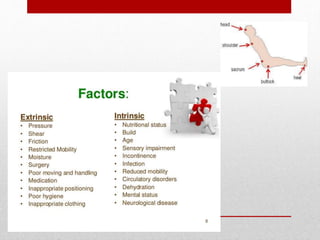
 Pressure ulcers - also known as pressure sores, decubitus ulcers and bedsores are
areas of localized damage to the skin and underlying tissue caused by pressure, shear
and friction.
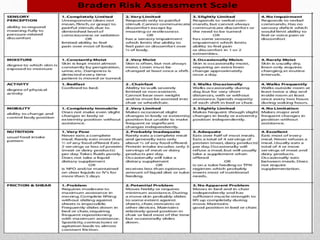
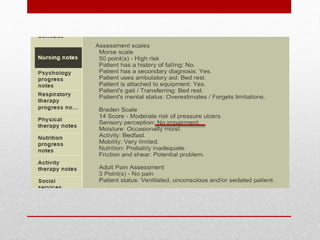
 Braden Scale for predicting risk for Pressure Ulcers - is a risk assessment tool that
was developed by Barbara Braden and Nancy Bergstrom to help health professionals
assess a patient's risk of developing a pressure ulcer.
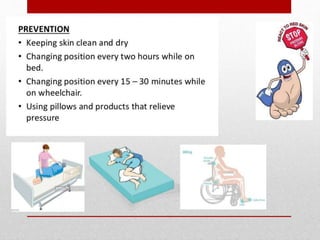
 Pressure ulcers prevention – these are measures which prevent or minimize the
occurrence of ulcers by relieving pressure through repositioning patient, using
pressure-relieving devices, improving mobility, sensory perception, tissue perfusion
and nutritional status, and reducing friction and shear as well as minimize irritating
moisture.
 Risk assessment- identification of the potential risk that a patient will develop skin
breakdown as the result of pressure to a bony prominence or body part impacted by
equipment.
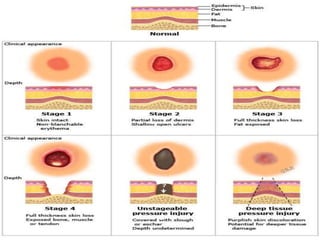
PRESSURE ULCER STAGING
Assessment
Braden Risk Assessment Scale
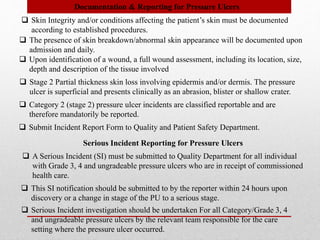
Documentation & Reporting for Pressure Ulcers
 Category 2 (stage 2) pressure ulcer incidents are classified reportable and are
therefore mandatorily be reported.
 Submit Incident Report Form to Quality and Patient Safety Department.
Serious Incident Reporting for Pressure Ulcers
 Serious Incident investigation should be undertaken For all Category/Grade 3, 4
and ungradeable pressure ulcers by the relevant team responsible for the care
setting where the pressure ulcer occurred.
 A Serious Incident (SI) must be submitted to Quality Department for all individual
with Grade 3, 4 and ungradeable pressure ulcers who are in receipt of commissioned
health care.
 This SI notification should be submitted to by the reporter within 24 hours upon
discovery or a change in stage of the PU to a serious stage.
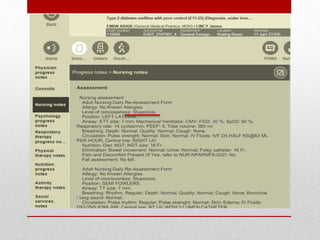
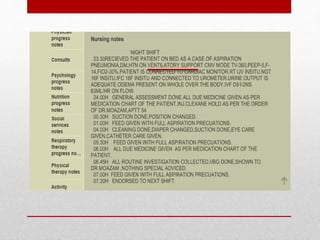
 Skin Integrity and/or conditions affecting the patient’s skin must be documented
according to established procedures.
 The presence of skin breakdown/abnormal skin appearance will be documented upon
admission and daily.
 Upon identification of a wound, a full wound assessment, including its location, size,
depth and description of the tissue involved
 Stage 2 Partial thickness skin loss involving epidermis and/or dermis. The pressure
ulcer is superficial and presents clinically as an abrasion, blister or shallow crater.
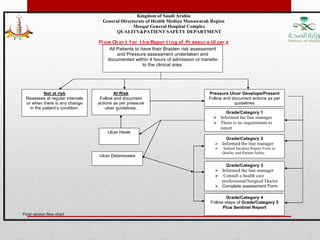
Final version flow chart
Kingdom of Saudi Arabia
General Directorate of Health Medina Munawarah Region
Meeqat General Hospital Complex
QUALITY&PATIENT SAFETY DEPARTMENT
Fl ow Char t f or t he Repor t ing of Pr essur e Ul cer s
Not at risk
Reassess at regular intervals
or when there is any change
in the patient’s condition.
Pressure Ulcer Develops/Present
Follow and document actions as per
guidelines
At Risk
Follow and document
actions as per pressure
ulcer guidelines.
All Patients to have their Braiden risk assessment
and Pressure assessment undertaken and
documented within 4 hours of admission or transfer
to the clinical area.
Grade/Category 1
 Informed the line manager
 There is no requirement to
report
Grade/Category 2
 Informed the line manager
 Submit Incident Report Form to
Quality and Patient Safety
Dept.

Grade/Category 3
 Informed the line manager
 Consult a health care
professional/Surgical Doctor
 Complete assessment Form
Ulcer Heals
Ulcer Deteriorates
Grade/Category 4
Follow steps of Grade/Category 3
Plus Sentinel Report
Pressure ulcer assessment prevention & reporting

Pressure ulcer assessment prevention & reporting

  • 1.
    PRESSURE ULCER ASSESSMENT, PREVENTION& REPORTING RAHIMA SALENDAB NQMC, Meeqat General Hospital, Madina, Al-munawarrah, KSA
  • 2.
    PURPOSE: • To identifypressure ulcer prevention responsibilities for the various disciplines and institute evidence based practice approaches to reduce pressure ulcer occurrence. • To provide guidelines for the various disciplines in proper skin assessment. • To apply evidence-based principles of wound care and delineate wound care responsibilities for the various disciplines involved diagnosing and managing wounds.
  • 3.
    DEFINITION:  Pressure ulcers- also known as pressure sores, decubitus ulcers and bedsores are areas of localized damage to the skin and underlying tissue caused by pressure, shear and friction.  Braden Scale for predicting risk for Pressure Ulcers - is a risk assessment tool that was developed by Barbara Braden and Nancy Bergstrom to help health professionals assess a patient's risk of developing a pressure ulcer.  Pressure ulcers prevention – these are measures which prevent or minimize the occurrence of ulcers by relieving pressure through repositioning patient, using pressure-relieving devices, improving mobility, sensory perception, tissue perfusion and nutritional status, and reducing friction and shear as well as minimize irritating moisture.  Risk assessment- identification of the potential risk that a patient will develop skin breakdown as the result of pressure to a bony prominence or body part impacted by equipment.
  • 4.
  • 7.
  • 8.
  • 14.
    Documentation & Reportingfor Pressure Ulcers  Category 2 (stage 2) pressure ulcer incidents are classified reportable and are therefore mandatorily be reported.  Submit Incident Report Form to Quality and Patient Safety Department. Serious Incident Reporting for Pressure Ulcers  Serious Incident investigation should be undertaken For all Category/Grade 3, 4 and ungradeable pressure ulcers by the relevant team responsible for the care setting where the pressure ulcer occurred.  A Serious Incident (SI) must be submitted to Quality Department for all individual with Grade 3, 4 and ungradeable pressure ulcers who are in receipt of commissioned health care.  This SI notification should be submitted to by the reporter within 24 hours upon discovery or a change in stage of the PU to a serious stage.  Skin Integrity and/or conditions affecting the patient’s skin must be documented according to established procedures.  The presence of skin breakdown/abnormal skin appearance will be documented upon admission and daily.  Upon identification of a wound, a full wound assessment, including its location, size, depth and description of the tissue involved  Stage 2 Partial thickness skin loss involving epidermis and/or dermis. The pressure ulcer is superficial and presents clinically as an abrasion, blister or shallow crater.
  • 15.
    Final version flowchart Kingdom of Saudi Arabia General Directorate of Health Medina Munawarah Region Meeqat General Hospital Complex QUALITY&PATIENT SAFETY DEPARTMENT Fl ow Char t f or t he Repor t ing of Pr essur e Ul cer s Not at risk Reassess at regular intervals or when there is any change in the patient’s condition. Pressure Ulcer Develops/Present Follow and document actions as per guidelines At Risk Follow and document actions as per pressure ulcer guidelines. All Patients to have their Braiden risk assessment and Pressure assessment undertaken and documented within 4 hours of admission or transfer to the clinical area. Grade/Category 1  Informed the line manager  There is no requirement to report Grade/Category 2  Informed the line manager  Submit Incident Report Form to Quality and Patient Safety Dept.  Grade/Category 3  Informed the line manager  Consult a health care professional/Surgical Doctor  Complete assessment Form Ulcer Heals Ulcer Deteriorates Grade/Category 4 Follow steps of Grade/Category 3 Plus Sentinel Report