The cranial nerves are a set of 12 paired
nerves in the back of your brain. Cranial
nerves send electrical signals between your
brain, face, neck and torso. Your nerves
help you taste, smell, head and feel
sensations. They also help you make facial
expressions, blink your eyes and move your
tongue.
 SMELL
 With the , a patient
should be able to identify
common, familiar and non-
irritating odors
 coffee
 soap
 flowers
 fresh orange / kalamansi
 camphor (Vicks)
 such as alcohol, ammonia,
perfume, etc.
 this will stimulate pain
rather than olfaction
 which tests CN V rather
than CN I
 CN I (OLFACTORY)
N: Identify scent in each
nostril
Abn: Neurogenic
Anosmia
 VISION
 Visual acuity
 Snellen’s chart*
 Visual fields
 Confrontational test*
 VISUAL ACUITY
 have the patient read a
Snellen’s eye chart from a
distance of
 patient covers one eye at a
time and reads to smallest
line possible
 VISUAL ACUITY
 if Snellen’s chart is
unavailable:
 let the
from
his face
 one eye at a time
 let the patient wear
eyeglasses
 RAISES UPPER LID
 CONSTRICTS PUPIL
 Check pupillary responses by
on one
pupil
 both pupils should constrict
 do the same for the other eye
 Ptosis
 EXTRA-OCULAR MOVEMENTS
 Motor to extrinsic eye
muscles
 have the patient hold his head
steady while you move your
finger about 1 foot from his
nose
 forming a large capital-H
 watch both of his eyes
move
 If one eye appears to have the
inability to track the motion of
the object
 cover the eye that was able
to track the motion
 repeat the procedure
Abn: Nystagmus – cerebellar
disorders
limited eye movement –
increased ICP
paralytic strabismus -
 SENSORY TO FACE AND TEETH
 pain
 touch
 MOVEMENT OF MUSCLES OF MASTICATION
 temporal muscles
 masseter muscles
 palpate the Masseter
 instruct the patient to bite
down hard
 next, ask the patient to
against resistance
applied by the instructor
 Corneal Reflex
 use a large Q-tip with the
cotton extended into a wisp
 ask the patient to look at a
distant object then
approaching laterally,
 look for the eye to blink
 Repeat this on the other eye
 MOVEMENT OF THE MUSCLES OF FACIAL EXPRESSION
 Initially, inspect the face during conversation and rest
including:
 drooping
 sagging
 smoothing of normal facial creases
 Next, ask the patient to:
 raise their eyebrows
 smile showing their teeth
 frown
 puff out both cheeks
 close both eyes tightly
When you wisp a piece of cotton on
your patient’s eyes, you are assessing
for the function of
A.CN III
B.CN IV
C.CN V
D.CN VI
 HEARING*
 BALANCE
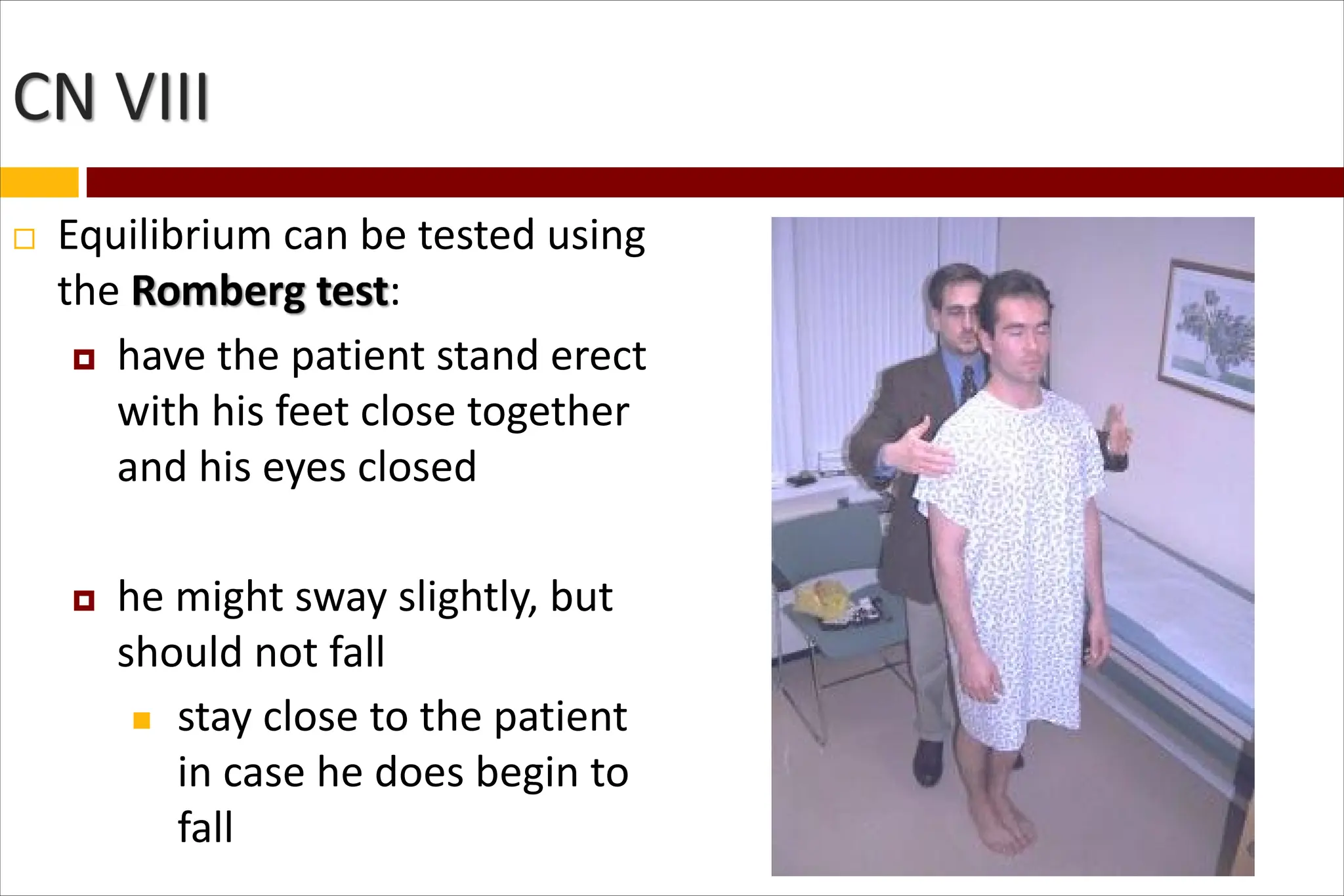
 Equilibrium can be tested using
the :
 have the patient stand erect
with his feet close together
and his eyes closed
 he might sway slightly, but
should not fall
 stay close to the patient
in case he does begin to
fall
 Taste and Touch at the back of the tongue
 Movement of Pharyngeal muscles
 Sensory to Pharynx, larynx, and viscera
 Movement of palate, pharynx, and larynx
 Ask the patient to and note any difficulty doing so
 Next, note the quality and sound of the patient's
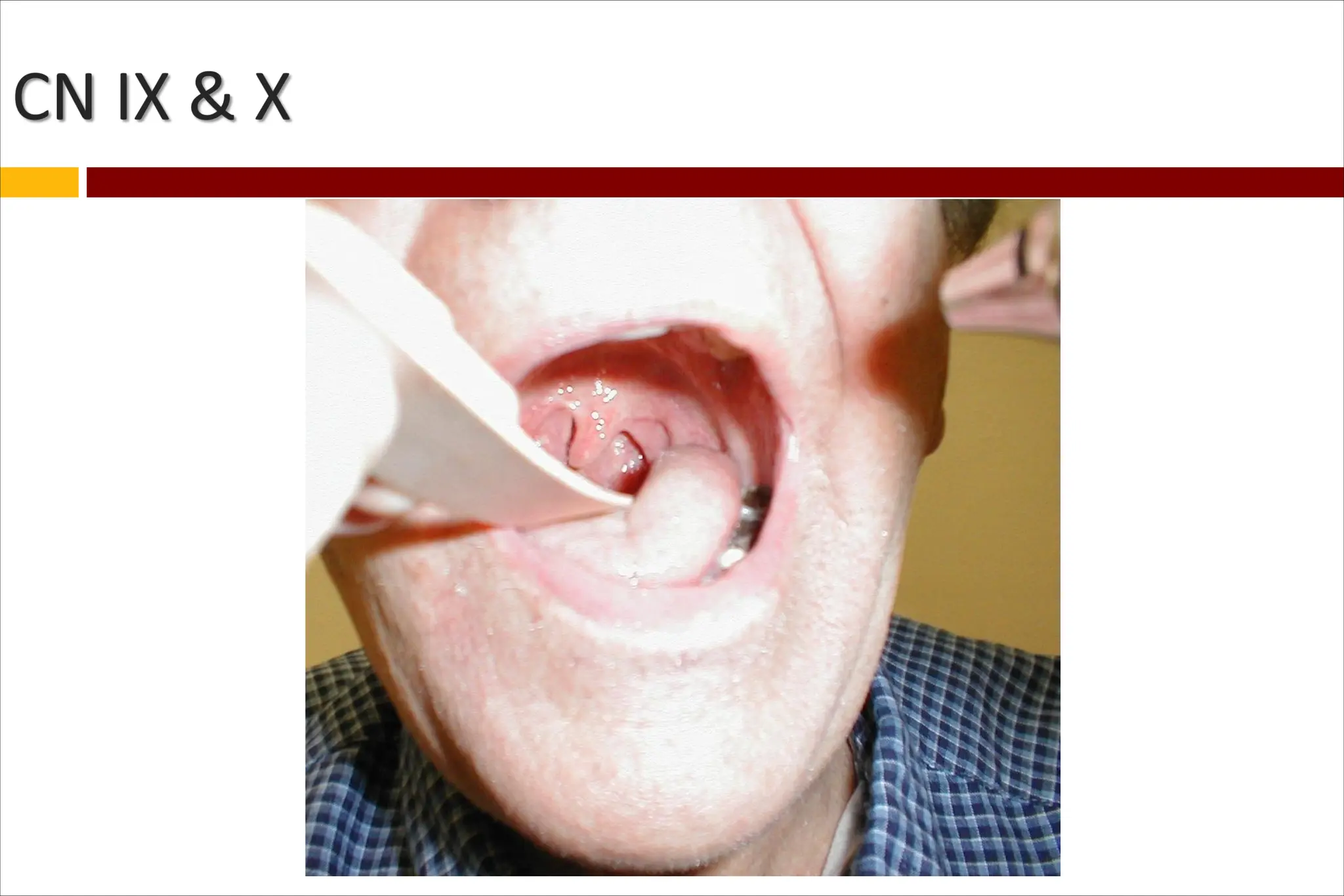
 Ask the patient to open their
mouth wide, protrude tongue,
and
 while the patient is
performing this task, flash
your penlight into the
patient's mouth
 observe the soft palate,
uvula and pharynx for
symmetry
 Next tell the patient you're
going to test his
 use a tongue depressor or
the butt of a long Q-tip
 perform this test by
touching the pharynx on
both the left and right sides,
observing the normal gag or
cough
 Motor to:
 Neck muscles
 Upper back muscles
 Place your hands on the
patients shoulders
 Have him
upward while you exert slight
resistance
 the strength and contraction
should be symmetrical
 Next, place one hand on the
side of the and
the other on the opposite SCM
muscle
 Have the patient turn his head
towards the hand on his jaw
while you apply slight
resistance
 have the patient
and move it side
to side
 normally, the tongue will be
protruded from the mouth and
remain midline
 Note:
 deviations of the tongue
from midline
 a complete lack of ability to
protrude the tongue
 tongue atrophy
 fasciculation on the tongue
 The Glasgow Coma Scale (GCS) is a neurological
scale used to assess a person’s level of
consciousness after a brain injury. It is commonly
used in emergency and intensive care settings to
evaluate the severity of brain injury based on eye
response, verbal response and motor response.
 Obeys commands 6
 Localizes pain 5
 Withdraws to pain 4
 Flexion to pain (Decorticate) 3
 Extension to pain (Decerebrate) 2
 None 1
 Oriented 5
 Confused 4
 Inappropriate (Random speech) 3
 Incomprehensible (Moaning) 2
 None 1
 Spontaneous 4
 To speech 3
 To pain 2
 None 1
 interpretation:
 Severe brain injury GCS = 3 to 8
 Moderate brain injury GCS = 9 to 12
 Minor brain injury GCS ≥ 13
N: score of 14-15 indicates optimal LOC
Abn: less than 14 – some impairment
less than 10 – emergency attention
less than 7 - coma
3 – deep coma
 definition of terms (levels of consciousness):
 normal; oriented
 disoriented; impaired thinking and responses
 people who do not respond quickly with information about their
name, location, and the time
 caused by sleep deprivation, malnutrition, allergies,
environmental pollution, drugs, and infection
 disoriented; restlessness, hallucinations, sometimes delusions
 person may be restless or agitated
 exhibit a marked deficit in attention
 sleepy
 shows excessive drowsiness
 responds to stimuli only with incoherent mumbles or
disorganized movements
 decreased alertness; slowed psychomotor responses
 has a decreased interest in their surroundings, slowed
responses, and sleepiness
 sleep-like state (not unconscious); little/no spontaneous activity
 only respond by grimacing or drawing away from painful stimuli
 cannot be aroused
 noresponse to stimuli
 have no corneal or gag reflex
 may have no pupillary response to light
Using the Glascow coma scale, a patient is
given a score of 5. This is interpreted as
A.Deep coma
B.Some impairment
C.Coma
D.Emergency attention
Upon determining Mr. X’s level of
consciousness utilizing the Glasgow
coma scale, he flexes to pain, produces
incomprehensible words, and opens eyes
spontaneously, his score is
A.13
B.9
C.7
D.8
The deep tendon reflex is sometimes called the
stretch reflex or myotatic reflex because of the
stretch action and the muscle response
involved. Some authors argue that they are not
the same reflex. They believe the tendon reflex
occurs after the tendon's active stretching
when it is tapped with the hammer.
 automatic / involuntary reaction in response to a stimulus
 does NOT require conscious thought
 does NOT reach higher brain centers
 *use neuro hammer on your own fingers
 to minimize trauma to the patient
 to give the nurse better control
 KNEE-JERK REFLEX /
PATELLAR REFLEX
 muscles contract in
response to stretching force
applied to it
 KNEE-JERK REFLEX /
PATELLAR REFLEX
 If (–) or exaggerated
 Brain or SC defect
 muscle stretch
muscle contraction
 5+ : sustained clonus
 4+ : non-sustained clonus (repetitive vibratory movements)
 3+ : brisk
 1+ : trace, or seen only with reinforcement
 0 : absent reflex
 Biceps Reflex
 Brachioradialis reflex
 Triceps reflex
 Patellar Reflex
 Achilles Reflex
 Plantar Reflex
 N: Flexion of toes
 Abn: Fanning/Babinski
 Abdominal Reflex
 N: Contraction
 Abn: no response
 May be absent in obese
clients and pregnant
 Cremasteric Reflex
Which among these reflexes does not
belong to the classification of
superficial reflexes?
A.Plantar reflex
B.Patellar reflex
C.Cremasteric reflex
D.Abdominal reflex
 Grade:
 5/5 : normal strength
 4/5 : movement possible against some resistance by the
examiner
 3/5 : movement possible against gravity, but not against
resistance by the examiner
 Grade:
 2/5 : movement possible, but not against gravity
 1/5 : muscle flicker, but no movement
 0/5 : no contraction
NEUROLOGICAL EXAMINAITION, BSN LEVEL 3 LESSON

NEUROLOGICAL EXAMINAITION, BSN LEVEL 3 LESSON

  • 3.
    The cranial nervesare a set of 12 paired nerves in the back of your brain. Cranial nerves send electrical signals between your brain, face, neck and torso. Your nerves help you taste, smell, head and feel sensations. They also help you make facial expressions, blink your eyes and move your tongue.
  • 5.
  • 6.
     With the, a patient should be able to identify common, familiar and non- irritating odors  coffee  soap  flowers  fresh orange / kalamansi  camphor (Vicks)
  • 7.
     such asalcohol, ammonia, perfume, etc.  this will stimulate pain rather than olfaction  which tests CN V rather than CN I
  • 8.
     CN I(OLFACTORY) N: Identify scent in each nostril Abn: Neurogenic Anosmia
  • 9.
     VISION  Visualacuity  Snellen’s chart*  Visual fields  Confrontational test*
  • 10.
     VISUAL ACUITY have the patient read a Snellen’s eye chart from a distance of  patient covers one eye at a time and reads to smallest line possible
  • 11.
     VISUAL ACUITY if Snellen’s chart is unavailable:  let the from his face  one eye at a time  let the patient wear eyeglasses
  • 13.
     RAISES UPPERLID  CONSTRICTS PUPIL
  • 14.
     Check pupillaryresponses by on one pupil  both pupils should constrict  do the same for the other eye
  • 16.
  • 17.
     EXTRA-OCULAR MOVEMENTS Motor to extrinsic eye muscles
  • 19.
     have thepatient hold his head steady while you move your finger about 1 foot from his nose  forming a large capital-H  watch both of his eyes move
  • 20.
     If oneeye appears to have the inability to track the motion of the object  cover the eye that was able to track the motion  repeat the procedure
  • 21.
    Abn: Nystagmus –cerebellar disorders limited eye movement – increased ICP paralytic strabismus -
  • 25.
     SENSORY TOFACE AND TEETH  pain  touch  MOVEMENT OF MUSCLES OF MASTICATION  temporal muscles  masseter muscles
  • 26.
     palpate theMasseter  instruct the patient to bite down hard  next, ask the patient to against resistance applied by the instructor
  • 27.
     Corneal Reflex use a large Q-tip with the cotton extended into a wisp  ask the patient to look at a distant object then approaching laterally,
  • 28.
     look forthe eye to blink  Repeat this on the other eye
  • 30.
     MOVEMENT OFTHE MUSCLES OF FACIAL EXPRESSION
  • 31.
     Initially, inspectthe face during conversation and rest including:  drooping  sagging  smoothing of normal facial creases
  • 32.
     Next, askthe patient to:  raise their eyebrows  smile showing their teeth  frown  puff out both cheeks  close both eyes tightly
  • 35.
    When you wispa piece of cotton on your patient’s eyes, you are assessing for the function of A.CN III B.CN IV C.CN V D.CN VI
  • 36.
  • 37.
     Equilibrium canbe tested using the :  have the patient stand erect with his feet close together and his eyes closed  he might sway slightly, but should not fall  stay close to the patient in case he does begin to fall
  • 39.
     Taste andTouch at the back of the tongue  Movement of Pharyngeal muscles
  • 40.
     Sensory toPharynx, larynx, and viscera  Movement of palate, pharynx, and larynx
  • 41.
     Ask thepatient to and note any difficulty doing so  Next, note the quality and sound of the patient's
  • 42.
     Ask thepatient to open their mouth wide, protrude tongue, and  while the patient is performing this task, flash your penlight into the patient's mouth  observe the soft palate, uvula and pharynx for symmetry
  • 43.
     Next tellthe patient you're going to test his  use a tongue depressor or the butt of a long Q-tip  perform this test by touching the pharynx on both the left and right sides, observing the normal gag or cough
  • 45.
     Motor to: Neck muscles  Upper back muscles
  • 46.
     Place yourhands on the patients shoulders  Have him upward while you exert slight resistance  the strength and contraction should be symmetrical
  • 47.
     Next, placeone hand on the side of the and the other on the opposite SCM muscle  Have the patient turn his head towards the hand on his jaw while you apply slight resistance
  • 48.
     have thepatient and move it side to side  normally, the tongue will be protruded from the mouth and remain midline
  • 49.
     Note:  deviationsof the tongue from midline  a complete lack of ability to protrude the tongue  tongue atrophy  fasciculation on the tongue
  • 54.
     The GlasgowComa Scale (GCS) is a neurological scale used to assess a person’s level of consciousness after a brain injury. It is commonly used in emergency and intensive care settings to evaluate the severity of brain injury based on eye response, verbal response and motor response.
  • 56.
     Obeys commands6  Localizes pain 5  Withdraws to pain 4  Flexion to pain (Decorticate) 3  Extension to pain (Decerebrate) 2  None 1
  • 59.
     Oriented 5 Confused 4  Inappropriate (Random speech) 3  Incomprehensible (Moaning) 2  None 1
  • 60.
     Spontaneous 4 To speech 3  To pain 2  None 1
  • 61.
     interpretation:  Severebrain injury GCS = 3 to 8  Moderate brain injury GCS = 9 to 12  Minor brain injury GCS ≥ 13
  • 62.
    N: score of14-15 indicates optimal LOC Abn: less than 14 – some impairment less than 10 – emergency attention less than 7 - coma 3 – deep coma
  • 63.
     definition ofterms (levels of consciousness):
  • 64.
  • 65.
     disoriented; impairedthinking and responses  people who do not respond quickly with information about their name, location, and the time  caused by sleep deprivation, malnutrition, allergies, environmental pollution, drugs, and infection
  • 66.
     disoriented; restlessness,hallucinations, sometimes delusions  person may be restless or agitated  exhibit a marked deficit in attention
  • 67.
     sleepy  showsexcessive drowsiness  responds to stimuli only with incoherent mumbles or disorganized movements
  • 68.
     decreased alertness;slowed psychomotor responses  has a decreased interest in their surroundings, slowed responses, and sleepiness
  • 69.
     sleep-like state(not unconscious); little/no spontaneous activity  only respond by grimacing or drawing away from painful stimuli
  • 70.
     cannot bearoused  noresponse to stimuli  have no corneal or gag reflex  may have no pupillary response to light
  • 71.
    Using the Glascowcoma scale, a patient is given a score of 5. This is interpreted as A.Deep coma B.Some impairment C.Coma D.Emergency attention
  • 72.
    Upon determining Mr.X’s level of consciousness utilizing the Glasgow coma scale, he flexes to pain, produces incomprehensible words, and opens eyes spontaneously, his score is A.13 B.9 C.7 D.8
  • 75.
    The deep tendonreflex is sometimes called the stretch reflex or myotatic reflex because of the stretch action and the muscle response involved. Some authors argue that they are not the same reflex. They believe the tendon reflex occurs after the tendon's active stretching when it is tapped with the hammer.
  • 76.
     automatic /involuntary reaction in response to a stimulus  does NOT require conscious thought  does NOT reach higher brain centers
  • 77.
     *use neurohammer on your own fingers  to minimize trauma to the patient  to give the nurse better control
  • 78.
     KNEE-JERK REFLEX/ PATELLAR REFLEX  muscles contract in response to stretching force applied to it
  • 79.
     KNEE-JERK REFLEX/ PATELLAR REFLEX  If (–) or exaggerated  Brain or SC defect  muscle stretch muscle contraction
  • 80.
     5+ :sustained clonus  4+ : non-sustained clonus (repetitive vibratory movements)  3+ : brisk  1+ : trace, or seen only with reinforcement  0 : absent reflex
  • 81.
  • 82.
  • 83.
  • 84.
  • 85.
  • 88.
     Plantar Reflex N: Flexion of toes  Abn: Fanning/Babinski
  • 89.
     Abdominal Reflex N: Contraction  Abn: no response  May be absent in obese clients and pregnant
  • 90.
  • 92.
    Which among thesereflexes does not belong to the classification of superficial reflexes? A.Plantar reflex B.Patellar reflex C.Cremasteric reflex D.Abdominal reflex
  • 94.
     Grade:  5/5: normal strength  4/5 : movement possible against some resistance by the examiner  3/5 : movement possible against gravity, but not against resistance by the examiner
  • 95.
     Grade:  2/5: movement possible, but not against gravity  1/5 : muscle flicker, but no movement  0/5 : no contraction