Structuring the Administrative Side of a Hospital For Disaster Charles M. Little, DO FACEP Department of Emergency Medicine University of Colorado Denver
Today’s Objectives Outline the administrative needs in disaster response Describe the US integrated disaster response system NIMS Delineate how hospitals fit into the structure Describe typical hospital emergency preparedness activities Discuss examples of typical responses
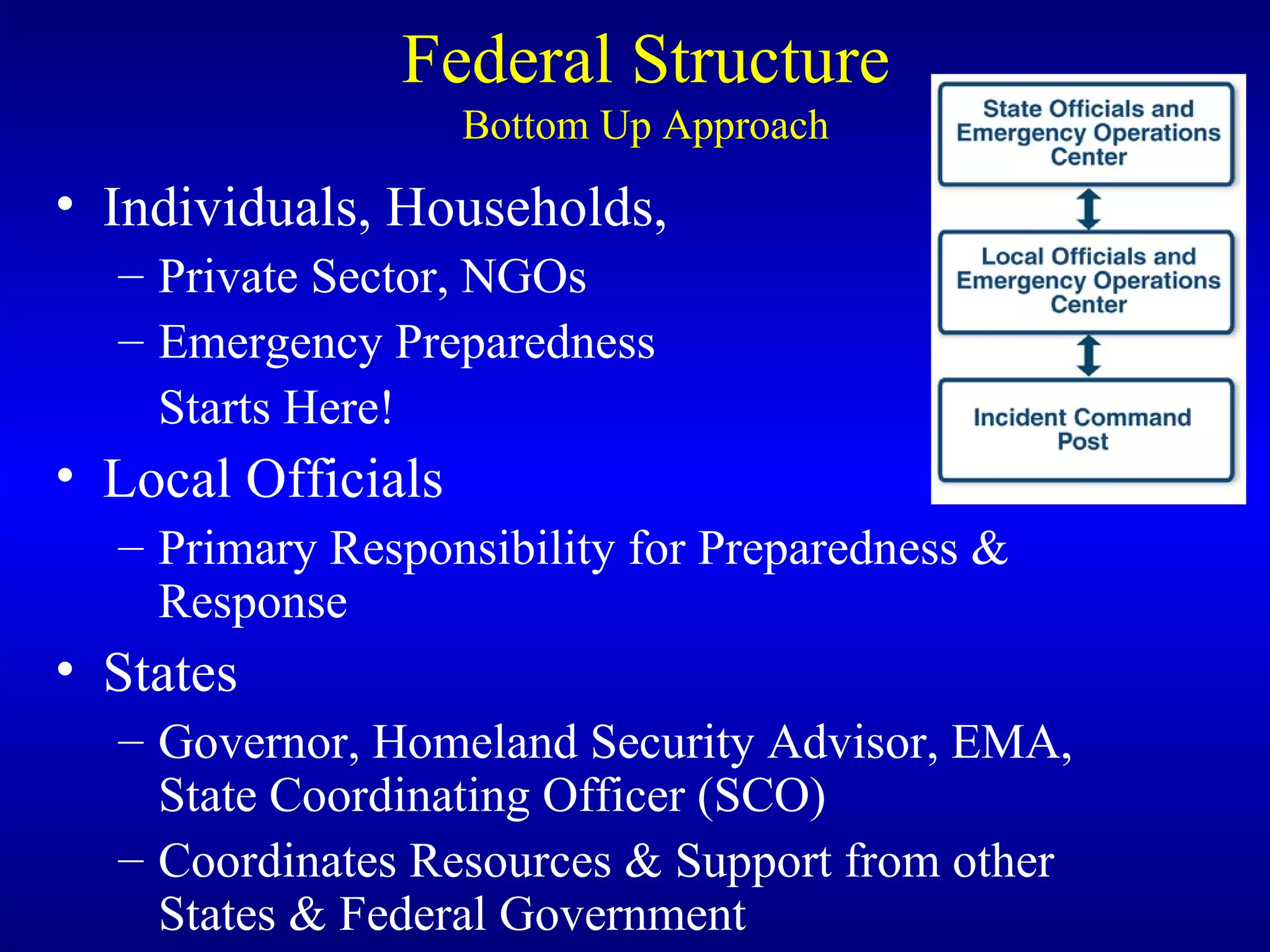
Federal Structure Bottom Up Approach Individuals, Households,  Private Sector, NGOs Emergency Preparedness  Starts Here! Local Officials Primary Responsibility for Preparedness & Response States Governor, Homeland Security Advisor, EMA, State Coordinating Officer (SCO) Coordinates Resources & Support from other States & Federal Government
Hospital Structure There are three groups of  the administrative structure: Administration Nursing Ancillary Physicians and Licensed  Independent Practitioners
Emergency Management Plan Mitigation/Preparedness & Program Support Hazard Vulnerability Analysis – Mitigation MOUs & Other Agreements Training Records Exercise Plans & Records Response & Recovery Emergency Operations Plan TJC 2009 EM Standards
Emergency Operations Plan Components 6 Critical Function Areas Communication Resources Safety & Security Staffing Utilities Clinical & Support Activities
Major Points Emergency Operations Plan Annexes Need for ICS The UCH experience
EOP – Critical Function Areas Communication Systems & Strategies Resources Inventory, Acquisition, Monitoring, and Replenishment Hospital Resource Directory Staff Support Shared Resources and Assets Transportation Safety & Security Internal Safety & Security Control Access & Movement Coordination of Security with External Agencies Management of Hazardous Materials & Waste Radioactive/Biological/Chemical Isolation & Decontamination
EOP – Critical Function Areas Utilities Electricity, Water, Fuel, Medical Gasses, etc. Clinical & Support Activities Management of Patient Clinical Activities Evacuation Surge Activities & Altered Standards of Care Clinical Services for Vulnerable Populations Patient Hygiene and Sanitation Patient Mental Health Needs Decedent Management Clinical Documentation and Tracking
Support Annexes Coordination of Common Functional & Admin Processes Critical Infrastructure and Key Resources Financial Management Private Sector Coordination Public Affairs Tribal Relations Volunteer and Donations Management Worker Safety and Health
Incident Annexes Describe CONOPS for Specific Contingencies & Hazards Biological Incident Cyber Incident Nuclear/Radiological/Chemical Incident Mass Evacuation Incident
Incident Command System (ICS) Originated 1970s Fire service based Tested in multiple disasters Similar organization across all responders NIMS: National Incident Management System Joint Commission
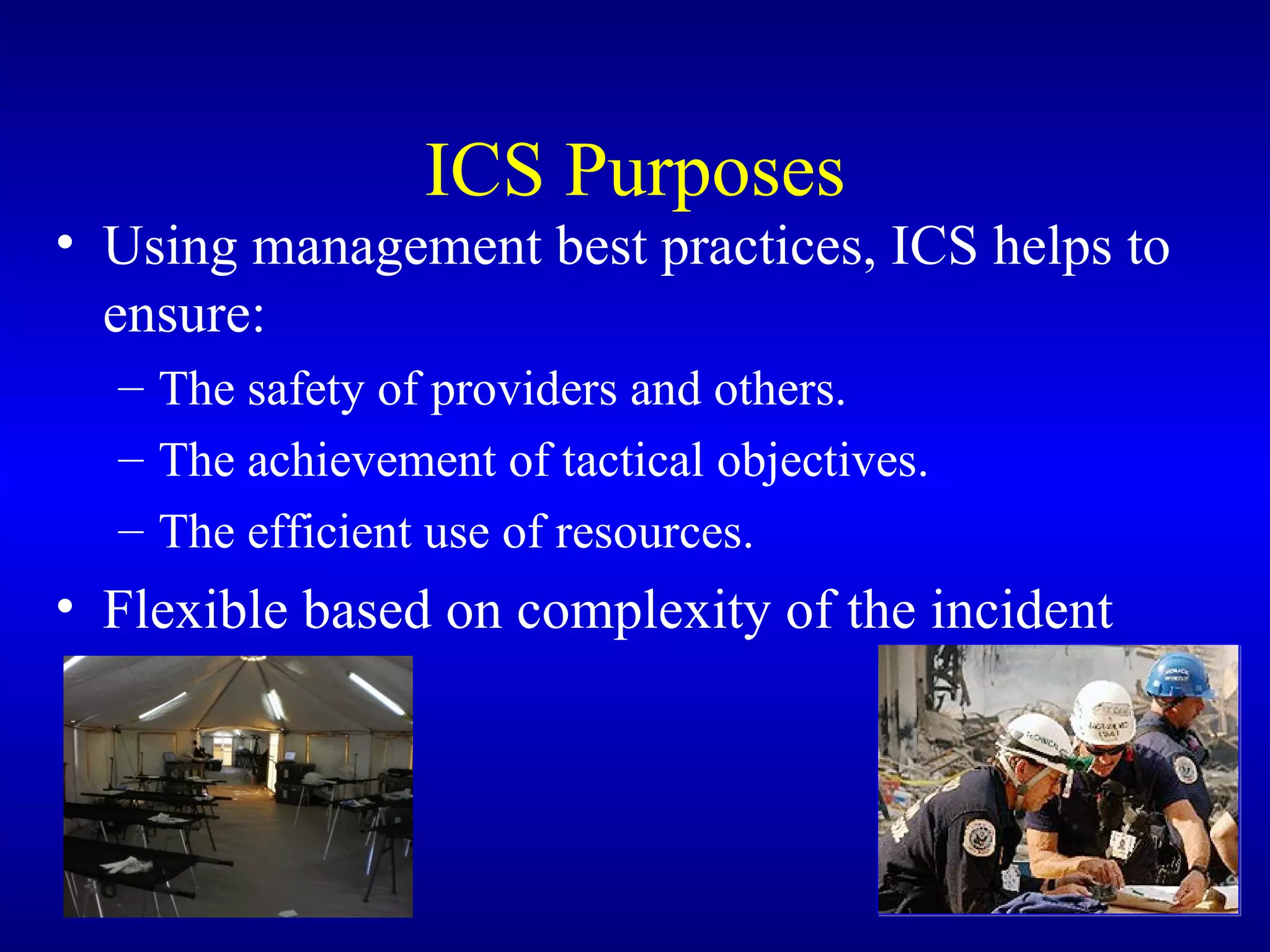
ICS Purposes Using management best practices, ICS helps to ensure: The safety of providers and others. The achievement of tactical objectives. The efficient use of resources. Flexible based on complexity of the incident
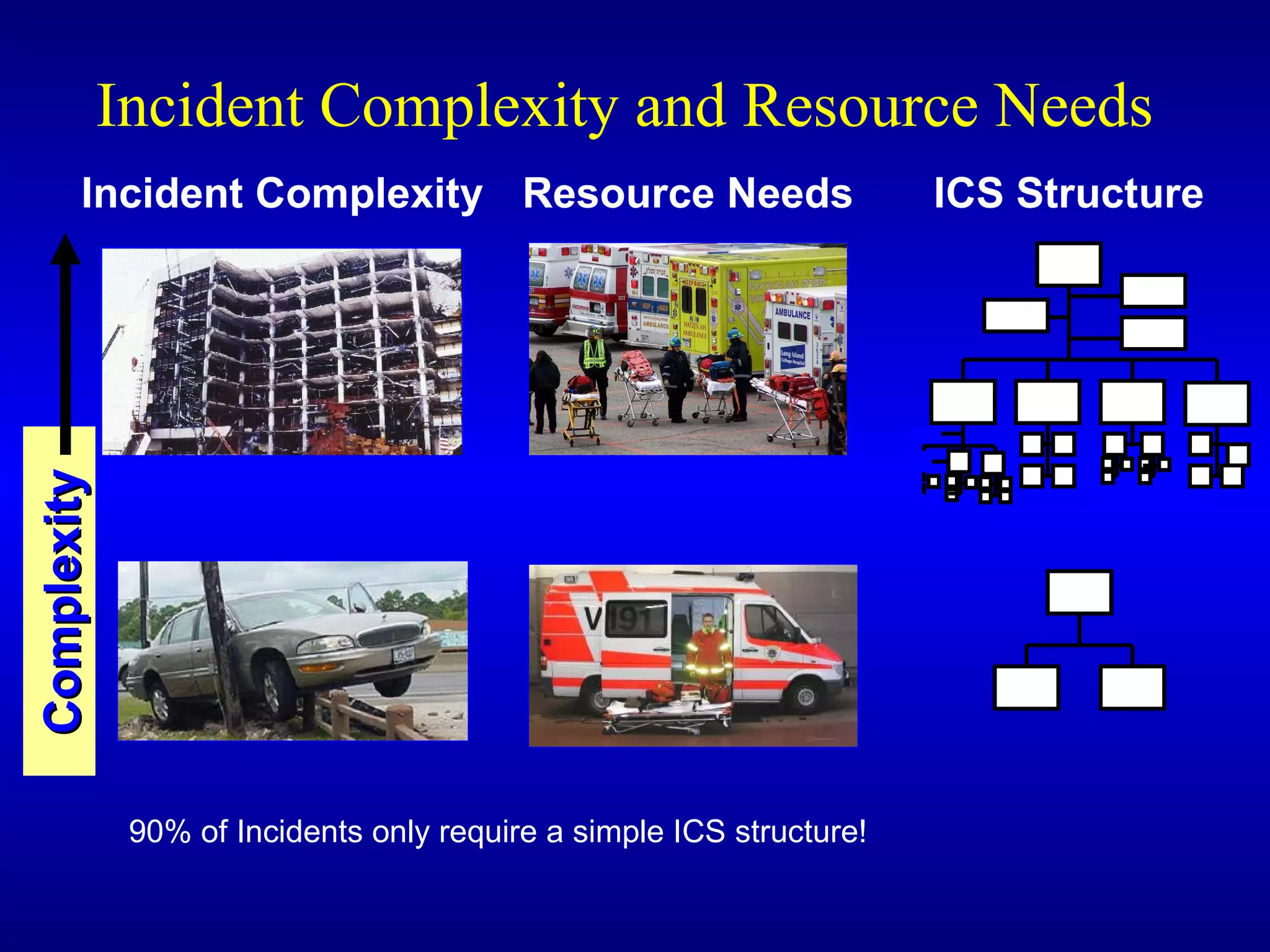
Incident Complexity and Resource Needs Incident Complexity Resource Needs ICS Structure Complexity 90% of Incidents only require a simple ICS structure!
 
 
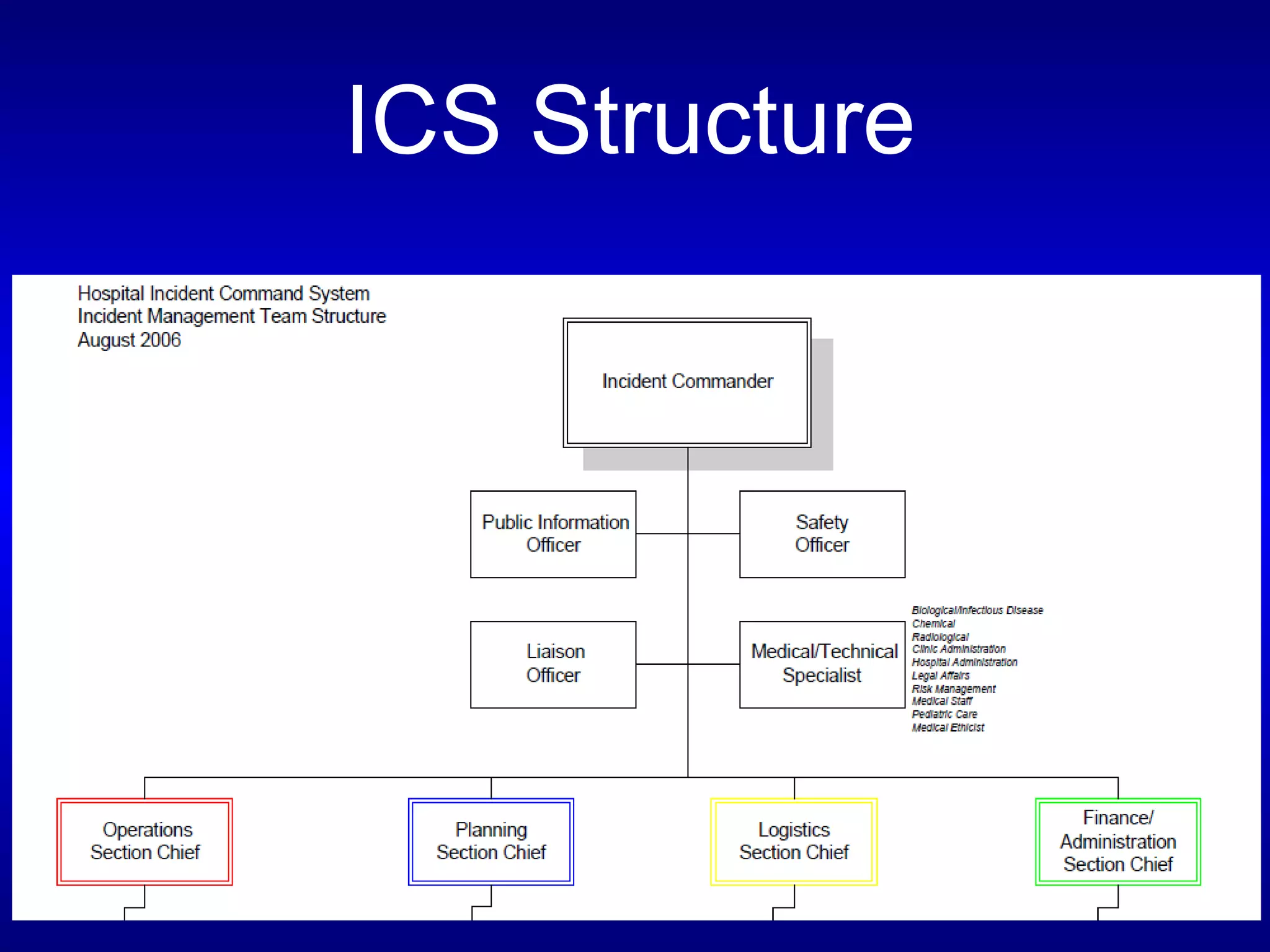
ICS Structure
Who should be Incident Commander?
Training FEMA IS – 100, 200,700 IS- 800 Advanced IS – 300, 400
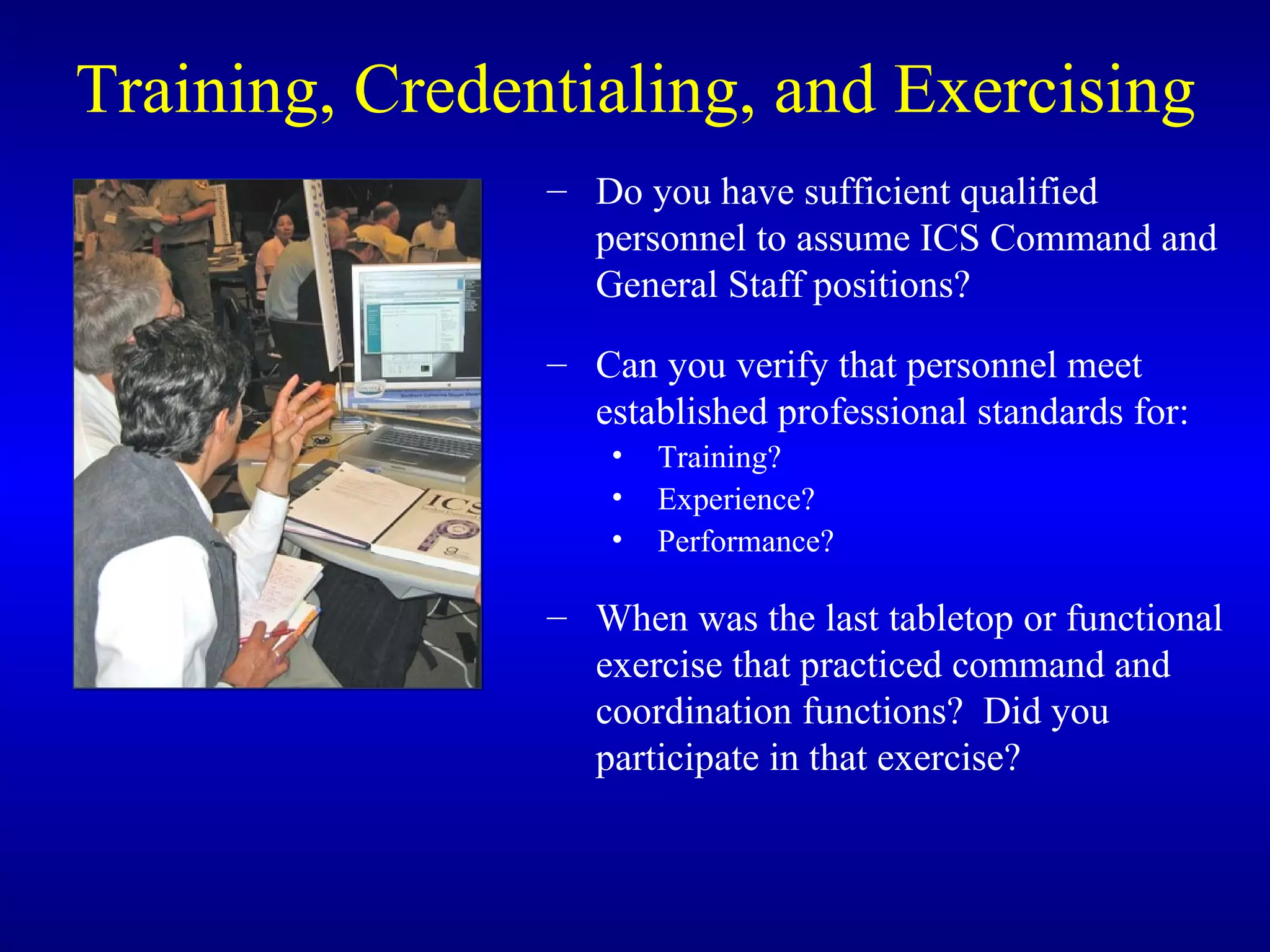
Training, Credentialing, and Exercising Do you have sufficient qualified personnel to assume ICS Command and General Staff positions? Can you verify that personnel meet established professional standards for: Training? Experience? Performance? When was the last tabletop or functional exercise that practiced command and coordination functions?  Did you participate in that exercise?
Chief Executive Delegate Command Authority to Incident Commander. Provide Policy Guidance on Priorities and Strategic Direction based on situational needs. Provide Financial Authority and Restrictions. Provide Reporting Requirements Provide Guidance on Demographic and Political Implications
Incident Command The activities at the Command Center (such as a Hospital Command Center-HCC) are directed by the Incident Commander (IC) IC has overall responsibility for all activities within the HCC The IC may appoint other Command Staff personnel to assist as the situation and resources warrant
Building Command & Staff Depth Three to five persons  should be trained for each command position in case a prolonged response is required Training and exercises should be used as a means of preparing personnel to competently and confidently assume one or more roles based on situational need and available resources. Completion of the specified NIMS courses, either online or in the classroom, should help to prepare those persons likely to assume command roles.
Special ICS Issues Unified command Possible working with outside agencies
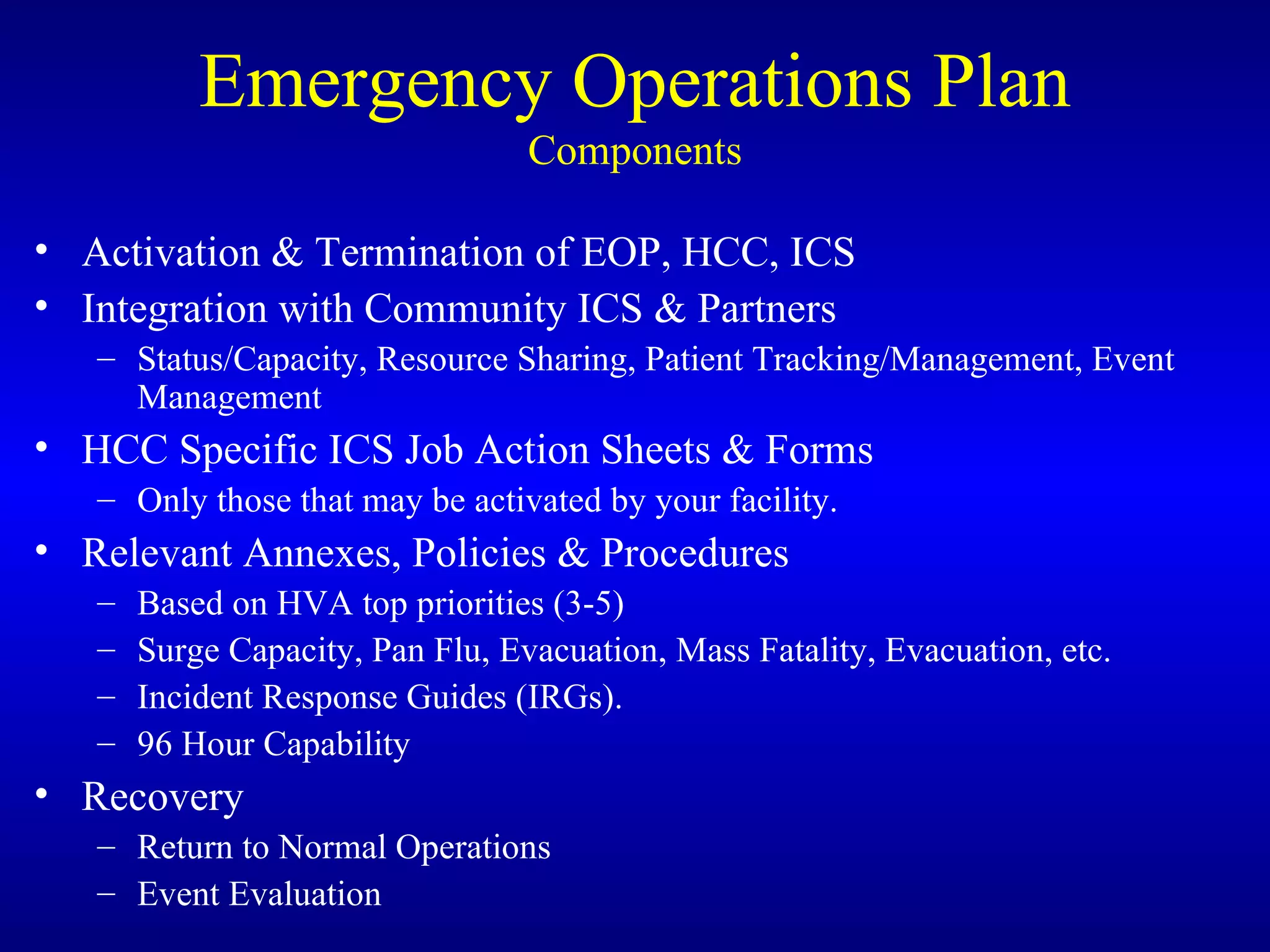
Emergency Operations Plan Components Activation & Termination of EOP, HCC, ICS Integration with Community ICS & Partners Status/Capacity, Resource Sharing, Patient Tracking/Management, Event Management HCC Specific ICS Job Action Sheets & Forms Only those that may be activated by your facility. Relevant Annexes, Policies & Procedures Based on HVA top priorities (3-5) Surge Capacity, Pan Flu, Evacuation, Mass Fatality, Evacuation, etc. Incident Response Guides (IRGs). 96 Hour Capability Recovery Return to Normal Operations Event Evaluation
EOP – Critical Function Areas Staffing Staff Roles & Responsibilities Reporting Instructions Training Acceptance & Use of Staff from other Healthcare Organizations Acceptance & Use of Volunteers Workforce Identification
Hazard Vulnerability Analysis Required Annually Systematic Approach for Recognizing Hazards The Risks of each Hazard are Analyzed Prioritizes Planning, Mitigation, Response, & Recovery Activities. Serves as the “Needs Assessment” for the Emergency Management Program. Should Involve Community Partners.
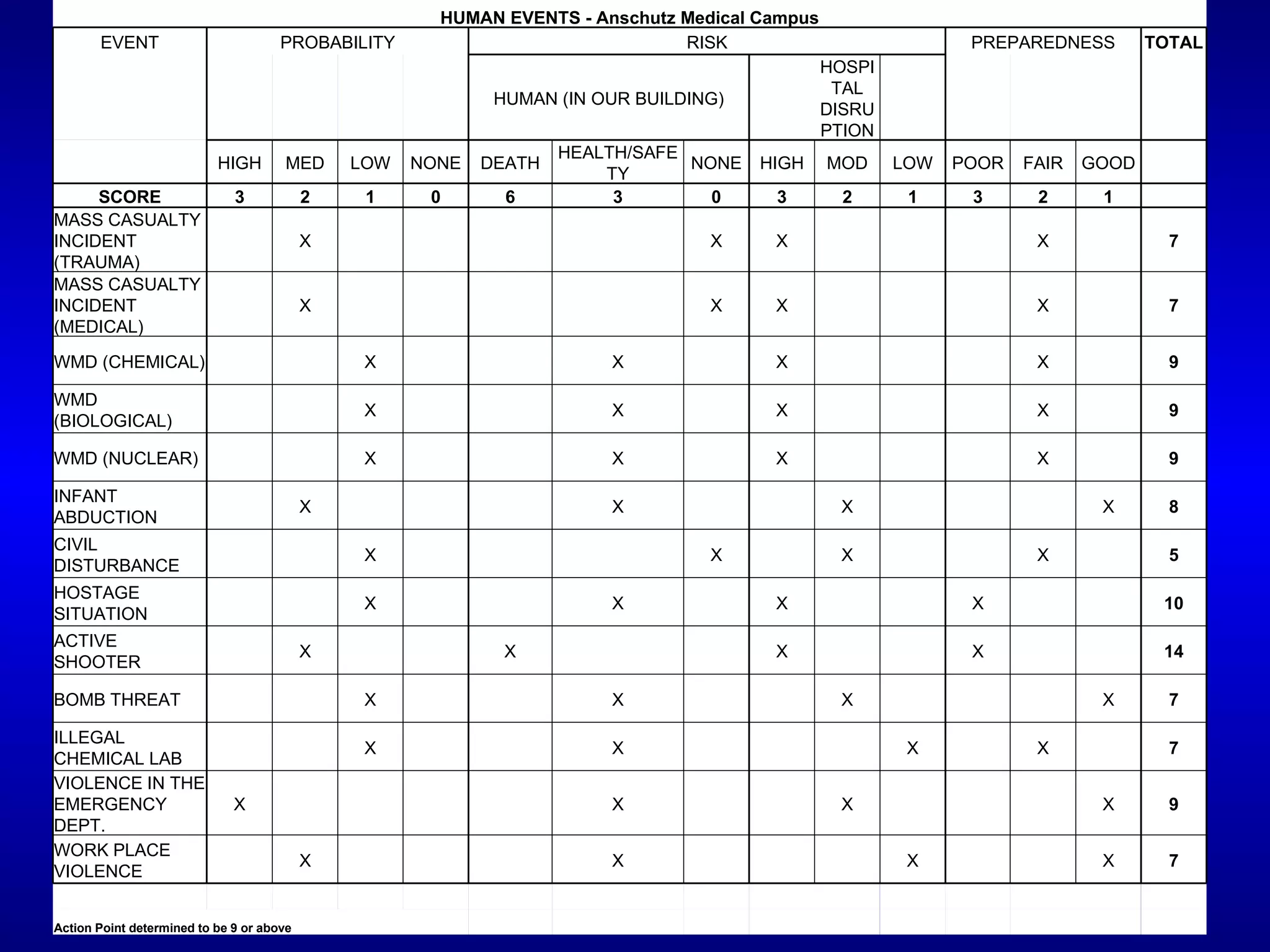
HUMAN EVENTS - Anschutz Medical Campus EVENT PROBABILITY RISK PREPAREDNESS TOTAL           HUMAN (IN OUR BUILDING)   HOSPITAL DISRUPTION             HIGH MED LOW NONE DEATH HEALTH/SAFETY NONE HIGH MOD LOW POOR FAIR GOOD   SCORE 3 2 1 0 6 3 0 3 2 1 3 2 1   MASS CASUALTY INCIDENT (TRAUMA)   X         X X       X   7 MASS CASUALTY INCIDENT (MEDICAL)   X         X X       X   7 WMD (CHEMICAL)     X     X   X       X   9 WMD (BIOLOGICAL)     X     X   X       X   9 WMD (NUCLEAR)     X     X   X       X   9 INFANT ABDUCTION   X       X     X       X 8 CIVIL DISTURBANCE     X       X   X     X   5 HOSTAGE SITUATION     X     X   X     X     10 ACTIVE SHOOTER   X   X     X     X     14 BOMB THREAT     X     X     X       X 7 ILLEGAL CHEMICAL LAB     X     X       X   X   7 VIOLENCE IN THE EMERGENCY DEPT. X       X     X       X 9 WORK PLACE VIOLENCE   X       X       X     X 7 Action Point determined to be 9 or above
MCI Hospital Response ED empties of all noncritical patients Move into hospital all admission D/C stable patients Critical patient flow should be unidirectional ED, critical studies, ICU or OR Operate in minimalist mode Defer tests not immediately mandatory
Individual Responsibilities
Response Have a pre-existing plan for family emergencies, medicines, child and pet care Respond When Requested or spontaneous? Establish a Location & Point of Contact Hospitals need to pre-designate
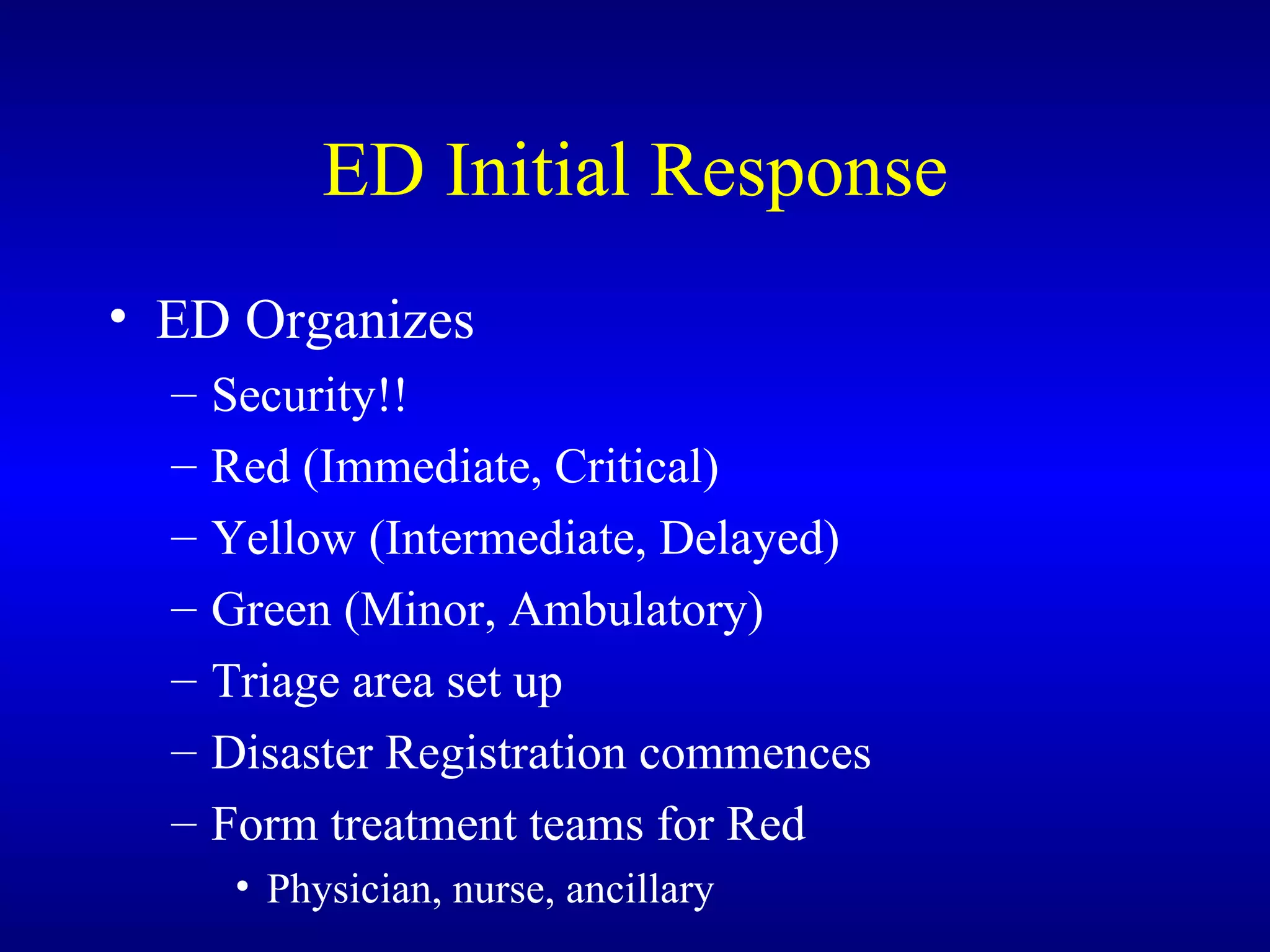
ED Initial Response ED Organizes Security!! Red (Immediate, Critical)  Yellow (Intermediate, Delayed) Green (Minor, Ambulatory) Triage area set up Disaster Registration commences Form treatment teams for Red Physician, nurse, ancillary
Hospital Admin Response Hospital Command Center Opens Coordinate Response Push out resources Labor Pool Supplies Family Center Behavioral Health Area Morgue
HCC Response Send staff and beds to ED Set up labor pool ICU and PACU personnel ideal Cross train Floor teams discharge all appropriate patients Use discharge holding area
MCI Hospital Phases: Chaos Duration: minutes to hours Poor communications Minimal and unreliable information Implement disaster plan, reorganize resources Staff checks on family well being
Casualty Receiving Duration: few hours Hospital resources limited to on hand only Operate in damage control mode, limited treatment of life and limb threatening injuries to maximize surge
Consolidation Duration:  about 24 hours All casualties received Restock supplies Tally patients and prioritize surgeries Rotate staff
Phases continued Definitive Care: weeks Further surgeries as needed Rehabilitation: months
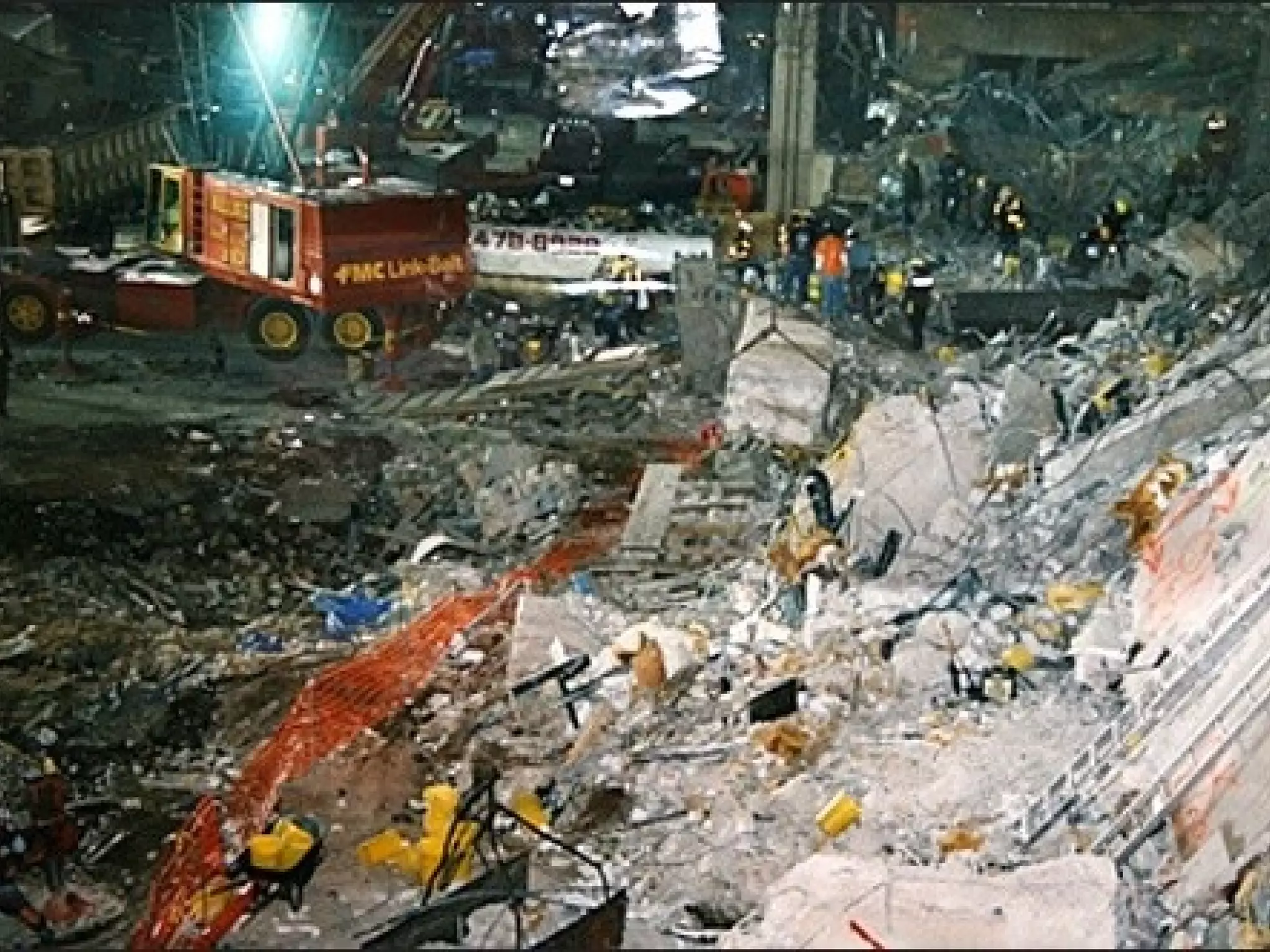
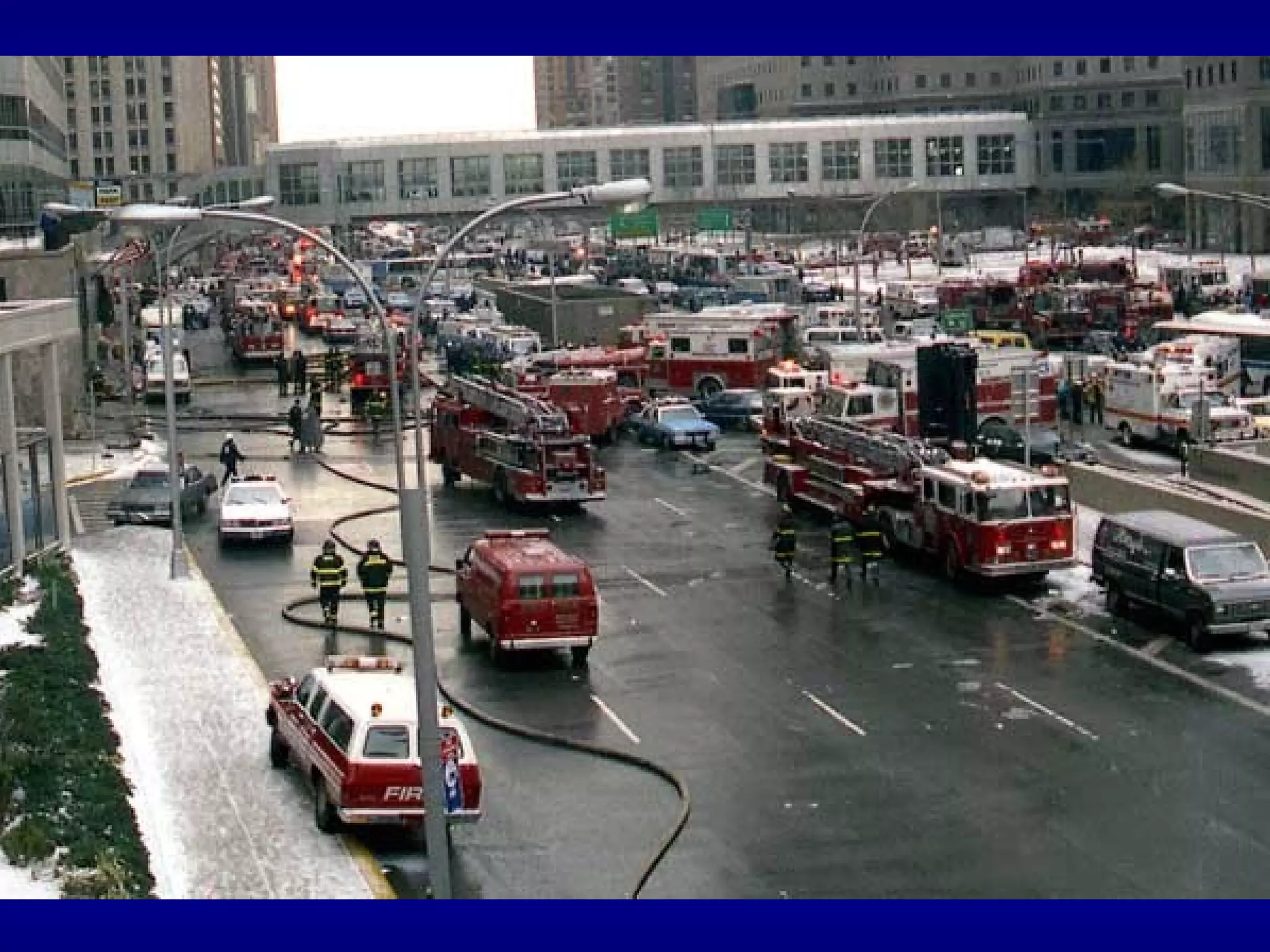
IEDs Highest FBI ranked terrorist threat in USA Easily made devices (recipes on the web) Primary bombing Maximize casualties and PR impact Closed spaces Secondary devices common Aimed at first responders Hospitals targeted overseas
 
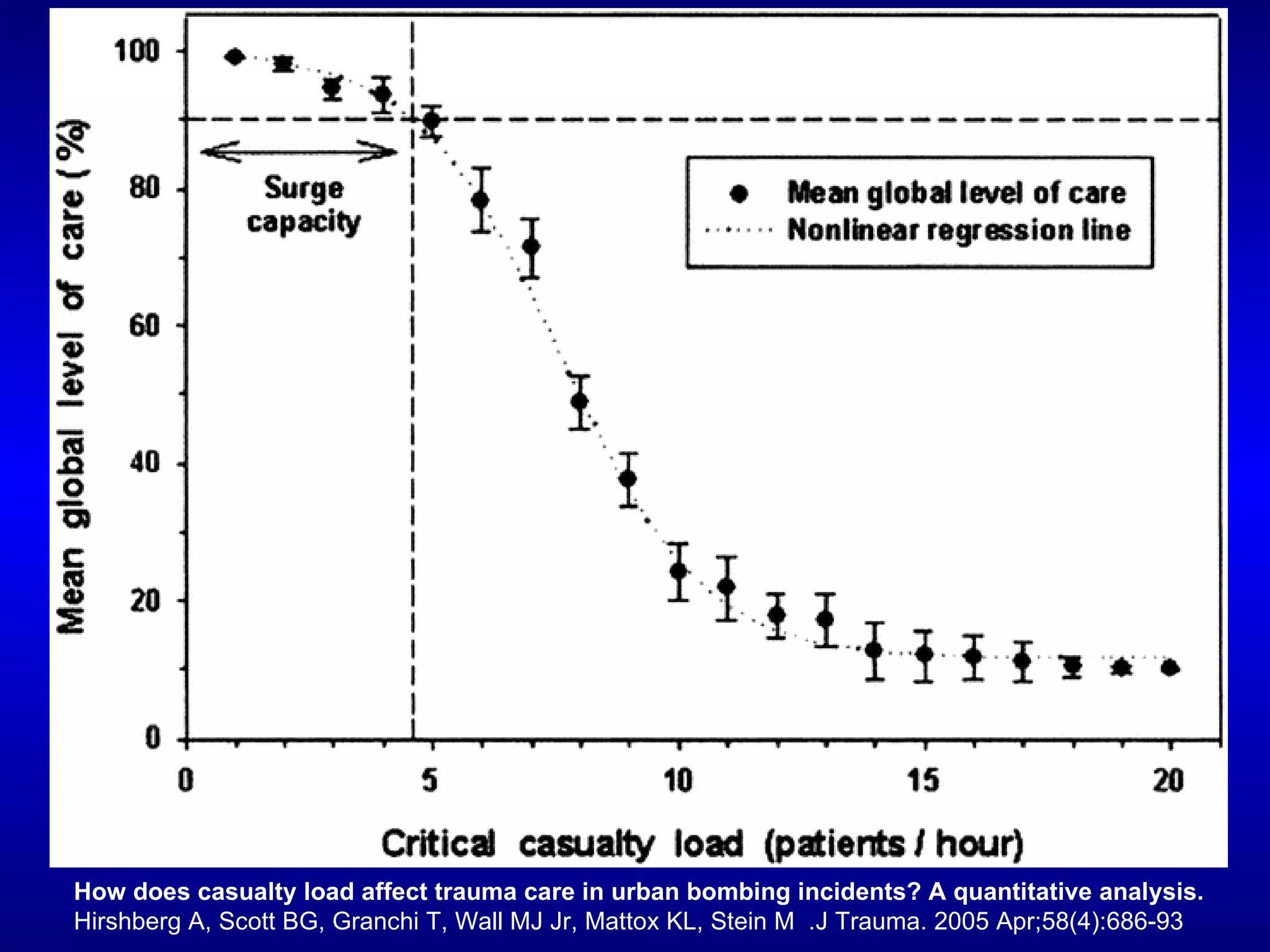
Hospital Trauma Capacity 1 critical patient/100 beds – normal operations 2-3 critical patients/100 beds – maximal response A hospital ramp up requires 30-60 minutes How does casualty load affect trauma care in urban bombing incidents? A quantitative analysis. Hirshberg A, Scott BG, Granchi T, Wall MJ Jr, Mattox KL, Stein M  .J Trauma. 2005 Apr;58(4):686-93
How does casualty load affect trauma care in urban bombing incidents? A quantitative analysis. Hirshberg A, Scott BG, Granchi T, Wall MJ Jr, Mattox KL, Stein M  .J Trauma. 2005 Apr;58(4):686-93
Conclusions It is important to have a well developed EOP Exercises are key! Continued staff education and training  is hard but necessary

Sshs lecture admin in disaster

  • 1.
    Structuring the AdministrativeSide of a Hospital For Disaster Charles M. Little, DO FACEP Department of Emergency Medicine University of Colorado Denver
  • 2.
    Today’s Objectives Outlinethe administrative needs in disaster response Describe the US integrated disaster response system NIMS Delineate how hospitals fit into the structure Describe typical hospital emergency preparedness activities Discuss examples of typical responses
  • 3.
    Federal Structure BottomUp Approach Individuals, Households, Private Sector, NGOs Emergency Preparedness Starts Here! Local Officials Primary Responsibility for Preparedness & Response States Governor, Homeland Security Advisor, EMA, State Coordinating Officer (SCO) Coordinates Resources & Support from other States & Federal Government
  • 4.
    Hospital Structure Thereare three groups of the administrative structure: Administration Nursing Ancillary Physicians and Licensed Independent Practitioners
  • 5.
    Emergency Management PlanMitigation/Preparedness & Program Support Hazard Vulnerability Analysis – Mitigation MOUs & Other Agreements Training Records Exercise Plans & Records Response & Recovery Emergency Operations Plan TJC 2009 EM Standards
  • 6.
    Emergency Operations PlanComponents 6 Critical Function Areas Communication Resources Safety & Security Staffing Utilities Clinical & Support Activities
  • 7.
    Major Points EmergencyOperations Plan Annexes Need for ICS The UCH experience
  • 8.
    EOP – CriticalFunction Areas Communication Systems & Strategies Resources Inventory, Acquisition, Monitoring, and Replenishment Hospital Resource Directory Staff Support Shared Resources and Assets Transportation Safety & Security Internal Safety & Security Control Access & Movement Coordination of Security with External Agencies Management of Hazardous Materials & Waste Radioactive/Biological/Chemical Isolation & Decontamination
  • 9.
    EOP – CriticalFunction Areas Utilities Electricity, Water, Fuel, Medical Gasses, etc. Clinical & Support Activities Management of Patient Clinical Activities Evacuation Surge Activities & Altered Standards of Care Clinical Services for Vulnerable Populations Patient Hygiene and Sanitation Patient Mental Health Needs Decedent Management Clinical Documentation and Tracking
  • 10.
    Support Annexes Coordinationof Common Functional & Admin Processes Critical Infrastructure and Key Resources Financial Management Private Sector Coordination Public Affairs Tribal Relations Volunteer and Donations Management Worker Safety and Health
  • 11.
    Incident Annexes DescribeCONOPS for Specific Contingencies & Hazards Biological Incident Cyber Incident Nuclear/Radiological/Chemical Incident Mass Evacuation Incident
  • 12.
    Incident Command System(ICS) Originated 1970s Fire service based Tested in multiple disasters Similar organization across all responders NIMS: National Incident Management System Joint Commission
  • 13.
    ICS Purposes Usingmanagement best practices, ICS helps to ensure: The safety of providers and others. The achievement of tactical objectives. The efficient use of resources. Flexible based on complexity of the incident
  • 14.
    Incident Complexity andResource Needs Incident Complexity Resource Needs ICS Structure Complexity 90% of Incidents only require a simple ICS structure!
  • 15.
  • 16.
  • 17.
  • 18.
    Who should beIncident Commander?
  • 19.
    Training FEMA IS– 100, 200,700 IS- 800 Advanced IS – 300, 400
  • 20.
    Training, Credentialing, andExercising Do you have sufficient qualified personnel to assume ICS Command and General Staff positions? Can you verify that personnel meet established professional standards for: Training? Experience? Performance? When was the last tabletop or functional exercise that practiced command and coordination functions? Did you participate in that exercise?
  • 21.
    Chief Executive DelegateCommand Authority to Incident Commander. Provide Policy Guidance on Priorities and Strategic Direction based on situational needs. Provide Financial Authority and Restrictions. Provide Reporting Requirements Provide Guidance on Demographic and Political Implications
  • 22.
    Incident Command Theactivities at the Command Center (such as a Hospital Command Center-HCC) are directed by the Incident Commander (IC) IC has overall responsibility for all activities within the HCC The IC may appoint other Command Staff personnel to assist as the situation and resources warrant
  • 23.
    Building Command &Staff Depth Three to five persons should be trained for each command position in case a prolonged response is required Training and exercises should be used as a means of preparing personnel to competently and confidently assume one or more roles based on situational need and available resources. Completion of the specified NIMS courses, either online or in the classroom, should help to prepare those persons likely to assume command roles.
  • 24.
    Special ICS IssuesUnified command Possible working with outside agencies
  • 25.
    Emergency Operations PlanComponents Activation & Termination of EOP, HCC, ICS Integration with Community ICS & Partners Status/Capacity, Resource Sharing, Patient Tracking/Management, Event Management HCC Specific ICS Job Action Sheets & Forms Only those that may be activated by your facility. Relevant Annexes, Policies & Procedures Based on HVA top priorities (3-5) Surge Capacity, Pan Flu, Evacuation, Mass Fatality, Evacuation, etc. Incident Response Guides (IRGs). 96 Hour Capability Recovery Return to Normal Operations Event Evaluation
  • 26.
    EOP – CriticalFunction Areas Staffing Staff Roles & Responsibilities Reporting Instructions Training Acceptance & Use of Staff from other Healthcare Organizations Acceptance & Use of Volunteers Workforce Identification
  • 27.
    Hazard Vulnerability AnalysisRequired Annually Systematic Approach for Recognizing Hazards The Risks of each Hazard are Analyzed Prioritizes Planning, Mitigation, Response, & Recovery Activities. Serves as the “Needs Assessment” for the Emergency Management Program. Should Involve Community Partners.
  • 28.
    HUMAN EVENTS -Anschutz Medical Campus EVENT PROBABILITY RISK PREPAREDNESS TOTAL           HUMAN (IN OUR BUILDING)   HOSPITAL DISRUPTION             HIGH MED LOW NONE DEATH HEALTH/SAFETY NONE HIGH MOD LOW POOR FAIR GOOD   SCORE 3 2 1 0 6 3 0 3 2 1 3 2 1   MASS CASUALTY INCIDENT (TRAUMA)   X         X X       X   7 MASS CASUALTY INCIDENT (MEDICAL)   X         X X       X   7 WMD (CHEMICAL)     X     X   X       X   9 WMD (BIOLOGICAL)     X     X   X       X   9 WMD (NUCLEAR)     X     X   X       X   9 INFANT ABDUCTION   X       X     X       X 8 CIVIL DISTURBANCE     X       X   X     X   5 HOSTAGE SITUATION     X     X   X     X     10 ACTIVE SHOOTER   X   X     X     X     14 BOMB THREAT     X     X     X       X 7 ILLEGAL CHEMICAL LAB     X     X       X   X   7 VIOLENCE IN THE EMERGENCY DEPT. X       X     X       X 9 WORK PLACE VIOLENCE   X       X       X     X 7 Action Point determined to be 9 or above
  • 29.
    MCI Hospital ResponseED empties of all noncritical patients Move into hospital all admission D/C stable patients Critical patient flow should be unidirectional ED, critical studies, ICU or OR Operate in minimalist mode Defer tests not immediately mandatory
  • 30.
  • 31.
    Response Have apre-existing plan for family emergencies, medicines, child and pet care Respond When Requested or spontaneous? Establish a Location & Point of Contact Hospitals need to pre-designate
  • 32.
    ED Initial ResponseED Organizes Security!! Red (Immediate, Critical) Yellow (Intermediate, Delayed) Green (Minor, Ambulatory) Triage area set up Disaster Registration commences Form treatment teams for Red Physician, nurse, ancillary
  • 33.
    Hospital Admin ResponseHospital Command Center Opens Coordinate Response Push out resources Labor Pool Supplies Family Center Behavioral Health Area Morgue
  • 34.
    HCC Response Sendstaff and beds to ED Set up labor pool ICU and PACU personnel ideal Cross train Floor teams discharge all appropriate patients Use discharge holding area
  • 35.
    MCI Hospital Phases:Chaos Duration: minutes to hours Poor communications Minimal and unreliable information Implement disaster plan, reorganize resources Staff checks on family well being
  • 36.
    Casualty Receiving Duration:few hours Hospital resources limited to on hand only Operate in damage control mode, limited treatment of life and limb threatening injuries to maximize surge
  • 37.
    Consolidation Duration: about 24 hours All casualties received Restock supplies Tally patients and prioritize surgeries Rotate staff
  • 38.
    Phases continued DefinitiveCare: weeks Further surgeries as needed Rehabilitation: months
  • 39.
    IEDs Highest FBIranked terrorist threat in USA Easily made devices (recipes on the web) Primary bombing Maximize casualties and PR impact Closed spaces Secondary devices common Aimed at first responders Hospitals targeted overseas
  • 40.
  • 41.
    Hospital Trauma Capacity1 critical patient/100 beds – normal operations 2-3 critical patients/100 beds – maximal response A hospital ramp up requires 30-60 minutes How does casualty load affect trauma care in urban bombing incidents? A quantitative analysis. Hirshberg A, Scott BG, Granchi T, Wall MJ Jr, Mattox KL, Stein M .J Trauma. 2005 Apr;58(4):686-93
  • 42.
    How does casualtyload affect trauma care in urban bombing incidents? A quantitative analysis. Hirshberg A, Scott BG, Granchi T, Wall MJ Jr, Mattox KL, Stein M .J Trauma. 2005 Apr;58(4):686-93
  • 43.
    Conclusions It isimportant to have a well developed EOP Exercises are key! Continued staff education and training is hard but necessary

Editor's Notes

  • #21 Explain that Executives/Senior Officials must ensure that incident responders are well trained and qualified. Tell them they must consider: If there are sufficient qualified personnel to assume ICS Command and General Staff positions. Explain that Executives/Senior Officials are responsible for ensuring that a qualified Incident Commander has been designated for the incident. Some agencies and jurisdictions maintain a roster of qualified Incident Commanders based on the complexity of the incident. Ask the participants to identify the qualities of an effective Incident Commander. If not mentioned by the participants, add any of the following qualities: skilled/experienced in directing tactical response operations; command presence; understanding of ICS; proven management record; strong decisionmaker; calm but quick-thinking; good communication skills; adaptability and flexibility; realistic about personal limitations; and political awareness. If they can verify that personnel meet established professional standards for: Training. Experience. Performance. When the last tabletop or functional exercise was conducted to practice command and coordination functions. Note that Executives/Senior Officials should participate in these exercises. February 2009 Page