





Horizontal Jaw Relation

www.indiandentalacademy.co
m
INDIAN DENTAL ACADEMY
Leader in continuing dental education
www.indiandentalacademy.com

www.indiandentalacademy.co
m
CONTENTS:


Definition



Significance of centric relation



Retruding the mandible to centric relation



Methods of recording centric relation
www.indiandentalacademy.co
m


Eccentric relation records



Recording of eccentric jaw relations



Review of Articles.



Conclusion



Bibliography.

www.indiandentalacademy.co
m
INTRODUCTION
To maintain stability of
complete dentures,the opposing teeth must
meet evenly on both sides of the dental arch
when the teeth contact anywhere within the
normal functional range of mandibular
movements.
www.indiandentalacademy.co
m
An occlusion for complete
dentures that provides these even contacts
can only be developed with centric occlusion
in harmony with centric relation.
Centric relation is a reference
relation with which the desired occlusion can
be coordinated and is constant for each
patient,provided that the soft tissue
structures in the temporamandibular joints
are healthy.
www.indiandentalacademy.co
m
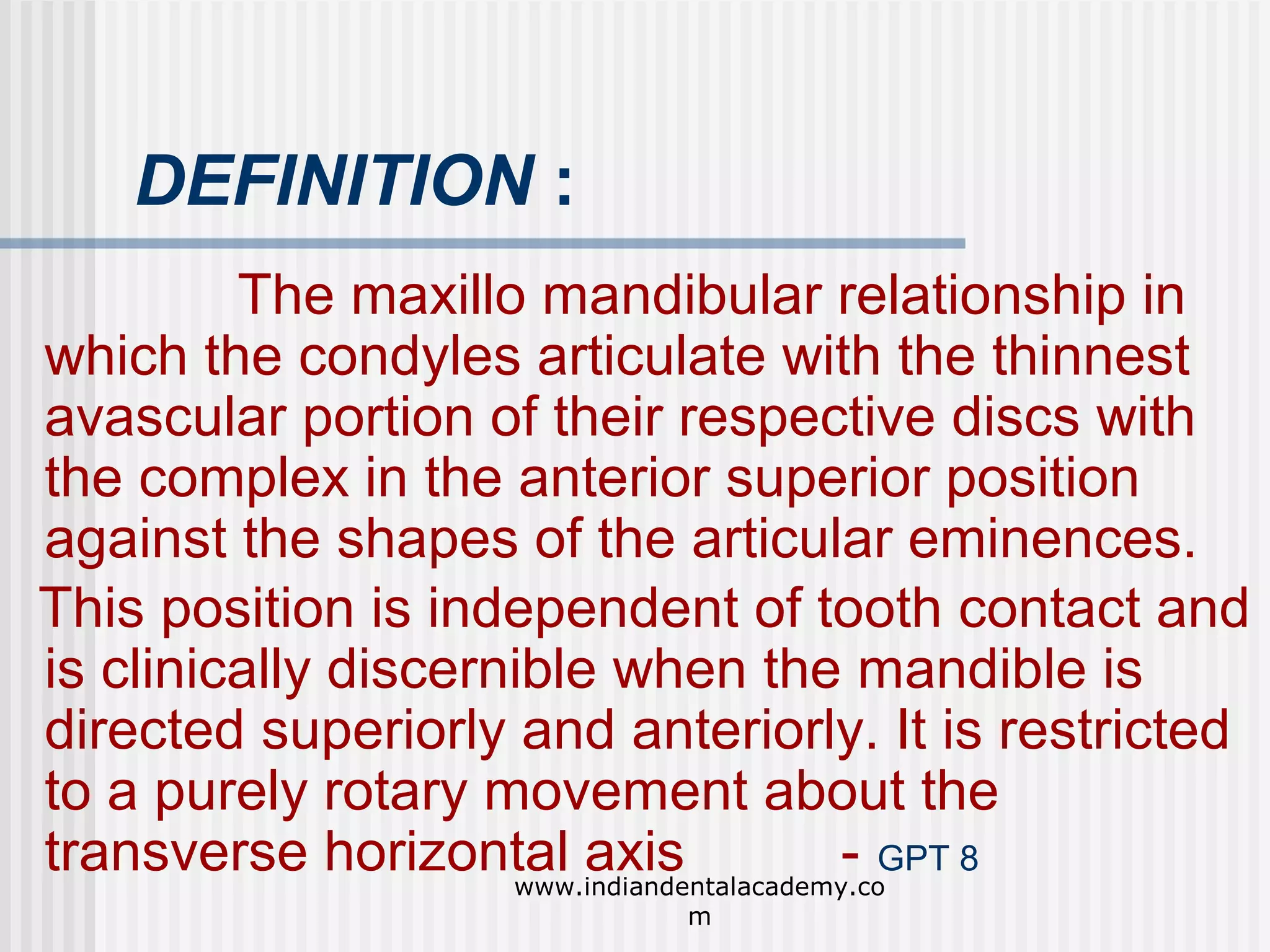
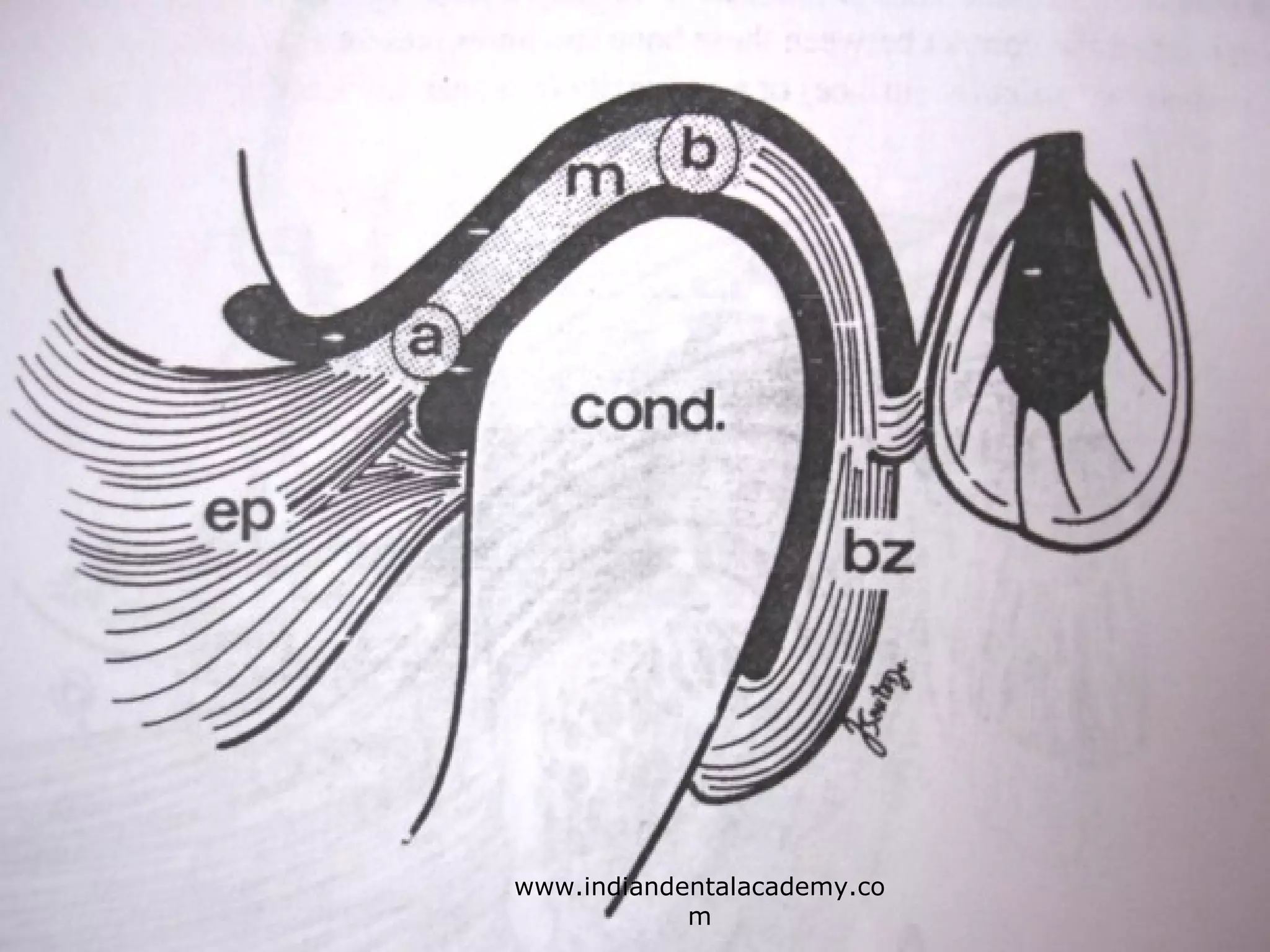
DEFINITION :
The maxillo mandibular relationship in
which the condyles articulate with the thinnest
avascular portion of their respective discs with
the complex in the anterior superior position
against the shapes of the articular eminences.
This position is independent of tooth contact and
is clinically discernible when the mandible is
directed superiorly and anteriorly. It is restricted
to a purely rotary movement about the
transverse horizontal axis
- GPT 8
www.indiandentalacademy.co
m
Significance of centric relation:


It is reproducible ,repeatable and
recordable position.



It is a definite learned position.

www.indiandentalacademy.co
m


Eccentric movements of mandible.



Functional movements.



The muscles that act on the
temperomandibular joint are arranged in
such a way that it is easy to move the
mandible to the centric position from where
all movements can be made.
www.indiandentalacademy.co
m


Mounting of casts.



proprioceptive centre.



Reference point .

www.indiandentalacademy.co
m
CENTRIC RELATION IS THE
TERMINAL HINGE RELATION:
During mandibular opening
movement,the condyles rotate initially in a
hinge and later in a translatory motion.A pure
hinge movement of the condyle occurs only
when the condyle is in its centric position.

www.indiandentalacademy.co
m
Combinations of translation and hinge
movement take place when the condyle
moves anterior to centric relation.
For this reason ,centric relation is
known as the terminal hinge relation.
Terminal hinge axis is the horizontal axis of
condyles when the condyles are in centric
relation.

www.indiandentalacademy.co
m
CHARACTER OF OCCLUSION IN
CENTRIC RELATION:
There are two concepts:
Point centric :
This happens when centric occlusion
and centric relation coincide.It is a precise
location of centric occlusion in centric relation.It
is a maximum intercuspation seen or given in
centric relation.
www.indiandentalacademy.co
m
Long centric/freedom in centric /
area centric:
When centric relation and
centric occlusion do not coincide,a
freedom is given to close the mandible
either into centric relation or slightly
anterior to its in centric occlusion with a
smooth gliding ,without effecting and
change in vertical dimension of occlusion.
www.indiandentalacademy.co
m
CONCEPTS AND OBJECTIVES IN RECORDING
CENTRIC RELATION:
1)

Minimal closing pressure :
Opposing teeth to touch
uniformly and simultaneously at their first
contact,minimal displacement of the
tissue

www.indiandentalacademy.co
m
2) Heavy closing pressure:
Produce same displacement
of the soft tissues as would exist when
heavy closing pressure are applied on the
dentures.

www.indiandentalacademy.co
m
RELATING CENTRIC RELATION TO
CENTRIC OCCLUSION:
Centric relation is a bone to bone
relation,where as centric occlusion is a
relationship of upper and lower teeth to each
other.centric relation must be accurately
recorded so that centric occlusion can be built
to coincide with it.

www.indiandentalacademy.co
m
When natural teeth are
removed,many receptors that initiate
impulses resulting in positioning of
mandible away from deflective occlusal
contacts into centric occlusion are lost or
destroyed. Therefore edentulous patients
cannot control mandibular movements or
avoid deflective occlusal contacts which
may direct the mandible away from
centric relation .
www.indiandentalacademy.co
m
Thus centric relation must be
recorded for edentulous patients so that
centric occlusion can be established in
harmony with this position.

www.indiandentalacademy.co
m
Retruding the mandible to centric
relation:
Difficulties seen are
Biological
 Psychological
 Mechanical


www.indiandentalacademy.co
m
Methods of assisting the patient to
retrude the mandible:
Instructing the patient to:


Relax the jaw ,pull it back and close slowly
and easily on your back teeth.



Get the feeling of pushing your
upper jaw out and close your back
teeth together.
www.indiandentalacademy.co
m


Protrude and retrude the mandible
repeatedly as the patient holds the fingers
lightly against the chin.



Turn the tongue backwards towards the
posterior border of the upper denture.

www.indiandentalacademy.co
m


Tap the occlusal rims or the back
teeth repeatedly.



Tilting the head back while all the
exercise is carried out.



Palpating the temporal and the
masseter muscles to relax them

www.indiandentalacademy.co
m
Methods of recording centric relation:
Classification by Heartwell:






Physiological / tactile / interocclusal
check record method.
Functional method.
Graphic method.

www.indiandentalacademy.co
m
Physiological / tactile / interocclusal
check record method:


In 1756,Philip pfaff, the dentist of
Frederick the great of Germany, was the
first to describe this technique.



The direct interocclusal record during that
period was a non-precision jaw record
obtained with a thermoplastic material,
usually wax or compound.

www.indiandentalacademy.co
m


In 1905,Christensen was one of the early
authors to use impression wax for bite
records.



In 1954, Brown recommended repeated
closures into softened wax rims.



Greene had his patients hold their jaw
apart for 10 sec to fatigue the muscles and
then had them snap the rims together.



Gradually these procedures evolved into
interocclusal records as they are usually
done today. www.indiandentalacademy.co
m
Physiological / tactile / interocclusal
check record method:


In this method the vertical dimension is
established first .



A tentative centric relation is
recorded,occlusal rims are articulated using
tentative records and artificial teeth are
arranged.



Now the trial dentures are ready for making
www.indiandentalacademy.co
the inter-occlusal check record.
m


The trial dentures are inserted into patient
mouth ,recording material is loaded onto
the occlusal surface of posterior teeth in
the mandibular occlusal rim and patient is
asked to slowly retrude the mandible and
close till tooth contact occurs.



The horizontal Condylar guide locks in the
articulator are unlocked and the trial
dentures are placed on their articulated
casts.
www.indiandentalacademy.co
m
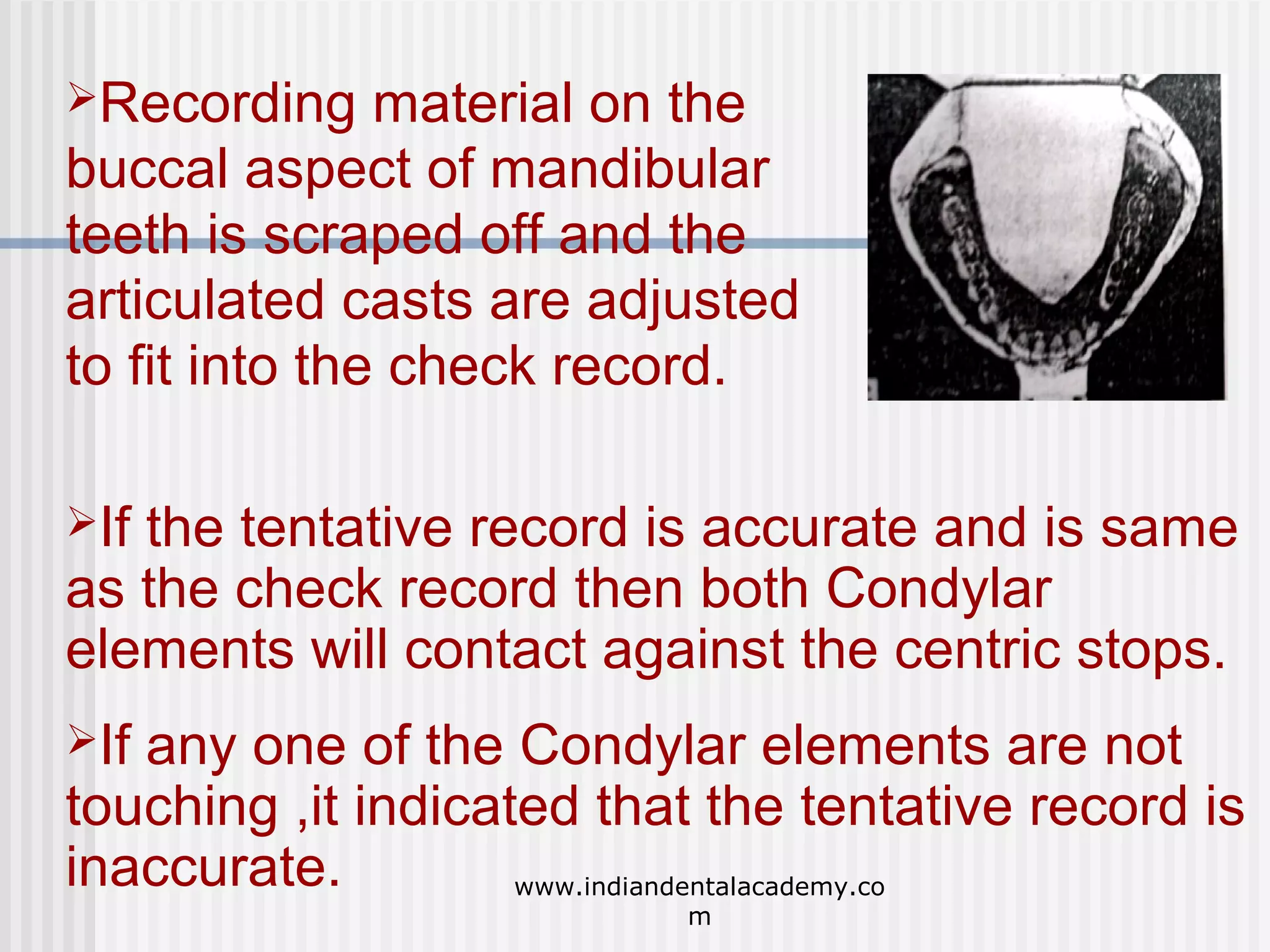
Recording

material on the
buccal aspect of mandibular
teeth is scraped off and the
articulated casts are adjusted
to fit into the check record.
If

the tentative record is accurate and is same
as the check record then both Condylar
elements will contact against the centric stops.
If

any one of the Condylar elements are not
touching ,it indicated that the tentative record is
inaccurate.
www.indiandentalacademy.co
m
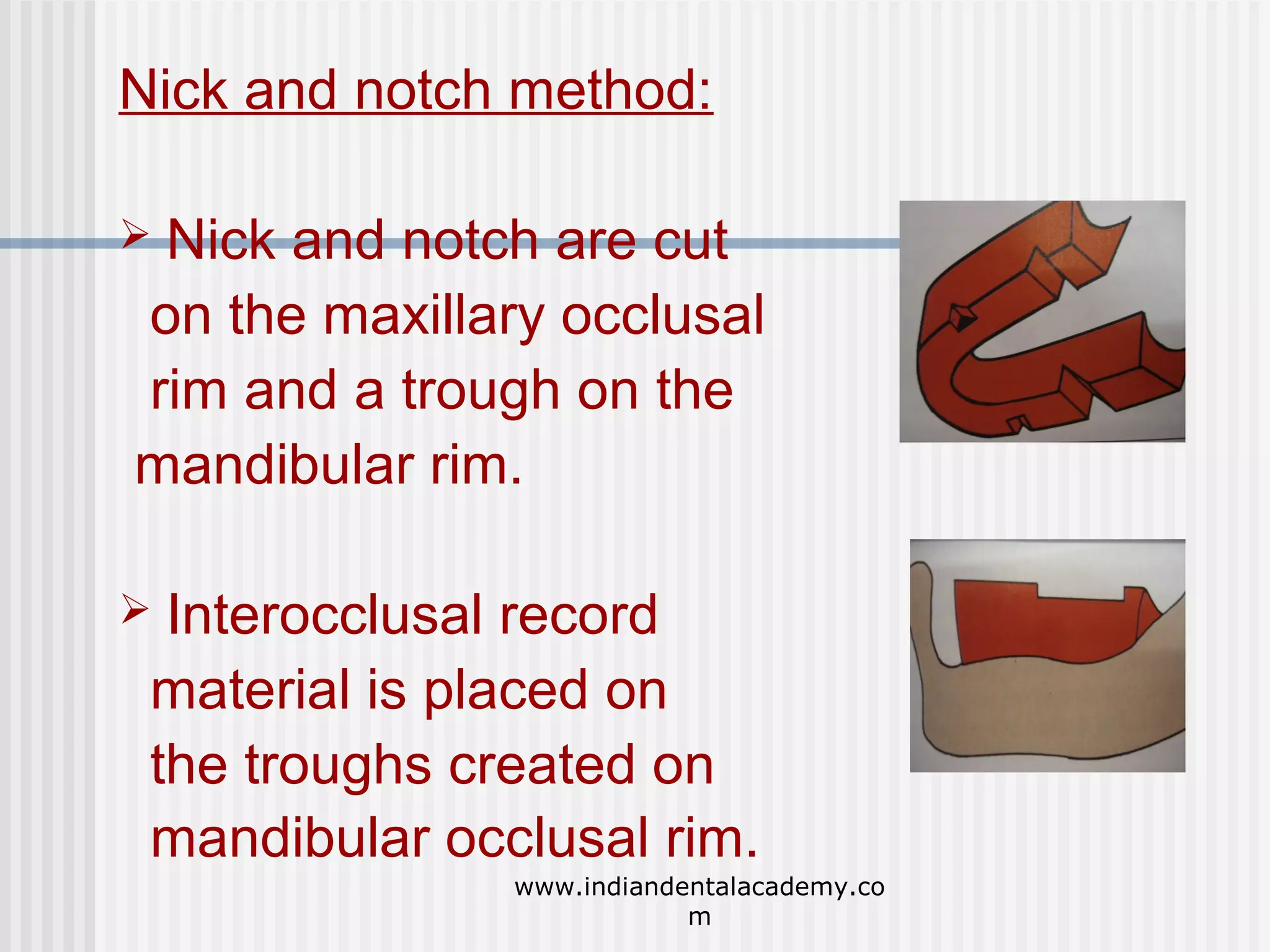
Nick and notch method:
Nick and notch are cut
on the maxillary occlusal
rim and a trough on the
mandibular rim.



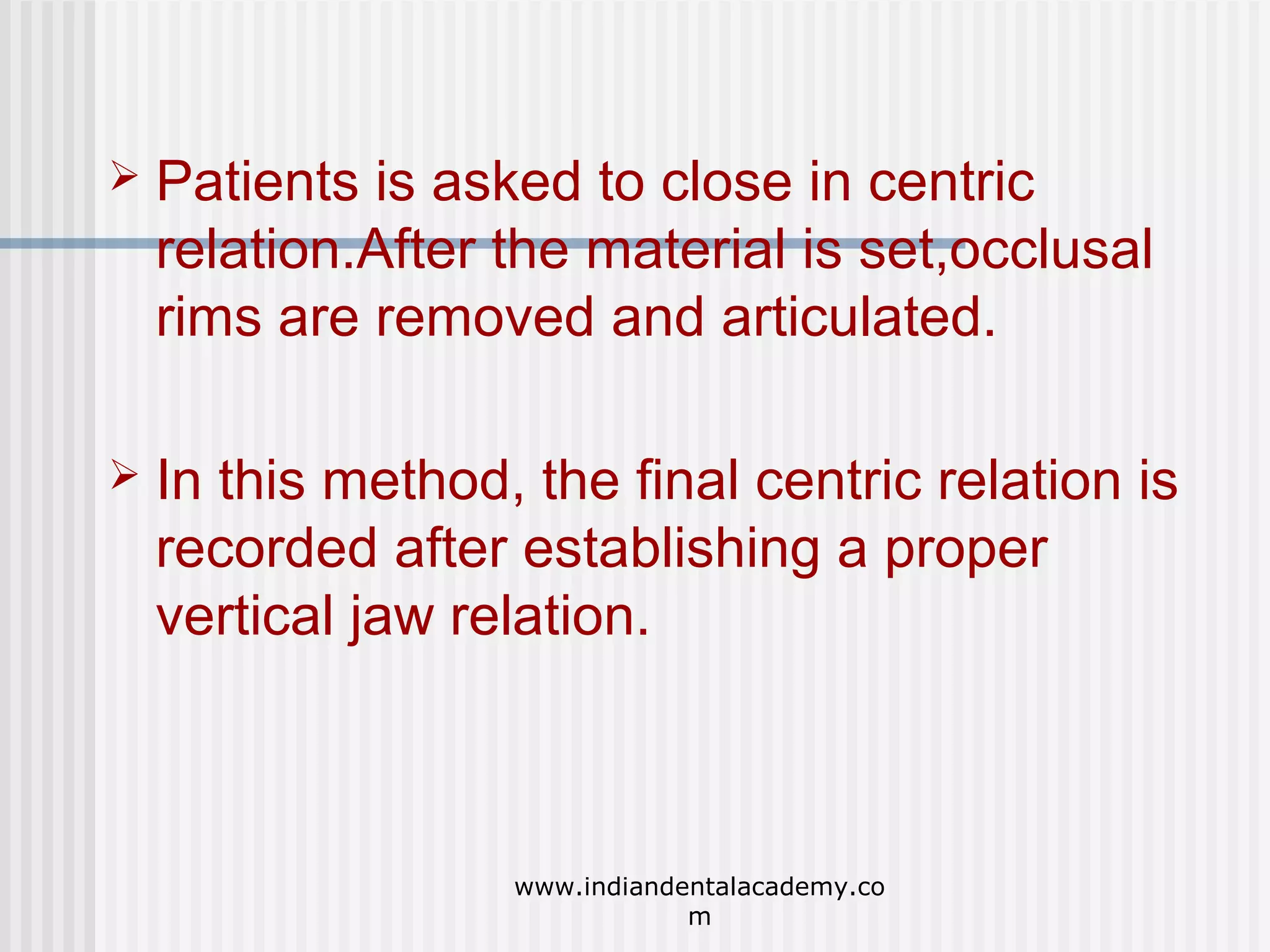
Interocclusal record
material is placed on
the troughs created on
mandibular occlusal rim.



www.indiandentalacademy.co
m


Patients is asked to close in centric
relation.After the material is set,occlusal
rims are removed and articulated.



In this method, the final centric relation is
recorded after establishing a proper
vertical jaw relation.

www.indiandentalacademy.co
m
Functional/chew in Method ::
Needles-house technique:


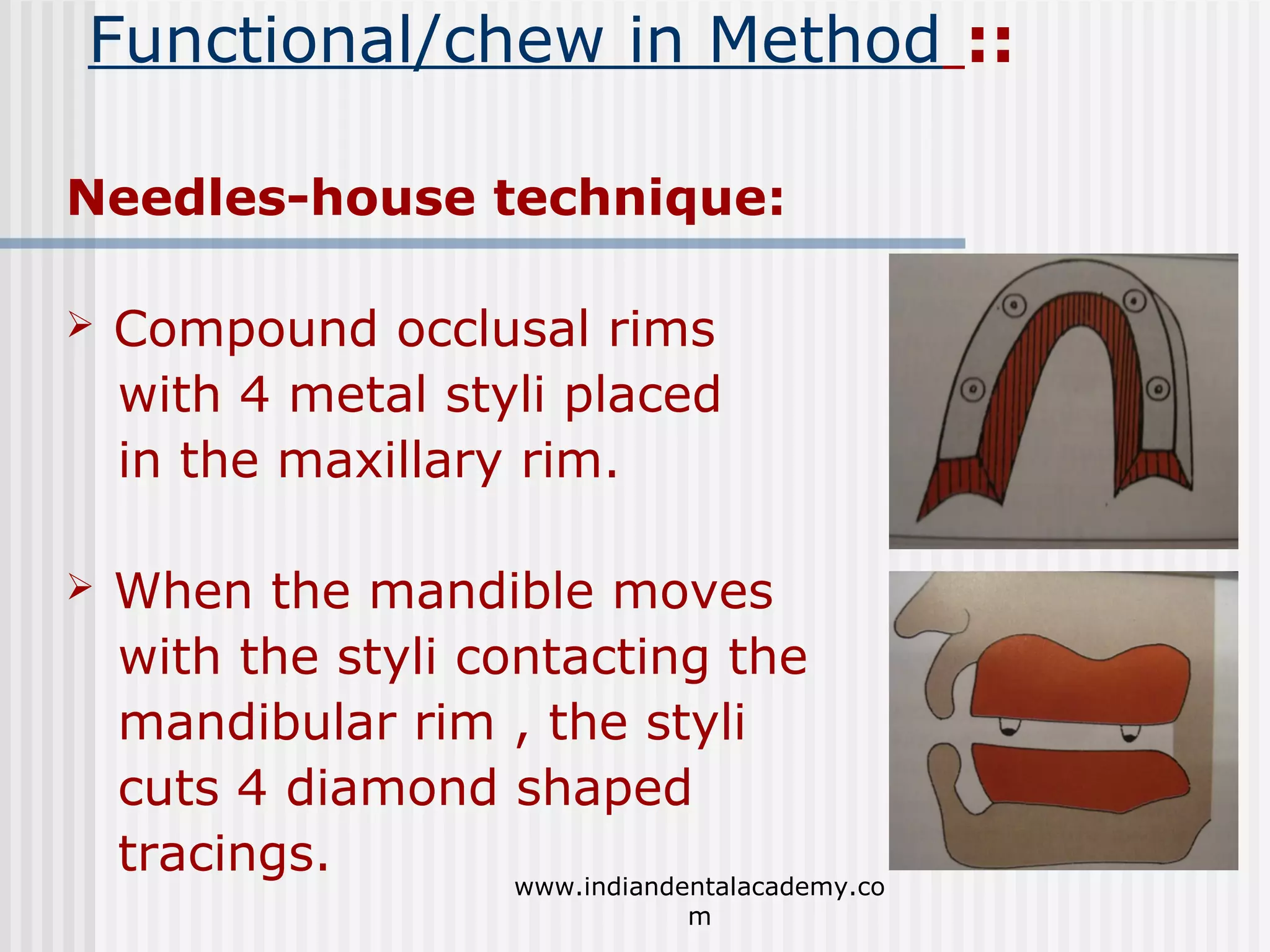
Compound occlusal rims
with 4 metal styli placed
in the maxillary rim.



When the mandible moves
with the styli contacting the
mandibular rim , the styli
cuts 4 diamond shaped
tracings.
www.indiandentalacademy.co
m


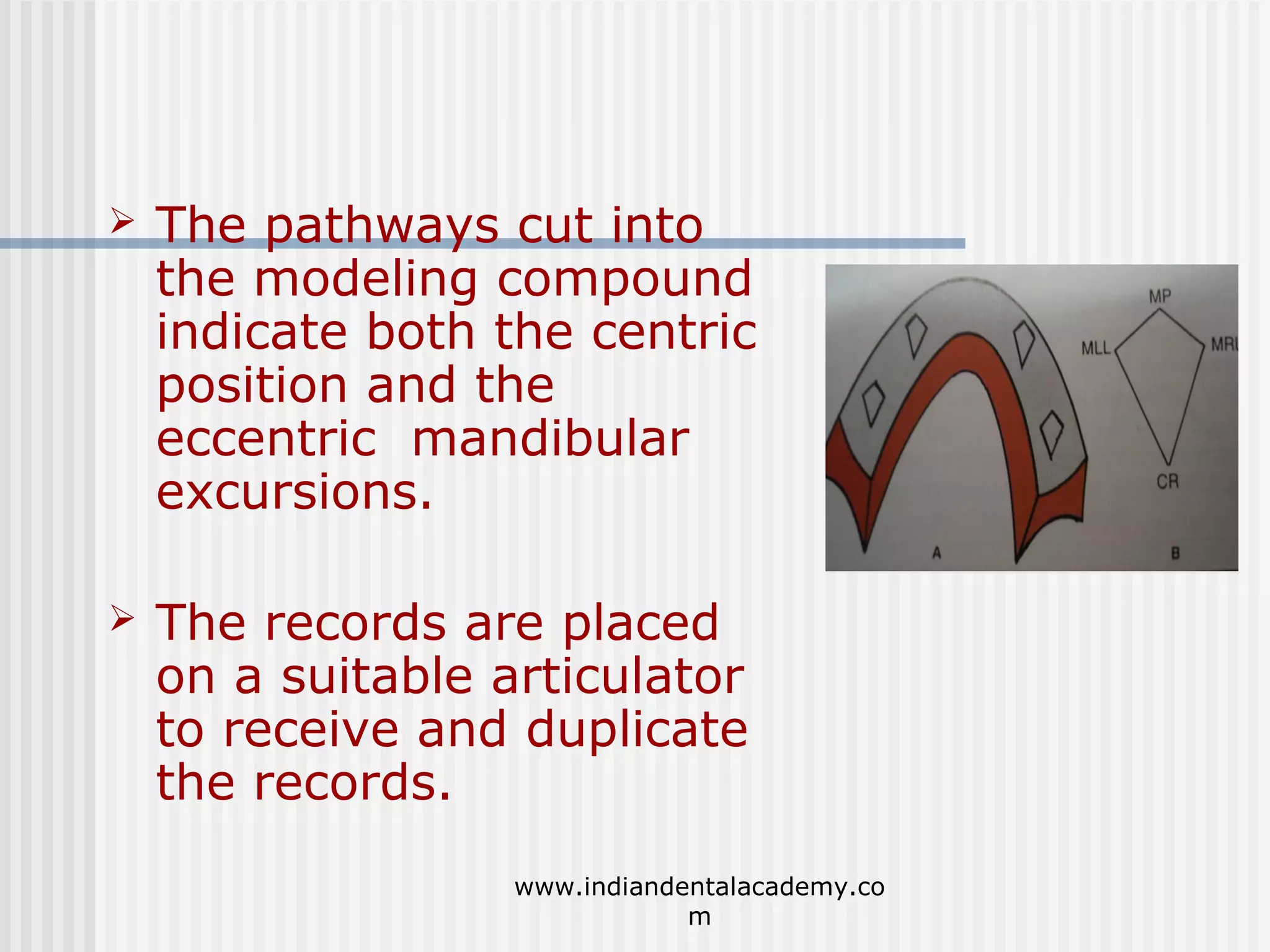
The pathways cut into
the modeling compound
indicate both the centric
position and the
eccentric mandibular
excursions.



The records are placed
on a suitable articulator
to receive and duplicate
the records.
www.indiandentalacademy.co
m
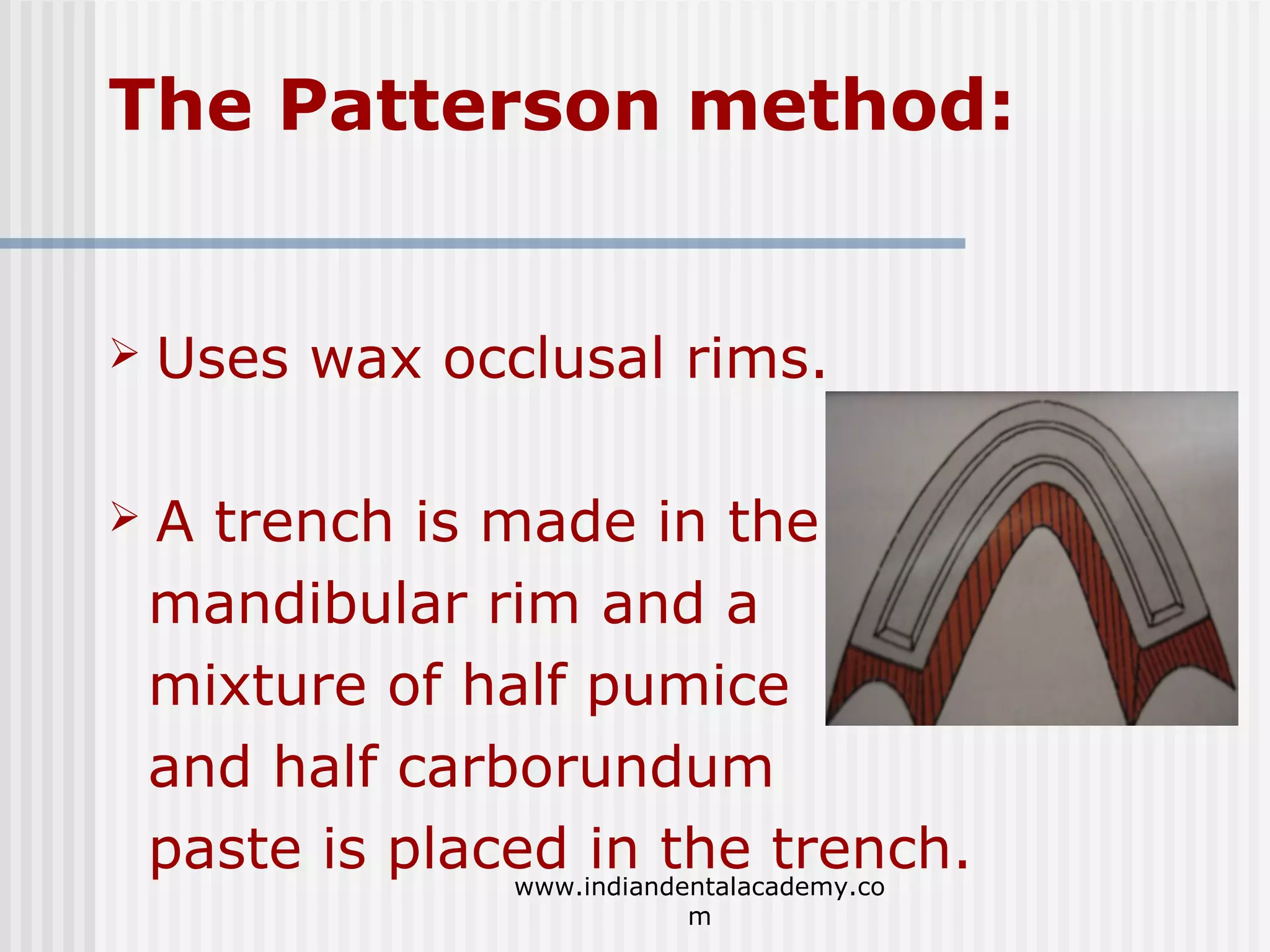
The Patterson method:



Uses wax occlusal rims.



A trench is made in the
mandibular rim and a
mixture of half pumice
and half carborundum
paste is placed in the trench.
www.indiandentalacademy.co
m


When the pumice and carborundum are
reduced to the pre determined height the
patient is asked to retrude the mandible
and the occlusion rims are joined with
metal staple pins.`

www.indiandentalacademy.co
m
Graphic methods:
Graphic methods are of two types:


Arrow point tracing.
- Intra oral
- Extra oral



Pantographic tracing.
www.indiandentalacademy.co
m
NEEDLE POINT TRACING:


The first known needle point tracing was
by Hesse in 1897, and the technique was
improved and popularized by Gysi around
1910.



Phillips developed a plate for upper rim
and a Tripoded ball bearing mounted on a
jackscrew for the lower rim. This
innovation was named the ‘central
bearing point’.
www.indiandentalacademy.co
m


In 1929,Stansbery introduced a technique
by using both central bearing point and
extra oral tracer and used plaster
between plates for centric registration.



Later Hall substituted compound for
centric relation record.



Hardy and Porter made a depression a
depression with a round bur at the apex
of tracing.
www.indiandentalacademy.co
m
Technique for Gothic Arch Tracing:
1) Make accurate stable maxillary and
mandibular record bases.
2) Contour the wax occlusal rims.
3) Establish the vertical jaw relation
4) Make a face bow transfer and mount the
maxillary cast .
5) With soft wax make a tentative centric
relation record.
www.indiandentalacademy.co
m
6)Relate the maxillary occlusion rims in the
soft wax record and attach the mandibular
cast to the articulator with plaster.
7)Adjust the articulator with the condylar
elements secured against the centric stops.
8)Reduce the mandibular occlusal rim to
provide excessive interocclusal distance.
www.indiandentalacademy.co
m
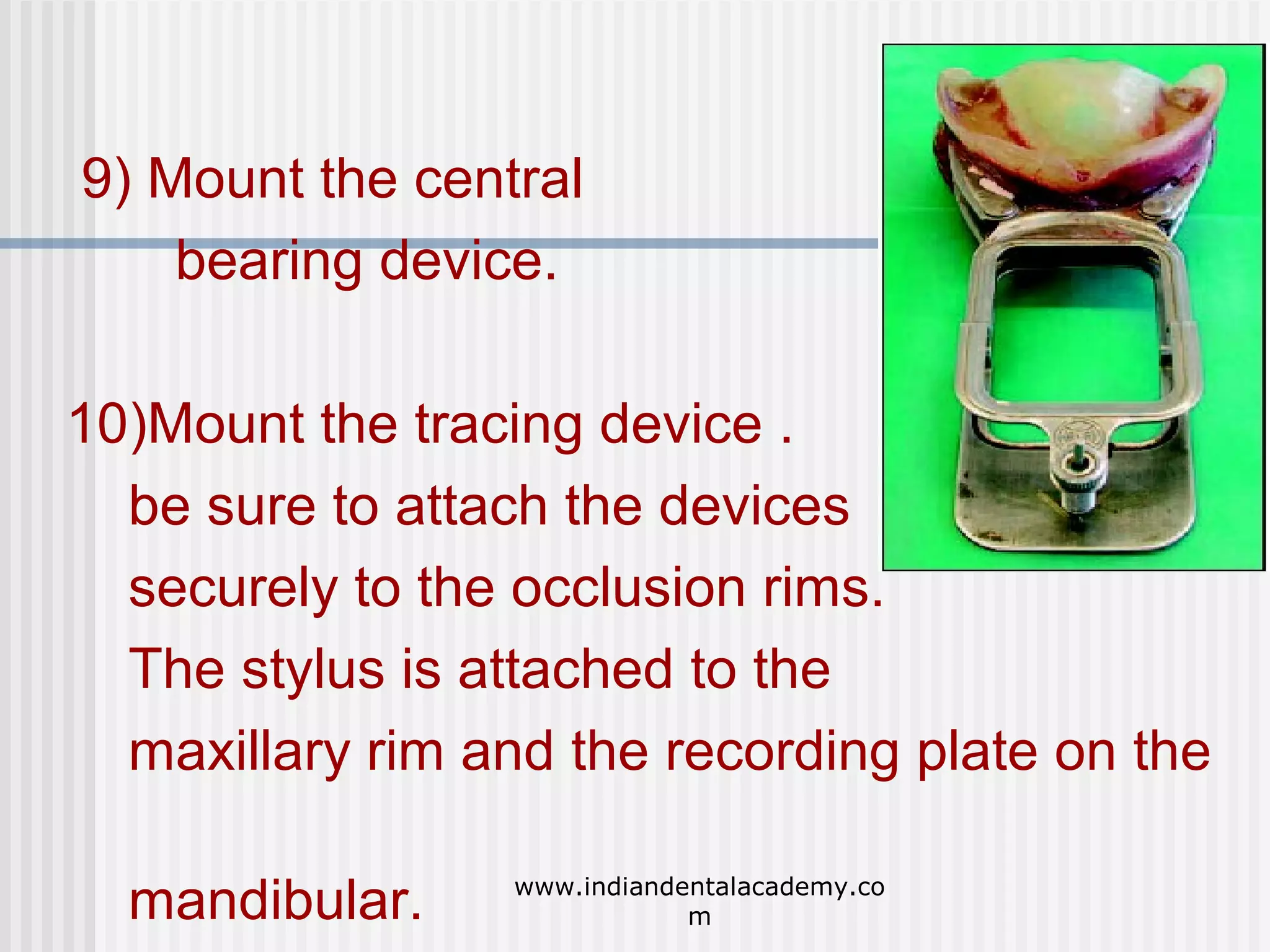
9) Mount the central
bearing device.
10)Mount the tracing device .
be sure to attach the devices
securely to the occlusion rims.
The stylus is attached to the
maxillary rim and the recording plate on the
mandibular.

www.indiandentalacademy.co
m
11)Seat the patient with the head upright.
12)Seat the recording bases with the attached
recording devices ,make sure that there is
no interference between the occlusion rims
when the mandible is moved in any
direction.
13)Retract the stylus and conduct training
exercises with the patient.
www.indiandentalacademy.co
m
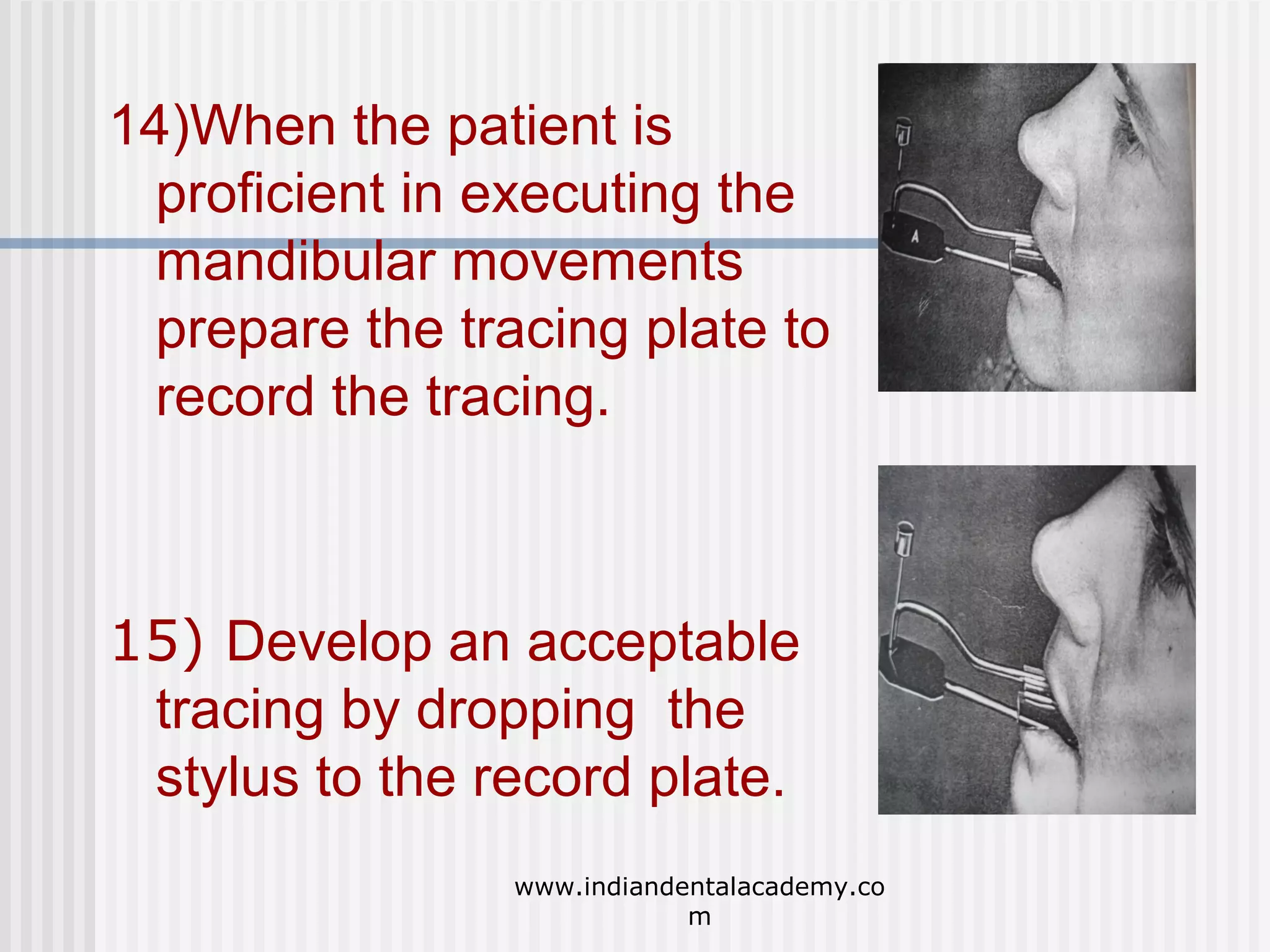
14)When the patient is
proficient in executing the
mandibular movements
prepare the tracing plate to
record the tracing.

15) Develop an acceptable
tracing by dropping the
stylus to the record plate.
www.indiandentalacademy.co
m
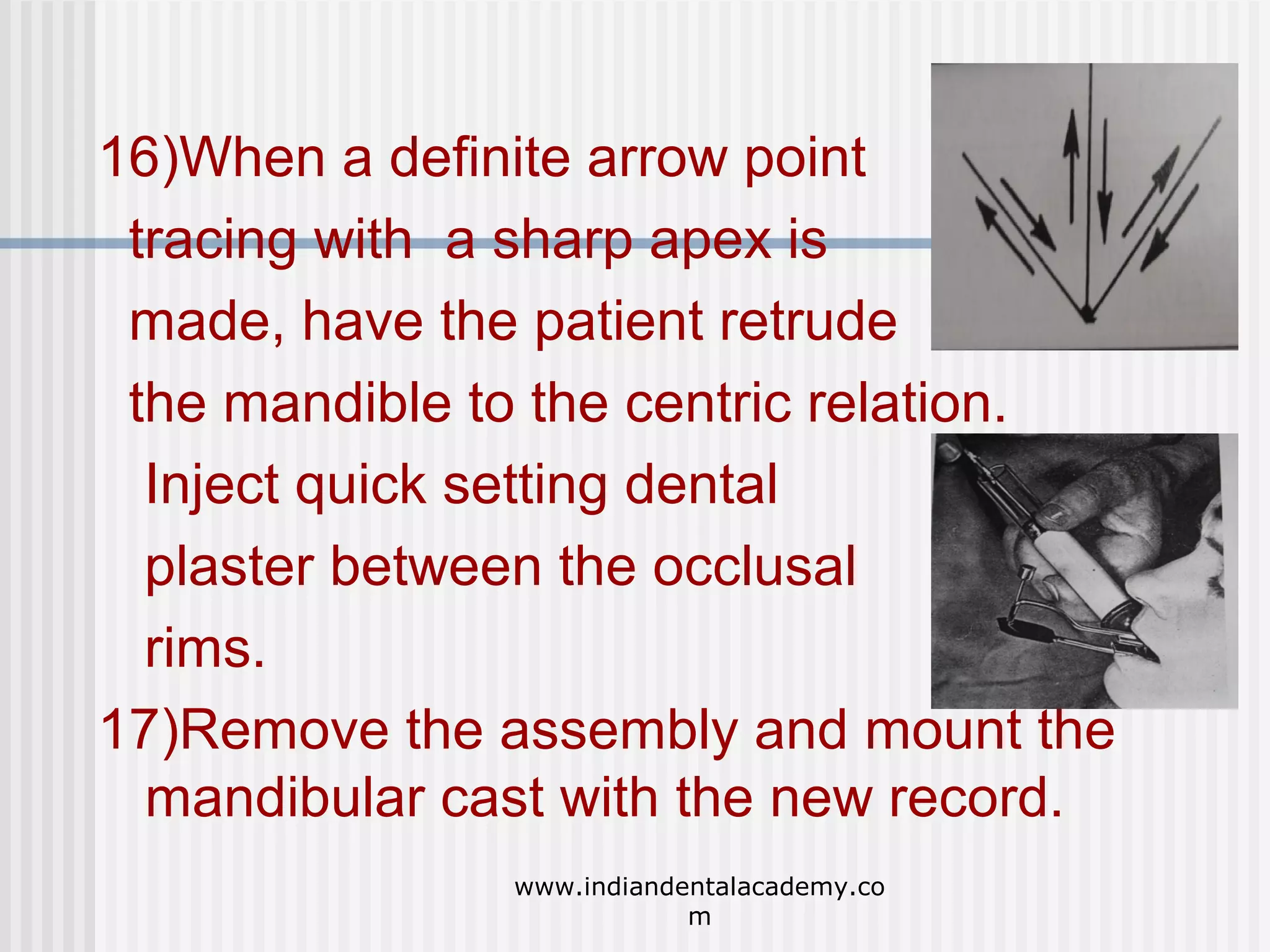
16)When a definite arrow point
tracing with a sharp apex is
made, have the patient retrude
the mandible to the centric relation.
Inject quick setting dental
plaster between the occlusal
rims.
17)Remove the assembly and mount the
mandibular cast with the new record.
www.indiandentalacademy.co
m
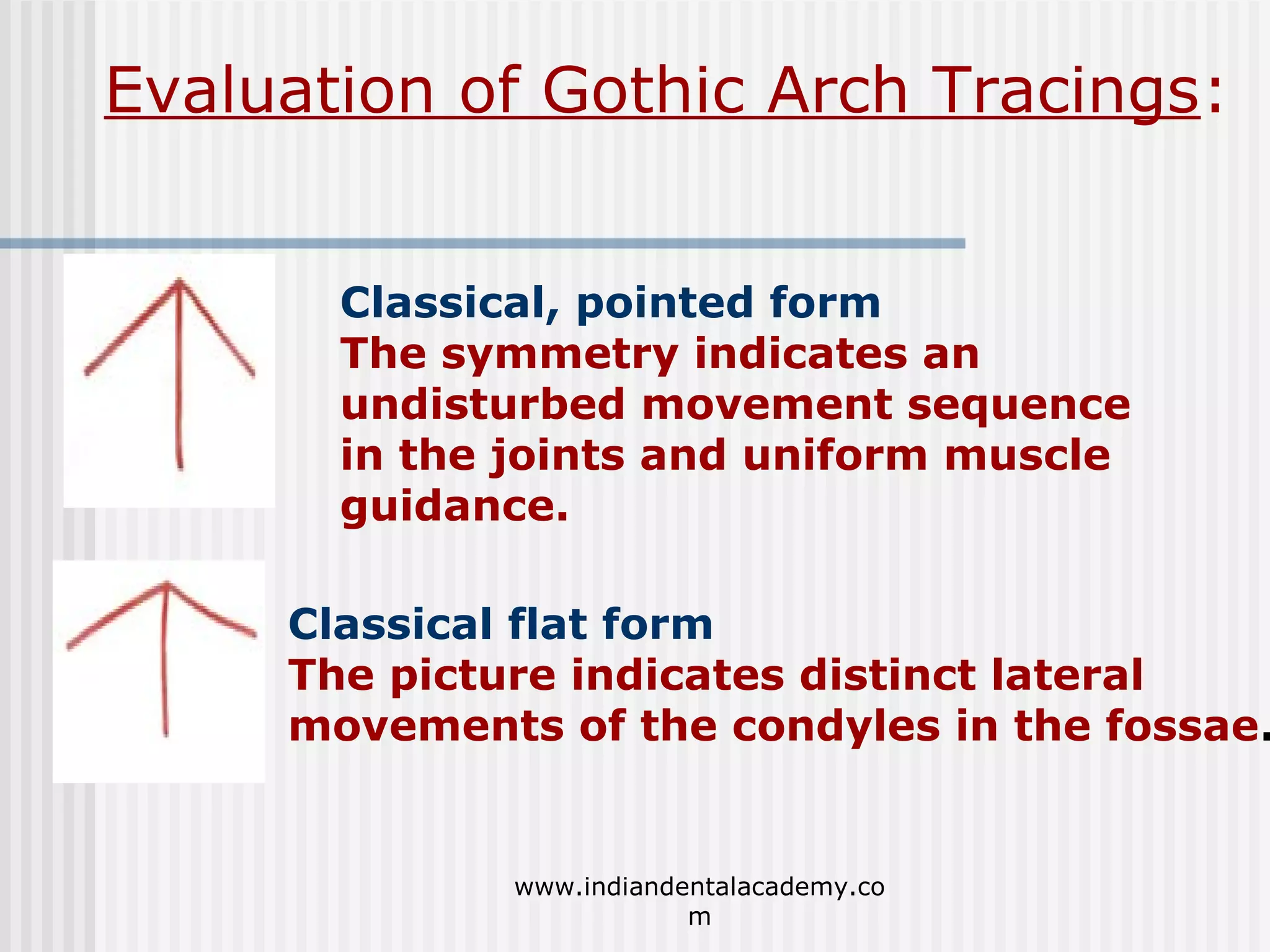
Evaluation of Gothic Arch Tracings:
Classical, pointed form
The symmetry indicates an
undisturbed movement sequence
in the joints and uniform muscle
guidance.

Classical flat form
The picture indicates distinct lateral
movements of the condyles in the fossae.

www.indiandentalacademy.co
m
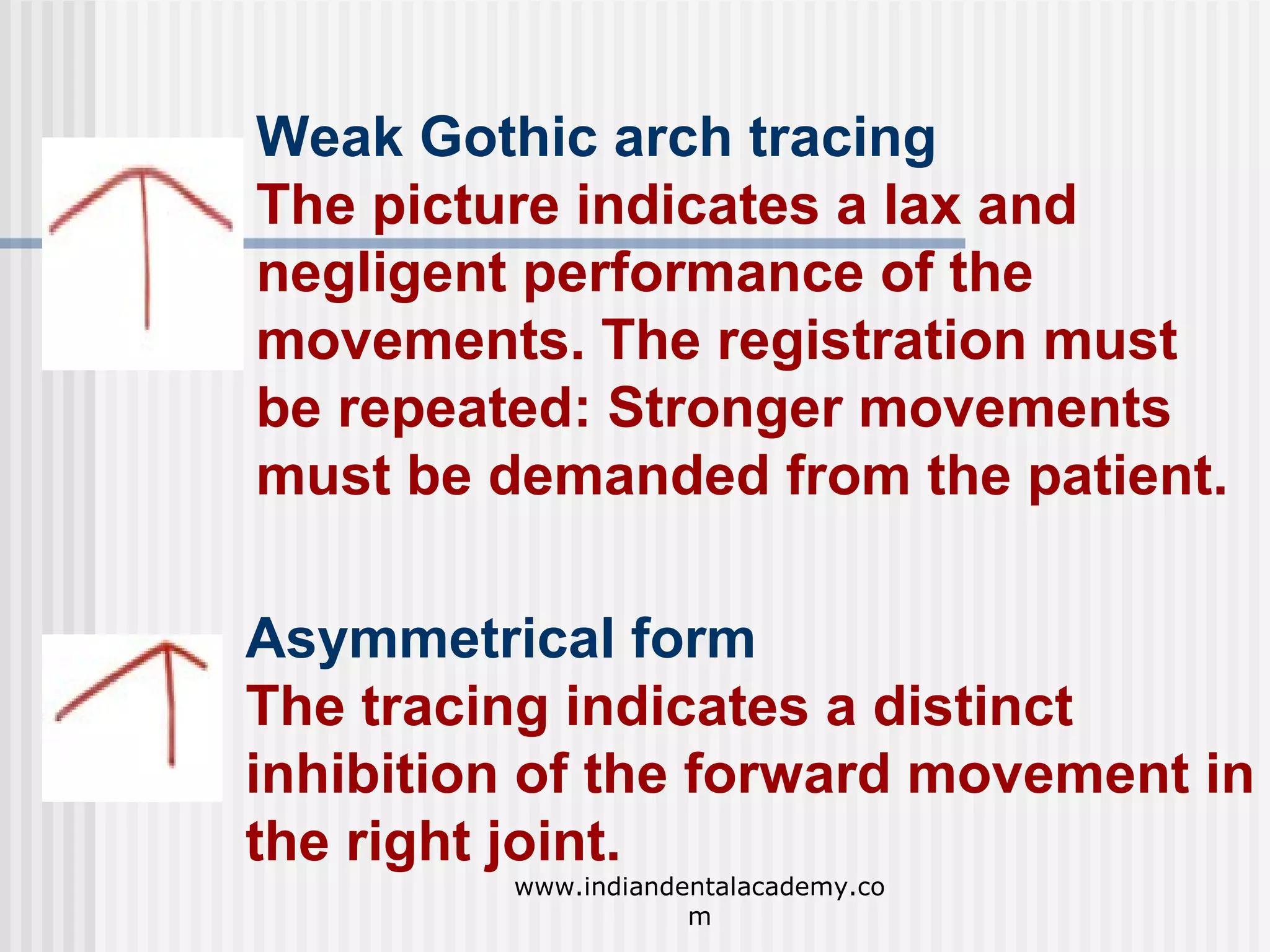
Weak Gothic arch tracing
The picture indicates a lax and
negligent performance of the
movements. The registration must
be repeated: Stronger movements
must be demanded from the patient.
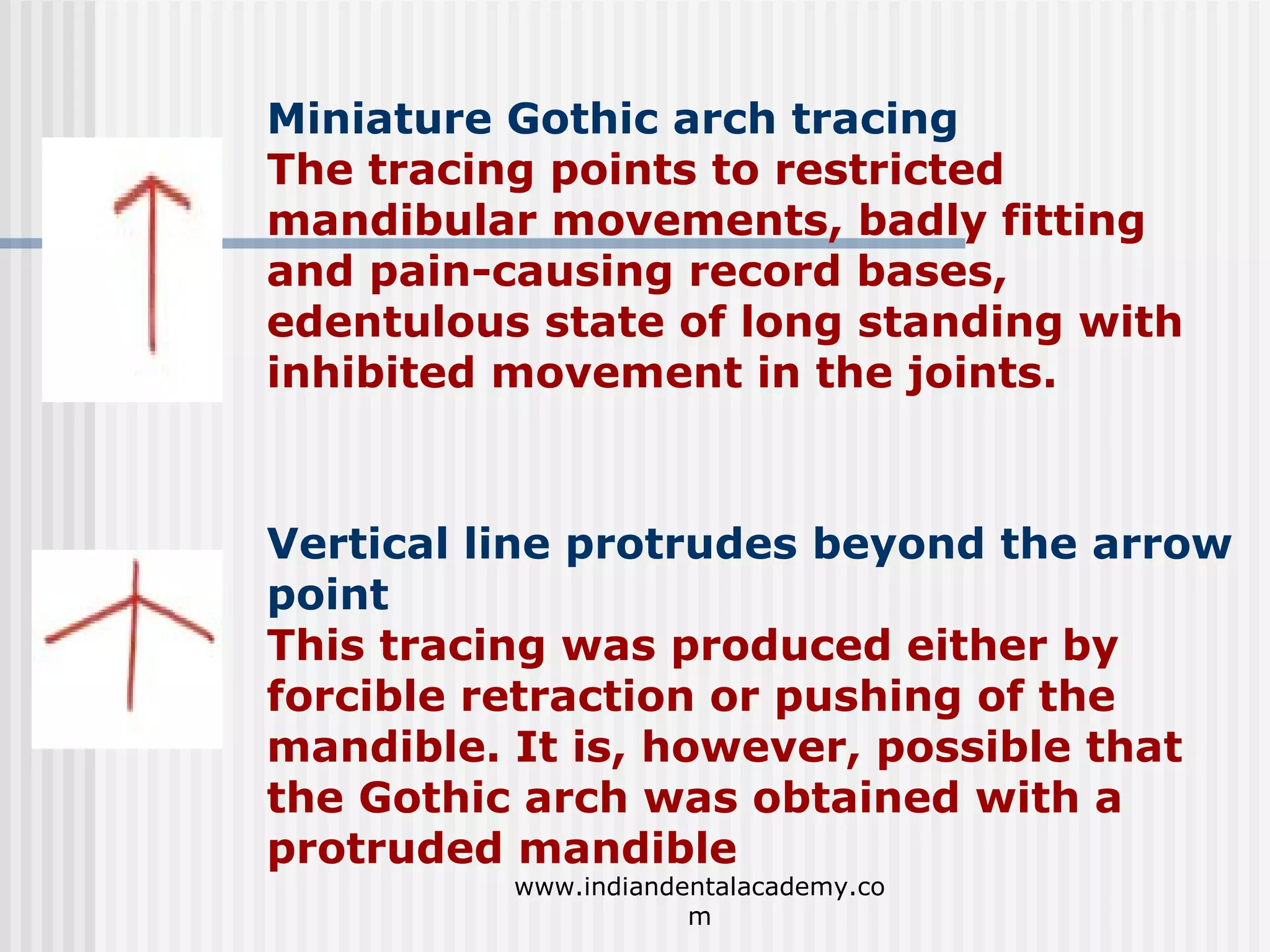
Asymmetrical form
The tracing indicates a distinct
inhibition of the forward movement in
the right joint.
www.indiandentalacademy.co
m
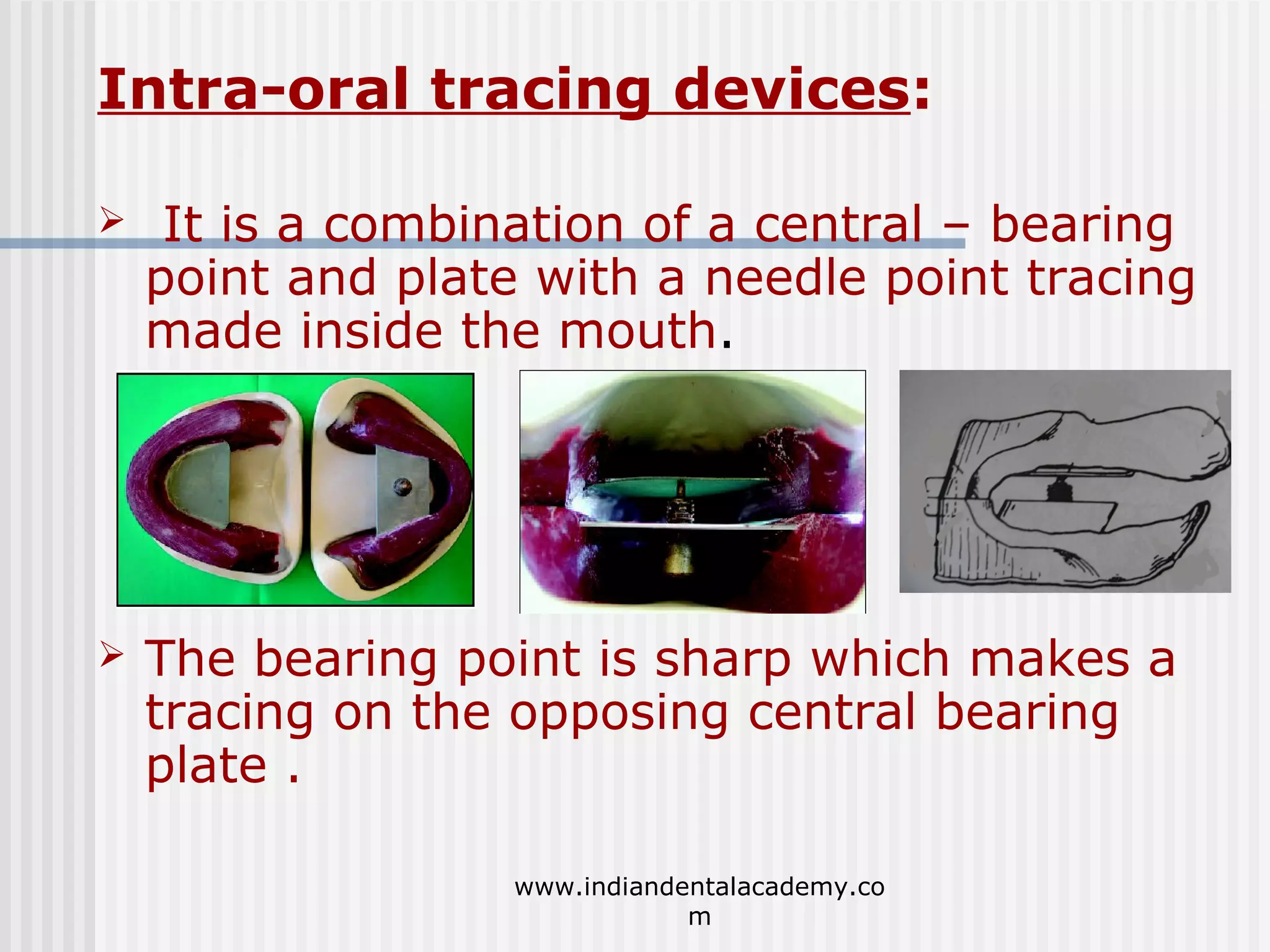
Miniature Gothic arch tracing
The tracing points to restricted
mandibular movements, badly fitting
and pain-causing record bases,
edentulous state of long standing with
inhibited movement in the joints.

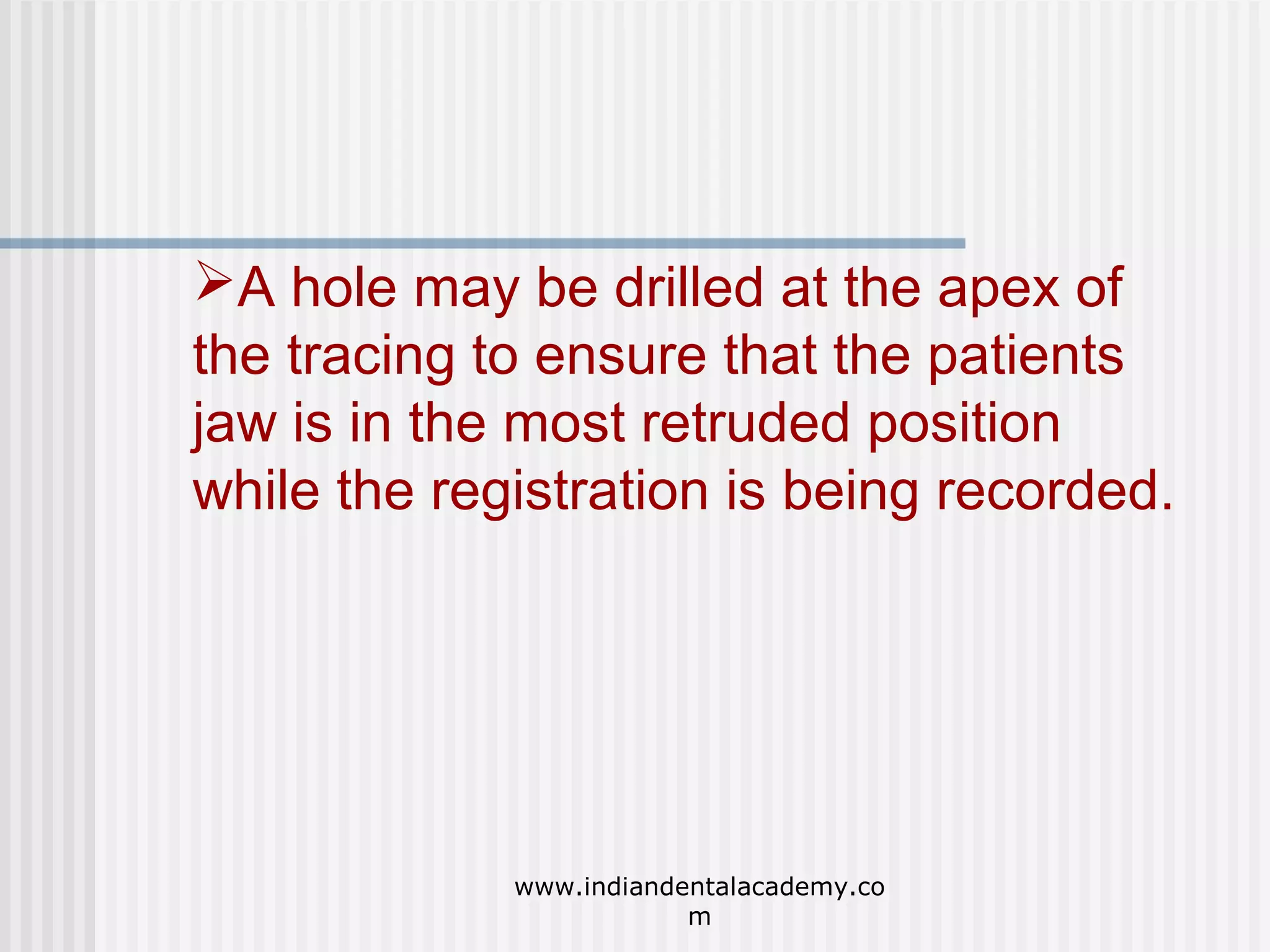
Vertical line protrudes beyond the arrow
point
This tracing was produced either by
forcible retraction or pushing of the
mandible. It is, however, possible that
the Gothic arch was obtained with a
protruded mandible
www.indiandentalacademy.co
m
Intra-oral tracing devices:


It is a combination of a central – bearing
point and plate with a needle point tracing
made inside the mouth.



The bearing point is sharp which makes a
tracing on the opposing central bearing
plate .
www.indiandentalacademy.co
m
A hole may be drilled at the apex of
the tracing to ensure that the patients
jaw is in the most retruded position
while the registration is being recorded.

www.indiandentalacademy.co
m
Digital Gothic Arch Tracing:


Here the stylus is a plastic sphere of 6mm
in diameter and is attached to the
maxillary rim with auto polymerizing
acrylic resin.



A resistance film sensor was attached to
the conventional tracing device ,that is
attached to the mandibular occlusal rim
www.indiandentalacademy.co
m
Digital Gothic Arch Tracing:

www.indiandentalacademy.co
m
Pantographic tracing:


A graphic record of mandibular
movement in three planes as registered
by the styli on the recording tables of a
pantograph; tracings of mandibular
movements recorded on plates in the
horizontal and sagital planes.



It’s a three dimensional graphic tracer.
www.indiandentalacademy.co
m
It resembles a complicated face bow.
 The surface over which
the tracing is done is
called a flag.




The styli draw tracing
patterns on the flag.

There are 6 flags present.
 Two flags located perpendicular to one
another near the condyle(hinge axis)
www.indiandentalacademy.co
 Two flags placed in the anterior region.
m

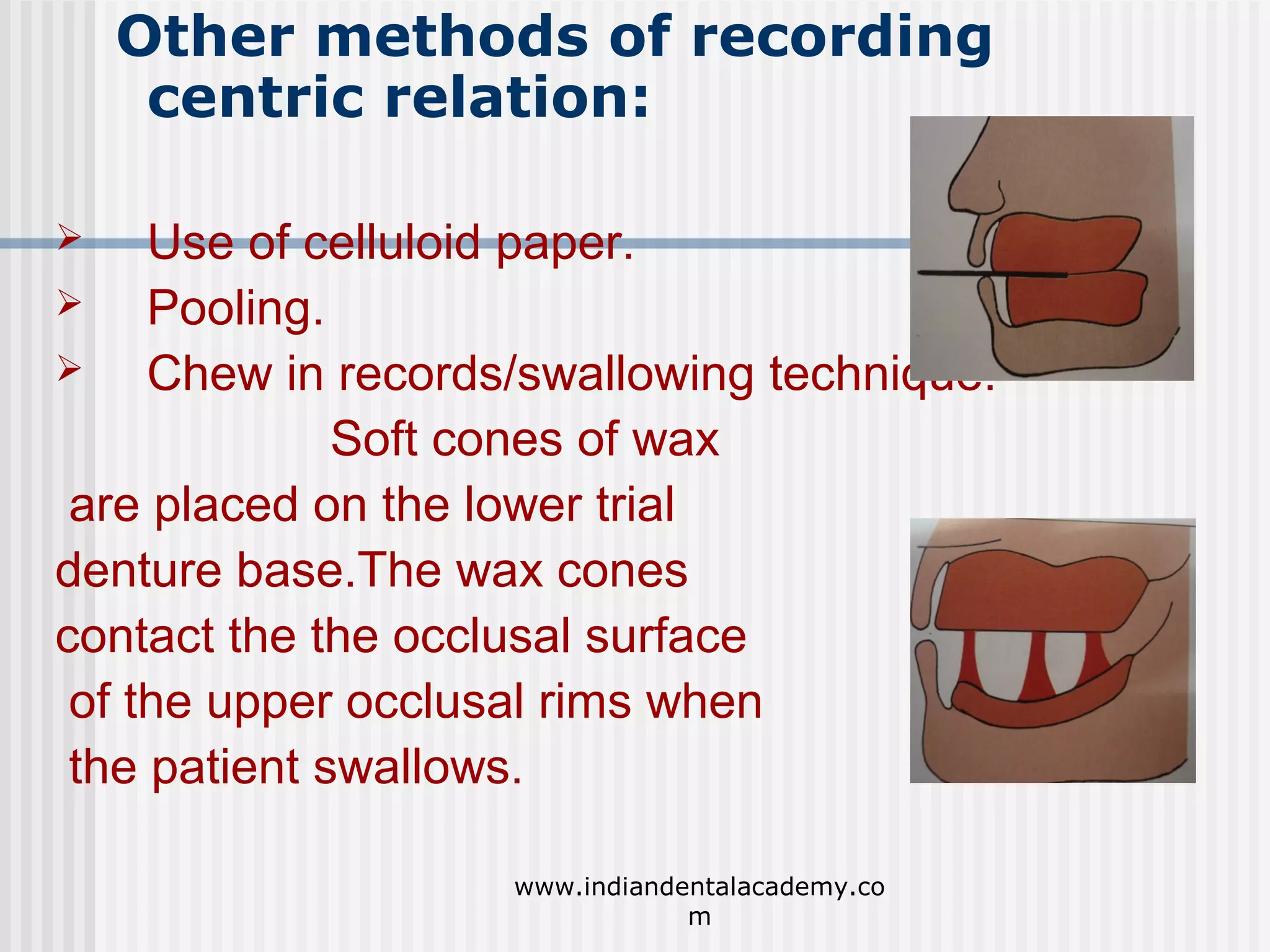
Other methods of recording
centric relation:
Use of celluloid paper.

Pooling.

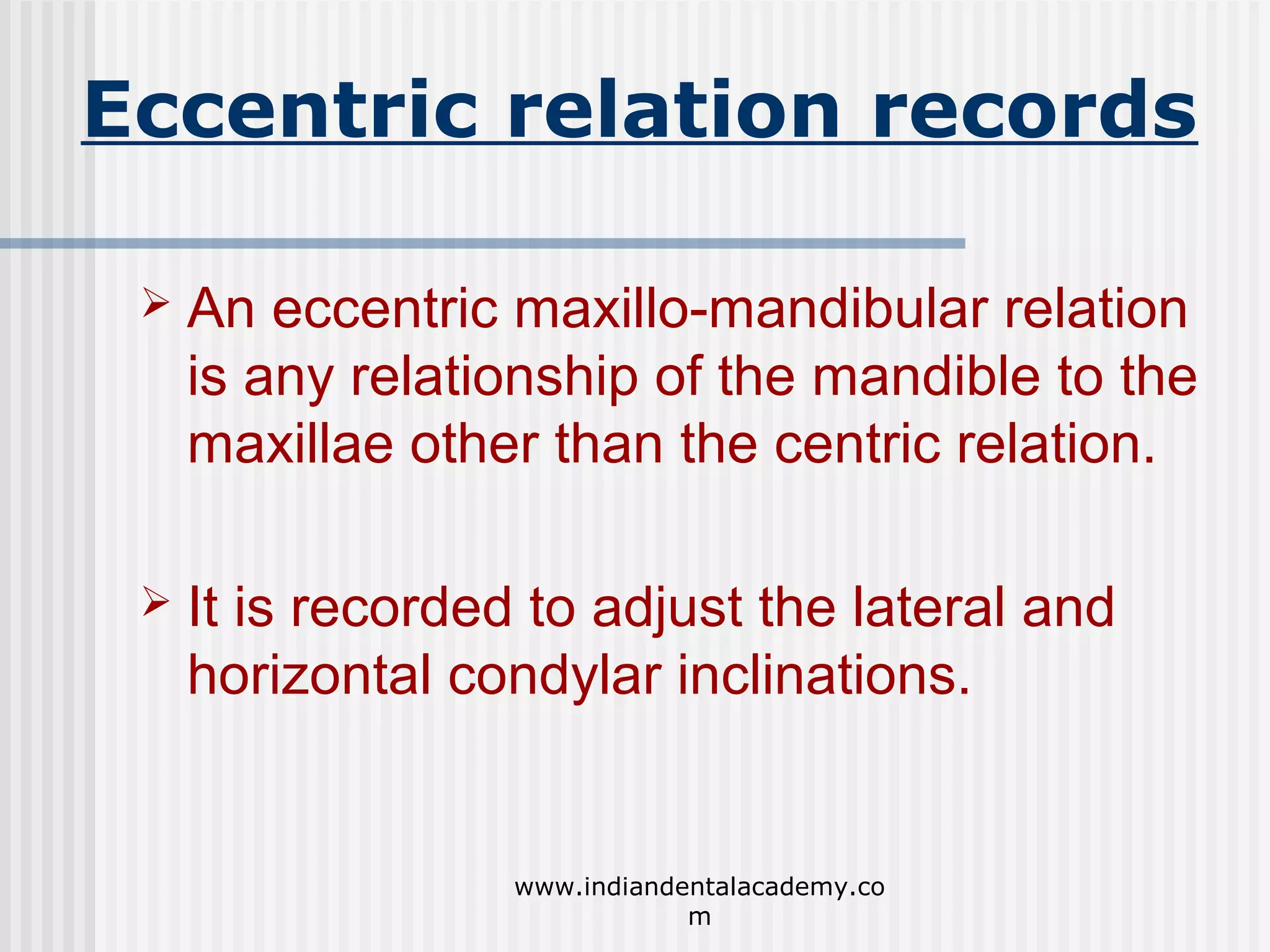
Chew in records/swallowing technique:
Soft cones of wax
are placed on the lower trial
denture base.The wax cones
contact the the occlusal surface
of the upper occlusal rims when
the patient swallows.


www.indiandentalacademy.co
m
Eccentric relation records


An eccentric maxillo-mandibular relation
is any relationship of the mandible to the
maxillae other than the centric relation.



It is recorded to adjust the lateral and
horizontal condylar inclinations.

www.indiandentalacademy.co
m


The adjustment permits the condylar
elements to travel to and from the centric
and eccentric positions and make it
possible to arrange the teeth for complete
dentures in balanced occlusion.



The eccentric positions to be recorded
are the protrusive and the right and left
lateral.
www.indiandentalacademy.co
m
Recording of eccentric jaw relations:
Gothic arch tracing :
(protrusive relation records)


Measure a distance of 5 to 6 mm from the
apex of the arrow point tracing on the
protrusive tracing and mark this point



Instruct the patient to protrude until the
point of the stylus rests in the marked
point
www.indiandentalacademy.co
m


Inject quick setting dental plaster between
the occlusal rims.



Free the horizontal condylar adjustment on
the articulator.



Raise the incisal pin about one half inch
from the top of the guide table.



Carefully seat the record bases on the cast.
www.indiandentalacademy.co
m


Using the locknuts as handles manipulate
one side ,then the other.



An accurate seating of both record bases
must be secured without forcing so that
the protrusive record is not destroyed.



Secure the lock nuts.
www.indiandentalacademy.co
m
Lateral relation records ::
Gothic arch tracing:
 Two records are required – one of
right lateral and one of left lateral


The articulator is adjusted as each
record is made.

www.indiandentalacademy.co
m
Review of Articles
1) Millet,Jeannin,Vincent & Malquarti:
Concluded that the record of the
relationship between the jaws in the
swallowing cycle can be used as the VDO but
is not favorable when used to obtain centric
relation.

www.indiandentalacademy.co
m
2) Dennis B .Gilboe: summarized that centric
relation should be considered as the most
superior position of the mandibular condyles
with the central bearing area of the disk in
contact with the articular surfaces of the
mandibular condyles and the articular
eminences.

www.indiandentalacademy.co
m
3) Williamson,Bowley and Randy :
Mandibular denture base
stability has been reported to be
increased by using an central bearing
intra oral gothic arch tracing device,as it
provides equalization of occlusal
pressure.

www.indiandentalacademy.co
m
4)Albert Yurkstas and krishan k kapur
carried out the study to evaluate the
effect of various factors on the reliability
or duplicability of wax records and the
Intraoral tracing procedures for
registering centric relation.They
concluded that the control wax and
central intra oral tracing records show
least variations.
www.indiandentalacademy.co
m
Conclusion :
The accurate determination,
recording & transfer of jaw relation records
from the edentulous patient to the articulator
is essential for the restoration of
function,facial appearance and the
maintenance of patient health.

www.indiandentalacademy.co
m
Therefore it is emphasized that
irrespective of the method used,
subsequent clinical checking and
rechecking must be done throughout the
entire denture construction phases.

www.indiandentalacademy.co
m
BIBLIOGRAPHY








Prosthodontic treatment for edentulous
patients.
- Boucher
Syllabus of Complete Denture - Heartwell

Essentials of complete denture
- Sheldon Winkler
Occlusion:principles and concepts.
www.indiandentalacademy.co
- jose’ dos sant
m


Evaluation,diagnosis,and Treatment of
Occlusal Problems.
- Peter E Dawson.



Text book of complete dentures.
-Swenson.



The Glossary of Prosthodontic Terms 8 th
Edition
- The Academy of Prosthodontics
www.indiandentalacademy.co
m


Report on the determination of occlusal vertical
dimension and centric relation using Swallowing in
edentulous patients.
-J Oral Rehab. 2003 Nov;30(11):1118-1122



Centric relation records- Historical review.
-J Prosthet Dent. 1982 Feb; 47(2):141-145.



Factors influencing centric relation records in
edentulous mouths.
- JPD 2005; 93; 305-310.
www.indiandentalacademy.co
m


Centric relation as the treatment position.
- J Prosthet Dent. 1983 Nov; 50(5):685-689.



Simplified technique of recording edentulous
jaw relationship.
- J Prosthet Dent. 1993 April; 69(4):448-449



Maximizing Mandibular prosthesis stability
utilizing centric recording.
- J Prosthet Dent. 2004 March; 13(1): 55 - 61
www.indiandentalacademy.co
m
www.indiandentalacademy.co
m
www.indiandentalacademy.co
m
Thank you
www.indiandentalacademy.com
Leader in continuing dental education

www.indiandentalacademy.co
m

Horizontal jaw relation /certified fixed orthodontic courses by Indian dental academy

  • 1.
  • 2.
    INDIAN DENTAL ACADEMY Leaderin continuing dental education www.indiandentalacademy.com www.indiandentalacademy.co m
  • 3.
    CONTENTS:  Definition  Significance of centricrelation  Retruding the mandible to centric relation  Methods of recording centric relation www.indiandentalacademy.co m
  • 4.
     Eccentric relation records  Recordingof eccentric jaw relations  Review of Articles.  Conclusion  Bibliography. www.indiandentalacademy.co m
  • 5.
    INTRODUCTION To maintain stabilityof complete dentures,the opposing teeth must meet evenly on both sides of the dental arch when the teeth contact anywhere within the normal functional range of mandibular movements. www.indiandentalacademy.co m
  • 6.
    An occlusion forcomplete dentures that provides these even contacts can only be developed with centric occlusion in harmony with centric relation. Centric relation is a reference relation with which the desired occlusion can be coordinated and is constant for each patient,provided that the soft tissue structures in the temporamandibular joints are healthy. www.indiandentalacademy.co m
  • 7.
    DEFINITION : The maxillomandibular relationship in which the condyles articulate with the thinnest avascular portion of their respective discs with the complex in the anterior superior position against the shapes of the articular eminences. This position is independent of tooth contact and is clinically discernible when the mandible is directed superiorly and anteriorly. It is restricted to a purely rotary movement about the transverse horizontal axis - GPT 8 www.indiandentalacademy.co m
  • 8.
    Significance of centricrelation:  It is reproducible ,repeatable and recordable position.  It is a definite learned position. www.indiandentalacademy.co m
  • 9.
     Eccentric movements ofmandible.  Functional movements.  The muscles that act on the temperomandibular joint are arranged in such a way that it is easy to move the mandible to the centric position from where all movements can be made. www.indiandentalacademy.co m
  • 10.
     Mounting of casts.  proprioceptivecentre.  Reference point . www.indiandentalacademy.co m
  • 11.
    CENTRIC RELATION ISTHE TERMINAL HINGE RELATION: During mandibular opening movement,the condyles rotate initially in a hinge and later in a translatory motion.A pure hinge movement of the condyle occurs only when the condyle is in its centric position. www.indiandentalacademy.co m
  • 12.
    Combinations of translationand hinge movement take place when the condyle moves anterior to centric relation. For this reason ,centric relation is known as the terminal hinge relation. Terminal hinge axis is the horizontal axis of condyles when the condyles are in centric relation. www.indiandentalacademy.co m
  • 13.
    CHARACTER OF OCCLUSIONIN CENTRIC RELATION: There are two concepts: Point centric : This happens when centric occlusion and centric relation coincide.It is a precise location of centric occlusion in centric relation.It is a maximum intercuspation seen or given in centric relation. www.indiandentalacademy.co m
  • 14.
    Long centric/freedom incentric / area centric: When centric relation and centric occlusion do not coincide,a freedom is given to close the mandible either into centric relation or slightly anterior to its in centric occlusion with a smooth gliding ,without effecting and change in vertical dimension of occlusion. www.indiandentalacademy.co m
  • 15.
    CONCEPTS AND OBJECTIVESIN RECORDING CENTRIC RELATION: 1) Minimal closing pressure : Opposing teeth to touch uniformly and simultaneously at their first contact,minimal displacement of the tissue www.indiandentalacademy.co m
  • 16.
    2) Heavy closingpressure: Produce same displacement of the soft tissues as would exist when heavy closing pressure are applied on the dentures. www.indiandentalacademy.co m
  • 17.
    RELATING CENTRIC RELATIONTO CENTRIC OCCLUSION: Centric relation is a bone to bone relation,where as centric occlusion is a relationship of upper and lower teeth to each other.centric relation must be accurately recorded so that centric occlusion can be built to coincide with it. www.indiandentalacademy.co m
  • 18.
    When natural teethare removed,many receptors that initiate impulses resulting in positioning of mandible away from deflective occlusal contacts into centric occlusion are lost or destroyed. Therefore edentulous patients cannot control mandibular movements or avoid deflective occlusal contacts which may direct the mandible away from centric relation . www.indiandentalacademy.co m
  • 19.
    Thus centric relationmust be recorded for edentulous patients so that centric occlusion can be established in harmony with this position. www.indiandentalacademy.co m
  • 20.
    Retruding the mandibleto centric relation: Difficulties seen are Biological  Psychological  Mechanical  www.indiandentalacademy.co m
  • 21.
    Methods of assistingthe patient to retrude the mandible: Instructing the patient to:  Relax the jaw ,pull it back and close slowly and easily on your back teeth.  Get the feeling of pushing your upper jaw out and close your back teeth together. www.indiandentalacademy.co m
  • 22.
     Protrude and retrudethe mandible repeatedly as the patient holds the fingers lightly against the chin.  Turn the tongue backwards towards the posterior border of the upper denture. www.indiandentalacademy.co m
  • 23.
     Tap the occlusalrims or the back teeth repeatedly.  Tilting the head back while all the exercise is carried out.  Palpating the temporal and the masseter muscles to relax them www.indiandentalacademy.co m
  • 24.
    Methods of recordingcentric relation: Classification by Heartwell:    Physiological / tactile / interocclusal check record method. Functional method. Graphic method. www.indiandentalacademy.co m
  • 25.
    Physiological / tactile/ interocclusal check record method:  In 1756,Philip pfaff, the dentist of Frederick the great of Germany, was the first to describe this technique.  The direct interocclusal record during that period was a non-precision jaw record obtained with a thermoplastic material, usually wax or compound. www.indiandentalacademy.co m
  • 26.
     In 1905,Christensen wasone of the early authors to use impression wax for bite records.  In 1954, Brown recommended repeated closures into softened wax rims.  Greene had his patients hold their jaw apart for 10 sec to fatigue the muscles and then had them snap the rims together.  Gradually these procedures evolved into interocclusal records as they are usually done today. www.indiandentalacademy.co m
  • 27.
    Physiological / tactile/ interocclusal check record method:  In this method the vertical dimension is established first .  A tentative centric relation is recorded,occlusal rims are articulated using tentative records and artificial teeth are arranged.  Now the trial dentures are ready for making www.indiandentalacademy.co the inter-occlusal check record. m
  • 28.
     The trial denturesare inserted into patient mouth ,recording material is loaded onto the occlusal surface of posterior teeth in the mandibular occlusal rim and patient is asked to slowly retrude the mandible and close till tooth contact occurs.  The horizontal Condylar guide locks in the articulator are unlocked and the trial dentures are placed on their articulated casts. www.indiandentalacademy.co m
  • 29.
    Recording material on the buccalaspect of mandibular teeth is scraped off and the articulated casts are adjusted to fit into the check record. If the tentative record is accurate and is same as the check record then both Condylar elements will contact against the centric stops. If any one of the Condylar elements are not touching ,it indicated that the tentative record is inaccurate. www.indiandentalacademy.co m
  • 30.
    Nick and notchmethod: Nick and notch are cut on the maxillary occlusal rim and a trough on the mandibular rim.  Interocclusal record material is placed on the troughs created on mandibular occlusal rim.  www.indiandentalacademy.co m
  • 31.
     Patients is askedto close in centric relation.After the material is set,occlusal rims are removed and articulated.  In this method, the final centric relation is recorded after establishing a proper vertical jaw relation. www.indiandentalacademy.co m
  • 32.
    Functional/chew in Method:: Needles-house technique:  Compound occlusal rims with 4 metal styli placed in the maxillary rim.  When the mandible moves with the styli contacting the mandibular rim , the styli cuts 4 diamond shaped tracings. www.indiandentalacademy.co m
  • 33.
     The pathways cutinto the modeling compound indicate both the centric position and the eccentric mandibular excursions.  The records are placed on a suitable articulator to receive and duplicate the records. www.indiandentalacademy.co m
  • 34.
    The Patterson method:  Useswax occlusal rims.  A trench is made in the mandibular rim and a mixture of half pumice and half carborundum paste is placed in the trench. www.indiandentalacademy.co m
  • 35.
     When the pumiceand carborundum are reduced to the pre determined height the patient is asked to retrude the mandible and the occlusion rims are joined with metal staple pins.` www.indiandentalacademy.co m
  • 36.
    Graphic methods: Graphic methodsare of two types:  Arrow point tracing. - Intra oral - Extra oral  Pantographic tracing. www.indiandentalacademy.co m
  • 37.
    NEEDLE POINT TRACING:  Thefirst known needle point tracing was by Hesse in 1897, and the technique was improved and popularized by Gysi around 1910.  Phillips developed a plate for upper rim and a Tripoded ball bearing mounted on a jackscrew for the lower rim. This innovation was named the ‘central bearing point’. www.indiandentalacademy.co m
  • 38.
     In 1929,Stansbery introduceda technique by using both central bearing point and extra oral tracer and used plaster between plates for centric registration.  Later Hall substituted compound for centric relation record.  Hardy and Porter made a depression a depression with a round bur at the apex of tracing. www.indiandentalacademy.co m
  • 39.
    Technique for GothicArch Tracing: 1) Make accurate stable maxillary and mandibular record bases. 2) Contour the wax occlusal rims. 3) Establish the vertical jaw relation 4) Make a face bow transfer and mount the maxillary cast . 5) With soft wax make a tentative centric relation record. www.indiandentalacademy.co m
  • 40.
    6)Relate the maxillaryocclusion rims in the soft wax record and attach the mandibular cast to the articulator with plaster. 7)Adjust the articulator with the condylar elements secured against the centric stops. 8)Reduce the mandibular occlusal rim to provide excessive interocclusal distance. www.indiandentalacademy.co m
  • 41.
    9) Mount thecentral bearing device. 10)Mount the tracing device . be sure to attach the devices securely to the occlusion rims. The stylus is attached to the maxillary rim and the recording plate on the mandibular. www.indiandentalacademy.co m
  • 42.
    11)Seat the patientwith the head upright. 12)Seat the recording bases with the attached recording devices ,make sure that there is no interference between the occlusion rims when the mandible is moved in any direction. 13)Retract the stylus and conduct training exercises with the patient. www.indiandentalacademy.co m
  • 43.
    14)When the patientis proficient in executing the mandibular movements prepare the tracing plate to record the tracing. 15) Develop an acceptable tracing by dropping the stylus to the record plate. www.indiandentalacademy.co m
  • 44.
    16)When a definitearrow point tracing with a sharp apex is made, have the patient retrude the mandible to the centric relation. Inject quick setting dental plaster between the occlusal rims. 17)Remove the assembly and mount the mandibular cast with the new record. www.indiandentalacademy.co m
  • 45.
    Evaluation of GothicArch Tracings: Classical, pointed form The symmetry indicates an undisturbed movement sequence in the joints and uniform muscle guidance. Classical flat form The picture indicates distinct lateral movements of the condyles in the fossae. www.indiandentalacademy.co m
  • 46.
    Weak Gothic archtracing The picture indicates a lax and negligent performance of the movements. The registration must be repeated: Stronger movements must be demanded from the patient. Asymmetrical form The tracing indicates a distinct inhibition of the forward movement in the right joint. www.indiandentalacademy.co m
  • 47.
    Miniature Gothic archtracing The tracing points to restricted mandibular movements, badly fitting and pain-causing record bases, edentulous state of long standing with inhibited movement in the joints. Vertical line protrudes beyond the arrow point This tracing was produced either by forcible retraction or pushing of the mandible. It is, however, possible that the Gothic arch was obtained with a protruded mandible www.indiandentalacademy.co m
  • 48.
    Intra-oral tracing devices:  Itis a combination of a central – bearing point and plate with a needle point tracing made inside the mouth.  The bearing point is sharp which makes a tracing on the opposing central bearing plate . www.indiandentalacademy.co m
  • 49.
    A hole maybe drilled at the apex of the tracing to ensure that the patients jaw is in the most retruded position while the registration is being recorded. www.indiandentalacademy.co m
  • 50.
    Digital Gothic ArchTracing:  Here the stylus is a plastic sphere of 6mm in diameter and is attached to the maxillary rim with auto polymerizing acrylic resin.  A resistance film sensor was attached to the conventional tracing device ,that is attached to the mandibular occlusal rim www.indiandentalacademy.co m
  • 51.
    Digital Gothic ArchTracing: www.indiandentalacademy.co m
  • 52.
    Pantographic tracing:  A graphicrecord of mandibular movement in three planes as registered by the styli on the recording tables of a pantograph; tracings of mandibular movements recorded on plates in the horizontal and sagital planes.  It’s a three dimensional graphic tracer. www.indiandentalacademy.co m
  • 53.
    It resembles acomplicated face bow.  The surface over which the tracing is done is called a flag.   The styli draw tracing patterns on the flag. There are 6 flags present.  Two flags located perpendicular to one another near the condyle(hinge axis) www.indiandentalacademy.co  Two flags placed in the anterior region. m 
  • 54.
    Other methods ofrecording centric relation: Use of celluloid paper.  Pooling.  Chew in records/swallowing technique: Soft cones of wax are placed on the lower trial denture base.The wax cones contact the the occlusal surface of the upper occlusal rims when the patient swallows.  www.indiandentalacademy.co m
  • 55.
    Eccentric relation records  Aneccentric maxillo-mandibular relation is any relationship of the mandible to the maxillae other than the centric relation.  It is recorded to adjust the lateral and horizontal condylar inclinations. www.indiandentalacademy.co m
  • 56.
     The adjustment permitsthe condylar elements to travel to and from the centric and eccentric positions and make it possible to arrange the teeth for complete dentures in balanced occlusion.  The eccentric positions to be recorded are the protrusive and the right and left lateral. www.indiandentalacademy.co m
  • 57.
    Recording of eccentricjaw relations: Gothic arch tracing : (protrusive relation records)  Measure a distance of 5 to 6 mm from the apex of the arrow point tracing on the protrusive tracing and mark this point  Instruct the patient to protrude until the point of the stylus rests in the marked point www.indiandentalacademy.co m
  • 58.
     Inject quick settingdental plaster between the occlusal rims.  Free the horizontal condylar adjustment on the articulator.  Raise the incisal pin about one half inch from the top of the guide table.  Carefully seat the record bases on the cast. www.indiandentalacademy.co m
  • 59.
     Using the locknutsas handles manipulate one side ,then the other.  An accurate seating of both record bases must be secured without forcing so that the protrusive record is not destroyed.  Secure the lock nuts. www.indiandentalacademy.co m
  • 60.
    Lateral relation records:: Gothic arch tracing:  Two records are required – one of right lateral and one of left lateral  The articulator is adjusted as each record is made. www.indiandentalacademy.co m
  • 61.
    Review of Articles 1)Millet,Jeannin,Vincent & Malquarti: Concluded that the record of the relationship between the jaws in the swallowing cycle can be used as the VDO but is not favorable when used to obtain centric relation. www.indiandentalacademy.co m
  • 62.
    2) Dennis B.Gilboe: summarized that centric relation should be considered as the most superior position of the mandibular condyles with the central bearing area of the disk in contact with the articular surfaces of the mandibular condyles and the articular eminences. www.indiandentalacademy.co m
  • 63.
    3) Williamson,Bowley andRandy : Mandibular denture base stability has been reported to be increased by using an central bearing intra oral gothic arch tracing device,as it provides equalization of occlusal pressure. www.indiandentalacademy.co m
  • 64.
    4)Albert Yurkstas andkrishan k kapur carried out the study to evaluate the effect of various factors on the reliability or duplicability of wax records and the Intraoral tracing procedures for registering centric relation.They concluded that the control wax and central intra oral tracing records show least variations. www.indiandentalacademy.co m
  • 65.
    Conclusion : The accuratedetermination, recording & transfer of jaw relation records from the edentulous patient to the articulator is essential for the restoration of function,facial appearance and the maintenance of patient health. www.indiandentalacademy.co m
  • 66.
    Therefore it isemphasized that irrespective of the method used, subsequent clinical checking and rechecking must be done throughout the entire denture construction phases. www.indiandentalacademy.co m
  • 67.
    BIBLIOGRAPHY     Prosthodontic treatment foredentulous patients. - Boucher Syllabus of Complete Denture - Heartwell Essentials of complete denture - Sheldon Winkler Occlusion:principles and concepts. www.indiandentalacademy.co - jose’ dos sant m
  • 68.
     Evaluation,diagnosis,and Treatment of OcclusalProblems. - Peter E Dawson.  Text book of complete dentures. -Swenson.  The Glossary of Prosthodontic Terms 8 th Edition - The Academy of Prosthodontics www.indiandentalacademy.co m
  • 69.
     Report on thedetermination of occlusal vertical dimension and centric relation using Swallowing in edentulous patients. -J Oral Rehab. 2003 Nov;30(11):1118-1122  Centric relation records- Historical review. -J Prosthet Dent. 1982 Feb; 47(2):141-145.  Factors influencing centric relation records in edentulous mouths. - JPD 2005; 93; 305-310. www.indiandentalacademy.co m
  • 70.
     Centric relation asthe treatment position. - J Prosthet Dent. 1983 Nov; 50(5):685-689.  Simplified technique of recording edentulous jaw relationship. - J Prosthet Dent. 1993 April; 69(4):448-449  Maximizing Mandibular prosthesis stability utilizing centric recording. - J Prosthet Dent. 2004 March; 13(1): 55 - 61 www.indiandentalacademy.co m
  • 71.
  • 72.
  • 73.
    Thank you www.indiandentalacademy.com Leader incontinuing dental education www.indiandentalacademy.co m