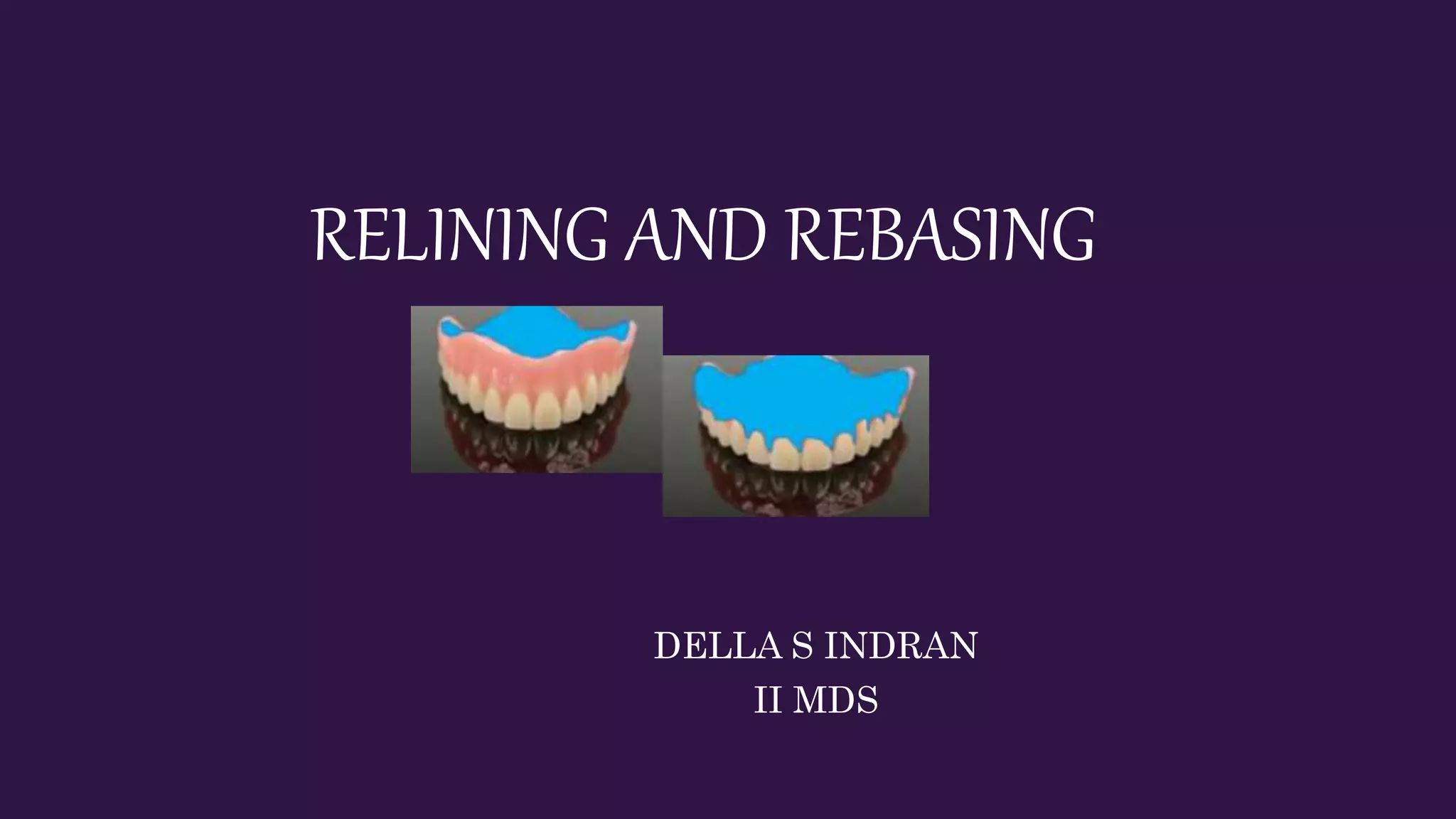
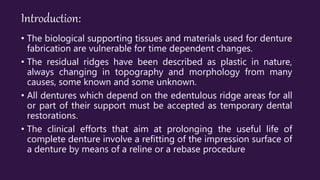
RELINING AND REBASING
DELLA S INDRAN
II MDS
LIST OF CONTENTS
• Introduction
• Definitions
• Indications
• General considerations
• Contraindications
• Tissue preparation
• Denture preparation
• Relining techniques
• Rebasing techniques
• Conclusion
• Literature review
Introduction:
• The biological supporting tissues and materials used for denture
fabrication are vulnerable for time dependent changes.
• The residual ridges have been described as plastic in nature,
always changing in topography and morphology from many
causes, some known and some unknown.
• All dentures which depend on the edentulous ridge areas for all
or part of their support must be accepted as temporary dental
restorations.
• The clinical efforts that aim at prolonging the useful life of
complete denture involve a refitting of the impression surface of
a denture by means of a reline or a rebase procedure
Definitions
GPT – 8
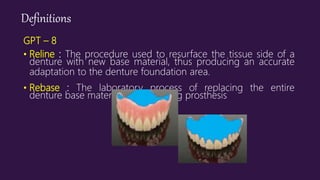
• Reline : The procedure used to resurface the tissue side of a
denture with new base material, thus producing an accurate
adaptation to the denture foundation area.
• Rebase : The laboratory process of replacing the entire
denture base material on an existing prosthesis
Winkler :
• Relining is the process of adding some material to the
tissue side of a denture to fill the space between the tissue and
the denture base.
• Rebasing is a process of replacing all the base material of
denture. The purpose of which is to fill the space between the
tissue and denture base without changing the position of the
teeth and the relation of the dentures
Indication :
• Immediate dentures at three to six months after their original
construction.
• When the residual alveolar ridges have resorbed and the
adaptation of the denture base to the ridges in poor.
• When the patient cannot afford the cost of having new dentures
constructed.
• When the construction of new dentures with the accompanying
series of appointments can cause physical or mental stress, such
as for geriatric and chronically ill patients.
Contraindications
The denture should not be relined when one of the following
defects exists.
• When an excessive amount of resorption has taken place.
• When abused soft tissues are present. The relining is not
indicated until the tissues recover and return as closely as
possible to normal form.
• When the patient complains of temporomandibular joint
problems. Until accurate diagnosis and treatment of the
problem has been accomplished, relining and rebasing in
contraindicated.
• If the dentures have poor esthetics or unsatisfactory jaw
relationships.
• If the dentures creates a major speech problem
General considerations
A through examination of the patient and of the existing denture
must be accomplished before commencing therapy.
• The occlusal vertical dimension should be satisfactory.
• Centric occlusion should coincide with centric relation, an error
is allowable if it is so slight as to be correctable.
• The patients appearance must be acceptable to the patient and
the dentist. The size, shape, shade, and arrangement of the
artificial teeth must be satisfactory.
• The oral tissues should be in optimum health.
• The posterior limit of the maxillary denture is correct.
• The denture base extensions are adequate
• The denture base extensions ensure distribution of masticatory
forces over as large an area as possible.
• The interocclusal distance is correct.
• Speech is satisfactory with the existing tooth arrangement.
• There is no existing hard or soft tissue condition that would
preclude the technique, such as redundant tissue or severe
osseous undercuts.
• Tissue preparation:
With any relining or rebasing technique, the tissues and
should be prepared for the necessary procedure as follows :
• Excessive hypertrophic tissues should be surgically removed.
• The oral mucosa should be free of areas of irritation.
• Removal of the dentures from the mouth during sleep is a
for several weeks before treatment commences.
• The dentures should be left out of the mouth at least two to
three days before making final impression.
• Daily massage of the soft tissue is helpful to stimulate their
blood supply.
• Denture preparation:
• Pressure areas of the tissue surface of the denture should be
relieved.
• Minor occlusal disharmony in corrected by selective grinding.
• Small border inadequacies are corrected.
• A correct posterior palatal seal area should be established
before the final impression.
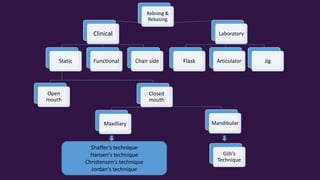
Relining &
Rebasing
Clinical
Static
Open
mouth
Closed
mouth
Maxilliary Mandibular
Functional Chair side
Laboratory
Flask Articulator Jig
Gilli’s
Technique
Shaffer's technique
Hansen's technique
Christensen's technique
Jordan's technique
Static ClosedMouth Maxilliary technique
• Shaffer’s Technique(1971)
• Centric relation:- It is recorded before
the impression is made, using modeling
compound or wax.
• Denture preparation:- The denture is
prepared by relieving 1.5 to 2mm from
the tissue surface and borders
• Special suggestion : A large part of the
middle of the palatal portion of the
maxillary denture is removed for
visibility in positioning the denture
during impression
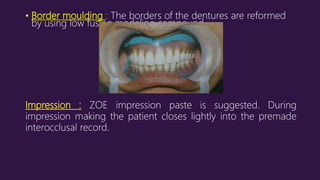
• Border moulding : The borders of the dentures are reformed
by using low fusing modeling compound.
Impression : ZOE impression paste is suggested. During
impression making the patient closes lightly into the premade
interocclusal record.
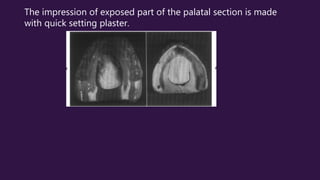
The impression of exposed part of the palatal section is made
with quick setting plaster.
• Advantages : The opening of the palatal portion will allow
better seating of the maxillary denture and prevent the
in VD.
• The premade inter occlusal record helps to positions the
dentures during impression.
• The two step impression technique will reduce the possibility
moving the maxillary denture forward during the final
impression making.
• Disadvantages : The wax inter occlusal record is not an
accurate and safe record that the patient can close on several
times without the possibility of damaging the record.
Static ClosedMouthMaxillary
• Hansen’s technique(1964)
• Centric relation : Existing centric occlusion and inter cuspation
are used
• Denture preparation : Same as Shaffer’s technique
• Special suggestion : First, the outline area should be deepened
on the polished surface up to half the thickness of the base.
• Holes are drilled at 5 to 6 mm intervals inside the grooves
• This helps for easy removal of the palatal portion during
processing.
• Border moulding : low fusing impression compound.
• Impression : Iowa wax is the material of choice in this
technique
• The impression is made in two stages as labial flange and crest
of the alveolar ridge anteriorly are recorded in second step.
• Advantages : The two step impression technique will reduce
the possibility of forward movement of maxillary denture.
• Disadvantages : Wax impression material is difficult to work
with and possibility of distortion exists.
Static ClosedMouthMaxillary
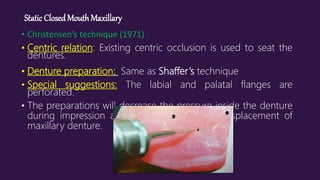
• Christensen’s technique (1971)
• Centric relation: Existing centric occlusion is used to seat the
dentures.
• Denture preparation: Same as Shaffer’s technique
• Special suggestions: The labial and palatal flanges are
perforated.
• The preparations will decrease the pressure inside the denture
during impression and thereby prevent the displacement of
maxillary denture.
• Border moulding: Same as previous techniques
• Impression: with ZOE paste.
StaticClosedMouthMaxillary
• Jordan’s technique(1972)
• Centric relation: Existing centric occlusion is used to seat
maxillary denture.
• Denture preparation: Same as other techniques
• Sprecial suggestions: Denture periphery is trimmed 1 to 2 mm
to create flat borders.
• Palatal portion is removed from maxillary denture as previous
techniques.
• Adhesive tape is attached on teeth to keep the denture clean.
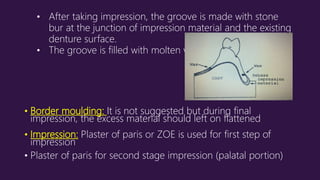
• Border moulding: It is not suggested but during final
impression, the excess material should left on flattened
• Impression: Plaster of paris or ZOE is used for first step of
impression
• Plaster of paris for second stage impression (palatal portion)
• After taking impression, the groove is made with stone
bur at the junction of impression material and the existing
denture surface.
• The groove is filled with molten wax.
StaticClosedMouthMandibular technique
• Gilli’s technique(1960)
• The ridge relation, ridge form and mucosa should be taken in
consideration for mandibular denture relining
• Centric relation: The existing centric occlusion is used as means
to seat the mandibular denture during final impression
Denture preparation: Not specified
Special suggestions: Loss of vertical
dimension is corrected by soft
modeling compound to the occlusal
surface of mandibular posterior
↓
Record until the satisfactory
vertical dimension is obtained
↓
The record
chilled
↓
Now, the lower
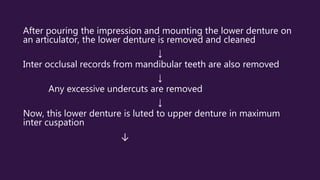
After pouring the impression and mounting the lower denture on
an articulator, the lower denture is removed and cleaned
↓
Inter occlusal records from mandibular teeth are also removed
↓
Any excessive undercuts are removed
↓
Now, this lower denture is luted to upper denture in maximum
inter cuspation
↓
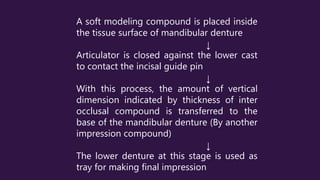
A soft modeling compound is placed inside
the tissue surface of mandibular denture
↓
Articulator is closed against the lower cast
to contact the incisal guide pin
↓
With this process, the amount of vertical
dimension indicated by thickness of inter
occlusal compound is transferred to the
base of the mandibular denture (By another
impression compound)
↓
The lower denture at this stage is used as
tray for making final impression
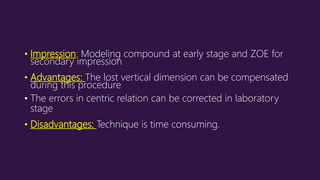
• Impression: Modeling compound at early stage and ZOE for
secondary impression
• Advantages: The lost vertical dimension can be compensated
during this procedure
• The errors in centric relation can be corrected in laboratory
stage
• Disadvantages: Technique is time consuming.
Static Open MouthTechnique
• Boucher’s technique
• It is the only technique in literature that explains the method of
relining the mandibular and maxillary denture
• The impressions are made independently without using centric
relation
• Centric relation: Jaw relation is recorded after making
impressions
• Denture preparation: The PPS is formed in modeling
compound on maxillary denture and 1 mm space is
provided for final wash impression
• Borders are reduced 1 mm
• Special suggestion: The lower denture prepared exactly in a
same way as a special tray
• A modeling compound handle is made over the lower anterior
teeth
• Border moulding: With green stick compound.
• Impression: ZOE impression material is used
• Advantages: Separate impression making and separate inter
occlusal recording will allow the operator to concentrate on
recording jaw relation.
• Disadvantages: More clinical and laboratory time.
Demanding labourous technique
Possibility of denture moving forward.
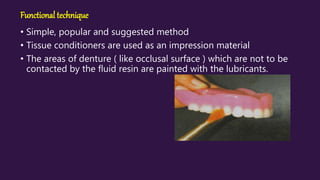
Functional technique
• Simple, popular and suggested method
• Tissue conditioners are used as an impression material
• The areas of denture ( like occlusal surface ) which are not to be
contacted by the fluid resin are painted with the lubricants.
The powder and liquid of soft liner are mixed in mixing cup for
polymerization
↓
While the material is creamy and soft, it is poured in the tissue
surface of the denture
When material reach in dough stage, denture is inserted in
patient’s mouth and patient is asked to close in centric relation to
maintain VD
↓
All the movements are performed like swallowing, smiling until
the material reach in rubber like stage
↓
After removal from the mouth, the excess tissue conditioner
is trimmed
Patient is asked to use the denture with the tissue conditioner.
This will functionally mould the material further
↓
When patient returns after 3 to 5 days, the under extension,
denuded areas and pressure spots are corrected by trimming or
adding the material
↓
The material is changed periodically till the tissues return to the
healthy stage
↓
Now, at last the ZOE or light body impression is made over the
conditioning material.
Chair side technique
• In this technique, auto polymerizing self cure resins are used for
relining dentures directly in patient’s mouth.
• They are added to denture base area after necessary trimming,
and allowed to polymerized in the mouth.
• It is called as instant chair side relining
• Disadvantages: material is porous and has an unpleasant odour.
• The excess monomer leaches out can cause tissue irritation
• The exothermic heat can burn the mucosa
• Poor colour stability.
• If not positioned correctly, it can lead to gross discrepancies
• Because of all these problems, the technique is not
recommended
LABORATORY TECHNIQUES
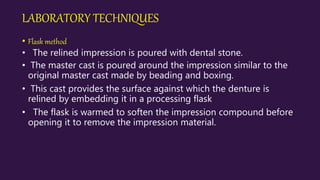
• Flask method
• The relined impression is poured with dental stone.
• The master cast is poured around the impression similar to the
original master cast made by beading and boxing.
• This cast provides the surface against which the denture is
relined by embedding it in a processing flask
• The flask is warmed to soften the impression compound before
opening it to remove the impression material.
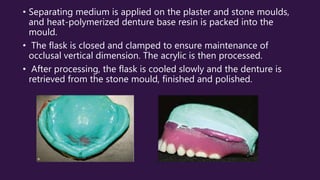
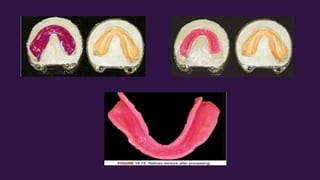
• Separating medium is applied on the plaster and stone moulds,
and heat-polymerized denture base resin is packed into the
mould.
• The flask is closed and clamped to ensure maintenance of
occlusal vertical dimension. The acrylic is then processed.
• After processing, the flask is cooled slowly and the denture is
retrieved from the stone mould, finished and polished.
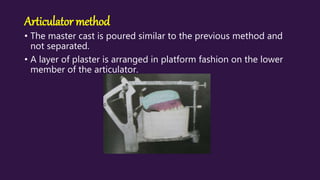
Articulator method
• The master cast is poured similar to the previous method and
not separated.
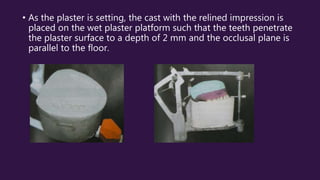
• A layer of plaster is arranged in platform fashion on the lower
member of the articulator.
• As the plaster is setting, the cast with the relined impression is
placed on the wet plaster platform such that the teeth penetrate
the plaster surface to a depth of 2 mm and the occlusal plane is
parallel to the floor.
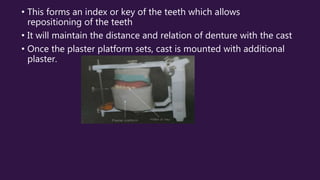
• This forms an index or key of the teeth which allows
repositioning of the teeth
• It will maintain the distance and relation of denture with the cast
• Once the plaster platform sets, cast is mounted with additional
plaster.
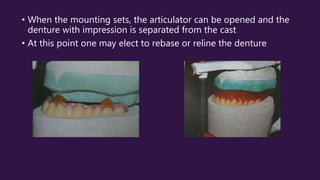
• When the mounting sets, the articulator can be opened and the
denture with impression is separated from the cast
• At this point one may elect to rebase or reline the denture
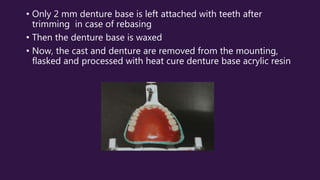
• Only 2 mm denture base is left attached with teeth after
trimming in case of rebasing
• Then the denture base is waxed
• Now, the cast and denture are removed from the mounting,
flasked and processed with heat cure denture base acrylic resin
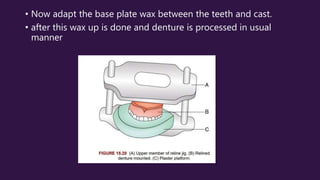
Jig Method
• The procedure is similar to that using an articulator
• The jig or hooper duplicator is used for this method
• Seat occlusal surface of the denture on the plaster platform on
lower member of relining jig
• After the index is made, mount the denture with the cast to the
upper member in relining jig similar to articulator method
• Open the jig, remove the denture base and trim it upto the
teeth (only 2 mm is left)
• Now adapt the base plate wax between the teeth and cast.
• after this wax up is done and denture is processed in usual
manner
Conclusion
• Relining and rebasing are not adequate substitute for new
dentures. However, relined or rebased dentures should be given
the same care as new dentures, and the patients should be
recalled as often as necessary for examination of the tissues and
the jaw relations
Review of literature
One-Visit Relining Procedure in Patient with Loss of Vertical Dimension : Case Report
Falatehan N, Gandhanya R.. Scientific Dental Journal. 2018 Sep 28;2(3):115-9.
• Case Report
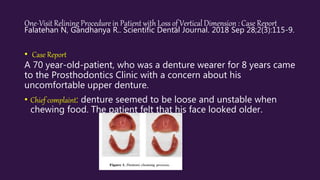
A 70 year-old-patient, who was a denture wearer for 8 years came
to the Prosthodontics Clinic with a concern about his
uncomfortable upper denture.
• Chief complaint: denture seemed to be loose and unstable when
chewing food. The patient felt that his face looked older.
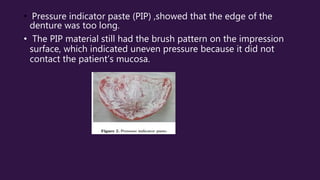
• Pressure indicator paste (PIP) ,showed that the edge of the
denture was too long.
• The PIP material still had the brush pattern on the impression
surface, which indicated uneven pressure because it did not
contact the patient’s mucosa.
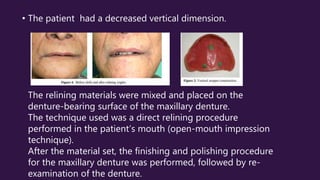
• The patient had a decreased vertical dimension.
The relining materials were mixed and placed on the
denture-bearing surface of the maxillary denture.
The technique used was a direct relining procedure
performed in the patient’s mouth (open-mouth impression
technique).
After the material set, the finishing and polishing procedure
for the maxillary denture was performed, followed by re-
examination of the denture.
conclusion
• A direct chair-side relining procedure may serve as an option for
a practical and accurate method to obtain a vertically stable
prosthesis with an improved esthetic.
In Vitro Evaluation of Resilient Liner and Hard Denture Liner on the Retentive Force
Nagata et al. International Journal of Oral-Medical Sciences. 2021 Mar
23;19(4):253-60.
• Purpose:
To clarify the relationship between the retention force and saliva
viscosity for resilient denture liners.
Methods:
Tensile tests were performed using a simple model to compare
the retention force of two commercially available resilient denture
liners (SOFRELINER TOUGH MEDIUM and SOFRELINER TOUGH
SUPER SOFT) and a hard denture relining material (TOKUYAMA
REBASE III NORMAL)
• Results:
The saliva viscosity and relining material significantly influence
denture retention.
• Conclusions:
Relining a denture with a silicone -based resilient denture liner
increases the retention force of the denture, and is particularly
effective when the fluid viscosity is high.
STUDY OF THE KNOWLEDGE AND USE OF RESILIENT DENTURE LINING MATERIALS IN CLINICAL
PRACTICE
Yankova et al.Journal of IMAB–Annual Proceeding Scientific Papers. 2021
Apr 2;27(2):3668-75.
• AIM
The aim of this study was to investigate the knowledge and use of
resilient denture lining materials (RDLMs) in clinical practice.
• Material and methods:
The study was conducted among dental practitioners and dental
technicians in 2016. A direct survey method was used, with a
questionnaire containing 11 questions
Results:
• Over half of the respondents do not use RDLMs in their
practice.
• In the cases of retentive prosthetic field or prosthetic field with
advanced atrophy, the respondents focus mainly on the surgical
preparation of the prosthetic field and recommend the use of
RDLMs if there are exostosis-related pain symptoms or painful
neurogenic points.
• One-third of the respondents prefer the use of long-term
RDLMs, and 73% prefer to apply the indirect lining technique.
• Conclusion: The various types of RDLMs and their characteristics
are well-known by the dental practitioners and dental
technicians but rarely used, due to a number of unresolved
related issues, such as bulging of the resilient material from the
denture base, appearance of an unpleasant odor, change in the
Rebasing as a Problem-Solving in Complete Dentures
Jemli S. Rebasing as a Problem-Solving in Complete Dentures. Saudi J Oral Dent Res.
2021;6(6):227-33
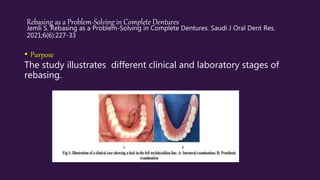
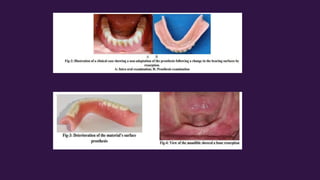
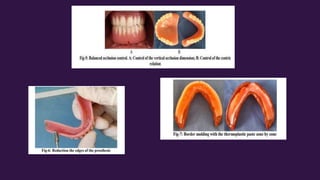
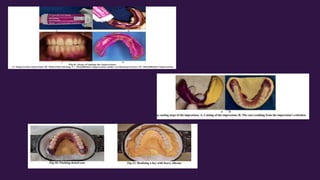
• Purpose
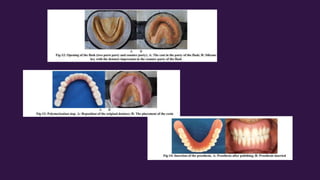
The study illustrates different clinical and laboratory stages of
rebasing.
• CONCLUSION
A regular annual visit of control or adjustment appointment is
essential as one of the most clinical phases of denture fabrication
to guarantee the patient’s care and preserve oral health.
Avoiding demarcation between new and old acrylic resin when relining or rebasing
dentures
Taylor et al. The Journal of prosthetic dentistry. 1981 Nov 1;46(5):582-.
• Following the relining or rebasing of complete or removable
partial dentures, frequently a white line of demarcation remains
between the new and old acrylic resin. At times this may be
objectionable to the patient and dentist. The addition of one
minor step in the laboratory technique will avoid this problem.
Procedure
• Pour cast, mount, and separate.
• Remove all the impression material.
• Remove a sufficient amount of the old acrylic resin to make
space for the new.
• Create a 90-degree butt joint between the existing denture
base and the reline acrylic resin.
• Polish the newly exposed denture surface with a clean
slurry of pumice.
• Carry the reline technique through to completion in the
usual manner. Be sure to paint the relieved denture surface
with methyl methacrylate monomer prior to packing to
ensure an adequate union.
• Following processing, polish the reline surface of the
denture base.
The junction between the old and new material is difficult to
determine, and there will be no objectionable white line present.
This technique is satisfactory for both heat polymerizing and
autopolymerizing resin reline methods.
• REFERENCES :
1. Essentials of complete denture prosthodontics – Winkler
2. Prosthodontic treatment for edentulous patients – Boucher
3. Dental laboratory procedures – Complete dentures – Rudd and
Marrow
4. Relining complete dentures with an oral cure silicone elastomer JPD
1966 ; 16 : 1054-1057
5. Relining techniques for complete denture JPD 1971 ; 26 : 373-381
6. Use of the remount jig as an aid in relining upper dentures JPD 1975
; 34 : 393-396
• The complete denture reline : a simplified technique JPD 1981 ; 45 : 564-
567
• Relining complete dentures with an oral cure silicone elastomer Feldmann
JPD 1970 ; 23 : 387-393
• Relining and rebasing dentures opposing nonrestored posterior
edentulous areas JPD 1996 ; 76 : 568-569
• Are new denture necessary ? JPD 1970 ; 23 : 512-521
• Denture relining or rebasing with a fluid resin Wolfe h.e JPD 1974 ; 31 :
521-526
• Relining and rebasing dentures opposing nonrestored posterior
edentulous areas JPD 1998 ; 79 : 604-606
• Temporary softliner materials BDJ 1981 ; 151 : 419-422
• Complete denture secondary impression techniquesJPD 1985 ; 54 : 660-
thank you

Relining and rebasing

  • 1.
  • 2.
    LIST OF CONTENTS •Introduction • Definitions • Indications • General considerations • Contraindications • Tissue preparation • Denture preparation • Relining techniques • Rebasing techniques • Conclusion • Literature review
  • 3.
    Introduction: • The biologicalsupporting tissues and materials used for denture fabrication are vulnerable for time dependent changes. • The residual ridges have been described as plastic in nature, always changing in topography and morphology from many causes, some known and some unknown. • All dentures which depend on the edentulous ridge areas for all or part of their support must be accepted as temporary dental restorations. • The clinical efforts that aim at prolonging the useful life of complete denture involve a refitting of the impression surface of a denture by means of a reline or a rebase procedure
  • 4.
    Definitions GPT – 8 •Reline : The procedure used to resurface the tissue side of a denture with new base material, thus producing an accurate adaptation to the denture foundation area. • Rebase : The laboratory process of replacing the entire denture base material on an existing prosthesis
  • 5.
    Winkler : • Reliningis the process of adding some material to the tissue side of a denture to fill the space between the tissue and the denture base. • Rebasing is a process of replacing all the base material of denture. The purpose of which is to fill the space between the tissue and denture base without changing the position of the teeth and the relation of the dentures
  • 6.
    Indication : • Immediatedentures at three to six months after their original construction. • When the residual alveolar ridges have resorbed and the adaptation of the denture base to the ridges in poor. • When the patient cannot afford the cost of having new dentures constructed. • When the construction of new dentures with the accompanying series of appointments can cause physical or mental stress, such as for geriatric and chronically ill patients.
  • 7.
    Contraindications The denture shouldnot be relined when one of the following defects exists. • When an excessive amount of resorption has taken place. • When abused soft tissues are present. The relining is not indicated until the tissues recover and return as closely as possible to normal form. • When the patient complains of temporomandibular joint problems. Until accurate diagnosis and treatment of the problem has been accomplished, relining and rebasing in contraindicated. • If the dentures have poor esthetics or unsatisfactory jaw relationships. • If the dentures creates a major speech problem
  • 8.
    General considerations A throughexamination of the patient and of the existing denture must be accomplished before commencing therapy. • The occlusal vertical dimension should be satisfactory. • Centric occlusion should coincide with centric relation, an error is allowable if it is so slight as to be correctable. • The patients appearance must be acceptable to the patient and the dentist. The size, shape, shade, and arrangement of the artificial teeth must be satisfactory. • The oral tissues should be in optimum health. • The posterior limit of the maxillary denture is correct.
  • 9.
    • The denturebase extensions are adequate • The denture base extensions ensure distribution of masticatory forces over as large an area as possible. • The interocclusal distance is correct. • Speech is satisfactory with the existing tooth arrangement. • There is no existing hard or soft tissue condition that would preclude the technique, such as redundant tissue or severe osseous undercuts.
  • 10.
    • Tissue preparation: Withany relining or rebasing technique, the tissues and should be prepared for the necessary procedure as follows : • Excessive hypertrophic tissues should be surgically removed. • The oral mucosa should be free of areas of irritation. • Removal of the dentures from the mouth during sleep is a for several weeks before treatment commences. • The dentures should be left out of the mouth at least two to three days before making final impression. • Daily massage of the soft tissue is helpful to stimulate their blood supply.
  • 11.
    • Denture preparation: •Pressure areas of the tissue surface of the denture should be relieved. • Minor occlusal disharmony in corrected by selective grinding. • Small border inadequacies are corrected. • A correct posterior palatal seal area should be established before the final impression.
  • 12.
    Relining & Rebasing Clinical Static Open mouth Closed mouth Maxilliary Mandibular FunctionalChair side Laboratory Flask Articulator Jig Gilli’s Technique Shaffer's technique Hansen's technique Christensen's technique Jordan's technique
  • 13.
    Static ClosedMouth Maxilliarytechnique • Shaffer’s Technique(1971) • Centric relation:- It is recorded before the impression is made, using modeling compound or wax. • Denture preparation:- The denture is prepared by relieving 1.5 to 2mm from the tissue surface and borders • Special suggestion : A large part of the middle of the palatal portion of the maxillary denture is removed for visibility in positioning the denture during impression
  • 14.
    • Border moulding: The borders of the dentures are reformed by using low fusing modeling compound. Impression : ZOE impression paste is suggested. During impression making the patient closes lightly into the premade interocclusal record.
  • 15.
    The impression ofexposed part of the palatal section is made with quick setting plaster.
  • 16.
    • Advantages :The opening of the palatal portion will allow better seating of the maxillary denture and prevent the in VD. • The premade inter occlusal record helps to positions the dentures during impression. • The two step impression technique will reduce the possibility moving the maxillary denture forward during the final impression making. • Disadvantages : The wax inter occlusal record is not an accurate and safe record that the patient can close on several times without the possibility of damaging the record.
  • 17.
    Static ClosedMouthMaxillary • Hansen’stechnique(1964) • Centric relation : Existing centric occlusion and inter cuspation are used • Denture preparation : Same as Shaffer’s technique • Special suggestion : First, the outline area should be deepened on the polished surface up to half the thickness of the base. • Holes are drilled at 5 to 6 mm intervals inside the grooves • This helps for easy removal of the palatal portion during processing.
  • 18.
    • Border moulding: low fusing impression compound. • Impression : Iowa wax is the material of choice in this technique • The impression is made in two stages as labial flange and crest of the alveolar ridge anteriorly are recorded in second step. • Advantages : The two step impression technique will reduce the possibility of forward movement of maxillary denture. • Disadvantages : Wax impression material is difficult to work with and possibility of distortion exists.
  • 19.
    Static ClosedMouthMaxillary • Christensen’stechnique (1971) • Centric relation: Existing centric occlusion is used to seat the dentures. • Denture preparation: Same as Shaffer’s technique • Special suggestions: The labial and palatal flanges are perforated. • The preparations will decrease the pressure inside the denture during impression and thereby prevent the displacement of maxillary denture.
  • 20.
    • Border moulding:Same as previous techniques • Impression: with ZOE paste.
  • 21.
    StaticClosedMouthMaxillary • Jordan’s technique(1972) •Centric relation: Existing centric occlusion is used to seat maxillary denture. • Denture preparation: Same as other techniques • Sprecial suggestions: Denture periphery is trimmed 1 to 2 mm to create flat borders. • Palatal portion is removed from maxillary denture as previous techniques. • Adhesive tape is attached on teeth to keep the denture clean.
  • 22.
    • Border moulding:It is not suggested but during final impression, the excess material should left on flattened • Impression: Plaster of paris or ZOE is used for first step of impression • Plaster of paris for second stage impression (palatal portion) • After taking impression, the groove is made with stone bur at the junction of impression material and the existing denture surface. • The groove is filled with molten wax.
  • 23.
    StaticClosedMouthMandibular technique • Gilli’stechnique(1960) • The ridge relation, ridge form and mucosa should be taken in consideration for mandibular denture relining • Centric relation: The existing centric occlusion is used as means to seat the mandibular denture during final impression
  • 24.
    Denture preparation: Notspecified Special suggestions: Loss of vertical dimension is corrected by soft modeling compound to the occlusal surface of mandibular posterior ↓ Record until the satisfactory vertical dimension is obtained ↓ The record chilled ↓ Now, the lower
  • 25.
    After pouring theimpression and mounting the lower denture on an articulator, the lower denture is removed and cleaned ↓ Inter occlusal records from mandibular teeth are also removed ↓ Any excessive undercuts are removed ↓ Now, this lower denture is luted to upper denture in maximum inter cuspation ↓
  • 26.
    A soft modelingcompound is placed inside the tissue surface of mandibular denture ↓ Articulator is closed against the lower cast to contact the incisal guide pin ↓ With this process, the amount of vertical dimension indicated by thickness of inter occlusal compound is transferred to the base of the mandibular denture (By another impression compound) ↓ The lower denture at this stage is used as tray for making final impression
  • 27.
    • Impression: Modelingcompound at early stage and ZOE for secondary impression • Advantages: The lost vertical dimension can be compensated during this procedure • The errors in centric relation can be corrected in laboratory stage • Disadvantages: Technique is time consuming.
  • 28.
    Static Open MouthTechnique •Boucher’s technique • It is the only technique in literature that explains the method of relining the mandibular and maxillary denture • The impressions are made independently without using centric relation • Centric relation: Jaw relation is recorded after making impressions • Denture preparation: The PPS is formed in modeling compound on maxillary denture and 1 mm space is provided for final wash impression • Borders are reduced 1 mm
  • 29.
    • Special suggestion:The lower denture prepared exactly in a same way as a special tray • A modeling compound handle is made over the lower anterior teeth • Border moulding: With green stick compound. • Impression: ZOE impression material is used • Advantages: Separate impression making and separate inter occlusal recording will allow the operator to concentrate on recording jaw relation. • Disadvantages: More clinical and laboratory time. Demanding labourous technique Possibility of denture moving forward.
  • 30.
    Functional technique • Simple,popular and suggested method • Tissue conditioners are used as an impression material • The areas of denture ( like occlusal surface ) which are not to be contacted by the fluid resin are painted with the lubricants.
  • 31.
    The powder andliquid of soft liner are mixed in mixing cup for polymerization ↓ While the material is creamy and soft, it is poured in the tissue surface of the denture When material reach in dough stage, denture is inserted in patient’s mouth and patient is asked to close in centric relation to maintain VD ↓ All the movements are performed like swallowing, smiling until the material reach in rubber like stage ↓ After removal from the mouth, the excess tissue conditioner is trimmed
  • 32.
    Patient is askedto use the denture with the tissue conditioner. This will functionally mould the material further ↓ When patient returns after 3 to 5 days, the under extension, denuded areas and pressure spots are corrected by trimming or adding the material ↓ The material is changed periodically till the tissues return to the healthy stage ↓ Now, at last the ZOE or light body impression is made over the conditioning material.
  • 33.
    Chair side technique •In this technique, auto polymerizing self cure resins are used for relining dentures directly in patient’s mouth. • They are added to denture base area after necessary trimming, and allowed to polymerized in the mouth. • It is called as instant chair side relining • Disadvantages: material is porous and has an unpleasant odour. • The excess monomer leaches out can cause tissue irritation • The exothermic heat can burn the mucosa • Poor colour stability.
  • 34.
    • If notpositioned correctly, it can lead to gross discrepancies • Because of all these problems, the technique is not recommended
  • 35.
    LABORATORY TECHNIQUES • Flaskmethod • The relined impression is poured with dental stone. • The master cast is poured around the impression similar to the original master cast made by beading and boxing. • This cast provides the surface against which the denture is relined by embedding it in a processing flask • The flask is warmed to soften the impression compound before opening it to remove the impression material.
  • 36.
    • Separating mediumis applied on the plaster and stone moulds, and heat-polymerized denture base resin is packed into the mould. • The flask is closed and clamped to ensure maintenance of occlusal vertical dimension. The acrylic is then processed. • After processing, the flask is cooled slowly and the denture is retrieved from the stone mould, finished and polished.
  • 38.
    Articulator method • Themaster cast is poured similar to the previous method and not separated. • A layer of plaster is arranged in platform fashion on the lower member of the articulator.
  • 39.
    • As theplaster is setting, the cast with the relined impression is placed on the wet plaster platform such that the teeth penetrate the plaster surface to a depth of 2 mm and the occlusal plane is parallel to the floor.
  • 40.
    • This formsan index or key of the teeth which allows repositioning of the teeth • It will maintain the distance and relation of denture with the cast • Once the plaster platform sets, cast is mounted with additional plaster.
  • 41.
    • When themounting sets, the articulator can be opened and the denture with impression is separated from the cast • At this point one may elect to rebase or reline the denture
  • 42.
    • Only 2mm denture base is left attached with teeth after trimming in case of rebasing • Then the denture base is waxed • Now, the cast and denture are removed from the mounting, flasked and processed with heat cure denture base acrylic resin
  • 43.
    Jig Method • Theprocedure is similar to that using an articulator • The jig or hooper duplicator is used for this method • Seat occlusal surface of the denture on the plaster platform on lower member of relining jig • After the index is made, mount the denture with the cast to the upper member in relining jig similar to articulator method • Open the jig, remove the denture base and trim it upto the teeth (only 2 mm is left)
  • 44.
    • Now adaptthe base plate wax between the teeth and cast. • after this wax up is done and denture is processed in usual manner
  • 46.
    Conclusion • Relining andrebasing are not adequate substitute for new dentures. However, relined or rebased dentures should be given the same care as new dentures, and the patients should be recalled as often as necessary for examination of the tissues and the jaw relations
  • 47.
  • 48.
    One-Visit Relining Procedurein Patient with Loss of Vertical Dimension : Case Report Falatehan N, Gandhanya R.. Scientific Dental Journal. 2018 Sep 28;2(3):115-9. • Case Report A 70 year-old-patient, who was a denture wearer for 8 years came to the Prosthodontics Clinic with a concern about his uncomfortable upper denture. • Chief complaint: denture seemed to be loose and unstable when chewing food. The patient felt that his face looked older.
  • 49.
    • Pressure indicatorpaste (PIP) ,showed that the edge of the denture was too long. • The PIP material still had the brush pattern on the impression surface, which indicated uneven pressure because it did not contact the patient’s mucosa.
  • 50.
    • The patienthad a decreased vertical dimension. The relining materials were mixed and placed on the denture-bearing surface of the maxillary denture. The technique used was a direct relining procedure performed in the patient’s mouth (open-mouth impression technique). After the material set, the finishing and polishing procedure for the maxillary denture was performed, followed by re- examination of the denture.
  • 51.
    conclusion • A directchair-side relining procedure may serve as an option for a practical and accurate method to obtain a vertically stable prosthesis with an improved esthetic.
  • 52.
    In Vitro Evaluationof Resilient Liner and Hard Denture Liner on the Retentive Force Nagata et al. International Journal of Oral-Medical Sciences. 2021 Mar 23;19(4):253-60. • Purpose: To clarify the relationship between the retention force and saliva viscosity for resilient denture liners. Methods: Tensile tests were performed using a simple model to compare the retention force of two commercially available resilient denture liners (SOFRELINER TOUGH MEDIUM and SOFRELINER TOUGH SUPER SOFT) and a hard denture relining material (TOKUYAMA REBASE III NORMAL)
  • 53.
    • Results: The salivaviscosity and relining material significantly influence denture retention. • Conclusions: Relining a denture with a silicone -based resilient denture liner increases the retention force of the denture, and is particularly effective when the fluid viscosity is high.
  • 54.
    STUDY OF THEKNOWLEDGE AND USE OF RESILIENT DENTURE LINING MATERIALS IN CLINICAL PRACTICE Yankova et al.Journal of IMAB–Annual Proceeding Scientific Papers. 2021 Apr 2;27(2):3668-75. • AIM The aim of this study was to investigate the knowledge and use of resilient denture lining materials (RDLMs) in clinical practice. • Material and methods: The study was conducted among dental practitioners and dental technicians in 2016. A direct survey method was used, with a questionnaire containing 11 questions
  • 55.
    Results: • Over halfof the respondents do not use RDLMs in their practice. • In the cases of retentive prosthetic field or prosthetic field with advanced atrophy, the respondents focus mainly on the surgical preparation of the prosthetic field and recommend the use of RDLMs if there are exostosis-related pain symptoms or painful neurogenic points. • One-third of the respondents prefer the use of long-term RDLMs, and 73% prefer to apply the indirect lining technique. • Conclusion: The various types of RDLMs and their characteristics are well-known by the dental practitioners and dental technicians but rarely used, due to a number of unresolved related issues, such as bulging of the resilient material from the denture base, appearance of an unpleasant odor, change in the
  • 56.
    Rebasing as aProblem-Solving in Complete Dentures Jemli S. Rebasing as a Problem-Solving in Complete Dentures. Saudi J Oral Dent Res. 2021;6(6):227-33 • Purpose The study illustrates different clinical and laboratory stages of rebasing.
  • 61.
    • CONCLUSION A regularannual visit of control or adjustment appointment is essential as one of the most clinical phases of denture fabrication to guarantee the patient’s care and preserve oral health.
  • 62.
    Avoiding demarcation betweennew and old acrylic resin when relining or rebasing dentures Taylor et al. The Journal of prosthetic dentistry. 1981 Nov 1;46(5):582-. • Following the relining or rebasing of complete or removable partial dentures, frequently a white line of demarcation remains between the new and old acrylic resin. At times this may be objectionable to the patient and dentist. The addition of one minor step in the laboratory technique will avoid this problem. Procedure • Pour cast, mount, and separate. • Remove all the impression material. • Remove a sufficient amount of the old acrylic resin to make space for the new.
  • 63.
    • Create a90-degree butt joint between the existing denture base and the reline acrylic resin. • Polish the newly exposed denture surface with a clean slurry of pumice. • Carry the reline technique through to completion in the usual manner. Be sure to paint the relieved denture surface with methyl methacrylate monomer prior to packing to ensure an adequate union. • Following processing, polish the reline surface of the denture base.
  • 64.
    The junction betweenthe old and new material is difficult to determine, and there will be no objectionable white line present. This technique is satisfactory for both heat polymerizing and autopolymerizing resin reline methods.
  • 65.
    • REFERENCES : 1.Essentials of complete denture prosthodontics – Winkler 2. Prosthodontic treatment for edentulous patients – Boucher 3. Dental laboratory procedures – Complete dentures – Rudd and Marrow 4. Relining complete dentures with an oral cure silicone elastomer JPD 1966 ; 16 : 1054-1057 5. Relining techniques for complete denture JPD 1971 ; 26 : 373-381 6. Use of the remount jig as an aid in relining upper dentures JPD 1975 ; 34 : 393-396
  • 66.
    • The completedenture reline : a simplified technique JPD 1981 ; 45 : 564- 567 • Relining complete dentures with an oral cure silicone elastomer Feldmann JPD 1970 ; 23 : 387-393 • Relining and rebasing dentures opposing nonrestored posterior edentulous areas JPD 1996 ; 76 : 568-569 • Are new denture necessary ? JPD 1970 ; 23 : 512-521 • Denture relining or rebasing with a fluid resin Wolfe h.e JPD 1974 ; 31 : 521-526 • Relining and rebasing dentures opposing nonrestored posterior edentulous areas JPD 1998 ; 79 : 604-606 • Temporary softliner materials BDJ 1981 ; 151 : 419-422 • Complete denture secondary impression techniquesJPD 1985 ; 54 : 660-
  • 67.