INTERNAL FORCES


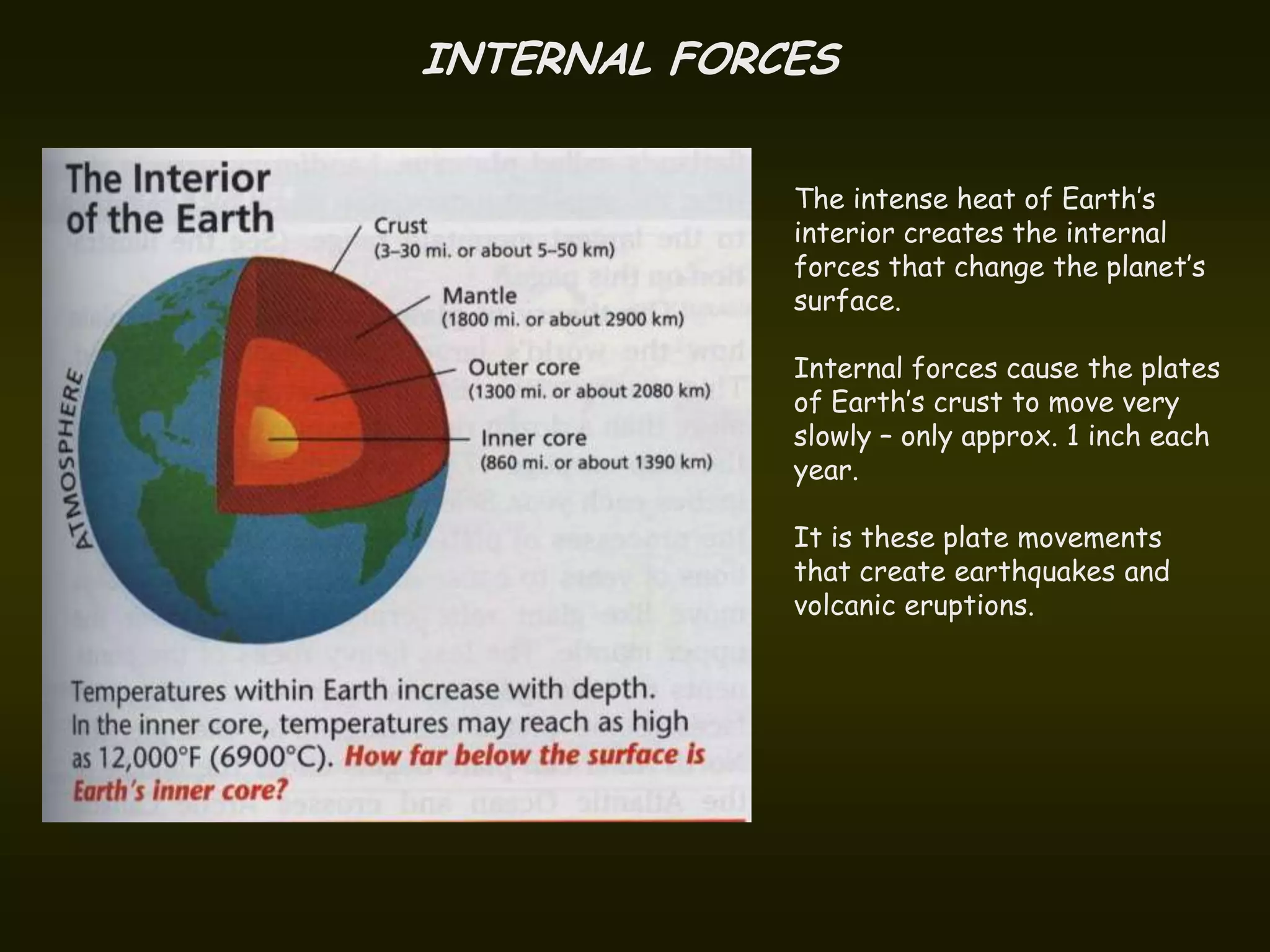
             The intense heat of Earth’s
             interior creates the internal
             forces that change the planet’s
             surface.
             Internal forces cause the plates
             of Earth’s crust to move very
             slowly – only approx. 1 inch each
             year.

             It is these plate movements
             that create earthquakes and
             volcanic eruptions.
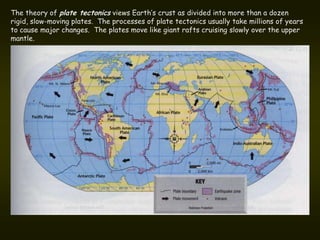
The theory of plate tectonics views Earth’s crust as divided into more than a dozen
rigid, slow-moving plates. The processes of plate tectonics usually take millions of years
to cause major changes. The plates move like giant rafts cruising slowly over the upper
mantle.
How much of Earth’s interior remains unexplored? Why can’t humans journey to the center of Earth? What does
Earth’s core produce of significance? And what may be happening to the core?
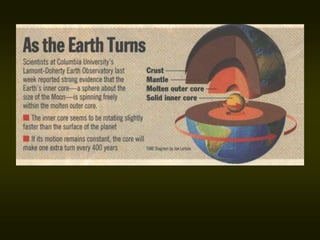
Identify the components of Earth, including composition & dimensions. Explain the revolutionary idea to access the core.
Is it feasible? And explain the value of earthquakes in studying the core.
Explain the significance of the core’s heat in protecting life from the sun’s deadly radiation. What is happening to
Earth’s magnetic shield? And describe the potential significance.
Indicators reveal that Earth is changing from the inside out. The planet may be on the verge of a magnetic reversal.
Has this happened before? How often does it tend to occur? And when was the last time Earth’s magnetic field
reversed? What can we expect when it reverses again?
Studies reveal that Earth’s magnetic field may be weakening. Explain the “nuclear reactor” theory. Which planet do
scientists use as a case study for this change? What is the theory as to what happened to Mar’s core? Describe the
impact? Could this happen on Earth? What would be the impact?
EARTHQUAKES
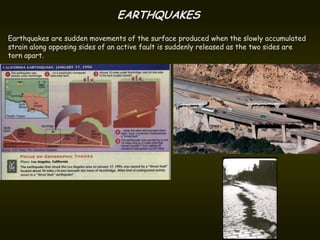
Earthquakes are sudden movements of the surface produced when the slowly accumulated
strain along opposing sides of an active fault is suddenly released as the two sides are
torn apart.
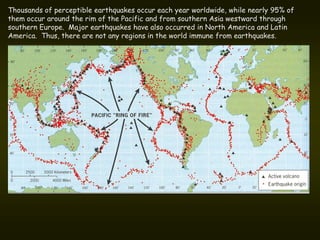
Thousands of perceptible earthquakes occur each year worldwide, while nearly 95% of
them occur around the rim of the Pacific and from southern Asia westward through
southern Europe. Major earthquakes have also occurred in North America and Latin
America. Thus, there are not any regions in the world immune from earthquakes.
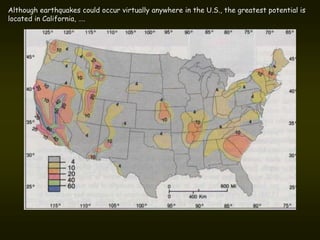
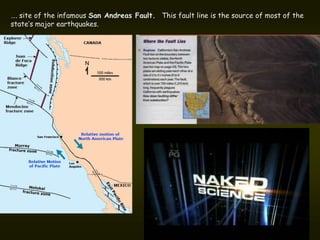
Although earthquakes could occur virtually anywhere in the U.S., the greatest potential is
located in California, ….
…. site of the infamous San Andreas Fault. This fault line is the source of most of the
state’s major earthquakes.
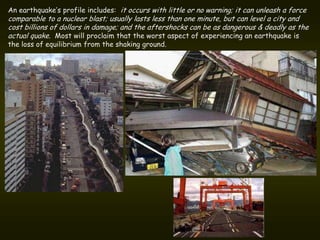
An earthquake’s profile includes: it occurs with little or no warning; it can unleash a force
comparable to a nuclear blast; usually lasts less than one minute, but can level a city and
cost billions of dollars in damage; and the aftershocks can be as dangerous & deadly as the
actual quake. Most will proclaim that the worst aspect of experiencing an earthquake is
the loss of equilibrium from the shaking ground.
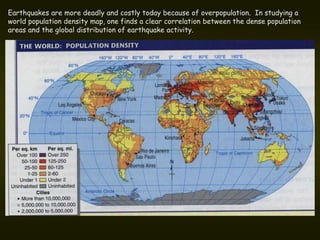
Earthquakes are more deadly and costly today because of overpopulation. In studying a
world population density map, one finds a clear correlation between the dense population
areas and the global distribution of earthquake activity.
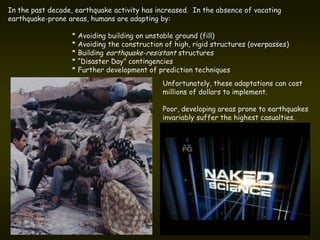
In the past decade, earthquake activity has increased. In the absence of vacating
earthquake-prone areas, humans are adapting by:

                  * Avoiding building on unstable ground (fill)
                  * Avoiding the construction of high, rigid structures (overpasses)
                  * Building earthquake-resistant structures
                  * “Disaster Day” contingencies
                  * Further development of prediction techniques
                                             Unfortunately, these adaptations can cost
                                             millions of dollars to implement.

                                             Poor, developing areas prone to earthquakes
                                             invariably suffer the highest casualties.
VOLCANISM
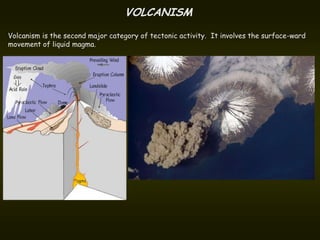
Volcanism is the second major category of tectonic activity. It involves the surface-ward
movement of liquid magma.
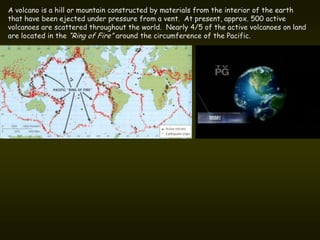
A volcano is a hill or mountain constructed by materials from the interior of the earth
that have been ejected under pressure from a vent. At present, approx. 500 active
volcanoes are scattered throughout the world. Nearly 4/5 of the active volcanoes on land
are located in the “Ring of Fire” around the circumference of the Pacific.
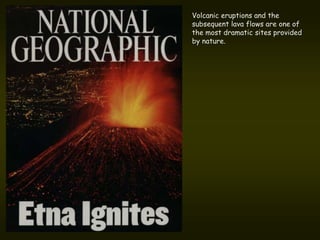
Volcanic eruptions and the
subsequent lava flows are one of
the most dramatic sites provided
by nature.
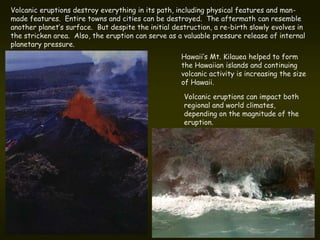
Volcanic eruptions destroy everything in its path, including physical features and man-
made features. Entire towns and cities can be destroyed. The aftermath can resemble
another planet’s surface. But despite the initial destruction, a re-birth slowly evolves in
the stricken area. Also, the eruption can serve as a valuable pressure release of internal
planetary pressure.
                                                    Hawaii’s Mt. Kilauea helped to form
                                                    the Hawaiian islands and continuing
                                                    volcanic activity is increasing the size
                                                    of Hawaii.

                                                     Volcanic eruptions can impact both
                                                     regional and world climates,
                                                     depending on the magnitude of the
                                                     eruption.
THE AGRICULTURAL REVOLUTION
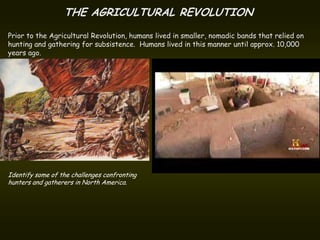
Prior to the Agricultural Revolution, humans lived in smaller, nomadic bands that relied on
hunting and gathering for subsistence. Humans lived in this manner until approx. 10,000
years ago.


Identify some of the challenges confronting
hunters and gatherers in North America.
The hunting and gathering subsistence lifestyle was harsh and tenuous, lacking reliable
food surpluses. Because of this unreliable food situation, how would the lives of our
ancestors been different from ours?


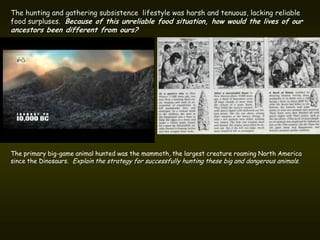
The primary big-game animal hunted was the mammoth, the largest creature roaming North America
since the Dinosaurs. Explain the strategy for successfully hunting these big and dangerous animals.
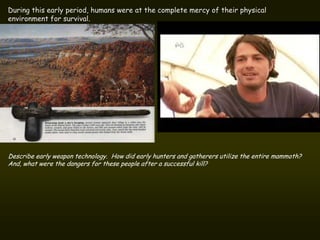
During this early period, humans were at the complete mercy of their physical
environment for survival.


Describe early weapon technology. How did early hunters and gatherers utilize the entire mammoth?
And, what were the dangers for these people after a successful kill?
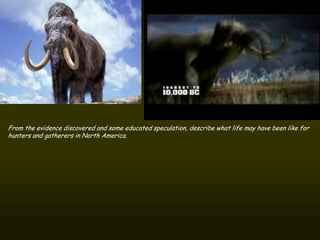
From the evidence discovered and some educated speculation, describe what life may have been like for
hunters and gatherers in North America.
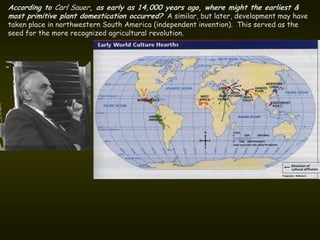
According to Carl Sauer, as early as 14,000 years ago, where might the earliest &
most primitive plant domestication occurred? A similar, but later, development may have
taken place in northwestern South America (independent invention). This served as the
seed for the more recognized agricultural revolution.
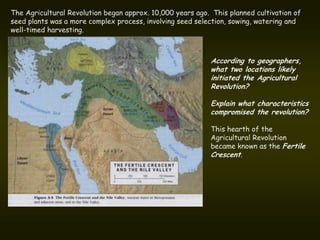
The Agricultural Revolution began approx. 10,000 years ago. This planned cultivation of
seed plants was a more complex process, involving seed selection, sowing, watering and
well-timed harvesting.


                                                           According to geographers,
                                                           what two locations likely
                                                           initiated the Agricultural
                                                           Revolution?

                                                           Explain what characteristics
                                                           compromised the revolution?

                                                           This hearth of the
                                                           Agricultural Revolution
                                                           became known as the Fertile
                                                           Crescent.
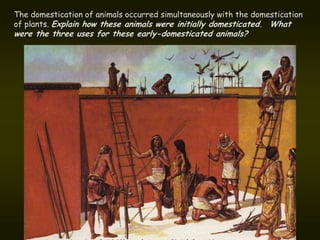
The domestication of animals occurred simultaneously with the domestication
of plants. Explain how these animals were initially domesticated. What
were the three uses for these early-domesticated animals?
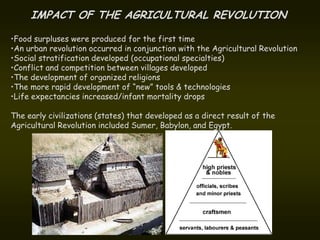
IMPACT OF THE AGRICULTURAL REVOLUTION

•Food surpluses were produced for the first time
•An urban revolution occurred in conjunction with the Agricultural Revolution
•Social stratification developed (occupational specialties)
•Conflict and competition between villages developed
•The development of organized religions
•The more rapid development of “new” tools & technologies
•Life expectancies increased/infant mortality drops

The early civilizations (states) that developed as a direct result of the
Agricultural Revolution included Sumer, Babylon, and Egypt.
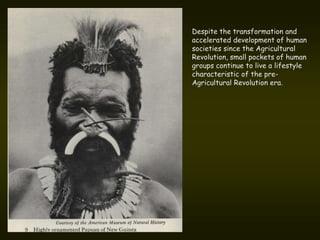
Despite the transformation and
accelerated development of human
societies since the Agricultural
Revolution, small pockets of human
groups continue to live a lifestyle
characteristic of the pre-
Agricultural Revolution era.
HOW DID HOLOCENE HUMANITY TRANSFORM the
  EARTH?
                  1. FARMING

              2. ADMINISTRATION

               3. URBANIZATION

             4. INDUSTRIALIZATION

       5. TRANSPORTATION & COMMUNICATION

                 6. POPULATION
FARMING
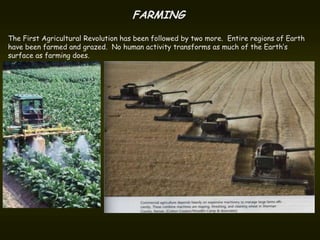
The First Agricultural Revolution has been followed by two more. Entire regions of Earth
have been farmed and grazed. No human activity transforms as much of the Earth’s
surface as farming does.
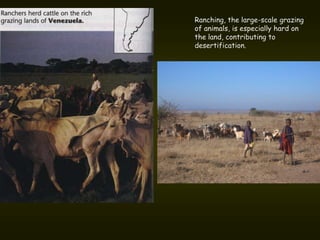
Ranching, the large-scale grazing
of animals, is especially hard on
the land, contributing to
desertification.
ADMINISTRATION
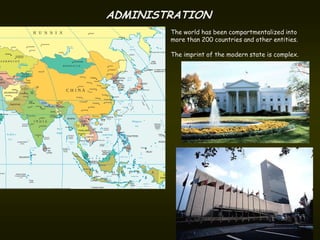
        The world has been compartmentalized into
        more than 200 countries and other entities.

        The imprint of the modern state is complex.
URBANIZATION

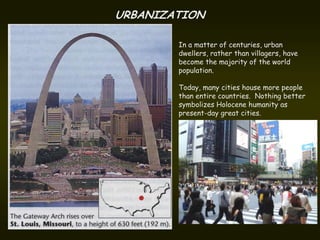
        In a matter of centuries, urban
        dwellers, rather than villagers, have
        become the majority of the world
        population.

        Today, many cities house more people
        than entire countries. Nothing better
        symbolizes Holocene humanity as
        present-day great cities.
INDUSTRIALIZATION
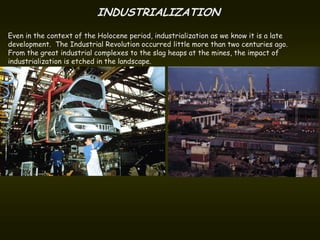
Even in the context of the Holocene period, industrialization as we know it is a late
development. The Industrial Revolution occurred little more than two centuries ago.
From the great industrial complexes to the slag heaps at the mines, the impact of
industrialization is etched in the landscape.
TRANSPORTATION & COMMUNICATION
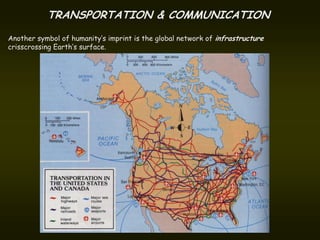
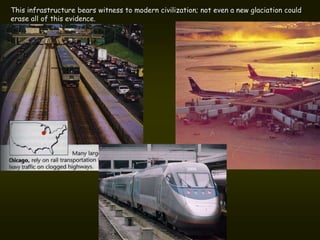
Another symbol of humanity’s imprint is the global network of infrastructure
crisscrossing Earth’s surface.
This infrastructure bears witness to modern civilization; not even a new glaciation could
erase all of this evidence.
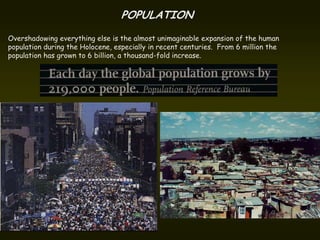
POPULATION
Overshadowing everything else is the almost unimaginable expansion of the human
population during the Holocene, especially in recent centuries. From 6 million the
population has grown to 6 billion, a thousand-fold increase.

Honors geo. ch3 p.p (pt. 2)

  • 1.
    INTERNAL FORCES The intense heat of Earth’s interior creates the internal forces that change the planet’s surface. Internal forces cause the plates of Earth’s crust to move very slowly – only approx. 1 inch each year. It is these plate movements that create earthquakes and volcanic eruptions.
  • 3.
    The theory ofplate tectonics views Earth’s crust as divided into more than a dozen rigid, slow-moving plates. The processes of plate tectonics usually take millions of years to cause major changes. The plates move like giant rafts cruising slowly over the upper mantle.
  • 4.
    How much ofEarth’s interior remains unexplored? Why can’t humans journey to the center of Earth? What does Earth’s core produce of significance? And what may be happening to the core?
  • 5.
    Identify the componentsof Earth, including composition & dimensions. Explain the revolutionary idea to access the core. Is it feasible? And explain the value of earthquakes in studying the core.
  • 6.
    Explain the significanceof the core’s heat in protecting life from the sun’s deadly radiation. What is happening to Earth’s magnetic shield? And describe the potential significance.
  • 7.
    Indicators reveal thatEarth is changing from the inside out. The planet may be on the verge of a magnetic reversal. Has this happened before? How often does it tend to occur? And when was the last time Earth’s magnetic field reversed? What can we expect when it reverses again?
  • 8.
    Studies reveal thatEarth’s magnetic field may be weakening. Explain the “nuclear reactor” theory. Which planet do scientists use as a case study for this change? What is the theory as to what happened to Mar’s core? Describe the impact? Could this happen on Earth? What would be the impact?
  • 9.
    EARTHQUAKES Earthquakes are suddenmovements of the surface produced when the slowly accumulated strain along opposing sides of an active fault is suddenly released as the two sides are torn apart.
  • 10.
    Thousands of perceptibleearthquakes occur each year worldwide, while nearly 95% of them occur around the rim of the Pacific and from southern Asia westward through southern Europe. Major earthquakes have also occurred in North America and Latin America. Thus, there are not any regions in the world immune from earthquakes.
  • 11.
    Although earthquakes couldoccur virtually anywhere in the U.S., the greatest potential is located in California, ….
  • 12.
    …. site ofthe infamous San Andreas Fault. This fault line is the source of most of the state’s major earthquakes.
  • 13.
    An earthquake’s profileincludes: it occurs with little or no warning; it can unleash a force comparable to a nuclear blast; usually lasts less than one minute, but can level a city and cost billions of dollars in damage; and the aftershocks can be as dangerous & deadly as the actual quake. Most will proclaim that the worst aspect of experiencing an earthquake is the loss of equilibrium from the shaking ground.
  • 14.
    Earthquakes are moredeadly and costly today because of overpopulation. In studying a world population density map, one finds a clear correlation between the dense population areas and the global distribution of earthquake activity.
  • 15.
    In the pastdecade, earthquake activity has increased. In the absence of vacating earthquake-prone areas, humans are adapting by: * Avoiding building on unstable ground (fill) * Avoiding the construction of high, rigid structures (overpasses) * Building earthquake-resistant structures * “Disaster Day” contingencies * Further development of prediction techniques Unfortunately, these adaptations can cost millions of dollars to implement. Poor, developing areas prone to earthquakes invariably suffer the highest casualties.
  • 19.
    VOLCANISM Volcanism is thesecond major category of tectonic activity. It involves the surface-ward movement of liquid magma.
  • 21.
    A volcano isa hill or mountain constructed by materials from the interior of the earth that have been ejected under pressure from a vent. At present, approx. 500 active volcanoes are scattered throughout the world. Nearly 4/5 of the active volcanoes on land are located in the “Ring of Fire” around the circumference of the Pacific.
  • 23.
    Volcanic eruptions andthe subsequent lava flows are one of the most dramatic sites provided by nature.
  • 25.
    Volcanic eruptions destroyeverything in its path, including physical features and man- made features. Entire towns and cities can be destroyed. The aftermath can resemble another planet’s surface. But despite the initial destruction, a re-birth slowly evolves in the stricken area. Also, the eruption can serve as a valuable pressure release of internal planetary pressure. Hawaii’s Mt. Kilauea helped to form the Hawaiian islands and continuing volcanic activity is increasing the size of Hawaii. Volcanic eruptions can impact both regional and world climates, depending on the magnitude of the eruption.
  • 28.
    THE AGRICULTURAL REVOLUTION Priorto the Agricultural Revolution, humans lived in smaller, nomadic bands that relied on hunting and gathering for subsistence. Humans lived in this manner until approx. 10,000 years ago. Identify some of the challenges confronting hunters and gatherers in North America.
  • 29.
    The hunting andgathering subsistence lifestyle was harsh and tenuous, lacking reliable food surpluses. Because of this unreliable food situation, how would the lives of our ancestors been different from ours? The primary big-game animal hunted was the mammoth, the largest creature roaming North America since the Dinosaurs. Explain the strategy for successfully hunting these big and dangerous animals.
  • 30.
    During this earlyperiod, humans were at the complete mercy of their physical environment for survival. Describe early weapon technology. How did early hunters and gatherers utilize the entire mammoth? And, what were the dangers for these people after a successful kill?
  • 31.
    From the evidencediscovered and some educated speculation, describe what life may have been like for hunters and gatherers in North America.
  • 32.
    According to CarlSauer, as early as 14,000 years ago, where might the earliest & most primitive plant domestication occurred? A similar, but later, development may have taken place in northwestern South America (independent invention). This served as the seed for the more recognized agricultural revolution.
  • 33.
    The Agricultural Revolutionbegan approx. 10,000 years ago. This planned cultivation of seed plants was a more complex process, involving seed selection, sowing, watering and well-timed harvesting. According to geographers, what two locations likely initiated the Agricultural Revolution? Explain what characteristics compromised the revolution? This hearth of the Agricultural Revolution became known as the Fertile Crescent.
  • 34.
    The domestication ofanimals occurred simultaneously with the domestication of plants. Explain how these animals were initially domesticated. What were the three uses for these early-domesticated animals?
  • 35.
    IMPACT OF THEAGRICULTURAL REVOLUTION •Food surpluses were produced for the first time •An urban revolution occurred in conjunction with the Agricultural Revolution •Social stratification developed (occupational specialties) •Conflict and competition between villages developed •The development of organized religions •The more rapid development of “new” tools & technologies •Life expectancies increased/infant mortality drops The early civilizations (states) that developed as a direct result of the Agricultural Revolution included Sumer, Babylon, and Egypt.
  • 36.
    Despite the transformationand accelerated development of human societies since the Agricultural Revolution, small pockets of human groups continue to live a lifestyle characteristic of the pre- Agricultural Revolution era.
  • 37.
    HOW DID HOLOCENEHUMANITY TRANSFORM the EARTH? 1. FARMING 2. ADMINISTRATION 3. URBANIZATION 4. INDUSTRIALIZATION 5. TRANSPORTATION & COMMUNICATION 6. POPULATION
  • 38.
    FARMING The First AgriculturalRevolution has been followed by two more. Entire regions of Earth have been farmed and grazed. No human activity transforms as much of the Earth’s surface as farming does.
  • 39.
    Ranching, the large-scalegrazing of animals, is especially hard on the land, contributing to desertification.
  • 40.
    ADMINISTRATION The world has been compartmentalized into more than 200 countries and other entities. The imprint of the modern state is complex.
  • 41.
    URBANIZATION In a matter of centuries, urban dwellers, rather than villagers, have become the majority of the world population. Today, many cities house more people than entire countries. Nothing better symbolizes Holocene humanity as present-day great cities.
  • 42.
    INDUSTRIALIZATION Even in thecontext of the Holocene period, industrialization as we know it is a late development. The Industrial Revolution occurred little more than two centuries ago. From the great industrial complexes to the slag heaps at the mines, the impact of industrialization is etched in the landscape.
  • 43.
    TRANSPORTATION & COMMUNICATION Anothersymbol of humanity’s imprint is the global network of infrastructure crisscrossing Earth’s surface.
  • 44.
    This infrastructure bearswitness to modern civilization; not even a new glaciation could erase all of this evidence.
  • 45.
    POPULATION Overshadowing everything elseis the almost unimaginable expansion of the human population during the Holocene, especially in recent centuries. From 6 million the population has grown to 6 billion, a thousand-fold increase.