THE ARAB/ISRAELI CONFLICT
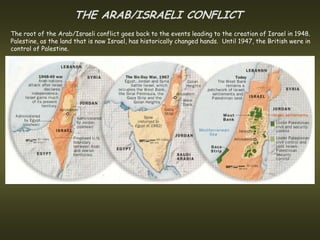
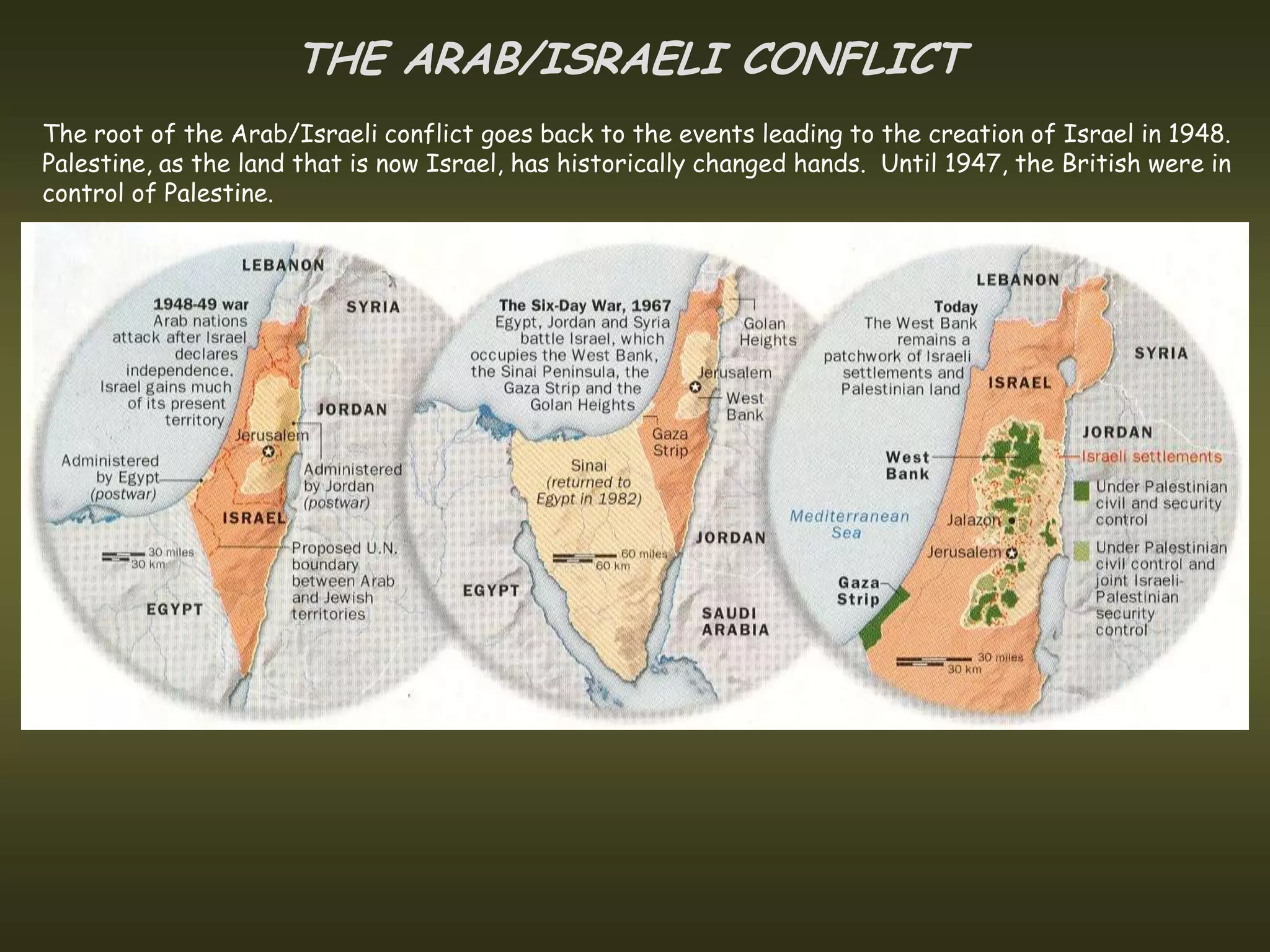
The root of the Arab/Israeli conflict goes back to the events leading to the creation of Israel in 1948.
Palestine, as the land that is now Israel, has historically changed hands. Until 1947, the British were in
control of Palestine.
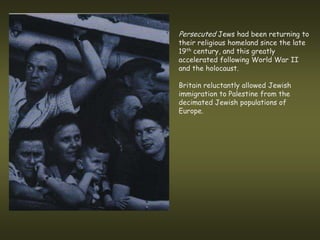
Persecuted Jews had been returning to
their religious homeland since the late
19th century, and this greatly
accelerated following World War II
and the holocaust.

Britain reluctantly allowed Jewish
immigration to Palestine from the
decimated Jewish populations of
Europe.
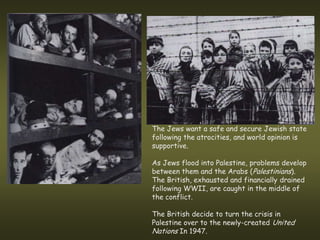
The Jews want a safe and secure Jewish state
following the atrocities, and world opinion is
supportive.

As Jews flood into Palestine, problems develop
between them and the Arabs (Palestinians).
The British, exhausted and financially drained
following WWII, are caught in the middle of
the conflict.

The British decide to turn the crisis in
Palestine over to the newly-created United
Nations In 1947.
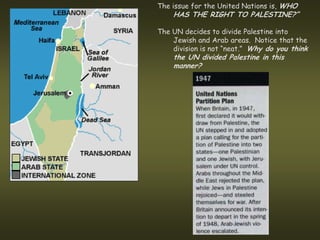
The issue for the United Nations is, WHO
    HAS THE RIGHT TO PALESTINE?”

The UN decides to divide Palestine into
    Jewish and Arab areas. Notice that the
    division is not “neat.” Why do you think
    the UN divided Palestine in this
    manner?
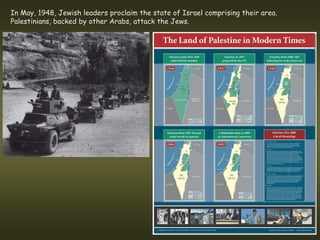
In May, 1948, Jewish leaders proclaim the state of Israel comprising their area.
Palestinians, backed by other Arabs, attack the Jews.
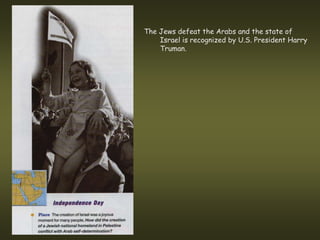
The Jews defeat the Arabs and the state of
    Israel is recognized by U.S. President Harry
    Truman.
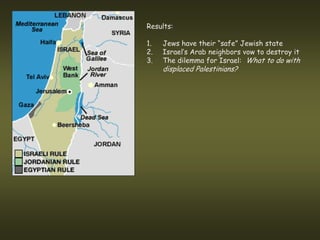
Results:

1.   Jews have their “safe” Jewish state
2.   Israel’s Arab neighbors vow to destroy it
3.   The dilemma for Israel: What to do with
     displaced Palestinians?
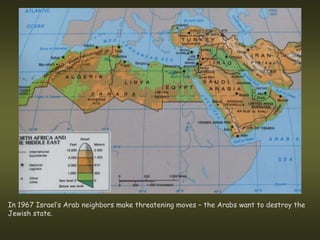
In 1967 Israel’s Arab neighbors make threatening moves – the Arabs want to destroy the
Jewish state.
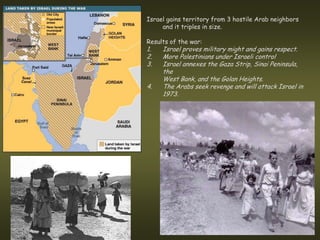
Israel gains territory from 3 hostile Arab neighbors
     and it triples in size.

Results of the war:
1.   Israel proves military might and gains respect.
2.   More Palestinians under Israeli control
3.   Israel annexes the Gaza Strip, Sinai Peninsula,
     the
     West Bank, and the Golan Heights.
4.   The Arabs seek revenge and will attack Israel in
     1973.
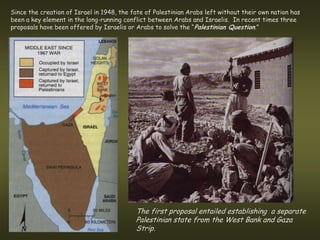
Since the creation of Israel in 1948, the fate of Palestinian Arabs left without their own nation has
been a key element in the long-running conflict between Arabs and Israelis. In recent times three
proposals have been offered by Israelis or Arabs to solve the “Palestinian Question.”


                                           The first proposal entailed establishing a separate
                                           Palestinian state from the West Bank and Gaza
                                           Strip.
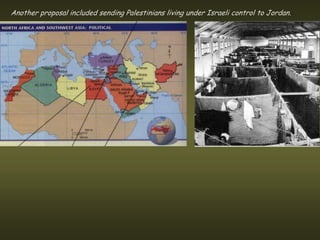
Another proposal included sending Palestinians living under Israeli control to Jordan.
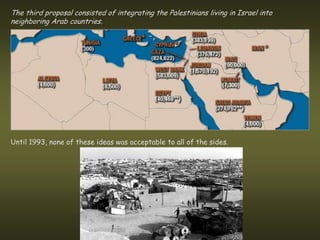
The third proposal consisted of integrating the Palestinians living in Israel into
neighboring Arab countries.


Until 1993, none of these ideas was acceptable to all of the sides.
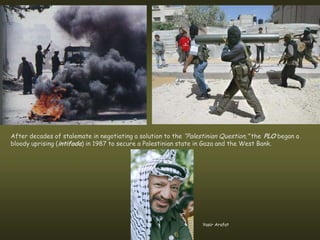
After decades of stalemate in negotiating a solution to the “Palestinian Question,” the PLO began a
bloody uprising (intifada) in 1987 to secure a Palestinian state in Gaza and the West Bank.


                                                                 Yasir Arafat
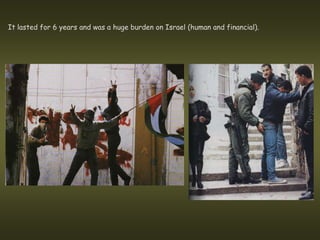
It lasted for 6 years and was a huge burden on Israel (human and financial).
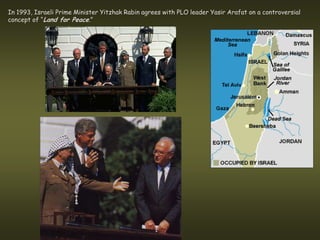
In 1993, Israeli Prime Minister Yitzhak Rabin agrees with PLO leader Yasir Arafat on a controversial
concept of “Land for Peace.”
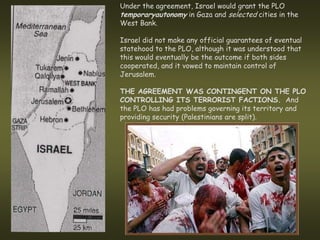
Under the agreement, Israel would grant the PLO
temporaryautonomy in Gaza and selected cities in the
West Bank.

Israel did not make any official guarantees of eventual
statehood to the PLO, although it was understood that
this would eventually be the outcome if both sides
cooperated, and it vowed to maintain control of
Jerusalem.

THE AGREEMENT WAS CONTINGENT ON THE PLO
CONTROLLING ITS TERRORIST FACTIONS. And
the PLO has had problems governing its territory and
providing security (Palestinians are split).
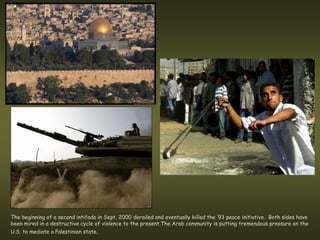
The beginning of a second intifada in Sept. 2000 derailed and eventually killed the ’93 peace initiative. Both sides have
been mired in a destructive cycle of violence to the present.The Arab community is putting tremendous pressure on the
U.S. to mediate a Palestinian state.
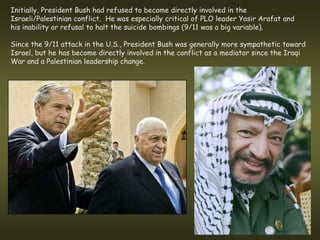
Initially, President Bush had refused to become directly involved in the
Israeli/Palestinian conflict. He was especially critical of PLO leader Yasir Arafat and
his inability or refusal to halt the suicide bombings (9/11 was a big variable).

Since the 9/11 attack in the U.S., President Bush was generally more sympathetic toward
Israel, but he has become directly involved in the conflict as a mediator since the Iraqi
War and a Palestinian leadership change.
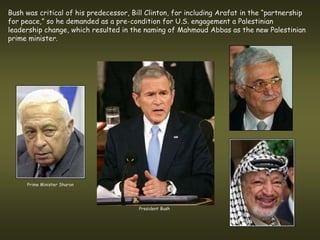
Bush was critical of his predecessor, Bill Clinton, for including Arafat in the “partnership
for peace,” so he demanded as a pre-condition for U.S. engagement a Palestinian
leadership change, which resulted in the naming of Mahmoud Abbas as the new Palestinian
prime minister.


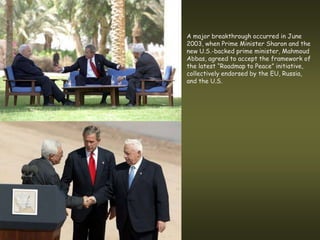
     Prime Minister Sharon


                                        President Bush
A major breakthrough occurred in June
2003, when Prime Minister Sharon and the
new U.S.-backed prime minister, Mahmoud
Abbas, agreed to accept the framework of
the latest “Roadmap to Peace” initiative,
collectively endorsed by the EU, Russia,
and the U.S.
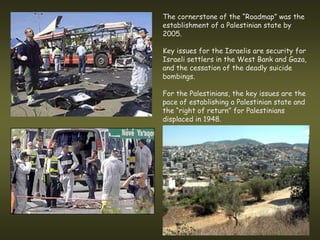
The cornerstone of the “Roadmap” was the
establishment of a Palestinian state by
2005.

Key issues for the Israelis are security for
Israeli settlers in the West Bank and Gaza,
and the cessation of the deadly suicide
bombings.

For the Palestinians, the key issues are the
pace of establishing a Palestinian state and
the “right of return” for Palestinians
displaced in 1948.
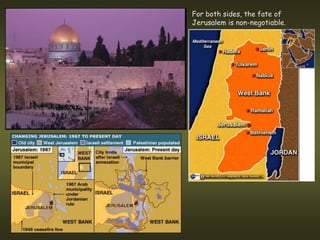
For both sides, the fate of
Jerusalem is non-negotiable.
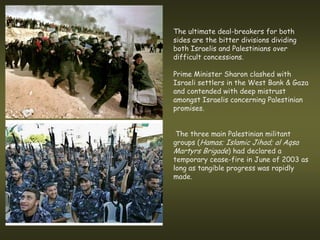
The ultimate deal-breakers for both
sides are the bitter divisions dividing
both Israelis and Palestinians over
difficult concessions.

Prime Minister Sharon clashed with
Israeli settlers in the West Bank & Gaza
and contended with deep mistrust
amongst Israelis concerning Palestinian
promises.

 The three main Palestinian militant
groups (Hamas; Islamic Jihad; al Aqsa
Martyrs Brigade) had declared a
temporary cease-fire in June of 2003 as
long as tangible progress was rapidly
made.
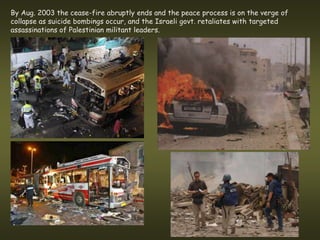
By Aug. 2003 the cease-fire abruptly ends and the peace process is on the verge of
collapse as suicide bombings occur, and the Israeli govt. retaliates with targeted
assassinations of Palestinian militant leaders.
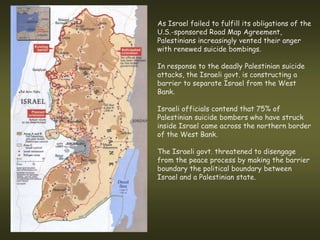
As Israel failed to fulfill its obligations of the
U.S.-sponsored Road Map Agreement,
Palestinians increasingly vented their anger
with renewed suicide bombings.
In response to the deadly Palestinian suicide
attacks, the Israeli govt. is constructing a
barrier to separate Israel from the West
Bank.

Israeli officials contend that 75% of
Palestinian suicide bombers who have struck
inside Israel came across the northern border
of the West Bank.

The Israeli govt. threatened to disengage
from the peace process by making the barrier
boundary the political boundary between
Israel and a Palestinian state.
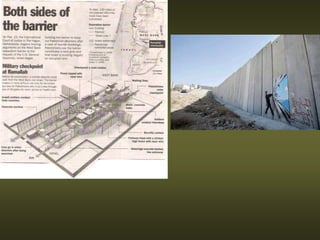
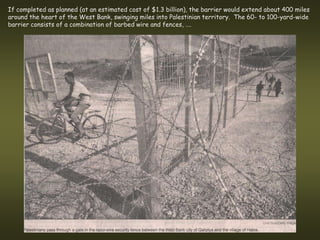
If completed as planned (at an estimated cost of $1.3 billion), the barrier would extend about 400 miles
around the heart of the West Bank, swinging miles into Palestinian territory. The 60- to 100-yard-wide
barrier consists of a combination of barbed wire and fences, ….
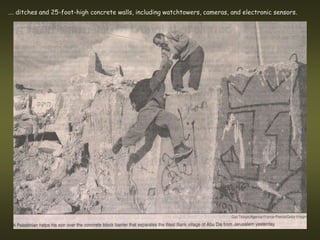
…. ditches and 25-foot-high concrete walls, including watchtowers, cameras, and electronic sensors.
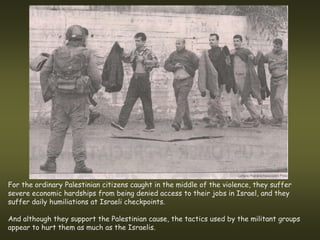
For the ordinary Palestinian citizens caught in the middle of the violence, they suffer
severe economic hardships from being denied access to their jobs in Israel, and they
suffer daily humiliations at Israeli checkpoints.

And although they support the Palestinian cause, the tactics used by the militant groups
appear to hurt them as much as the Israelis.
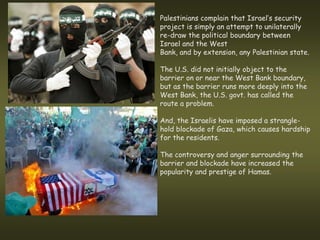
Palestinians complain that Israel’s security
project is simply an attempt to unilaterally
re-draw the political boundary between
Israel and the West
Bank, and by extension, any Palestinian state.

The U.S. did not initially object to the
barrier on or near the West Bank boundary,
but as the barrier runs more deeply into the
West Bank, the U.S. govt. has called the
route a problem.

And, the Israelis have imposed a strangle-
hold blockade of Gaza, which causes hardship
for the residents.

The controversy and anger surrounding the
barrier and blockade have increased the
popularity and prestige of Hamas.
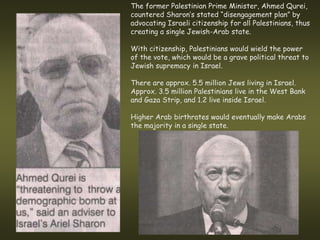
The former Palestinian Prime Minister, Ahmed Qurei,
countered Sharon’s stated “disengagement plan” by
advocating Israeli citizenship for all Palestinians, thus
creating a single Jewish-Arab state.

With citizenship, Palestinians would wield the power
of the vote, which would be a grave political threat to
Jewish supremacy in Israel.

There are approx. 5.5 million Jews living in Israel.
Approx. 3.5 million Palestinians live in the West Bank
and Gaza Strip, and 1.2 live inside Israel.

Higher Arab birthrates would eventually make Arabs
the majority in a single state.
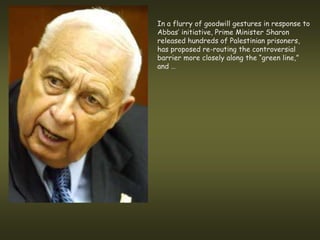
In a flurry of goodwill gestures in response to
Abbas’ initiative, Prime Minister Sharon
released hundreds of Palestinian prisoners,
has proposed re-routing the controversial
barrier more closely along the “green line,”
and …
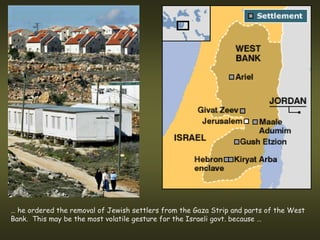
… he ordered the removal of Jewish settlers from the Gaza Strip and parts of the West
Bank. This may be the most volatile gesture for the Israeli govt. because …
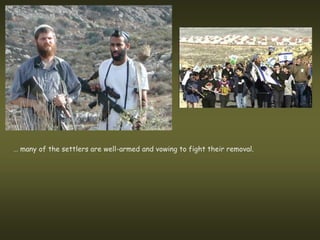
… many of the settlers are well-armed and vowing to fight their removal.
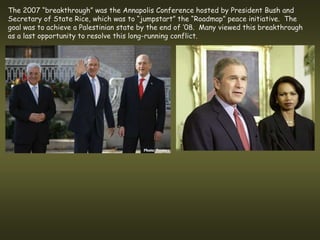
The 2007 “breakthrough” was the Annapolis Conference hosted by President Bush and
Secretary of State Rice, which was to “jumpstart” the “Roadmap” peace initiative. The
goal was to achieve a Palestinian state by the end of ’08. Many viewed this breakthrough
as a last opportunity to resolve this long-running conflict.
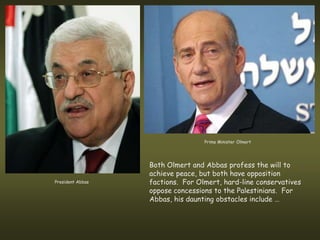
Prime Minister Olmert


                  Both Olmert and Abbas profess the will to
                  achieve peace, but both have opposition
President Abbas   factions. For Olmert, hard-line conservatives
                  oppose concessions to the Palestinians. For
                  Abbas, his daunting obstacles include …
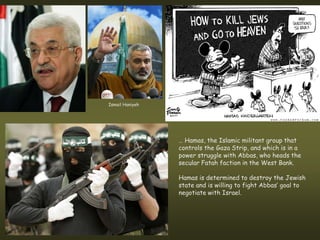
Ismail Haniyeh


                 … Hamas, the Islamic militant group that
                 controls the Gaza Strip, and which is in a
                 power struggle with Abbas, who heads the
                 secular Fatah faction in the West Bank.

                 Hamas is determined to destroy the Jewish
                 state and is willing to fight Abbas’ goal to
                 negotiate with Israel.
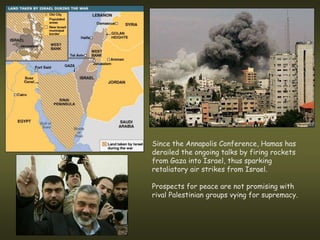
Since the Annapolis Conference, Hamas has
derailed the ongoing talks by firing rockets
from Gaza into Israel, thus sparking
retaliatory air strikes from Israel.

Prospects for peace are not promising with
rival Palestinian groups vying for supremacy.
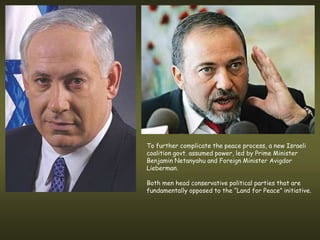
To further complicate the peace process, a new Israeli
coalition govt. assumed power, led by Prime Minister
Benjamin Netanyahu and Foreign Minister Avigdor
Lieberman.

Both men head conservative political parties that are
fundamentally opposed to the “Land for Peace” initiative.
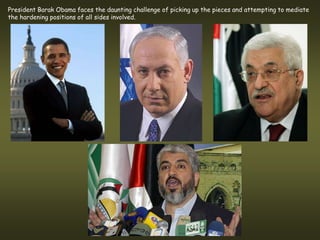
President Barak Obama faces the daunting challenge of picking up the pieces and attempting to mediate
the hardening positions of all sides involved.
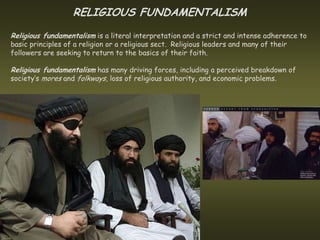
RELIGIOUS FUNDAMENTALISM
Religious fundamentalism is a literal interpretation and a strict and intense adherence to
basic principles of a religion or a religious sect. Religious leaders and many of their
followers are seeking to return to the basics of their faith.

Religious fundamentalism has many driving forces, including a perceived breakdown of
society’s mores and folkways, loss of religious authority, and economic problems.
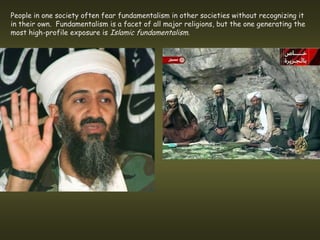
People in one society often fear fundamentalism in other societies without recognizing it
in their own. Fundamentalism is a facet of all major religions, but the one generating the
most high-profile exposure is Islamic fundamentalism.

Honors geo. ch 13 pt. 3

  • 1.
    THE ARAB/ISRAELI CONFLICT Theroot of the Arab/Israeli conflict goes back to the events leading to the creation of Israel in 1948. Palestine, as the land that is now Israel, has historically changed hands. Until 1947, the British were in control of Palestine.
  • 2.
    Persecuted Jews hadbeen returning to their religious homeland since the late 19th century, and this greatly accelerated following World War II and the holocaust. Britain reluctantly allowed Jewish immigration to Palestine from the decimated Jewish populations of Europe.
  • 3.
    The Jews wanta safe and secure Jewish state following the atrocities, and world opinion is supportive. As Jews flood into Palestine, problems develop between them and the Arabs (Palestinians). The British, exhausted and financially drained following WWII, are caught in the middle of the conflict. The British decide to turn the crisis in Palestine over to the newly-created United Nations In 1947.
  • 4.
    The issue forthe United Nations is, WHO HAS THE RIGHT TO PALESTINE?” The UN decides to divide Palestine into Jewish and Arab areas. Notice that the division is not “neat.” Why do you think the UN divided Palestine in this manner?
  • 5.
    In May, 1948,Jewish leaders proclaim the state of Israel comprising their area. Palestinians, backed by other Arabs, attack the Jews.
  • 6.
    The Jews defeatthe Arabs and the state of Israel is recognized by U.S. President Harry Truman.
  • 7.
    Results: 1. Jews have their “safe” Jewish state 2. Israel’s Arab neighbors vow to destroy it 3. The dilemma for Israel: What to do with displaced Palestinians?
  • 8.
    In 1967 Israel’sArab neighbors make threatening moves – the Arabs want to destroy the Jewish state.
  • 11.
    Israel gains territoryfrom 3 hostile Arab neighbors and it triples in size. Results of the war: 1. Israel proves military might and gains respect. 2. More Palestinians under Israeli control 3. Israel annexes the Gaza Strip, Sinai Peninsula, the West Bank, and the Golan Heights. 4. The Arabs seek revenge and will attack Israel in 1973.
  • 12.
    Since the creationof Israel in 1948, the fate of Palestinian Arabs left without their own nation has been a key element in the long-running conflict between Arabs and Israelis. In recent times three proposals have been offered by Israelis or Arabs to solve the “Palestinian Question.” The first proposal entailed establishing a separate Palestinian state from the West Bank and Gaza Strip.
  • 13.
    Another proposal includedsending Palestinians living under Israeli control to Jordan.
  • 14.
    The third proposalconsisted of integrating the Palestinians living in Israel into neighboring Arab countries. Until 1993, none of these ideas was acceptable to all of the sides.
  • 15.
    After decades ofstalemate in negotiating a solution to the “Palestinian Question,” the PLO began a bloody uprising (intifada) in 1987 to secure a Palestinian state in Gaza and the West Bank. Yasir Arafat
  • 16.
    It lasted for6 years and was a huge burden on Israel (human and financial).
  • 17.
    In 1993, IsraeliPrime Minister Yitzhak Rabin agrees with PLO leader Yasir Arafat on a controversial concept of “Land for Peace.”
  • 18.
    Under the agreement,Israel would grant the PLO temporaryautonomy in Gaza and selected cities in the West Bank. Israel did not make any official guarantees of eventual statehood to the PLO, although it was understood that this would eventually be the outcome if both sides cooperated, and it vowed to maintain control of Jerusalem. THE AGREEMENT WAS CONTINGENT ON THE PLO CONTROLLING ITS TERRORIST FACTIONS. And the PLO has had problems governing its territory and providing security (Palestinians are split).
  • 19.
    The beginning ofa second intifada in Sept. 2000 derailed and eventually killed the ’93 peace initiative. Both sides have been mired in a destructive cycle of violence to the present.The Arab community is putting tremendous pressure on the U.S. to mediate a Palestinian state.
  • 20.
    Initially, President Bushhad refused to become directly involved in the Israeli/Palestinian conflict. He was especially critical of PLO leader Yasir Arafat and his inability or refusal to halt the suicide bombings (9/11 was a big variable). Since the 9/11 attack in the U.S., President Bush was generally more sympathetic toward Israel, but he has become directly involved in the conflict as a mediator since the Iraqi War and a Palestinian leadership change.
  • 21.
    Bush was criticalof his predecessor, Bill Clinton, for including Arafat in the “partnership for peace,” so he demanded as a pre-condition for U.S. engagement a Palestinian leadership change, which resulted in the naming of Mahmoud Abbas as the new Palestinian prime minister. Prime Minister Sharon President Bush
  • 22.
    A major breakthroughoccurred in June 2003, when Prime Minister Sharon and the new U.S.-backed prime minister, Mahmoud Abbas, agreed to accept the framework of the latest “Roadmap to Peace” initiative, collectively endorsed by the EU, Russia, and the U.S.
  • 23.
    The cornerstone ofthe “Roadmap” was the establishment of a Palestinian state by 2005. Key issues for the Israelis are security for Israeli settlers in the West Bank and Gaza, and the cessation of the deadly suicide bombings. For the Palestinians, the key issues are the pace of establishing a Palestinian state and the “right of return” for Palestinians displaced in 1948.
  • 24.
    For both sides,the fate of Jerusalem is non-negotiable.
  • 25.
    The ultimate deal-breakersfor both sides are the bitter divisions dividing both Israelis and Palestinians over difficult concessions. Prime Minister Sharon clashed with Israeli settlers in the West Bank & Gaza and contended with deep mistrust amongst Israelis concerning Palestinian promises. The three main Palestinian militant groups (Hamas; Islamic Jihad; al Aqsa Martyrs Brigade) had declared a temporary cease-fire in June of 2003 as long as tangible progress was rapidly made.
  • 26.
    By Aug. 2003the cease-fire abruptly ends and the peace process is on the verge of collapse as suicide bombings occur, and the Israeli govt. retaliates with targeted assassinations of Palestinian militant leaders.
  • 34.
    As Israel failedto fulfill its obligations of the U.S.-sponsored Road Map Agreement, Palestinians increasingly vented their anger with renewed suicide bombings. In response to the deadly Palestinian suicide attacks, the Israeli govt. is constructing a barrier to separate Israel from the West Bank. Israeli officials contend that 75% of Palestinian suicide bombers who have struck inside Israel came across the northern border of the West Bank. The Israeli govt. threatened to disengage from the peace process by making the barrier boundary the political boundary between Israel and a Palestinian state.
  • 36.
    If completed asplanned (at an estimated cost of $1.3 billion), the barrier would extend about 400 miles around the heart of the West Bank, swinging miles into Palestinian territory. The 60- to 100-yard-wide barrier consists of a combination of barbed wire and fences, ….
  • 37.
    …. ditches and25-foot-high concrete walls, including watchtowers, cameras, and electronic sensors.
  • 38.
    For the ordinaryPalestinian citizens caught in the middle of the violence, they suffer severe economic hardships from being denied access to their jobs in Israel, and they suffer daily humiliations at Israeli checkpoints. And although they support the Palestinian cause, the tactics used by the militant groups appear to hurt them as much as the Israelis.
  • 39.
    Palestinians complain thatIsrael’s security project is simply an attempt to unilaterally re-draw the political boundary between Israel and the West Bank, and by extension, any Palestinian state. The U.S. did not initially object to the barrier on or near the West Bank boundary, but as the barrier runs more deeply into the West Bank, the U.S. govt. has called the route a problem. And, the Israelis have imposed a strangle- hold blockade of Gaza, which causes hardship for the residents. The controversy and anger surrounding the barrier and blockade have increased the popularity and prestige of Hamas.
  • 40.
    The former PalestinianPrime Minister, Ahmed Qurei, countered Sharon’s stated “disengagement plan” by advocating Israeli citizenship for all Palestinians, thus creating a single Jewish-Arab state. With citizenship, Palestinians would wield the power of the vote, which would be a grave political threat to Jewish supremacy in Israel. There are approx. 5.5 million Jews living in Israel. Approx. 3.5 million Palestinians live in the West Bank and Gaza Strip, and 1.2 live inside Israel. Higher Arab birthrates would eventually make Arabs the majority in a single state.
  • 41.
    In a flurryof goodwill gestures in response to Abbas’ initiative, Prime Minister Sharon released hundreds of Palestinian prisoners, has proposed re-routing the controversial barrier more closely along the “green line,” and …
  • 42.
    … he orderedthe removal of Jewish settlers from the Gaza Strip and parts of the West Bank. This may be the most volatile gesture for the Israeli govt. because …
  • 43.
    … many ofthe settlers are well-armed and vowing to fight their removal.
  • 44.
    The 2007 “breakthrough”was the Annapolis Conference hosted by President Bush and Secretary of State Rice, which was to “jumpstart” the “Roadmap” peace initiative. The goal was to achieve a Palestinian state by the end of ’08. Many viewed this breakthrough as a last opportunity to resolve this long-running conflict.
  • 45.
    Prime Minister Olmert Both Olmert and Abbas profess the will to achieve peace, but both have opposition President Abbas factions. For Olmert, hard-line conservatives oppose concessions to the Palestinians. For Abbas, his daunting obstacles include …
  • 46.
    Ismail Haniyeh … Hamas, the Islamic militant group that controls the Gaza Strip, and which is in a power struggle with Abbas, who heads the secular Fatah faction in the West Bank. Hamas is determined to destroy the Jewish state and is willing to fight Abbas’ goal to negotiate with Israel.
  • 47.
    Since the AnnapolisConference, Hamas has derailed the ongoing talks by firing rockets from Gaza into Israel, thus sparking retaliatory air strikes from Israel. Prospects for peace are not promising with rival Palestinian groups vying for supremacy.
  • 48.
    To further complicatethe peace process, a new Israeli coalition govt. assumed power, led by Prime Minister Benjamin Netanyahu and Foreign Minister Avigdor Lieberman. Both men head conservative political parties that are fundamentally opposed to the “Land for Peace” initiative.
  • 49.
    President Barak Obamafaces the daunting challenge of picking up the pieces and attempting to mediate the hardening positions of all sides involved.
  • 50.
    RELIGIOUS FUNDAMENTALISM Religious fundamentalismis a literal interpretation and a strict and intense adherence to basic principles of a religion or a religious sect. Religious leaders and many of their followers are seeking to return to the basics of their faith. Religious fundamentalism has many driving forces, including a perceived breakdown of society’s mores and folkways, loss of religious authority, and economic problems.
  • 51.
    People in onesociety often fear fundamentalism in other societies without recognizing it in their own. Fundamentalism is a facet of all major religions, but the one generating the most high-profile exposure is Islamic fundamentalism.