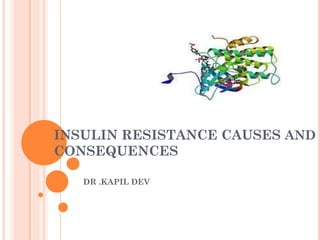
INSULIN RESISTANCE CAUSES AND
CONSEQUENCES
DR .KAPIL DEV
INSULIN


RESISTANCE

Decreased biological response to normal concentration of
circulating insulin.



Insulin (endogenous) or administered (exogenous).



Beta cells in the pancreas subsequently increase their
production of insulin, further contributing to
hyperinsulinaemia
INSULIN RESISTANCE IS OFTEN SEEN
WITH THE FOLLOWING CONDITIONS
DM,
 Metabolic syndrome,
 Obesity ,
 Pregnancy ,
 Infection or severe illness,
 Stress ,
 Inactivity and excess weight.

SIGNS AND SYMPTOMS


Inability to focus.



Increased hunger.



Intestinal bloating (cannot digest and absorb).



Sleepiness (after meals).



Weight gain, difficulty losing weight ( around abdominal
organs in both males and females).




Increased blood pressure



Increased pro-inflammatory


.

Acanthosis nigricans.





Depression.

Increased blood triglyceride levels.
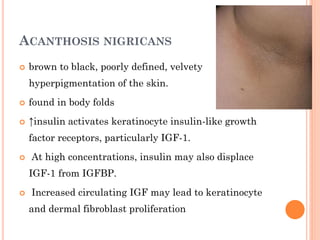
ACANTHOSIS NIGRICANS


brown to black, poorly defined, velvety
hyperpigmentation of the skin.



found in body folds



↑insulin activates keratinocyte insulin-like growth
factor receptors, particularly IGF-1.



At high concentrations, insulin may also displace
IGF-1 from IGFBP.



Increased circulating IGF may lead to keratinocyte
and dermal fibroblast proliferation
CAUSES AND CONSEQUENCES
PKB mutation
 Mutation in IRS
 Increased in serine phosporylation of IRS protein
 PI3 Kinase Activity
 Metabolic syndrome.
 Type 2 Diabetes mellites.
 Obesity/ Inactivity and excess weight

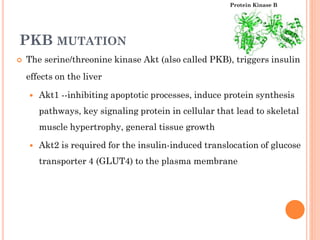
Protein Kinase B

PKB MUTATION


The serine/threonine kinase Akt (also called PKB), triggers insulin

effects on the liver


Akt1 --inhibiting apoptotic processes, induce protein synthesis
pathways, key signaling protein in cellular that lead to skeletal

muscle hypertrophy, general tissue growth


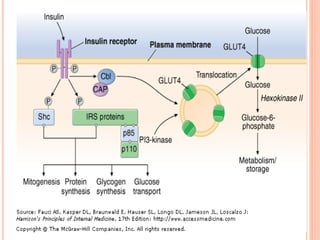
Akt2 is required for the insulin-induced translocation of glucose
transporter 4 (GLUT4) to the plasma membrane


Phosphorylation of the serine stimulates Akt phosphorylation at a
T308 residue.



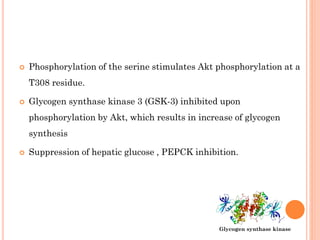
Glycogen synthase kinase 3 (GSK-3) inhibited upon
phosphorylation by Akt, which results in increase of glycogen
synthesis



Suppression of hepatic glucose , PEPCK inhibition.

Glycogen synthase kinase
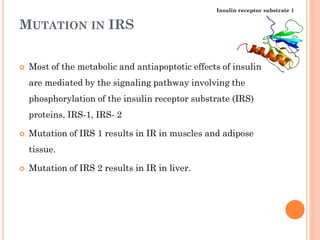
Insulin receptor substrate 1

MUTATION IN IRS


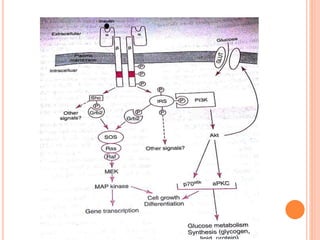
Most of the metabolic and antiapoptotic effects of insulin
are mediated by the signaling pathway involving the
phosphorylation of the insulin receptor substrate (IRS)
proteins, IRS-1, IRS- 2



Mutation of IRS 1 results in IR in muscles and adipose
tissue.



Mutation of IRS 2 results in IR in liver.
INCREASED IN SERINE PHOSPORYLATION
OF IRS PROTEINS


Serine phosphorylation of IRS proteins can reduce the ability of IRS

proteins to attract PI3-kinase, minimizing its activation.


Serine phosphorylation in turn ↓ IRS-1 tyrosine phosphorylation,
impairing downstream effectors.



serine phosphorylation may lead to dissociation between insulin
receptor/IRS-1 &/or IRS-1/PI3-kinase, preventing PI3-kinase
activation or increased degradation of IRS-1



circulating FFA & adipokine tumour necrosis factor (TNF) may ↑
serine phosphorylation of IRS proteins, causing impaired insulin
signal transduction
CAUSES OF SERINE PHOSPHORYLATION
OF IRS-1 PROTEINS ARE
Obesity
 Stress
 Hyperinsulinemia




PKC θ
• hyperglycemia
• Diacylglycerol
• inflammation
PI3 KINASE ACTIVITY


class 1a


Consisting of a regulatory subunit p85, tightly associated with a

catalytic subunit, p110.


p85 monomer & p85-p110 heterodimer compete for same binding
sites on tyrosine-phosphorylated IRS proteins, Imbalance could
cause either ↑ or ↓PI3kinase activity



Human placental growth hormone causes severe insulin resistance
by specifically ↑ expression of p85α subunit



Subsequently affecting the ability of insulin to stimulate the
association of the p85-p110 heterodimer with IRS-1



Reducing the PI3-kinase insulin signaling resistant states induced
by obesity, type 2 diabetes
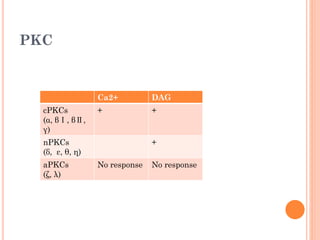
PKC

Ca2+
cPKCs
(α, βⅠ, βⅡ,
γ)

DAG

+

+

nPKCs
(δ, ε, θ, η)
aPKCs
(ζ, λ)

+
No response

No response
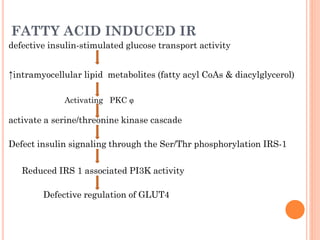
FATTY ACID INDUCED IR
defective insulin-stimulated glucose transport activity

↑intramyocellular lipid metabolites (fatty acyl CoAs & diacylglycerol)
Activating PKC

activate a serine/threonine kinase cascade
Defect insulin signaling through the Ser/Thr phosphorylation IRS-1
Reduced IRS 1 associated PI3K activity
Defective regulation of GLUT4
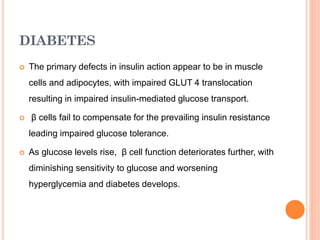
DIABETES


The primary defects in insulin action appear to be in muscle
cells and adipocytes, with impaired GLUT 4 translocation
resulting in impaired insulin-mediated glucose transport.



β cells fail to compensate for the prevailing insulin resistance
leading impaired glucose tolerance.



As glucose levels rise, β cell function deteriorates further, with
diminishing sensitivity to glucose and worsening

hyperglycemia and diabetes develops.
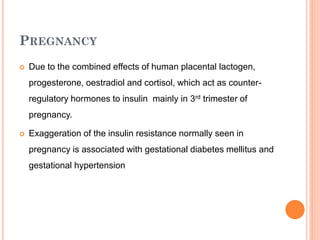
PREGNANCY


Due to the combined effects of human placental lactogen,
progesterone, oestradiol and cortisol, which act as counterregulatory hormones to insulin mainly in 3rd trimester of
pregnancy.



Exaggeration of the insulin resistance normally seen in
pregnancy is associated with gestational diabetes mellitus and
gestational hypertension
PCOS


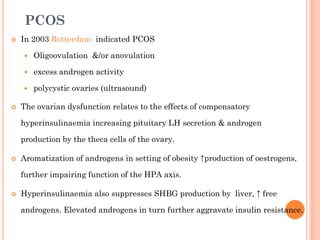
In 2003 Rotterdam- indicated PCOS



excess androgen activity




Oligoovulation &/or anovulation

polycystic ovaries (ultrasound)

The ovarian dysfunction relates to the effects of compensatory
hyperinsulinaemia increasing pituitary LH secretion & androgen
production by the theca cells of the ovary.



Aromatization of androgens in setting of obesity ↑production of oestrogens,
further impairing function of the HPA axis.



Hyperinsulinaemia also suppresses SHBG production by liver, ↑ free
androgens. Elevated androgens in turn further aggravate insulin resistance.
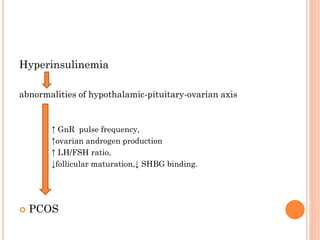
Hyperinsulinemia
abnormalities of hypothalamic-pituitary-ovarian axis

↑ GnR pulse frequency,
↑ovarian androgen production
↑ LH/FSH ratio,
↓follicular maturation,↓ SHBG binding.



PCOS
INSULIN RESISTANCE SYNDROME


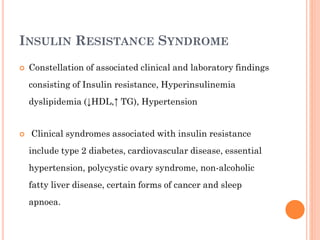
Constellation of associated clinical and laboratory findings
consisting of Insulin resistance, Hyperinsulinemia
dyslipidemia (↓HDL,↑ TG), Hypertension



Clinical syndromes associated with insulin resistance
include type 2 diabetes, cardiovascular disease, essential
hypertension, polycystic ovary syndrome, non-alcoholic

fatty liver disease, certain forms of cancer and sleep
apnoea.
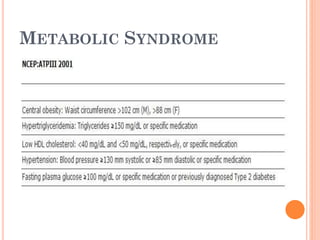
METABOLIC SYNDROME
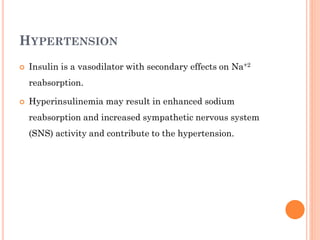
HYPERTENSION


Insulin is a vasodilator with secondary effects on Na+2
reabsorption.



Hyperinsulinemia may result in enhanced sodium
reabsorption and increased sympathetic nervous system
(SNS) activity and contribute to the hypertension.
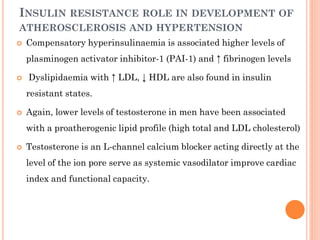
INSULIN RESISTANCE ROLE IN DEVELOPMENT OF
ATHEROSCLEROSIS AND HYPERTENSION


Compensatory hyperinsulinaemia is associated higher levels of
plasminogen activator inhibitor-1 (PAI-1) and ↑ fibrinogen levels



Dyslipidaemia with ↑ LDL, ↓ HDL are also found in insulin
resistant states.



Again, lower levels of testosterone in men have been associated

with a proatherogenic lipid profile (high total and LDL cholesterol)


Testosterone is an L-channel calcium blocker acting directly at the
level of the ion pore serve as systemic vasodilator improve cardiac
index and functional capacity.


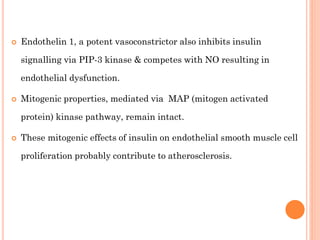
Endothelin 1, a potent vasoconstrictor also inhibits insulin
signalling via PIP-3 kinase & competes with NO resulting in
endothelial dysfunction.



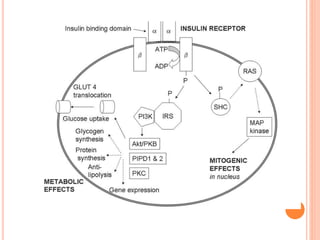
Mitogenic properties, mediated via MAP (mitogen activated
protein) kinase pathway, remain intact.



These mitogenic effects of insulin on endothelial smooth muscle cell
proliferation probably contribute to atherosclerosis.
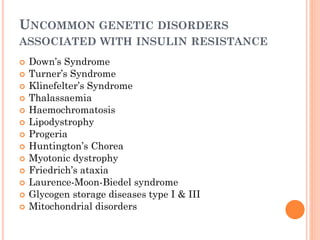
UNCOMMON GENETIC DISORDERS
ASSOCIATED WITH INSULIN RESISTANCE
















Down’s Syndrome
Turner’s Syndrome
Klinefelter’s Syndrome
Thalassaemia
Haemochromatosis
Lipodystrophy
Progeria
Huntington’s Chorea
Myotonic dystrophy
Friedrich’s ataxia
Laurence-Moon-Biedel syndrome
Glycogen storage diseases type I & III
Mitochondrial disorders
MEASUREMENT OF INSULIN RESISTANCE
Research Methods


HOMA IR

= Fasting Glucose(mmol/L) x Fasting Insulin(mU/L)
22.5



Quantitative
Insulin Sensitivity
Check Index
(QUICKI )

= 1 / [log(fasting insulin µU/mL) + log(FBG mg/dL)]


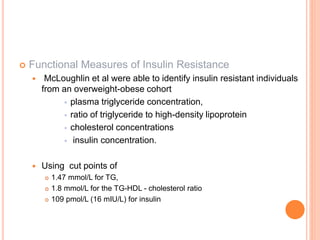
Functional Measures of Insulin Resistance


McLoughlin et al were able to identify insulin resistant individuals
from an overweight-obese cohort
 plasma triglyceride concentration,
 ratio of triglyceride to high-density lipoprotein
 cholesterol concentrations
 insulin concentration.



Using cut points of




1.47 mmol/L for TG,
1.8 mmol/L for the TG-HDL - cholesterol ratio
109 pmol/L (16 mIU/L) for insulin
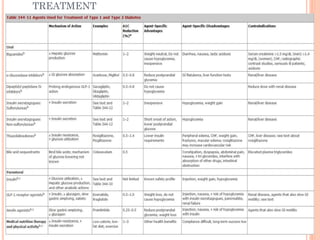
TREATMENT
REFERENCES


Review Article -Insulin and Insulin Resistance-Gisela WilcoxMelbourne Pathology, Collingwood, VIC 3066, Monash
University Department of MUnit, C/- Body Composition
Laboratory, Monash Medical Centre, Clayton, VIC 316



Willams Endocrinology12TH EDN



Teitz Clinical Chemistry 5TH EDN



Text book of biochemistry 3rd EDN lby dr.dinesh puri
Insulin resistance causes and  consequences

Insulin resistance causes and consequences

  • 1.
    INSULIN RESISTANCE CAUSESAND CONSEQUENCES DR .KAPIL DEV
  • 2.
    INSULIN  RESISTANCE Decreased biological responseto normal concentration of circulating insulin.  Insulin (endogenous) or administered (exogenous).  Beta cells in the pancreas subsequently increase their production of insulin, further contributing to hyperinsulinaemia
  • 3.
    INSULIN RESISTANCE ISOFTEN SEEN WITH THE FOLLOWING CONDITIONS DM,  Metabolic syndrome,  Obesity ,  Pregnancy ,  Infection or severe illness,  Stress ,  Inactivity and excess weight. 
  • 4.
    SIGNS AND SYMPTOMS  Inabilityto focus.  Increased hunger.  Intestinal bloating (cannot digest and absorb).  Sleepiness (after meals).  Weight gain, difficulty losing weight ( around abdominal organs in both males and females).   Increased blood pressure  Increased pro-inflammatory  . Acanthosis nigricans.   Depression. Increased blood triglyceride levels.
  • 5.
    ACANTHOSIS NIGRICANS  brown toblack, poorly defined, velvety hyperpigmentation of the skin.  found in body folds  ↑insulin activates keratinocyte insulin-like growth factor receptors, particularly IGF-1.  At high concentrations, insulin may also displace IGF-1 from IGFBP.  Increased circulating IGF may lead to keratinocyte and dermal fibroblast proliferation
  • 8.
    CAUSES AND CONSEQUENCES PKBmutation  Mutation in IRS  Increased in serine phosporylation of IRS protein  PI3 Kinase Activity  Metabolic syndrome.  Type 2 Diabetes mellites.  Obesity/ Inactivity and excess weight 
  • 9.
    Protein Kinase B PKBMUTATION  The serine/threonine kinase Akt (also called PKB), triggers insulin effects on the liver  Akt1 --inhibiting apoptotic processes, induce protein synthesis pathways, key signaling protein in cellular that lead to skeletal muscle hypertrophy, general tissue growth  Akt2 is required for the insulin-induced translocation of glucose transporter 4 (GLUT4) to the plasma membrane
  • 10.
     Phosphorylation of theserine stimulates Akt phosphorylation at a T308 residue.  Glycogen synthase kinase 3 (GSK-3) inhibited upon phosphorylation by Akt, which results in increase of glycogen synthesis  Suppression of hepatic glucose , PEPCK inhibition. Glycogen synthase kinase
  • 11.
    Insulin receptor substrate1 MUTATION IN IRS  Most of the metabolic and antiapoptotic effects of insulin are mediated by the signaling pathway involving the phosphorylation of the insulin receptor substrate (IRS) proteins, IRS-1, IRS- 2  Mutation of IRS 1 results in IR in muscles and adipose tissue.  Mutation of IRS 2 results in IR in liver.
  • 12.
    INCREASED IN SERINEPHOSPORYLATION OF IRS PROTEINS  Serine phosphorylation of IRS proteins can reduce the ability of IRS proteins to attract PI3-kinase, minimizing its activation.  Serine phosphorylation in turn ↓ IRS-1 tyrosine phosphorylation, impairing downstream effectors.  serine phosphorylation may lead to dissociation between insulin receptor/IRS-1 &/or IRS-1/PI3-kinase, preventing PI3-kinase activation or increased degradation of IRS-1  circulating FFA & adipokine tumour necrosis factor (TNF) may ↑ serine phosphorylation of IRS proteins, causing impaired insulin signal transduction
  • 13.
    CAUSES OF SERINEPHOSPHORYLATION OF IRS-1 PROTEINS ARE Obesity  Stress  Hyperinsulinemia   PKC θ • hyperglycemia • Diacylglycerol • inflammation
  • 14.
    PI3 KINASE ACTIVITY  class1a  Consisting of a regulatory subunit p85, tightly associated with a catalytic subunit, p110.  p85 monomer & p85-p110 heterodimer compete for same binding sites on tyrosine-phosphorylated IRS proteins, Imbalance could cause either ↑ or ↓PI3kinase activity  Human placental growth hormone causes severe insulin resistance by specifically ↑ expression of p85α subunit  Subsequently affecting the ability of insulin to stimulate the association of the p85-p110 heterodimer with IRS-1  Reducing the PI3-kinase insulin signaling resistant states induced by obesity, type 2 diabetes
  • 16.
    PKC Ca2+ cPKCs (α, βⅠ, βⅡ, γ) DAG + + nPKCs (δ,ε, θ, η) aPKCs (ζ, λ) + No response No response
  • 17.
    FATTY ACID INDUCEDIR defective insulin-stimulated glucose transport activity ↑intramyocellular lipid metabolites (fatty acyl CoAs & diacylglycerol) Activating PKC activate a serine/threonine kinase cascade Defect insulin signaling through the Ser/Thr phosphorylation IRS-1 Reduced IRS 1 associated PI3K activity Defective regulation of GLUT4
  • 18.
    DIABETES  The primary defectsin insulin action appear to be in muscle cells and adipocytes, with impaired GLUT 4 translocation resulting in impaired insulin-mediated glucose transport.  β cells fail to compensate for the prevailing insulin resistance leading impaired glucose tolerance.  As glucose levels rise, β cell function deteriorates further, with diminishing sensitivity to glucose and worsening hyperglycemia and diabetes develops.
  • 19.
    PREGNANCY  Due to thecombined effects of human placental lactogen, progesterone, oestradiol and cortisol, which act as counterregulatory hormones to insulin mainly in 3rd trimester of pregnancy.  Exaggeration of the insulin resistance normally seen in pregnancy is associated with gestational diabetes mellitus and gestational hypertension
  • 20.
    PCOS  In 2003 Rotterdam-indicated PCOS   excess androgen activity   Oligoovulation &/or anovulation polycystic ovaries (ultrasound) The ovarian dysfunction relates to the effects of compensatory hyperinsulinaemia increasing pituitary LH secretion & androgen production by the theca cells of the ovary.  Aromatization of androgens in setting of obesity ↑production of oestrogens, further impairing function of the HPA axis.  Hyperinsulinaemia also suppresses SHBG production by liver, ↑ free androgens. Elevated androgens in turn further aggravate insulin resistance.
  • 21.
    Hyperinsulinemia abnormalities of hypothalamic-pituitary-ovarianaxis ↑ GnR pulse frequency, ↑ovarian androgen production ↑ LH/FSH ratio, ↓follicular maturation,↓ SHBG binding.  PCOS
  • 22.
    INSULIN RESISTANCE SYNDROME  Constellationof associated clinical and laboratory findings consisting of Insulin resistance, Hyperinsulinemia dyslipidemia (↓HDL,↑ TG), Hypertension  Clinical syndromes associated with insulin resistance include type 2 diabetes, cardiovascular disease, essential hypertension, polycystic ovary syndrome, non-alcoholic fatty liver disease, certain forms of cancer and sleep apnoea.
  • 23.
  • 24.
    HYPERTENSION  Insulin is avasodilator with secondary effects on Na+2 reabsorption.  Hyperinsulinemia may result in enhanced sodium reabsorption and increased sympathetic nervous system (SNS) activity and contribute to the hypertension.
  • 25.
    INSULIN RESISTANCE ROLEIN DEVELOPMENT OF ATHEROSCLEROSIS AND HYPERTENSION  Compensatory hyperinsulinaemia is associated higher levels of plasminogen activator inhibitor-1 (PAI-1) and ↑ fibrinogen levels  Dyslipidaemia with ↑ LDL, ↓ HDL are also found in insulin resistant states.  Again, lower levels of testosterone in men have been associated with a proatherogenic lipid profile (high total and LDL cholesterol)  Testosterone is an L-channel calcium blocker acting directly at the level of the ion pore serve as systemic vasodilator improve cardiac index and functional capacity.
  • 26.
     Endothelin 1, apotent vasoconstrictor also inhibits insulin signalling via PIP-3 kinase & competes with NO resulting in endothelial dysfunction.  Mitogenic properties, mediated via MAP (mitogen activated protein) kinase pathway, remain intact.  These mitogenic effects of insulin on endothelial smooth muscle cell proliferation probably contribute to atherosclerosis.
  • 27.
    UNCOMMON GENETIC DISORDERS ASSOCIATEDWITH INSULIN RESISTANCE              Down’s Syndrome Turner’s Syndrome Klinefelter’s Syndrome Thalassaemia Haemochromatosis Lipodystrophy Progeria Huntington’s Chorea Myotonic dystrophy Friedrich’s ataxia Laurence-Moon-Biedel syndrome Glycogen storage diseases type I & III Mitochondrial disorders
  • 28.
    MEASUREMENT OF INSULINRESISTANCE Research Methods  HOMA IR = Fasting Glucose(mmol/L) x Fasting Insulin(mU/L) 22.5  Quantitative Insulin Sensitivity Check Index (QUICKI ) = 1 / [log(fasting insulin µU/mL) + log(FBG mg/dL)]
  • 29.
     Functional Measures ofInsulin Resistance  McLoughlin et al were able to identify insulin resistant individuals from an overweight-obese cohort  plasma triglyceride concentration,  ratio of triglyceride to high-density lipoprotein  cholesterol concentrations  insulin concentration.  Using cut points of    1.47 mmol/L for TG, 1.8 mmol/L for the TG-HDL - cholesterol ratio 109 pmol/L (16 mIU/L) for insulin
  • 30.
  • 31.
    REFERENCES  Review Article -Insulinand Insulin Resistance-Gisela WilcoxMelbourne Pathology, Collingwood, VIC 3066, Monash University Department of MUnit, C/- Body Composition Laboratory, Monash Medical Centre, Clayton, VIC 316  Willams Endocrinology12TH EDN  Teitz Clinical Chemistry 5TH EDN  Text book of biochemistry 3rd EDN lby dr.dinesh puri