JELILAT KAREEM
KUZIVA ZVAREVASHE
EMILY CLARKE
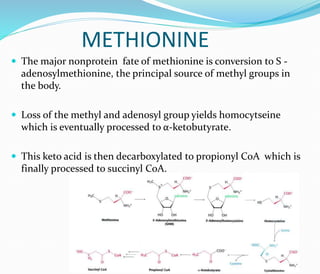
METHIONINE
 The major nonprotein fate of methionine is conversion to S -
adenosylmethionine, the principal source of methyl groups in
the body.
 Loss of the methyl and adenosyl group yields homocytseine
which is eventually processed to α-ketobutyrate.
 This keto acid is then decarboxylated to propionyl CoA which is
finally processed to succinyl CoA.
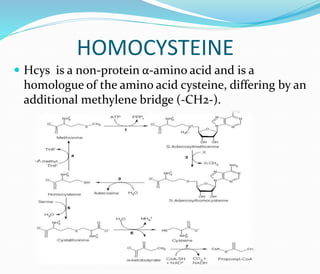
HOMOCYSTEINE
 Hcys is a non-protein α-amino acid and is a
homologue of the amino acid cysteine, differing by an
additional methylene bridge (-CH2-).
 It is a metabolic byproduct of protein metabolism
and in particular the metabolism of methionine.
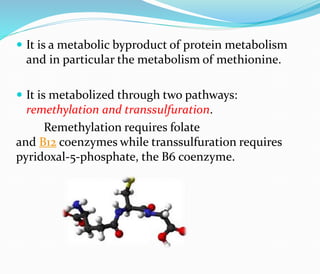
 It is metabolized through two pathways:
remethylation and transsulfuration.
Remethylation requires folate
and B12 coenzymes while transsulfuration requires
pyridoxal-5-phosphate, the B6 coenzyme.
The Methylation Cycle and Hcys:
• Typically, about 50% of Hcys is remethylated and the
remaining Hcys is transsulfurated to cysteine. The
cysteine that is formed is then used to produce
glutathione. Glutathione is a powerful anti-oxidant
that protects cellular components against oxidative
stress.
• Vitamin B2 and magnesium are involved in Hcys
metabolism. Without proper levels of methylated B6,
B12, folate, B2 and magnesium, dangerous levels of
Hcys may build up in the body.
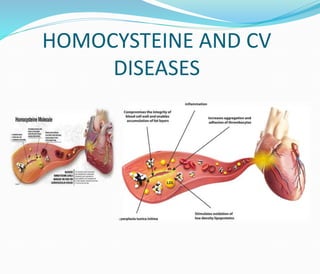
HOMOCYSTEINE AND CV
DISEASES
What causes elevated Hcys levels?
 Hcys levels increase in the body when the metabolism of
methionine to cysteine is impaired. This may be due to
dietary deficiencies in vitamin B6, vitamin B12, and folic
acid.
 While alcoholics tend to be malnourished and lacking in B
vitamins, alcohol itself may independently cause Hcys levels
in the blood to rise.
 Can elevated Hcys levels be hereditary?
 Genetic abnormalities may affect the body's ability to
metabolize Hcys to cysteine, causing elevation of Hcys levels
in the blood and urine.
HYPERHOMOCYSTEINEMIA
 HyperHcys-emia is defined as a medical condition
characterized by an abnormally high level (above
15 μmol/L) of Hcys in the blood.
 There are two types of hyperhomocysteinemia:
(1) the rare but severe forms are due to major genetic
mutations of the enzymes implicated in Hcys
metabolism;
The enzymes involved can be methylene
tetrahydrofolate reductase, methionine synthase, and
cystathionine-β-synthase.
The most common one is single nucleotide
polymorphisms of 5,10-methylene tetrahydrofolate
reductase which has been associated with mild and
moderate hyperhomocysteinemia.
(2) the more common forms cause moderately
elevated Hcys levels related to a pathogenesis such as
genetic and environmental factors.
EFFECTS OF HYPERHOMOCYSTEINEMIA ON CV
DISEASES
There has been an indication towards a significant
correlation between hyperhomocysteinemia and
cardiovascular disease and its complications such as
heart attacks and strokes.
It is also believed that hyperhomocysteinemia leads
to endothelial cell damage, and reduction in the
flexibility of vessels.
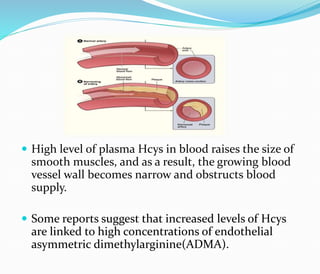
 High level of plasma Hcys in blood raises the size of
smooth muscles, and as a result, the growing blood
vessel wall becomes narrow and obstructs blood
supply.
 Some reports suggest that increased levels of Hcys
are linked to high concentrations of endothelial
asymmetric dimethylarginine(ADMA).
Hyperhomocysteinemia has been associated with an
increased risk of cardiovascular disease in end-stage renal
disease, especially in patients without malnutrition and
inflammation.
 Also, plasma ADMA levels have been associated with
cardiovascular disease in renal failure patients. Both Hcys
and ADMA are thought to mediate their adverse vascular
effects by impairing endothelial, nitric oxide-dependent
function resulting in decreased vasodilatation, increased
smooth muscle cell proliferation, platelet dysfunction
and increased monocyte adhesion.
 Hcys-induced injury to the arterial wall is one of the factors
that can initiate the process of atherosclerosis, leading to
endothelial dysfunction and eventually to heart attacks and
stroke.
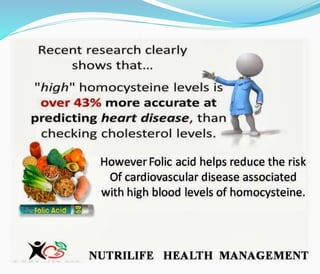
 It has long been known that high levels of Hcys is an
independent predictor of CV disease. However, in the absence of
a clear mechanism linking Hcys to CV disease, there has been an
ongoing debate about whether this relationship is one of cause
and effect or whether an elevated level of plasma Hcys is an
epiphenomenon, reflecting the presence of some other
proatherogenic factor that is actually responsible for the
cardiovascular disease.
 The mechanistic link may be a Hcys-induced reduction in the
concentration of high density lipoproteins (HDLs).
 A report made it known that Hcys reduces the concentration of
HDL cholesterol in plasma by inhibiting the hepatic synthesis of
apoA-I, the main HDL apolipoprotein. So there is a real
possibility that a Hcys-induced inhibition of apoA-I synthesis is
the mechanism linking Hcys to the development of
atherosclerosis.
• Common levels of hyperhomocysteinemia in
Western populations are 10- 12μmol/L, and a
rise of about 20μmol/L are found in
populations with low Vit. B intake (New Delhi
as an instance).
• Women have 10- 15% less Hcys during their
reproductive years than men; this explains
why they suffer myocardial infarction 10- 15
years later than men.
HOMOCYSTINURIA
 Also called Classical homocystinuria, because it is a
deficiency of cystathionine beta synthase
deficiency.
 Children born with homocystinuria, often died at a very
young age with advanced atherosclerosis in their
arteries because this defect leads to a multi-systemic
disorder of the connective tissue, muscles, (CNS),
and CV system.
 Homocystinuria represents a group of
hereditary metabolic disorders characterized by an
accumulation of the homocysteine in the serum and an
increased excretion of homocysteine in the urine.
 Signs and symptoms of homocystinuria that may be
seen include the following:
o A family history of homocystinuria
o Flush across the cheeks
o Musculoskeletal
 Tall, thin build resembling Marfanoid habitus
 Long limbs (dolichostenomelia)
 High-arched feet (pes cavus)
 Knock knees (genu valgum)
o Intellectual disability
o Seizures
o Psychiatric disease
 Eye anomalies
 Vascular disease
 Extensive atheroma formation at a young age which
affects many arteries but not the coronary arteries
 Intravascular thrombosis
Symptoms of Elevated Hcys
Elevated homocysteine levels in the body DO NOT
cause any symptoms
 Elevated Hcys levels affect the interior lining of
blood vessels in the body, increasing the risk
of atherosclerosis or narrowing of blood vessels.
This can result in early heart attack and stroke
 There is a relationship between the levels of Hcys in the
body and the size of the carotid arteries that supply the
brain with blood; the higher Hcys level, the narrower or
more stenosed the carotid artery.
 Alzheimer's disease and other types of dementia may
be more frequently seen in patients with increased
Hcys in the blood
 In pregnancy, Hcys levels tend to decrease. Elevated
Hcys levels may be associated with some fetal
abnormalities and with potential blood vessel problems
in the placenta, causing abruption.
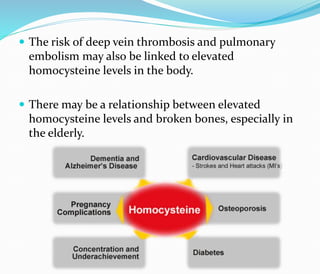
 The risk of deep vein thrombosis and pulmonary
embolism may also be linked to elevated
homocysteine levels in the body.
 There may be a relationship between elevated
homocysteine levels and broken bones, especially in
the elderly.
TREATMENT
 Blood tests that show Hcys levels above 8 μmol/L are
an indication of methylation deficiencies and elevated
risk of cardiovascular disease.
 These individuals should supplement their diet with
pre-methylated forms of B vitamins such as methyl-
folate, methyl-B12, Pyridoxal 5′ Phosphate, riboflavin,
trimethylglycine, magnesium and choline.
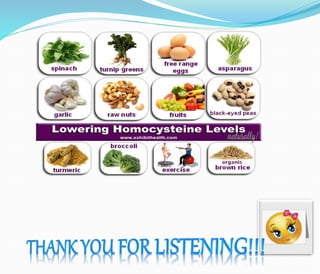
 N-Acetyl Cysteine and lipoic acid are also great
supplements to help boost glutathione and lower
Hcys levels. High quality omega-3 fatty acids
and medium chain saturated fats from coconut oil are
critical players in lowering Hcys as well.
 The effects of vitamin treatment may be monitored
by routine, scheduled blood tests.
 However, evidence to support the value of treating
elevated blood levels of homocysteine (except in
cases of severely high levels) in the general
population is lacking. Therefore, it is not
recommended that people be treated with vitamins
to lower homocysteine levels as a way to
prevent vascular disease.
 Some patients do not respond to the vitamin
supplementation and are considered pyridoxine-
resistant. A diet low in methionine is recommended
in addition to the B vitamins.
Homocysteine and methionine

Homocysteine and methionine

  • 1.
  • 2.
    METHIONINE  The majornonprotein fate of methionine is conversion to S - adenosylmethionine, the principal source of methyl groups in the body.  Loss of the methyl and adenosyl group yields homocytseine which is eventually processed to α-ketobutyrate.  This keto acid is then decarboxylated to propionyl CoA which is finally processed to succinyl CoA.
  • 3.
    HOMOCYSTEINE  Hcys isa non-protein α-amino acid and is a homologue of the amino acid cysteine, differing by an additional methylene bridge (-CH2-).
  • 4.
     It isa metabolic byproduct of protein metabolism and in particular the metabolism of methionine.  It is metabolized through two pathways: remethylation and transsulfuration. Remethylation requires folate and B12 coenzymes while transsulfuration requires pyridoxal-5-phosphate, the B6 coenzyme.
  • 5.
    The Methylation Cycleand Hcys: • Typically, about 50% of Hcys is remethylated and the remaining Hcys is transsulfurated to cysteine. The cysteine that is formed is then used to produce glutathione. Glutathione is a powerful anti-oxidant that protects cellular components against oxidative stress. • Vitamin B2 and magnesium are involved in Hcys metabolism. Without proper levels of methylated B6, B12, folate, B2 and magnesium, dangerous levels of Hcys may build up in the body.
  • 6.
  • 7.
    What causes elevatedHcys levels?  Hcys levels increase in the body when the metabolism of methionine to cysteine is impaired. This may be due to dietary deficiencies in vitamin B6, vitamin B12, and folic acid.  While alcoholics tend to be malnourished and lacking in B vitamins, alcohol itself may independently cause Hcys levels in the blood to rise.  Can elevated Hcys levels be hereditary?  Genetic abnormalities may affect the body's ability to metabolize Hcys to cysteine, causing elevation of Hcys levels in the blood and urine.
  • 8.
    HYPERHOMOCYSTEINEMIA  HyperHcys-emia isdefined as a medical condition characterized by an abnormally high level (above 15 μmol/L) of Hcys in the blood.  There are two types of hyperhomocysteinemia: (1) the rare but severe forms are due to major genetic mutations of the enzymes implicated in Hcys metabolism; The enzymes involved can be methylene tetrahydrofolate reductase, methionine synthase, and cystathionine-β-synthase. The most common one is single nucleotide polymorphisms of 5,10-methylene tetrahydrofolate reductase which has been associated with mild and moderate hyperhomocysteinemia.
  • 9.
    (2) the morecommon forms cause moderately elevated Hcys levels related to a pathogenesis such as genetic and environmental factors. EFFECTS OF HYPERHOMOCYSTEINEMIA ON CV DISEASES There has been an indication towards a significant correlation between hyperhomocysteinemia and cardiovascular disease and its complications such as heart attacks and strokes. It is also believed that hyperhomocysteinemia leads to endothelial cell damage, and reduction in the flexibility of vessels.
  • 10.
     High levelof plasma Hcys in blood raises the size of smooth muscles, and as a result, the growing blood vessel wall becomes narrow and obstructs blood supply.  Some reports suggest that increased levels of Hcys are linked to high concentrations of endothelial asymmetric dimethylarginine(ADMA).
  • 11.
    Hyperhomocysteinemia has beenassociated with an increased risk of cardiovascular disease in end-stage renal disease, especially in patients without malnutrition and inflammation.  Also, plasma ADMA levels have been associated with cardiovascular disease in renal failure patients. Both Hcys and ADMA are thought to mediate their adverse vascular effects by impairing endothelial, nitric oxide-dependent function resulting in decreased vasodilatation, increased smooth muscle cell proliferation, platelet dysfunction and increased monocyte adhesion.  Hcys-induced injury to the arterial wall is one of the factors that can initiate the process of atherosclerosis, leading to endothelial dysfunction and eventually to heart attacks and stroke.
  • 12.
     It haslong been known that high levels of Hcys is an independent predictor of CV disease. However, in the absence of a clear mechanism linking Hcys to CV disease, there has been an ongoing debate about whether this relationship is one of cause and effect or whether an elevated level of plasma Hcys is an epiphenomenon, reflecting the presence of some other proatherogenic factor that is actually responsible for the cardiovascular disease.  The mechanistic link may be a Hcys-induced reduction in the concentration of high density lipoproteins (HDLs).  A report made it known that Hcys reduces the concentration of HDL cholesterol in plasma by inhibiting the hepatic synthesis of apoA-I, the main HDL apolipoprotein. So there is a real possibility that a Hcys-induced inhibition of apoA-I synthesis is the mechanism linking Hcys to the development of atherosclerosis.
  • 14.
    • Common levelsof hyperhomocysteinemia in Western populations are 10- 12μmol/L, and a rise of about 20μmol/L are found in populations with low Vit. B intake (New Delhi as an instance). • Women have 10- 15% less Hcys during their reproductive years than men; this explains why they suffer myocardial infarction 10- 15 years later than men.
  • 15.
    HOMOCYSTINURIA  Also calledClassical homocystinuria, because it is a deficiency of cystathionine beta synthase deficiency.  Children born with homocystinuria, often died at a very young age with advanced atherosclerosis in their arteries because this defect leads to a multi-systemic disorder of the connective tissue, muscles, (CNS), and CV system.  Homocystinuria represents a group of hereditary metabolic disorders characterized by an
  • 16.
    accumulation of thehomocysteine in the serum and an increased excretion of homocysteine in the urine.  Signs and symptoms of homocystinuria that may be seen include the following: o A family history of homocystinuria o Flush across the cheeks o Musculoskeletal  Tall, thin build resembling Marfanoid habitus  Long limbs (dolichostenomelia)  High-arched feet (pes cavus)  Knock knees (genu valgum) o Intellectual disability o Seizures o Psychiatric disease
  • 17.
     Eye anomalies Vascular disease  Extensive atheroma formation at a young age which affects many arteries but not the coronary arteries  Intravascular thrombosis Symptoms of Elevated Hcys Elevated homocysteine levels in the body DO NOT cause any symptoms  Elevated Hcys levels affect the interior lining of blood vessels in the body, increasing the risk of atherosclerosis or narrowing of blood vessels. This can result in early heart attack and stroke
  • 18.
     There isa relationship between the levels of Hcys in the body and the size of the carotid arteries that supply the brain with blood; the higher Hcys level, the narrower or more stenosed the carotid artery.  Alzheimer's disease and other types of dementia may be more frequently seen in patients with increased Hcys in the blood  In pregnancy, Hcys levels tend to decrease. Elevated Hcys levels may be associated with some fetal abnormalities and with potential blood vessel problems in the placenta, causing abruption.
  • 19.
     The riskof deep vein thrombosis and pulmonary embolism may also be linked to elevated homocysteine levels in the body.  There may be a relationship between elevated homocysteine levels and broken bones, especially in the elderly.
  • 20.
    TREATMENT  Blood teststhat show Hcys levels above 8 μmol/L are an indication of methylation deficiencies and elevated risk of cardiovascular disease.  These individuals should supplement their diet with pre-methylated forms of B vitamins such as methyl- folate, methyl-B12, Pyridoxal 5′ Phosphate, riboflavin, trimethylglycine, magnesium and choline.  N-Acetyl Cysteine and lipoic acid are also great supplements to help boost glutathione and lower Hcys levels. High quality omega-3 fatty acids and medium chain saturated fats from coconut oil are critical players in lowering Hcys as well.
  • 21.
     The effectsof vitamin treatment may be monitored by routine, scheduled blood tests.  However, evidence to support the value of treating elevated blood levels of homocysteine (except in cases of severely high levels) in the general population is lacking. Therefore, it is not recommended that people be treated with vitamins to lower homocysteine levels as a way to prevent vascular disease.  Some patients do not respond to the vitamin supplementation and are considered pyridoxine- resistant. A diet low in methionine is recommended in addition to the B vitamins.