
Muscles are very important part
of our body. Without muscles
the body will lose its ability to
move and carry out various
actions. In fact, without the
human muscular system, we
probably won't be able to
survive.
DISEASE OF MUSCULAR SYSTEM
Muscular Dystrophy

This is a genetic disease is a group of inherited
muscle disease that causes damage to muscle
fibers. The symptoms of muscular dystrophy
disease include weakness, loss of mobility and
lack of coordination. The most common diseases
classified as muscular dystrophy are Duchenne,
Becker,       limb        girdle,     congenital,
facioscapulohumeral, myotonic, oculopharyngeal,
distal, and Emery-Dreifuss. The basic fact about
muscular dystrophy is that there is no specific
cure for muscular dystrophy. You can read more
about muscular dystrophy life expectancy.
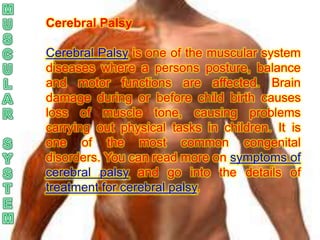
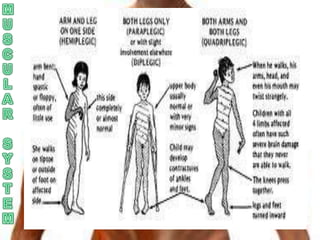
Cerebral Palsy

Cerebral Palsy is one of the muscular system
diseases where a persons posture, balance
and motor functions are affected. Brain
damage during or before child birth causes
loss of muscle tone, causing problems
carrying out physical tasks in children. It is
one of the most common congenital
disorders. You can read more on symptoms of
cerebral palsy and go into the details of
treatment for cerebral palsy.
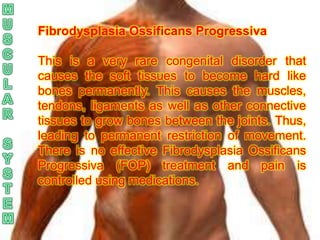
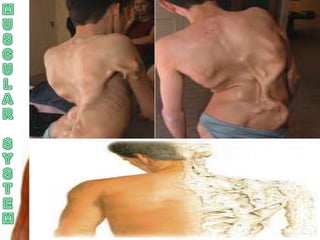
Fibrodysplasia Ossificans Progressiva

This is a very rare congenital disorder that
causes the soft tissues to become hard like
bones permanently. This causes the muscles,
tendons, ligaments as well as other connective
tissues to grow bones between the joints. Thus,
leading to permanent restriction of movement.
There is no effective Fibrodysplasia Ossificans
Progressiva (FOP) treatment and pain is
controlled using medications.
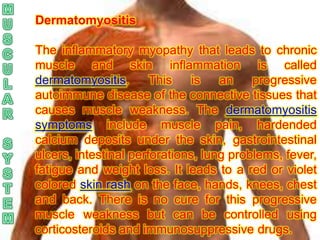
Dermatomyositis

The inflammatory myopathy that leads to chronic
muscle and skin inflammation is called
dermatomyositis.       This    is   an    progressive
autoimmune disease of the connective tissues that
causes muscle weakness. The dermatomyositis
symptoms include muscle pain, hardended
calcium deposits under the skin, gastrointestinal
ulcers, intestinal perforations, lung problems, fever,
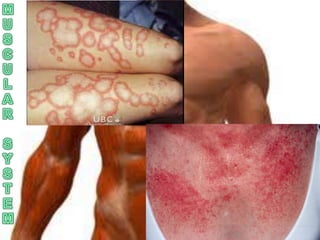
fatigue and weight loss. It leads to a red or violet
colored skin rash on the face, hands, knees, chest
and back. There is no cure for this progressive
muscle weakness but can be controlled using
corticosteroids and immunosuppressive drugs.
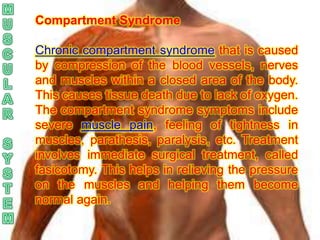
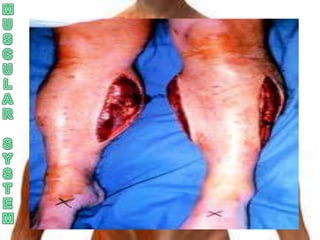
Compartment Syndrome

Chronic compartment syndrome that is caused
by compression of the blood vessels, nerves
and muscles within a closed area of the body.
This causes tissue death due to lack of oxygen.
The compartment syndrome symptoms include
severe muscle pain, feeling of tightness in
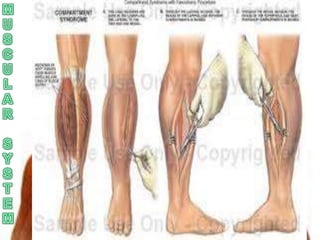
muscles, parathesis, paralysis, etc. Treatment
involves immediate surgical treatment, called
fasicotomy. This helps in relieving the pressure
on the muscles and helping them become
normal again.
Myasthenia Gravis

Myasthenia gravis is a chronic autoimmune
disease characterized by muscle weakness and
fatigue. There is a breakdown of the
neuromuscular junction and thus, brain loses
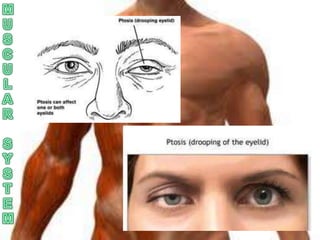
control over these muscles. The myasthenia
gravis symptoms and signs include drooping
eyelids, difficulty swallowing, muscle fatigue,
breathing difficulty, inability to control facial
expressions, etc. Medications and surgical
intervention are a part of myasthenia gravis
treatment.
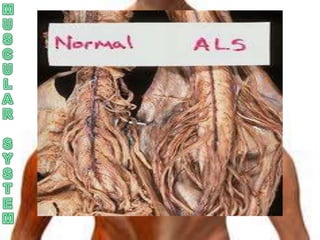
Amyotrophic Lateral Sclerosis

Amyotrophic lateral sclerosis is a serious
neurodegenerative       disease.      This
disease is also known as the Lou
Gehrig's disease. In this disease, the
motor neurons destroy that leads to loss
of control over voluntary muscle
movement. The early symptoms of ALS
include difficulty to swallow, breath and
speak. Paralysis is an advanced Lou
Gehrig's disease symptom.
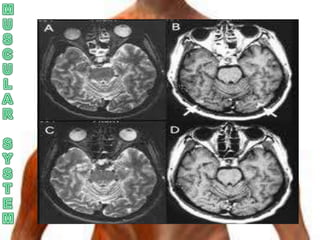
Mitochondrial Myopathies

Mitochondrial myopathies is a condition
where the mitochondria, the powerhouse of
cells, is damaged. The symptoms of this
neuromuscular disease include muscle
weakness, heart rhythm abnomalities,
deafness, blindness and heart failure. In
some cases, it leads to seizures, dementia,
drooping eyelids and vomiting. Other
symptoms include breathing difficulty,
nausea and headache.
Rhabdomyolysis

Rhabdomyolysis is a condition where there is
rapid skeletal muscle destruction. This causes
the muscle fibers to breakdown into myoglobin
that is released into the urine. This leads to
kidney failure as myoglobin is dangerous to
the kidney. Rhabdomyolysis symptoms include
muscle weakness, stiffness, and pain. If
detected early, there is a possibility of
rhabdomyolysis treatment. Treatment includes
use of intravenous fluid, dialysis as well as
hemofiltration in severe cases.
Myofascial Pain Syndrome

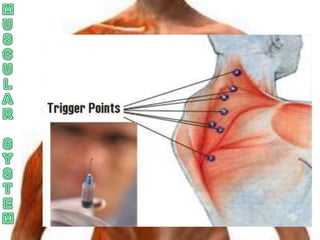
Myofascial pain syndrome is a chronic
muscle pain disorder. It is characterized by
aches, pain and burning sensation around
sensitive points of the muscles called the
trigger points. One may also feel joint
stiffness, area of tension like a knot and
sleep problems due to severe pain. Use of
corticosteroids, botulism toxin injections,
massage therapy and physical therapy help
in management of myofacial pain
syndrome.
A new gene mutation that causes muscular
dystrophy has been identified by University
of Iowa researchers thanks to a strong
international collaboration and a single
patient with mild muscle disease and severe
cognitive impairment.
Read more: New Form of Muscular
Dystrophy Identified

http://www.medindia.net/news/New-Form-
of-Muscular-Dystrophy-Identified-82128-
1.htm#ixzz1SdelMK9Q

http://www.medindia.net/news/New-Form-of-Muscular-Dystrophy-
Identified-82128-1.htm
Muscular system

Muscular system

  • 2.
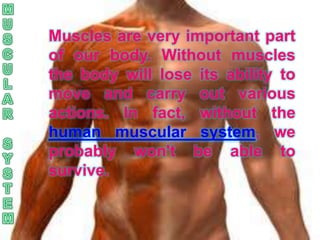
    Muscles are veryimportant part of our body. Without muscles the body will lose its ability to move and carry out various actions. In fact, without the human muscular system, we probably won't be able to survive.
  • 3.
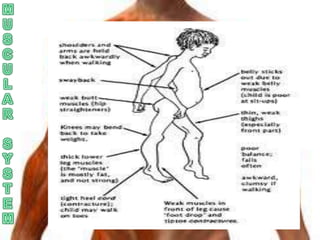
    DISEASE OF MUSCULARSYSTEM Muscular Dystrophy This is a genetic disease is a group of inherited muscle disease that causes damage to muscle fibers. The symptoms of muscular dystrophy disease include weakness, loss of mobility and lack of coordination. The most common diseases classified as muscular dystrophy are Duchenne, Becker, limb girdle, congenital, facioscapulohumeral, myotonic, oculopharyngeal, distal, and Emery-Dreifuss. The basic fact about muscular dystrophy is that there is no specific cure for muscular dystrophy. You can read more about muscular dystrophy life expectancy.
  • 5.
    Cerebral Palsy Cerebral Palsyis one of the muscular system diseases where a persons posture, balance and motor functions are affected. Brain damage during or before child birth causes loss of muscle tone, causing problems carrying out physical tasks in children. It is one of the most common congenital disorders. You can read more on symptoms of cerebral palsy and go into the details of treatment for cerebral palsy.
  • 7.
    Fibrodysplasia Ossificans Progressiva Thisis a very rare congenital disorder that causes the soft tissues to become hard like bones permanently. This causes the muscles, tendons, ligaments as well as other connective tissues to grow bones between the joints. Thus, leading to permanent restriction of movement. There is no effective Fibrodysplasia Ossificans Progressiva (FOP) treatment and pain is controlled using medications.
  • 9.
    Dermatomyositis The inflammatory myopathythat leads to chronic muscle and skin inflammation is called dermatomyositis. This is an progressive autoimmune disease of the connective tissues that causes muscle weakness. The dermatomyositis symptoms include muscle pain, hardended calcium deposits under the skin, gastrointestinal ulcers, intestinal perforations, lung problems, fever, fatigue and weight loss. It leads to a red or violet colored skin rash on the face, hands, knees, chest and back. There is no cure for this progressive muscle weakness but can be controlled using corticosteroids and immunosuppressive drugs.
  • 11.
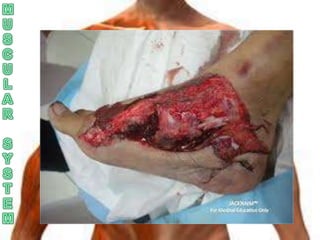
    Compartment Syndrome Chronic compartmentsyndrome that is caused by compression of the blood vessels, nerves and muscles within a closed area of the body. This causes tissue death due to lack of oxygen. The compartment syndrome symptoms include severe muscle pain, feeling of tightness in muscles, parathesis, paralysis, etc. Treatment involves immediate surgical treatment, called fasicotomy. This helps in relieving the pressure on the muscles and helping them become normal again.
  • 14.
    Myasthenia Gravis Myasthenia gravisis a chronic autoimmune disease characterized by muscle weakness and fatigue. There is a breakdown of the neuromuscular junction and thus, brain loses control over these muscles. The myasthenia gravis symptoms and signs include drooping eyelids, difficulty swallowing, muscle fatigue, breathing difficulty, inability to control facial expressions, etc. Medications and surgical intervention are a part of myasthenia gravis treatment.
  • 16.
    Amyotrophic Lateral Sclerosis Amyotrophiclateral sclerosis is a serious neurodegenerative disease. This disease is also known as the Lou Gehrig's disease. In this disease, the motor neurons destroy that leads to loss of control over voluntary muscle movement. The early symptoms of ALS include difficulty to swallow, breath and speak. Paralysis is an advanced Lou Gehrig's disease symptom.
  • 18.
    Mitochondrial Myopathies Mitochondrial myopathiesis a condition where the mitochondria, the powerhouse of cells, is damaged. The symptoms of this neuromuscular disease include muscle weakness, heart rhythm abnomalities, deafness, blindness and heart failure. In some cases, it leads to seizures, dementia, drooping eyelids and vomiting. Other symptoms include breathing difficulty, nausea and headache.
  • 20.
    Rhabdomyolysis Rhabdomyolysis is acondition where there is rapid skeletal muscle destruction. This causes the muscle fibers to breakdown into myoglobin that is released into the urine. This leads to kidney failure as myoglobin is dangerous to the kidney. Rhabdomyolysis symptoms include muscle weakness, stiffness, and pain. If detected early, there is a possibility of rhabdomyolysis treatment. Treatment includes use of intravenous fluid, dialysis as well as hemofiltration in severe cases.
  • 22.
    Myofascial Pain Syndrome Myofascialpain syndrome is a chronic muscle pain disorder. It is characterized by aches, pain and burning sensation around sensitive points of the muscles called the trigger points. One may also feel joint stiffness, area of tension like a knot and sleep problems due to severe pain. Use of corticosteroids, botulism toxin injections, massage therapy and physical therapy help in management of myofacial pain syndrome.
  • 24.
    A new genemutation that causes muscular dystrophy has been identified by University of Iowa researchers thanks to a strong international collaboration and a single patient with mild muscle disease and severe cognitive impairment. Read more: New Form of Muscular Dystrophy Identified http://www.medindia.net/news/New-Form- of-Muscular-Dystrophy-Identified-82128- 1.htm#ixzz1SdelMK9Q http://www.medindia.net/news/New-Form-of-Muscular-Dystrophy- Identified-82128-1.htm