Home energy management system
Sami Repo
Tampere University of Technology
sami.repo@tut.fi
14.11.2012
Contents
•  Why DSO is interested in Home Energy Management
System (HEMS)?
•  HEMS in distribution network automation
•  Alternation controller
•  Example
Why DSO is interested in HEMS?
•  Real-time monitoring of MV and LV networks
–  Monitoring of whole distribution network (measurements + alarms)
–  Operate closer to limits (improve utilization of network capacity)
–  Network planning risks have increased (DG, load changes)
–  Role of LV networks have increased (PV, EV, heat pumps, ...)
•  Integration of Distributed Energy Resources (DERs)
–  Load shifting to low load periods to avoid network congestion in
MV or LV networks
–  Load shifting to high local production periods to avoid LV network
voltage rise
–  Controlled island operation during disturbances becomes possible
•  Multipurpose ICT system for smart grid is needed
HEMS in distribution network automation
DMS
Aggregation
system
Secondary
substation
automation
HEMS
DERs
Dynamic
grid
tariffs
Info of DERs:
actual and
forecasted
Schedule
of DERs
Availability of
DERs
Direct controls
Coordination of network
management
Dynamic
energy
price
HEMS in distribution network automation
Smart meter
Thermostat
Enterprise Application Integration
Temperature EVDG
Direct load
control
PQ
monitoring
Mains
switch
Home energy management
DMS
MDMS CISNIS
Substation automation
SCADA NIS
Secondary substation
automation
PQ
monitoring
IED
IEDRTU
Secondary substation
automation
RTURTU
Control centre
Primary substation
Secondary
substation
Customer
Connection point
Aggregation
system
Where Aggregation
system should be
connected?
1. HEMS + DSO
control centre
2. Secondary
substation
automation +
DSO control
centre
Vision of HEMS
in distribution network automation
•  Integration of Aggregation system with secondary
substation automation
–  Needed where LV network is the bottleneck of the whole system
–  Secondary substation automation collect information from HEMS
first and then provides this information to Aggregator system
•  Aggregator system may not overload LV network
•  Fast response in case of emergency (fast changing) situations
•  Control centre level management is too slow (used only for
coordination purposes e.g. in day-ahead planning phase)
•  DSO provides automation system to end customers and
market participants
–  All market participants may use the same system
•  DSO is a neutral participant in energy market
•  National HEMS solution
•  Compare to smart meters
–  Owns secondary substation automation + smart meters + HEMS
–  Neighbourhood energy management realized by end customer
HEMS in distribution network automation
Alternation controller
Battery
Storage
and UPS
Solar
panel
Home
lighting
system
Car pre-heating
system
Secondary
substation
automation
HEMS
HVAC
Sauna
Stove
Electric
heating Storage
water
heater
EV
battery
charger
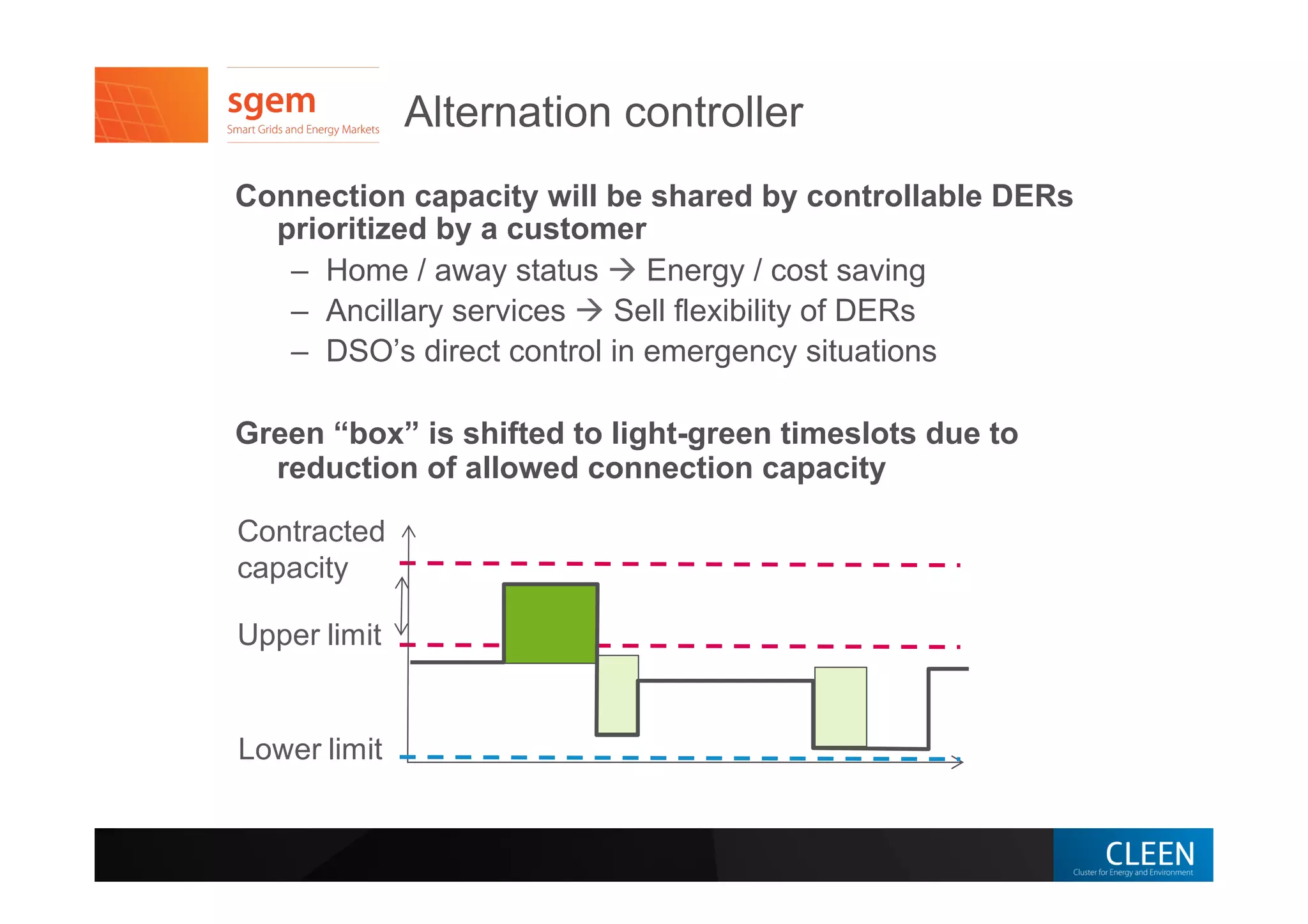
Connection capacity will be shared by controllable DERs
prioritized by a customer
–  Home / away status  Energy / cost saving
–  Ancillary services  Sell flexibility of DERs
–  DSO’s direct control in emergency situations
Green “box” is shifted to light-green timeslots due to
reduction of allowed connection capacity
Alternation controller
Contracted
capacity
Upper limit
Lower limit
Example

Home Energy Management System

  • 1.
    Home energy managementsystem Sami Repo Tampere University of Technology sami.repo@tut.fi 14.11.2012
  • 2.
    Contents •  Why DSOis interested in Home Energy Management System (HEMS)? •  HEMS in distribution network automation •  Alternation controller •  Example
  • 3.
    Why DSO isinterested in HEMS? •  Real-time monitoring of MV and LV networks –  Monitoring of whole distribution network (measurements + alarms) –  Operate closer to limits (improve utilization of network capacity) –  Network planning risks have increased (DG, load changes) –  Role of LV networks have increased (PV, EV, heat pumps, ...) •  Integration of Distributed Energy Resources (DERs) –  Load shifting to low load periods to avoid network congestion in MV or LV networks –  Load shifting to high local production periods to avoid LV network voltage rise –  Controlled island operation during disturbances becomes possible •  Multipurpose ICT system for smart grid is needed
  • 4.
    HEMS in distributionnetwork automation DMS Aggregation system Secondary substation automation HEMS DERs Dynamic grid tariffs Info of DERs: actual and forecasted Schedule of DERs Availability of DERs Direct controls Coordination of network management Dynamic energy price
  • 5.
    HEMS in distributionnetwork automation Smart meter Thermostat Enterprise Application Integration Temperature EVDG Direct load control PQ monitoring Mains switch Home energy management DMS MDMS CISNIS Substation automation SCADA NIS Secondary substation automation PQ monitoring IED IEDRTU Secondary substation automation RTURTU Control centre Primary substation Secondary substation Customer Connection point Aggregation system Where Aggregation system should be connected? 1. HEMS + DSO control centre 2. Secondary substation automation + DSO control centre
  • 6.
    Vision of HEMS indistribution network automation •  Integration of Aggregation system with secondary substation automation –  Needed where LV network is the bottleneck of the whole system –  Secondary substation automation collect information from HEMS first and then provides this information to Aggregator system •  Aggregator system may not overload LV network •  Fast response in case of emergency (fast changing) situations •  Control centre level management is too slow (used only for coordination purposes e.g. in day-ahead planning phase) •  DSO provides automation system to end customers and market participants –  All market participants may use the same system •  DSO is a neutral participant in energy market •  National HEMS solution •  Compare to smart meters –  Owns secondary substation automation + smart meters + HEMS –  Neighbourhood energy management realized by end customer
  • 7.
    HEMS in distributionnetwork automation
  • 8.
    Alternation controller Battery Storage and UPS Solar panel Home lighting system Carpre-heating system Secondary substation automation HEMS HVAC Sauna Stove Electric heating Storage water heater EV battery charger
  • 9.
    Connection capacity willbe shared by controllable DERs prioritized by a customer –  Home / away status  Energy / cost saving –  Ancillary services  Sell flexibility of DERs –  DSO’s direct control in emergency situations Green “box” is shifted to light-green timeslots due to reduction of allowed connection capacity Alternation controller Contracted capacity Upper limit Lower limit
  • 10.