Autorità per l’energia elettrica e il gas
Registration and validation of energy
saving activities – Practical
experiences and cost-effective
solutions
International Energy Agency seminar
Copenhagen, 19 April 2006
The Italian white certificates market and
the measurement and verification of end-
use energy efficiency improvements
Marcella Pavan
Head - Energy Efficiency Policy Division
Italian Regulatory Authority for Electricity and Gas (*)
(*) This is not an official document of the Italian Regulatory Authority for Electricity and Gas
Autorità per l’energia elettrica e il gas
ContentsContents
1. The Context: the Italian tradable white
certificates scheme
2. Major Measurement and Verification issues
3. The AEEG’s M&V approach and two practical
examples
4. Appendix
Autorità per l’energia elettrica e il gas
1. The Context: the Italian
tradable white certificates
scheme
Autorità per l’energia elettrica e il gas
Main features/1Main features/1
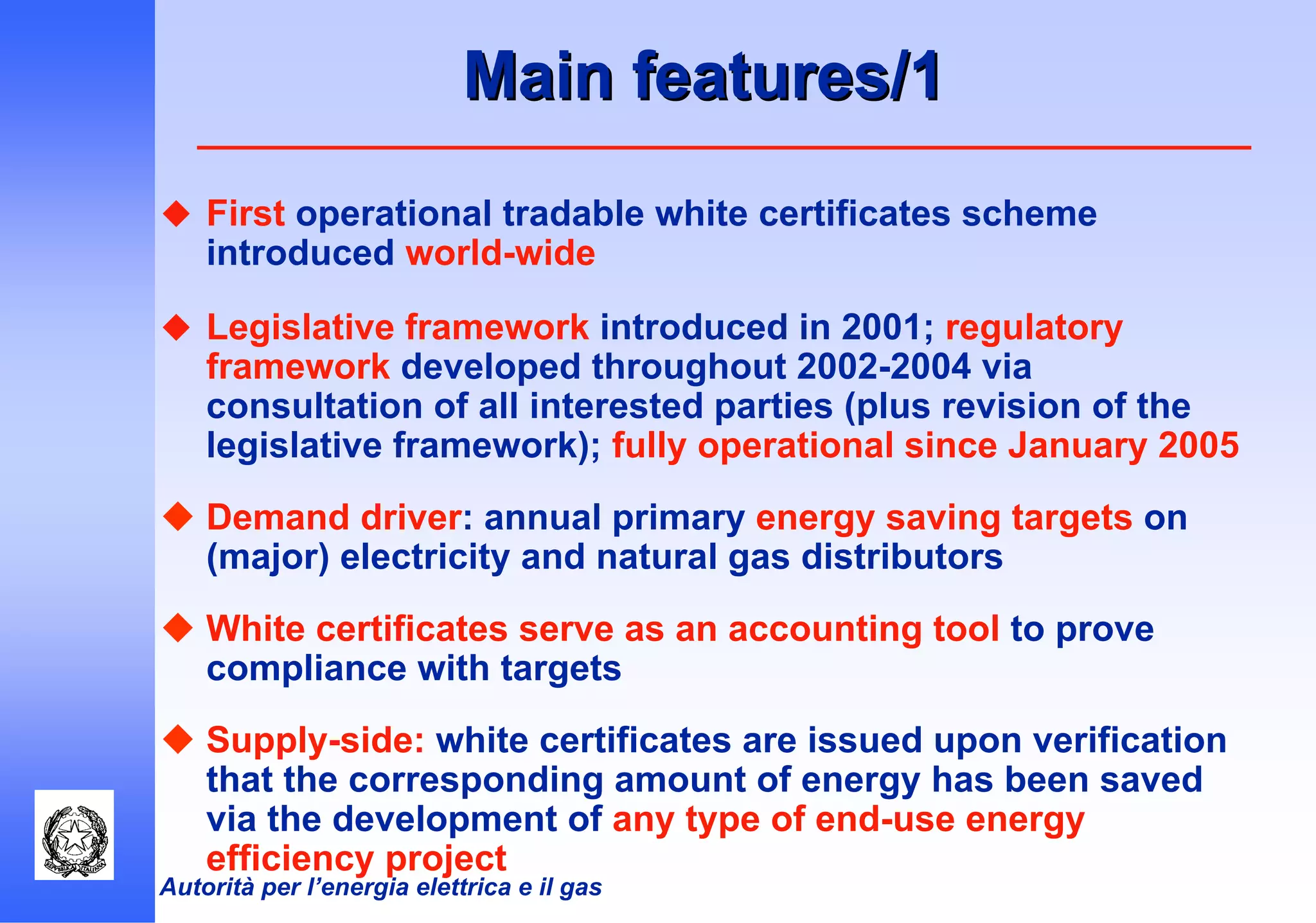
First operational tradable white certificates scheme
introduced world-wide
Legislative framework introduced in 2001; regulatory
framework developed throughout 2002-2004 via
consultation of all interested parties (plus revision of the
legislative framework); fully operational since January 2005
Demand driver: annual primary energy saving targets on
(major) electricity and natural gas distributors
White certificates serve as an accounting tool to prove
compliance with targets
Supply-side: white certificates are issued upon verification
that the corresponding amount of energy has been saved
via the development of any type of end-use energy
efficiency project
Autorità per l’energia elettrica e il gas
Main features/2Main features/2
Projects can be developed by/certificates are issued to obliged
distributors, non-obliged distributors, companies controlled by
distributors, energy service providers
Certificates are tradable in a specific marketplace or over the
counter
Non-compliant distributors are subject to administrative
sanctions
Obliged distributors can recover part of the costs borne to meet
their target via electricity and natural gas rates
The Electricity and Natural Gas Regulator (AEEG) is in charge of:
defining the technical rules for projects design, development and evaluation
(i.e. M&V of energy savings) as well as for the issuing of white certificates
defining the economic rules governing the scheme: sanctions, cost-recovery
mechanism, trading rules (jointly with the Electricity Market Operator)
administering and monitoring the system
Autorità per l’energia elettrica e il gas
The importance of M&VThe importance of M&V
to the systemto the system
Within the scheme white certificates:
serve as an accounting tool to prove that the
corresponding amount of energy has been saved and to
monitor the extent to which the mandatory targets have
been met
have an economic value
You want to be sure that they represent “real”
savings
Autorità per l’energia elettrica e il gas
2. Major Measurement and
Verification (M&V) issues
Autorità per l’energia elettrica e il gas
Why M&V rules for energyWhy M&V rules for energy
savings are neededsavings are needed
What is “special” about M&V of energy
savings?
you can not measure energy savings at the meter
you have to measure the energy savings via a comparison of
the energy consumption before and after the project
in some cases the “before the project” scenario is not known
(data, new installations) and you need to make assumptions
(“project baseline”)
in other cases the “before the project” scenario is known, but
you need to net out the impact on consumption trends of
variables other than those on which the energy saving project
have an influence (climatic and working conditions)
in other cases measuring everything is not cost-effective
Autorità per l’energia elettrica e il gas
Major M&V issues/1Major M&V issues/1
Technical issues:
baseline setting: what is the reference scenario? (cf. following
slide);
additionality and treatment of (partial) free-riders: do we take
into account savings that would have been achieved by
project participants even in the absence of the project (may be
at a later date)? If yes, how?
adjustments to take into account changing framework
conditions
impact of different delivery mechanisms (e.g direct delivery
versus discount bonus)
[treatment of free-drivers: do we take into account – and, if
yes, how – positive impact on non-participants? And what
about extensive positive impacts on participants?]
Autorità per l’energia elettrica e il gas
M&V issues/2M&V issues/2
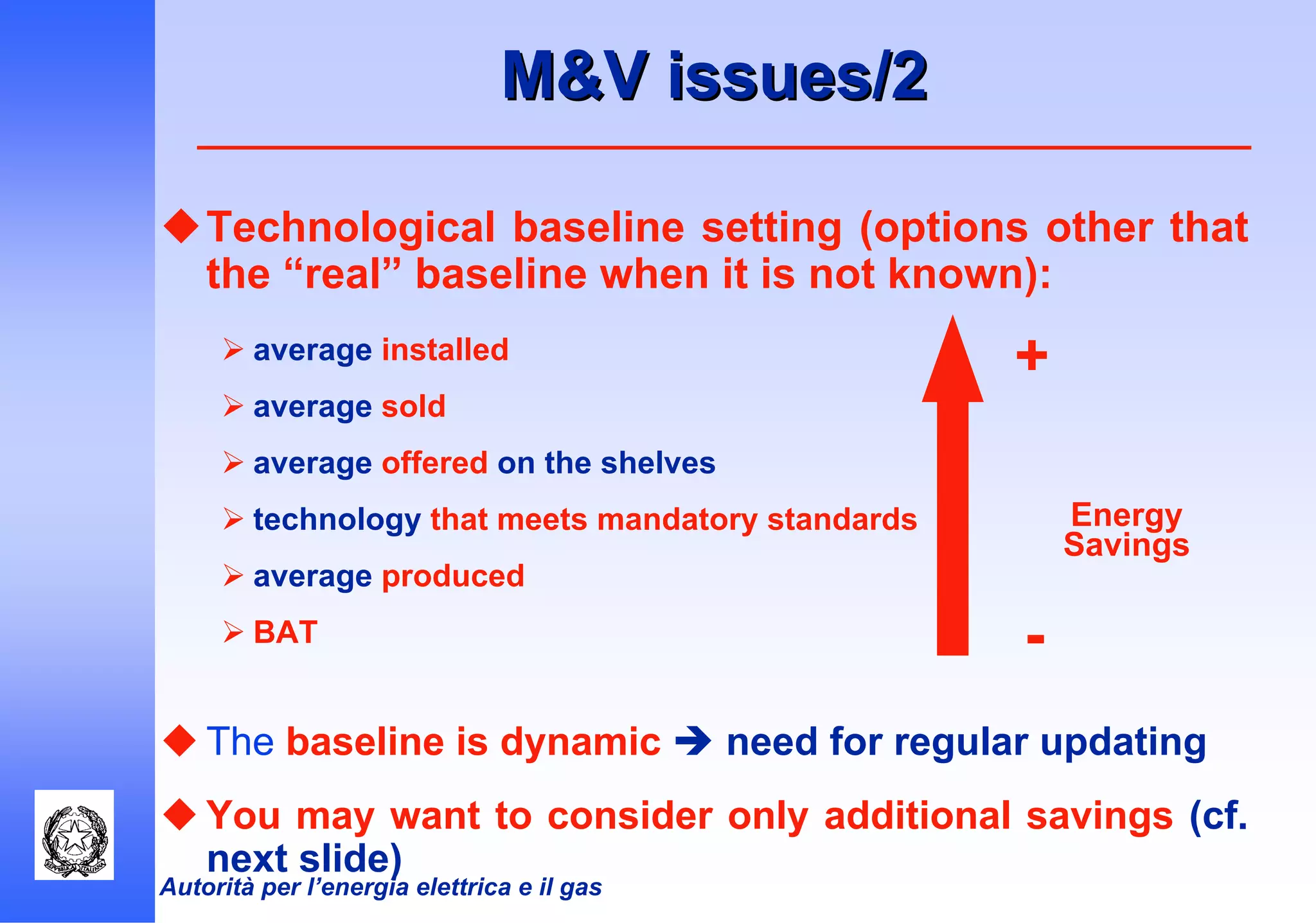
Technological baseline setting (options other that
the “real” baseline when it is not known):
average installed
average sold
average offered on the shelves
technology that meets mandatory standards
average produced
BAT
The baseline is dynamic need for regular updating
You may want to consider only additional savings (cf.
next slide)
Energy
Savings
+
-
Autorità per l’energia elettrica e il gas
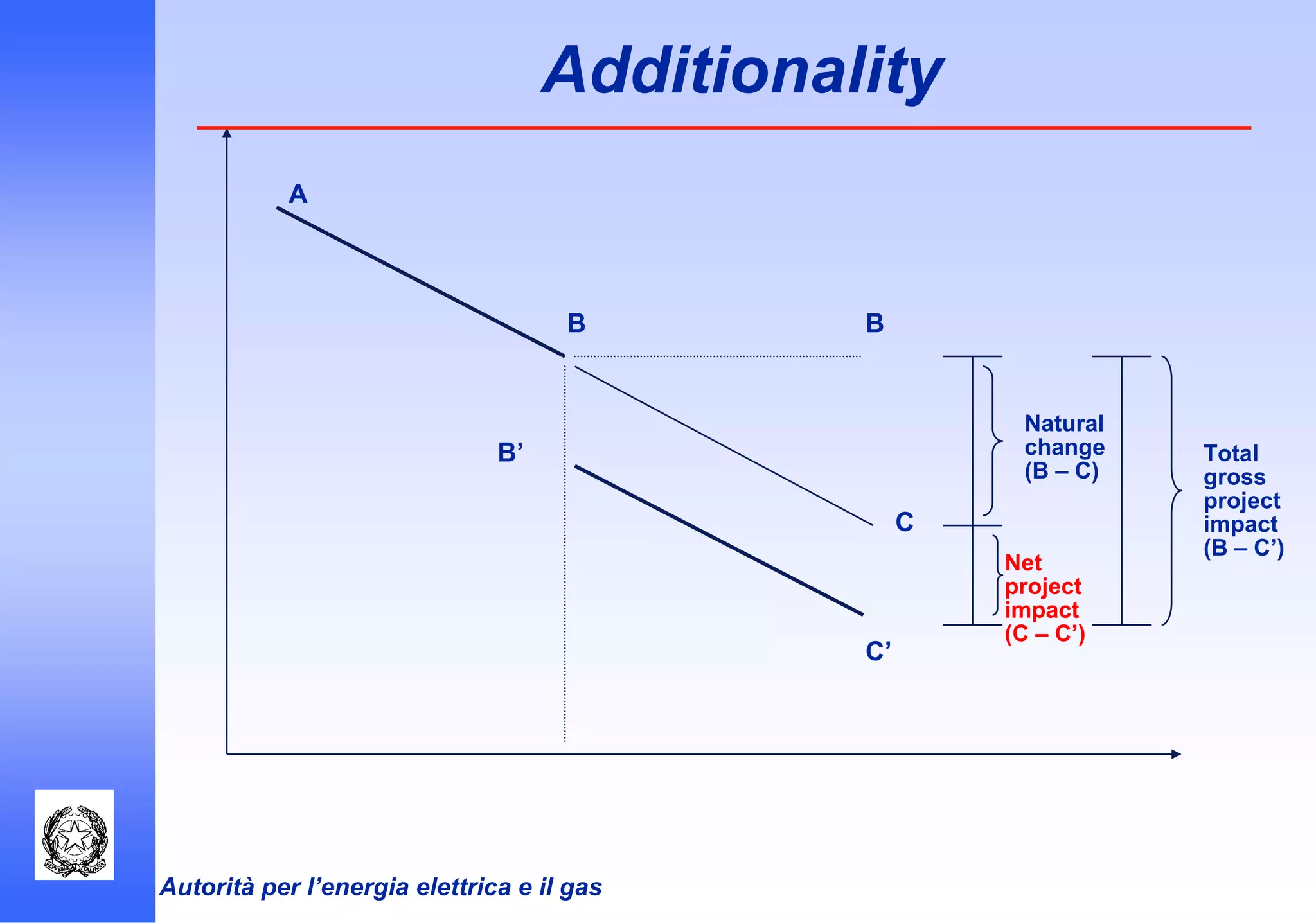
Additionality
A
B
B’
C
C’
B
Natural
change
(B – C)
Net
project
impact
(C – C’)
Total
gross
project
impact
(B – C’)
Autorità per l’energia elettrica e il gas
M&V issues/3M&V issues/3
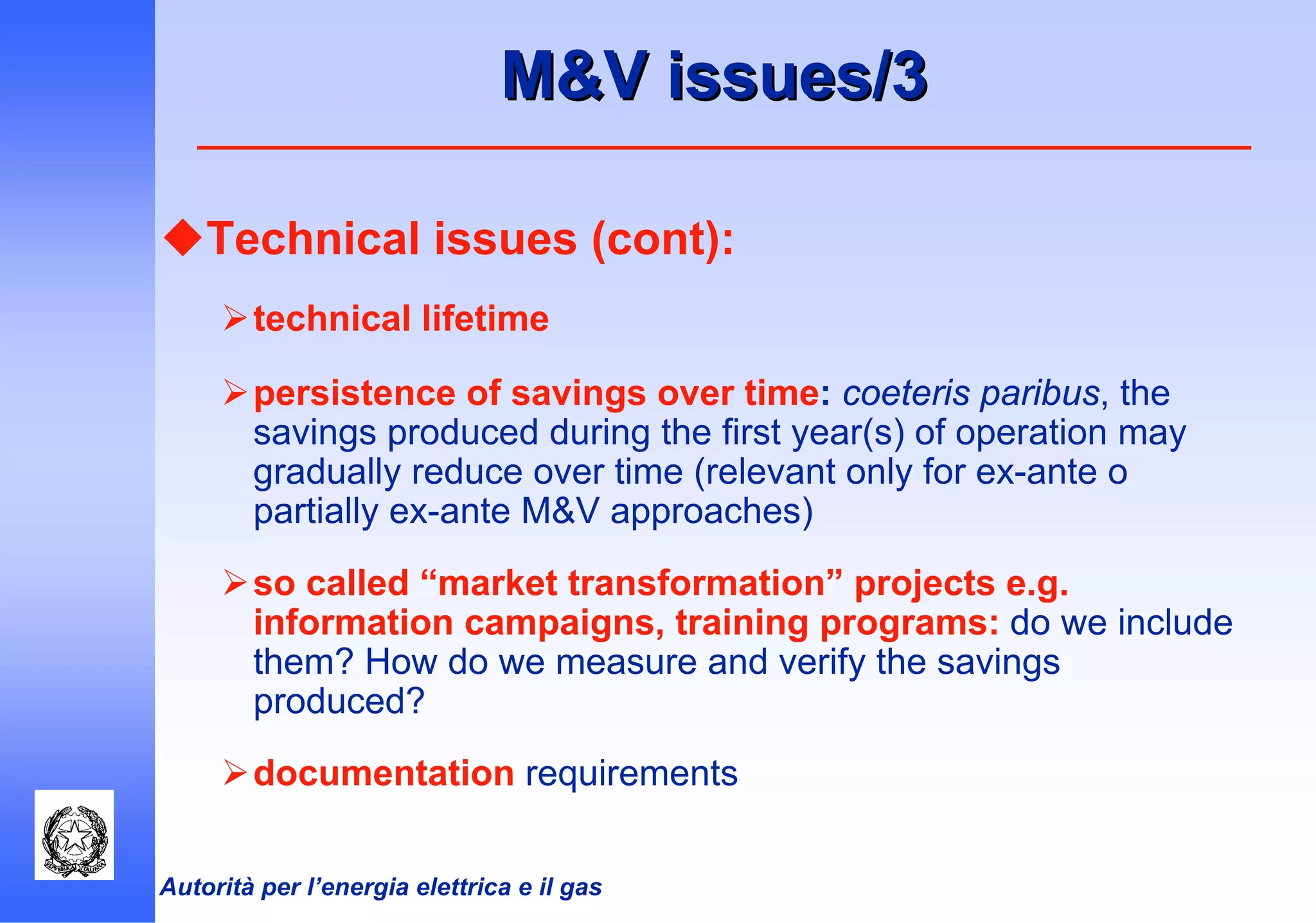
Technical issues (cont):
technical lifetime
persistence of savings over time: coeteris paribus, the
savings produced during the first year(s) of operation may
gradually reduce over time (relevant only for ex-ante o
partially ex-ante M&V approaches)
so called “market transformation” projects e.g.
information campaigns, training programs: do we include
them? How do we measure and verify the savings
produced?
documentation requirements
Autorità per l’energia elettrica e il gas
Alternative M&V approaches,Alternative M&V approaches,
tradetrade--offs and general criteriaoffs and general criteria
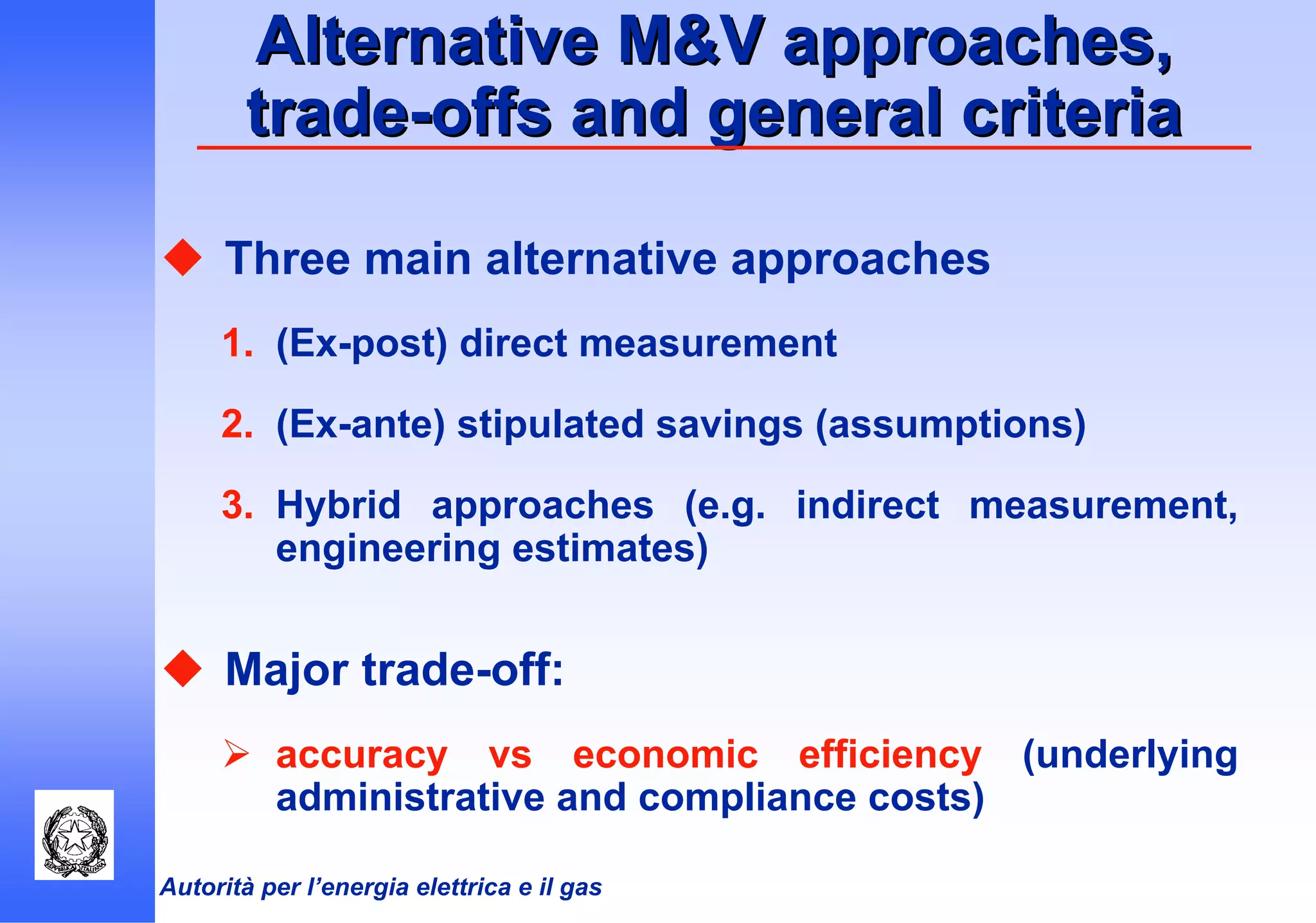
Three main alternative approaches
1. (Ex-post) direct measurement
2. (Ex-ante) stipulated savings (assumptions)
3. Hybrid approaches (e.g. indirect measurement,
engineering estimates)
Major trade-off:
accuracy vs economic efficiency (underlying
administrative and compliance costs)
Autorità per l’energia elettrica e il gas
3. The AEEG’s approach
Autorità per l’energia elettrica e il gas
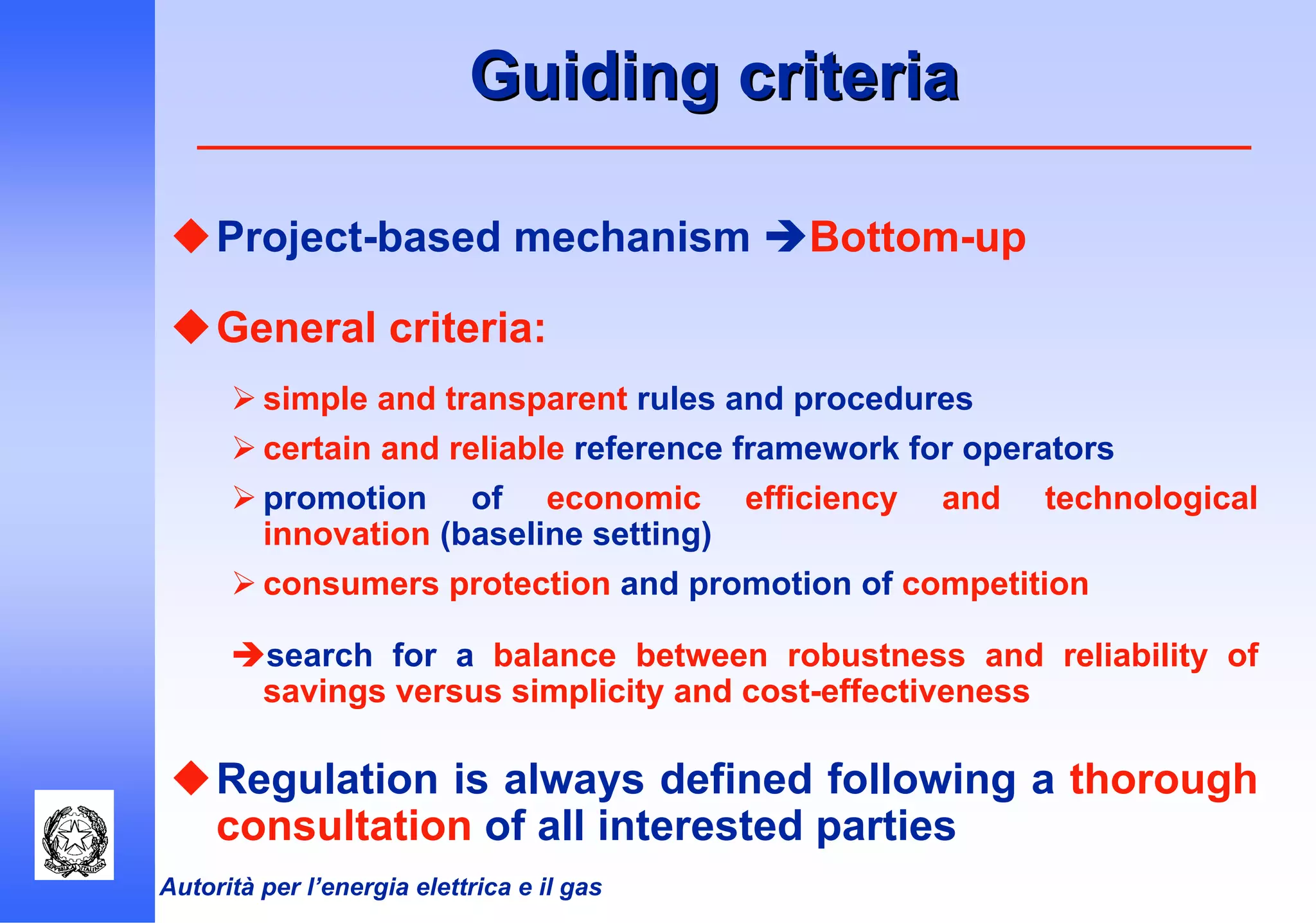
Guiding criteriaGuiding criteria
Project-based mechanism Bottom-up
General criteria:
simple and transparent rules and procedures
certain and reliable reference framework for operators
promotion of economic efficiency and technological
innovation (baseline setting)
consumers protection and promotion of competition
search for a balance between robustness and reliability of
savings versus simplicity and cost-effectiveness
Regulation is always defined following a thorough
consultation of all interested parties
Autorità per l’energia elettrica e il gas
M&V procedures: AEEG’s
approach
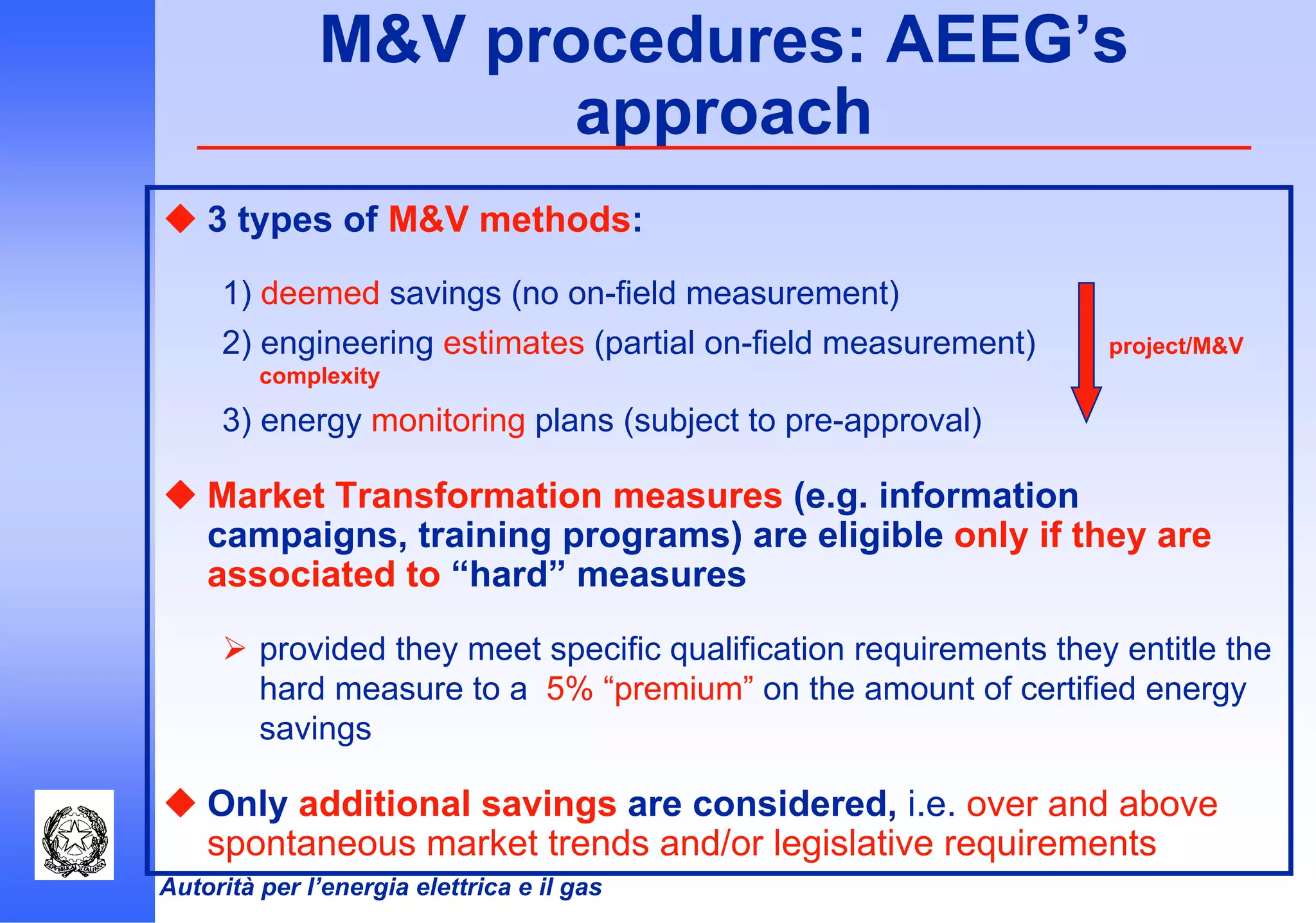
3 types of M&V methods:
1) deemed savings (no on-field measurement)
2) engineering estimates (partial on-field measurement) project/M&V
complexity
3) energy monitoring plans (subject to pre-approval)
Market Transformation measures (e.g. information
campaigns, training programs) are eligible only if they are
associated to “hard” measures
provided they meet specific qualification requirements they entitle the
hard measure to a 5% “premium” on the amount of certified energy
savings
Only additional savings are considered, i.e. over and above
spontaneous market trends and/or legislative requirements
Autorità per l’energia elettrica e il gas
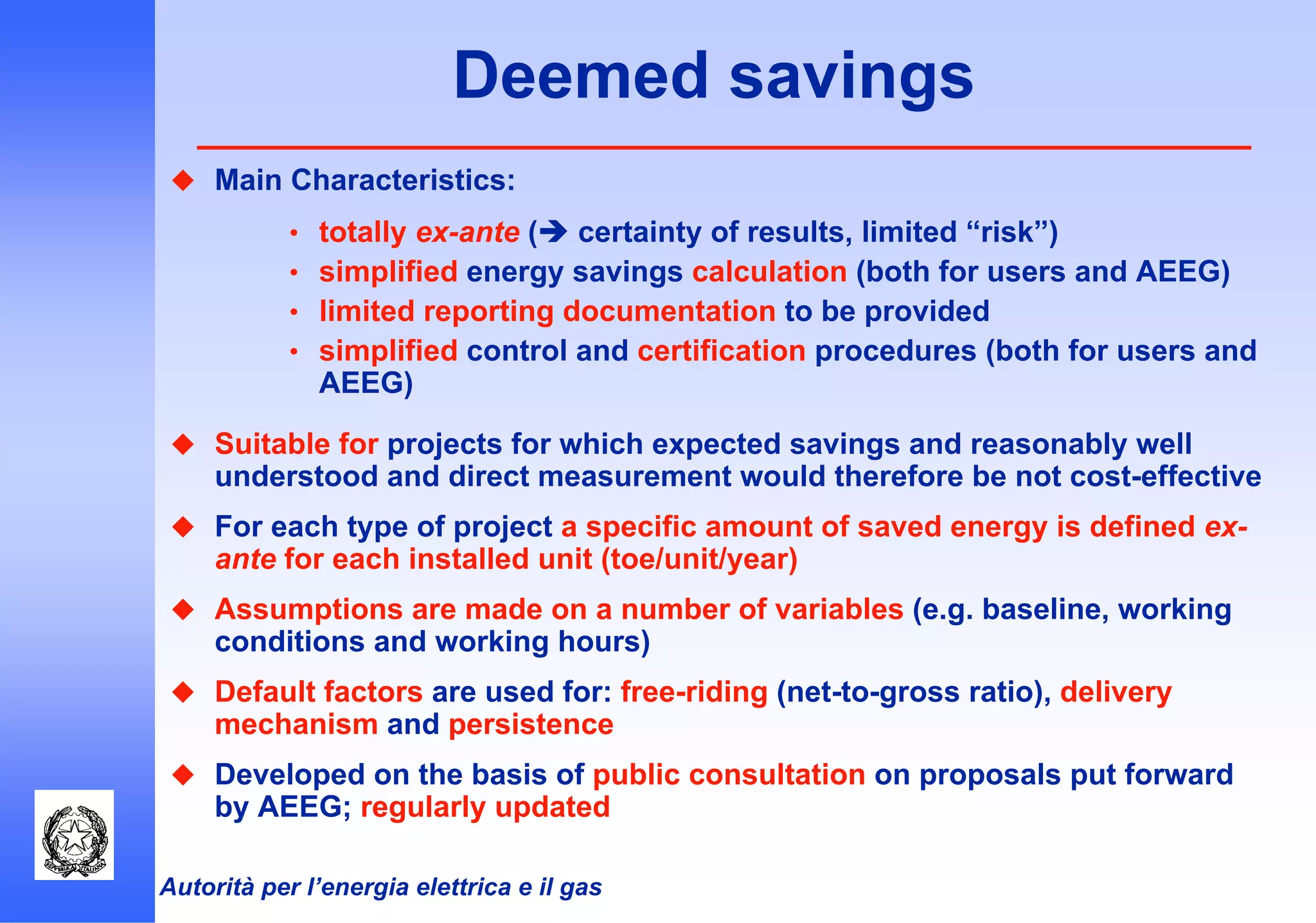
Deemed savings
Main Characteristics:
• totally ex-ante ( certainty of results, limited “risk”)
• simplified energy savings calculation (both for users and AEEG)
• limited reporting documentation to be provided
• simplified control and certification procedures (both for users and
AEEG)
Suitable for projects for which expected savings and reasonably well
understood and direct measurement would therefore be not cost-effective
For each type of project a specific amount of saved energy is defined ex-
ante for each installed unit (toe/unit/year)
Assumptions are made on a number of variables (e.g. baseline, working
conditions and working hours)
Default factors are used for: free-riding (net-to-gross ratio), delivery
mechanism and persistence
Developed on the basis of public consultation on proposals put forward
by AEEG; regularly updated
Autorità per l’energia elettrica e il gas
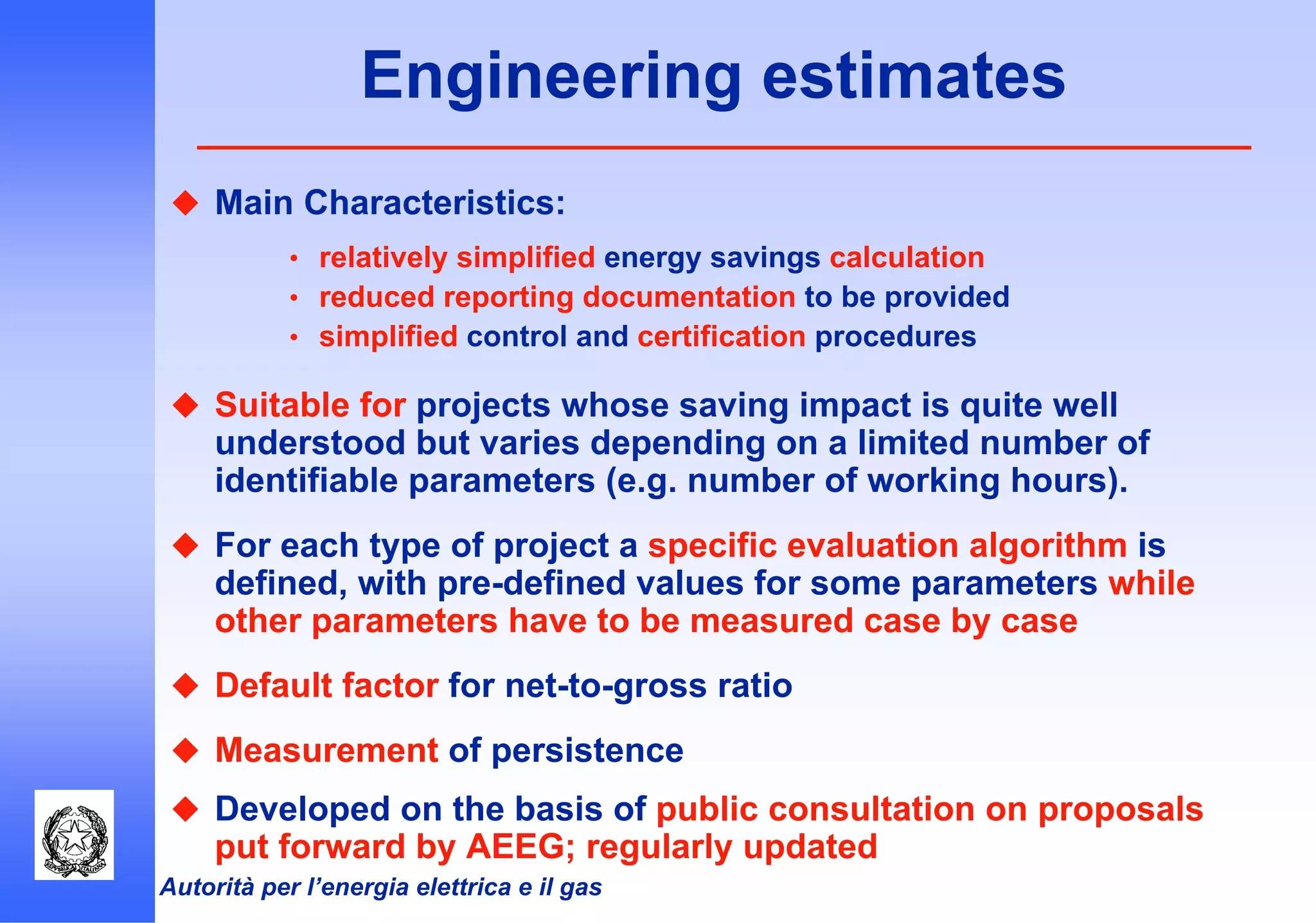
Engineering estimates
Main Characteristics:
• relatively simplified energy savings calculation
• reduced reporting documentation to be provided
• simplified control and certification procedures
Suitable for projects whose saving impact is quite well
understood but varies depending on a limited number of
identifiable parameters (e.g. number of working hours).
For each type of project a specific evaluation algorithm is
defined, with pre-defined values for some parameters while
other parameters have to be measured case by case
Default factor for net-to-gross ratio
Measurement of persistence
Developed on the basis of public consultation on proposals
put forward by AEEG; regularly updated
Autorità per l’energia elettrica e il gas
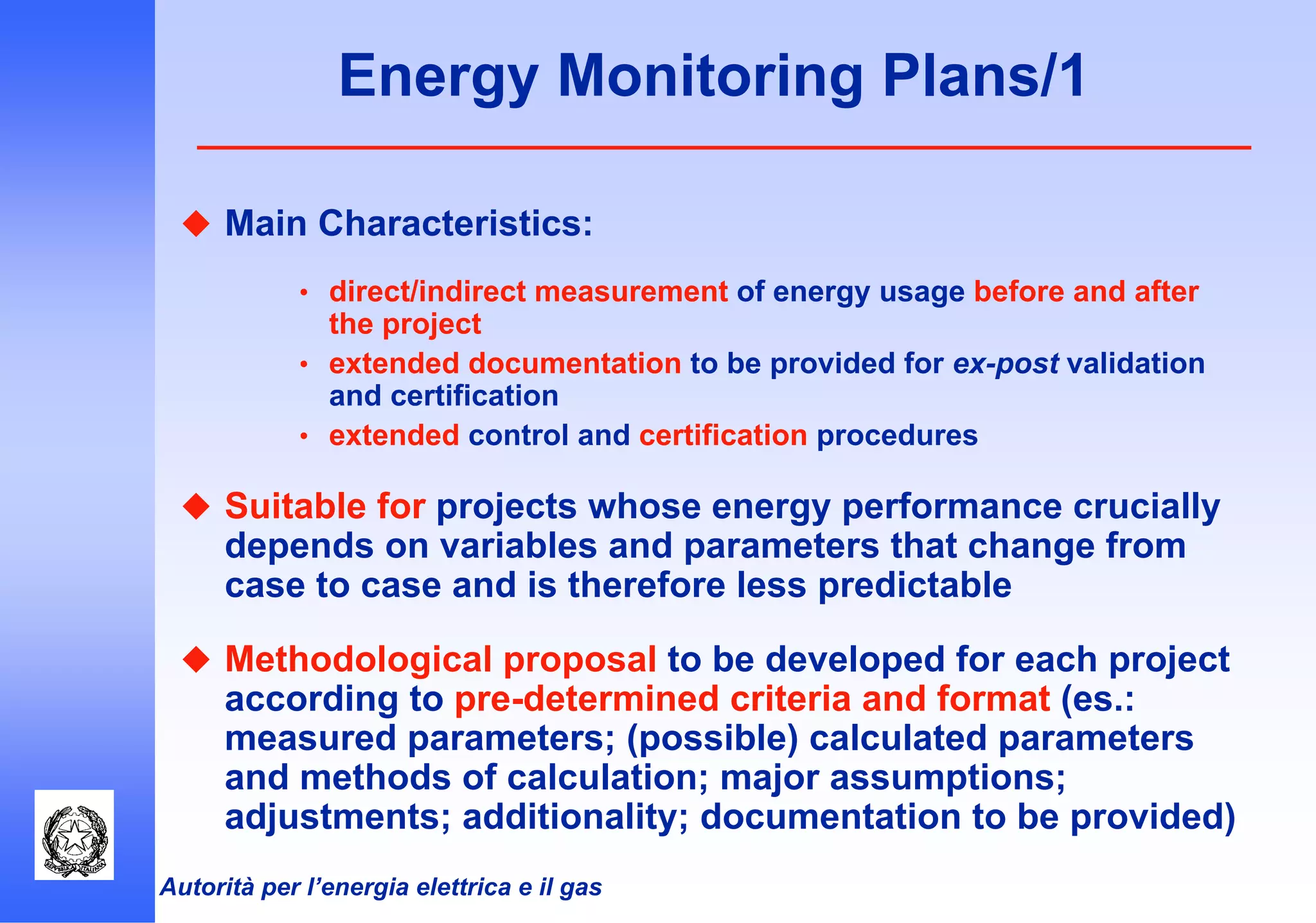
Energy Monitoring Plans/1
Main Characteristics:
• direct/indirect measurement of energy usage before and after
the project
• extended documentation to be provided for ex-post validation
and certification
• extended control and certification procedures
Suitable for projects whose energy performance crucially
depends on variables and parameters that change from
case to case and is therefore less predictable
Methodological proposal to be developed for each project
according to pre-determined criteria and format (es.:
measured parameters; (possible) calculated parameters
and methods of calculation; major assumptions;
adjustments; additionality; documentation to be provided)
Autorità per l’energia elettrica e il gas
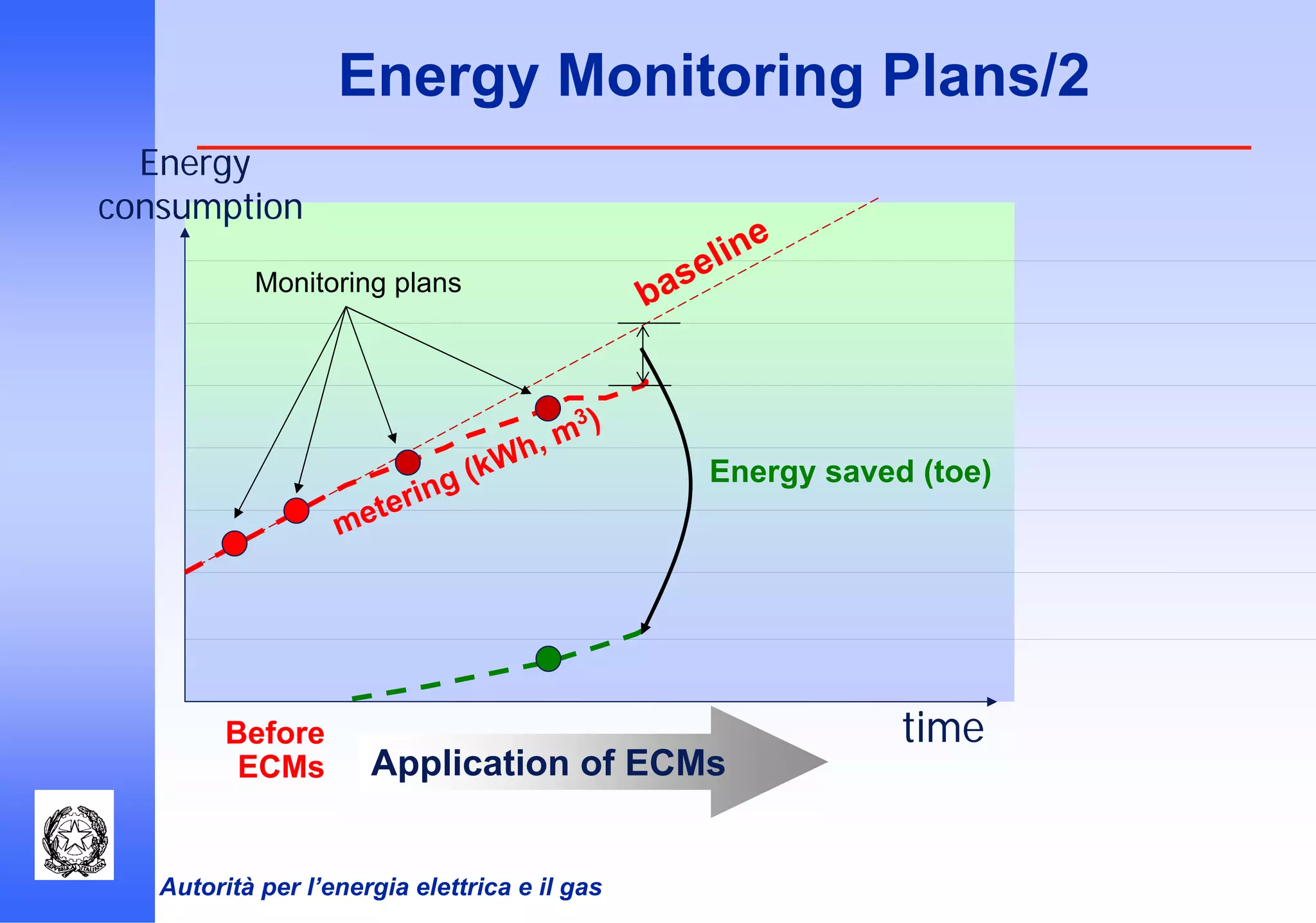
Energy Monitoring Plans/2
baseline
Before
ECMs
Energy saved (toe)
metering (kWh, m
3 )
Monitoring plans
Application of ECMs
time
Energy
consumption
Autorità per l’energia elettrica e il gas
Example of deemed savings
calculation/1
Baseline Technology
incandescent lamp
Efficient Technology
Class “A” Compact Fluorescent Lamp
Deemed energy savings calculation metholodogy
DEEs = (Pinc. – PCFL) x h/y [kWh/year/lamp]
DEPs = DEEs x Fel [toe/year/lamp]
where Fel = 0.22 x 10 –3 toe/kWh
Autorità per l’energia elettrica e il gas
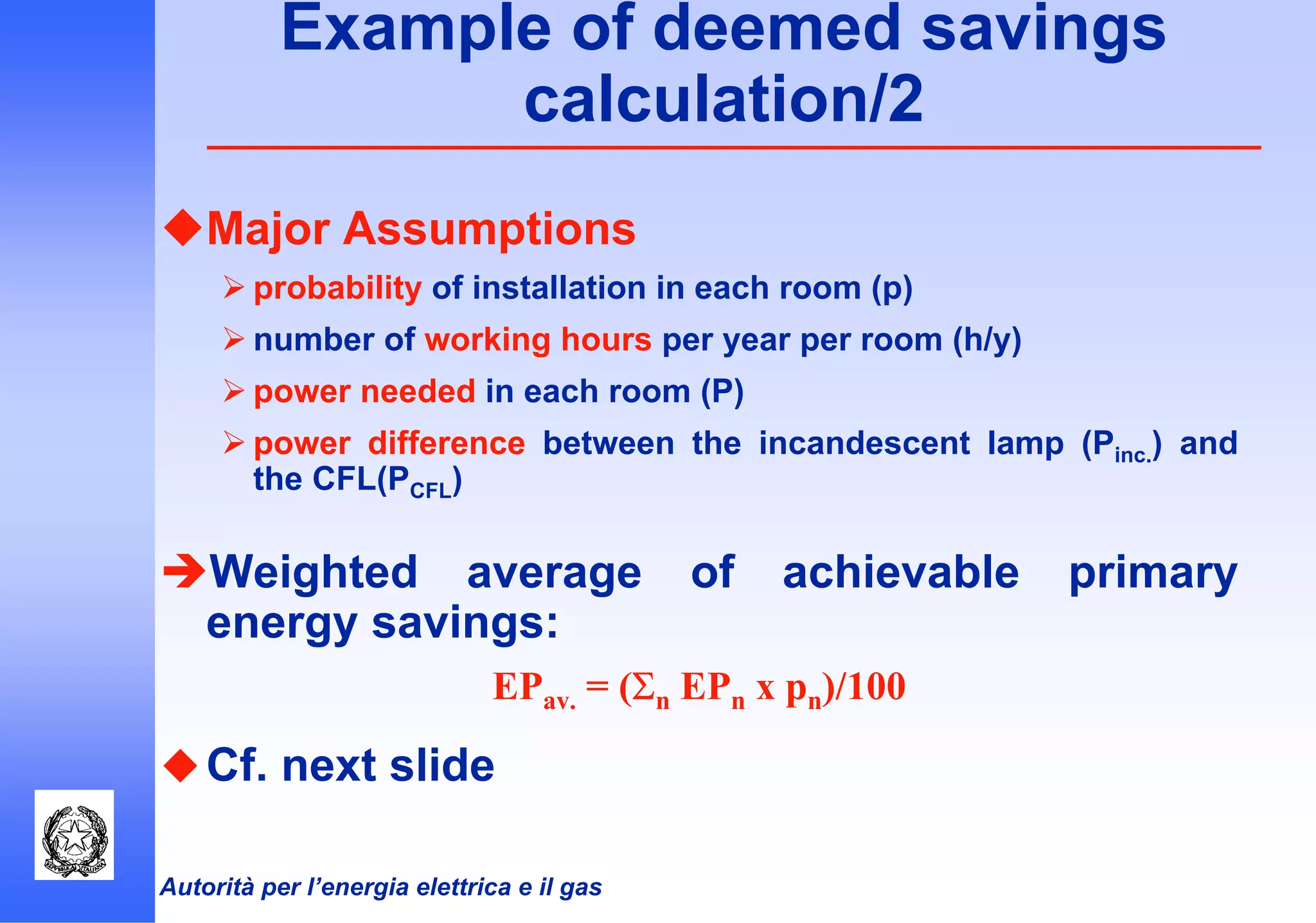
Example of deemed savings
calculation/2
Major Assumptions
probability of installation in each room (p)
number of working hours per year per room (h/y)
power needed in each room (P)
power difference between the incandescent lamp (Pinc.) and
the CFL(PCFL)
Weighted average of achievable primary
energy savings:
EPav. = (Σn EPn x pn)/100
Cf. next slide
Autorità per l’energia elettrica e il gas
Example of deemed savings
calculation/3
Weighted average of achievable primary energy
savings:
EPmed = (Σn EPn x pn)/100 = 14,6 · 10-3 toe/y/unit
Case
No
Room Pinc[W] PCFL
[W]
DP
[W]
Use
[h/year]
DEEs
[kWh/y/unit]
DEPs
[10-3
toe/y/unit]
p
[%]
DEPsprob
[10-3
toe/y/unit]
1 Kitchen 100 20 80 1200 96 21.12 30 6.34
2 “ 75 15 60 “ 72 15.84 10 1.58
3 “ 60 11 49 “ 58.8 12.94 5 0.65
4 Dining/living
room
100 20 80 800 64 14.08 20 2.82
5 “ 75 15 60 “ 48 10.56 5 0.53
6 “ 60 11 49 “ 39.2 8.62 5 0.43
7 Bath 60 11 49 300 14.7 3.23 10 0.32
8 Bedroom 40 9 31 300 9.3 2.05 10 0.2
9 Outside 100 20 80 2000 160 35.2 5 1.76
Autorità per l’energia elettrica e il gas
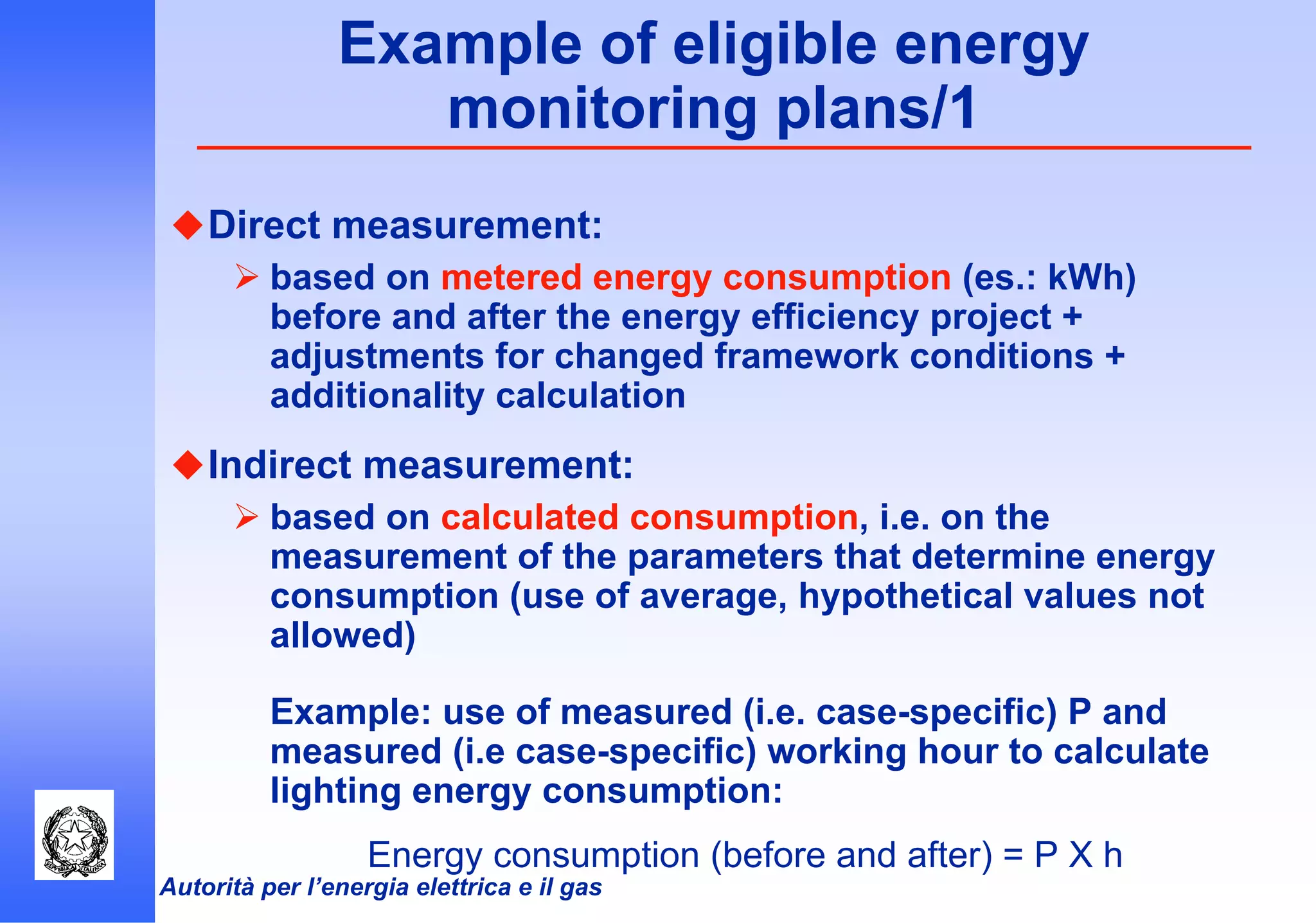
Example of eligible energy
monitoring plans/1
Direct measurement:
based on metered energy consumption (es.: kWh)
before and after the energy efficiency project +
adjustments for changed framework conditions +
additionality calculation
Indirect measurement:
based on calculated consumption, i.e. on the
measurement of the parameters that determine energy
consumption (use of average, hypothetical values not
allowed)
Example: use of measured (i.e. case-specific) P and
measured (i.e case-specific) working hour to calculate
lighting energy consumption:
Energy consumption (before and after) = P X h
Autorità per l’energia elettrica e il gas
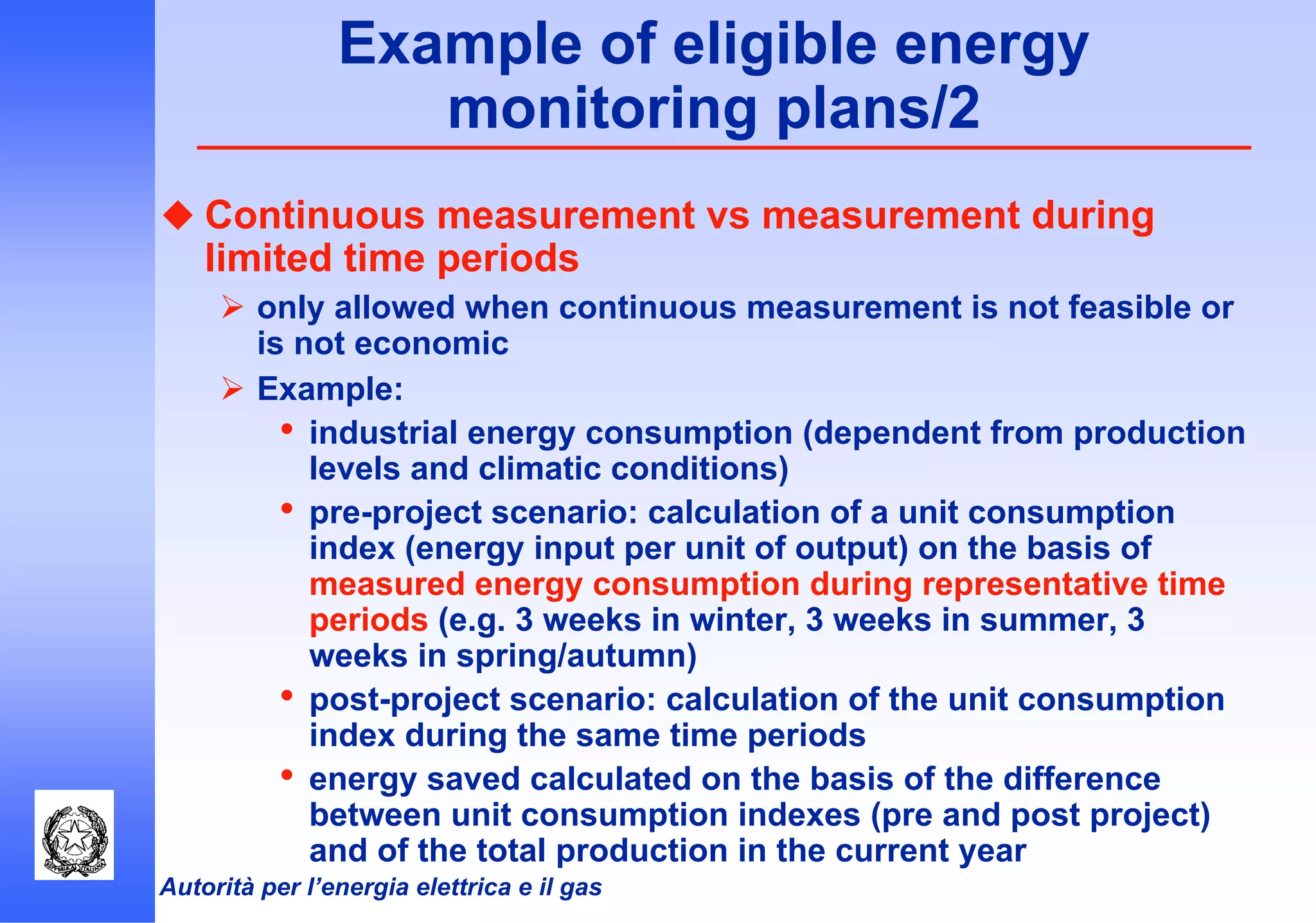
Example of eligible energy
monitoring plans/2
Continuous measurement vs measurement during
limited time periods
only allowed when continuous measurement is not feasible or
is not economic
Example:
• industrial energy consumption (dependent from production
levels and climatic conditions)
• pre-project scenario: calculation of a unit consumption
index (energy input per unit of output) on the basis of
measured energy consumption during representative time
periods (e.g. 3 weeks in winter, 3 weeks in summer, 3
weeks in spring/autumn)
• post-project scenario: calculation of the unit consumption
index during the same time periods
• energy saved calculated on the basis of the difference
between unit consumption indexes (pre and post project)
and of the total production in the current year
Autorità per l’energia elettrica e il gas
APPENDIX
Autorità per l’energia elettrica e il gas
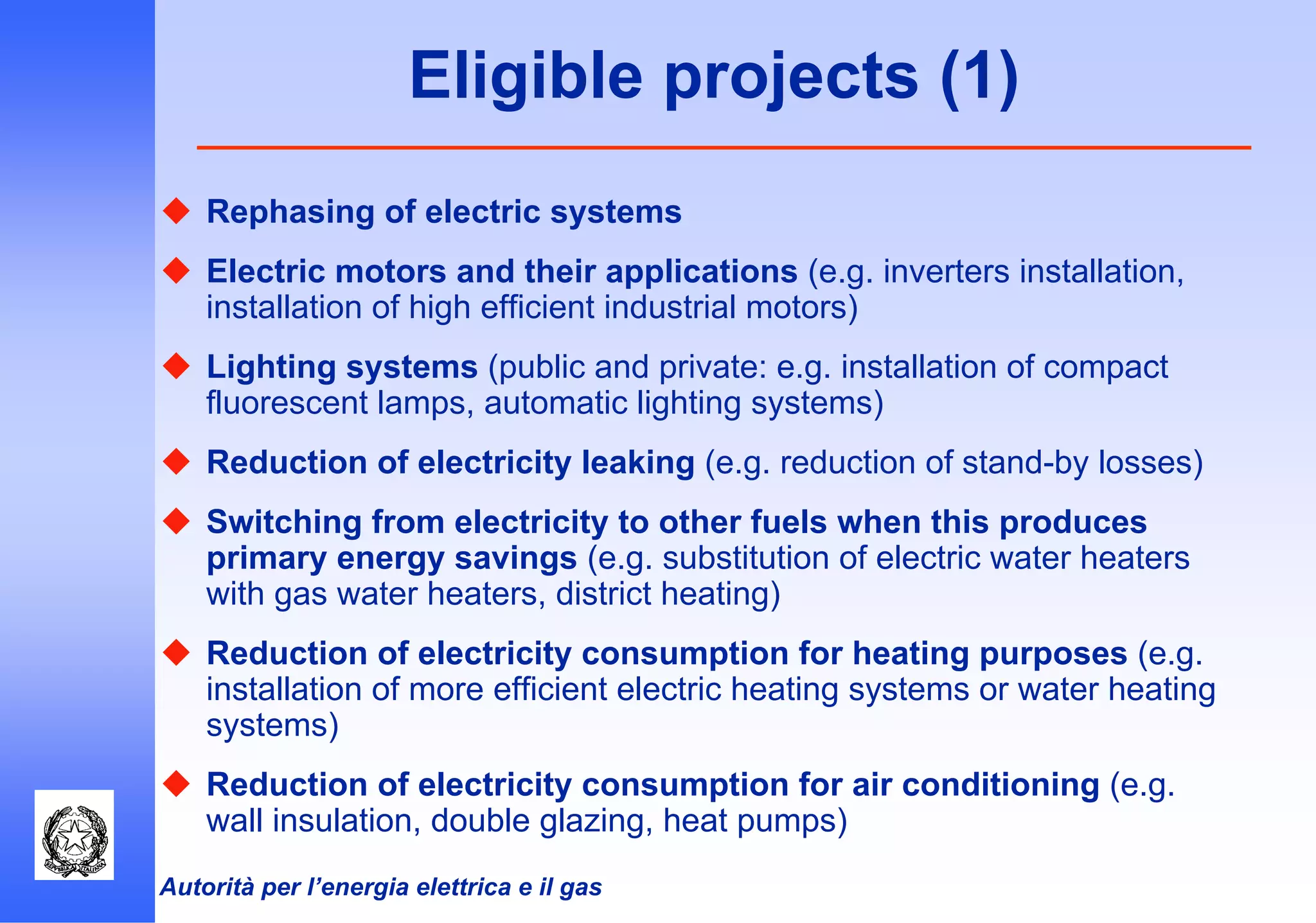
Eligible projects (1)
Rephasing of electric systems
Electric motors and their applications (e.g. inverters installation,
installation of high efficient industrial motors)
Lighting systems (public and private: e.g. installation of compact
fluorescent lamps, automatic lighting systems)
Reduction of electricity leaking (e.g. reduction of stand-by losses)
Switching from electricity to other fuels when this produces
primary energy savings (e.g. substitution of electric water heaters
with gas water heaters, district heating)
Reduction of electricity consumption for heating purposes (e.g.
installation of more efficient electric heating systems or water heating
systems)
Reduction of electricity consumption for air conditioning (e.g.
wall insulation, double glazing, heat pumps)
Autorità per l’energia elettrica e il gas
Eligible projects (2)
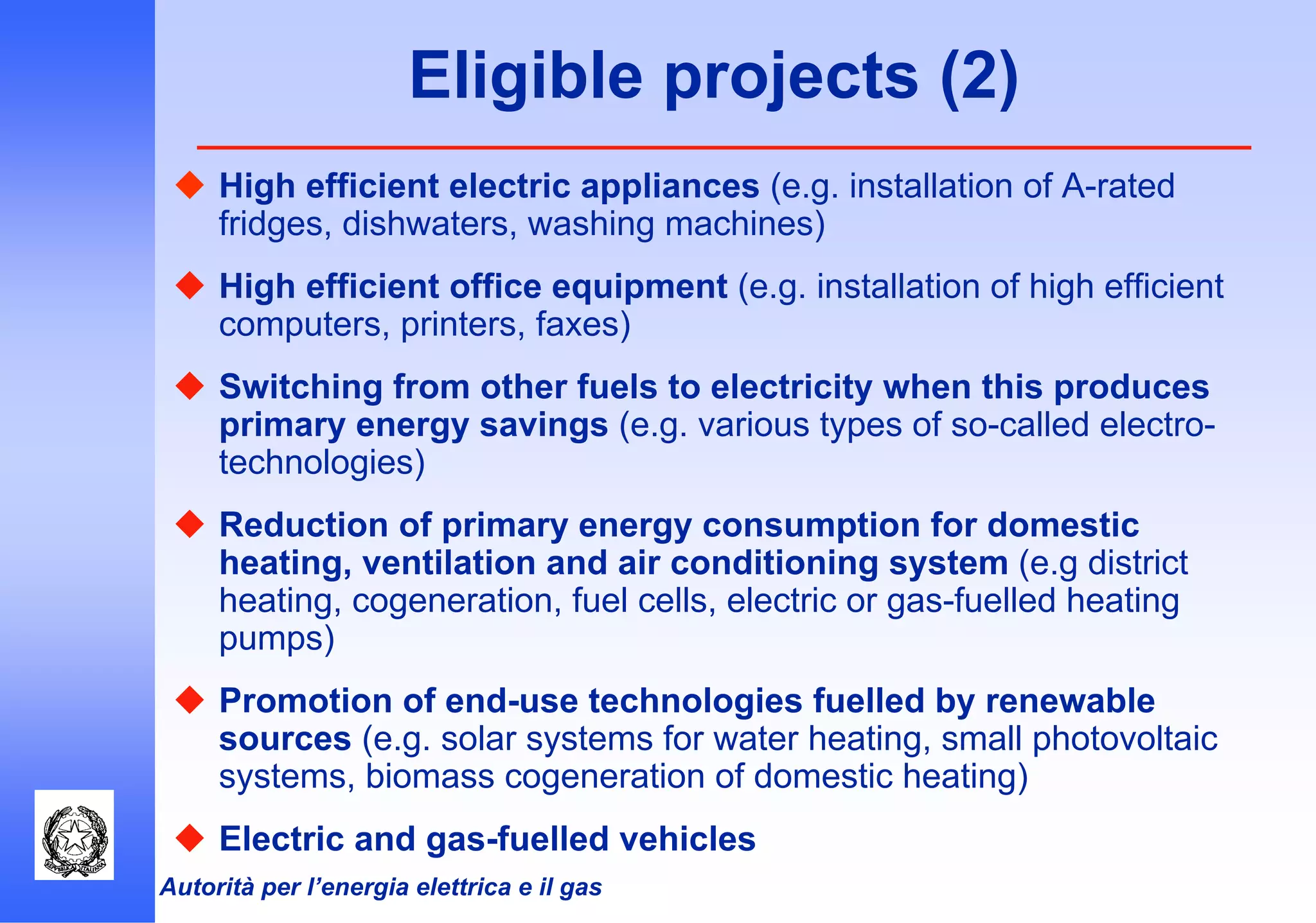
High efficient electric appliances (e.g. installation of A-rated
fridges, dishwaters, washing machines)
High efficient office equipment (e.g. installation of high efficient
computers, printers, faxes)
Switching from other fuels to electricity when this produces
primary energy savings (e.g. various types of so-called electro-
technologies)
Reduction of primary energy consumption for domestic
heating, ventilation and air conditioning system (e.g district
heating, cogeneration, fuel cells, electric or gas-fuelled heating
pumps)
Promotion of end-use technologies fuelled by renewable
sources (e.g. solar systems for water heating, small photovoltaic
systems, biomass cogeneration of domestic heating)
Electric and gas-fuelled vehicles
Autorità per l’energia elettrica e il gas
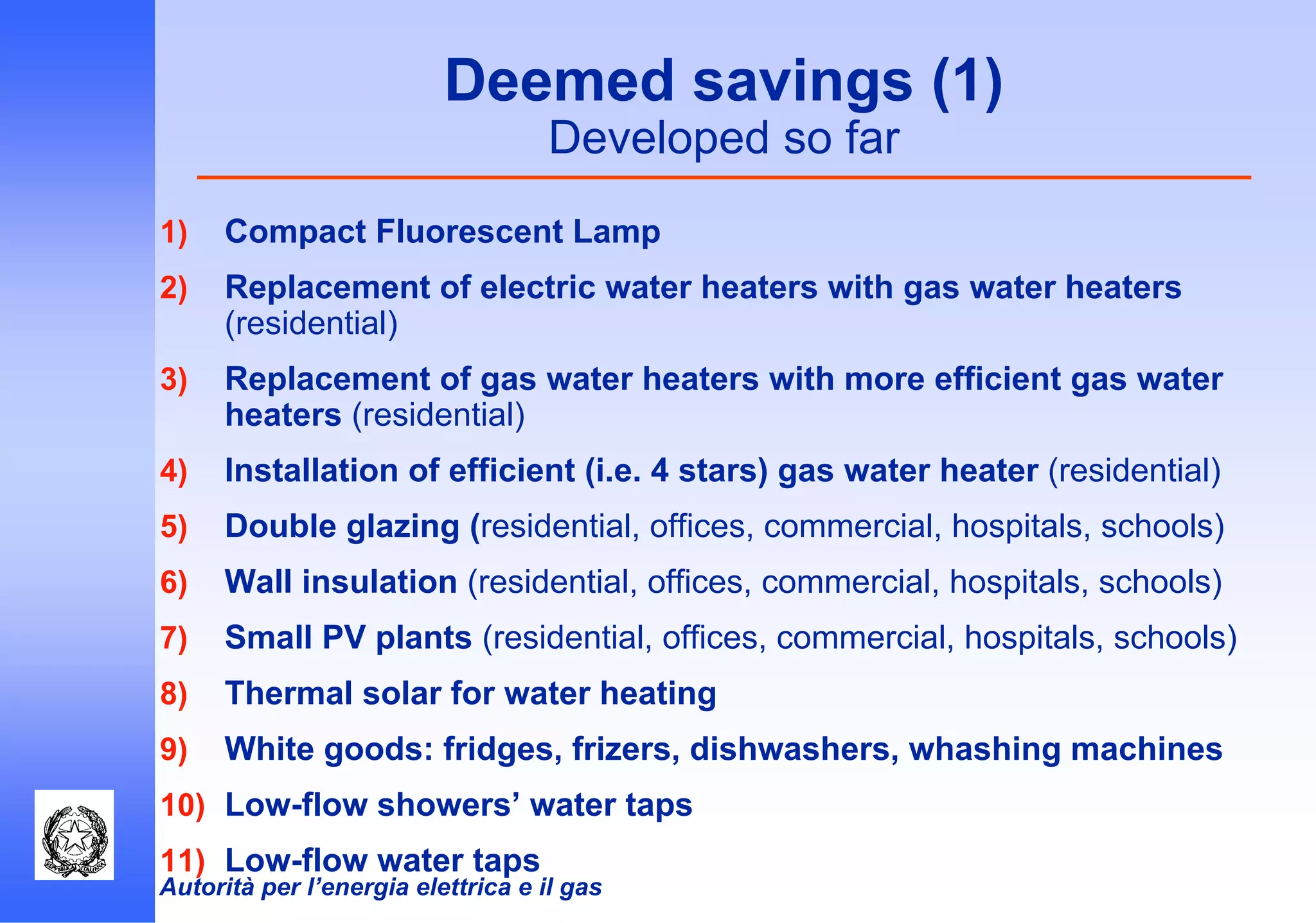
Deemed savings (1)
Developed so far
1) Compact Fluorescent Lamp
2) Replacement of electric water heaters with gas water heaters
(residential)
3) Replacement of gas water heaters with more efficient gas water
heaters (residential)
4) Installation of efficient (i.e. 4 stars) gas water heater (residential)
5) Double glazing (residential, offices, commercial, hospitals, schools)
6) Wall insulation (residential, offices, commercial, hospitals, schools)
7) Small PV plants (residential, offices, commercial, hospitals, schools)
8) Thermal solar for water heating
9) White goods: fridges, frizers, dishwashers, whashing machines
10) Low-flow showers’ water taps
11) Low-flow water taps
Autorità per l’energia elettrica e il gas
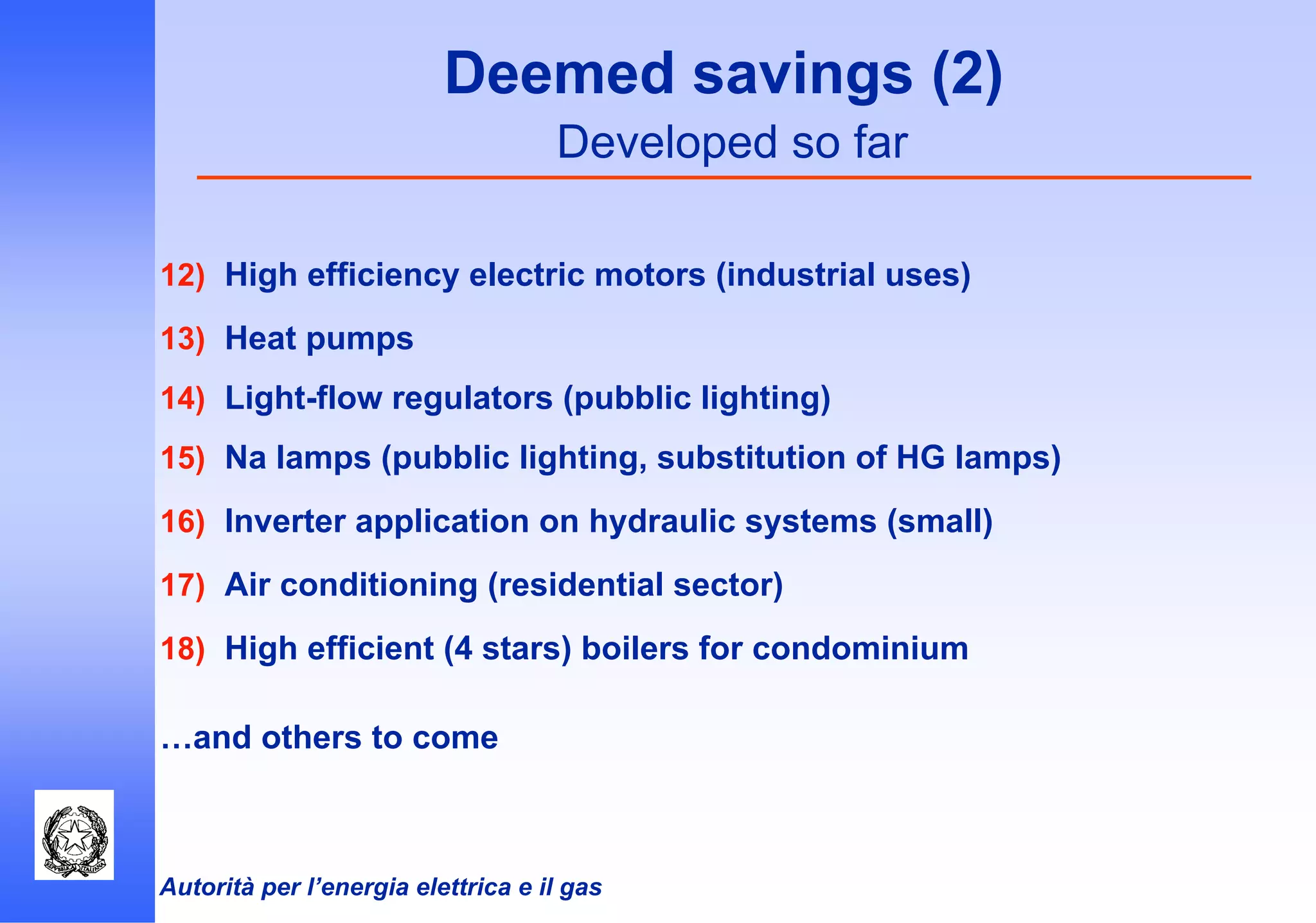
Deemed savings (2)
Developed so far
12) High efficiency electric motors (industrial uses)
13) Heat pumps
14) Light-flow regulators (pubblic lighting)
15) Na lamps (pubblic lighting, substitution of HG lamps)
16) Inverter application on hydraulic systems (small)
17) Air conditioning (residential sector)
18) High efficient (4 stars) boilers for condominium
…and others to come
Autorità per l’energia elettrica e il gas
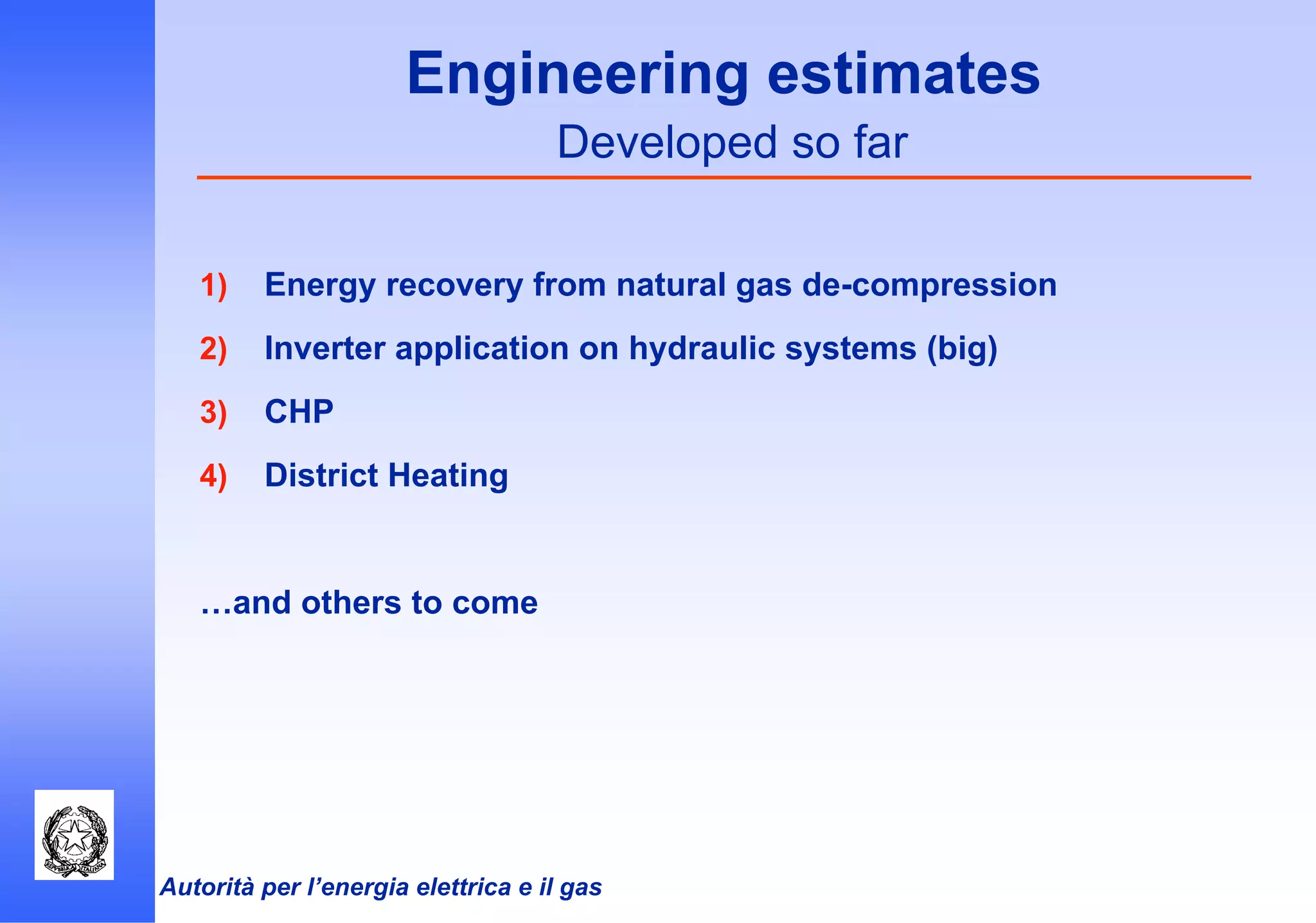
Engineering estimates
Developed so far
1) Energy recovery from natural gas de-compression
2) Inverter application on hydraulic systems (big)
3) CHP
4) District Heating
…and others to come
Autorità per l’energia elettrica e il gas
Supportive documentation inSupportive documentation in
EnglishEnglish
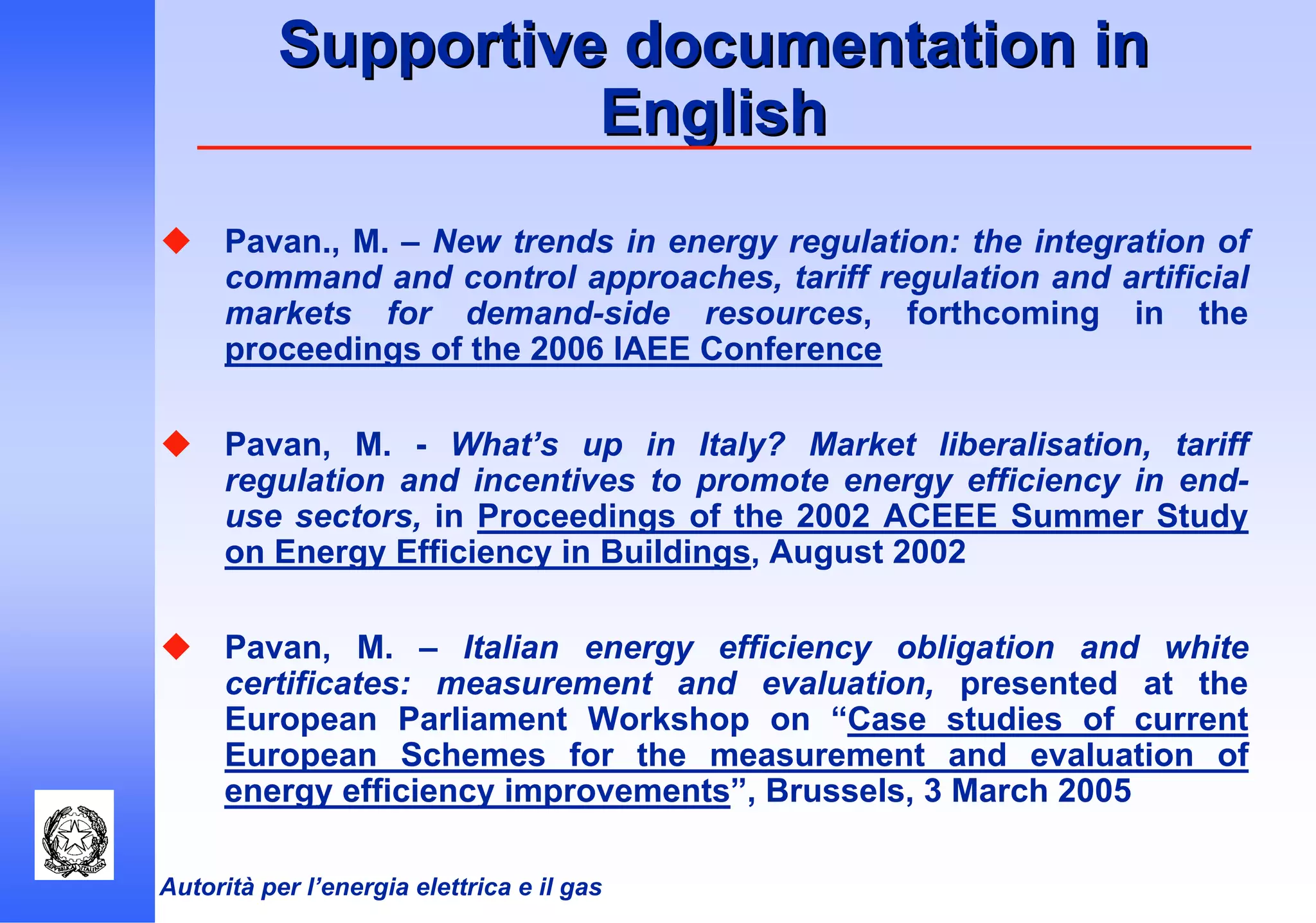
Pavan., M. – New trends in energy regulation: the integration of
command and control approaches, tariff regulation and artificial
markets for demand-side resources, forthcoming in the
proceedings of the 2006 IAEE Conference
Pavan, M. - What’s up in Italy? Market liberalisation, tariff
regulation and incentives to promote energy efficiency in end-
use sectors, in Proceedings of the 2002 ACEEE Summer Study
on Energy Efficiency in Buildings, August 2002
Pavan, M. – Italian energy efficiency obligation and white
certificates: measurement and evaluation, presented at the
European Parliament Workshop on “Case studies of current
European Schemes for the measurement and evaluation of
energy efficiency improvements”, Brussels, 3 March 2005
Autorità per l’energia elettrica e il gas
ContactsContacts
Marcella Pavan
Head - Energy Efficiency Policy Division
Autorità per l’energia elettrica e il gas
Piazza Cavour 5
20121 Milan – ITALY
tel: +39 02 65 565 263/313
fax: +39 02 65 565 230
e-mail: mpavan@autorita.energia.it
WEB Site: http://www.autorita.energia.it/ee/index.htm
(in Italian)

The Italian white certificates market and the measurement and verification of end-use energy efficiency improvements

  • 1.
    Autorità per l’energiaelettrica e il gas Registration and validation of energy saving activities – Practical experiences and cost-effective solutions International Energy Agency seminar Copenhagen, 19 April 2006 The Italian white certificates market and the measurement and verification of end- use energy efficiency improvements Marcella Pavan Head - Energy Efficiency Policy Division Italian Regulatory Authority for Electricity and Gas (*) (*) This is not an official document of the Italian Regulatory Authority for Electricity and Gas
  • 2.
    Autorità per l’energiaelettrica e il gas ContentsContents 1. The Context: the Italian tradable white certificates scheme 2. Major Measurement and Verification issues 3. The AEEG’s M&V approach and two practical examples 4. Appendix
  • 3.
    Autorità per l’energiaelettrica e il gas 1. The Context: the Italian tradable white certificates scheme
  • 4.
    Autorità per l’energiaelettrica e il gas Main features/1Main features/1 First operational tradable white certificates scheme introduced world-wide Legislative framework introduced in 2001; regulatory framework developed throughout 2002-2004 via consultation of all interested parties (plus revision of the legislative framework); fully operational since January 2005 Demand driver: annual primary energy saving targets on (major) electricity and natural gas distributors White certificates serve as an accounting tool to prove compliance with targets Supply-side: white certificates are issued upon verification that the corresponding amount of energy has been saved via the development of any type of end-use energy efficiency project
  • 5.
    Autorità per l’energiaelettrica e il gas Main features/2Main features/2 Projects can be developed by/certificates are issued to obliged distributors, non-obliged distributors, companies controlled by distributors, energy service providers Certificates are tradable in a specific marketplace or over the counter Non-compliant distributors are subject to administrative sanctions Obliged distributors can recover part of the costs borne to meet their target via electricity and natural gas rates The Electricity and Natural Gas Regulator (AEEG) is in charge of: defining the technical rules for projects design, development and evaluation (i.e. M&V of energy savings) as well as for the issuing of white certificates defining the economic rules governing the scheme: sanctions, cost-recovery mechanism, trading rules (jointly with the Electricity Market Operator) administering and monitoring the system
  • 6.
    Autorità per l’energiaelettrica e il gas The importance of M&VThe importance of M&V to the systemto the system Within the scheme white certificates: serve as an accounting tool to prove that the corresponding amount of energy has been saved and to monitor the extent to which the mandatory targets have been met have an economic value You want to be sure that they represent “real” savings
  • 7.
    Autorità per l’energiaelettrica e il gas 2. Major Measurement and Verification (M&V) issues
  • 8.
    Autorità per l’energiaelettrica e il gas Why M&V rules for energyWhy M&V rules for energy savings are neededsavings are needed What is “special” about M&V of energy savings? you can not measure energy savings at the meter you have to measure the energy savings via a comparison of the energy consumption before and after the project in some cases the “before the project” scenario is not known (data, new installations) and you need to make assumptions (“project baseline”) in other cases the “before the project” scenario is known, but you need to net out the impact on consumption trends of variables other than those on which the energy saving project have an influence (climatic and working conditions) in other cases measuring everything is not cost-effective
  • 9.
    Autorità per l’energiaelettrica e il gas Major M&V issues/1Major M&V issues/1 Technical issues: baseline setting: what is the reference scenario? (cf. following slide); additionality and treatment of (partial) free-riders: do we take into account savings that would have been achieved by project participants even in the absence of the project (may be at a later date)? If yes, how? adjustments to take into account changing framework conditions impact of different delivery mechanisms (e.g direct delivery versus discount bonus) [treatment of free-drivers: do we take into account – and, if yes, how – positive impact on non-participants? And what about extensive positive impacts on participants?]
  • 10.
    Autorità per l’energiaelettrica e il gas M&V issues/2M&V issues/2 Technological baseline setting (options other that the “real” baseline when it is not known): average installed average sold average offered on the shelves technology that meets mandatory standards average produced BAT The baseline is dynamic need for regular updating You may want to consider only additional savings (cf. next slide) Energy Savings + -
  • 11.
    Autorità per l’energiaelettrica e il gas Additionality A B B’ C C’ B Natural change (B – C) Net project impact (C – C’) Total gross project impact (B – C’)
  • 12.
    Autorità per l’energiaelettrica e il gas M&V issues/3M&V issues/3 Technical issues (cont): technical lifetime persistence of savings over time: coeteris paribus, the savings produced during the first year(s) of operation may gradually reduce over time (relevant only for ex-ante o partially ex-ante M&V approaches) so called “market transformation” projects e.g. information campaigns, training programs: do we include them? How do we measure and verify the savings produced? documentation requirements
  • 13.
    Autorità per l’energiaelettrica e il gas Alternative M&V approaches,Alternative M&V approaches, tradetrade--offs and general criteriaoffs and general criteria Three main alternative approaches 1. (Ex-post) direct measurement 2. (Ex-ante) stipulated savings (assumptions) 3. Hybrid approaches (e.g. indirect measurement, engineering estimates) Major trade-off: accuracy vs economic efficiency (underlying administrative and compliance costs)
  • 14.
    Autorità per l’energiaelettrica e il gas 3. The AEEG’s approach
  • 15.
    Autorità per l’energiaelettrica e il gas Guiding criteriaGuiding criteria Project-based mechanism Bottom-up General criteria: simple and transparent rules and procedures certain and reliable reference framework for operators promotion of economic efficiency and technological innovation (baseline setting) consumers protection and promotion of competition search for a balance between robustness and reliability of savings versus simplicity and cost-effectiveness Regulation is always defined following a thorough consultation of all interested parties
  • 16.
    Autorità per l’energiaelettrica e il gas M&V procedures: AEEG’s approach 3 types of M&V methods: 1) deemed savings (no on-field measurement) 2) engineering estimates (partial on-field measurement) project/M&V complexity 3) energy monitoring plans (subject to pre-approval) Market Transformation measures (e.g. information campaigns, training programs) are eligible only if they are associated to “hard” measures provided they meet specific qualification requirements they entitle the hard measure to a 5% “premium” on the amount of certified energy savings Only additional savings are considered, i.e. over and above spontaneous market trends and/or legislative requirements
  • 17.
    Autorità per l’energiaelettrica e il gas Deemed savings Main Characteristics: • totally ex-ante ( certainty of results, limited “risk”) • simplified energy savings calculation (both for users and AEEG) • limited reporting documentation to be provided • simplified control and certification procedures (both for users and AEEG) Suitable for projects for which expected savings and reasonably well understood and direct measurement would therefore be not cost-effective For each type of project a specific amount of saved energy is defined ex- ante for each installed unit (toe/unit/year) Assumptions are made on a number of variables (e.g. baseline, working conditions and working hours) Default factors are used for: free-riding (net-to-gross ratio), delivery mechanism and persistence Developed on the basis of public consultation on proposals put forward by AEEG; regularly updated
  • 18.
    Autorità per l’energiaelettrica e il gas Engineering estimates Main Characteristics: • relatively simplified energy savings calculation • reduced reporting documentation to be provided • simplified control and certification procedures Suitable for projects whose saving impact is quite well understood but varies depending on a limited number of identifiable parameters (e.g. number of working hours). For each type of project a specific evaluation algorithm is defined, with pre-defined values for some parameters while other parameters have to be measured case by case Default factor for net-to-gross ratio Measurement of persistence Developed on the basis of public consultation on proposals put forward by AEEG; regularly updated
  • 19.
    Autorità per l’energiaelettrica e il gas Energy Monitoring Plans/1 Main Characteristics: • direct/indirect measurement of energy usage before and after the project • extended documentation to be provided for ex-post validation and certification • extended control and certification procedures Suitable for projects whose energy performance crucially depends on variables and parameters that change from case to case and is therefore less predictable Methodological proposal to be developed for each project according to pre-determined criteria and format (es.: measured parameters; (possible) calculated parameters and methods of calculation; major assumptions; adjustments; additionality; documentation to be provided)
  • 20.
    Autorità per l’energiaelettrica e il gas Energy Monitoring Plans/2 baseline Before ECMs Energy saved (toe) metering (kWh, m 3 ) Monitoring plans Application of ECMs time Energy consumption
  • 21.
    Autorità per l’energiaelettrica e il gas Example of deemed savings calculation/1 Baseline Technology incandescent lamp Efficient Technology Class “A” Compact Fluorescent Lamp Deemed energy savings calculation metholodogy DEEs = (Pinc. – PCFL) x h/y [kWh/year/lamp] DEPs = DEEs x Fel [toe/year/lamp] where Fel = 0.22 x 10 –3 toe/kWh
  • 22.
    Autorità per l’energiaelettrica e il gas Example of deemed savings calculation/2 Major Assumptions probability of installation in each room (p) number of working hours per year per room (h/y) power needed in each room (P) power difference between the incandescent lamp (Pinc.) and the CFL(PCFL) Weighted average of achievable primary energy savings: EPav. = (Σn EPn x pn)/100 Cf. next slide
  • 23.
    Autorità per l’energiaelettrica e il gas Example of deemed savings calculation/3 Weighted average of achievable primary energy savings: EPmed = (Σn EPn x pn)/100 = 14,6 · 10-3 toe/y/unit Case No Room Pinc[W] PCFL [W] DP [W] Use [h/year] DEEs [kWh/y/unit] DEPs [10-3 toe/y/unit] p [%] DEPsprob [10-3 toe/y/unit] 1 Kitchen 100 20 80 1200 96 21.12 30 6.34 2 “ 75 15 60 “ 72 15.84 10 1.58 3 “ 60 11 49 “ 58.8 12.94 5 0.65 4 Dining/living room 100 20 80 800 64 14.08 20 2.82 5 “ 75 15 60 “ 48 10.56 5 0.53 6 “ 60 11 49 “ 39.2 8.62 5 0.43 7 Bath 60 11 49 300 14.7 3.23 10 0.32 8 Bedroom 40 9 31 300 9.3 2.05 10 0.2 9 Outside 100 20 80 2000 160 35.2 5 1.76
  • 24.
    Autorità per l’energiaelettrica e il gas Example of eligible energy monitoring plans/1 Direct measurement: based on metered energy consumption (es.: kWh) before and after the energy efficiency project + adjustments for changed framework conditions + additionality calculation Indirect measurement: based on calculated consumption, i.e. on the measurement of the parameters that determine energy consumption (use of average, hypothetical values not allowed) Example: use of measured (i.e. case-specific) P and measured (i.e case-specific) working hour to calculate lighting energy consumption: Energy consumption (before and after) = P X h
  • 25.
    Autorità per l’energiaelettrica e il gas Example of eligible energy monitoring plans/2 Continuous measurement vs measurement during limited time periods only allowed when continuous measurement is not feasible or is not economic Example: • industrial energy consumption (dependent from production levels and climatic conditions) • pre-project scenario: calculation of a unit consumption index (energy input per unit of output) on the basis of measured energy consumption during representative time periods (e.g. 3 weeks in winter, 3 weeks in summer, 3 weeks in spring/autumn) • post-project scenario: calculation of the unit consumption index during the same time periods • energy saved calculated on the basis of the difference between unit consumption indexes (pre and post project) and of the total production in the current year
  • 26.
    Autorità per l’energiaelettrica e il gas APPENDIX
  • 27.
    Autorità per l’energiaelettrica e il gas Eligible projects (1) Rephasing of electric systems Electric motors and their applications (e.g. inverters installation, installation of high efficient industrial motors) Lighting systems (public and private: e.g. installation of compact fluorescent lamps, automatic lighting systems) Reduction of electricity leaking (e.g. reduction of stand-by losses) Switching from electricity to other fuels when this produces primary energy savings (e.g. substitution of electric water heaters with gas water heaters, district heating) Reduction of electricity consumption for heating purposes (e.g. installation of more efficient electric heating systems or water heating systems) Reduction of electricity consumption for air conditioning (e.g. wall insulation, double glazing, heat pumps)
  • 28.
    Autorità per l’energiaelettrica e il gas Eligible projects (2) High efficient electric appliances (e.g. installation of A-rated fridges, dishwaters, washing machines) High efficient office equipment (e.g. installation of high efficient computers, printers, faxes) Switching from other fuels to electricity when this produces primary energy savings (e.g. various types of so-called electro- technologies) Reduction of primary energy consumption for domestic heating, ventilation and air conditioning system (e.g district heating, cogeneration, fuel cells, electric or gas-fuelled heating pumps) Promotion of end-use technologies fuelled by renewable sources (e.g. solar systems for water heating, small photovoltaic systems, biomass cogeneration of domestic heating) Electric and gas-fuelled vehicles
  • 29.
    Autorità per l’energiaelettrica e il gas Deemed savings (1) Developed so far 1) Compact Fluorescent Lamp 2) Replacement of electric water heaters with gas water heaters (residential) 3) Replacement of gas water heaters with more efficient gas water heaters (residential) 4) Installation of efficient (i.e. 4 stars) gas water heater (residential) 5) Double glazing (residential, offices, commercial, hospitals, schools) 6) Wall insulation (residential, offices, commercial, hospitals, schools) 7) Small PV plants (residential, offices, commercial, hospitals, schools) 8) Thermal solar for water heating 9) White goods: fridges, frizers, dishwashers, whashing machines 10) Low-flow showers’ water taps 11) Low-flow water taps
  • 30.
    Autorità per l’energiaelettrica e il gas Deemed savings (2) Developed so far 12) High efficiency electric motors (industrial uses) 13) Heat pumps 14) Light-flow regulators (pubblic lighting) 15) Na lamps (pubblic lighting, substitution of HG lamps) 16) Inverter application on hydraulic systems (small) 17) Air conditioning (residential sector) 18) High efficient (4 stars) boilers for condominium …and others to come
  • 31.
    Autorità per l’energiaelettrica e il gas Engineering estimates Developed so far 1) Energy recovery from natural gas de-compression 2) Inverter application on hydraulic systems (big) 3) CHP 4) District Heating …and others to come
  • 32.
    Autorità per l’energiaelettrica e il gas Supportive documentation inSupportive documentation in EnglishEnglish Pavan., M. – New trends in energy regulation: the integration of command and control approaches, tariff regulation and artificial markets for demand-side resources, forthcoming in the proceedings of the 2006 IAEE Conference Pavan, M. - What’s up in Italy? Market liberalisation, tariff regulation and incentives to promote energy efficiency in end- use sectors, in Proceedings of the 2002 ACEEE Summer Study on Energy Efficiency in Buildings, August 2002 Pavan, M. – Italian energy efficiency obligation and white certificates: measurement and evaluation, presented at the European Parliament Workshop on “Case studies of current European Schemes for the measurement and evaluation of energy efficiency improvements”, Brussels, 3 March 2005
  • 33.
    Autorità per l’energiaelettrica e il gas ContactsContacts Marcella Pavan Head - Energy Efficiency Policy Division Autorità per l’energia elettrica e il gas Piazza Cavour 5 20121 Milan – ITALY tel: +39 02 65 565 263/313 fax: +39 02 65 565 230 e-mail: mpavan@autorita.energia.it WEB Site: http://www.autorita.energia.it/ee/index.htm (in Italian)