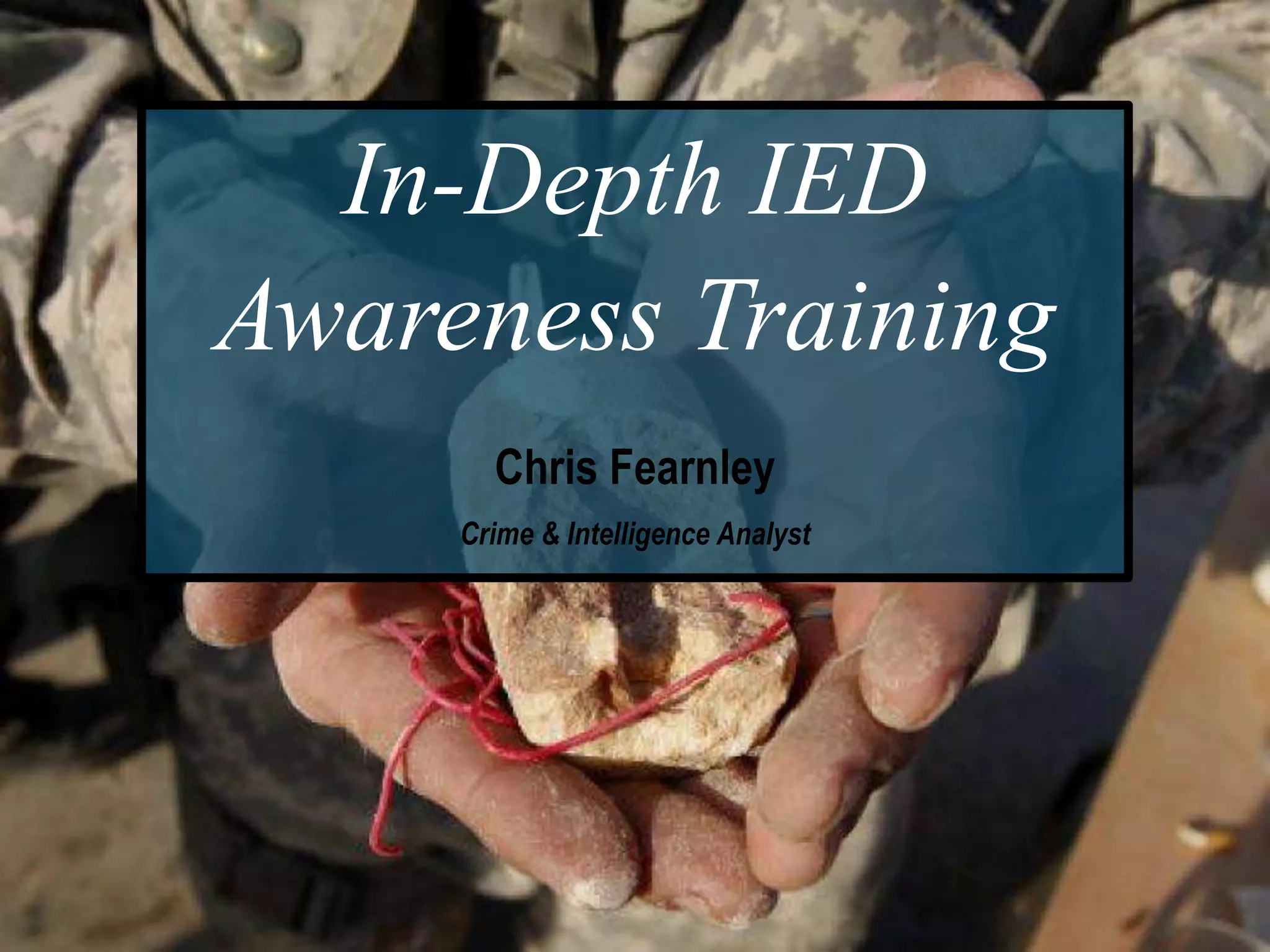
In-Depth IED
Awareness Training
Chris Fearnley
Crime & Intelligence Analyst
Scope
• What is an IED?
• The five components of an IED
– Casing
– Explosive
– Power source
– Detonator / Initiator
– Trigger / Firing Switch
• Different types of IED
– Command (RC or CW)
– VOIED
– PBIED
– VBIED
– EFP
– Chemical / Biological
• IED Enhancements
• Experimental IEDs
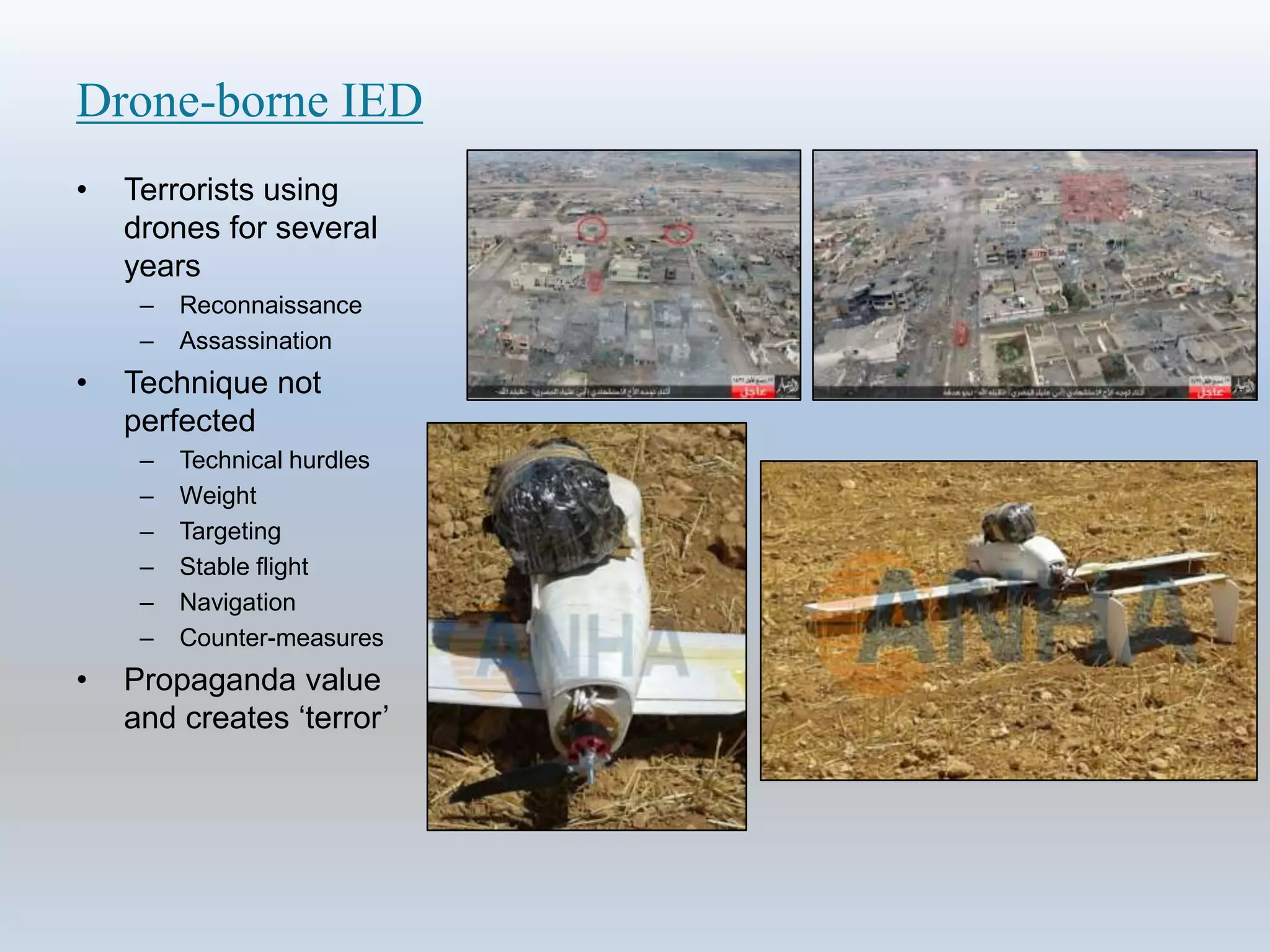
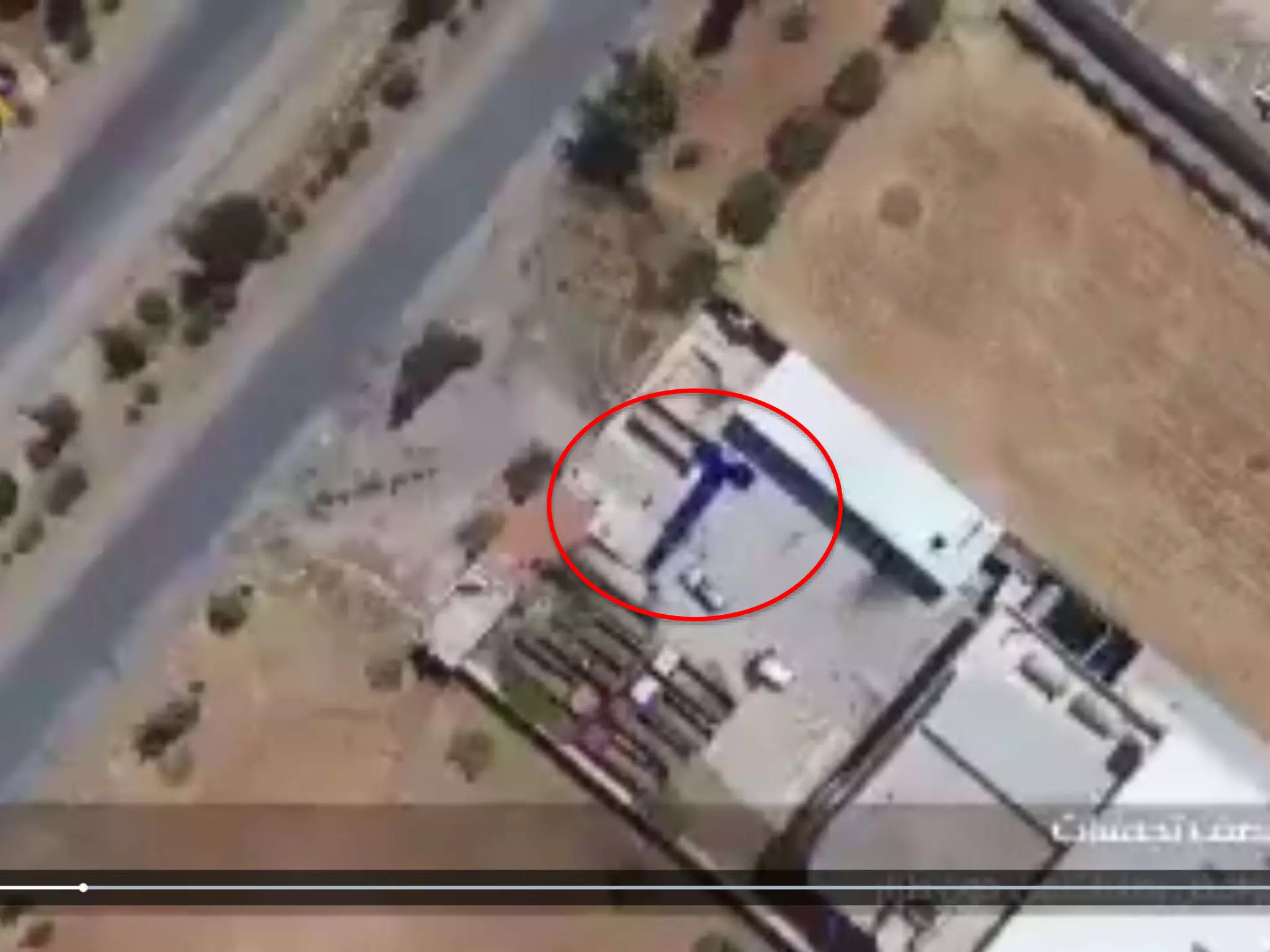
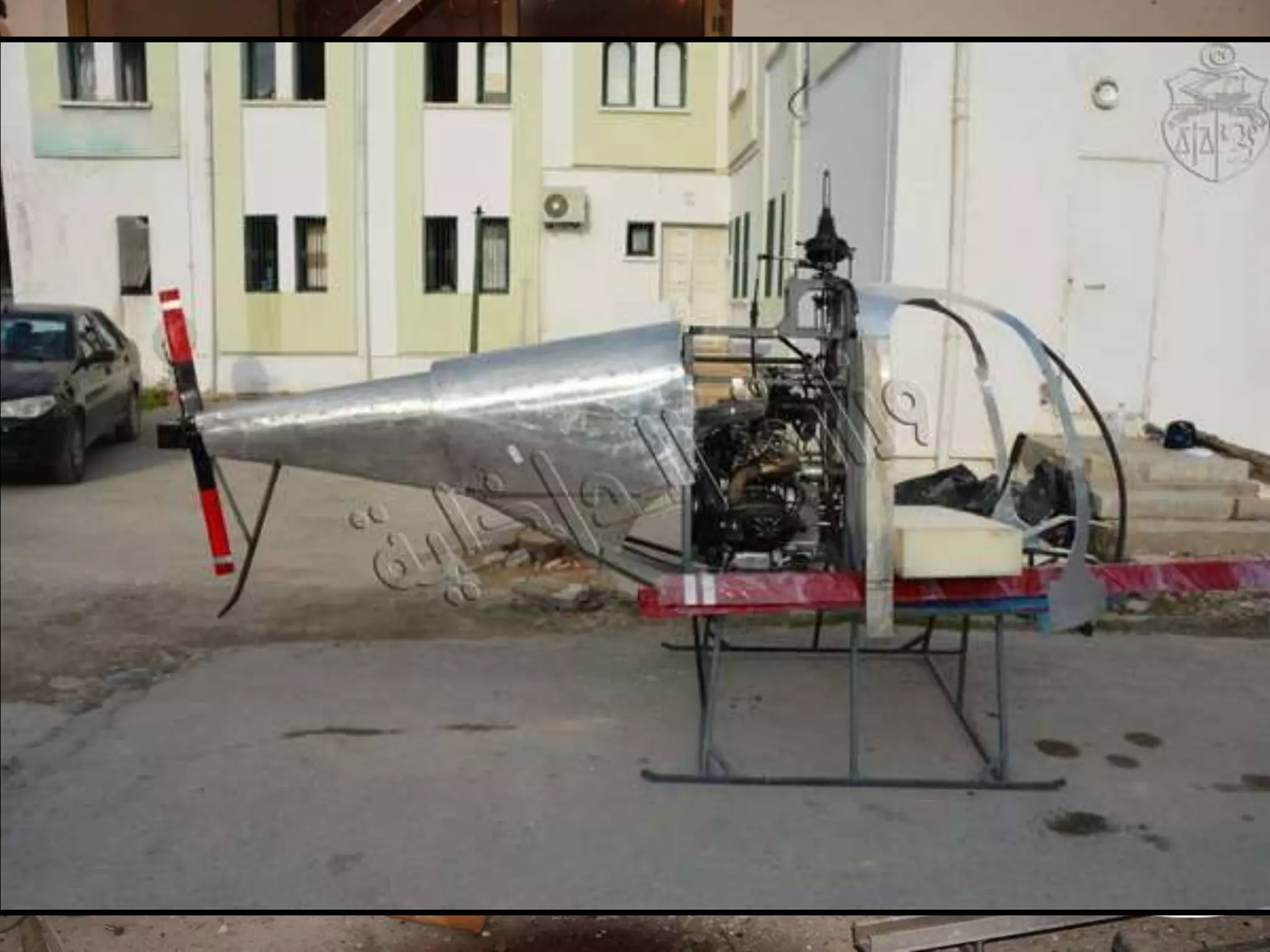
– Drone-borne
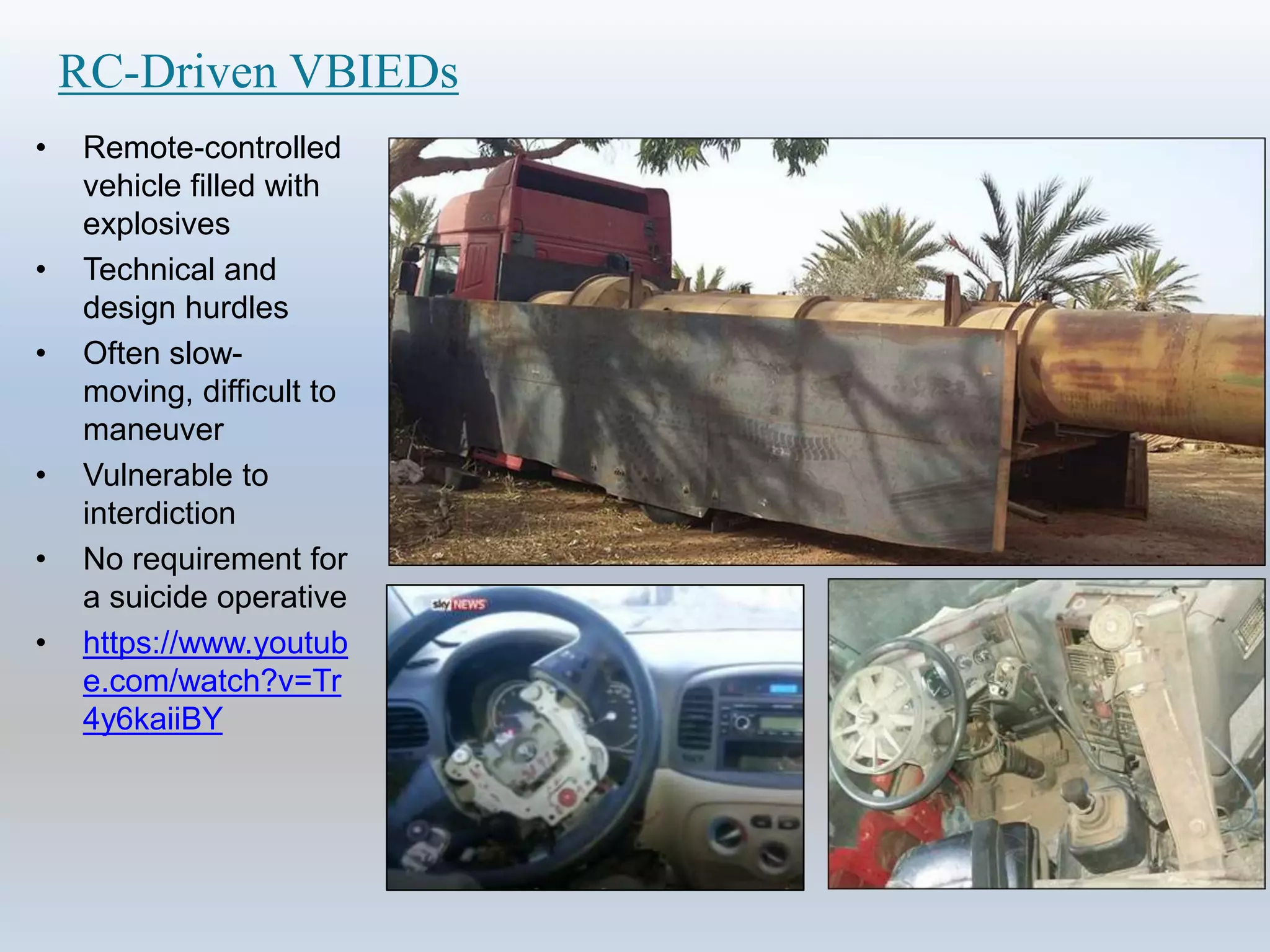
– RC-driven VBIEDs
The Casing
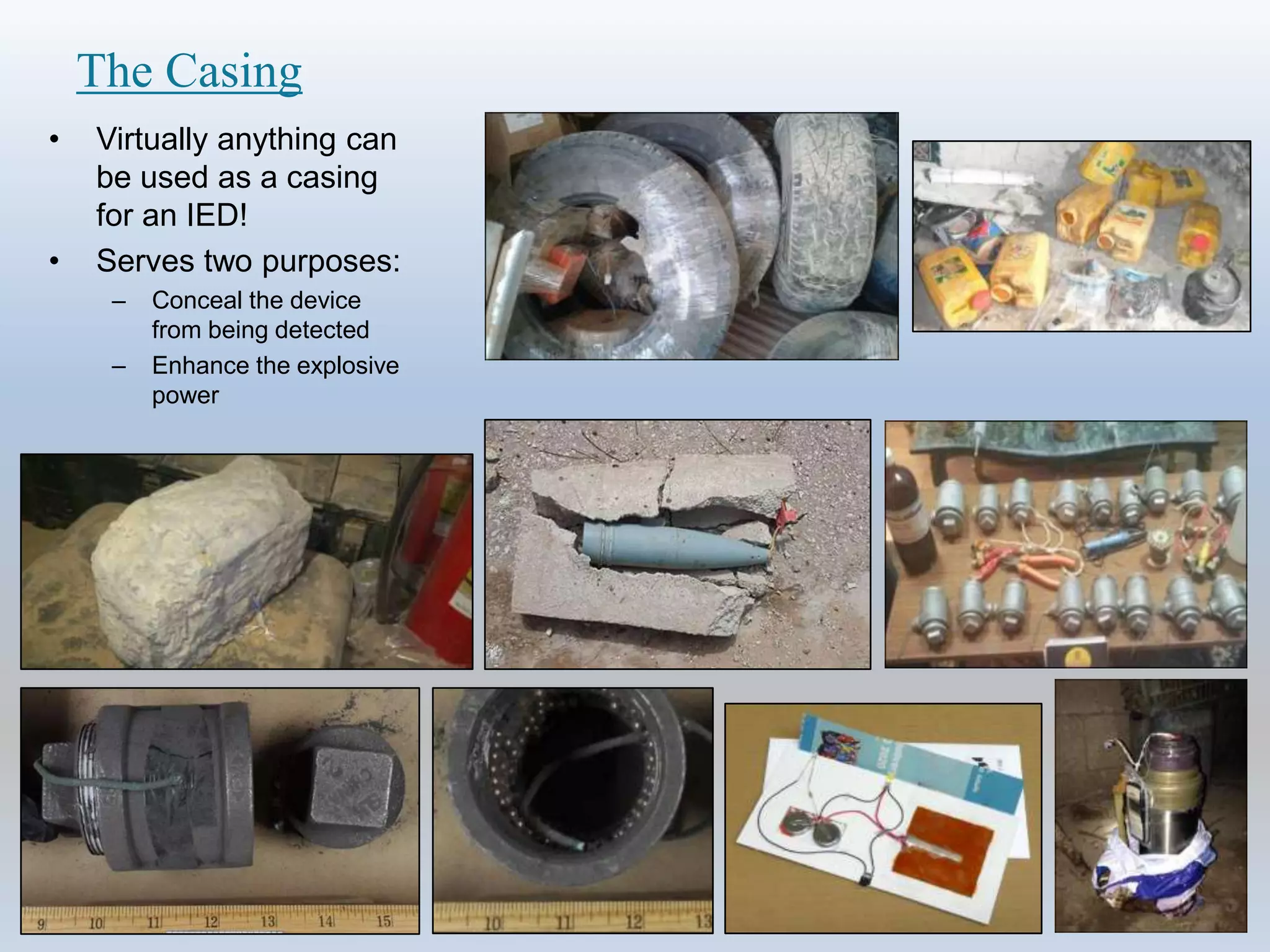
• Virtually anything can
be used as a casing
for an IED!
• Serves two purposes:
– Conceal the device
from being detected
– Enhance the explosive
power
The Explosive
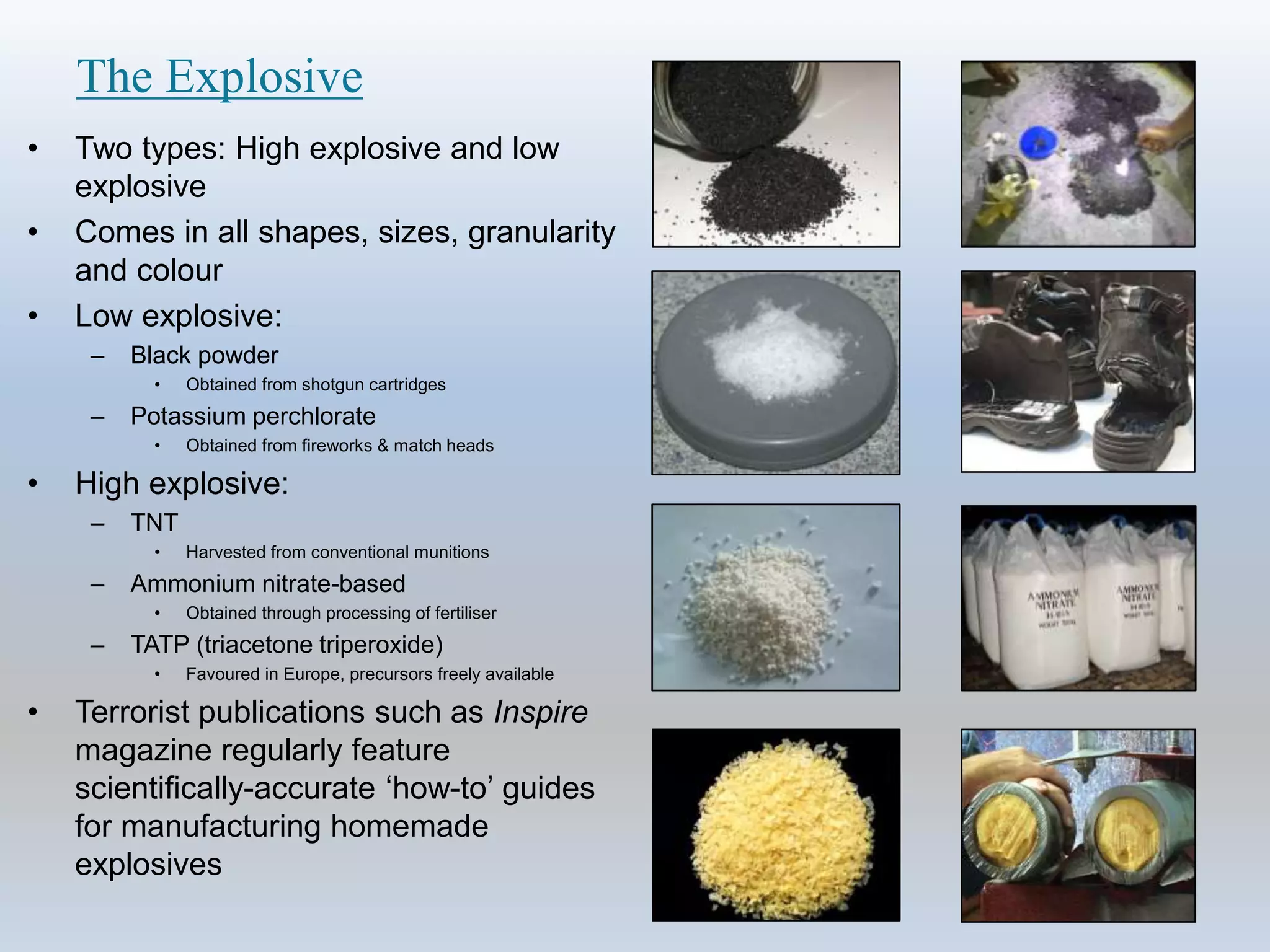
• Two types: High explosive and low
explosive
• Comes in all shapes, sizes, granularity
and colour
• Low explosive:
– Black powder
• Obtained from shotgun cartridges
– Potassium perchlorate
• Obtained from fireworks & match heads
• High explosive:
– TNT
• Harvested from conventional munitions
– Ammonium nitrate-based
• Obtained through processing of fertiliser
– TATP (triacetone triperoxide)
• Favoured in Europe, precursors freely available
• Terrorist publications such as Inspire
magazine regularly feature
scientifically-accurate ‘how-to’ guides
for manufacturing homemade
explosives
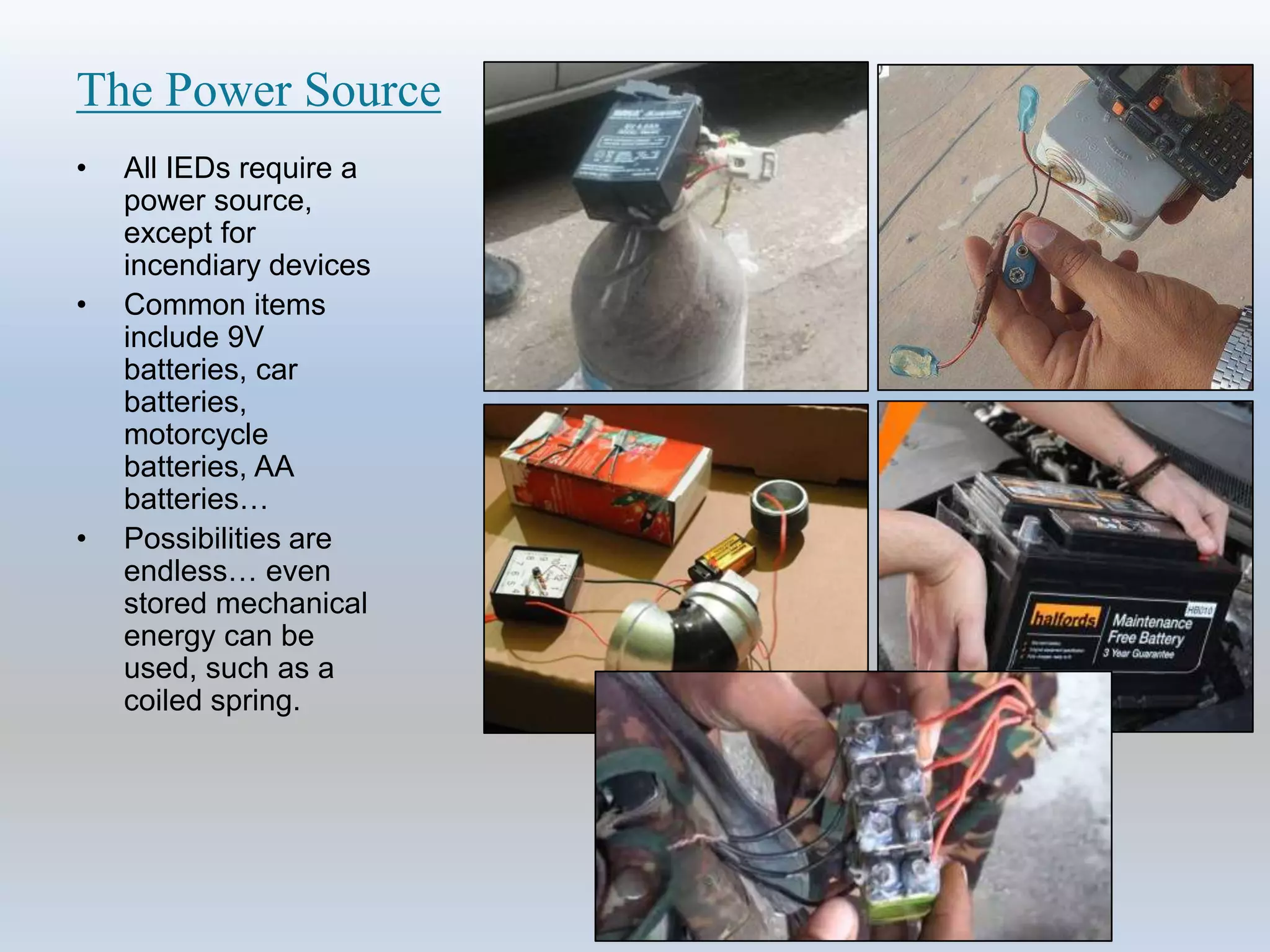
The Power Source
• All IEDs require a
power source,
except for
incendiary devices
• Common items
include 9V
batteries, car
batteries,
motorcycle
batteries, AA
batteries…
• Possibilities are
endless… even
stored mechanical
energy can be
used, such as a
coiled spring.
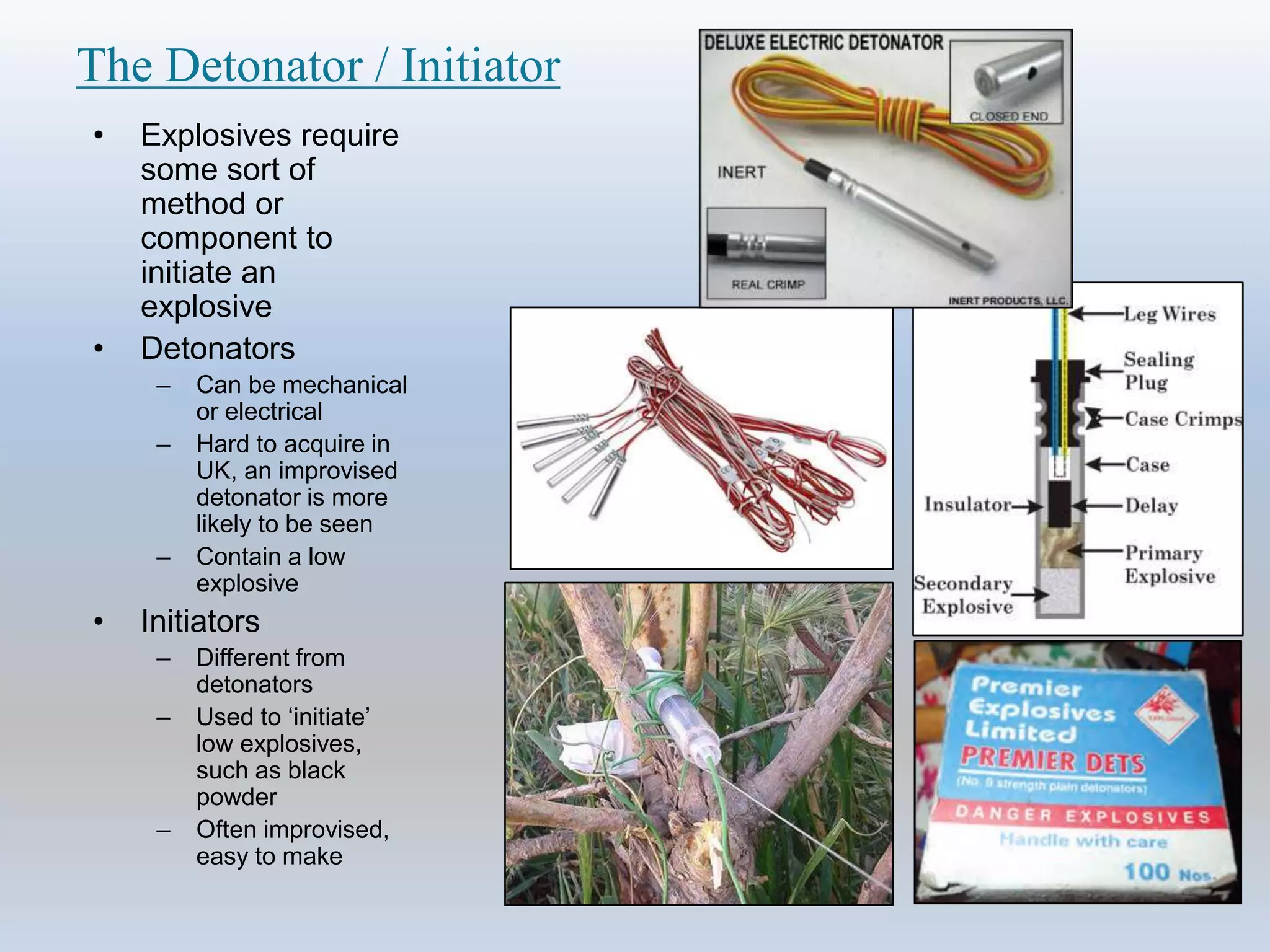
The Detonator / Initiator
• Explosives require
some sort of
method or
component to
initiate an
explosive
• Detonators
– Can be mechanical
or electrical
– Hard to acquire in
UK, an improvised
detonator is more
likely to be seen
– Contain a low
explosive
• Initiators
– Different from
detonators
– Used to ‘initiate’
low explosives,
such as black
powder
– Often improvised,
easy to make
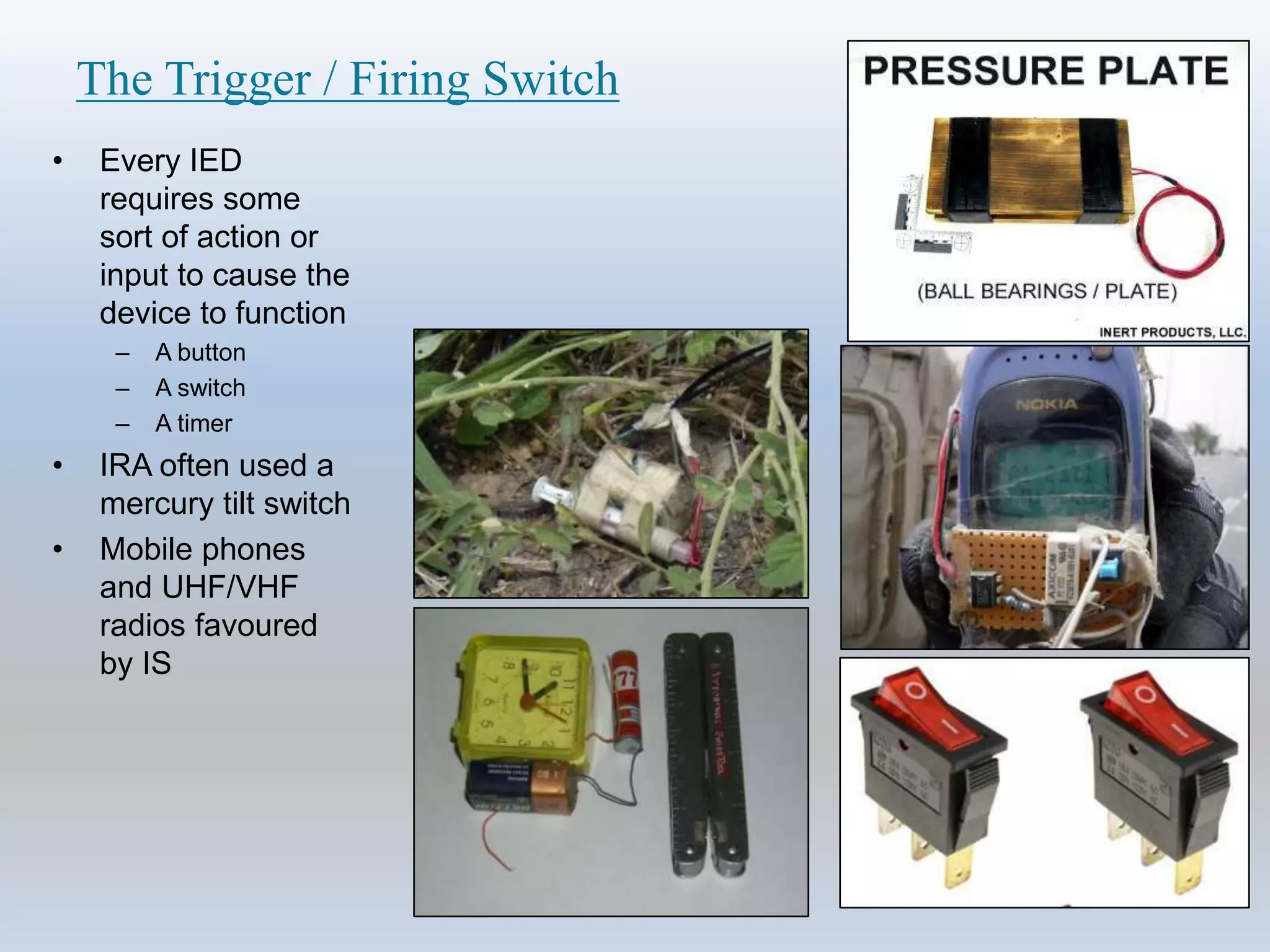
The Trigger / Firing Switch
• Every IED
requires some
sort of action or
input to cause the
device to function
– A button
– A switch
– A timer
• IRA often used a
mercury tilt switch
• Mobile phones
and UHF/VHF
radios favoured
by IS
The Different
Types of IED
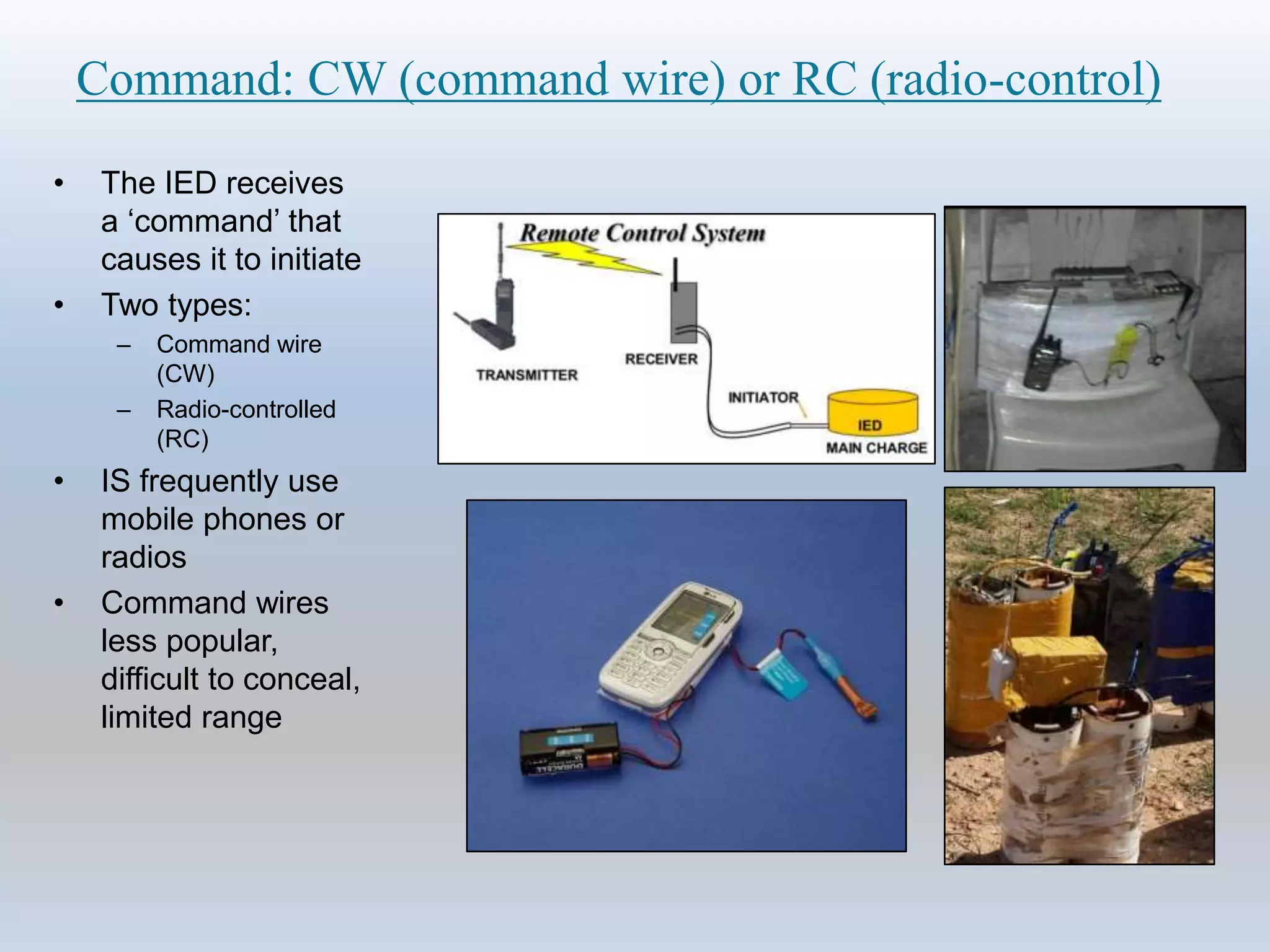
Command: CW (command wire) or RC (radio-control)
• The IED receives
a ‘command’ that
causes it to initiate
• Two types:
– Command wire
(CW)
– Radio-controlled
(RC)
• IS frequently use
mobile phones or
radios
• Command wires
less popular,
difficult to conceal,
limited range
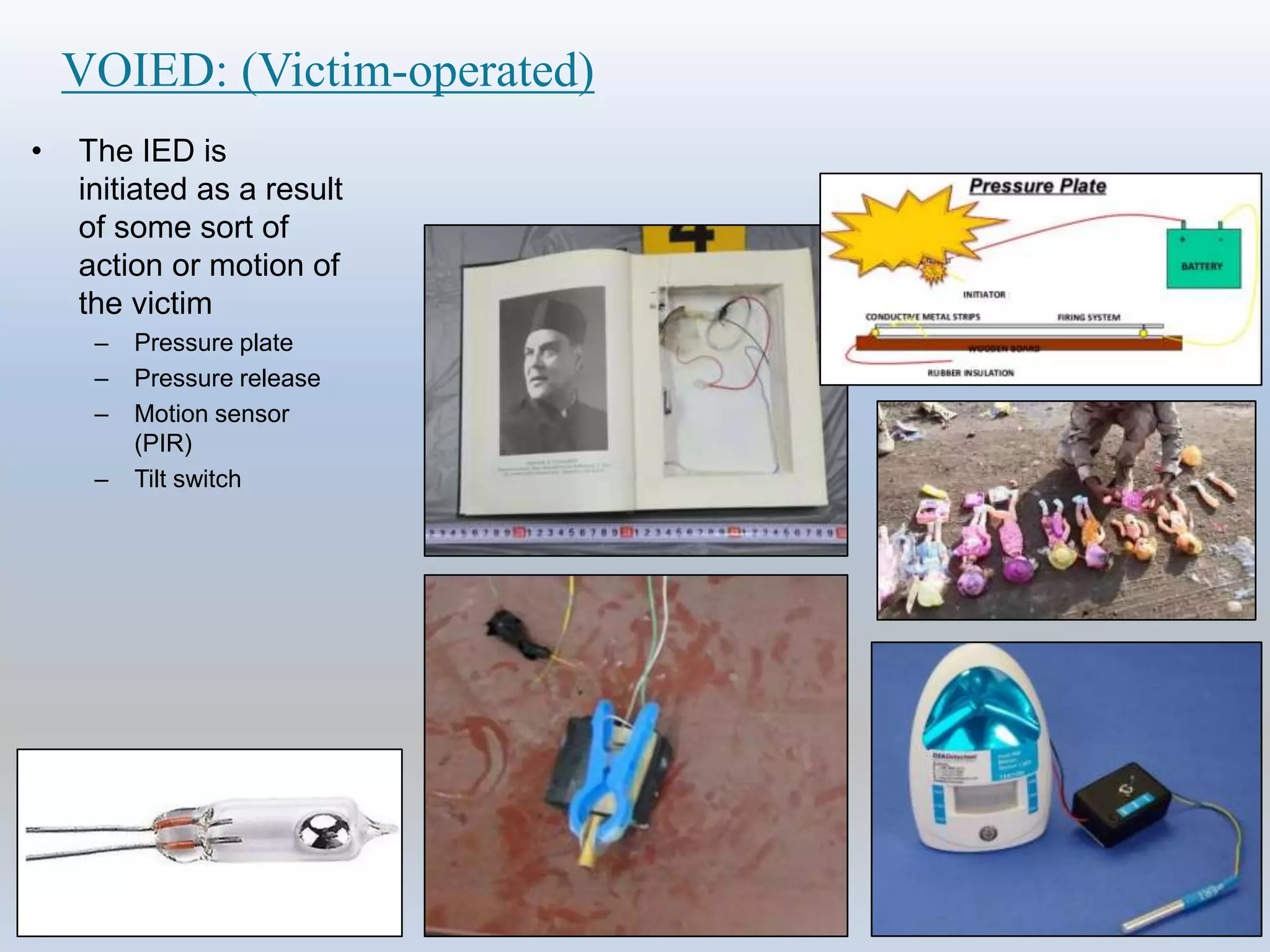
VOIED: (Victim-operated)
• The IED is
initiated as a result
of some sort of
action or motion of
the victim
– Pressure plate
– Pressure release
– Motion sensor
(PIR)
– Tilt switch
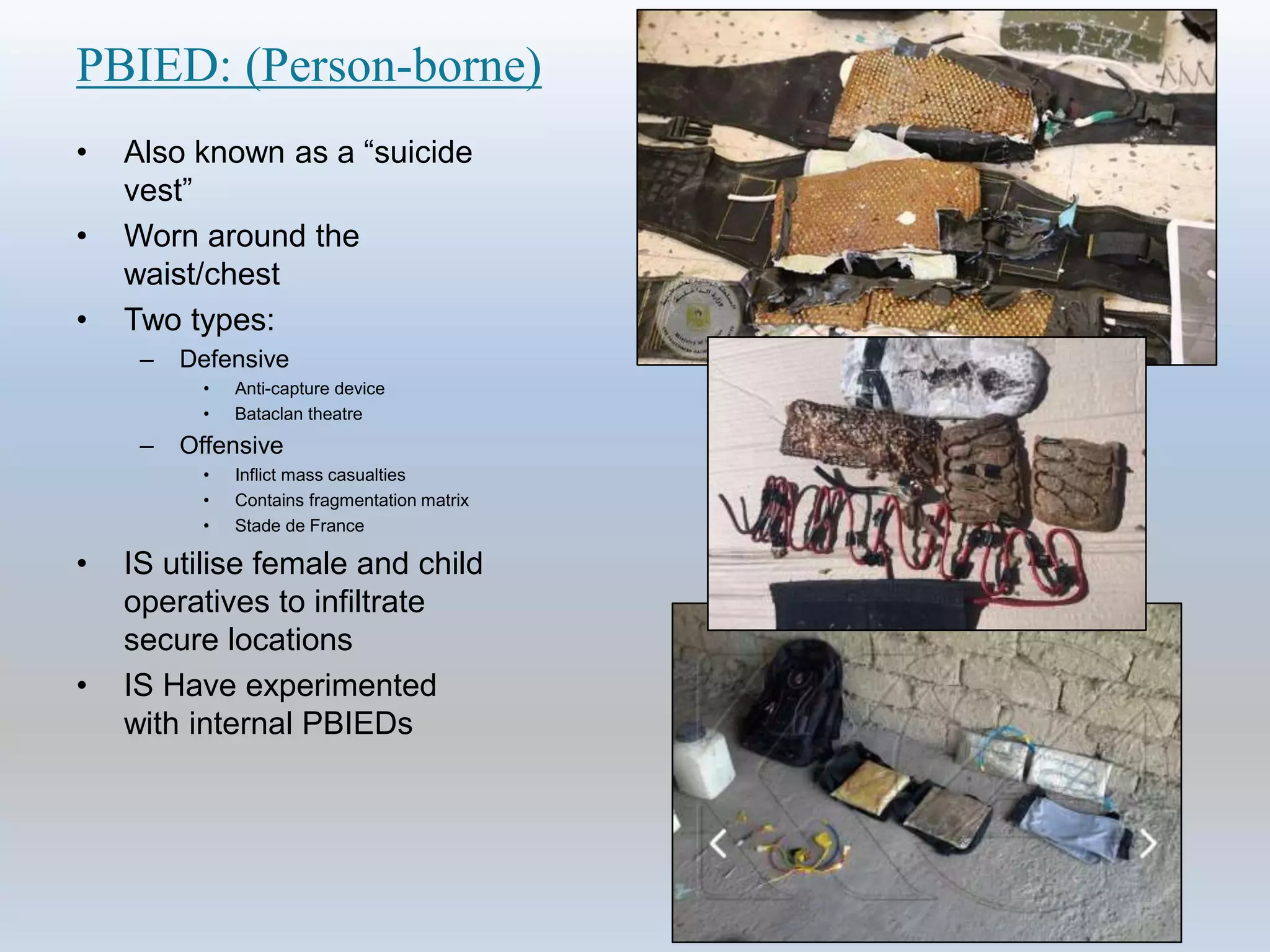
PBIED: (Person-borne)
• Also known as a “suicide
vest”
• Worn around the
waist/chest
• Two types:
– Defensive
• Anti-capture device
• Bataclan theatre
– Offensive
• Inflict mass casualties
• Contains fragmentation matrix
• Stade de France
• IS utilise female and child
operatives to infiltrate
secure locations
• IS Have experimented
with internal PBIEDs
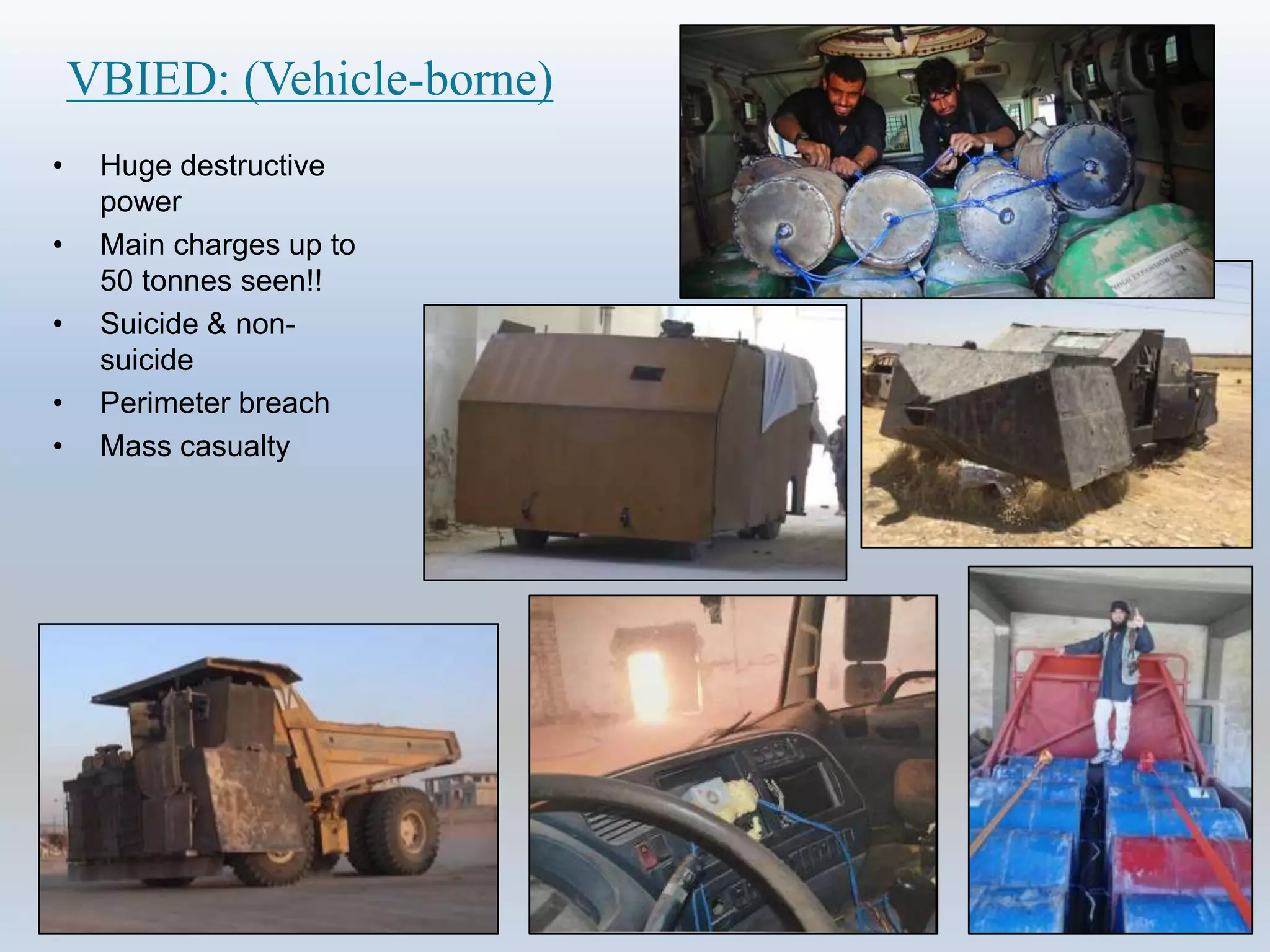
VBIED: (Vehicle-borne)
• Huge destructive
power
• Main charges up to
50 tonnes seen!!
• Suicide & non-
suicide
• Perimeter breach
• Mass casualty
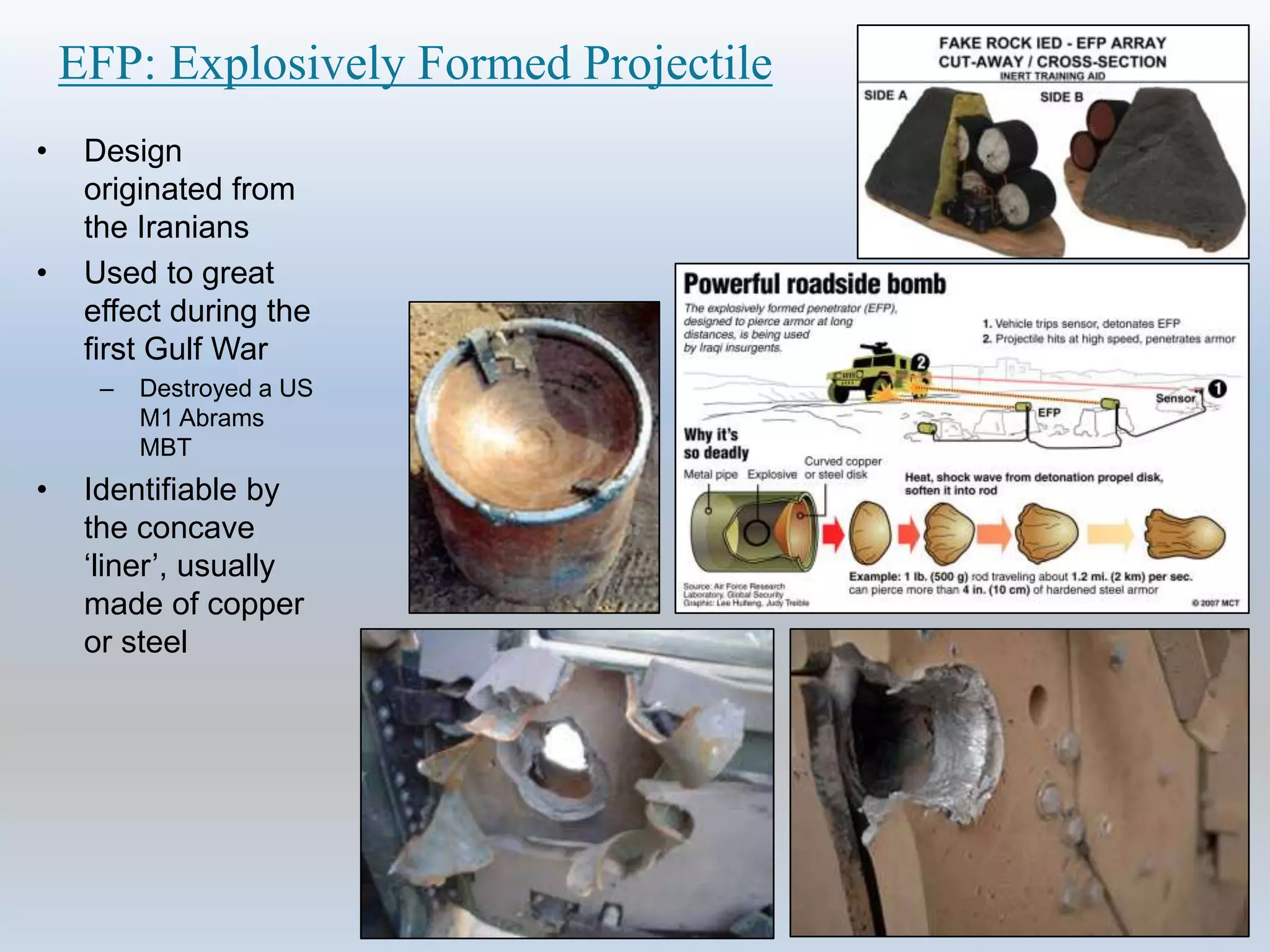
EFP: Explosively Formed Projectile
• Design
originated from
the Iranians
• Used to great
effect during the
first Gulf War
– Destroyed a US
M1 Abrams
MBT
• Identifiable by
the concave
‘liner’, usually
made of copper
or steel
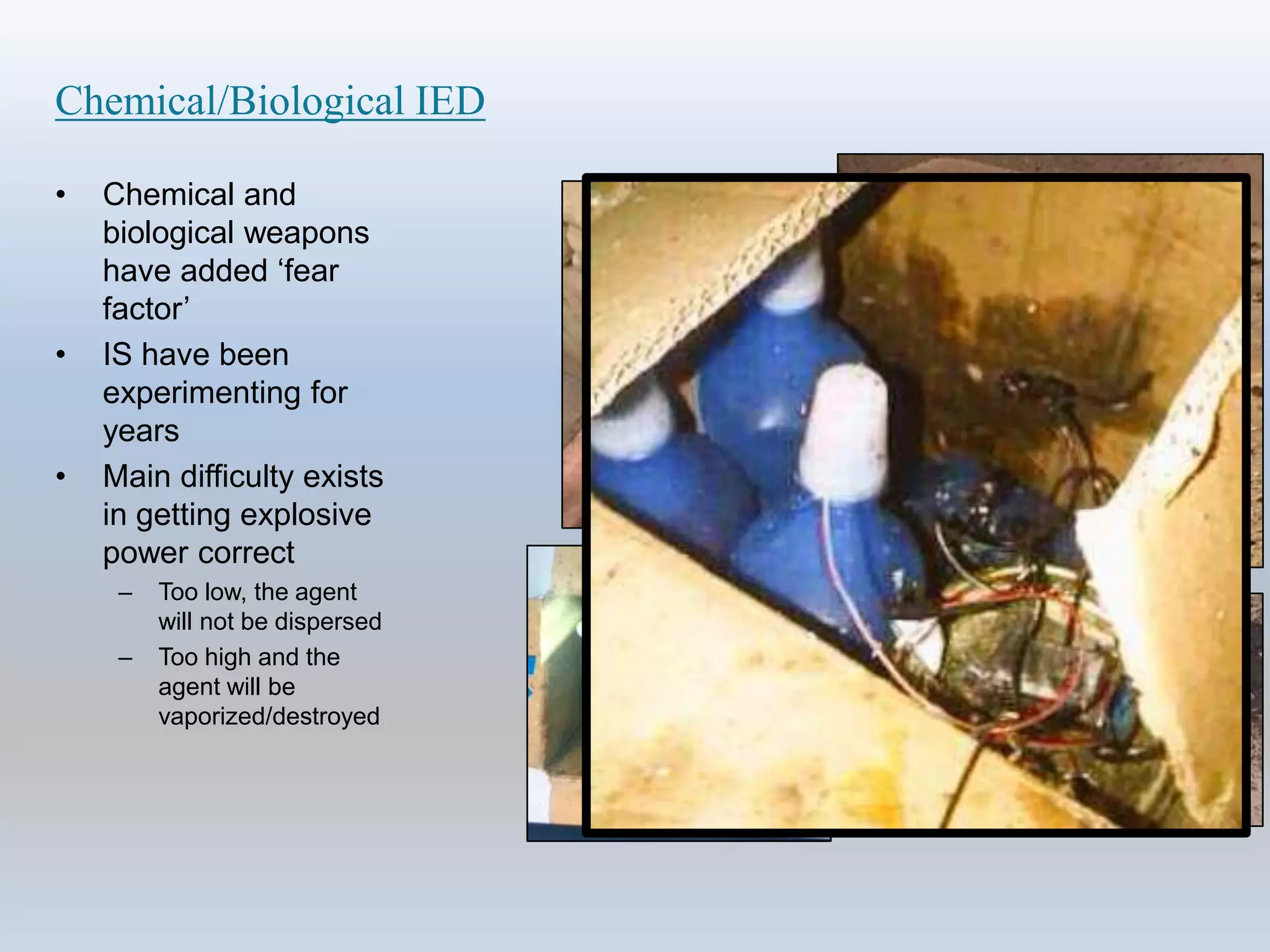
Chemical/Biological IED
• Chemical and
biological weapons
have added ‘fear
factor’
• IS have been
experimenting for
years
• Main difficulty exists
in getting explosive
power correct
– Too low, the agent
will not be dispersed
– Too high and the
agent will be
vaporized/destroyed
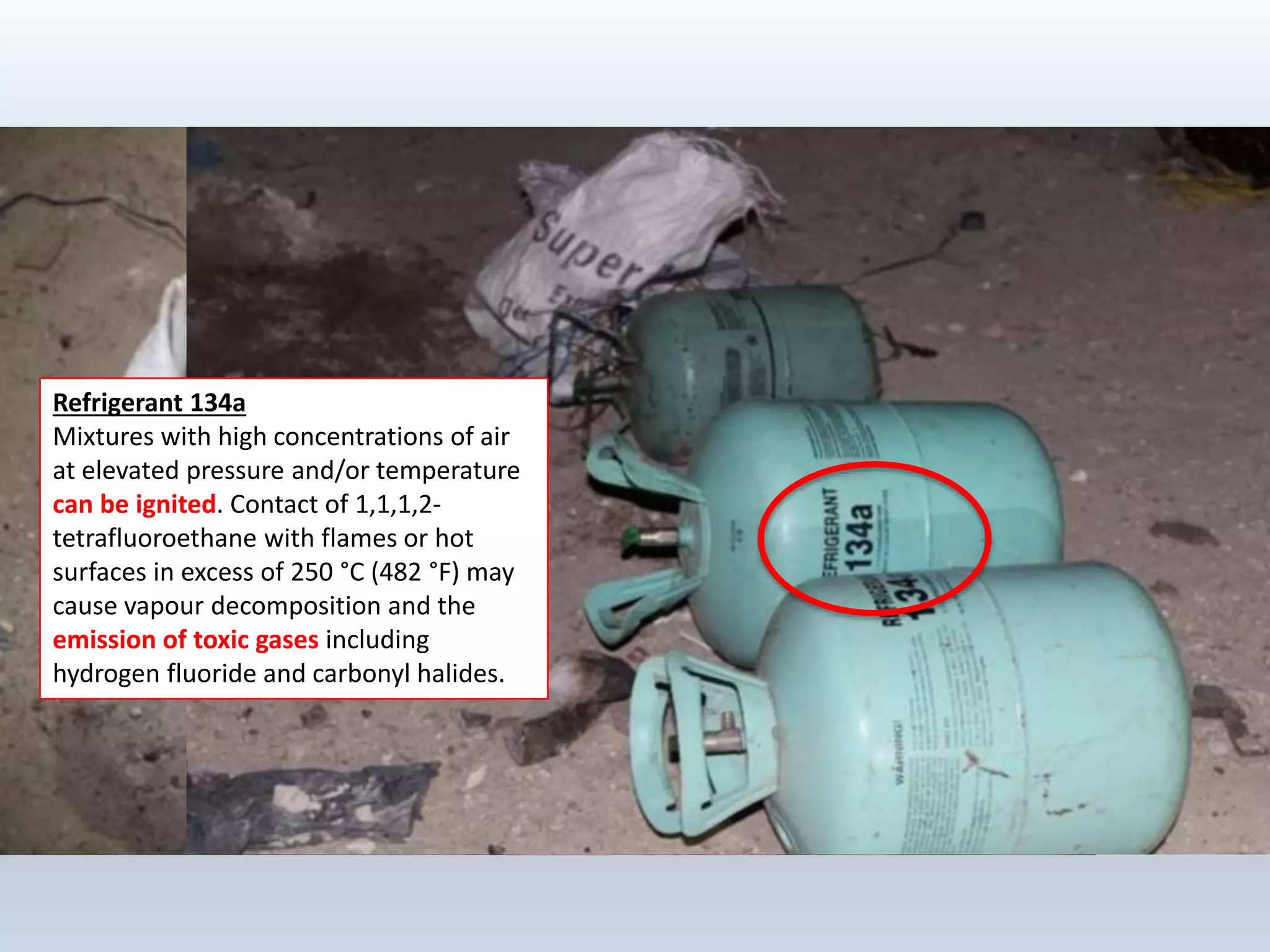
Refrigerant 134a
Mixtures with high concentrations of air
at elevated pressure and/or temperature
can be ignited. Contact of 1,1,1,2-
tetrafluoroethane with flames or hot
surfaces in excess of 250 °C (482 °F) may
cause vapour decomposition and the
emission of toxic gases including
hydrogen fluoride and carbonyl halides.
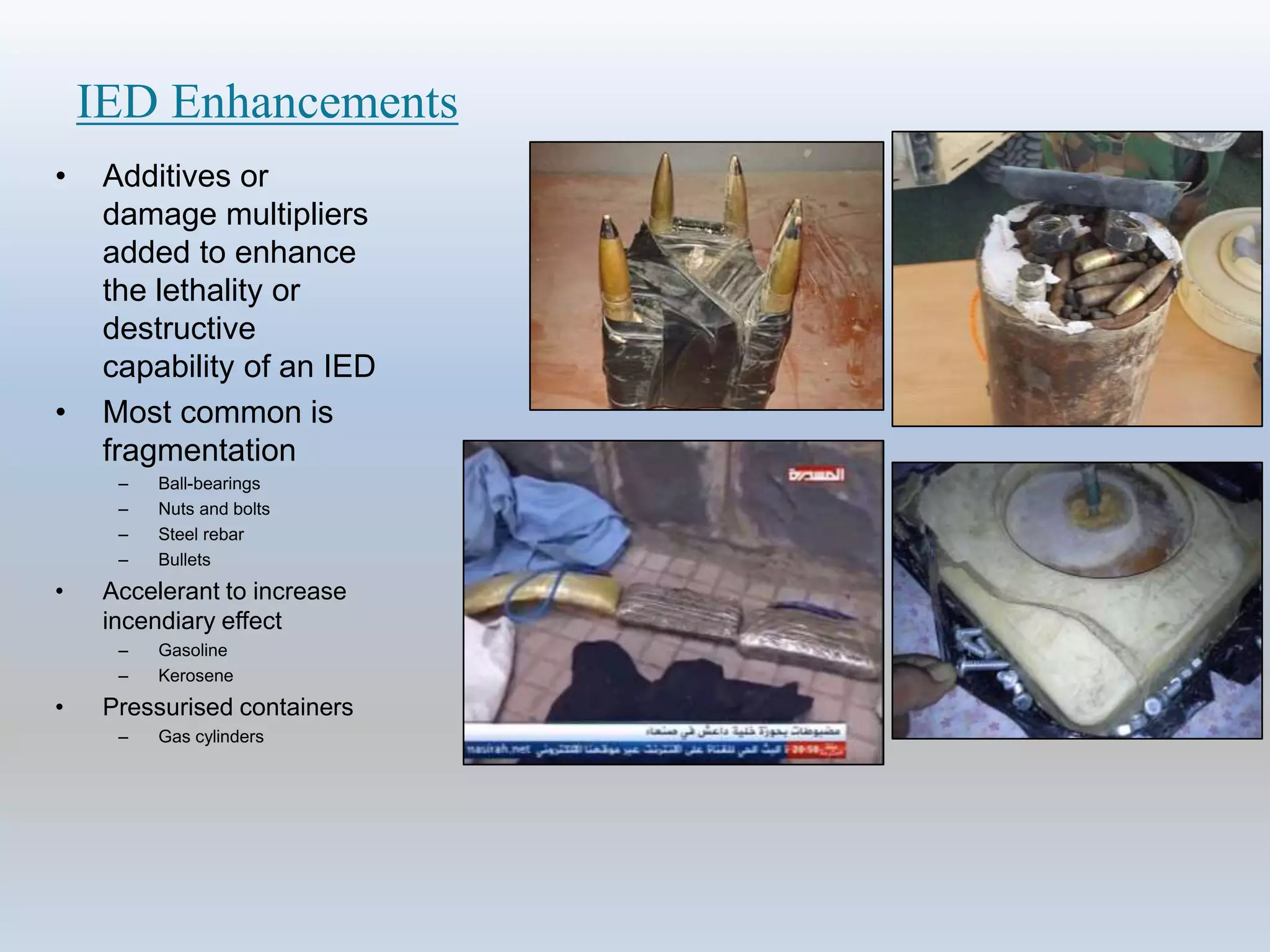
IED Enhancements
• Additives or
damage multipliers
added to enhance
the lethality or
destructive
capability of an IED
• Most common is
fragmentation
– Ball-bearings
– Nuts and bolts
– Steel rebar
– Bullets
• Accelerant to increase
incendiary effect
– Gasoline
– Kerosene
• Pressurised containers
– Gas cylinders
Experimental
IEDs
Drone-borne IED
• Terrorists using
drones for several
years
– Reconnaissance
– Assassination
• Technique not
perfected
– Technical hurdles
– Weight
– Targeting
– Stable flight
– Navigation
– Counter-measures
• Propaganda value
and creates ‘terror’
RC-Driven VBIEDs
• Remote-controlled
vehicle filled with
explosives
• Technical and
design hurdles
• Often slow-
moving, difficult to
maneuver
• Vulnerable to
interdiction
• No requirement for
a suicide operative
• https://www.youtub
e.com/watch?v=Tr
4y6kaiiBY
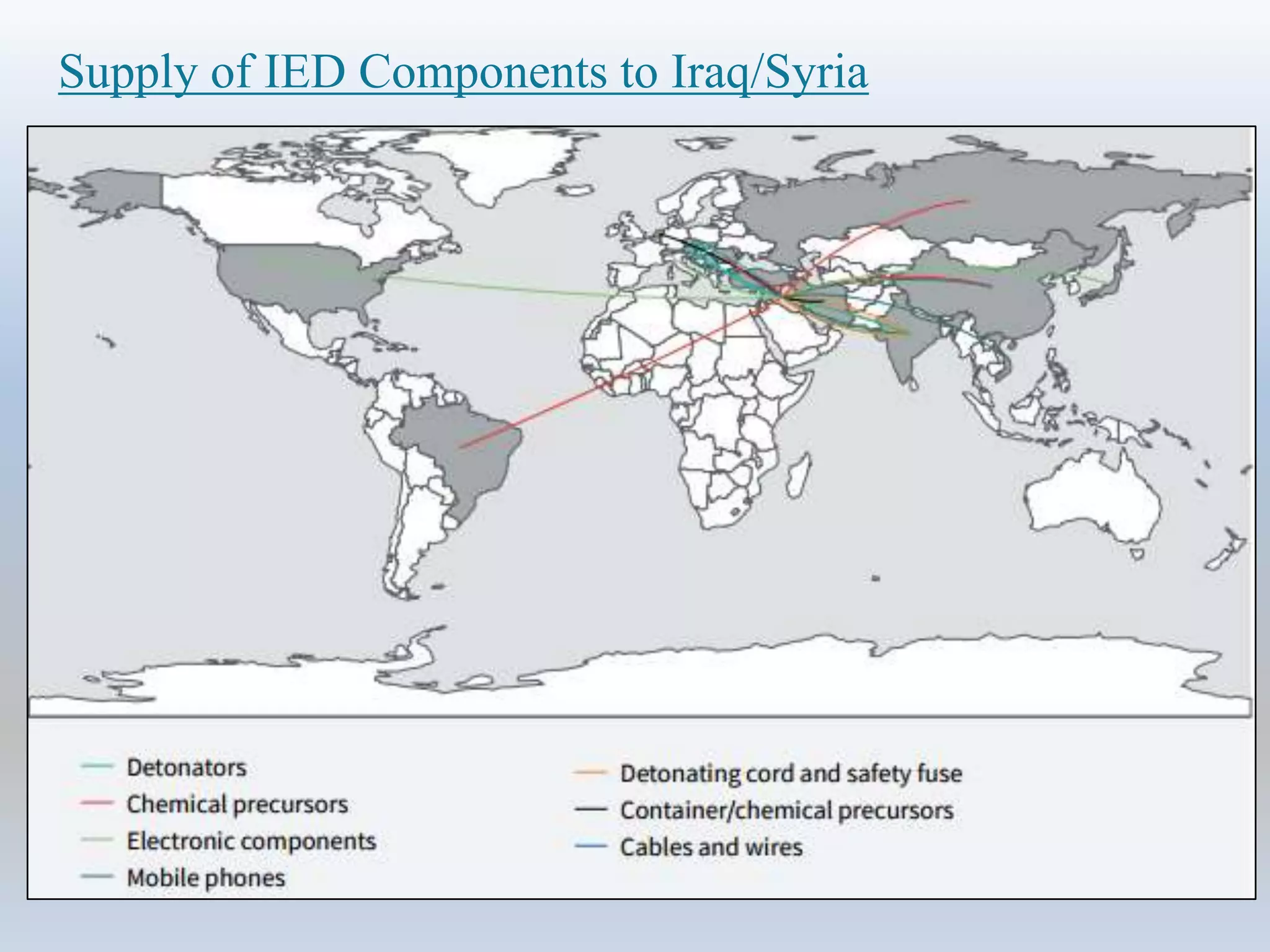
Supply of IED Components to Iraq/Syria
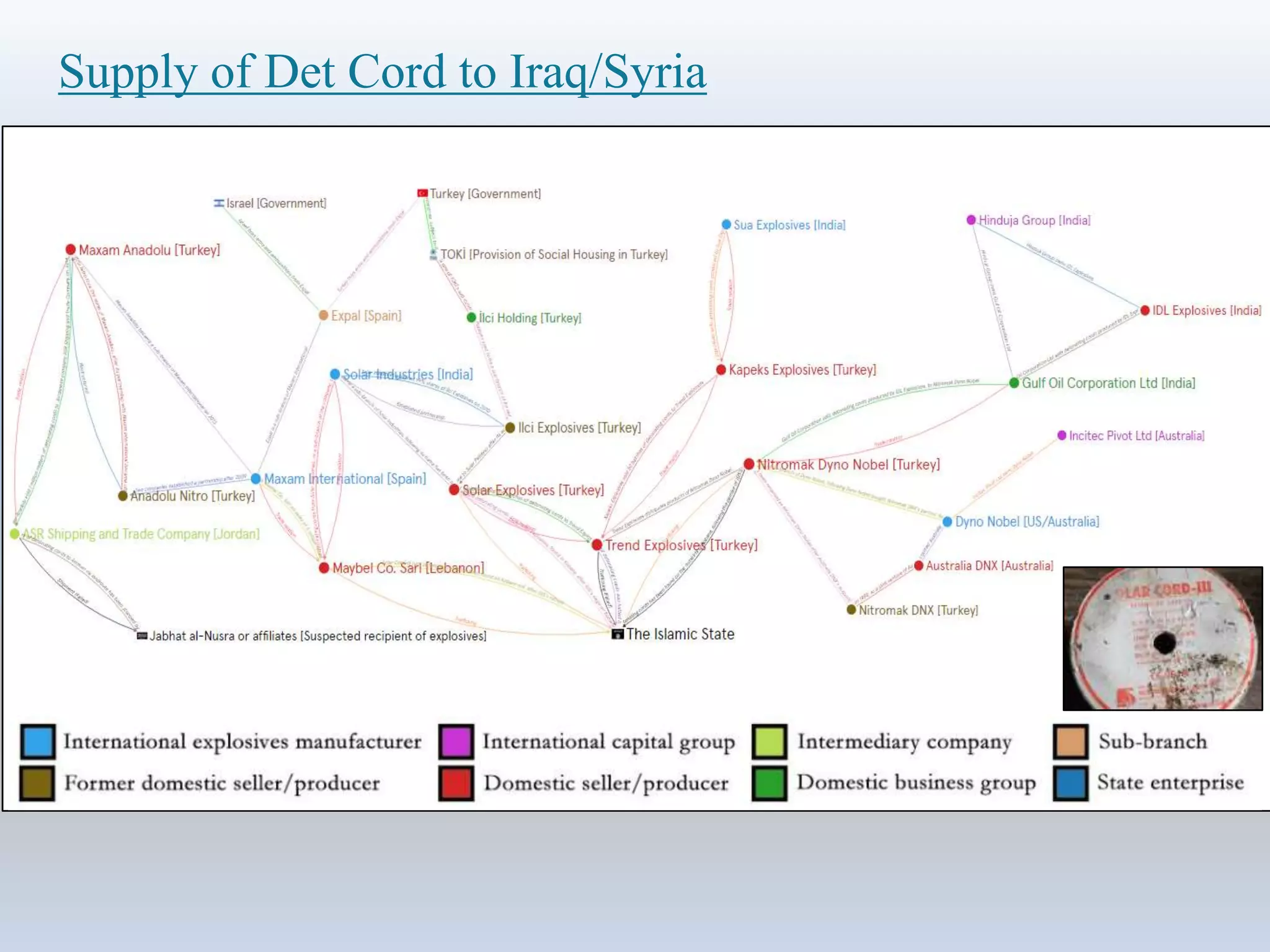
Supply of Det Cord to Iraq/Syria
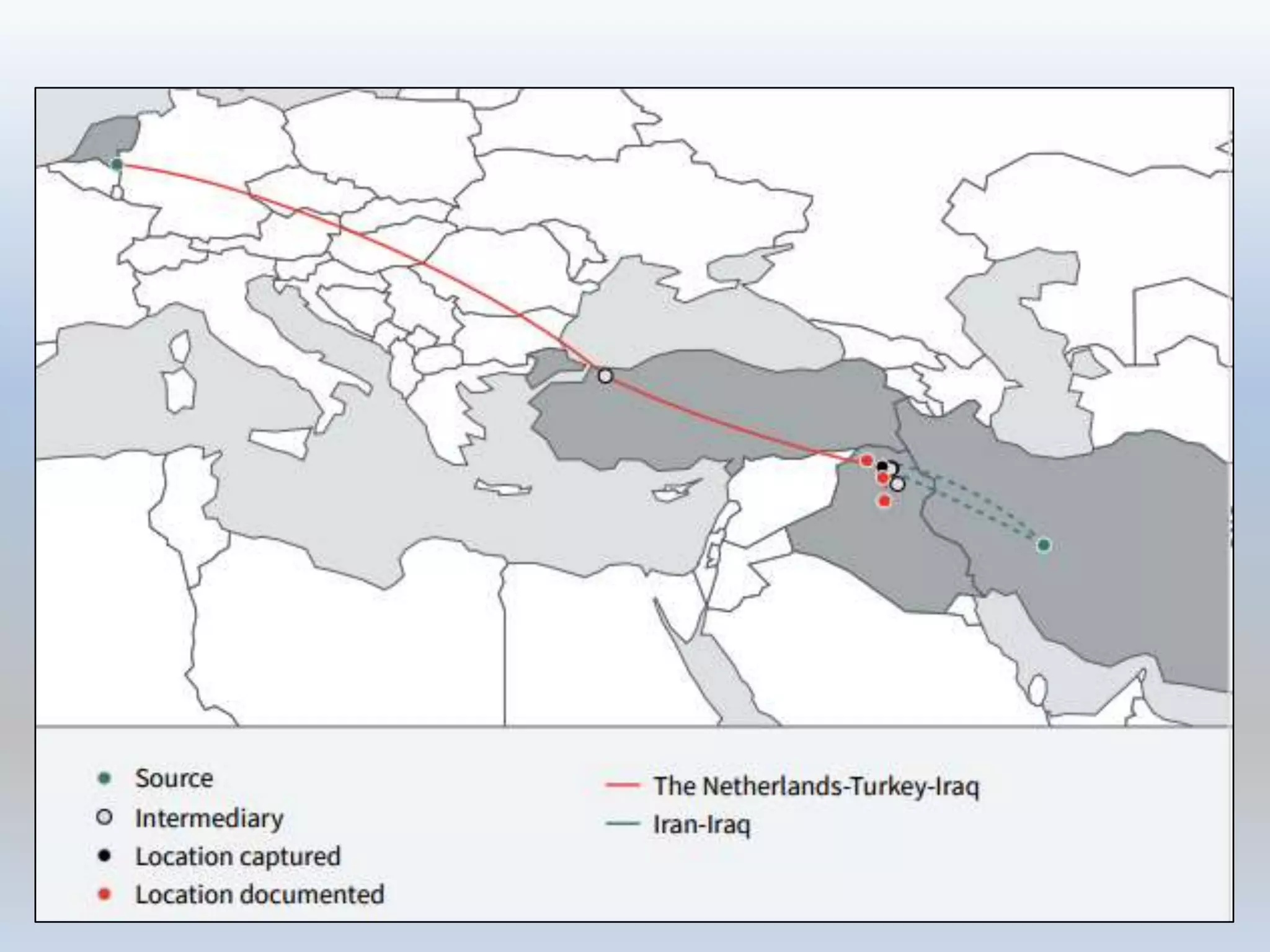
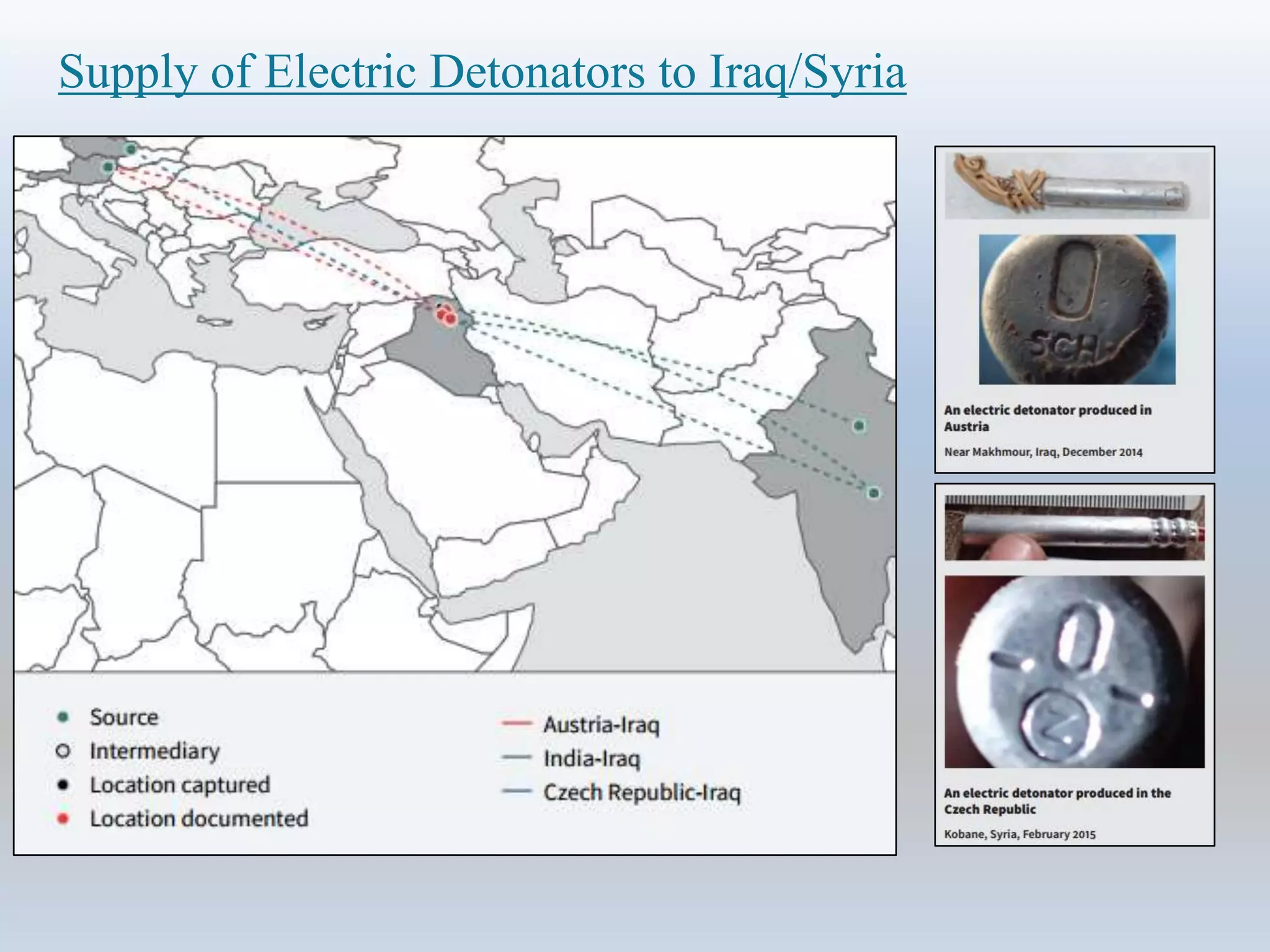
Supply of Electric Detonators to Iraq/Syria

In-depth IED Awareness Training

  • 1.
    In-Depth IED Awareness Training ChrisFearnley Crime & Intelligence Analyst
  • 2.
    Scope • What isan IED? • The five components of an IED – Casing – Explosive – Power source – Detonator / Initiator – Trigger / Firing Switch • Different types of IED – Command (RC or CW) – VOIED – PBIED – VBIED – EFP – Chemical / Biological • IED Enhancements • Experimental IEDs – Drone-borne – RC-driven VBIEDs
  • 3.
    The Casing • Virtuallyanything can be used as a casing for an IED! • Serves two purposes: – Conceal the device from being detected – Enhance the explosive power
  • 4.
    The Explosive • Twotypes: High explosive and low explosive • Comes in all shapes, sizes, granularity and colour • Low explosive: – Black powder • Obtained from shotgun cartridges – Potassium perchlorate • Obtained from fireworks & match heads • High explosive: – TNT • Harvested from conventional munitions – Ammonium nitrate-based • Obtained through processing of fertiliser – TATP (triacetone triperoxide) • Favoured in Europe, precursors freely available • Terrorist publications such as Inspire magazine regularly feature scientifically-accurate ‘how-to’ guides for manufacturing homemade explosives
  • 6.
    The Power Source •All IEDs require a power source, except for incendiary devices • Common items include 9V batteries, car batteries, motorcycle batteries, AA batteries… • Possibilities are endless… even stored mechanical energy can be used, such as a coiled spring.
  • 7.
    The Detonator /Initiator • Explosives require some sort of method or component to initiate an explosive • Detonators – Can be mechanical or electrical – Hard to acquire in UK, an improvised detonator is more likely to be seen – Contain a low explosive • Initiators – Different from detonators – Used to ‘initiate’ low explosives, such as black powder – Often improvised, easy to make
  • 9.
    The Trigger /Firing Switch • Every IED requires some sort of action or input to cause the device to function – A button – A switch – A timer • IRA often used a mercury tilt switch • Mobile phones and UHF/VHF radios favoured by IS
  • 13.
  • 14.
    Command: CW (commandwire) or RC (radio-control) • The IED receives a ‘command’ that causes it to initiate • Two types: – Command wire (CW) – Radio-controlled (RC) • IS frequently use mobile phones or radios • Command wires less popular, difficult to conceal, limited range
  • 15.
    VOIED: (Victim-operated) • TheIED is initiated as a result of some sort of action or motion of the victim – Pressure plate – Pressure release – Motion sensor (PIR) – Tilt switch
  • 16.
    PBIED: (Person-borne) • Alsoknown as a “suicide vest” • Worn around the waist/chest • Two types: – Defensive • Anti-capture device • Bataclan theatre – Offensive • Inflict mass casualties • Contains fragmentation matrix • Stade de France • IS utilise female and child operatives to infiltrate secure locations • IS Have experimented with internal PBIEDs
  • 17.
    VBIED: (Vehicle-borne) • Hugedestructive power • Main charges up to 50 tonnes seen!! • Suicide & non- suicide • Perimeter breach • Mass casualty
  • 18.
    EFP: Explosively FormedProjectile • Design originated from the Iranians • Used to great effect during the first Gulf War – Destroyed a US M1 Abrams MBT • Identifiable by the concave ‘liner’, usually made of copper or steel
  • 19.
    Chemical/Biological IED • Chemicaland biological weapons have added ‘fear factor’ • IS have been experimenting for years • Main difficulty exists in getting explosive power correct – Too low, the agent will not be dispersed – Too high and the agent will be vaporized/destroyed
  • 20.
    Refrigerant 134a Mixtures withhigh concentrations of air at elevated pressure and/or temperature can be ignited. Contact of 1,1,1,2- tetrafluoroethane with flames or hot surfaces in excess of 250 °C (482 °F) may cause vapour decomposition and the emission of toxic gases including hydrogen fluoride and carbonyl halides.
  • 21.
    IED Enhancements • Additivesor damage multipliers added to enhance the lethality or destructive capability of an IED • Most common is fragmentation – Ball-bearings – Nuts and bolts – Steel rebar – Bullets • Accelerant to increase incendiary effect – Gasoline – Kerosene • Pressurised containers – Gas cylinders
  • 26.
  • 27.
    Drone-borne IED • Terroristsusing drones for several years – Reconnaissance – Assassination • Technique not perfected – Technical hurdles – Weight – Targeting – Stable flight – Navigation – Counter-measures • Propaganda value and creates ‘terror’
  • 30.
    RC-Driven VBIEDs • Remote-controlled vehiclefilled with explosives • Technical and design hurdles • Often slow- moving, difficult to maneuver • Vulnerable to interdiction • No requirement for a suicide operative • https://www.youtub e.com/watch?v=Tr 4y6kaiiBY
  • 31.
    Supply of IEDComponents to Iraq/Syria
  • 32.
    Supply of DetCord to Iraq/Syria
  • 34.
    Supply of ElectricDetonators to Iraq/Syria