Presentation to IEA DSM – EXCO Meeting
“Energy Efficiency Obligations –
the UK Practical Experience on Validating &
Evaluating Energy Savings”
Eoin Lees
19 April 2006
Key topics to be addressed
• Brief history of UK energy efficiency obligations
• Key elements of measurement philosophy
• Need for continuous assessment of energy savings
& impact of recent research
• Verification in Practice
• Final energy and carbon savings from first phase of
UK Energy Efficiency Commitment (EEC)
What are Energy Efficiency Obligations?
• A legal obligation on energy suppliers/retailers or
distributors to save energy in their customers’
premises
• Can be applied to any end use sector e.g. residential,
small business, all sectors
• Energy saving target are set by
Government/Regulator and individual energy targets
for supplier/retailer or distributor are proportional to
their customer numbers
• Work in monopoly or liberalised market
Key Principles for UK design
• Focus on desired outcome i.e. energy saving in the
customer’s household
• Ex ante savings - proven energy efficiency measures
only (if not energy suppliers pay for measurement
costs)
• To give a representative value of the energy savings
for any EE measure, use average lifetime of the
measure but discount over life of measure (initially
8%,then 6% will be 3.5%)
• Ring fence low income – 50% of the benefit to come
from low income households
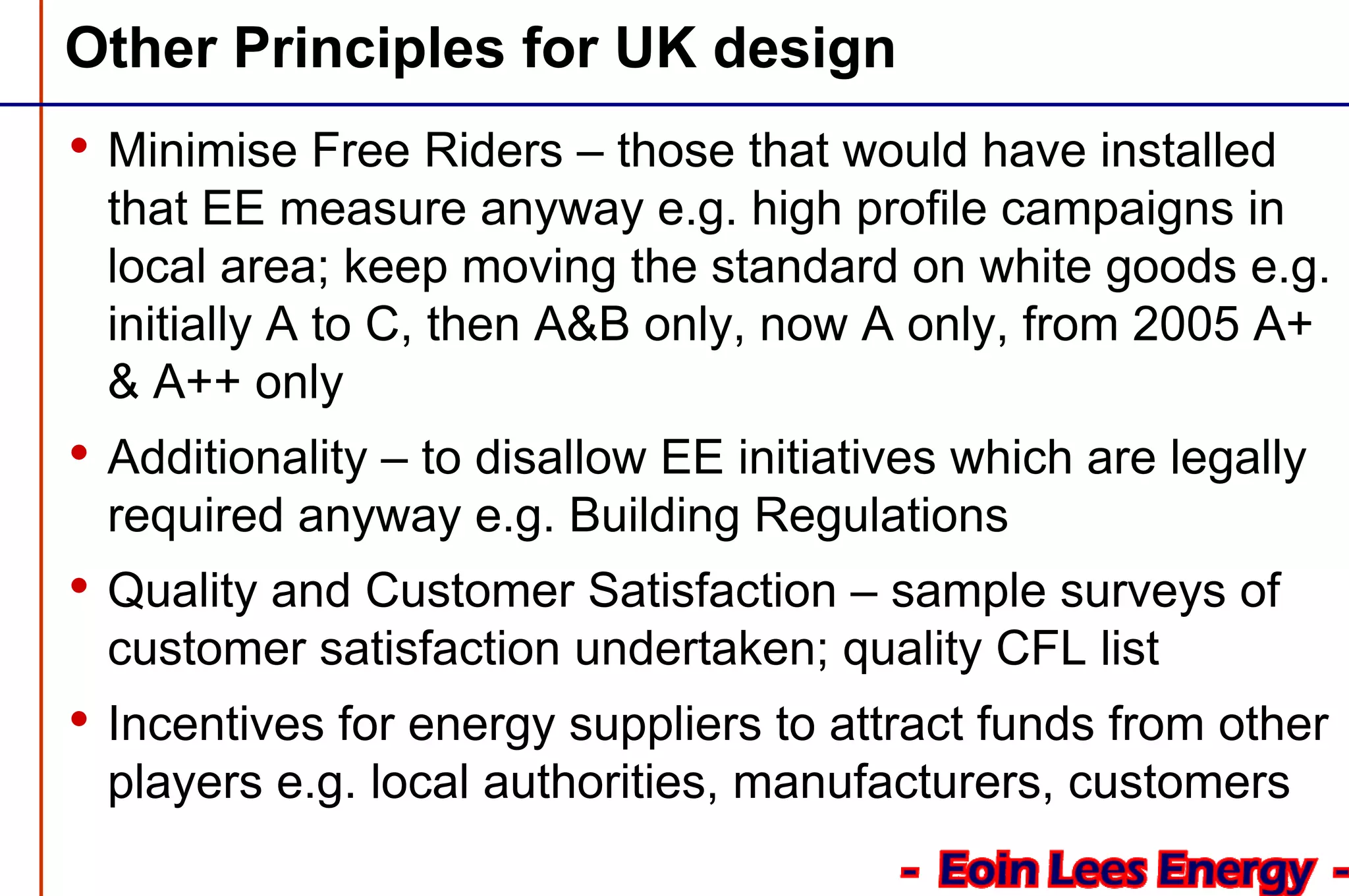
Other Principles for UK design
• Minimise Free Riders – those that would have installed
that EE measure anyway e.g. high profile campaigns in
local area; keep moving the standard on white goods e.g.
initially A to C, then A&B only, now A only, from 2005 A+
& A++ only
• Additionality – to disallow EE initiatives which are legally
required anyway e.g. Building Regulations
• Quality and Customer Satisfaction – sample surveys of
customer satisfaction undertaken; quality CFL list
• Incentives for energy suppliers to attract funds from other
players e.g. local authorities, manufacturers, customers
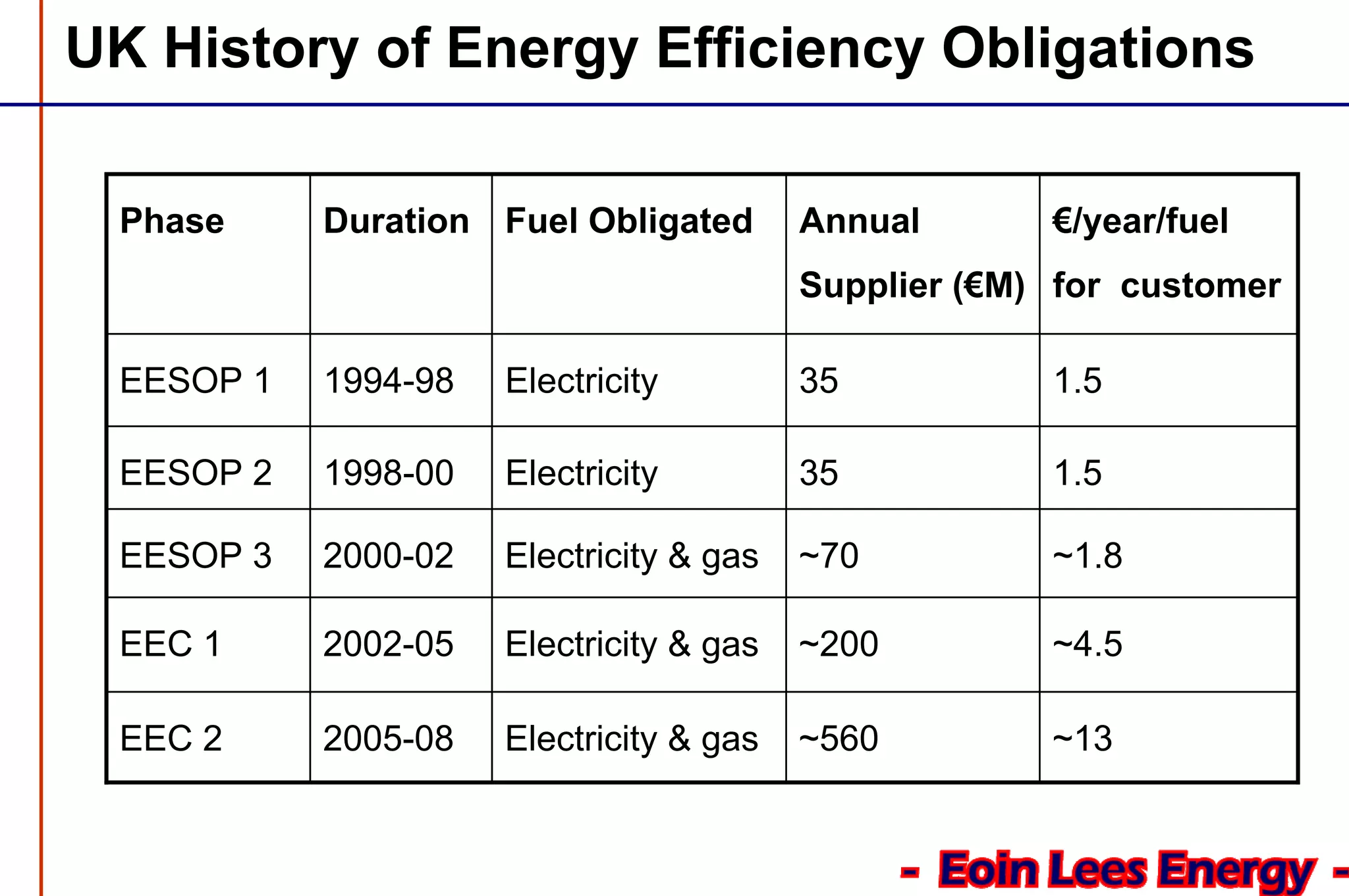
UK History of Energy Efficiency Obligations
Phase Duration Fuel Obligated Annual
Supplier (€M)
€/year/fuel
for customer
EESOP 1 1994-98 Electricity 35 1.5
EEC 2 2005-08 Electricity & gas ~560 ~13
EESOP 2 1998-00 Electricity 35 1.5
EESOP 3 2000-02 Electricity & gas ~70 ~1.8
EEC 1 2002-05 Electricity & gas ~200 ~4.5
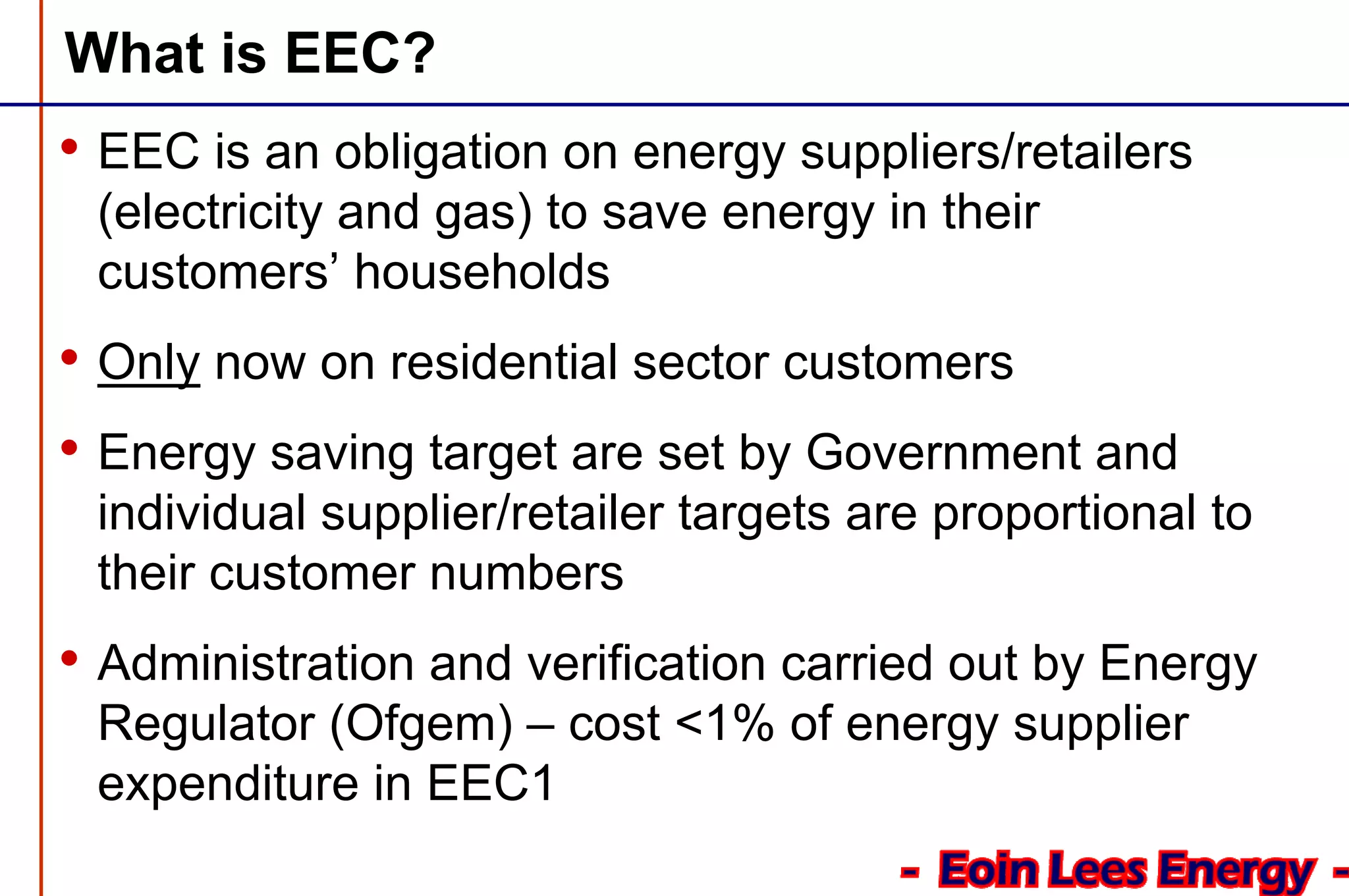
What is EEC?
• EEC is an obligation on energy suppliers/retailers
(electricity and gas) to save energy in their
customers’ households
• Only now on residential sector customers
• Energy saving target are set by Government and
individual supplier/retailer targets are proportional to
their customer numbers
• Administration and verification carried out by Energy
Regulator (Ofgem) – cost <1% of energy supplier
expenditure in EEC1
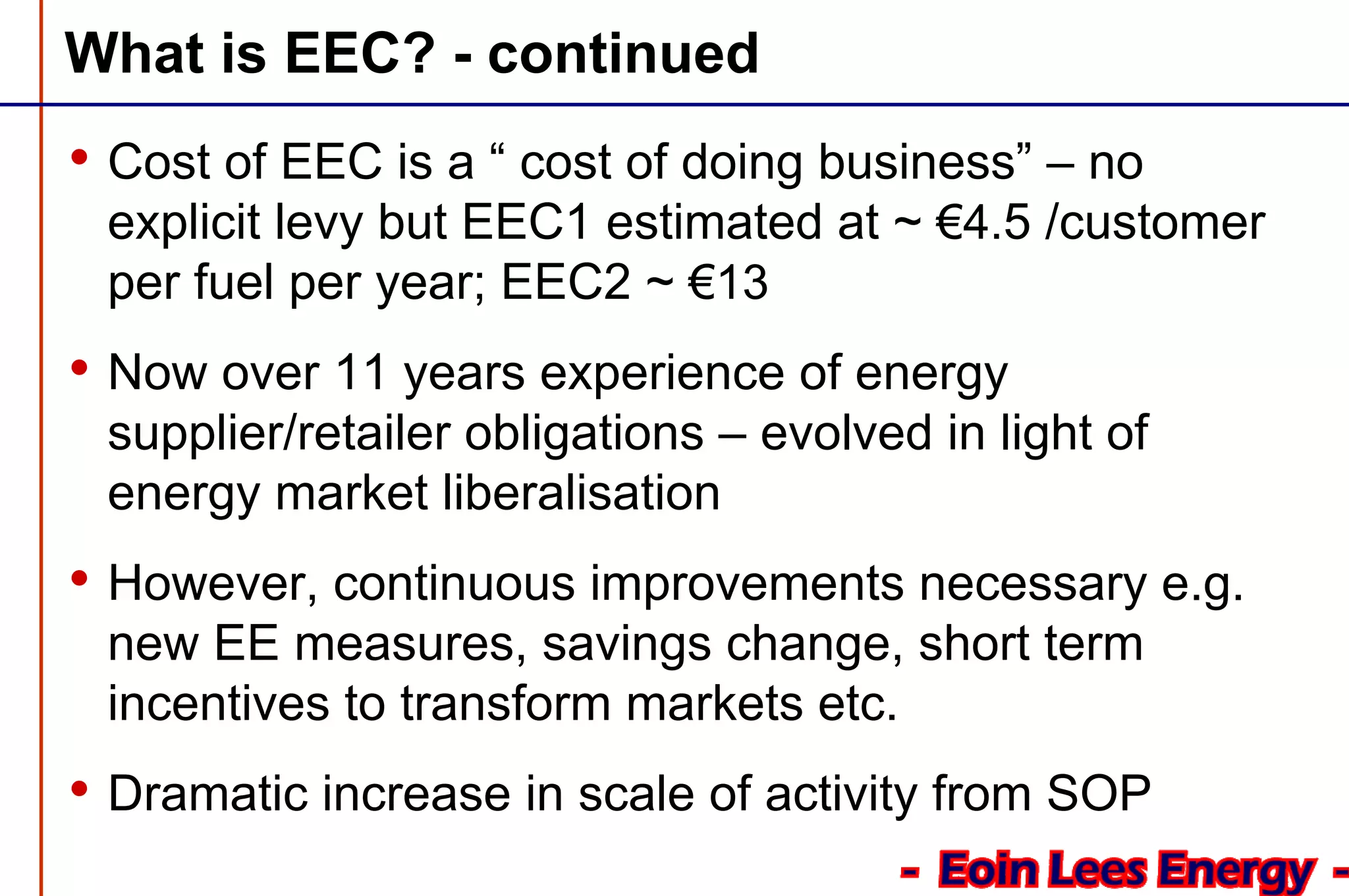
What is EEC? - continued
• Cost of EEC is a “ cost of doing business” – no
explicit levy but EEC1 estimated at ~ €4.5 /customer
per fuel per year; EEC2 ~ €13
• Now over 11 years experience of energy
supplier/retailer obligations – evolved in light of
energy market liberalisation
• However, continuous improvements necessary e.g.
new EE measures, savings change, short term
incentives to transform markets etc.
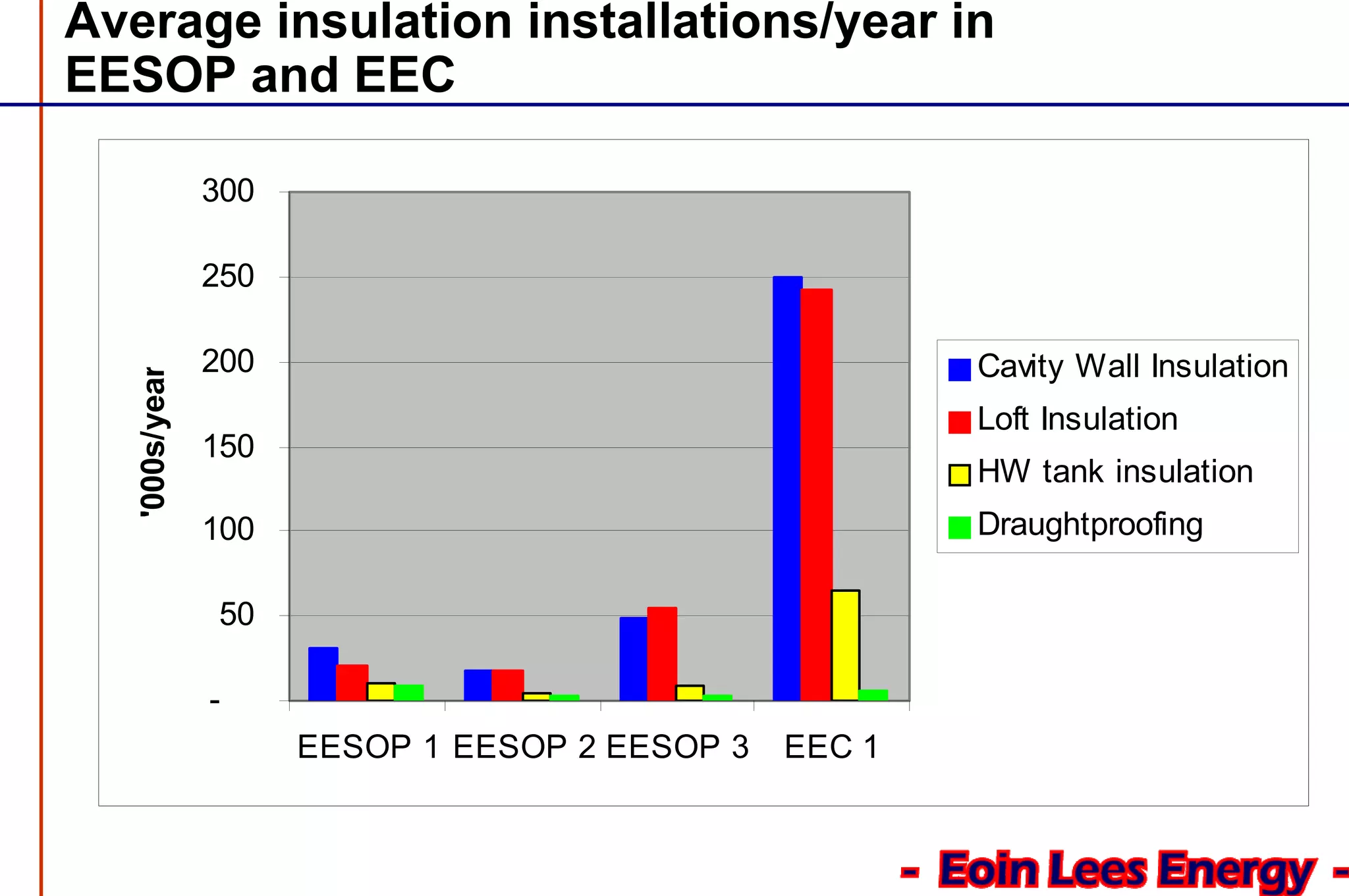
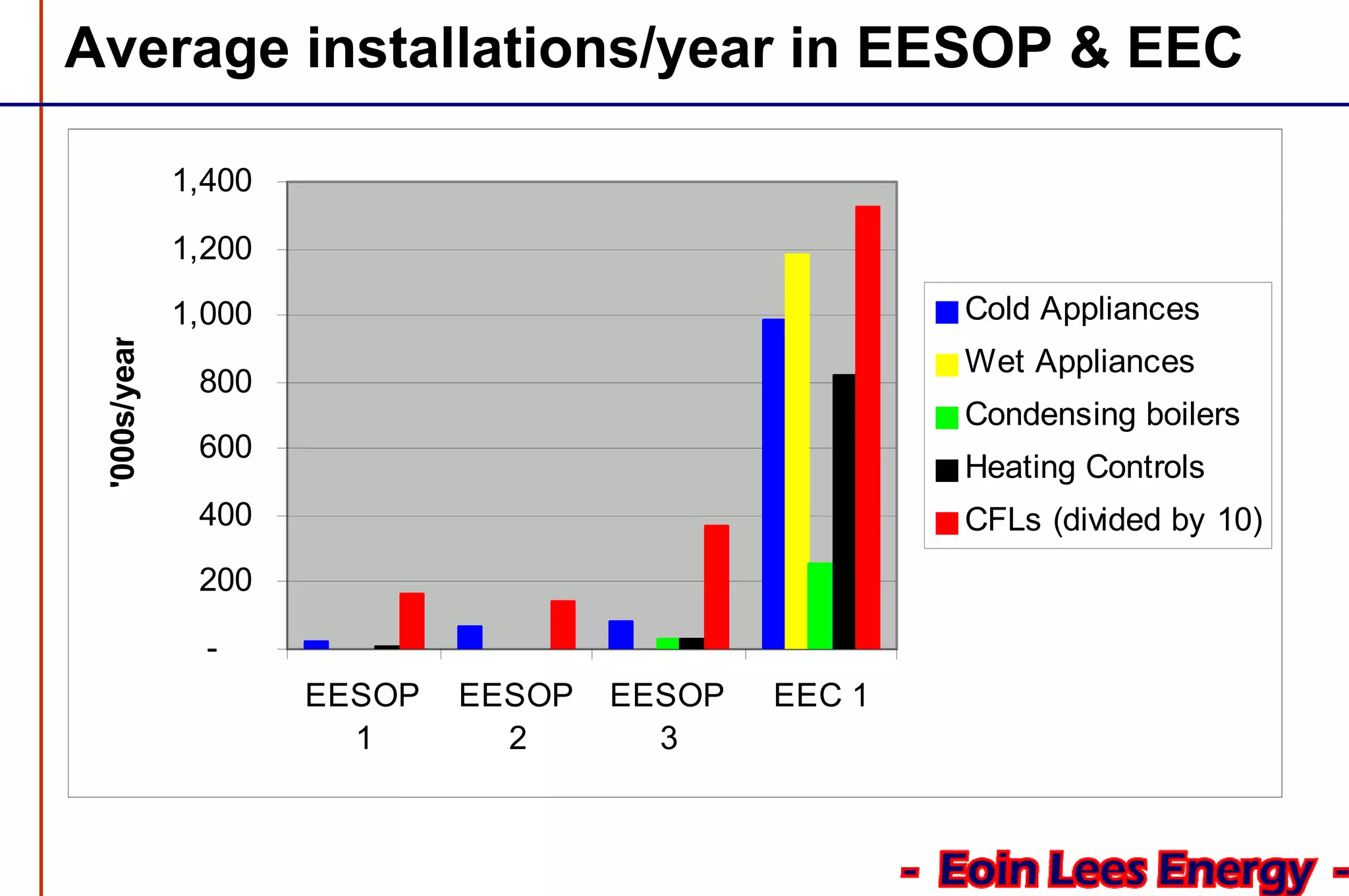
• Dramatic increase in scale of activity from SOP
Average insulation installations/year in
EESOP and EEC
-
50
100
150
200
250
300
EESOP 1 EESOP 2 EESOP 3 EEC 1
'000s/year
Cavity Wall Insulation
Loft Insulation
HW tank insulation
Draughtproofing
Average installations/year in EESOP & EEC
-
200
400
600
800
1,000
1,200
1,400
EESOP
1
EESOP
2
EESOP
3
EEC 1
'000s/year
Cold Appliances
Wet Appliances
Condensing boilers
Heating Controls
CFLs (divided by 10)
Key elements of Measurement Philosophy - 1
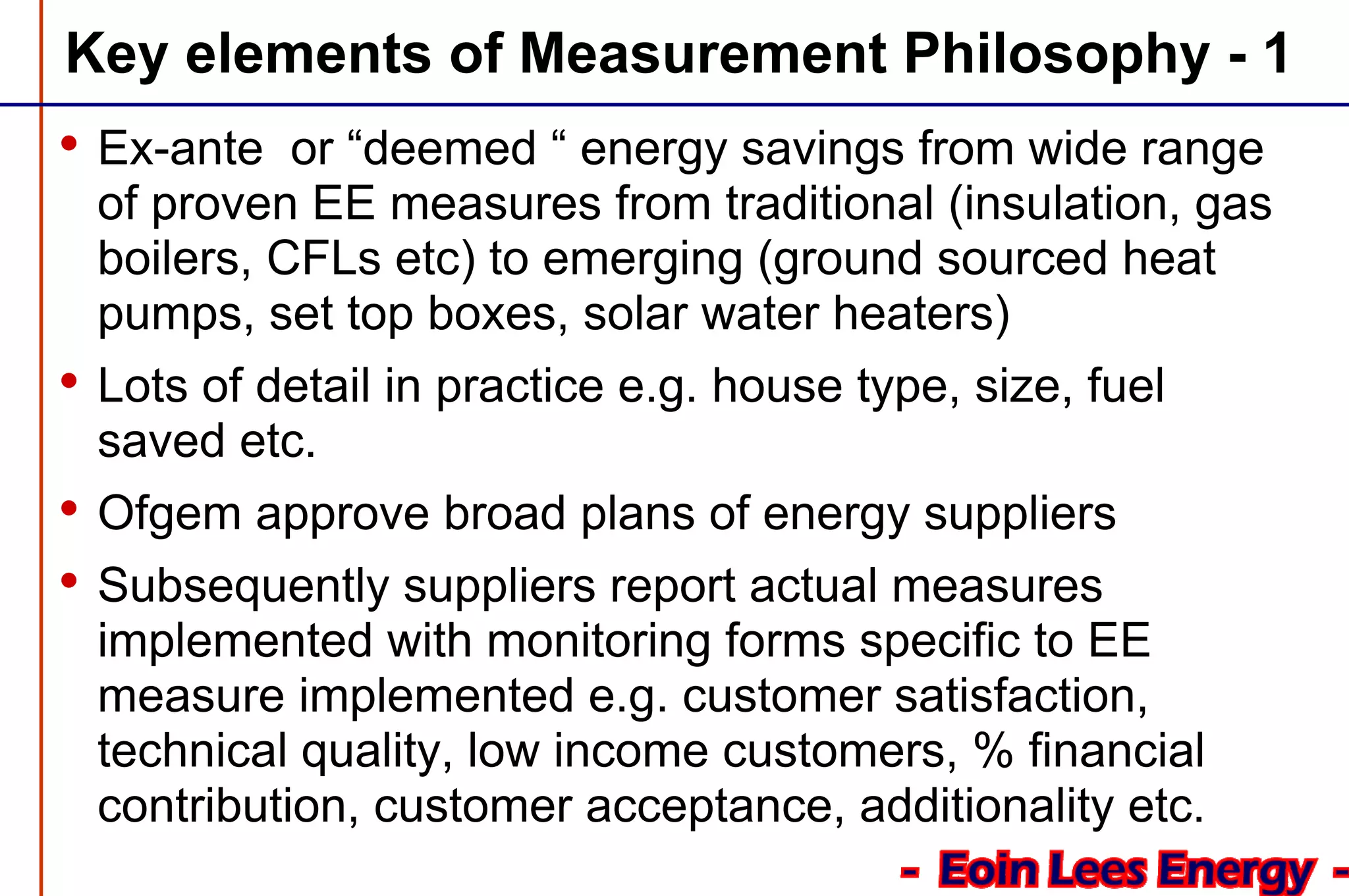
• Ex-ante or “deemed “ energy savings from wide range
of proven EE measures from traditional (insulation, gas
boilers, CFLs etc) to emerging (ground sourced heat
pumps, set top boxes, solar water heaters)
• Lots of detail in practice e.g. house type, size, fuel
saved etc.
• Ofgem approve broad plans of energy suppliers
• Subsequently suppliers report actual measures
implemented with monitoring forms specific to EE
measure implemented e.g. customer satisfaction,
technical quality, low income customers, % financial
contribution, customer acceptance, additionality etc.
Key elements of Measurement Philosophy - 2
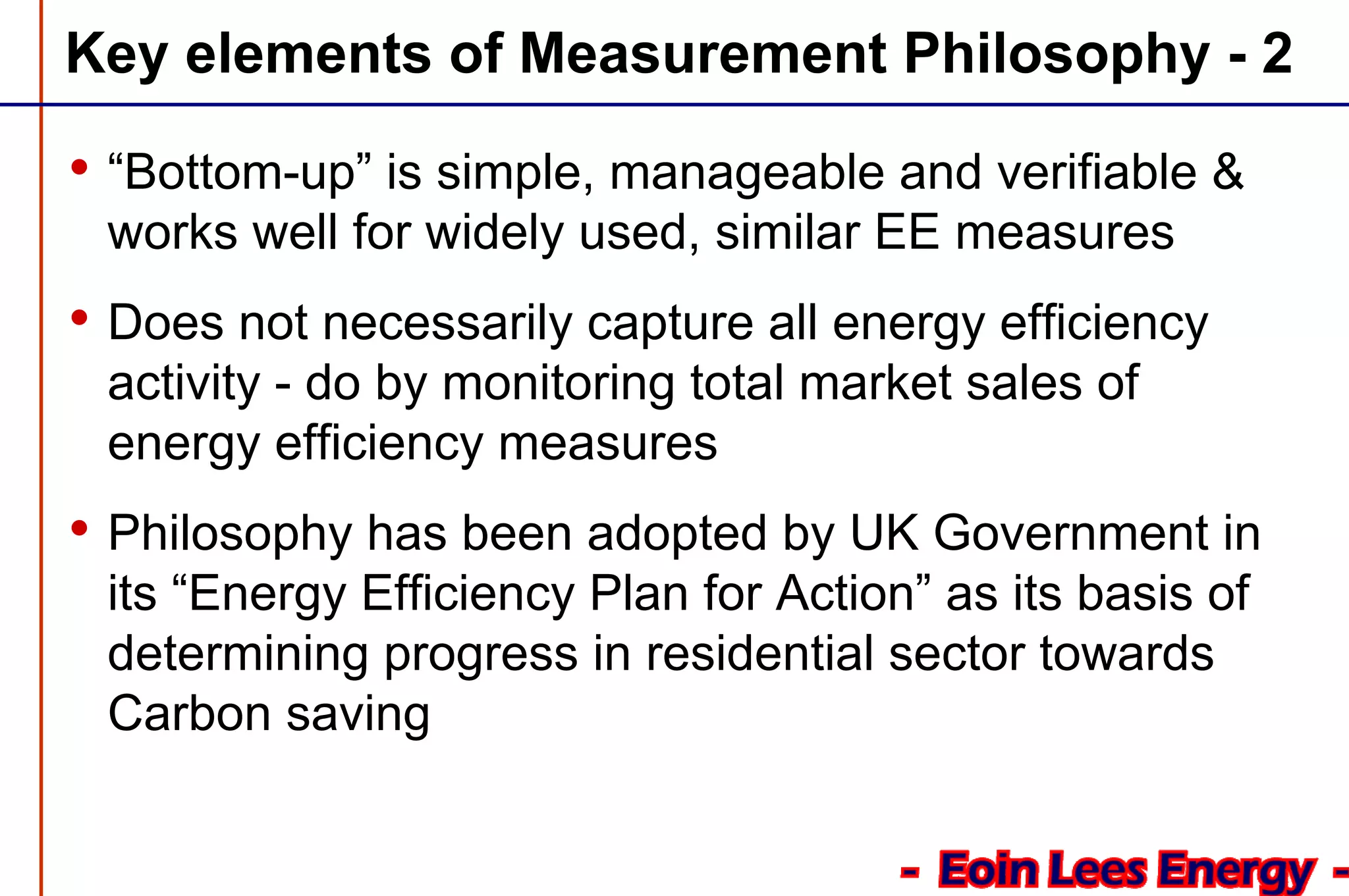
• “Bottom-up” is simple, manageable and verifiable &
works well for widely used, similar EE measures
• Does not necessarily capture all energy efficiency
activity - do by monitoring total market sales of
energy efficiency measures
• Philosophy has been adopted by UK Government in
its “Energy Efficiency Plan for Action” as its basis of
determining progress in residential sector towards
Carbon saving
Meeting the EEC Target
• Target is energy savings but individual fuel savings are
weighted by C content
• Any fuel can be saved but mainly gas and electricity
• Energy supplier/retailer schemes must be “additional”,
e.g. beyond Building Regulations or better than market
average for appliances
• 50% of savings/benefit to come from low income
households
• Save energy from any residential customer
Lessons for EEC2 from Continuous Assessment -1
• Need to change “scoring system” for CFLs – focus on
100W equiv “sticks” – not the consumer preference for
lower wattages and “look alikes”/decorative CFLs
(shorter lives)
• Research hours of use and wattage → in EEC2, every
CFL has a energy credit of 33.5 kWh/a irrespective of
wattage replaced and average 14 year life
• Means all lighting points can now be addressed
• No discernable rebound effect from lighting
Lessons for EEC2 from Continuous Assessment - 2
• Research shows comfort factor (rebound effect) following
insulation measures being installed is identical for high
and low income at 30%
• Energy savings from cavity wall insulation are 10% lower
than expected
• Need to allow for higher heating efficiencies in the future
as average gas boiler efficiency will increase (Building
Regulations) thus lowering the insulation savings
• Ongoing research into effectiveness of existing loft
insulation
Verification in Practice
• Energy supplier submit final report on an energy
efficiency initiative with claimed savings to Ofgem
• Ofgem audits a random sample of each supplier
scheme to check eligibility, measures in place,
savings estimates realistic etc.
• Ofgem also requires energy suppliers to undertake
some technical quality monitoring (e.g. insulation) –
typically 2-5% of installations
• Suppliers must submit quality surveys of individual
scheme activities
Outcome EEC1 April 2002- March 2005
• All major energy suppliers easily met their targets;
insulation savings carried forward to EEC2
equivalent of 24% of EEC2 target
• Energy suppliers have again delivered 20% more
cost effectively than the target anticipated
• 38% of savings came from insulation; 12% from
heating; 16% from appliances and 34% from lighting
• Lighting is the most common measure nearly 40
million CFLs; 6.5 million A-rated appliances
Are EE Obligations good for “UK plc”?
• Annual saving of 0.4MtC at cost -€430/tC (Defra)
• The cost to the nation of saving a unit of electricity is €2
cents/kWh c.f. household cost in 2004 of €10 cents/kWh
• The cost to the nation of saving a unit of gas is €0.7
cents/kWh c.f. household cost in 2004 of €2.5 cents/kWh
• At least 2 out of 5 households in UK will have directly
benefited from EEC1 (mainly CFLs and appliances)
• Most low income households will have directly benefited
from EEC1 (mainly CFLs)
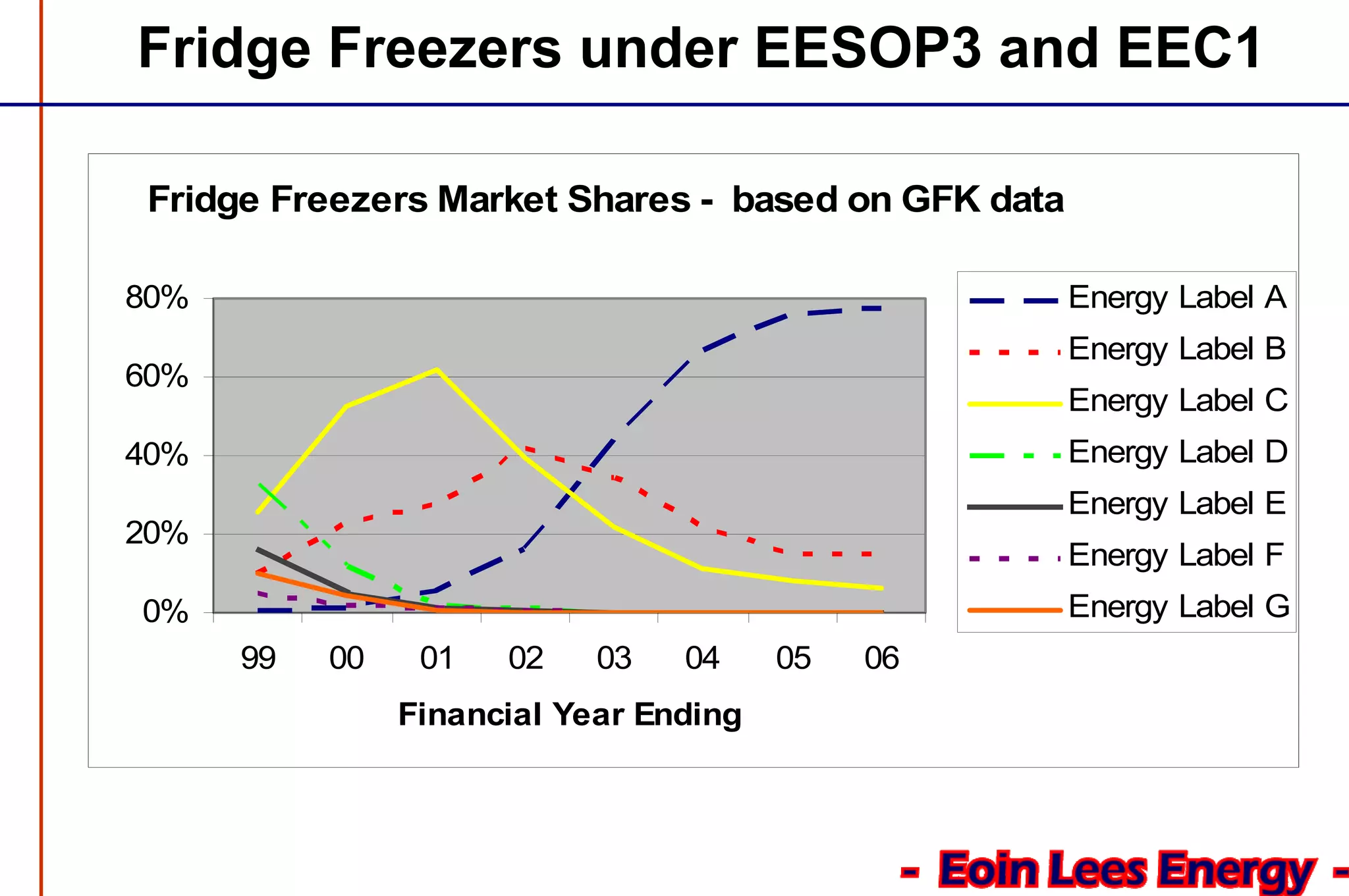
• Market for cold appliances (over 60% A-rated) and wet
appliances (80%) underwent a “tipping point”
Fridge Freezers under EESOP3 and EEC1
Fridge Freezers Market Shares - based on GFK data
0%
20%
40%
60%
80%
99 00 01 02 03 04 05 06
Financial Year Ending
Energy Label A
Energy Label B
Energy Label C
Energy Label D
Energy Label E
Energy Label F
Energy Label G
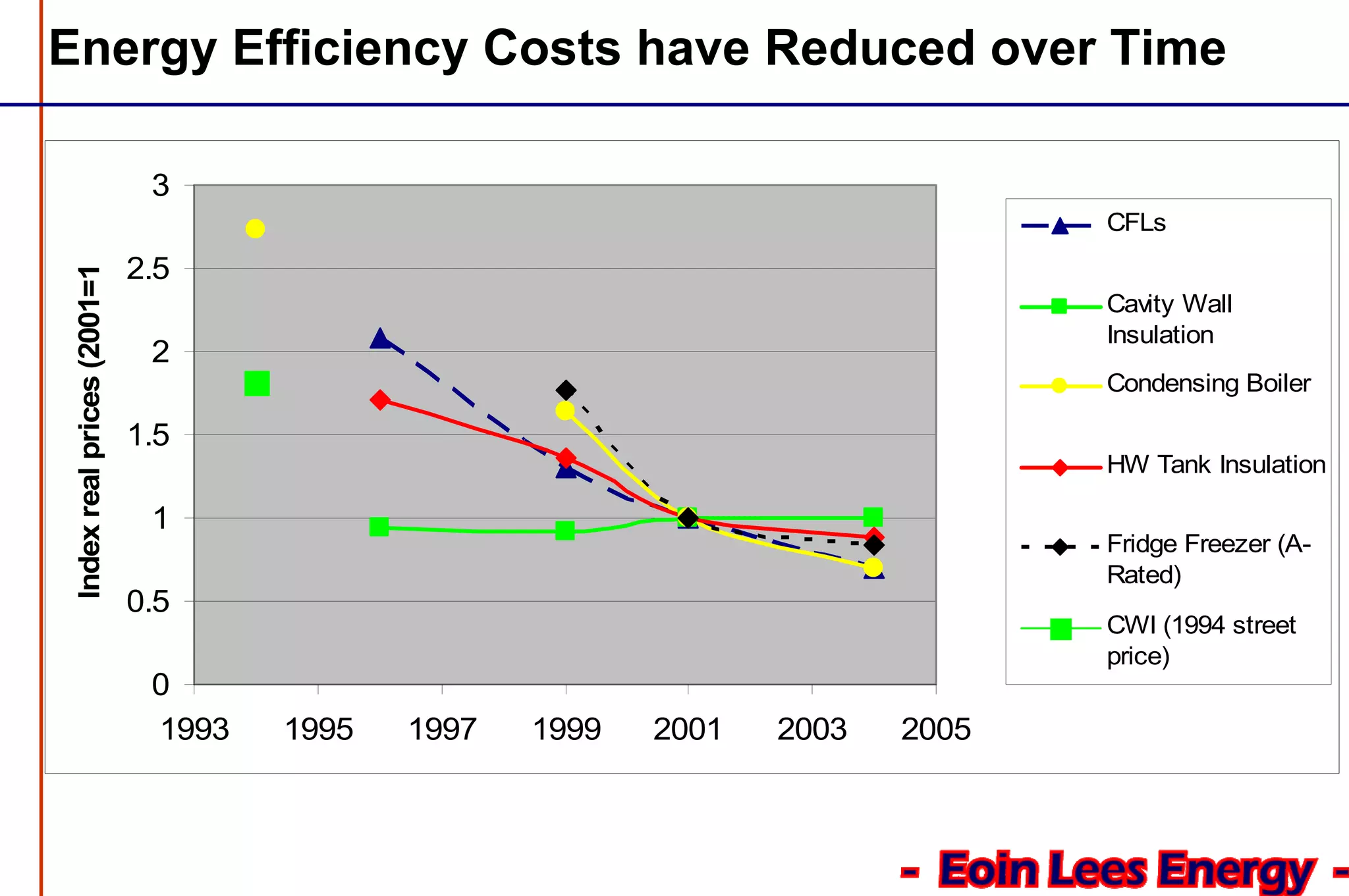
Energy Efficiency Costs have Reduced over Time
0
0.5
1
1.5
2
2.5
3
1993 1995 1997 1999 2001 2003 2005
Indexrealprices(2001=1
CFLs
Cavity Wall
Insulation
Condensing Boiler
HW Tank Insulation
Fridge Freezer (A-
Rated)
CWI (1994 street
price)

Energy Efficiency Obligations - the UK Practical Experience on Validating & Evaluating Energy Savings

  • 1.
    Presentation to IEADSM – EXCO Meeting “Energy Efficiency Obligations – the UK Practical Experience on Validating & Evaluating Energy Savings” Eoin Lees 19 April 2006
  • 2.
    Key topics tobe addressed • Brief history of UK energy efficiency obligations • Key elements of measurement philosophy • Need for continuous assessment of energy savings & impact of recent research • Verification in Practice • Final energy and carbon savings from first phase of UK Energy Efficiency Commitment (EEC)
  • 3.
    What are EnergyEfficiency Obligations? • A legal obligation on energy suppliers/retailers or distributors to save energy in their customers’ premises • Can be applied to any end use sector e.g. residential, small business, all sectors • Energy saving target are set by Government/Regulator and individual energy targets for supplier/retailer or distributor are proportional to their customer numbers • Work in monopoly or liberalised market
  • 4.
    Key Principles forUK design • Focus on desired outcome i.e. energy saving in the customer’s household • Ex ante savings - proven energy efficiency measures only (if not energy suppliers pay for measurement costs) • To give a representative value of the energy savings for any EE measure, use average lifetime of the measure but discount over life of measure (initially 8%,then 6% will be 3.5%) • Ring fence low income – 50% of the benefit to come from low income households
  • 5.
    Other Principles forUK design • Minimise Free Riders – those that would have installed that EE measure anyway e.g. high profile campaigns in local area; keep moving the standard on white goods e.g. initially A to C, then A&B only, now A only, from 2005 A+ & A++ only • Additionality – to disallow EE initiatives which are legally required anyway e.g. Building Regulations • Quality and Customer Satisfaction – sample surveys of customer satisfaction undertaken; quality CFL list • Incentives for energy suppliers to attract funds from other players e.g. local authorities, manufacturers, customers
  • 6.
    UK History ofEnergy Efficiency Obligations Phase Duration Fuel Obligated Annual Supplier (€M) €/year/fuel for customer EESOP 1 1994-98 Electricity 35 1.5 EEC 2 2005-08 Electricity & gas ~560 ~13 EESOP 2 1998-00 Electricity 35 1.5 EESOP 3 2000-02 Electricity & gas ~70 ~1.8 EEC 1 2002-05 Electricity & gas ~200 ~4.5
  • 7.
    What is EEC? •EEC is an obligation on energy suppliers/retailers (electricity and gas) to save energy in their customers’ households • Only now on residential sector customers • Energy saving target are set by Government and individual supplier/retailer targets are proportional to their customer numbers • Administration and verification carried out by Energy Regulator (Ofgem) – cost <1% of energy supplier expenditure in EEC1
  • 8.
    What is EEC?- continued • Cost of EEC is a “ cost of doing business” – no explicit levy but EEC1 estimated at ~ €4.5 /customer per fuel per year; EEC2 ~ €13 • Now over 11 years experience of energy supplier/retailer obligations – evolved in light of energy market liberalisation • However, continuous improvements necessary e.g. new EE measures, savings change, short term incentives to transform markets etc. • Dramatic increase in scale of activity from SOP
  • 9.
    Average insulation installations/yearin EESOP and EEC - 50 100 150 200 250 300 EESOP 1 EESOP 2 EESOP 3 EEC 1 '000s/year Cavity Wall Insulation Loft Insulation HW tank insulation Draughtproofing
  • 10.
    Average installations/year inEESOP & EEC - 200 400 600 800 1,000 1,200 1,400 EESOP 1 EESOP 2 EESOP 3 EEC 1 '000s/year Cold Appliances Wet Appliances Condensing boilers Heating Controls CFLs (divided by 10)
  • 11.
    Key elements ofMeasurement Philosophy - 1 • Ex-ante or “deemed “ energy savings from wide range of proven EE measures from traditional (insulation, gas boilers, CFLs etc) to emerging (ground sourced heat pumps, set top boxes, solar water heaters) • Lots of detail in practice e.g. house type, size, fuel saved etc. • Ofgem approve broad plans of energy suppliers • Subsequently suppliers report actual measures implemented with monitoring forms specific to EE measure implemented e.g. customer satisfaction, technical quality, low income customers, % financial contribution, customer acceptance, additionality etc.
  • 12.
    Key elements ofMeasurement Philosophy - 2 • “Bottom-up” is simple, manageable and verifiable & works well for widely used, similar EE measures • Does not necessarily capture all energy efficiency activity - do by monitoring total market sales of energy efficiency measures • Philosophy has been adopted by UK Government in its “Energy Efficiency Plan for Action” as its basis of determining progress in residential sector towards Carbon saving
  • 13.
    Meeting the EECTarget • Target is energy savings but individual fuel savings are weighted by C content • Any fuel can be saved but mainly gas and electricity • Energy supplier/retailer schemes must be “additional”, e.g. beyond Building Regulations or better than market average for appliances • 50% of savings/benefit to come from low income households • Save energy from any residential customer
  • 14.
    Lessons for EEC2from Continuous Assessment -1 • Need to change “scoring system” for CFLs – focus on 100W equiv “sticks” – not the consumer preference for lower wattages and “look alikes”/decorative CFLs (shorter lives) • Research hours of use and wattage → in EEC2, every CFL has a energy credit of 33.5 kWh/a irrespective of wattage replaced and average 14 year life • Means all lighting points can now be addressed • No discernable rebound effect from lighting
  • 15.
    Lessons for EEC2from Continuous Assessment - 2 • Research shows comfort factor (rebound effect) following insulation measures being installed is identical for high and low income at 30% • Energy savings from cavity wall insulation are 10% lower than expected • Need to allow for higher heating efficiencies in the future as average gas boiler efficiency will increase (Building Regulations) thus lowering the insulation savings • Ongoing research into effectiveness of existing loft insulation
  • 16.
    Verification in Practice •Energy supplier submit final report on an energy efficiency initiative with claimed savings to Ofgem • Ofgem audits a random sample of each supplier scheme to check eligibility, measures in place, savings estimates realistic etc. • Ofgem also requires energy suppliers to undertake some technical quality monitoring (e.g. insulation) – typically 2-5% of installations • Suppliers must submit quality surveys of individual scheme activities
  • 17.
    Outcome EEC1 April2002- March 2005 • All major energy suppliers easily met their targets; insulation savings carried forward to EEC2 equivalent of 24% of EEC2 target • Energy suppliers have again delivered 20% more cost effectively than the target anticipated • 38% of savings came from insulation; 12% from heating; 16% from appliances and 34% from lighting • Lighting is the most common measure nearly 40 million CFLs; 6.5 million A-rated appliances
  • 18.
    Are EE Obligationsgood for “UK plc”? • Annual saving of 0.4MtC at cost -€430/tC (Defra) • The cost to the nation of saving a unit of electricity is €2 cents/kWh c.f. household cost in 2004 of €10 cents/kWh • The cost to the nation of saving a unit of gas is €0.7 cents/kWh c.f. household cost in 2004 of €2.5 cents/kWh • At least 2 out of 5 households in UK will have directly benefited from EEC1 (mainly CFLs and appliances) • Most low income households will have directly benefited from EEC1 (mainly CFLs) • Market for cold appliances (over 60% A-rated) and wet appliances (80%) underwent a “tipping point”
  • 19.
    Fridge Freezers underEESOP3 and EEC1 Fridge Freezers Market Shares - based on GFK data 0% 20% 40% 60% 80% 99 00 01 02 03 04 05 06 Financial Year Ending Energy Label A Energy Label B Energy Label C Energy Label D Energy Label E Energy Label F Energy Label G
  • 20.
    Energy Efficiency Costshave Reduced over Time 0 0.5 1 1.5 2 2.5 3 1993 1995 1997 1999 2001 2003 2005 Indexrealprices(2001=1 CFLs Cavity Wall Insulation Condensing Boiler HW Tank Insulation Fridge Freezer (A- Rated) CWI (1994 street price)