Role of Fertilizer Policy in
Transforming Agriculture of
Myanmar
Hnin Yu Lwin, Theingi Myint, Shwemar Than, Nay Myo Aung,
Cho Cho San, Dolly Kyaw, Tin Htut
Yezin Agricultural Universityime
Focus on Four Domains
1. Trends in Fertilizer use,
2. Market Structure and Supply-side issues,
3. The Pricing Environment, and
4. Regional/Cross Border Trade Issues
2
Introduction
• Myanmar agriculture sector contributes about 36% of
GDP, employing 60% of the workforce and 20% of
foreign exchange earnings.
• Development issue is improvement in the productivity
and profitability of agriculture.
• Myanmar envisions a high level of agricultural
productivity that will ensure equity in household food
security, income and employment and sustainable
utilization of natural resources.
3
Role of fertilizer in crop productivity and
self-sufficiency
• Chemical fertilizer is undoubtedly one of the agricultural
inputs to increase the high yield when used in proper time and
proper nutrient balance.
• In Myanmar, chemical fertilizer application for paddy crop
started in 1956-1957.
• However, proper application was adopted in 1978 as part of
the package of the IR 8, the first high yielding variety that
supports the Green Revolution campaign.
• After 1978, farmers widely used chemical fertilizer because of
the proven good response to the applied chemical fertilizer by
high yielding rice varieties and fulfill food self-sufficiency.
5
Fertilizer subsidies
• In Myanmar, fertilizer prices were heavily subsidized by the
government before 1990s.
• The government official price of fertilizer was kept low for 15
years until 1990, but after the 1990s, it slowly increased to a
level close to the international price.
• Since 2003, the government was obliged to totally withdraw
subsidies; the price was rapidly raised in the domestic market.
• Therefore, the fertilizer prices was totally free market price
based on the international fertilizer price, transportation cost
and exchange rate between currency of Myanmar and trade
partners after 2003.
6
Table 1: Fertilizer consumption in Myanmar
and public-private concentration
Year
Domestic
Urea
Production
(MT) a
Fertilizer
Import
(MT)b
Total
Consumption
(MT) c
MoAI
Distribution
(MT)d
Government
Concentration
(%) e
Private
Concentration
(%) f
2004-05 14,293 11,956 26,249 11,215 42.7 57.3
2005-06 4,580 19,363 23,943 11,762 49.1 50.9
2006-07 115,055 54,842 169,897 13,612 8.0 92.0
2007-08 110,031 33,686 143,717 7,687 5.3 94.7
2008-09 106,138 6,505 112,643 10,570 9.4 90.6
2009-10 69,776 28,380 98,156 7,560 7.7 92.3
Source: a FAOSTAT, 2013; b & d Myanmar Agricultural Statistics (1997-98 to 2009-10):
c, e & f own calculation
7
Table 2: Proportion of fertilizer distribution by MoAI (%)
Crop 1990-91 1995-96 2000-01 2005-06 2008-09
Paddy 72.0 82.6 81.5 27.1 66.9
Wheat 0.8 0.0 0.0 0.0 0.0
Maize 3.4 0.0 0.3 1.0 1.7
Millet 0.2 0.0 0.0 0.0 0.0
Groundnut 2.0 1.6 0.3 0.0 0.0
Sesame 1.8 2.0 0.6 0.0 0.0
Oil Palm 0.1 0.2 0.0 12.9 1.9
Sunflower 1.9 1.4 0.8 0.0 0.0
Cotton 1.1 4.0 3.3 14.4 5.4
Jute 4.9 2.1 1.4 19.1 9.8
Rubber 0.7 0.5 0.7 15.7 1.8
Pulses 6.0 1.9 2.0 0.0 0.0
Potato 0.0 0.0 0.0 0.0 0.0
Tobacco 0.2 0.0 0.0 0.0 0.0
Sugarcane 0.9 3.6 4.8 7.4 1.5
Fruits and vegetables 0.8 0.0 0.0 1.7 7.2
Others 3.2 0.2 4.4 0.7 3.8
Source: CSO, 2009
8
Table 3: Fertilizer consuming farm households in regions
Region/State
Number of households, by usage of fertilizer
Organic Fertilizer % Inorganic/ Chemical Fertilizer %
Union of Myanmar 4,415,732 100.0 3,930,370 100.0
Kachin 106,629 3.6 54,689 1.6
Kayah 21,390 0.7 27,064 0.8
Kayin 49,579 1.7 34,500 1.0
Chin 14,779 0.5 1,350 0.0
Sagaing 711,798 24.3 579,131 17.3
Taninthayi 73,663 2.5 61,730 1.8
Bago East 225,786 7.7 210,640 6.3
Bago West 270,297 9.2 265,198 7.9
Magway 573,633 19.6 525,221 15.7
Mandalay 694,618 23.7 597,009 17.9
Mon 142,108 4.9 144,554 4.3
Rakhine 268,604 9.2 189,919 5.7
Yangon 190,013 6.5 195,688 5.9
Shan South 213,552 7.3 196,818 5.9
Shan North 223,856 7.7 201,856 6.0
Shan East 39,959 1.4 38,704 1.2
Ayeyarwady 595,468 20.4 606,299 18.1Source: Myanmar Census of Agriculture, 2010 9
Table 4: Estimation of fertilizer consumption
per hectare of gross area sown
Year
Gross Area
Sown (000 Ha)a
Total Fertilizer
Consumption
(MT)b
Fertilizer
Consumption
per Hectare
(Kg/Ha)c
2004-2005 17431.4 26,249 1.5
2005-2006 18754.4 23,943 1.3
2006-2007 20405.1 169,897 8.3
2007-2008 22117.0 143,717 6.5
2008-2009 22961.1 112,643 4.9
2009-2010 23362.6 98,156 4.2
Source: a MOAI 2010, b own calculation based on FAOSTAT data and
Myanmar Agricultural Statistics (1997-98 to 2009-10); c own calculation
10
Table 5: Fertilizer use by farm size
in the study area (Nay Pyi Taw, 2012)
Farm Size
(Hectare)
Urea
(Kg/Ha)
T-super
(Kg/Ha)
Potash
(Kg/Ha)
Compound
(Kg/Ha)
0.2 – 2.02 119.1 13.5 9.2 71.3
2.14 – 4.05 120.7 16.4 12.3 65.1
4.17 – 6.07 154.3 12.8 15.9 70.3
6.48 – 17 148.1 26.2 20.3 64.0
Note: Number of sample household = 652
Source: Household survey at Nay Pyi Taw, 2013
11
Table 6: Response of rice to fertilizers
in the rain-fed farms (Nay Pyi Taw, 2012)
Land Holding
Area
(Hectare)
Average
Fertilizer
Utilization
(Kg/ Ha)
Paddy Yield per
Hectare (MT/Ha)
Partial Factor
Productivity of
Fertilizer
0.2 – 2.02 213.1 4.5 21.2
2.14 – 4.05 214.4 4.3 20.1
4.17 – 6.07 253.4 4.7 18.5
6.48 – 17 258.6 4.4 17.0
Note: Number of sample household = 652; these response results are based on products
Source: Household survey at Nay Pyi Taw, 2013
12
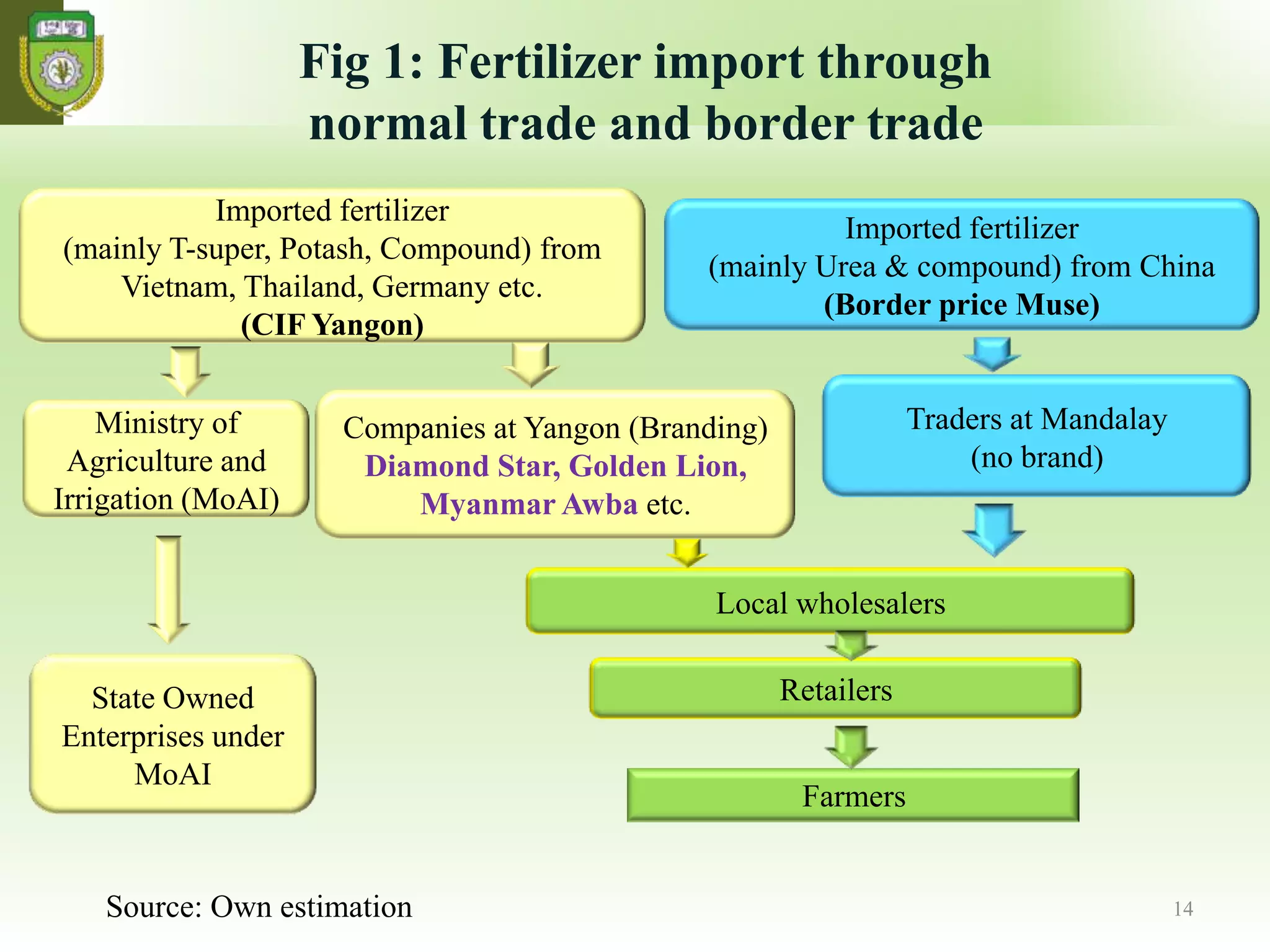
Fig 1: Fertilizer import through
normal trade and border trade
Imported fertilizer
(mainly T-super, Potash, Compound) from
Vietnam, Thailand, Germany etc.
(CIF Yangon)
Companies at Yangon (Branding)
Diamond Star, Golden Lion,
Myanmar Awba etc.
Retailers
Local wholesalers
Farmers
Ministry of
Agriculture and
Irrigation (MoAI)
State Owned
Enterprises under
MoAI
Imported fertilizer
(mainly Urea & compound) from China
(Border price Muse)
Traders at Mandalay
(no brand)
Source: Own estimation 14
Fig 2: Domestically produced fertilizer
distribution
Quota
Domestic (Urea) fertilizer
manufacturing factories
Ministry of Energy
Local wholesalers
State owned enterprises
Ministry of Agriculture
and Irrigation
Regional Authorities
Farmers
Source: Own estimation 15
Fertilizer retail market level
• Retailers exist at village level
• Buying behavior
– Late payment for branded fertilizer
ordered from companies
– Direct payment for non-branded
fertilizer
• Selling behavior to farmers
– Mostly direct payment
– Late payment with interest rate: 5%
/month
16
0.00
10.00
20.00
30.00
40.00
50.00
60.00
70.00
80.00
Urea(Kg/ha)
Source: CSO Various Issues
18
Fig 3: Urea fertilizer application rate in paddy production
based on MOAI distribution
Fig 4: Ratio of urea fertilizer price to paddy price
Source: DOA and MIS various issues
0
2
4
6
8
10
12
Urea/paddypriceratio
Fully
Subsidized
Period
Partially
Subsidized
Period
Liberalized
Period
19
0
100
200
300
400
500
600
700
800
900
2006Jan.
April
July
Oct.
2007Jan.
April
July
Oct.
2008Jan.
April
July
Oct.
2009Jan.
April
July
Oct.
2010Jan.
April
July
Oct.
2011Jan.
April
July
Oct.
2012Jan.
April
July
Oct.
Urea China at Yangon('000 k/MT)
Urea China at Mandalay('000 k/MT)
Prilled Urea fob bulk at Baltic ($/MT)
Prilled Urea fob bulk at Yuzhny ($/MT)
Source: MIS Various Issues
20
Fig 5: Urea fertilizer prices
in domestic and international market
Regional/Cross Border Trade Issues
• Exemption of import tax on agricultural inputs is one
of the significant reform measures in the country
underlying market economy.
• Cross-border trade from China is affecting
unregistered, low quality fertilizer supply in the
market.
• Lack of bilateral agreement between China and
Myanmar on imported fertilizer quality control
• Although there is no restriction on fertilizer
import, product registration to MoAI and import
license application to MoC are necessary.
• Law enforcement on product quality and unregistered
product is still weak.
22
Summary of fertilizer market performance
Indicators Issues/ constraints
Price Unfavorable fertilizer/output price ratios
High fertilizer import cost
Uneconomic use of fertilizer
Low output price
Low crop response
Accessibility Lack of market information about global, regional and local
prices and quantities
Limited product and use knowledge by farmers and public
High inland road freight rates
Quality of
fertilizer use at
the farm level
Lack of legal and regulatory framework for monitoring
product quality and illegal traders
Market
development
Inadequate financial available for importer, wholesaler and
retailers
23
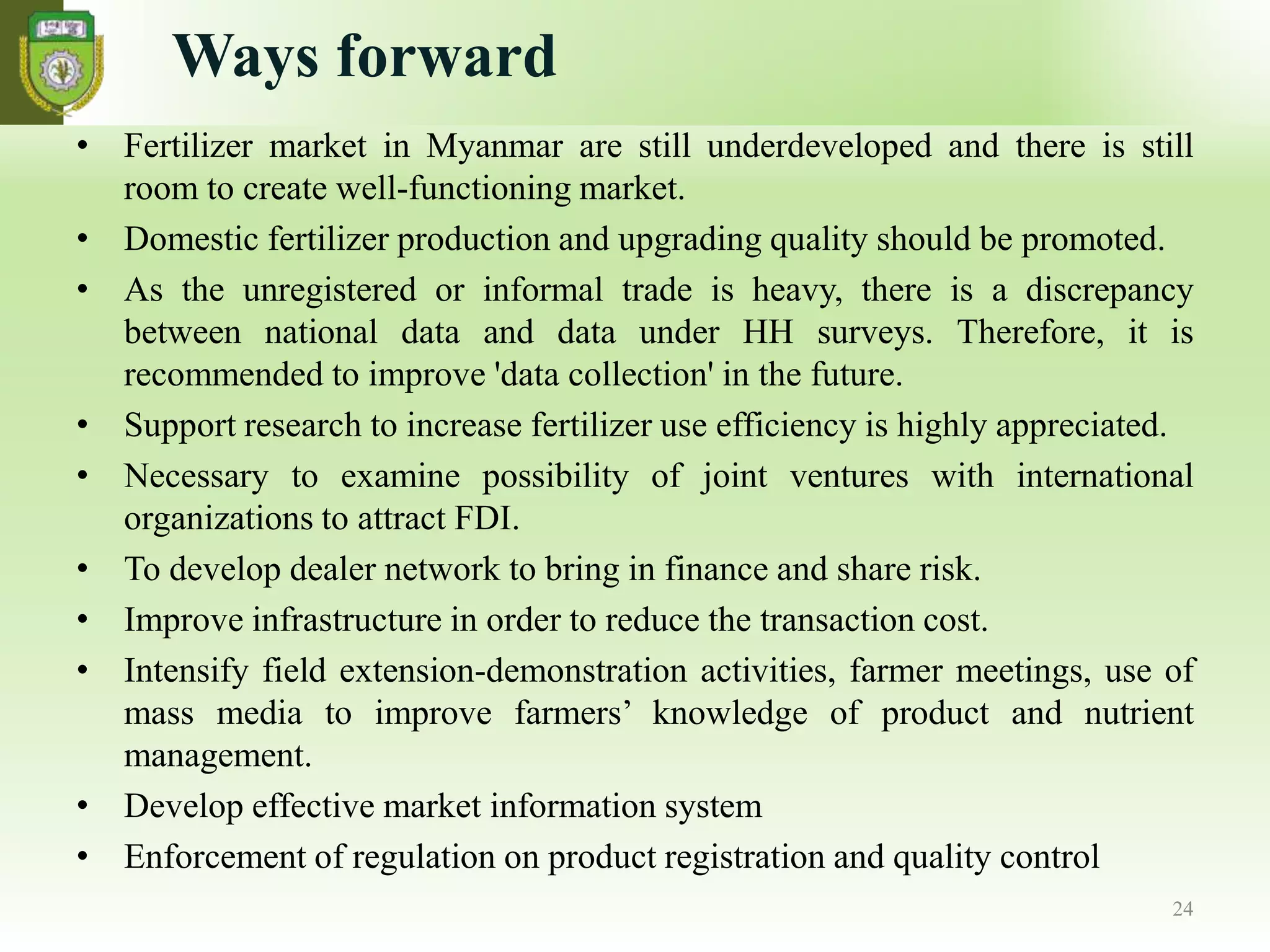
Ways forward
• Fertilizer market in Myanmar are still underdeveloped and there is still
room to create well-functioning market.
• Domestic fertilizer production and upgrading quality should be promoted.
• As the unregistered or informal trade is heavy, there is a discrepancy
between national data and data under HH surveys. Therefore, it is
recommended to improve 'data collection' in the future.
• Support research to increase fertilizer use efficiency is highly appreciated.
• Necessary to examine possibility of joint ventures with international
organizations to attract FDI.
• To develop dealer network to bring in finance and share risk.
• Improve infrastructure in order to reduce the transaction cost.
• Intensify field extension-demonstration activities, farmer meetings, use of
mass media to improve farmers’ knowledge of product and nutrient
management.
• Develop effective market information system
• Enforcement of regulation on product registration and quality control
24
Thank You!!!

The Fertilizer sector in Myanmar- Hnin Yu Lwin

  • 1.
    Role of FertilizerPolicy in Transforming Agriculture of Myanmar Hnin Yu Lwin, Theingi Myint, Shwemar Than, Nay Myo Aung, Cho Cho San, Dolly Kyaw, Tin Htut Yezin Agricultural Universityime
  • 2.
    Focus on FourDomains 1. Trends in Fertilizer use, 2. Market Structure and Supply-side issues, 3. The Pricing Environment, and 4. Regional/Cross Border Trade Issues 2
  • 3.
    Introduction • Myanmar agriculturesector contributes about 36% of GDP, employing 60% of the workforce and 20% of foreign exchange earnings. • Development issue is improvement in the productivity and profitability of agriculture. • Myanmar envisions a high level of agricultural productivity that will ensure equity in household food security, income and employment and sustainable utilization of natural resources. 3
  • 5.
    Role of fertilizerin crop productivity and self-sufficiency • Chemical fertilizer is undoubtedly one of the agricultural inputs to increase the high yield when used in proper time and proper nutrient balance. • In Myanmar, chemical fertilizer application for paddy crop started in 1956-1957. • However, proper application was adopted in 1978 as part of the package of the IR 8, the first high yielding variety that supports the Green Revolution campaign. • After 1978, farmers widely used chemical fertilizer because of the proven good response to the applied chemical fertilizer by high yielding rice varieties and fulfill food self-sufficiency. 5
  • 6.
    Fertilizer subsidies • InMyanmar, fertilizer prices were heavily subsidized by the government before 1990s. • The government official price of fertilizer was kept low for 15 years until 1990, but after the 1990s, it slowly increased to a level close to the international price. • Since 2003, the government was obliged to totally withdraw subsidies; the price was rapidly raised in the domestic market. • Therefore, the fertilizer prices was totally free market price based on the international fertilizer price, transportation cost and exchange rate between currency of Myanmar and trade partners after 2003. 6
  • 7.
    Table 1: Fertilizerconsumption in Myanmar and public-private concentration Year Domestic Urea Production (MT) a Fertilizer Import (MT)b Total Consumption (MT) c MoAI Distribution (MT)d Government Concentration (%) e Private Concentration (%) f 2004-05 14,293 11,956 26,249 11,215 42.7 57.3 2005-06 4,580 19,363 23,943 11,762 49.1 50.9 2006-07 115,055 54,842 169,897 13,612 8.0 92.0 2007-08 110,031 33,686 143,717 7,687 5.3 94.7 2008-09 106,138 6,505 112,643 10,570 9.4 90.6 2009-10 69,776 28,380 98,156 7,560 7.7 92.3 Source: a FAOSTAT, 2013; b & d Myanmar Agricultural Statistics (1997-98 to 2009-10): c, e & f own calculation 7
  • 8.
    Table 2: Proportionof fertilizer distribution by MoAI (%) Crop 1990-91 1995-96 2000-01 2005-06 2008-09 Paddy 72.0 82.6 81.5 27.1 66.9 Wheat 0.8 0.0 0.0 0.0 0.0 Maize 3.4 0.0 0.3 1.0 1.7 Millet 0.2 0.0 0.0 0.0 0.0 Groundnut 2.0 1.6 0.3 0.0 0.0 Sesame 1.8 2.0 0.6 0.0 0.0 Oil Palm 0.1 0.2 0.0 12.9 1.9 Sunflower 1.9 1.4 0.8 0.0 0.0 Cotton 1.1 4.0 3.3 14.4 5.4 Jute 4.9 2.1 1.4 19.1 9.8 Rubber 0.7 0.5 0.7 15.7 1.8 Pulses 6.0 1.9 2.0 0.0 0.0 Potato 0.0 0.0 0.0 0.0 0.0 Tobacco 0.2 0.0 0.0 0.0 0.0 Sugarcane 0.9 3.6 4.8 7.4 1.5 Fruits and vegetables 0.8 0.0 0.0 1.7 7.2 Others 3.2 0.2 4.4 0.7 3.8 Source: CSO, 2009 8
  • 9.
    Table 3: Fertilizerconsuming farm households in regions Region/State Number of households, by usage of fertilizer Organic Fertilizer % Inorganic/ Chemical Fertilizer % Union of Myanmar 4,415,732 100.0 3,930,370 100.0 Kachin 106,629 3.6 54,689 1.6 Kayah 21,390 0.7 27,064 0.8 Kayin 49,579 1.7 34,500 1.0 Chin 14,779 0.5 1,350 0.0 Sagaing 711,798 24.3 579,131 17.3 Taninthayi 73,663 2.5 61,730 1.8 Bago East 225,786 7.7 210,640 6.3 Bago West 270,297 9.2 265,198 7.9 Magway 573,633 19.6 525,221 15.7 Mandalay 694,618 23.7 597,009 17.9 Mon 142,108 4.9 144,554 4.3 Rakhine 268,604 9.2 189,919 5.7 Yangon 190,013 6.5 195,688 5.9 Shan South 213,552 7.3 196,818 5.9 Shan North 223,856 7.7 201,856 6.0 Shan East 39,959 1.4 38,704 1.2 Ayeyarwady 595,468 20.4 606,299 18.1Source: Myanmar Census of Agriculture, 2010 9
  • 10.
    Table 4: Estimationof fertilizer consumption per hectare of gross area sown Year Gross Area Sown (000 Ha)a Total Fertilizer Consumption (MT)b Fertilizer Consumption per Hectare (Kg/Ha)c 2004-2005 17431.4 26,249 1.5 2005-2006 18754.4 23,943 1.3 2006-2007 20405.1 169,897 8.3 2007-2008 22117.0 143,717 6.5 2008-2009 22961.1 112,643 4.9 2009-2010 23362.6 98,156 4.2 Source: a MOAI 2010, b own calculation based on FAOSTAT data and Myanmar Agricultural Statistics (1997-98 to 2009-10); c own calculation 10
  • 11.
    Table 5: Fertilizeruse by farm size in the study area (Nay Pyi Taw, 2012) Farm Size (Hectare) Urea (Kg/Ha) T-super (Kg/Ha) Potash (Kg/Ha) Compound (Kg/Ha) 0.2 – 2.02 119.1 13.5 9.2 71.3 2.14 – 4.05 120.7 16.4 12.3 65.1 4.17 – 6.07 154.3 12.8 15.9 70.3 6.48 – 17 148.1 26.2 20.3 64.0 Note: Number of sample household = 652 Source: Household survey at Nay Pyi Taw, 2013 11
  • 12.
    Table 6: Responseof rice to fertilizers in the rain-fed farms (Nay Pyi Taw, 2012) Land Holding Area (Hectare) Average Fertilizer Utilization (Kg/ Ha) Paddy Yield per Hectare (MT/Ha) Partial Factor Productivity of Fertilizer 0.2 – 2.02 213.1 4.5 21.2 2.14 – 4.05 214.4 4.3 20.1 4.17 – 6.07 253.4 4.7 18.5 6.48 – 17 258.6 4.4 17.0 Note: Number of sample household = 652; these response results are based on products Source: Household survey at Nay Pyi Taw, 2013 12
  • 14.
    Fig 1: Fertilizerimport through normal trade and border trade Imported fertilizer (mainly T-super, Potash, Compound) from Vietnam, Thailand, Germany etc. (CIF Yangon) Companies at Yangon (Branding) Diamond Star, Golden Lion, Myanmar Awba etc. Retailers Local wholesalers Farmers Ministry of Agriculture and Irrigation (MoAI) State Owned Enterprises under MoAI Imported fertilizer (mainly Urea & compound) from China (Border price Muse) Traders at Mandalay (no brand) Source: Own estimation 14
  • 15.
    Fig 2: Domesticallyproduced fertilizer distribution Quota Domestic (Urea) fertilizer manufacturing factories Ministry of Energy Local wholesalers State owned enterprises Ministry of Agriculture and Irrigation Regional Authorities Farmers Source: Own estimation 15
  • 16.
    Fertilizer retail marketlevel • Retailers exist at village level • Buying behavior – Late payment for branded fertilizer ordered from companies – Direct payment for non-branded fertilizer • Selling behavior to farmers – Mostly direct payment – Late payment with interest rate: 5% /month 16
  • 18.
    0.00 10.00 20.00 30.00 40.00 50.00 60.00 70.00 80.00 Urea(Kg/ha) Source: CSO VariousIssues 18 Fig 3: Urea fertilizer application rate in paddy production based on MOAI distribution
  • 19.
    Fig 4: Ratioof urea fertilizer price to paddy price Source: DOA and MIS various issues 0 2 4 6 8 10 12 Urea/paddypriceratio Fully Subsidized Period Partially Subsidized Period Liberalized Period 19
  • 20.
    0 100 200 300 400 500 600 700 800 900 2006Jan. April July Oct. 2007Jan. April July Oct. 2008Jan. April July Oct. 2009Jan. April July Oct. 2010Jan. April July Oct. 2011Jan. April July Oct. 2012Jan. April July Oct. Urea China atYangon('000 k/MT) Urea China at Mandalay('000 k/MT) Prilled Urea fob bulk at Baltic ($/MT) Prilled Urea fob bulk at Yuzhny ($/MT) Source: MIS Various Issues 20 Fig 5: Urea fertilizer prices in domestic and international market
  • 22.
    Regional/Cross Border TradeIssues • Exemption of import tax on agricultural inputs is one of the significant reform measures in the country underlying market economy. • Cross-border trade from China is affecting unregistered, low quality fertilizer supply in the market. • Lack of bilateral agreement between China and Myanmar on imported fertilizer quality control • Although there is no restriction on fertilizer import, product registration to MoAI and import license application to MoC are necessary. • Law enforcement on product quality and unregistered product is still weak. 22
  • 23.
    Summary of fertilizermarket performance Indicators Issues/ constraints Price Unfavorable fertilizer/output price ratios High fertilizer import cost Uneconomic use of fertilizer Low output price Low crop response Accessibility Lack of market information about global, regional and local prices and quantities Limited product and use knowledge by farmers and public High inland road freight rates Quality of fertilizer use at the farm level Lack of legal and regulatory framework for monitoring product quality and illegal traders Market development Inadequate financial available for importer, wholesaler and retailers 23
  • 24.
    Ways forward • Fertilizermarket in Myanmar are still underdeveloped and there is still room to create well-functioning market. • Domestic fertilizer production and upgrading quality should be promoted. • As the unregistered or informal trade is heavy, there is a discrepancy between national data and data under HH surveys. Therefore, it is recommended to improve 'data collection' in the future. • Support research to increase fertilizer use efficiency is highly appreciated. • Necessary to examine possibility of joint ventures with international organizations to attract FDI. • To develop dealer network to bring in finance and share risk. • Improve infrastructure in order to reduce the transaction cost. • Intensify field extension-demonstration activities, farmer meetings, use of mass media to improve farmers’ knowledge of product and nutrient management. • Develop effective market information system • Enforcement of regulation on product registration and quality control 24
  • 25.